Ghost in the Hollowway

Tradition: Austrian Mythology
Alternative Names: The Hollowway Ghost
Category: Ghost


The Myth

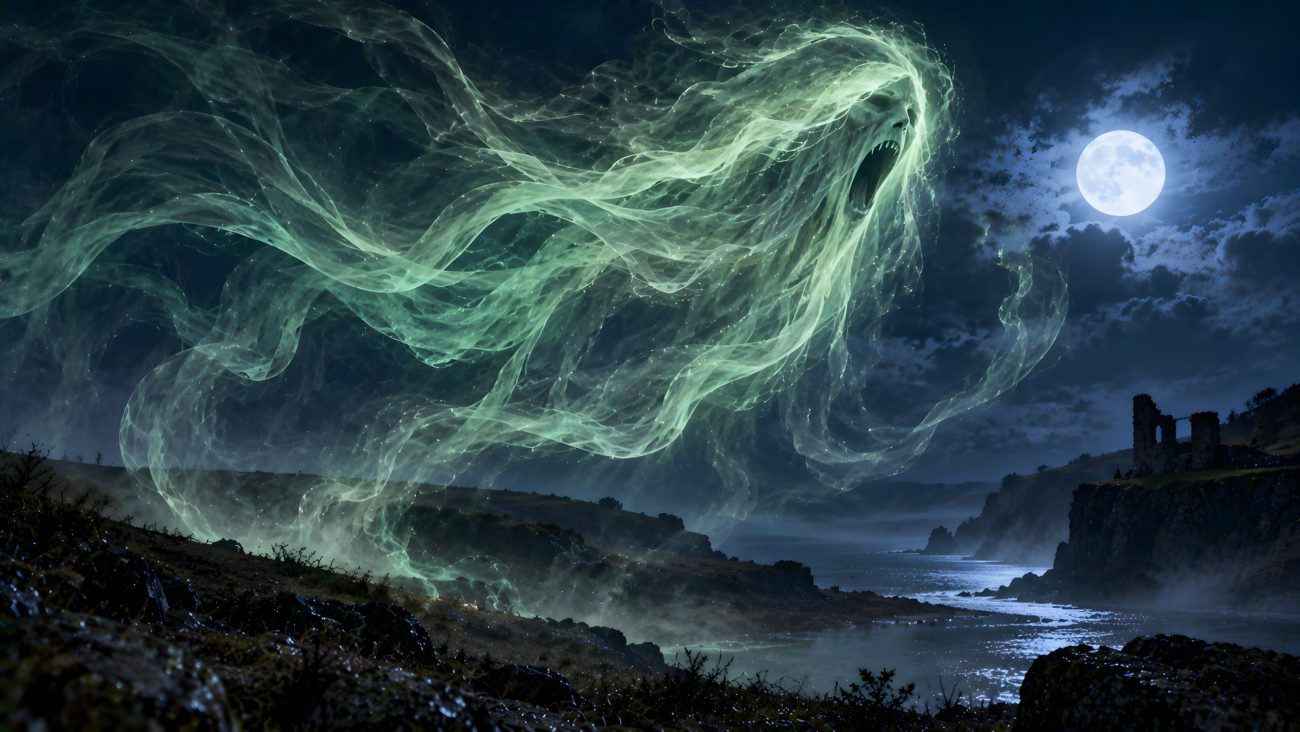
The Ghost in the Hollowway haunts a long, deep hollow road on a distant mountain near Dornbirn in Vorarlberg, Austria. The hollow runs alongside an ordinary mountain road, and during winter, wooden sleds travel along their own track through its depths. Yet in the height of summer, when the surroundings are otherwise quiet, the hollow becomes the scene of a terrifying supernatural disturbance.

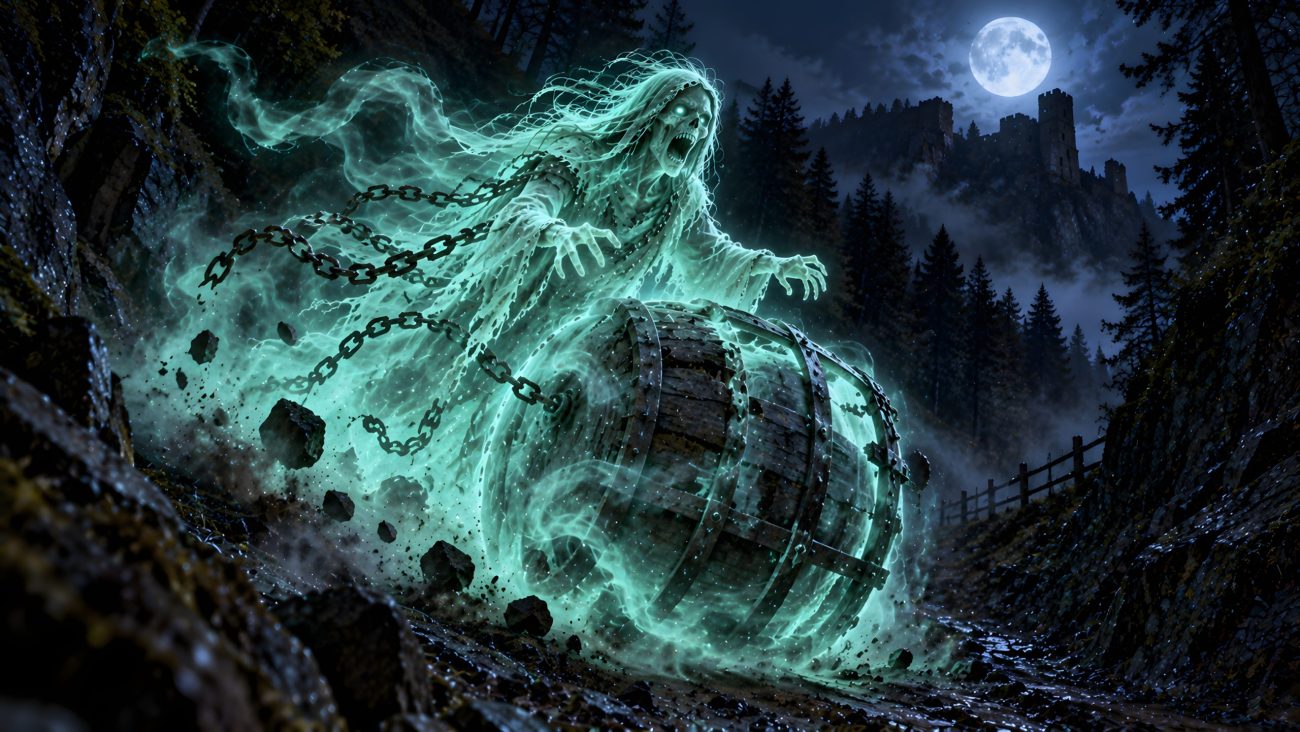
Around midnight, a tremendous roaring sound echoes through the hollow, resembling a heavy barrel rolling down the passage. The noise is accompanied by occasional piercing screams, while a strange clattering reverberates along the entire length of the hollow. Even the bravest traveller is overcome with fear when the mysterious sounds begin. Then, just as suddenly as it started, the roaring and clanging cease, leaving the hollow in complete silence.

Centuries ago, a knight’s castle stood near this haunted road, and the desolate surrounding area is still known as “at the castle.” The origins of the haunting have been forgotten, and nobody can explain what the ghostly roaring and screaming signify. The hollow remains a mysterious place where unexplained sounds disturb the summer nights.


Sources

“Der Geist im Hohlweg.” SAGEN.at – Vorarlberger Sagen aus dem Rheintal. Reproduced by SAGEN.at. https://www.sagen.at/texte/sagen/oesterreich/vorarlberg/rheintal/geistimhholweg.html


Woman with Red Hair

Tradition: Austrian Mythology
Alternative Names: Die Frau mit den roten Haaren, The Red-Haired Woman
Category: Ghost


The Myth

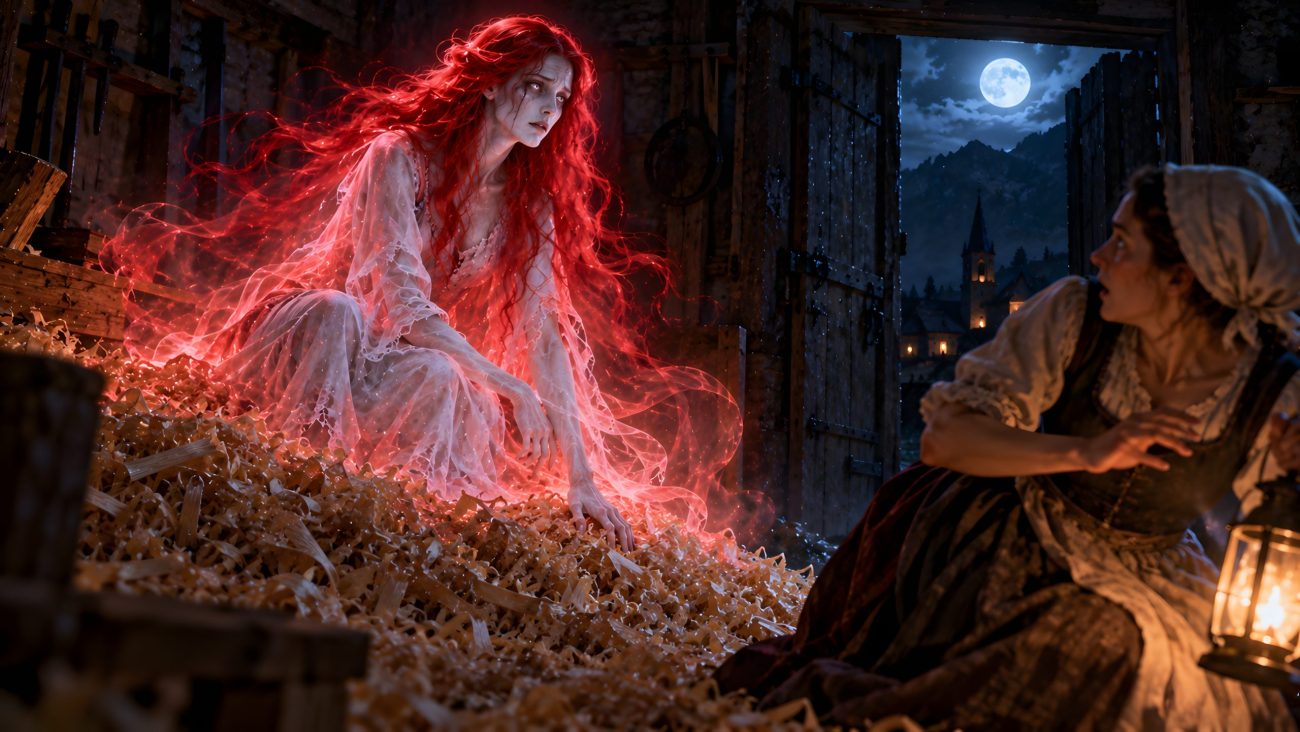
In Dornbirn, Vorarlberg, there once lived a carpenter whose young wife had red hair. When she fell seriously ill, her husband made a vow at her bedside to undertake a pilgrimage to Einsiedeln in Switzerland if she recovered. However, the woman died a few weeks later, and the carpenter soon forgot his promise. Instead of fulfilling his vow, he began courting a friend of his deceased wife and eventually married her.

About fourteen days after the wedding, the new wife went downstairs into a room on the ground floor to collect wood shavings for the kitchen. When she returned, she had a terrifying encounter: her predecessor was sitting upon the pile of shavings. The red-haired woman addressed her in a loud voice, explaining that her husband had promised to make a pilgrimage to Einsiedeln. Until he fulfilled this vow, she could find no peace in her grave and was condemned to remain among the living.

The following morning, at three o’clock, the carpenter and his new wife set off for Switzerland. They travelled to Einsiedeln, prayed at the holy site, and arranged for several Masses to be celebrated. After they returned home, the red-haired woman’s ghost was never seen again. The carpenter’s new wife could once more enter the room and collect wood shavings without fear, for the restless spirit had finally found peace.


Sources

“Die Frau.” SAGEN.at – Vorarlberger Sagen aus dem Rheintal. Reproduced by SAGEN.at. https://www.sagen.at/texte/sagen/oesterreich/vorarlberg/rheintal/diefrau.html


La Llorona

Tradition: Mexican Mythology
Alternative Names: The Weeping Woman, Maria
Category: Ghost


The Myth

La Llorona is the ghost of a woman named Maria who drowned her own children in a river in an act of revenge against her lover. When she realized that her children were dead, she was overcome with grief and drowned herself as well. After her death, Maria reached the gates of Heaven, where she was asked where her children were. Unable to find them, she was denied entry until she could locate them.

Since then, La Llorona has wandered along riverbanks at night, weeping for her lost children and crying out for their forgiveness. Her sorrowful cries carry through the darkness as she searches endlessly for the children she murdered. In some versions of the legend, she attempts to replace them by abducting living children and drowning them in the river.

La Llorona is a feared figure throughout Latin America, and her story is often told to warn children against wandering outside after dark. Her ghostly cries serve as a warning to those who venture too close to rivers at night, where they may encounter the grieving spirit searching for the children she can never recover.


Sources

“La Llorona § Regional versions.” Wikipedia: The Free Encyclopedia. Wikimedia Foundation. Accessed October 15, 2026. https://en.wikipedia.org/wiki/La_Llorona#Regional_versions


Urguči

Tradition: Latvian Mythology
Alternative Names: Urguči
Category: Ghost


The Myth

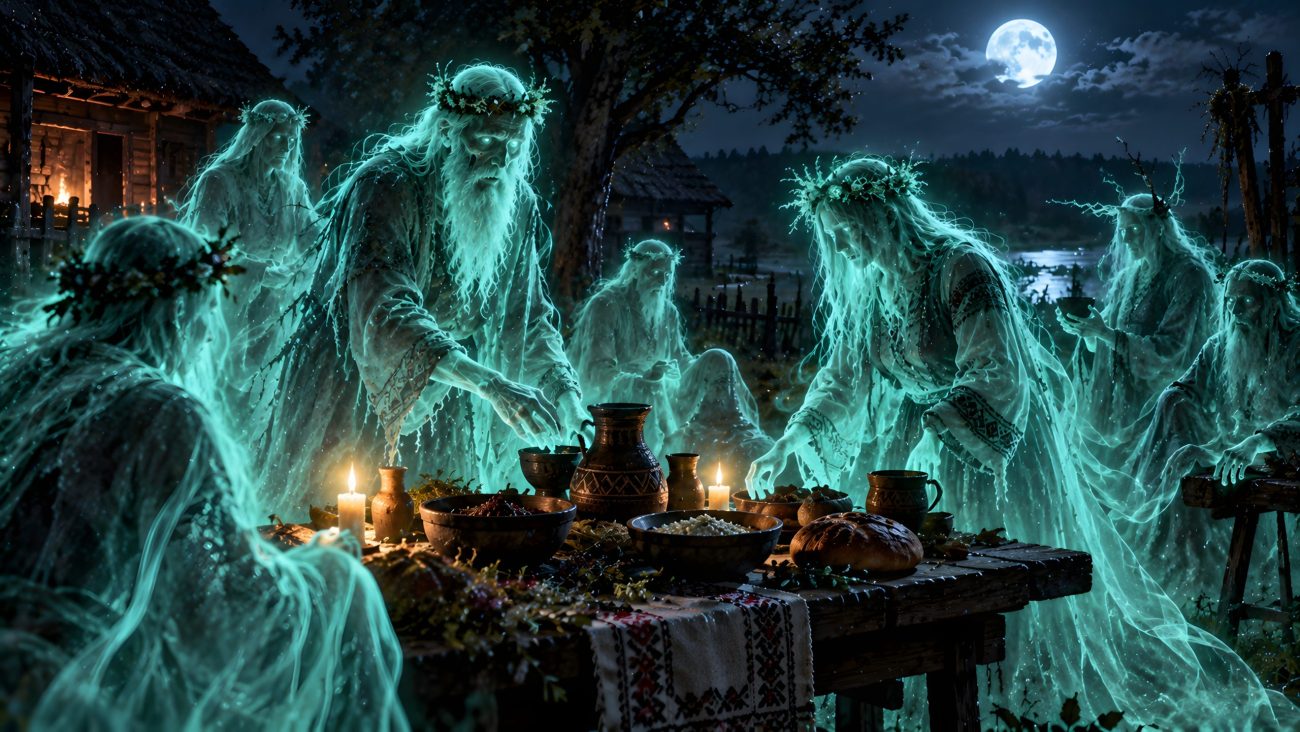
The Urguči are spirits of the dead in Latvian mythology who were traditionally welcomed with offerings of food and drink. During a ritual, the spirits were summoned to join a feast and were given nourishment before being ceremonially sent back to the world of the dead. The ritual involved washing and preparing food and drink for the visiting spirits, allowing the living to honour the dead and share a temporary gathering with them.

The Urguči are particularly associated with Simjuda Day, a traditional day connected with the remembrance of the dead. During the observance, the spirits were invited to partake in the offerings before being dismissed at the end of the gathering. They were understood as beings who could return temporarily to the world of the living, accept the hospitality offered to them, and then depart once the ritual was complete.

The Urguči may have been imagined as spirits whose presence was accompanied by indistinct, growling, or roaring sounds. Their precise appearance is not described, but their association with ritual feasting and the return of the dead makes them distinctive among Latvian spirits. Their visits represent a temporary meeting between the living and the deceased, in which offerings provide a way to welcome the dead while ensuring that they eventually return to their own realm.


Sources

“Urguči.” Vikipēdija (Latvian Wikipedia). Wikimedia Foundation. Accessed October 15, 2026. https://lv.wikipedia.org/wiki/Urgu%C4%8Di


Tęsknica

Tradition: Polish Mythology
Alternative Names: Tęsknota, Osmętnica
Category: Ghost


The Myth

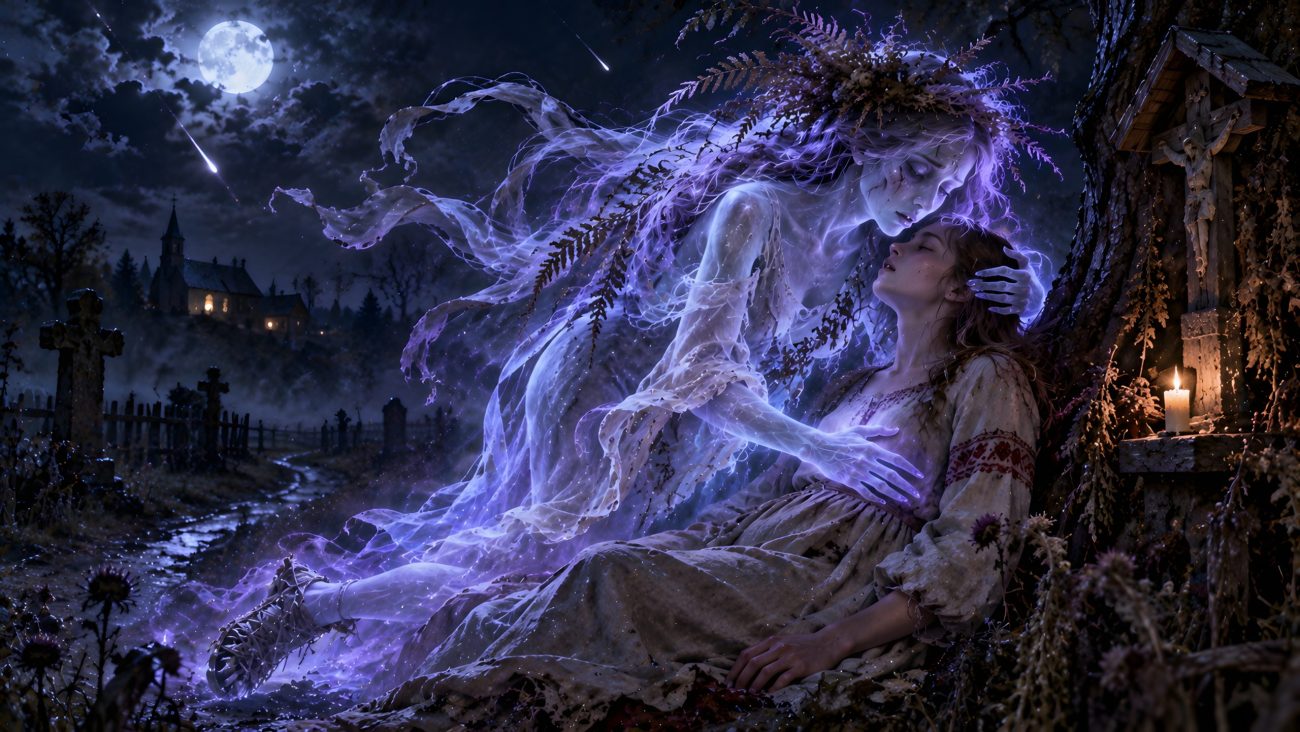
Tęsknica is a female demon in Slavic mythology, appearing as a pale, ghostly woman who embodies deep longing, sorrow, and a state of melancholy. She descends from the sky alongside falling stars, emerging from a black storm cloud. A wreath of dried ferns rests upon her head, and she wraps herself in a grey cloth taken from beneath the bed of a dead person. On her feet, she wears clogs woven by her own hands from green reeds pulled from a lake or from vines growing beside the water. She walks slowly with her head bowed, often sitting near cemeteries or beside roadside shrines at crossroads.

Tęsknica seeks out sorrowful, lonely, and weeping girls. When she finds one, she sits beside her, embraces her with thin, wasted arms, kisses her on the lips, and lays a heavy hand upon her heart. She most often targets young women who have not yet had children. Her touch leaves no wounds or visible marks, but it drains the victim of her strength and vitality. The afflicted girl loses her appetite and thirst, suffers from sleeplessness, and gradually becomes weak and motionless. Those touched by Tęsknica usually die not long afterward.

The only hope of salvation comes with the arrival of the Three Women, invisible angels of God who descend from heaven to help the afflicted. Until their intervention, Tęsknica’s victim remains trapped in sorrow and longing, slowly wasting away under the demon’s supernatural influence.


Sources

“Tęsknica.” Wikipedia, wolna encyklopedia (Polish Wikipedia). Wikimedia Foundation. Accessed October 15, 2026. https://pl.wikipedia.org/wiki/T%C4%99sknica


Gnieciuch

Tradition: Polish Mythology
Alternative Names: Gniot, Gniotek, Gnietek, Gnocek, Gnotek, Wiek
Category: Ghost


The Myth

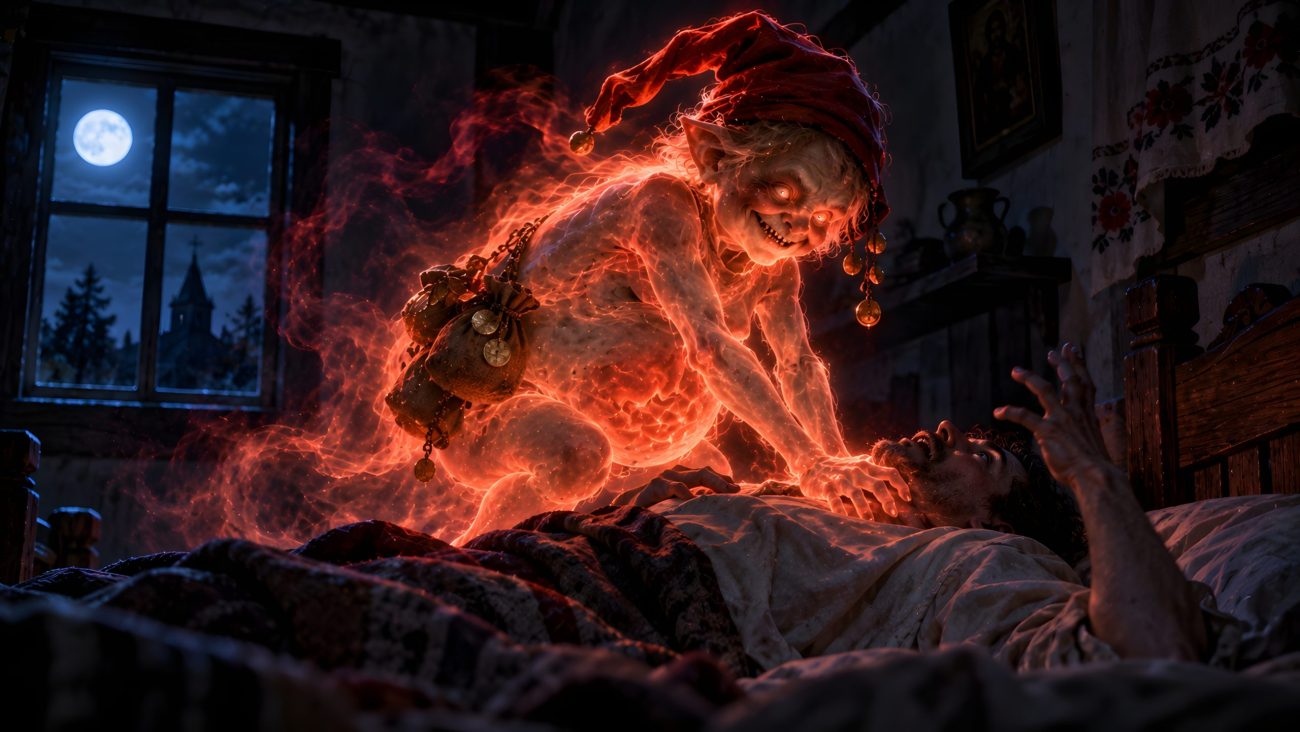
The Gnieciuch is a terrifying demon in Polish mythology that attacks people while they sleep, crushing their bodies beneath its enormous weight and strangling them in their beds. In Lesser Poland, it appears as a small, fat boy with a huge belly, a red cap, and considerable wealth. Despite its childlike appearance, the creature is dangerously heavy. Before strangling its victim, it removes the intestines from its own belly so that its weight will not crush the person to death too quickly. In the region around Ropczyce, the Gnieciuch is imagined as a silent, perpetually cold little boy who smacks his lips as he approaches someone to torment them.

The Gnieciuch’s appearance varies between regions. Among the Lasowiacy, the related Gniotek is described as a small but extraordinarily heavy creature with a large belly, thin arms and legs, and long fingers ending in crooked claws. Its hideous head has large ears, bulging eyes, and a wide mouth filled with protruding teeth. Other accounts describe it as a little boy with a distended belly, a crooked red cap, and pockets full of money. In Ocice, it resembles a heavy little doll wearing a golden cap and shoes and carrying three bags of money. The people of Mielec believed that its red cap contained wealth beyond measure.

The Gnieciuch is also associated with strange bargains and dangerous temptations. Anyone who manages to steal its red cap may be offered as much money as the cap can hold in exchange for returning it. However, the demon may instead take revenge on the thief. Although its wealth promises great riches, obtaining it is considered practically impossible.

The creature is said to hide in the hallways of houses, particularly in the recesses where millstones are kept. It listens to household conversations and may cause disturbances even during the day. When it enters a room through a knot in the ceiling, it leaves its intestines behind before beginning its nocturnal attack. It first settles on the sleeper’s legs, then slowly crawls upward until it reaches the chest. There, it pins the victim down with its hands and legs and grips the throat, leaving the person almost completely helpless. If the sleeper fails to awaken in time, the Gnieciuch may strangle them to death. In some accounts, it first presses against the stomach and chest before sucking away the victim’s blood and vital strength, leaving the person weak upon waking.

The Gniotek is particularly associated with tormenting drunkards and is believed to be invisible to sober people. Other traditions describe Gnieciuchy as the restless souls of deceased family members, people who were wronged during their lives, those who died suddenly or without confession, and the damned. These spirits return to trouble the living, appearing as small but heavy beings whose oppressive presence turns sleep into a struggle for survival.


Sources

“Gnieciuch.” Wikipedia, wolna encyklopedia (Polish Wikipedia). Wikimedia Foundation. Accessed October 15, 2026. https://pl.wikipedia.org/wiki/Gnieciuch

Gelin

Tradition: Turkish Mythology
Alternative Names: Gelinler (plural)
Category: Ghost


The Myth

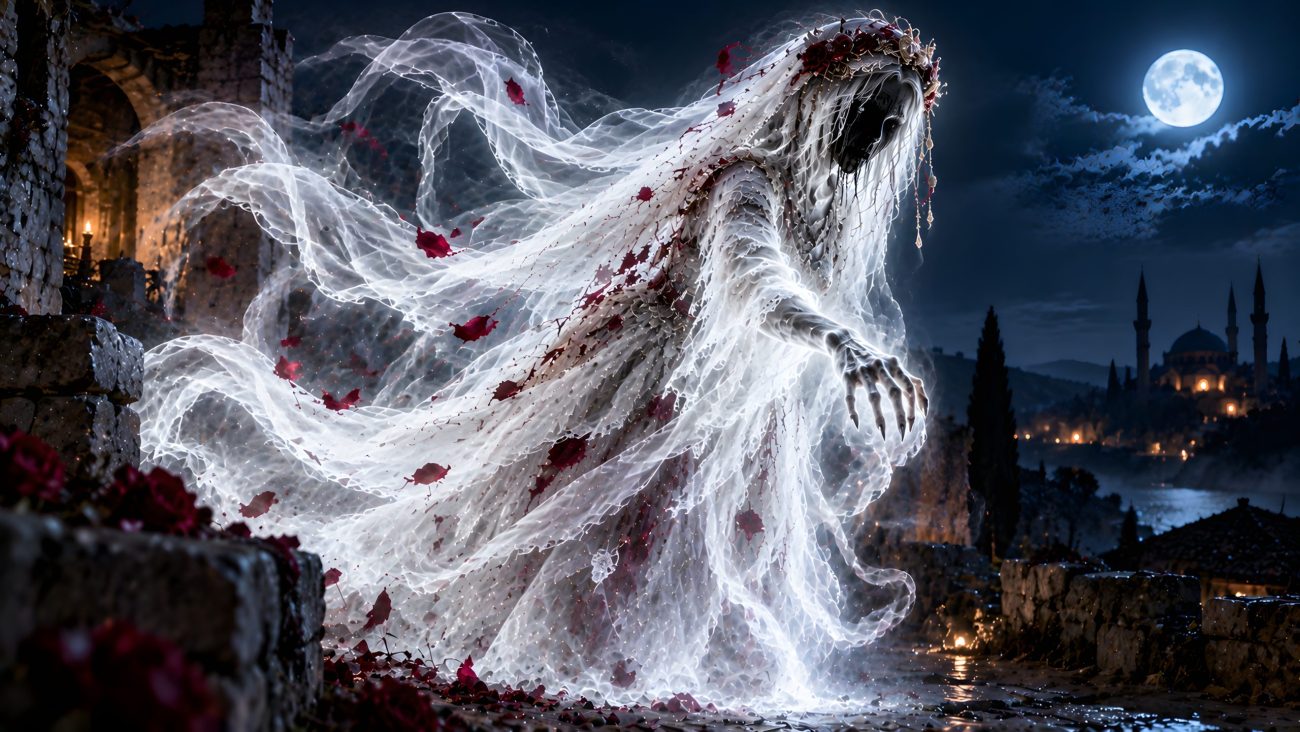
Gelin means “bride” in Turkish and is sometimes associated with stories of female ghosts who were brides in life. These spectral figures are connected with local legends of tragedy, in which a bride’s story ends in sorrow and her presence remains associated with the place where the tragedy occurred.

The Gelin is not a specific supernatural being with one established appearance or set of powers. Rather, the name is associated with tragic bride figures who appear in local ghost stories. The details of their appearances and hauntings vary between legends, and the word itself simply means “bride” rather than “ghost.”


Sources

“Gelin.” Wikipedia: The Free Encyclopedia. Wikimedia Foundation. Accessed October 15, 2026. https://en.wikipedia.org/wiki/Gelin


Cyhyraeth

Tradition: Welsh Mythology
Alternative Names: Cyhyraeth
Category: Ghost


The Myth

The Cyhyraeth is a ghostly spirit in Welsh mythology that has no visible body. Instead of appearing as a figure, it announces approaching death through a mournful, disembodied voice. Its cries are described as doleful and unpleasant, resembling the groans and sighs of someone suffering from a terrible illness.

The Cyhyraeth is said to sound three times before a person dies. Each cry grows weaker and fainter than the one before it, serving as a threefold warning that death is approaching. Its voice is associated particularly with the region around the River Tywi in eastern Dyfed and the coast of Glamorganshire. Along the Glamorganshire coast, the spirit may be heard before a shipwreck, accompanied by a mysterious corpse-light.

The Cyhyraeth also gives warning when Welsh people are about to die far from their homeland. Even across distant places, its sorrowful cries announce their approaching end. Like the Irish Banshee and the Scottish Cailleach, it is a supernatural harbinger of death, its invisible presence bringing the sound of grief before tragedy strikes.


Sources

“Cyhyraeth.” Wikipedia: The Free Encyclopedia. Wikimedia Foundation. Accessed October 15, 2026. https://en.wikipedia.org/wiki/Cyhyraeth


Eidolon

Tradition: Greek Mythology
Alternative Names: Eidola, Eidolons
Category: Ghost


The Myth

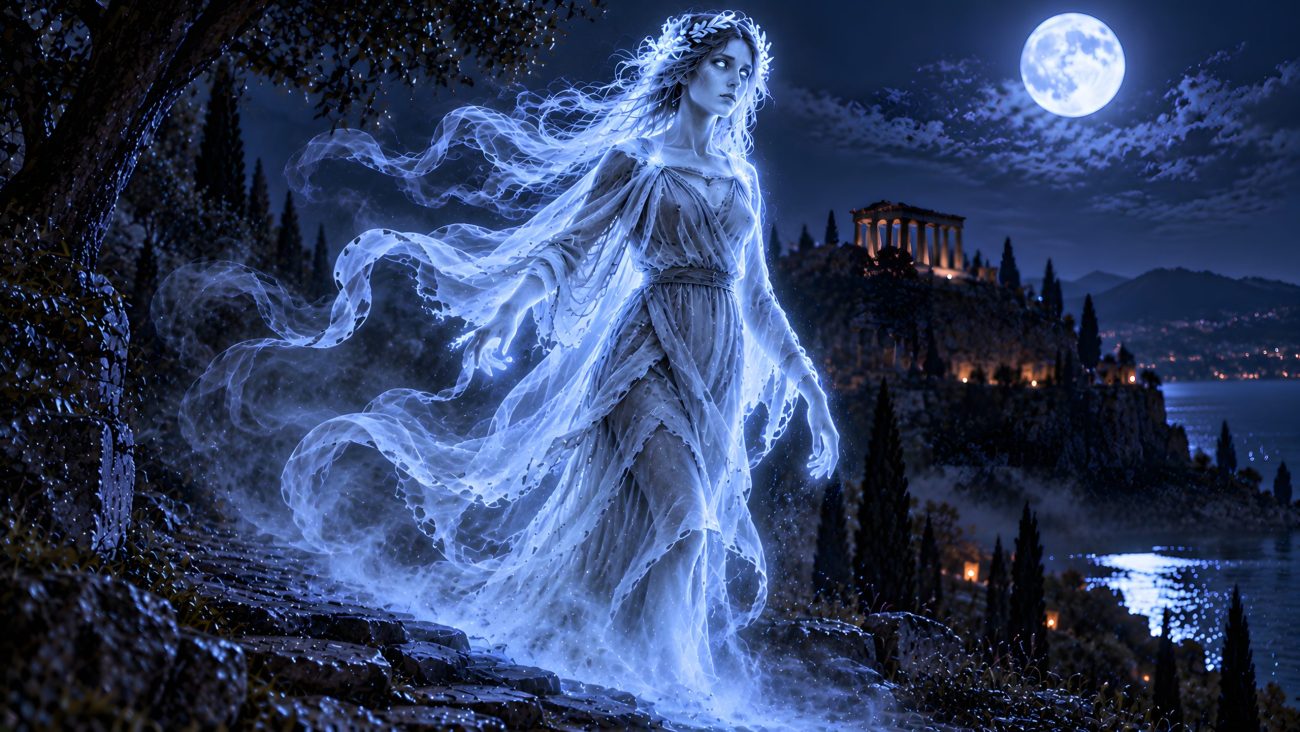
An Eidolon is a phantom or spirit-image that resembles a living or dead person. It appears in the likeness of a human being, taking the form of a shadowy double or an apparition of someone who has passed away. In Greek mythology, an Eidolon can represent the image of the dead or appear as the deceased person themselves, lingering in the world as a spectral presence.

One of the best-known examples concerns Helen of Troy. In some versions of the story, an Eidolon of Helen appeared in Troy during the Trojan War, while the real Helen was elsewhere. The phantom resembled Helen so perfectly that the Greeks and Trojans could believe she was physically present in the city. The existence of this double changed the meaning of the war, as the armies fought over an apparition rather than the actual woman.

Eidola also appear among the dead in the Greek underworld. In the Odyssey, after the suitors of Penelope are killed, their spirits gather in the palace as spectral images of the men they once were. These apparitions retain the appearance of the living but exist as shades separated from the world of the living. The Eidolon therefore represents the mysterious image that remains after death, a phantom likeness that can appear before the living even when the person it resembles is no longer present.


Sources

“Eidolon.” Wikipedia: The Free Encyclopedia. Wikimedia Foundation. Accessed October 15, 2026. https://en.wikipedia.org/wiki/Eidolon


Cauld Lad of Hylton

Tradition: English Mythology
Alternative Names: Cauld Lad, Cold Lad of Hylton
Category: Ghost


The Myth

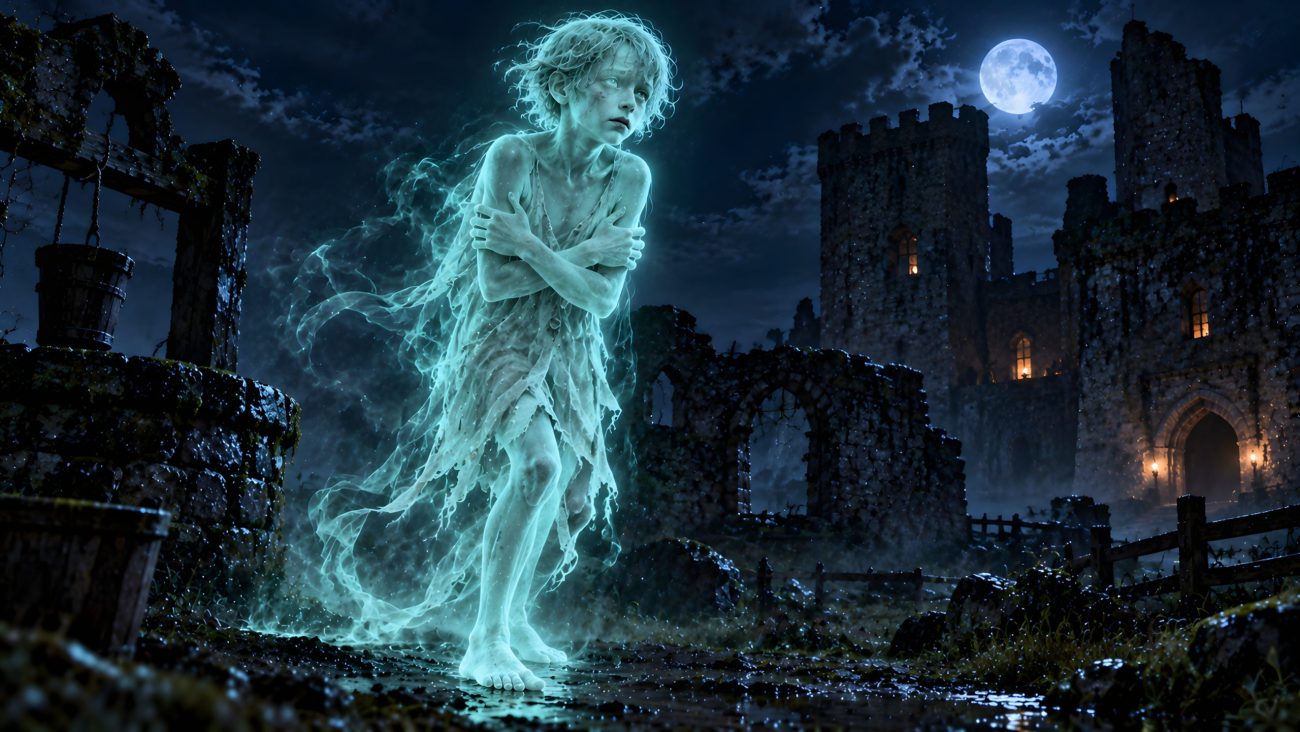
The Cauld Lad of Hylton is the ghost of Robert Skelton, a stable boy said to have been murdered at Hylton Castle near Sunderland in northern England. According to one version of the legend, he was killed after courting Baron Hylton’s daughter. Another account claims that the boy overslept when ordered to prepare the baron’s horse for an important journey. Enraged by the delay, the baron struck him with a riding crop, stabbed him with a pitchfork, or beheaded him. The boy’s body was then thrown into a deep pond or an abandoned well.

After the murder, strange disturbances began inside Hylton Castle. Kitchens were mysteriously cleaned when left untidy and thrown into disorder when everything had been put in its proper place. Hot ashes were removed from fireplaces and scattered across the floor, sometimes bearing the imprint of a body that had lain upon them. Chamber pots were emptied onto the floor, and unseen hands seemed to move objects throughout the castle.

Eventually, a cook decided to remain awake until midnight to discover the cause of the disturbances. He encountered the naked ghost of a young boy, who cried out, “I’m cauld!”—meaning that he was cold. The cook and his wife took pity on the spirit and left a warm cloak for him. The following night, they heard the ghost sing, “Here’s a cloak and here’s a hood, the Cauld Lad of Hylton will do no more good.” After receiving the clothing, the ghost disappeared, and the strange disturbances ceased.

In other versions of the legend, the Cauld Lad is described as an enchanted elf, a barghest, or a brownie whose mischief is intended to draw attention to his suffering. He sings a sorrowful song predicting that he will remain enchanted until an acorn grows into a tree, the tree becomes a cradle, and the child rocked in that cradle grows into a man who can finally release him. Despite the story of his disappearance after receiving clothing, people have continued to claim that they hear the Cauld Lad’s ghostly cries around Hylton Castle.


Sources

“Cauld Lad of Hylton.” Wikipedia: The Free Encyclopedia. Wikimedia Foundation. Accessed October 15, 2026. https://en.wikipedia.org/wiki/Cauld_Lad_of_Hylton