Taraxippos

Tradition: Greek Mythology
Alternative Names: Taraxippus, Taraxippoi (plural)
Category: Ghost


The Myth

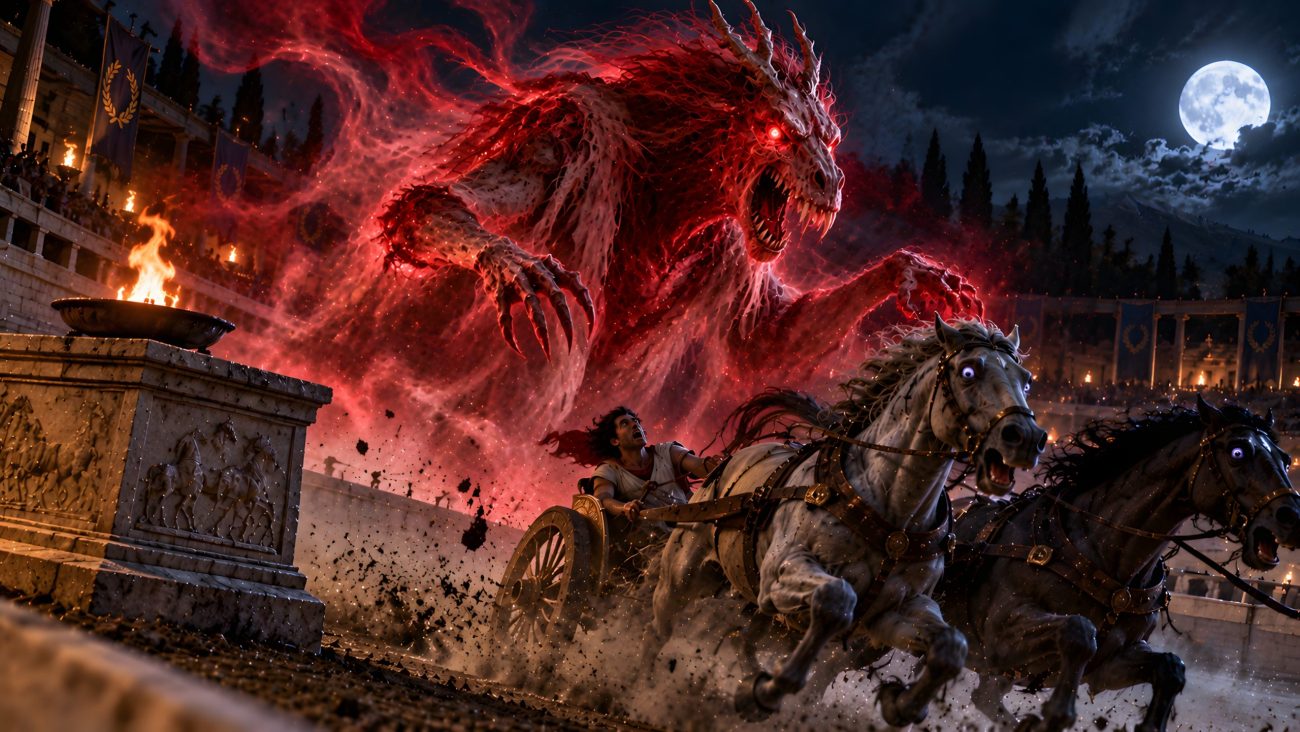
Taraxippos is a terrifying supernatural presence blamed for frightening horses during chariot races throughout ancient Greece. The name means “horse disturber,” and Taraxippoi were associated with places where horses suddenly became uncontrollably afraid, often causing chariots to crash and injuring their drivers. The most notorious was Taraxippos Olympios at Olympia, where a round altar stood beside the racetrack. As chariots passed this spot, horses were seized by a powerful and inexplicable terror. Charioteers offered sacrifices and prayers to appease the spirit and ensure their horses would pass safely.

The identity of Taraxippos varied between traditions. At Olympia, some believed it was the ghost of King Oenomaus, who had once killed the suitors of his daughter Hippodamia in chariot races. Others identified the presence with the tomb of Myrtilus, whose death was connected to Oenomaus, or with the grave of Ischenus, a giant born from the earth. These accounts connected the terrifying presence to the restless dead and the dangers surrounding ancient racing grounds.

At the Isthmian Games, Taraxippos Isthmios was identified as the ghost of Glaucus of Pontiae, who had been torn apart by his own horses. At the Nemean Games, Taraxippos Nemeios was associated not with a ghostly figure but with a red rock above the turning point of the racetrack. A flash from the rock supposedly terrified horses as though they had seen fire. Thus, Taraxippos was not always imagined as a single spirit with a fixed appearance, but as a supernatural force that caused horses to panic at particular places.


Sources

“Shade (mythology).” Wikipedia: The Free Encyclopedia. Wikimedia Foundation. Accessed October 15, 2026. https://en.wikipedia.org/wiki/Shade_%28mythology%29
Umbra

Tradition: Greek Mythology, Roman Mythology
Alternative Names: Skia, Shade
Category: Ghost


The Myth

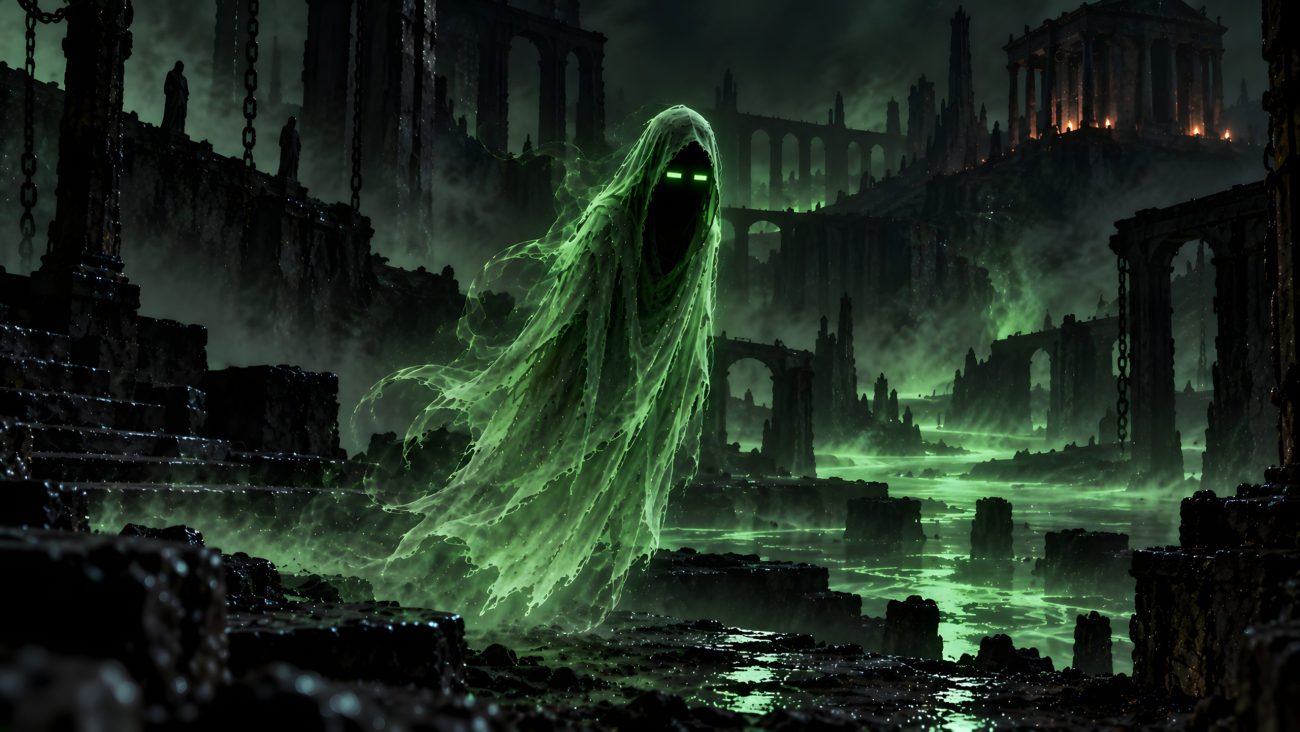
A Shade is the spirit of a deceased person who dwells in the underworld, existing as a shadowy remnant of their former life. Shades inhabit the realm of the dead, separated from the world of the living, where they linger in a diminished and shadow-like state. The concept also appears in ancient Near Eastern beliefs, where the dead were thought to dwell in a shadowy underworld. In Biblical Hebrew tradition, this realm was associated with Sheol, also described as the shadow of death.

Shades appear prominently in Greek and Roman mythology. In Homer’s Odyssey, Odysseus journeys into Hades and encounters the spirits of the dead, including the shade of the prophet Tiresias. In Virgil’s Aeneid, Aeneas descends into the underworld and encounters numerous shades of the departed. These spirits retain traces of their former identities and can be recognized by the living when encountered in the realm of the dead.

Not everyone was believed to remain a shade after death. Certain exceptional individuals could be elevated to the status of heroes and ascend to the divine sphere. According to Plutarch, Alexander the Great received an oracle confirming that his deceased companion Hephaistion had become a hero and attained divine status. Such beliefs distinguished ordinary shades, who remained in the underworld, from exceptional dead who were honoured as more than mortal spirits.

The image of the shade continued into later literature, including Dante Alighieri’s Divine Comedy, in which many of the dead encountered in the afterlife are described as shadows. The shade became a lasting symbol of mortality and the lingering presence of the deceased, representing the fragile boundary between the living world and the realm of the dead.


Sources

“Shade (mythology).” Wikipedia: The Free Encyclopedia. Wikimedia Foundation. Accessed October 15, 2026. https://en.wikipedia.org/wiki/Shade_%28mythology%29


Eidolon

Tradition: Greek Mythology
Alternative Names: Eidola, Eidolons
Category: Ghost


The Myth

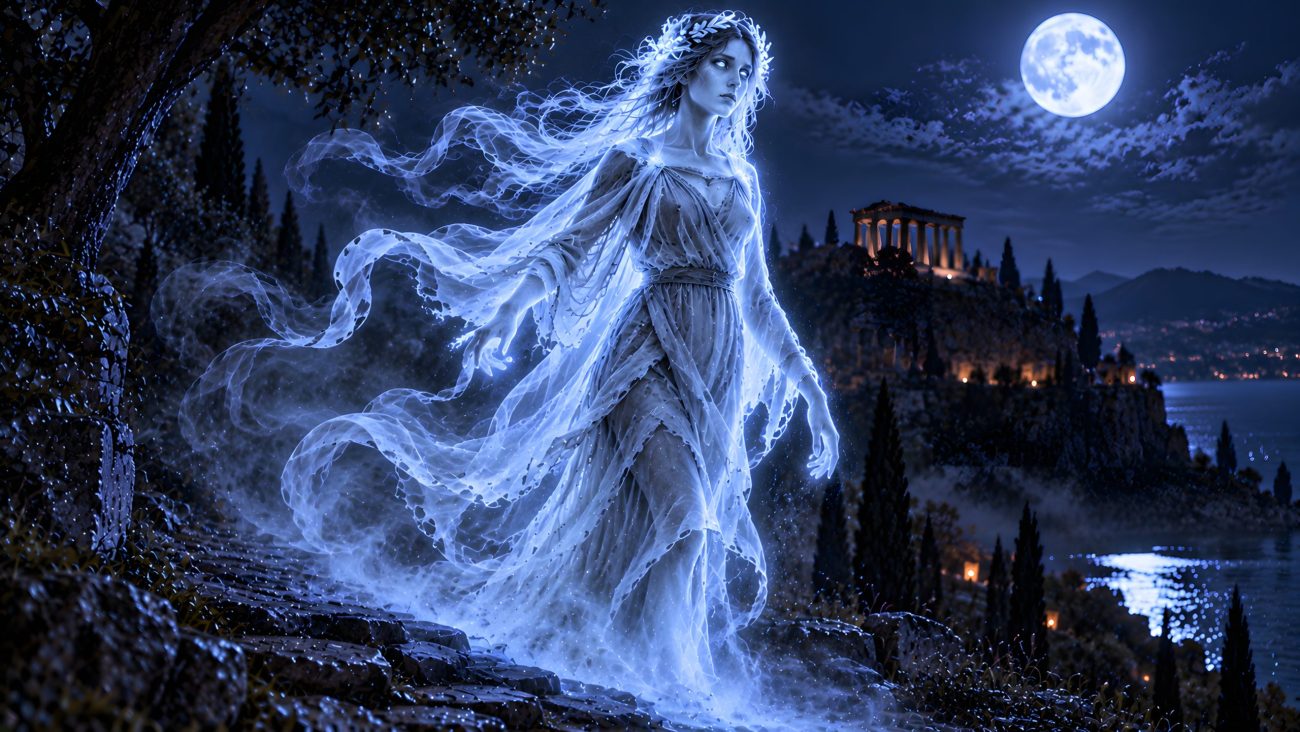
An Eidolon is a phantom or spirit-image that resembles a living or dead person. It appears in the likeness of a human being, taking the form of a shadowy double or an apparition of someone who has passed away. In Greek mythology, an Eidolon can represent the image of the dead or appear as the deceased person themselves, lingering in the world as a spectral presence.

One of the best-known examples concerns Helen of Troy. In some versions of the story, an Eidolon of Helen appeared in Troy during the Trojan War, while the real Helen was elsewhere. The phantom resembled Helen so perfectly that the Greeks and Trojans could believe she was physically present in the city. The existence of this double changed the meaning of the war, as the armies fought over an apparition rather than the actual woman.

Eidola also appear among the dead in the Greek underworld. In the Odyssey, after the suitors of Penelope are killed, their spirits gather in the palace as spectral images of the men they once were. These apparitions retain the appearance of the living but exist as shades separated from the world of the living. The Eidolon therefore represents the mysterious image that remains after death, a phantom likeness that can appear before the living even when the person it resembles is no longer present.


Sources

“Eidolon.” Wikipedia: The Free Encyclopedia. Wikimedia Foundation. Accessed October 15, 2026. https://en.wikipedia.org/wiki/Eidolon