Prikulich of Stolzenberg

Tradition / Region: Romanian Mythology
Alternate Names: Prikulitsch; The Stolzenberg Dog Fiend
Category: Dog


The Myth

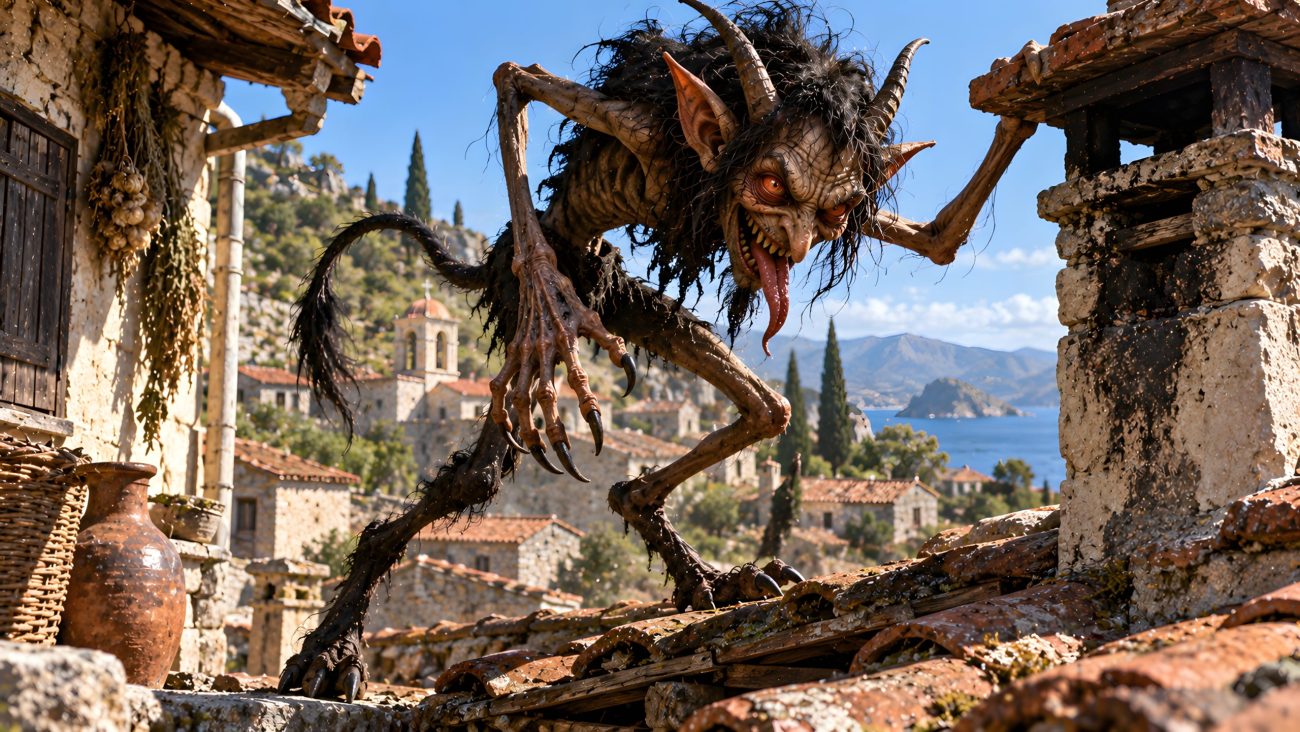
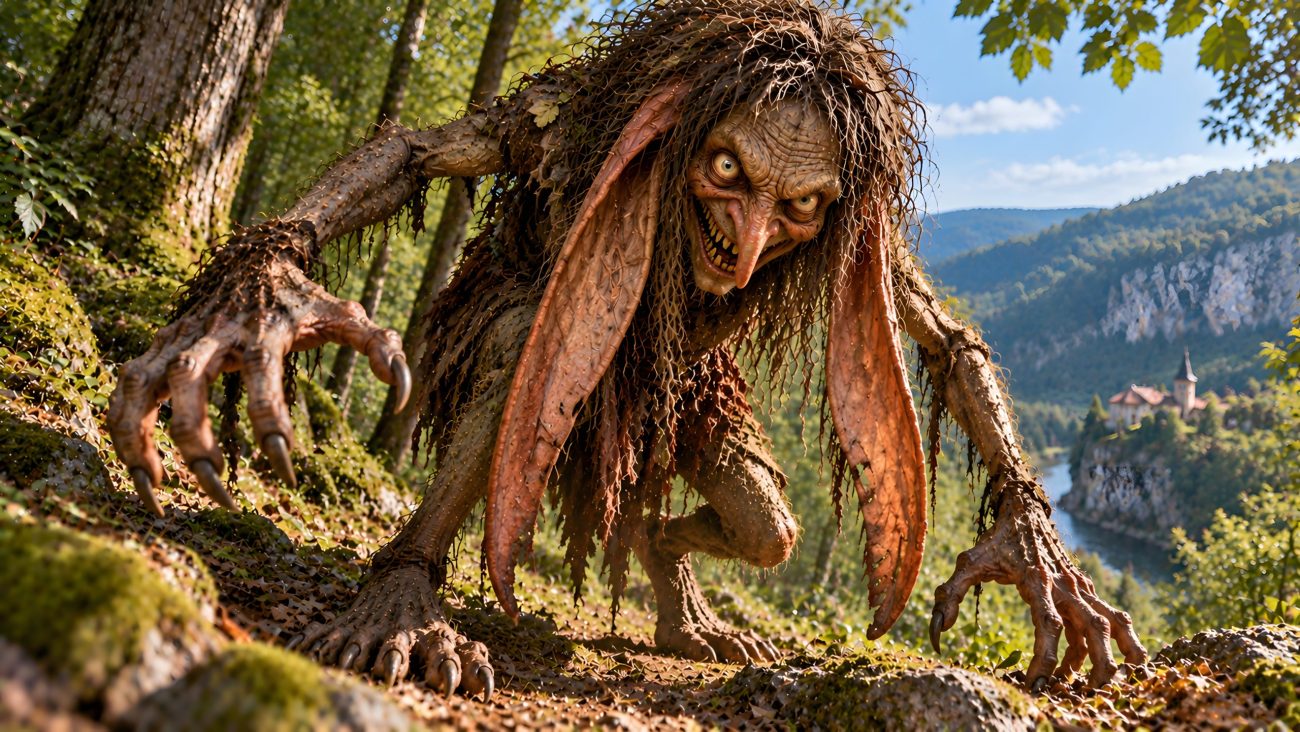
One night, a villager was walking along the path near the clay pit known as the Leimkel. As he paused beside one of the deep holes, something suddenly tumbled out into the path. It was a thick, black creature, as large as a wolf, rolling from the pit and plunging into the ditch beside the road.

Terrified, the man folded his hands and began to pray the Lord’s Prayer. The prayer protected him, and the creature did not approach. Later he learned what it had been — a Prikulich.

He saw the being again in Stolzenberg itself, once more around midnight. He had just come from his mother’s house when a dark shape slipped out of a courtyard and crossed the street only a few steps in front of him. Its large, dark eyes rolled strangely in its head as it passed.

People in the village said the creature was none other than a Galician Jewish tradesman who had settled there. At night he wandered in the form of a beast, and many claimed to have seen him fighting with the village dogs. They said this was why the man’s face was often torn and scratched.

Once, the gendarmes seized him and stabbed him until he bled. At that moment the creature’s power broke, and he stood before them again in human form. Instead of cursing them, he spoke with relief:

“Thank you for doing this to me. Now I am redeemed.”


Sources

sagen.at contributors. (n.d.). Der Prikulitsch in Stolzenberg. In sagen.at, from https://www.sagen.at/texte/sagen/rumaenien/siebenbuergen/stolzenberg.html


Prikulich of Giesshübel

Tradition / Region: Romanian Mythology
Alternate Names: Prikulich; The Dog Prikulich
Category: Dog


The Myth

In the village of Giesshübel there once lived a reckless young man known for chasing after the maids and living without restraint. One day, when he returned home, something uncanny happened. As he entered, he suddenly flipped over, and in that instant he was no longer a man but a white dog marked with grey spots.

From then on, the creature lived a double existence. By day the dog stayed quietly in the stable, keeping out of sight. But each night, when midnight came, it slipped out into the street. There it ran through the village and fought fiercely with the other dogs, as if driven by some restless and savage urge.

One night, when the dog returned home, his mother was waiting. Suspecting what he truly was, she struck him in the side with an awl. At the touch of the iron, the dog tumbled over once, twice, and a third time.

With the last turn, the animal vanished, and the young man lay there again in human form, freed from his strange condition.


Sources

sagen.at contributors. (n.d.). Der Prikulitsch in Giesshübel. In sagen.at, from https://www.sagen.at/texte/sagen/rumaenien/siebenbuergen/giesshuebel.html


Alzen Bridge Devil

Tradition / Region: Romanian Mythology
Alternate Names:
Category: Demon


The Myth

Many years ago, the pastor of Alzen had the habit of visiting the casino in Leschkirch twice each week. At midnight his coachman was sent to fetch him home. This duty troubled the servant greatly, for he had to drive alone across the Altmühl bridge at that lonely and haunted hour.

It was the custom to halt on the far side of the bridge so the horses could rest. Whether the coachman wished it or not, the animals were trained to stop there, and no urging could make them do otherwise.

One cold, bright night, under a clear moon, the coachman drove out as usual. The pastor’s coat lay folded on the back seat for the journey home. When the carriage reached the far side of the bridge, the horses halted of their own accord.

At that moment the coachman saw, in the pale light, a silent figure detach itself from the shadow of the bridge. Hat in hand, it climbed lightly onto the back seat and put on the priest’s coat.

The coachman trembled with fear. He thought he had glimpsed two horns upon the stranger’s head. His hands shook so violently he could scarcely hold the reins, and he dared not turn around again. The horses, as if driven by some unseen force, sped onward at a furious pace until they reached the appointed place.

Only then did the coachman gather the courage to look back. The seat was empty. The coat lay exactly where he had left it, untouched, and there was no sign of the strange passenger.

In the days that followed, people in every tavern spoke of the event. It was said that the pastor’s servant had unwittingly driven the Devil himself, and that he nearly left his master’s service rather than face such a night again.


Sources

sagen.at contributors. (n.d.). Alzener Pfarrersknecht als des Teufels Fuhrmann. In sagen.at, from https://www.sagen.at/texte/sagen/rumaenien/siebenbuergen/alzenerpfarrersknecht.html


Prepelitsch

Tradition / Region: Romanian Mythology
Alternate Names:
Category: Dog, Shapeshifter


The Myth

Near Agnetheln, a young married couple once worked together in the fields. When their drinking water was gone, the husband told his wife he would fetch more. Before leaving, he warned her that if a dog should come and attack her, she must defend herself bravely.

No sooner had he gone than a large dog appeared and rushed at the woman. It was fierce and relentless. She fought back as best she could, struggling to drive it away, but the beast managed to seize her apron and tear off a corner before finally running off across the fields.

Some time later her husband returned with the water. As she turned toward him, she froze in horror. Caught between his teeth was the very piece torn from her apron.

From that moment it was clear that the dog had not been an ordinary animal, but the man himself in another form.


Sources

sagen.at contributors. (n.d.). Prepelitsch. In sagen.at, from https://www.sagen.at/texte/sagen/rumaenien/siebenbuergen/prepelitsch.html


Servant as a Goat

Tradition / Region: Romanian Mythology
Alternate Names:
Category: Shapeshifter, Sheep


The Myth

In the Transylvanian village of Heitau, a Romanian farmhand once walked along the road with two maids. As they went, the man suddenly threw himself into a somersault. Then he somersaulted a second time, and a third.

At once he was no longer a man but a grey-spotted billy goat.

The animal charged furiously at the two girls. With its horns it gored and tore at their red katana, shredding the garments into pieces. The maids fled in terror as the goat raged around them.

After some time, the creature again threw itself into three somersaults. As it completed the last one, the goat vanished and the farmhand stood there once more in human form.

Yet the transformation had not left him untouched. A small shred of the torn red cloth had grown fast to his ears, and this strange mark, it was said, remained with him for the rest of his life.


Sources

sagen.at contributors. (n.d.). Knecht als Ziegenbock. In sagen.at, from https://www.sagen.at/texte/sagen/rumaenien/siebenbuergen/knechtalsziegenbock.html


Detta

Tradition / Region: Romanian Mythology
Alternate Names:
Category: Fairy


The Myth

In the old town of Timișoara there once lived two fairies, Mazura and Detta. Mazura was cruel and ill-tempered, while Detta was gentle and beautiful. The two quarreled constantly, for Mazura wished to rule the city alone and often threatened to destroy her rival. Detta, who longed for peace and would not live in hatred, finally chose to leave.

One morning she rose early and walked out into the open countryside, not knowing where she would go. She crossed fields and meadows, always heading west. By evening the sun burned red in the sky, and Detta came upon a small river whose waters murmured softly. Pleased with the place, she said, “Here I will stay. I like it here.”

She lifted her hands and whispered a spell, and at once a splendid house appeared on the riverbank. Yet Detta soon felt lonely and wished for human company. The next day she spoke another charm, and an inn sprang up beside her home. Still, she feared no one would pass that way, so she cast a third spell, and a country road formed, running close to the inn.

Now Detta was content. Travelers came along the road and stopped at the welcoming inn of the kind and beautiful hostess. A year later a band of Swabian settlers arrived from the Black Forest, searching for a place to live. Detta urged them to remain, telling them the land had forests, fields, and water enough for all. The Swabians liked what they saw and settled there.

Before long, the bravest and most handsome young hunter among them, Franzl, fell in love with Detta. When he asked her to marry him, she answered, “Franzl, I love you, but you must promise me one thing: never walk beside me in the street and never touch me in public or before strangers. If you break this promise, great misfortune will follow.” Franzl agreed, and they wed.

Ten years passed, and they had two children. One day they were invited to a wedding. Detta told her husband she would go ahead and meet him there, as always. But Franzl felt ashamed. The villagers whispered that husband and wife never appeared together and must not truly love each other. Determined to silence the gossip, he decided to ignore her warning. He believed her fears were only fancy.

He left the house and hurried after her. When he caught up, he slipped his arm around her shoulder and smiled.

Detta turned pale. “Franzl, why did you do that? Now I am lost…”

At once a blinding flash burst forth. In that instant the beautiful fairy, her grand house, and the inn vanished forever.

In memory of her, the settlers named their village Detta. And the place bore that name for generations afterward.


Sources

sagen.at contributors. (n.d.). Die bildschöne Detta. In sagen.at, from https://www.sagen.at/texte/sagen/rumaenien/banat/detta.html


Witch of Bitschter Pond

Tradition / Region: Luxembourg Mythology
Alternate Names: The Old Witch of Bits; Matchmaking Witch of the Bits Pond
Category: Witch, Forest dweller, Lake dweller


The Myth

In earlier times, the Bitschter Pond lay in the deep valley between Buderscheid and the Pirmesknapp. The large body of water stretched from the Buderscheid mill to the Pirmesberg hill, surrounded by dense, wild forest. People said the place was haunted, for many spirits were believed to dwell there.

Among them lived the infamous old witch of Bits. She practiced fortune-telling and matchmaking, and young men and women who longed for marriage would seek her out. The witch possessed a mysterious bottle in which there was an egg and a crucified Christ. By means of this bottle, she told those who consulted her whom they would marry, where that person lived, and what they must do to win them.

At night, she was said to fly like a bird over the pond, crying out with a hoarse, croaking voice. Around the pond, other witches gathered, and in the moonlight they danced wildly in the trees, making music and raising a dreadful noise. They were also seen hovering around the Pirmesberg, reveling in the forest and floating through the air.

At last the witch’s deeds became known. She was seized and blown into the Bitschter Pond. At once a violent thunderstorm broke out, flooding the waters and turning the place into a great quagmire.

Even long afterward, people said the place was not a pleasant one, and many were afraid to pass the site of the old pond at night.


Gallery


Sources

sagen.at contributors. (n.d.). Der Bitschter Weiher. In sagen.at, from https://www.sagen.at/texte/sagen/luxemburg/Bischter_Weiher.html


Interpretive Lenses

Religious Readings
  • Christian Ascetic Deep Dive
Philosophical Readings
  • Nietzschean Deep Dive
Psychological Readings
  • Jungian Deep Dive
Esoteric Deep Dive
  • Hermetic Deep Dive
Political / Social Readings
  • Marxist Deep Dive

Haunting at the Enerèweschter Weiher

Tradition / Region: Luxembourg Mythology
Alternate Names: Spirits of the Enerèweschter Pond
Category: Ghost, Lake dweller


The Myth

Many years ago, on Friday nights, two enormous human figures were said to appear at the pond called Enerèweschter Weiher in the forest near Lintgen. Each carried a long whip and lashed the water with such force that the noise echoed far and wide. At the same time, strange cries of “Hoo-hoo! Hoo-hoo!” rang through the night.

Afterward, the figures would perform a circle dance around the pond. Whenever anyone tried to approach them, they vanished at the slightest sound, leaving only a loud splash behind in the water.

One night, several daring young men from the village hid behind thick tree trunks, each armed with a club, determined to uncover the truth. As midnight drew near, they again heard the whipping and the eerie cries, and they saw the figures dancing. At a signal, they rushed forward and struck with all their strength. But their blows met nothing. They heard only a splash in the pond, and then all was still.

From that time on, the haunting ceased. Yet even today, some villagers believe that invisible spirits still play their tricks at the Enerèweschter Weiher.


Gallery


Sources

sagen.at contributors. (n.d.). Der Spuk am Enerèweschter Weiher zu Lintgen. In sagen.at, from https://www.sagen.at/texte/sagen/luxemburg/Spuk_Lintgen.html


Interpretive Lenses

Religious Readings
  • Christian Ascetic Deep Dive
Philosophical Readings
  • Nietzschean Deep Dive
Psychological Readings
  • Jungian Deep Dive
Esoteric Deep Dive
  • Hermetic Deep Dive
Political / Social Readings
  • Marxist Deep Dive

Washerwomen at the Kaselter Bach

Tradition / Region: Luxembourg Mythology
Alternate Names: Storm washerwomen of Kaselter Bach
Category: Ghost


The Myth

Near Lintgen, at the source of the Kaselter Bach, there once stood a tall beech tree. People said that shortly before a thunderstorm, musicians dressed in red would often appear there and play soft music.

At the same time, from the edge of the spring came the loud knocking and banging of washerwomen beating their laundry in rhythm with the music. According to the legend, these women caused rain and storms by splashing water upward with their washing sheets, sending it into the clouds.

No one dared to watch or disturb them. It was said that even the strongest man would have been crushed or killed by a single blow from these washerwomen.

One traveler, who dared to whistle when he heard the ghostly music, was immediately struck by lightning. And two shoemaker’s apprentices, returning drunk from the Lorenzweiler fair and cursing the apparition, were found the next day beside the Kaselter stream with torn clothes, battered faces, and fractured skulls.

Thus the people avoided the place whenever storms gathered.


Gallery


Sources

sagen.at contributors. (n.d.). Wäscherinnen am Kaselter Bach bei Lintgen. In sagen.at, from https://www.sagen.at/texte/sagen/luxemburg/Waescherinnen_Lintgen.html


Interpretive Lenses

Religious Readings
  • Christian Ascetic Deep Dive
Philosophical Readings
  • Nietzschean Deep Dive
Psychological Readings
  • Jungian Deep Dive
Esoteric Deep Dive
  • Hermetic Deep Dive
Political / Social Readings
  • Marxist Deep Dive

Washerwomen at the Pond Rahloch

Tradition / Region: Luxembourg Mythology
Alternate Names: Rahloch washerwomen
Category: Ghost, Lake dweller


The Myth

Between Sandweiler and Itzig lies a pond known as the Rahloch, a place once regarded as eerie and feared.

One night, a lone wanderer passed by the pond and heard the sharp echo of washerwomen’s sheets sounding through the still air. As he approached, he saw several old women standing at the water’s edge, silently beating laundry before them.

Seeing nothing strange in their work, he called out, “You are washing very late!” But the women gave no answer. Thinking to jest, he spoke again: “Ah, you wretched women, won’t you wash my clothes too?”

Hardly had he spoken when the women rushed upon him and beat him so severely that he fell senseless to the ground. When he later came to, he found his clothes completely soaked, and realized that the washerwomen had stripped him and washed them while he lay unconscious.

Filled with terror, he fled home as fast as he could. Only the next day did he notice that his hair had turned gray from the fright.


Gallery


Sources

sagen.at contributors. (n.d.). Die Wäscherinnen am Weiher „Rahloch“. In sagen.at, from https://www.sagen.at/texte/sagen/luxemburg/Waescherinnen_Rahloch.html


Interpretive Lenses

Religious Readings
  • Christian Ascetic Deep Dive
Philosophical Readings
  • Nietzschean Deep Dive
Psychological Readings
  • Jungian Deep Dive
Esoteric Deep Dive
  • Hermetic Deep Dive
Political / Social Readings
  • Marxist Deep Dive