Jatai

Tradition / Region: Japan (Ehime Prefecture and other regions)
Alternate Names:
Category: Object/ yōkai


The Myth

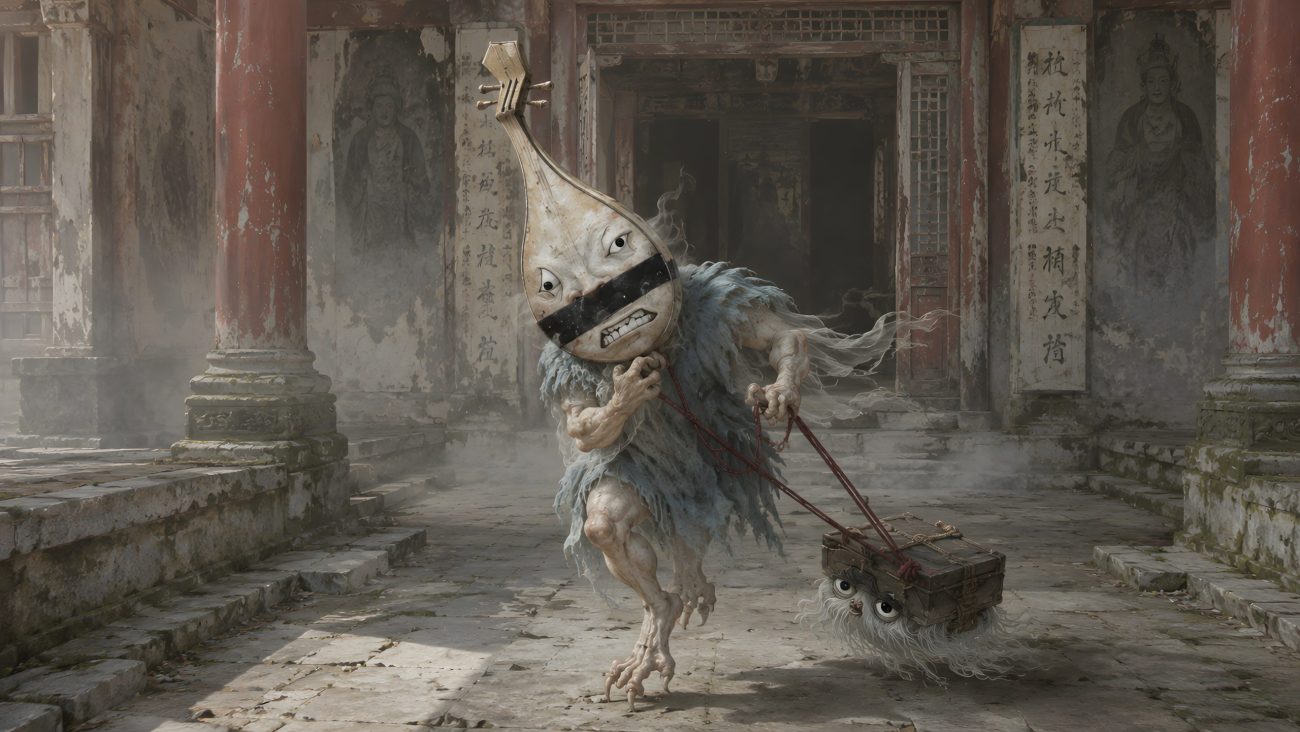
The Jatai is said to appear at night as a living obi, a kimono sash that moves on its own like a great snake. By day it is nothing more than a length of cloth, but after night falls it slithers from its resting place, coiling and gliding through rooms in search of victims.

According to old folk belief, if a person lays an obi near their pillow while sleeping, they may dream of snakes. From this belief grew the story that the obi itself can transform. Because the word for a snake’s body sounds the same as the word for a wicked heart, the sash was believed to awaken as a murderous being. In this form it becomes the Jatai, a dangerous tsukumogami born from jealousy and malice.

The Jatai is especially associated with an obi once worn by a jealous woman. After long use, the resentment bound into the garment gives it life. When it hunts, it wraps itself around sleeping men and strangles them in their beds.

The creature is described as a poisonous snake, long enough to coil itself around a person seven times. This detail is remembered as part of its fearsome nature and its unnatural length. Once the Jatai has tightened its coils, escape is said to be impossible.

The Jatai is depicted in Toriyama Sekien’s Konjaku Hyakki Shūi, where it appears as a living sash transformed into a deadly serpent. Through these tales, the Jatai is remembered as a reminder that strong emotions can linger in objects, waiting for the moment when they take on a life of their own.


Interpretive Lenses

Religious Readings
Philosophical Readings
Psychological Readings
Esoteric Deep Dive
Political / Social Readings
Other

Tuuslar

Tradition / Region: Estonian Mythology, Finnish Mythology
Alternate Names:
Category: Sorcerer


The Myth

A Finnish Tuuslar once fled across the sea to the island of Lavassaare, pursued by enemies who sought to destroy him. As he fled, he used his magic to defend himself. He transformed fish in the surrounding waters into terrifying sea monsters, hoping to frighten his pursuers away. Even so, they continued after him and reached the small island.

When the enemies landed, the Tuuslar took a handful of feathers from his beak and blew them into the air. At once, warriors fell from the sky like hail, filling the island and driving the attackers into panic. Terrified, they fled, leaving the Tuuslar alone on Lavassaare.

The Tuuslar remained on the island for many years. From there, he played tricks on the people living along the Viru coast, using his witchcraft to deceive and trouble them. At last, he departed, flying away on the back of a great northern eagle, and was never seen again.

After his departure, the island of Lavassaare stood empty for a long time. People feared to land there, believing the Tuuslar’s magic still lingered. Eventually, peaceful Finns arrived and settled the island. These settlers were said to have lost their witchcraft spells, and their descendants are believed to live on the island to this day.

According to the legend, children are sometimes seen playing and throwing feathers into the air, saying, “Let’s try—can we get shepherds?” remembering the Tuuslar’s magic.

Another tale tells that a Finnish Tuuslar once threw a stone at the sleeping Kalevipoeg, but missed. The stone was said to remain near the Suigu farm in Viru-Jaagupi, marking the place where the spell failed.


Põhja konn

Tradition / Region: Estonian Mythology
Alternate Names: The Dragon of the North, The Northern Frog, The Frog of the North
Category: Frog, Dragon


The Myth

Põhja konn is a monstrous being said to come from the far north. It is described as a vast and terrible creature that devastates the land wherever it travels. In some tellings, its body is said to be as large as an enormous ox, with the legs of a frog and a long, snake-like tail stretching the length of a chain. Its body is covered in scales said to be stronger than stone or iron. It moves across the land in enormous leaps, devouring people and animals alike and leaving desolation behind it.

According to the tale collected by Friedrich Reinhold Kreutzwald, the monster’s destruction seemed unstoppable. It was said that Põhja konn might have devoured every living creature in the world had it not been opposed. The people believed that only someone in possession of King Solomon’s ring could defeat the creature.

A brave young man set out to find a way to stop Põhja konn. His journey led him to a powerful magician from the East, who told him that the birds might aid him. The magician gave the youth a magical brew that allowed him to understand the language of birds and promised that if the youth returned with King Solomon’s ring, he would explain the writing engraved upon it.

Listening to the birds, the youth learned that only a witch-maiden could help him and that she could be found at a certain spring on the night of the full moon. He went there and met her. Though she was angered by his approach, she forgave him and took him to her home. While there, the youth heard a mysterious voice warning him not to give her any blood.

The witch-maiden asked the youth to marry her. When he hesitated, she offered him King Solomon’s ring in exchange for three drops of his blood and explained the powers the ring possessed. The youth pretended to doubt her words, and she demonstrated the ring’s magic, allowing him to try it himself. Using its power of invisibility, the youth escaped and flew away with the ring.

He returned to the magician, who read the inscription on the ring and gave him precise instructions on how to kill Põhja konn. The youth then traveled to a kingdom where a king had promised his daughter and half his realm to anyone who could slay the monster. Following the magician’s directions, the king provided the youth with an iron horse and an iron spear. Using these and the powers of the ring, changing it from finger to finger as instructed, the youth confronted Põhja konn and killed it.

After the monster’s defeat, the youth married the princess. However, the witch-maiden soon sought revenge. She transformed into an eagle, attacked the youth, reclaimed King Solomon’s ring, and chained him inside a cave, intending to leave him there to die. Many years passed before the magician came to the king and revealed that the youth could still be found. Guided once again by birds, they located the cave and freed him. Though he was weak and emaciated, the magician nursed him back to health. The youth returned to his wife and lived in prosperity, but he never saw the ring again.

In other tellings, Põhja konn does not perish completely. After being defeated, it retreats deep underground, where it lies hidden. It is said to promise its service to the brave hero who overcame it, should the land ever face danger again. To awaken Põhja konn, however, one must know the ancient languages of birds or snakes. In later times, when enemies threatened the land and these languages were nearly forgotten, only a few people remembered the old words and were able to call the creature forth, driving the invaders away.

Across its many versions, Põhja konn remains a vast frog-dragon of the north, a being of immense power whose presence brings ruin, whose defeat reshapes kingdoms, and whose fate lies somewhere between destruction, sleep, and return.


Nurikabe

Tradition / Region: Japan (Edo-period yōkai scrolls)
Alternate Names:
Category: Yōkai / Lion / Dog


The Myth

In illustrated yōkai scrolls from Japan, a creature known as the Nurikabe appears in a form unlike the better-known invisible wall of later folklore. This Nurikabe is a tangible beast with four legs and a powerful body. Its most striking feature is its enormous face, which bears three eyes that shine with an unnatural blue light. It has large, drooping ears like those of an elephant and two black tusks that curve outward. Its body is painted white, giving it a ghostly and imposing appearance. Some describe it as resembling a dog or a lion, though it does not fully match any known animal.

In the scrolls where it appears, the Nurikabe is shown near crashing waves. Behind it emerge figures such as Umi-otoko, a human seaman, and Umi-bōzu, a fearsome sea spirit. This setting places the Nurikabe at the boundary between land and sea, standing where the human world meets the supernatural. It does not act directly against the figures shown, but its presence dominates the scene, suggesting a powerful being that guards or obstructs passage.

The scroll depicting this Nurikabe is dated to the early nineteenth century. No clear written legend accompanies it, and its precise origin is unknown. It is uncertain whether this beast represents a specific local tradition or whether it was created by the artist as a yōkai form inspired by existing beliefs. Its connection to the later Nurikabe known for blocking travelers’ paths is not clearly stated in the original material.

As it appears in the scroll, the Nurikabe remains an enigmatic creature: a massive, watchful being standing firm amid waves and spirits, neither clearly hostile nor welcoming, marking a place where movement forward is uncertain and dangerous.


Interpretive Lenses

Religious Readings
Philosophical Readings
Psychological Readings
Esoteric Deep Dive
Political / Social Readings
Other

Katakana

Tradition / Region: Greek Mythology
Alternate Names:
Category: Bat, Vampire


The Myth

On the Greek islands of Crete and Rhodes, people tell of a vampire known as the katakana. It is believed that certain dead do not remain at rest. In older times, Cretans feared that if a person were buried in loose, unconstrained earth, the dead might rise again as a katakana. Because of this danger, holy soil was brought from sacred places, including the Holy Sepulcher, and sprinkled over cemeteries to prevent the dead from returning.

The katakana was said to arise from the bodies of suicides, evil people, or those who had been excommunicated from the church. After death, such individuals could transform into vampires, retaining a distorted likeness of their former selves. The katakana was described as constantly smiling, its teeth always visible, giving it a chilling and unnatural expression.

Unlike some other undead beings, the katakana did not rely solely on biting to create others of its kind. Instead, it was said to spit a burning, bloody discharge at people. If this sticky substance struck its target, the victim would in time become a katakana as well, transformed into a vampire like the one that cursed them.

People believed the katakana could be driven away temporarily by gunshots, but destroying it required strict measures. To kill it permanently, the vampire had to be decapitated, or at least struck in the head with a sharp-edged weapon. Its severed head was then boiled in vinegar, and its nails were burned. Another method involved trapping the katakana in a container filled with salt water, which could immobilize it.

These actions had to be carried out within the first forty days after the vampire’s rise. If this time passed, the katakana was believed to become indestructible, immune to all attempts to destroy it. Because of this, vigilance and speed were considered essential when signs of a katakana appeared.

Beliefs about the katakana were understood as a local island form of broader Greek vampire traditions, yet its distinctive grin, burning spit, and specific methods of destruction set it apart as one of the most feared undead beings of the Aegean islands.


Centzon Tōtōchtin

Tradition / Region: Aztec Mythology, Mexcian Mythology
Alternate Names: Centzontōtōchtin (“Four Hundred Rabbits”)
Category: Rabbit, deity


The Myth

In Mexica mythology, the Centzon Tōtōchtin are a great company of divine rabbits known as the Four Hundred Rabbits. They are gods associated with pulque, the fermented drink made from the maguey plant, and they are said to gather frequently for feasts and drunken celebrations. The number four hundred does not signify a precise count, but rather an uncountable multitude.

The Centzon Tōtōchtin are the children of Mayahuel, the goddess of the maguey plant, and Patecatl. Mayahuel was believed to nourish her children with the sap of the maguey, which became pulque. Through this parentage, the rabbits are bound to the plant and its intoxicating drink.

Each of the Centzon Tōtōchtin embodies a different aspect of drunkenness and behavior brought on by pulque. Among them are Tepoztecatl, Texcatzonatl, Colhuatzincatl, and Macuiltochtli, whose name means “Five Rabbit.” Tepoztecatl is often described as their leader and is closely associated with ritual calendars and sacred festivals.

The rabbits are said to assemble together, drinking pulque and celebrating noisily. In these gatherings, they represent the many forms intoxication can take, from joy and laughter to disorder and excess. Their presence explains why different people react differently when they drink, each one being touched by a different rabbit god.

The Centzon Tōtōchtin appear in myths surrounding the discovery and ritual use of pulque. In some stories, a rabbit is involved in revealing the maguey’s hidden properties, linking the animal directly to the sacred drink. Shrines and temples, including those dedicated to Tepoztecatl, honored these gods through offerings of pulque during festivals and ceremonies.

Thus, the Centzon Tōtōchtin remain remembered as a divine multitude of rabbit gods, born from the maguey, gathering endlessly in celebration, and inseparably bound to pulque and its effects among gods and humans alike.


Interpretive Lenses

Religious Readings
Philosophical Readings
Psychological Readings
Esoteric Deep Dive
Political / Social Readings
Other

Grant

Tradition / Region: English Mythology
Alternate Names:
Category: Horse, Demon


The Myth

There is said to be in England a kind of demon called the Grant. It appears in the form of a young horse or yearling foal, standing upright on its hind legs, with bright, sparkling eyes. Though not always seen, it most often shows itself in the streets during the heat of the day or around sunset.

When danger is about to strike—especially fire or disaster expected during the coming night or the following day—the Grant emerges and runs through the streets. As it moves, it provokes dogs to bark and chase it. By pretending to flee, it draws the dogs after it, though none can ever catch it.

Through this strange behavior, the Grant serves as a warning. Its sudden appearance and commotion alert the inhabitants that danger is near. Though terrifying to those who witness it, the demon’s actions are said to protect the people by putting them on guard before disaster can strike.

Thus the Grant is remembered as a fearful yet strangely helpful presence—an illusionary demon whose wild run through the streets signals that harm is approaching.


Sources

Wikipedia contributors. (n.d.). Grant (folklore). In Wikipedia. Retrieved June 29, 2026, from https://en.wikipedia.org/wiki/Grant_(folklore)


Zwanenjonkvrouw

Tradition / Region: Netherlands (Noord-Holland, Heemskerk)
Alternate Names:
Category: Swan maiden / nymph


The Myth

In Noord-Holland, people tell of the Zwanenjonkvrouw, a woman of extraordinary beauty who can take the form of a swan. She changes between swan and human shape by means of a magical swan shirt, known as her zwanenhemd. When she wears it, she becomes a swan; when it is removed, she remains human.

In many tales, a man discovers the Zwanenjonkvrouw while she is bathing and steals her swan shirt. Without it, she is unable to return to her true form. The man then forces her to become his wife, and she lives among humans, bound by the loss of her garment rather than by her own will.

For a time, she remains with him, but she never ceases to long for her swan shirt. When she eventually finds it again, she immediately leaves her husband without mercy and disappears, returning to her true nature and her former life.

In a legend from Heemskerk, the story ends more tragically. When the man chooses to abandon her in favor of an ordinary human woman, the Zwanenjonkvrouw falls down dead, her life ending the moment she is rejected.

Thus the Zwanenjonkvrouw is remembered as a swan-maiden bound by theft, marriage, and loss, whose fate is sealed by the recovery of her stolen form or by betrayal.


Interpretive Lenses

Religious Readings
Philosophical Readings
Psychological Readings
Esoteric Deep Dive
Political / Social Readings
Other

Anhangá

Tradition / Region: Brazilian Mythology
Alternate Names: Anhanga, Anhan, Agnan, Kaagere
Category: Deer


The Myth

Anhangá is a feared spirit known among many Indigenous peoples of Brazil. It is said to torment both the living and the dead, appearing in nature through sudden, violent sounds such as storms, tempests, and unexplained noises. The presence of Anhangá brings fear, confusion, illness, and suffering.

Most often, Anhangá appears in the form of a deer. Hunters describe seeing a white or red deer with burning, fiery eyes, sometimes with antlers covered in hair. This deer is not an ordinary animal but a spirit that guards wildlife. It watches over animals in open fields and forests and punishes hunters who hunt abusively, especially those who pursue females with young.

When Anhangá intervenes in a hunt, it brings fever, madness, and confusion. A hunter may lose his sense of direction, mistake one being for another, or act against his own family without realizing it. In one well-known story, a hunter chased a doe and her nursing fawn. He seized the fawn to draw the mother closer and fired his weapon. Only afterward did he discover that Anhangá had deceived him, and that he had killed his own mother, mistaking her for the animal.

Anhangá does not appear only as a deer. It is said to take many forms in order to deceive and afflict people. It may appear as birds, mammals, fish, reptiles, or strange hybrid beings. These forms include an armadillo, a pirarucu fish, a turtle, oxen, birds such as the tinamou, and human-like figures. Because of this, hunters and travelers are taught never to trust appearances in the wilderness.

The spirit is also believed to torment the souls of the dead. During funerary rituals, people feared that Anhangá would seize the soul on its journey to the Land Without Evils, a blessed place where virtuous souls were meant to go. To protect the dead, food offerings were placed near the burial site so that Anhangá would consume the offerings instead of the soul. Fires were kept burning to warm and protect the deceased and to keep Anhangá at a distance. The living encouraged the dead to keep their fires from going out.

It was believed that only the most virtuous souls — those who had defended their people and killed many enemies — reached the high mountain of the Land Without Evils. Those who failed in this were said to fall under the power of Anhangá, becoming tormented spirits themselves.

Anhangá was also feared during travel, especially over water. Storms and violent sounds were sometimes believed to be caused by the spirits of the dead associated with Anhangá. Among some groups, Anhangá was said to follow or serve Jurupari, and together they were feared as dangerous spirits capable of possession, kidnapping, and death.

Because Anhangá could change form at will, it was impossible to know when it was near. Its presence was marked by fear, illness, illusion, and the sudden reversal of fortune. Hunters, mourners, and travelers all treated the wilderness with caution, knowing that Anhangá might be watching, waiting to punish disrespect, cruelty, or weakness.


Source

Wikipedia contributors. (n.d.). Anhangá. In Wikipedia, The Free Encyclopedia, from https://en.wikipedia.org/wiki/Anhang%C3%A1


Rashamen

Tradition / Region: Japan (Edo period)
Alternate Names: Raschamen
Category: Sheep


The Myth

Rashamen was the name used for sheep brought to Japan by overseas ships. Because sheep were unfamiliar, people associated them with foreigners, and the name was said to come from rasha, the woolen clothing worn by Westerners.

In 1776, during the An’ei era, an animal called a raschamen was exhibited as a public spectacle in the districts of Ryōgoku and Asakusa in Edo. People paid to see it as a rare and strange creature from abroad. The animal on display was a sheep, with paint smeared over its body to make it look more unusual.

The spectacle became widely known. The sheep was taken around and shown to crowds, presented as something exotic rather than as an ordinary animal.

The event was later mentioned by Hiraga Gennai in his work Hoheiron Kohen, where he described the rashamen performance and noted that it was simply a painted sheep being displayed to the public.


Interpretive Lenses

Religious Readings
Philosophical Readings
Psychological Readings
Esoteric Deep Dive
Political / Social Readings
Other