Nang Tani

Tradition: Thai Mythology
Alternative Names: Phi Tani, Phrai Tani, Lady of Tani
Category: Ghost


The Myth

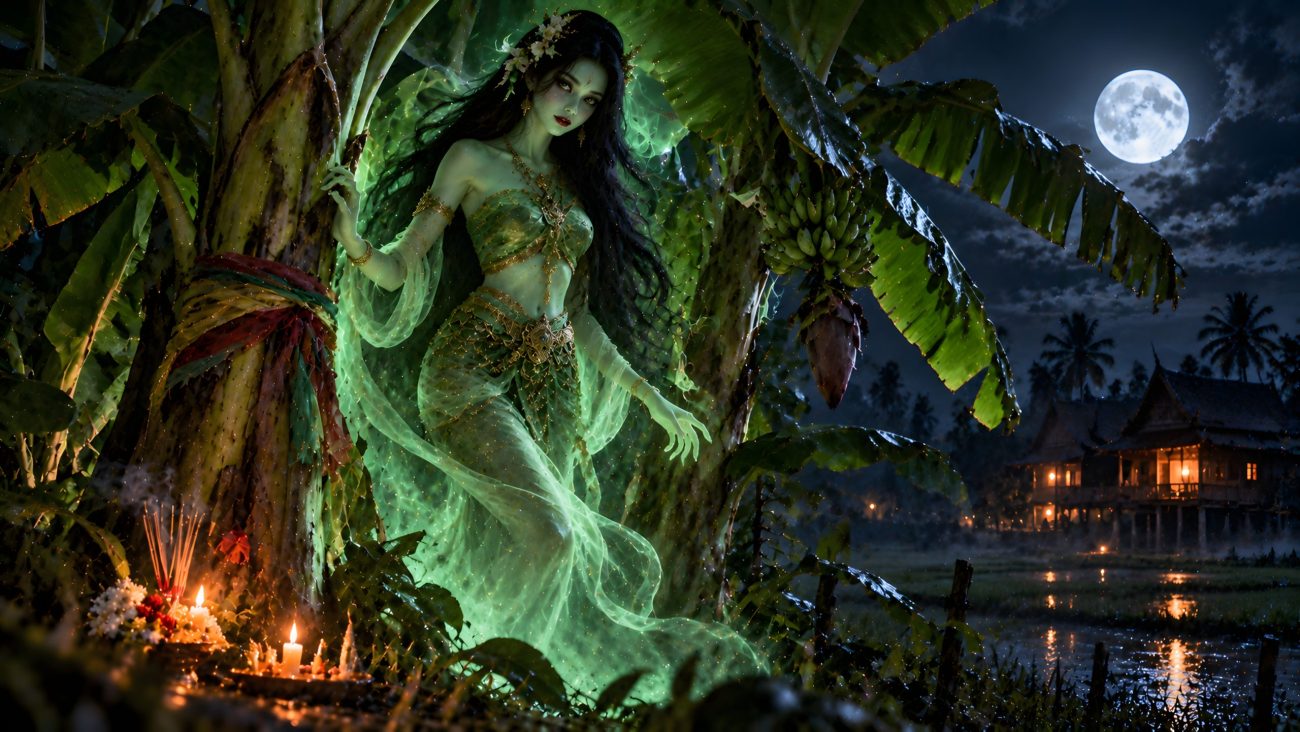
Nang Tani is a female spirit who inhabits wild banana trees known as Kluai Tani. She appears as a beautiful young woman wearing a traditional Thai green costume, with a greenish complexion that blends into the surrounding foliage. Her lips are red like the ripe fruit of the ivy gourd, and her abundant black hair hangs loose around her shoulders. She usually stands with her feet hovering slightly above the ground, never quite touching the earth. In some depictions, the lower half of her body becomes immaterial, with her clothing fading into a wisp that emerges from the banana tree’s trunk.

Most of the time, Nang Tani remains hidden within her tree, but she may emerge and become visible, especially on nights when the moon is full. She belongs to the group of female tree spirits known as Nang Mai, or Ladies of the Wood. The wild banana trees she inhabits are considered uncanny and are generally avoided near homes and village compounds. Although they resemble ordinary banana plants, their fruit is inedible, and they are more commonly found along roadsides, at the edges of cultivated fields, and near the outskirts of villages.

Nang Tani is generally regarded as a gentle and benevolent spirit, though she can become dangerous to men who have mistreated women. She may punish those who have wronged women, but she is also known for kindness, including offering food to passing Buddhist monks. People show respect for her by leaving sweets, flowers, and incense as offerings. They may also tie colourful satin or silk around the trunk of a banana tree believed to be her home. Cutting down a tree inhabited by Nang Tani is considered a bad omen, and people avoid disturbing her dwelling. Amulets depicting the spirit are also popular, reflecting the mixture of reverence, fear, and affection with which she is regarded.


Sources

“Nang Tani.” Wikipedia: The Free Encyclopedia. Wikimedia Foundation. Accessed October 15, 2026. https://en.wikipedia.org/wiki/Nang_Tani
Nang Ta-khian

Tradition: Thai Mythology
Alternative Names: Lady of Ta-khian, Nang Mai
Category: Ghost


The Myth

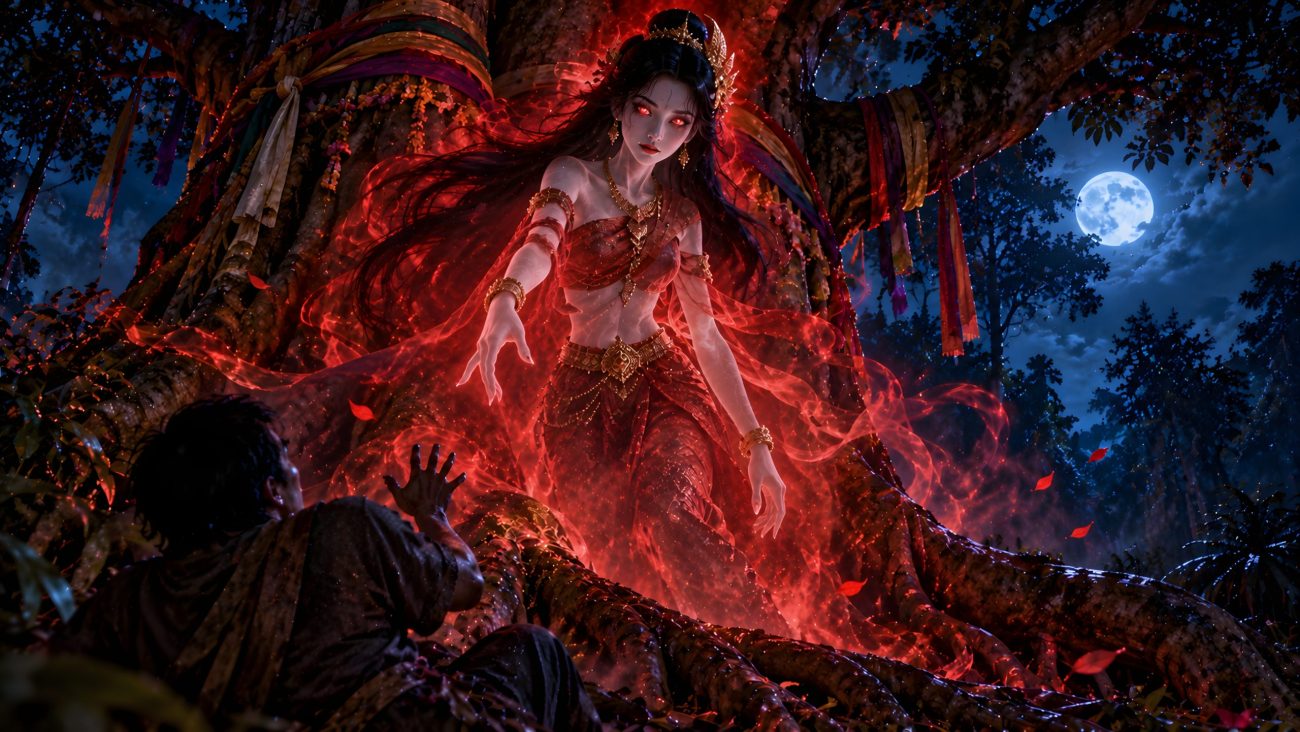
Nang Ta-khian is a female spirit who inhabits the enormous Ta-khian trees of Thailand. She often manifests as a beautiful young woman wearing traditional Thai clothing in reddish or brownish colours. These ancient trees have massive trunks and wide-spreading roots, and the spirit dwells in their immediate surroundings, deep within forests and away from inhabited places. She may also haunt houses whose beams, stilts, or pillars have been made from Ta-khian wood, remaining attached to the timber taken from her tree.

Nang Ta-khian is a powerful guardian of her home and its surrounding forest. She may harm wicked or immoral people who approach her dwelling, while those who behave righteously have little to fear from her. Her presence makes the felling of a Ta-khian tree a dangerous undertaking, for she is believed to become furious if her tree is cut down and may follow the timber wherever it is taken. Traditionally, people avoid cutting down trees inhabited by the spirit, fearing her anger and supernatural vengeance.

Ta-khian trees are sometimes marked by lengths of colourful satin wrapped around their trunks. These offerings and coverings are associated with respect for the spirit and help protect ancient trees from being felled. If a tree must be cut down, a special ceremony is traditionally performed to ask the spirit’s permission. Ta-khian wood is considered suitable for use in Buddhist monasteries, where the spiritual merit of the monks is believed to be sufficient to render the spirit harmless. Nang Ta-khian thus embodies the sacred and dangerous power of ancient trees, protecting her woodland home and punishing those who disturb it without proper respect.


Sources

“Nang Ta-khian.” Wikipedia: The Free Encyclopedia. Wikimedia Foundation. Accessed October 15, 2026. https://en.wikipedia.org/wiki/Nang_Ta-khian


Phi Kong Koi

Tradition / Region: Thai Mythology
Alternative names: Kong Koi, Phi Teen Diao (“One-Footed Ghost”), Phi Pong, Phi Pong Kang
Category: Ghost


The Myth

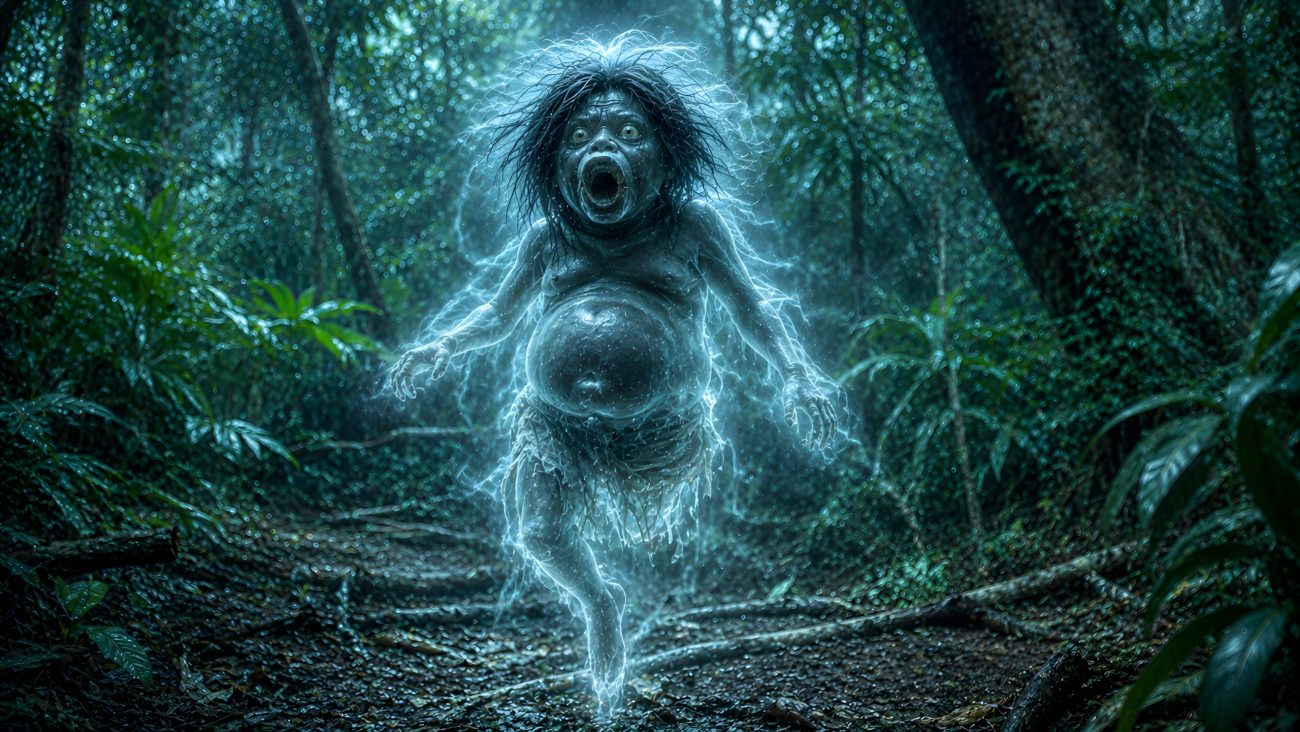
The Phi Kong Koi is an ugly, child-sized spirit with dark skin, shaggy hair, and a swollen belly. Most accounts describe it as having only a single leg, moving by hopping through the forest while crying out “Koi! Koi! Koi!”. Some traditions portray it as monkey-like, while others describe it as a tiny woman with backward feet or a creature with a tube-shaped mouth resembling that of a giant fly. Nearly all agree that it cannot climb trees.

Deep in the forests of Thailand and Laos, travelers fear the Phi Kong Koi, a nocturnal spirit that stalks lonely camps and jungle paths. It approaches sleeping victims and sucks blood from their toes, which is why travelers traditionally sleep with their feet crossed or pressed together.

Its presence is often announced by eerie cries, strange splashing sounds, and childish laughter coming from the darkness. Many who investigate find nothing but empty forest.

Some stories portray bands of Phi Kong Koi armed with tiny crossbows, behaving almost like hidden jungle tribes, while others describe them as supernatural ghosts that vanish before dawn. Objects found abandoned in the forest are sometimes believed to belong to them, and anyone who takes such treasures risks attracting their wrath.

Thus the Phi Kong Koi is remembered as the one-footed ghost of the jungle—a blood-drinking phantom whose cries echo through the night while it searches for sleeping travelers.


Sources

Wikipedia contributors. (n.d.). Kong koi. In Wikipedia. Retrieved June 21, 2026, from https://en.wikipedia.org/wiki/Kong_koi


Phi Phong

Tradition / Region: Thai Mythology
Alternative names: Phi Pao, Phong
Category: Ghost


The Myth

The Phi Phong is a ghost associated with failed black magic. It is said that those who practice dark sorcery without properly controlling its power may eventually become Phi Phong themselves.

According to tradition, the transformation begins with the cultivation of a mysterious magical plant called wan phi phong, whose white leaves glow in the darkness. As the plant grows, its leaves slowly begin to resemble the face of the person tending it. In time, the cultivator is transformed into a Phi Phong.

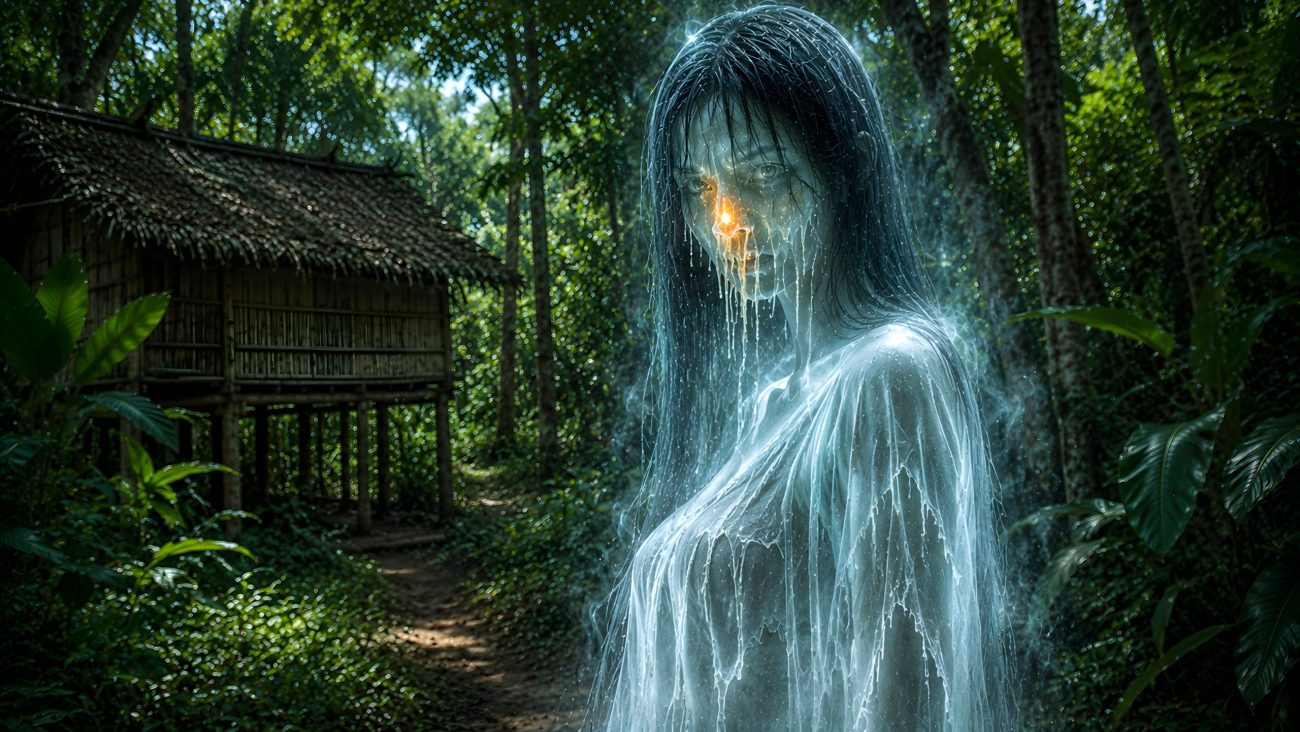
By day, a Phi Phong looks like an ordinary human and lives unnoticed among others. At night, however, its true nature is revealed. A dim flame shines from within its nostrils, while a sticky, wax-like substance drips down from its nose. Like the Phi Krasue and Phi Pop, it feeds upon impure things such as frogs, animal dung, rotting flesh, and afterbirth.

Although it generally avoids people, the Phi Phong can become dangerous if angered. It is said to cast strange objects onto the roofs of those who offend it, bringing sickness, misfortune, and even death upon the entire household.

One of the few ways to destroy a Phi Phong is to correctly identify the person who bears the curse and publicly declare them to be a Phi Phong. Once exposed, the spirit loses its power and dies.

The condition itself is believed to be contagious. Through saliva or contaminated food and water, the curse can pass from one person to another, much like other supernatural afflictions of Thai folklore.

Some traditions claim that sorcerers deliberately keep Phi Phong spirits within small containers. Inside rests a strange white larva or worm-like creature which, through spells and rituals, gradually transforms into a waxy substance. The spirit is fed with offerings such as gold leaf or needles and grants its keeper supernatural protection and resistance to harm. However, if the strict rituals are neglected, the spirit escapes and begins attacking people on its own.

Stories of Phi Phong are especially common near marshes and isolated fields. Villagers speak of mysterious red lights floating through the night sky, rising and falling above the darkness. These ghostly flames are said to be the wandering fire of the Phi Phong, silently searching for filth to consume before disappearing once more into the night.


Sources

Wikipedia contributors. (n.d.). Phong (ghost). In Wikipedia. Retrieved June 21, 2026, from https://en.wikipedia.org/wiki/Phong_%28ghost%29