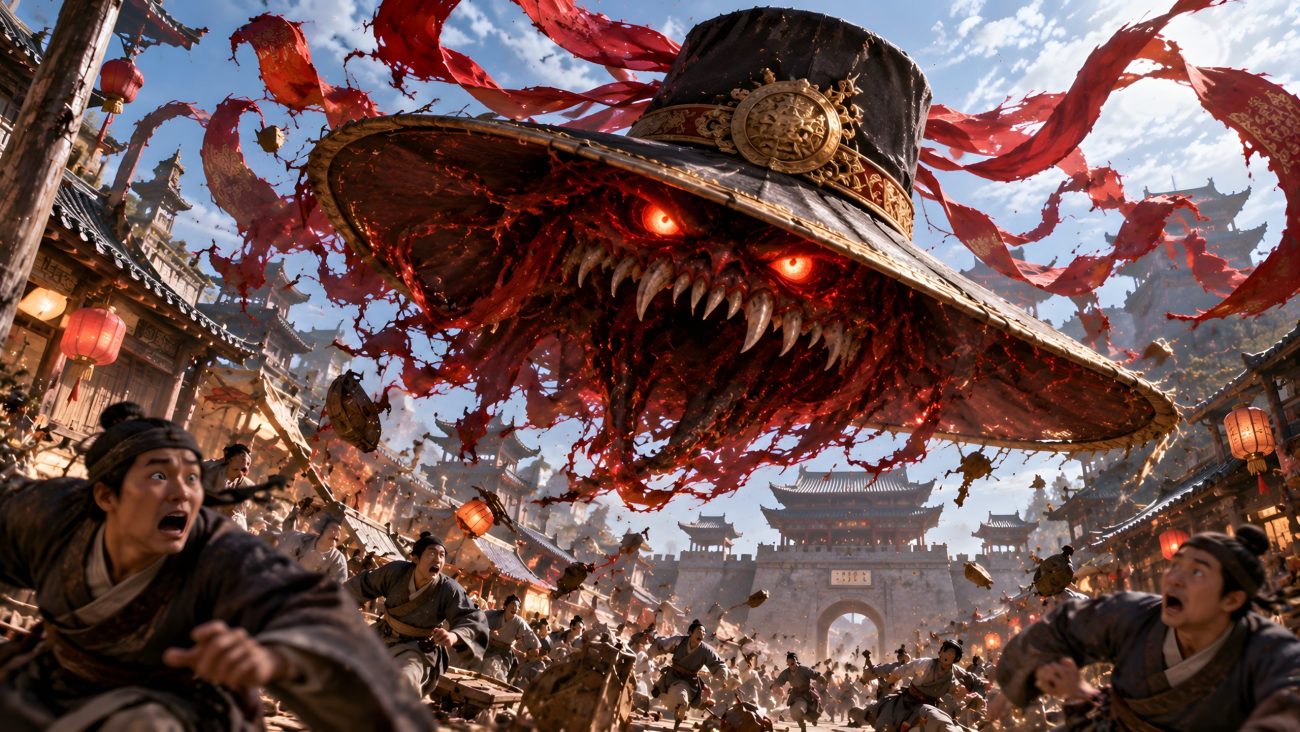
Demon hat

Tradition: Chinese Mythology
Alternative Names: 帽妖, The Hat Yokai, The Hat Demon Incident of 1018
Category: Object


The Myth

The Hat Demon Panic was a widespread supernatural scare during the Northern Song dynasty, beginning in 1018 during the reign of Emperor Zhenzong. Reports circulated of a strange creature resembling a hat that could fly through the air and enter homes at night to devour people. The rumours initially spread around Luoyang, one of the dynasty’s major cities, where frightened residents became afraid to sleep. Daily routines, work, and commerce were disrupted as households stayed awake at night to protect themselves.

On the twenty-fifth day of the fifth lunar month, the governor Zhang Min formally reported the situation to the emperor. Emperor Zhenzong ordered an investigation, questioned the local authorities about their failure to contain the rumours, and summoned Daoist masters to perform rituals. The panic continued to spread over the following months, reaching Kaifeng, the capital, and other major population centres. People stayed awake with weapons at hand, and even some soldiers were reportedly affected. When someone mistook an ordinary object for the creature and shouted in alarm, neighbours joined in, sometimes triggering waves of screaming that spread through entire streets.

The emperor eventually offered rewards to anyone who identified the people spreading the rumours. Several individuals were arrested, including a monk known as Tianshang and two fortune-tellers, Zhang Gang and Geng Gai. The three principal rumour-mongers were executed, while some of their followers and other participants received imprisonment or exile. In Nanjing, however, the prefect Wang Zeng took a different approach: he publicly declared the creature a fabrication, ordered the city gates left open at night, and challenged the supposed monster to enter. He also sent soldiers to arrest those spreading panic, and the rumours soon subsided there.

The incident illustrates how reports of a mysterious creature could develop into a major social and political crisis. The original sightings remain unclear, and later interpretations have suggested that the initial report may have arisen from an unusual sighting before the rumours were amplified and exploited by political actors. The surviving account does not establish whether any actual supernatural creature existed; the Hat Demon is remembered primarily through the widespread fear and disorder associated with the incident.


Sources

“Mào Yāo” (北宋帽妖案). Chinese Wikipedia. Wikimedia Foundation. Accessed October 24, 2026. https://zh.wikipedia.org/wiki/%E5%8C%97%E5%AE%8B%E5%B8%BD%E5%A6%96%E6%A1%88
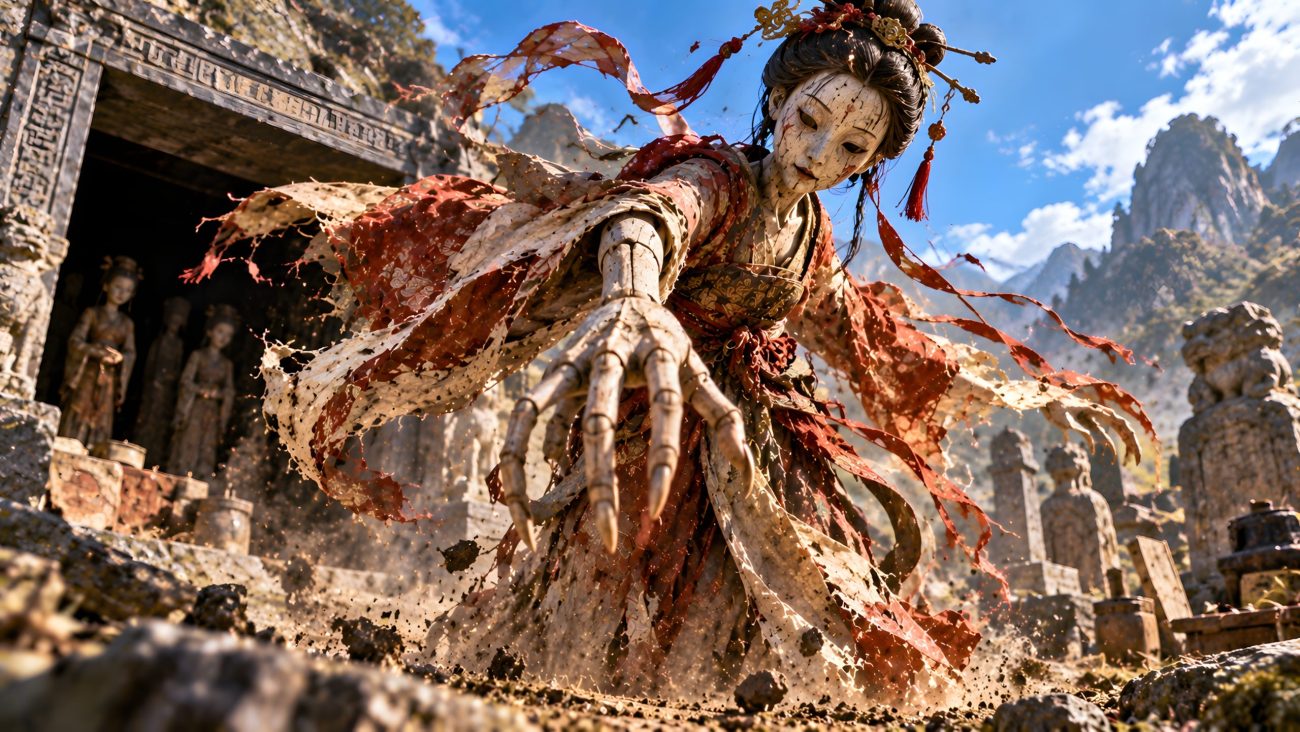
Mengqi Bizi

Tradition: Chinese Mythology
Alternative Names: 盟器婢子, Maidservant of the Burial Objects
Category: Object


The Myth

Mengqi Bizi is a supernatural being from Chinese tradition said to arise when a mengqi, a wooden figurine of a female servant made for burial, becomes a spirit. These figures were used as funerary objects, representing maidservants intended to accompany the deceased in death.

The creature is mentioned in two Chinese literary sources: Pei Yan’s Chuanqi and Zhang’s account in the Beimeng Suoyan. However, the available descriptions provide little information about its appearance, behaviour, or supernatural abilities beyond its origin as an animated burial object.

The term Mengqi Bizi can also refer directly to a female servant figurine used in burial practices, rather than to the supernatural creature itself. The legend therefore connects the idea of objects acquiring spiritual life with the tradition of placing representations of servants in tombs.


Sources

“Mengqi Bizi” (盟器婢子). Chinese Wikipedia. Wikimedia Foundation. Accessed October 24, 2026. https://zh.wikipedia.org/wiki/%E7%9B%9F%E5%99%A8%E5%A9%A2%E5%AD%90


Guanzhong Guishou

Tradition: Chinese Mythology
Alternative Names: 棺中鬼手, Ghost Hand in the Coffin
Category: Object


The Myth

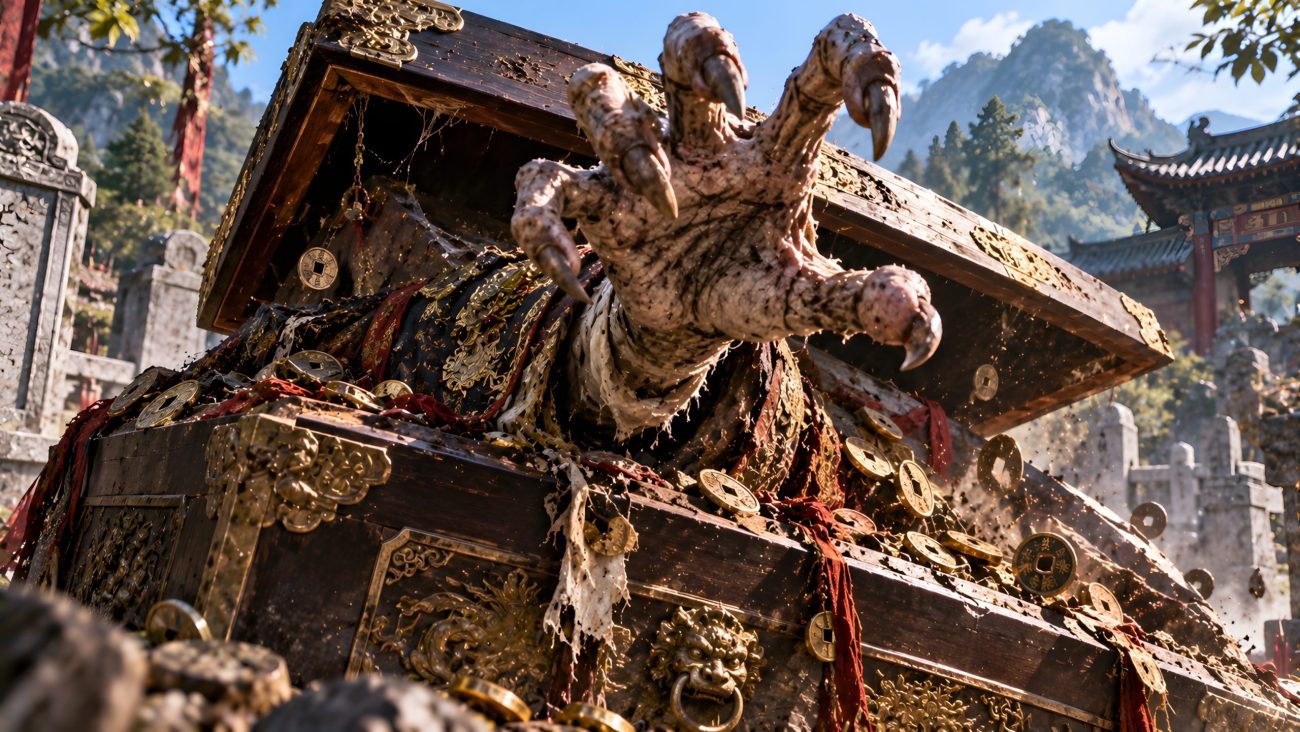
The Guanzhong Guishou, meaning “Ghost Hand in the Coffin,” is a supernatural phenomenon described in the Chinese collection Xieduo (《谐铎》). It appears as a hand reaching out from inside a coffin, emerging during the hours after midnight. The story centres on a corrupt government official whose greed persists even after death.

Even while lying dead in his coffin, the official continues to stretch out his hand to demand money. His disturbing behaviour transforms an ordinary image of the dead into a symbol of greed that cannot be satisfied, even beyond the grave. The hand represents the official’s enduring attachment to wealth and his inability to escape the corruption that defined his life.

The tale criticizes the corruption of government officials and the decay of administrative justice in Qing-era China. Through dark supernatural imagery and satire, it exposes a system in which those entrusted with authority exploit others for personal gain. The official’s posthumous demand for money suggests that corruption has become so deeply rooted that even death cannot bring it to an end.


Sources

“Guān zhōng guǐ shǒu” (棺中鬼手). Chinese Wikipedia. Wikimedia Foundation. Accessed October 24, 2026. https://zh.wikipedia.org/wiki/%E6%A3%BA%E4%B8%AD%E9%AC%BC%E6%89%8B


Nihai

Tradition: Chinese Mythology
Alternative Names: Mud Child, Mud Doll, Mud Figurine, 泥孩, 泥娃娃, 泥偶
Category: Object


The Myth

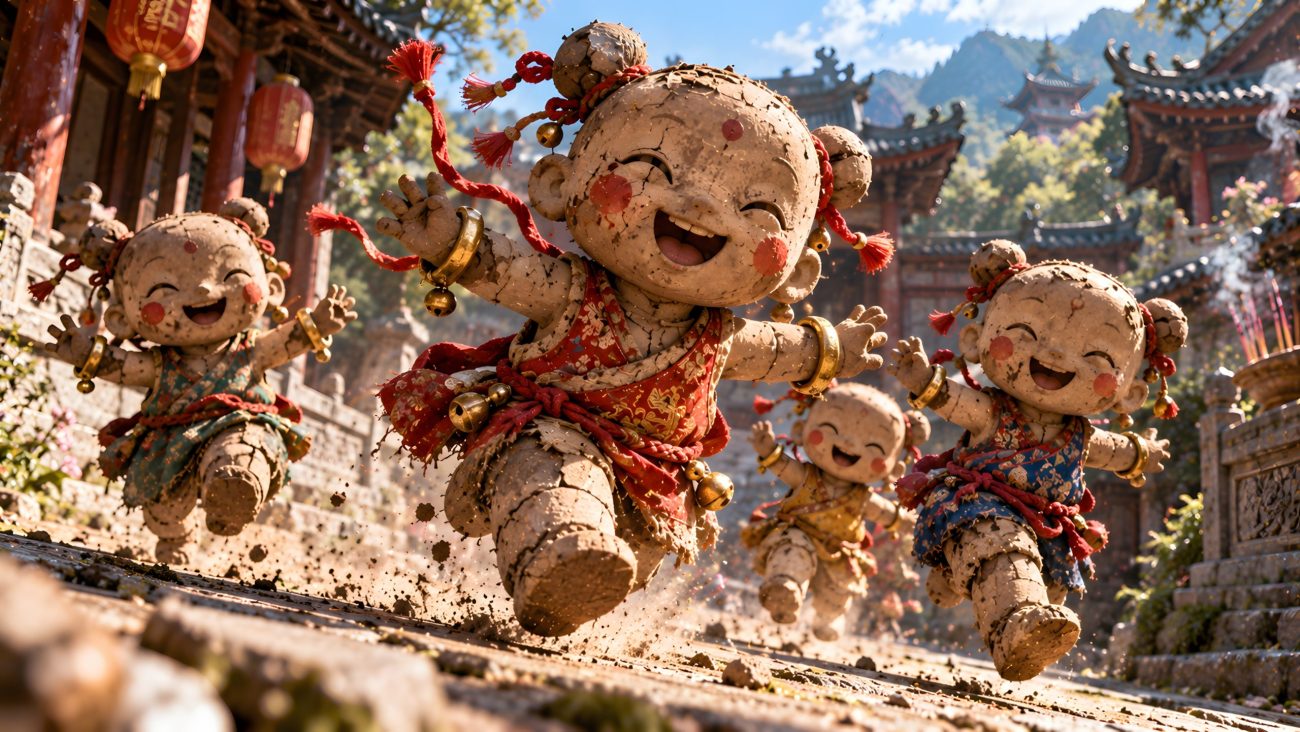
Nihai, also known as mud dolls or mud figurines, are supernatural beings formed from clay figures. They appear in Chinese accounts of objects that become strange or potentially dangerous after being treated as more than ordinary objects. In traditional Han Chinese customs, women seeking children sometimes tied red or colored threads to clay dolls in temples and brought them home as part of fertility-related practices.

In Yuewei Caotang Biji, Ji Yun recounts a childhood memory of seeing four or five small children dressed in colorful clothes and wearing golden bracelets. They played with him affectionately and called him their younger brother, but as he grew older, they disappeared. When he later told his father about them, his father recalled that Ji Yun’s deceased mother had desperately wanted children. She had repeatedly asked a Buddhist nun to bring clay dolls from a temple, tied them with colored silk threads, given each one a pet name, and placed them in her bedroom. She fed them fruit as though they were her own children. After her death, his father had the dolls buried in an empty courtyard behind the building. He suspected that the mysterious children Ji Yun had seen were these figures, and considered digging them up for fear that they might become troublesome spirits, but the exact burial place had long since been forgotten.

Another account in Jianhu Miji mentions a monster associated with a clay doll used to weigh down bedding. Together, these stories portray clay figures as objects that can acquire a supernatural presence, particularly when they are treated as substitutes for children or become associated with intense human attachment.


Sources

“Clay Dolls” (泥孩; 泥傀儡). Chinese Wikipedia. Wikimedia Foundation. Accessed October 24, 2026. https://zh.wikipedia.org/wiki/%E6%B3%A5%E5%AD%A9 and https://zh.wikipedia.org/wiki/%E6%B3%A5%E5%82%80%E5%84%A1


Pipa Ghost

Tradition / Region: Chinese Mythology
Alternative names: Pipa Spirit
Category: Ghost, Object


The Myth

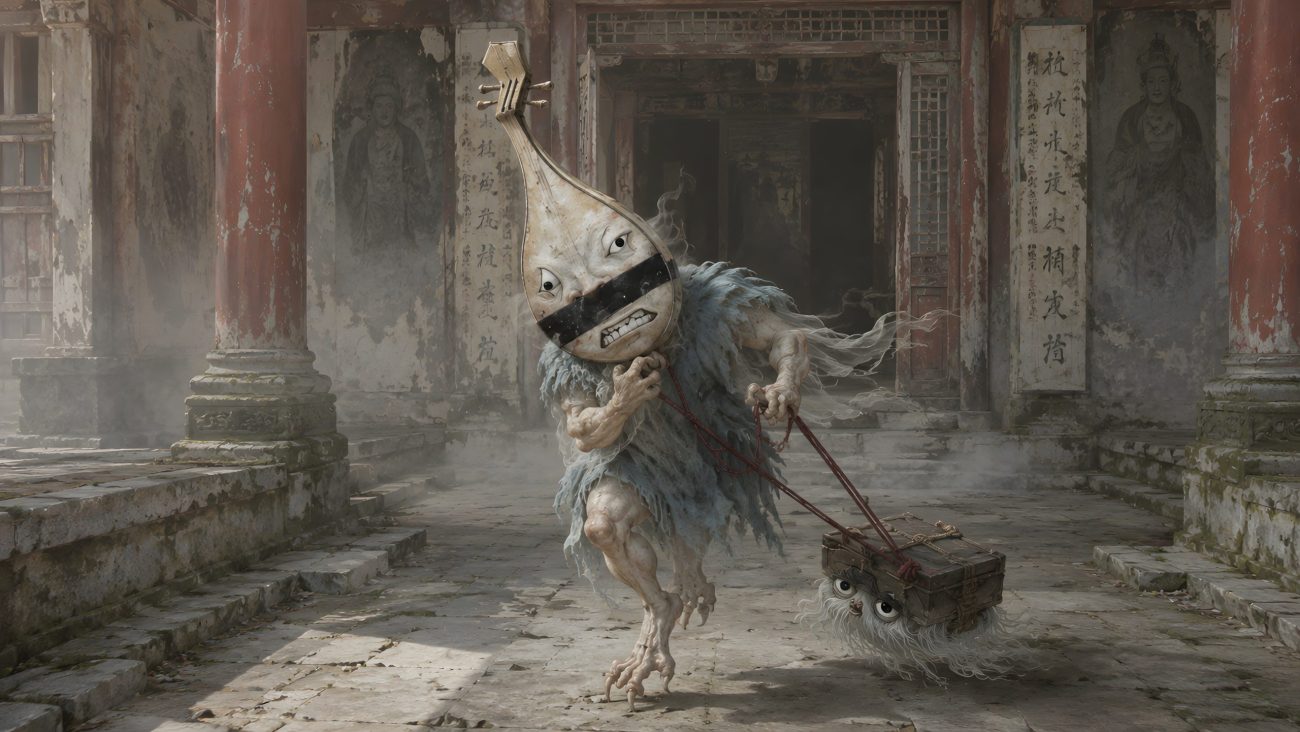
The Pipa Ghost is an invisible malevolent spirit said to inhabit a pipa, the traditional Chinese lute, from which it takes its name. Though normally unseen, it can speak and possesses supernatural intelligence. Once released, it is capable of entering human beings, causing mysterious illnesses and spreading misfortune throughout entire communities.

According to ancient Chinese legend, the Pipa Ghost is a soul that has taken residence within a pipa. By night it leaves its hiding place to hunt, feeding upon the internal organs of both humans and animals. Those it attacks soon waste away and die, while villages plagued by its presence suffer sickness, livestock deaths, and widespread calamity.

Some traditions claim the spirit remains sealed inside household vessels or beneath tightly covered pots. If a pot is broken or its lid left carelessly open, the Pipa Ghost escapes and begins haunting the household. Anyone suspected of being possessed by the spirit is believed to endanger the entire village.

Among the Dai people of Yunnan, the fear of the Pipa Ghost became deeply rooted in local belief. Families accused of harboring one of these spirits were often completely ostracized. Those believed to be possessed could be expelled from the village, their homes burned, and, in extreme cases, attacked or even killed by frightened neighbors. It was also believed that someone carrying the Pipa Ghost could marry only another person similarly afflicted, lest the spirit spread into another family.

To rid a community of the demon, shamans performed exorcisms and special ceremonies intended to capture or destroy the spirit. During times of plague, entire villages gathered to conduct rituals in which the Pipa Ghost was symbolically hunted down and burned, believing this would end the epidemic and restore harmony.

Thus the Pipa Ghost is remembered as one of China’s most feared possessing spirits—a hidden demon that spreads disease, devours life from within, and turns fear itself into a force capable of destroying entire communities.


Sources

Wikipedia contributors. (n.d.). 琵琶鬼. In 維基百科,自由的百科全書. Retrieved June 27, 2026, from https://zh.wikipedia.org/wiki/%E7%90%B5%E7%90%B6%E9%AC%BC