Black Hare

Tradition / Region: Austrian Mythology
Alternate Names: –
Category: Rabbit (hare)


The Myth

The Devil appears as a black hare and is understood to be a manifestation of the Devil himself, taking animal form to deceive and claim human lives.

The legend takes place in an old farmhouse where a group of workers were threshing grain in autumn. During a break, they joked and challenged one another, and one of the farmhands boasted that a person could hang themselves even from a single straw. When the others doubted him, he insisted it was possible and agreed to prove it, asking them to cut him down immediately if he began to suffocate.

He tied a straw to a beam and placed it around his neck, attempting to demonstrate his claim. At that exact moment, a pitch-black hare with glowing red eyes suddenly ran through the barn. The sight startled everyone, and they all chased after it, completely forgetting the man hanging from the straw.

When they finally returned, exhausted and empty-handed, they found him dead, still hanging. The straw had not broken.

The black hare was understood to have been the Devil, appearing deliberately to distract the others and claim the life of the reckless man.


Sources

sagen.at contributors. (n.d.). Der schwarze Hase. In sagen.at, from https://www.sagen.at/texte/sagen/oesterreich/oberoesterreich/linz/derschwarzehase.html


Wörthersee Sprite

Tradition / Region: Austrian Mythology
Alternate Names: Wassermann
Category: Spirit


The Myth

The Wörthersee Sprite is a male water spirit said to inhabit Lake Wörthersee and is known for dragging young women into its depths. One evening, a servant girl went alone to bathe in the lake at sunset. After some time in the water, the surface suddenly grew restless and waves began to rise, and from the middle of the lake she saw something approaching her. She recognized the figure by its pale green face and the wreath of reeds in its hair — it was the Wassermann.

Overcome with fear, she ran out of the water and fled back to the house, managing to lock the door just in time. Moments later, the Wassermann reached the house and could be heard outside, but it was unable to enter. The doorway bore the protective sign “C + M + B”, which prevented the spirit from crossing the threshold.

The Wassermann, which was said to claim victims from the lake each year, was forced to leave empty-handed. The girl survived, but from that day on, she never entered the lake after sunset again.


Sources

sagen.at contributors. (n.d.). Die Wichtelcher zu Useldingen. In sagen.at, from https://www.sagen.at/texte/sagen/luxemburg/Wichtlein_Useldingen.html


Ghostly Cat

Tradition / Region: Austrian Mythology
Alternate Names: White Cat Spirit
Category: Cat, Ghost


The Myth

The Ghostly Cat is the spirit of a woman condemned to wander in the form of a large white cat, appearing at night on the rooftops of an old house.

The legend tells of a man who lived a corrupt and immoral life, while his wife endured everything in silence. Eventually, he fell under the influence of another wicked woman, and together they plotted to murder his wife using poisoned food.

However, through a twist of fate, the poison was consumed by the very woman who had prepared it. The effects were unnatural and disturbing. Instead of dying immediately, she began to lose her humanity and believed herself to be a cat.

She crawled on all fours, ran wildly through the house, climbed across the roof, and screamed like an animal. Her madness intensified with time, growing worse by the hour, until finally she fell from the highest point of the roof and broke her neck.

After her death, she did not find rest.

She became a restless spirit, condemned to return as a ghostly white cat, roaming the rooftops at night. Those who come too close to her path risk being attacked, as she lashes out with sharp claws at anyone who dares approach.

The Ghostly Cat represents a punishment tied to guilt, corruption, and unnatural transformation — a human reduced to an animal in life, and bound to that form even after death.


Sources

sagen.at contributors. (n.d.). Die gespenstische Katze. In sagen.at, from https://www.sagen.at/texte/sagen/oesterreich/wien/sagen_legenden_gugitz/katze.html


Iron Man

Tradition / Region: Albanian Mythology
Alternate Names: Half-Iron Man
Category: Human creature


The Myth

The Iron Man is a being that is half human and half iron, combining human awareness with unnatural physical strength and durability. His body is fused with metal, making him extremely difficult to harm, and he exists as a powerful and dangerous figure.

He appears as a prisoner who has been locked away for life, indicating that he is already feared and known. When he is released, he immediately devours the king’s daughter and escapes to a distant, inaccessible place in another world, where he keeps her captive.

The Iron Man is not a mindless monster but an intelligent and predatory being. When the hero reaches him, he proves overwhelmingly powerful and kills the hero by draining his blood, leaving only skin and bones behind.

His true power lies in the fact that his life is not contained within his body. Instead, it is hidden externally in a layered structure: inside a boar, within the boar a hare, and within the hare three doves. As long as these exist, he cannot be killed.

The hero ultimately defeats him through knowledge and strategy rather than strength. By killing the boar, then the hare, and finally the three doves, the Iron Man’s life force is destroyed. At that exact moment, his body collapses and he dies instantly.

The Iron Man represents a form of false invincibility, a being whose apparent immortality depends on a hidden and separable life source rather than his physical form.


Sources

Albanian Literature contributors. (n.d.). Folktale 4. In Albanian Literature, from http://www.albanianliterature.net/folktales/tale_04.html

Dozon, A. (1879). Manuel de la langue chkipe ou albanaise: Grammaire, vocabulaire, chrestomathie. In Paris: Ernest Leroux (reprinted in Folklor shqiptar 1, Proza popullore, 1963). Translated by Elsie, R.


Skull Husband

Tradition / Region: Albanian Mythology
Alternate Names: —
Category: Skeleton


The Myth

The Skull Husband is a man transformed into a skull, bound to exist in that form until restored. Despite his appearance, he possesses agency and the ability to provide wealth and assistance.

A king promised his daughter in marriage to whoever freed his horse. When the oath was fulfilled, she was sent to a palace where her husband appeared only as a skull. The first two daughters rejected this fate, but the third accepted it without fear and treated the skull as a true husband.

The skull responded to her acceptance by providing for her needs. Through commands delivered by a servant, it granted her access to wealth, food, and servants. Her life became one of abundance, despite the unnatural form of her husband.

When her sisters demanded to see the husband in human form, the maiden sought help. She encountered a supernatural maiden who revealed that the skull was in fact a transformed man. At that moment, the enchantment was broken, and the skull became a living man once more.

The transformation had been imposed to keep him hidden from the world, and it was undone through intervention and the maiden’s actions.


Sources

Albanian Literature contributors. (n.d.). Folktale 11. In Albanian Literature, from http://www.albanianliterature.net/folktales/tale_11.html

Frashëri, S. (1936). Folklor shqipëtar. In Durrës (reprinted in Folklor shqiptar 1, Proza popullore, 1963). Translated by Elsie, R.


Giant Falcon

Tradition / Region: Albanian Mythology
Alternate Names: —
Category: Bird


The Myth

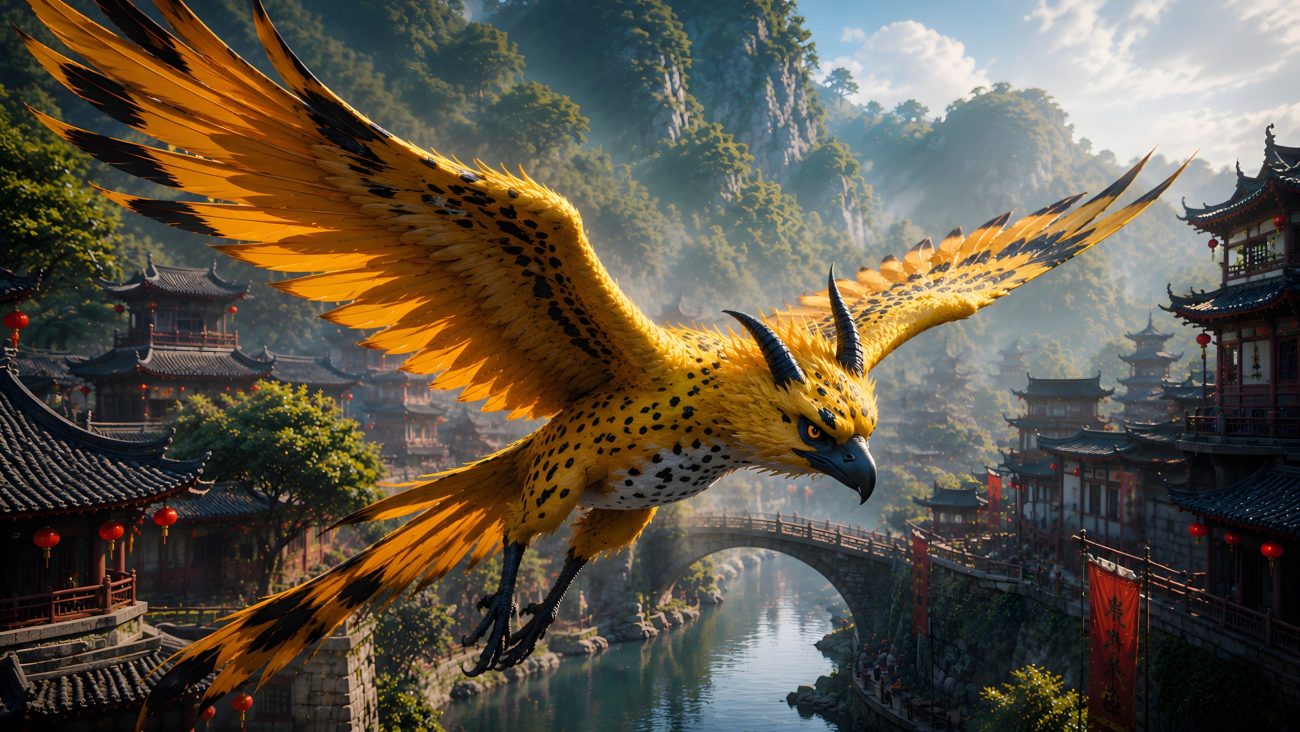
The Giant Falcon is an enormous and ancient bird encountered during a hero’s journey. It serves as a guide and means of transport to a distant, unreachable realm, but demands sustenance and assistance in return.

A young man searching for the half iron being was told by the south wind that he would find a falcon so large it could no longer fly. When he found it, he seized it and demanded information. The falcon agreed to help, but only after being fed and restored, as its wings had weakened with age.

The young man remained with the falcon and provided it with large amounts of meat until its strength returned. Once recovered, the falcon allowed him to climb onto its back and carried him across vast distances to a mountain in another world where the half iron being lived.

During the journey, the falcon required constant feeding. When the meat ran out, it demanded more, threatening to drop him. The young man cut flesh from his own body to sustain the bird until they reached their destination. Afterward, the falcon restored him by returning what it had taken, bringing him back to health.

The falcon later recognized the hero again after his death and revived him using swallow’s milk, restoring him to life and allowing him to continue his quest.


Sources

Albanian Literature contributors. (n.d.). Folktale 4. In Albanian Literature, from http://www.albanianliterature.net/folktales/tale_04.html

Dozon, A. (1879). Manuel de la langue chkipe ou albanaise: Grammaire, vocabulaire, chrestomathie. In Paris: Ernest Leroux (reprinted in Folklor shqiptar 1, Proza popullore, 1963). Translated by Elsie, R.


Devouring Wild Mare

Tradition / Region: Albanian Mythology
Alternate Names: —
Category: Horse


The Myth

The Devouring Wild Mare is a dangerous supernatural horse said to consume all living beings. Despite its violent nature, it can be subdued through cunning and oath-binding.

A young hero was sent to water a mare known for devouring anyone who approached it. Guided by a magical horse, he prepared a trap by mixing honey into the water and placing a golden saddle nearby. When the mare arrived, it drank the sweetened water and was drawn to the sight of the saddle.

The mare called out for a human to ride it. The hero revealed himself but demanded an oath for safety. The mare swore by the head of Demirçil, the hero’s horse, that it would not harm him. Only after this oath did the hero descend and mount the mare.

Once mounted, the mare did not attack him. Instead, it behaved peacefully and even expressed a desire to be reunited with its offspring, the very horse that had guided the hero. The three then moved together without conflict.

Although known as a devourer of living beings, the mare’s behavior was restrained when bound by oath and approached with strategy.


Sources

Albanian Literature contributors. (n.d.). Folktale 7. In Albanian Literature, from http://www.albanianliterature.net/folktales/tale_07.html

Dozon, A. (1879). Manuel de la langue chkipe ou albanaise: Grammaire, vocabulaire, chrestomathie. In Paris: Ernest Leroux (reprinted in Folklor shqiptar 1, Proza popullore, 1963). Translated by Elsie, R.


Aerico

Tradition / Region: Albanian Mythology
Alternate Names: Aërico
Category: Goblin


The Myth

The Aerico is a solitary and malevolent goblin said to dwell in trees, particularly ancient cherry trees. It is fiercely territorial and hostile toward humans, defending its domain with harmful effects on those who come too close.

The creature inhabits old trees, favoring those that have stood for generations. It does not tolerate intrusion and reacts aggressively to any human presence near its dwelling. According to the tradition, even standing within the shadow of the tree it inhabits can bring harm. Those affected may experience swelling in their hands, feet, or other parts of the body.

The Aerico is described as deeply hostile to humans, acting without provocation simply due to proximity. Its presence is not tied to any specific narrative event but exists as a localized belief tied to particular places and trees.

In later interpretations, the physical effects attributed to the Aerico—especially swelling of limbs—have been associated with real illnesses, such as Elephantiasis. The myth itself, however, persists as part of older rural traditions, though it is now largely diminished.


Sources

fr-academic contributors. (n.d.). Aërico. In fr-academic, from https://fr-academic.com/dic.nsf/frwiki/56435


Sun Stag

Tradition / Region: Albanian Mythology
Alternate Names: —
Category: Deer


The Myth

The Sun Stag is a benevolent animal associated with the sun, summoned to safely carry a maiden back to her home. It is distinguished from more dangerous creatures by its peaceful nature and willingness to help.

After being taken by the sun, a maiden longed to return to her mother. The sun told her to summon an animal to carry her home. First came the Kulshedra, which admitted it would devour her, and so it was rejected. Then the maiden summoned a stag. When asked what it would eat and drink, the stag replied that it would eat fresh grass and drink cold water. Satisfied, the sun chose the stag to escort her.

The stag carried the maiden on its antlers. Along the journey, it paused and told her to climb a tree while it searched for food, warning her not to come down for anyone else. When a Kulshedra approached and tried to lure her down, the maiden refused. The stag returned in time, took her again upon its antlers, and carried her safely home.

Before departing, the stag had asked that the maiden’s mother provide fresh hay in return for its help.


Sources

Albanian Literature contributors. (n.d.). Folktale 22. In Albanian Literature, from http://www.albanianliterature.net/folktales/tale_22.html

Dozon, A. (1879). Manuel de la langue chkipe ou albanaise: Grammaire, vocabulaire, chrestomathie. In Paris: Ernest Leroux (reprinted in Folklor shqiptar 1, Proza popullore, 1963). Translated by Elsie, R.


Sisters of the Sun

Tradition / Region: Albanian Mythology
Alternate Names: –
Category: Spirit


The Myth

The Sun Sisters are supernatural maidens encountered beneath the earth who possess knowledge and provide guidance. They are associated with fire, ovens, and acts of labor, and reward kindness with assistance.

A young woman searching for her lost husband was told to descend into the earth. There she encountered the younger sister of the sun, who was baking bread and cleaning the oven with her bare hands and breasts. The young woman took pity on her and found tools to ease her work. In return, the sister directed her to the elder sister.

She then found the elder sister of the sun, who was also cleaning an oven in the same manner. Again, the young woman helped her by bringing proper tools. In return, the elder sister gave her a walnut, a hazelnut, and an almond, and told her to continue on her path, informing her where her husband could be found.


Sources

Albanian Literature contributors. (n.d.). Folktale 23. In Albanian Literature, from http://www.albanianliterature.net/folktales/tale_23.html

von Hahn, J. G. (1864). Das Schlangenkind. In Griechische und albanesische Märchen (pp. 116–124). Leipzig: Engelmann. Translated by Elsie, R.