Remerschen Giant

Tradition: Luxembourg Mythology
Alternative Names: Der große Mann zu Remerschen, The Great Man of Remerschen
Category: Giant


The Myth

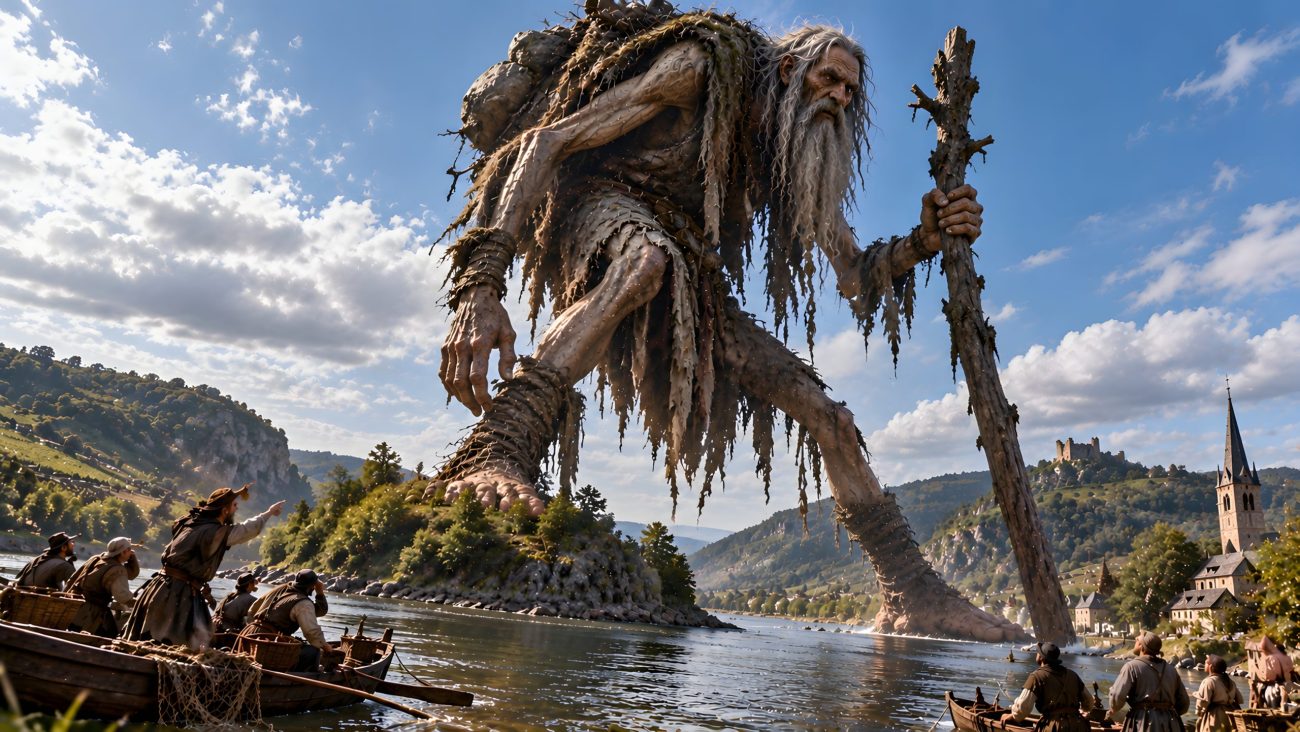
The Giant of Remerschen was an enormous man said to have lived near the Moselle River in Luxembourg. Fishermen on the river frequently saw him approaching from the direction of Remerschen. His stature was so extraordinary that he could cross the entire Moselle in just two steps.

Whenever the giant reached the river, he placed one foot on the island near Besch and the other on the opposite bank. With this immense stride, he crossed the water effortlessly, as though the broad river were no obstacle at all. The legend preserves a striking image of a giant whose extraordinary size allowed him to traverse the Moselle with ease.


Sources

La Fontaine, Edmond de. Luxemburger Sagen und Legenden. Gesammelt und herausgegeben von Ed. de la Fontaine. Luxemburg: Jos. Beffort, 1882.


Krügekrämer

Tradition: Luxembourg Mythology
Alternative Names: Der Krügekrämer, The Jug Peddler
Category: Giant


The Myth

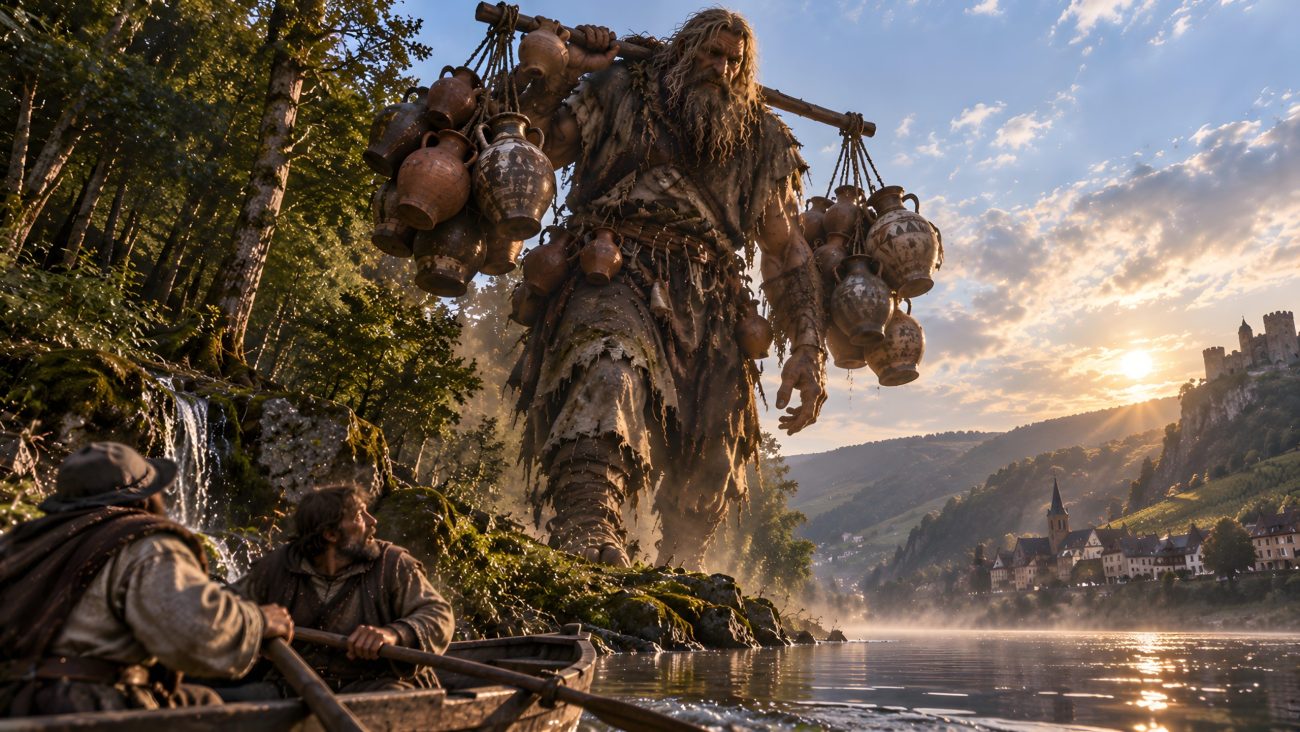
The Krügekrämer was a mysterious, gigantic figure said to haunt the northeastern corner of the Remich Forest in Luxembourg, near a salty spring known as the Salzbur. The spring flowed into the Moselle almost as soon as it emerged from the ground. Fishermen traveling home by boat at night frequently encountered the strange, tall man near the spring. They gave him the name Krügekrämer, meaning “Jug Peddler,” because he carried a large number of earthenware jugs that clattered together ominously as he moved.

The apparition reportedly followed the fishermen along the river until they reached a nearby small ravine, where he vanished without a trace. His immense height made him especially frightening to those who encountered him in the darkness.

One fisherman recounted seeing the Krügekrämer himself on a late winter evening. He and a companion had gone fishing and intended to land near the Salzbur to unwind their fishing line. As they approached, the fisherman heard the unmistakable clatter of clay vessels striking one another. When the moon emerged from behind a cloud, he saw the figure standing close before him, as tall as a poplar tree. His companion had noticed nothing, but the fisherman quickly signaled to him, and they hurriedly rowed to the opposite bank of the Moselle to escape the uncanny apparition.


Sources

La Fontaine, Edmond de. Luxemburger Sagen und Legenden. Gesammelt und herausgegeben von Ed. de la Fontaine. Luxemburg: Jos. Beffort, 1882.


Tree-High Figure

Tradition: Luxembourg Mythology
Alternative Names: Die baumhohe Gestalt, The Tree-Tall Figure
Category: Giant


The Myth

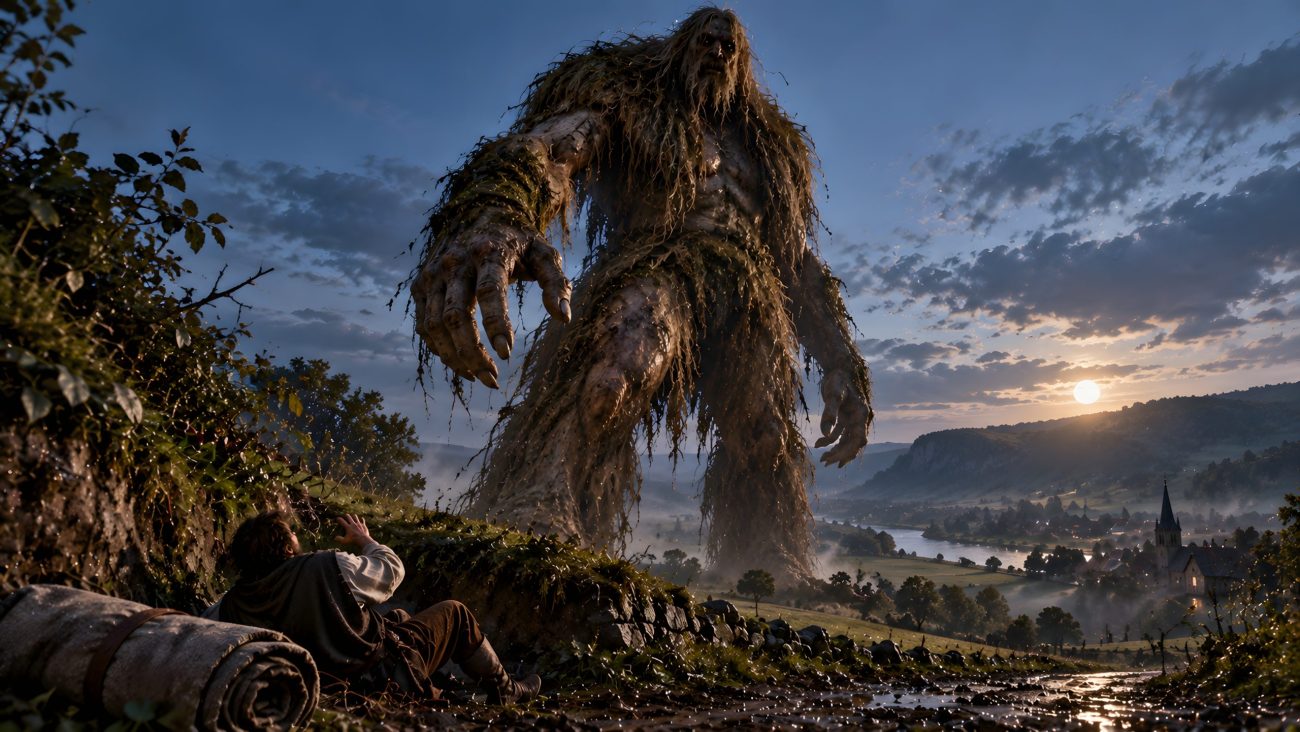
The Tree-High Figure was a mysterious, hairy creature encountered at night near the Höllenfeld in Luxembourg. According to a local legend, a weaver from Stadtbredimus was carrying a roll of cloth to Schwebsingen when he passed the field after dark. In a roadside ditch, he noticed a shapeless figure covered in long hair, curled up as though it were a dead animal.

Curious, the weaver approached to examine what he had found. Suddenly, the figure rose from the ditch and began to grow, becoming larger and larger until it stood as tall as a tree. Terrified by the uncanny sight, the weaver swore never to pass that place again except in broad daylight.


Sources

La Fontaine, Edmond de. Luxemburger Sagen und Legenden. Gesammelt und herausgegeben von Ed. de la Fontaine. Luxemburg: Jos. Beffort, 1882.


Ardennes Giant

Tradition: Luxembourg Mythology
Alternative Names: Der Riese im Ardennerwald, The Ardennes Giant
Category: Giant


The Myth

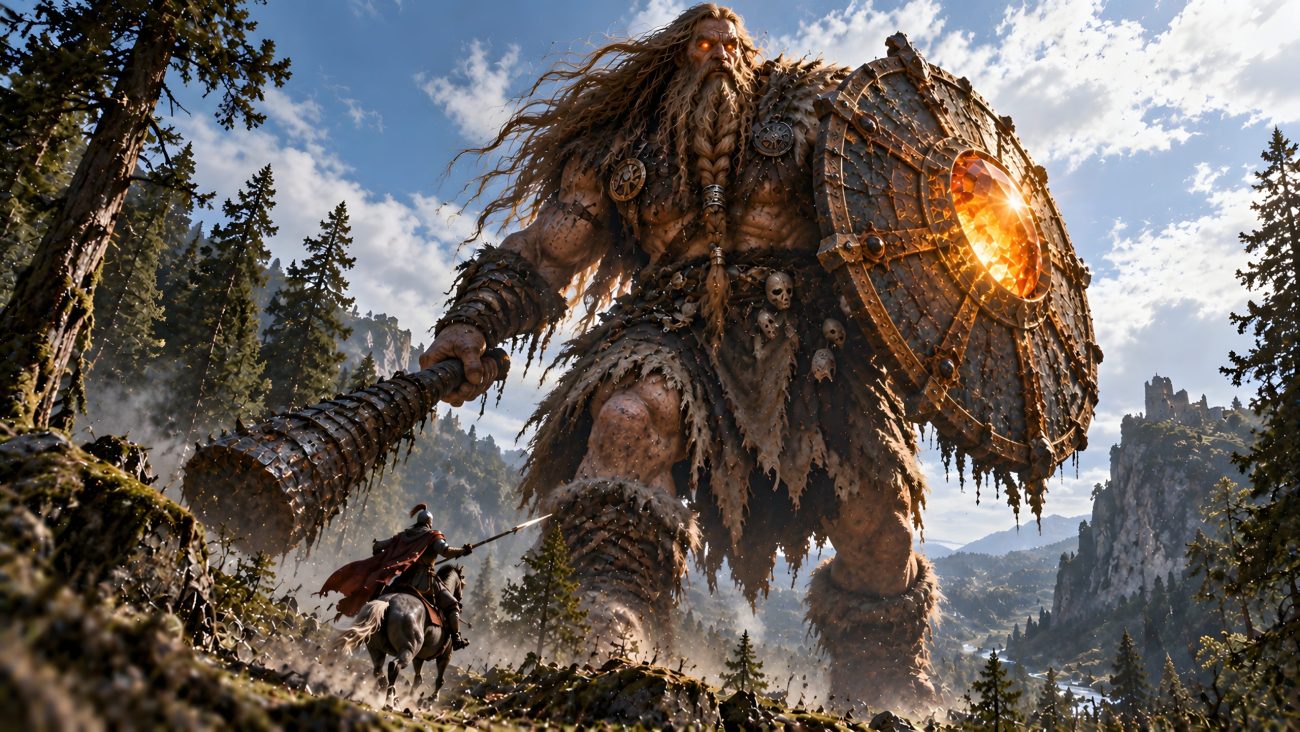
The Giant of the Ardennes Forest was a monstrous being who possessed a magnificent gemstone that shone as brightly as the Sun. The giant had mounted the precious jewel in the center of his shield, granting it magical powers that made the shield invulnerable to ordinary weapons. When Emperor Charlemagne learned of this treasure while holding court at Aachen, he expressed his desire to possess it. Six of his bravest companions immediately volunteered to venture into the Ardennes Forest and seize the jewel for their emperor. Among them was the father of the young Roland, the hero who would later become famous in legend. Although Roland was considered too young to lead the expedition, he pleaded until he was permitted to accompany his father as a shield-bearer.

When the knights reached the forest, they separated to search more effectively for the giant. For three days and three nights, they wandered through the dense undergrowth without finding him. On the fourth day, exhaustion overcame Roland’s father, who lay down to sleep beneath an ancient oak tree. As soon as his father began to snore, Roland spotted the giant descending from a mountain, his shield flashing with brilliant sparks of light. Without waking his father, the young hero seized his weapon, mounted his warhorse, and charged toward the enormous opponent.

The giant looked down upon Roland with contempt and mocked him, but the young warrior refused to retreat. A fierce battle began. The giant swung a heavy iron bar at Roland, who swiftly dodged the crushing blow and hurled his spear at the monster. However, the spear bounced harmlessly off the giant’s enchanted shield, protected by the magical gemstone. Realizing that ordinary attacks could not penetrate the shield’s power, Roland drew his sword in both hands and struck at the giant’s left hand, severing it from his body. Since the giant had been holding the shield with that hand, the magical protection was broken, and he lost his courage.

Roland then defeated the giant completely by cutting off his head. He claimed the radiant gemstone from the fallen giant’s shield and returned with it to Emperor Charlemagne. The emperor and his court were astonished when the young shield-bearer presented the precious jewel. Through his courage, quick thinking, and skill in battle, Roland had accomplished a feat that the other knights had failed to achieve, securing the magical treasure for his emperor.


Sources

La Fontaine, Edmond de. Luxemburger Sagen und Legenden. Gesammelt und herausgegeben von Ed. de la Fontaine. Luxemburg: Jos. Beffort, 1882.


Bayreck Giant

Tradition: Czech Mythology
Alternative Names: Bayreck Giant, Giant of Bayreck Castle
Category: Giant


The Myth

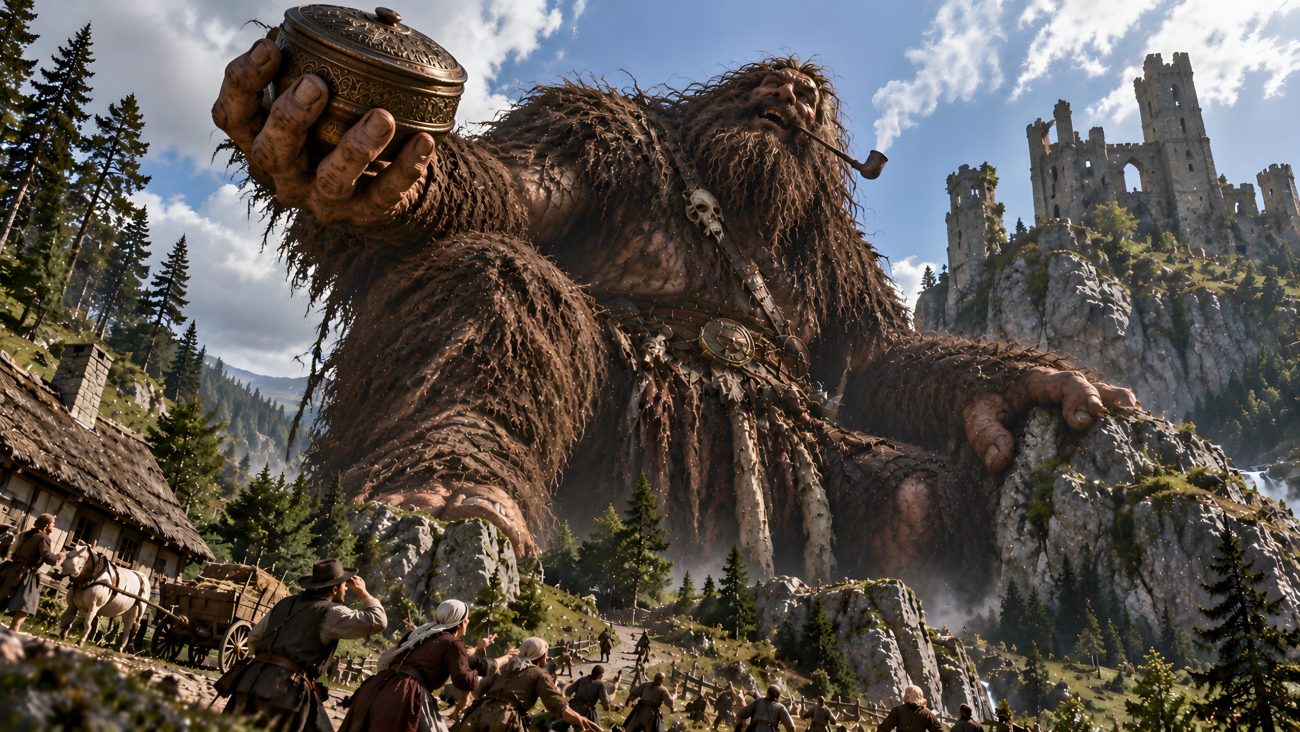
The Bayreck Giant was a giant who lived in Bayreck Castle, a ruined stronghold nestled in the mountain forests near Mount Osser in the Bohemian Forest. According to local legends, giants once inhabited the surrounding mountains and maintained friendly relations with their relatives living in neighboring strongholds. The Bayreck Giant regularly hurled his snuffbox across to the Giant’s Mountain near Kauth so that his cousin could use it. He also exchanged daily greetings with the giant who lived in the castle at Gewinzi, shaking hands across the hills and valleys. When the people of Neuern needed hammers, the Bayreck Giant would simply throw them down to the town.

The giant’s family occasionally descended into the human world. One day, the giantess went down into the countryside and scooped up a farmer, together with his plow and oxen, carrying them back to the castle. Her father was displeased by her actions and ordered her to return the little human to the place where she had found him. He warned that these small people would eventually bring about the giants’ destruction. The story portrays the giants as immensely powerful beings whose interactions with ordinary humans could have dangerous consequences, even when their actions were not necessarily intended to cause harm.

Bayreck Castle was also associated with an extensive network of underground tunnels. According to one tale, a goose chased into a passage beneath the castle emerged from the well at Klenau. On another occasion, someone lit a fire in the castle’s cellar, and the smoke reportedly travelled for miles before appearing at the Black Tower in Klatovy. These passages have since been filled in, but they remain part of the castle’s mysterious reputation.

An enchanted treasure is said to lie beneath Bayreck Castle. Every Palm Sunday, while High Mass is celebrated in Neuern, a chasm opens and reveals the way to the hidden wealth. Once, a priest, a sacristan, and a poor shepherd entered the opening in the hope of becoming rich. Inside, they discovered the devil sitting on an iron chest, with its key held between his teeth. They tried sprinkling him with holy water and pulling him away, but he refused to move. When they asked what he wanted in exchange for the treasure, he breathed fire and demanded a soul. The priest and sacristan offered him the shepherd’s soul, but the devil rejected it because the shepherd was an honest man. Finally, the devil agreed to surrender the chest if they carried him to Klenau in a nine-cornered sack. Unable to find such a sack, the three men abandoned their attempt, and the treasure remains hidden beneath Bayreck Castle to this day.


Sources

“Schloss Bayreck.” SAGEN.at – Böhmerwald-Sagen. Reproduced by SAGEN.at. https://www.sagen.at/texte/sagen/tschechien/watzlik/schlossbayreck.html


Delisrutsch Giant

Tradition: Liechtenstein Mythology
Alternative Names: Delisrotsch, Deli, Fidel
Category: Giant


The Myth

The Delisrutsch is a giant associated with a tragic legend from the Lawena Alp in Liechtenstein. According to the story, the events took place around three hundred years ago, when the herdsmen and dairyman who tended the alpine pastures were known for their godlessness. Before driving their cattle up to the alp, they declared that they would undertake the journey in the devil’s name rather than God’s. A poor widow, however, insisted that she would drive her own cow to the pasture in God’s name alone.

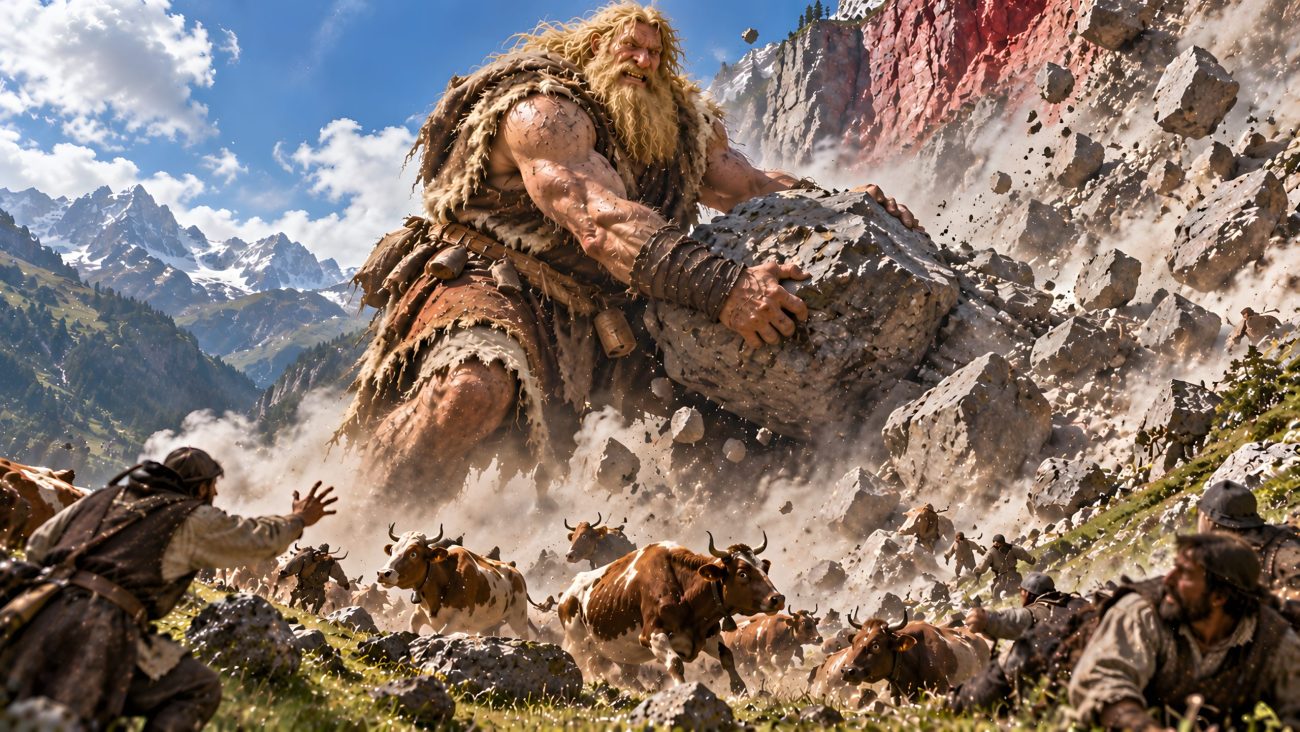
One day, the herdsmen drove their cattle from the Lawena barn towards the Rote Wand, or Red Wall. As the animals reached the pasture, a section of rock suddenly broke away from the mountainside and thundered down the slope. The enormous rockfall buried the cattle and their keepers, destroying the herds in a single catastrophe. Only the widow’s cow survived, spared from the disaster because its owner had entrusted its journey to God.

In another version of the legend, the herdsman who tended the alpine pasture was himself a giant. When the rockfall descended, it buried him along with his cows, while the poor widow’s cow remained unharmed. The giant was named Deli, a form of Fidel, and the place where the disaster occurred became known as Delisrotsch. The legend thus explains the local place-name through the giant’s death and presents the survival of the widow’s cow as a sign of divine protection.


Sources

“Die Delisrutsch.” SAGEN.at – Liechtensteiner Sagen. Reproduced by SAGEN.at. https://www.sagen.at/texte/sagen/liechtenstein/seger/delisrutsch.html


Upper Austria Giant

Tradition: Austrian Mythology
Alternative Names: Oberösterreichische Riesen, Giants of the Mühlviertel, Giant Imago, Giant Hans
Category: Giant


The Myth

Giants feature prominently in the legends of Upper Austria, where they are credited with shaping the landscape, building churches and castles, and leaving enormous stones and bones as traces of their presence. Their immense strength could explain violent storms, unusual rock formations, and the construction of buildings that seemed beyond ordinary human capabilities. Around Traunkirchen, people once said that giants were becoming angry whenever storms raged and roared across the area. Other traditions placed giants in underground passages and caves near Enzenberg, while reports of enormous human remains discovered near Kirchschlag were interpreted as evidence that giants had once lived there.

Many stories emphasize the extraordinary strength and appetite of individual giants. Giant Hans, a farmhand from the upper Mühlviertel, belonged to a family of giants and was hired by a farmer when he was seventeen. At breakfast, he ate two large loaves of bread, and when sent into the forest to gather wood, he simply pulled trees out of the ground by their roots. His enormous appetite frightened the farmer and his wife, who struggled to provide enough food for him. The farmer eventually attempted to kill Hans by throwing blocks of stone into a deep pit he was digging, but Hans remained unharmed and merely complained that the farmer was putting too much sand into the hole. Another legend tells of a giant sleeping in the Bohemian Forest whose body was mistaken for a mountain by a passing farmer. When the farmer accidentally drove his horses into the giant’s nostril, the giant sneezed so violently that the farmer and his team were hurled an hour away. The enormous giant Imago was likewise remembered for using high mountains as flint, with a fragment of one supposedly forming the Traunstein.

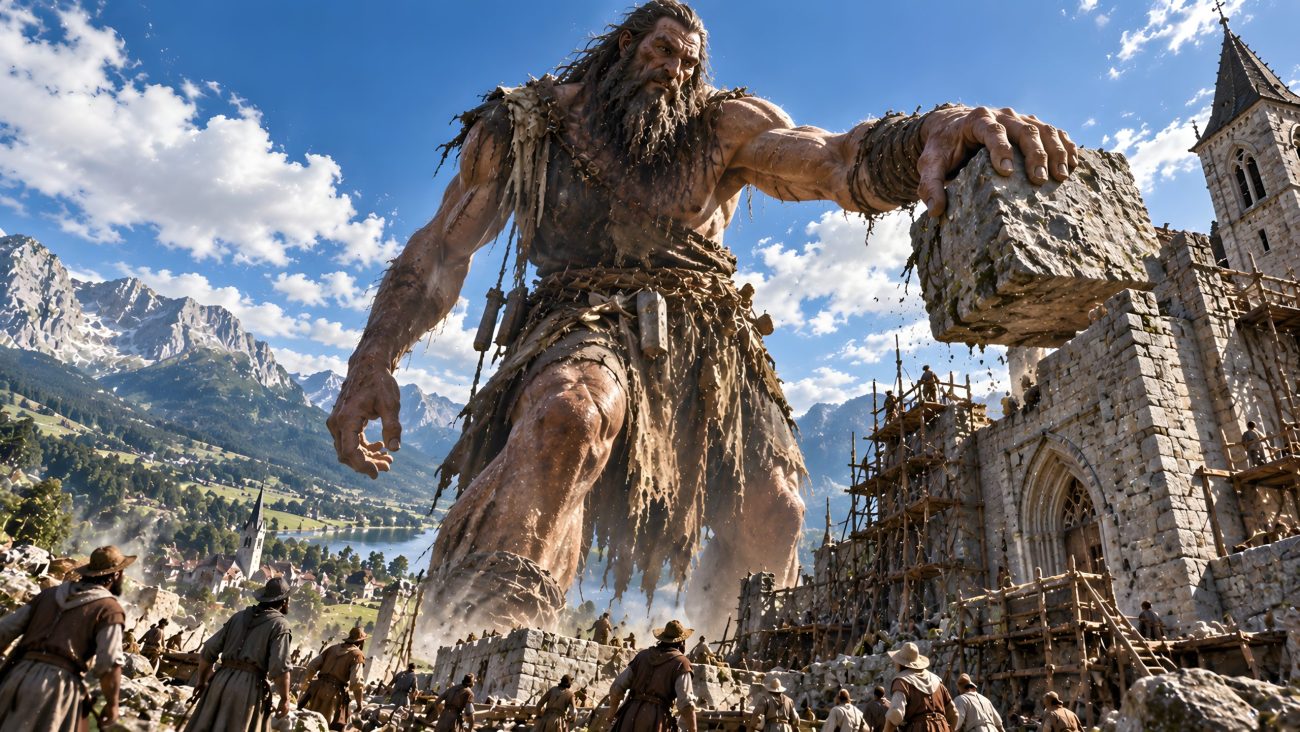
Giants were also credited with constructing important buildings and monuments throughout the region. Three giants supposedly helped build the church at Taufkirchen by throwing stones over great distances from the Rainbach stream to the construction site. Their heads were later associated with carved figures supporting the church’s vault, known as the Giants’ Heads. Giants from the Viechtau were said to have built the small church on Johannisberg near Traunkirchen, while a giantess helped construct the town tower of Enns by carrying a massive stone block in her apron. A rib attributed to the giantess reportedly hung from a chain in the tower for many years. Other legends credit giants with building Neuhaus Castle, Wolfsegg Castle, and Lichtenhag Castle. Enormous bones, handprints, knee impressions, and stones scattered along streams were interpreted as physical reminders of their work.

Some tales explain unusual geological formations through conflicts between giants and other supernatural beings. Near Natternbach, St. Ägidi, and Kopfing, a balancing stone known as the Wackelstein is also called the Maiden’s Stone. According to the legend, three pagan maidens carried it in their aprons to a wooded ridge to perform sacrifices. In the Katergebirge mountains, a giant once possessed a mighty hammer and lived near the Jochwand and the Ewige Wand, which were originally connected. After a dwarf living in Anzenau repeatedly mocked him, the giant hurled his hammer at the dwarf, shattering him and causing the ground beneath him to disappear into the depths. The two rock walls were separated, and the end of the Jochwand became known as Hammerberg.

Another legend from the Mühlviertel describes giants who attempted to build a castle where Freistadt now stands. They gathered stones from the Aist River, taking them from a wall that the devil was constructing to drown the inhabitants of Prägarten. The devil had intended to punish the inhabitants for stealing two of his souls, but the giants repeatedly disrupted his work by carrying away his building materials. In retaliation, the devil destroyed their castle and threw its enormous stone blocks into the Aist, where they supposedly remain. He later encountered one of the giants in the Thury Valley and transformed him into a boulder known as Devil’s Rock. Across these traditions, giants are powerful figures whose actions explain the origins of buildings, stones, mountains, and other striking features of the Upper Austrian landscape.


Sources

“Die Kraft der Riesen.” SAGEN.at – Österreichische Sagen aus Oberösterreich. Reproduced by SAGEN.at. https://www.sagen.at/texte/sagen/oesterreich/oberoesterreich/allgemein/kraft_riesen.html
Hunen

Tradition: Dutch Mythology
Alternative Names: Huinen, Hunnen, Hunewief (giant’s wife), Hunewiven (giant women)
Category: Giant


The Myth

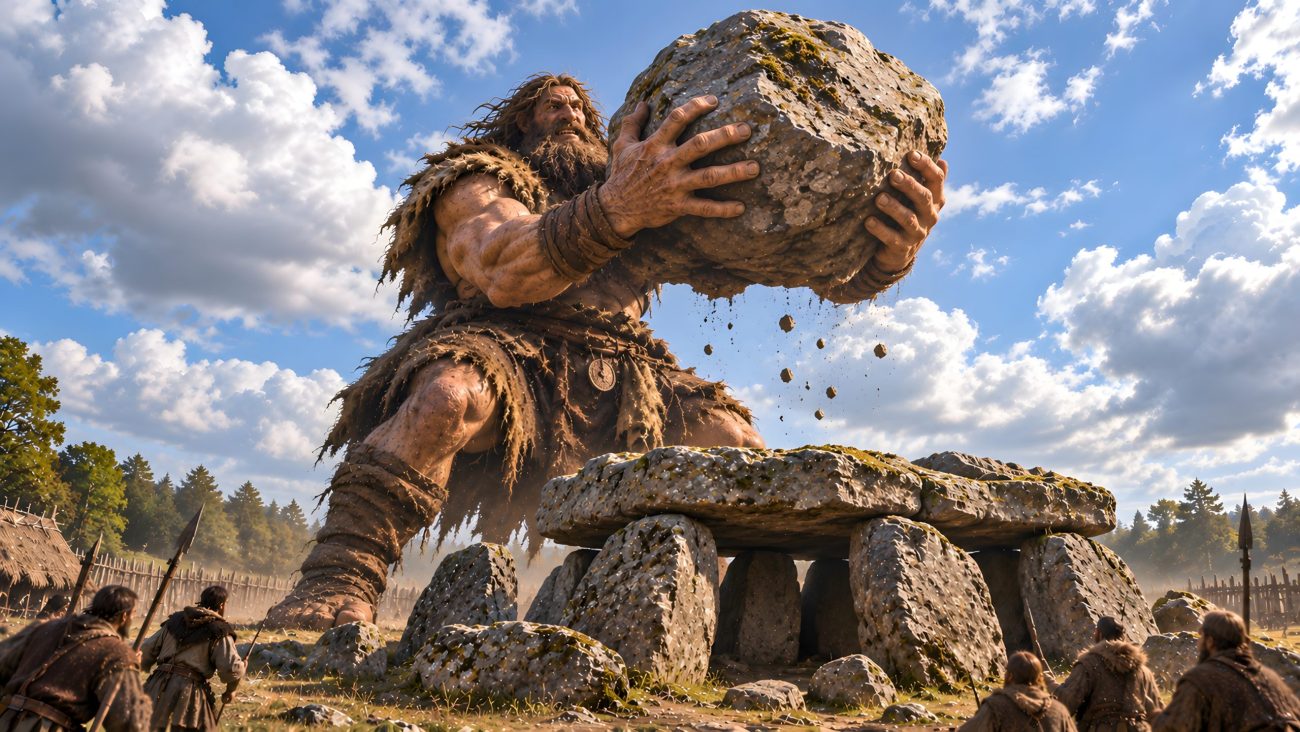
Hunen are giants from the folklore of Drenthe and Overijssel in the eastern Netherlands. They are credited with building the region’s ancient megalithic tombs, known as hunebedden, as well as huneborgen and huneschanzen. They were enormous, powerful men capable of extraordinary feats of strength, including pulling entire trees out of the ground. Their immense strength made them dangerous to ordinary people, even during seemingly harmless encounters.

People had to be careful when a hune offered to shake their hand, as the giant’s grip could crush a person’s hand. In one tale, a farmer anticipated this danger by offering the hune the wooden handle of a manure fork instead. The giant squeezed it so forcefully that he ground the handle into powder. The story illustrates the extraordinary strength of the hunen and the need for ordinary people to use their wits when dealing with them.

The female hunen, known as hunewiven or hunewiefs, were associated with witchcraft. They could use their powers to heal people, but they could also inflict illness through magic. Their frightening reputation extended into family life, particularly in stories about protecting children. A Twents lullaby warns a hunewief to stay away from a baby’s cradle, threatening to beat her if she approaches. The song reflects the fear that a hunewief might make a child sick or steal it away.

The hunen thus occupy an important place in regional Dutch folklore as both legendary builders and powerful supernatural beings. While the male giants were known chiefly for their immense physical strength, their female counterparts possessed magical abilities that could bring either healing or harm. Their association with the ancient megalithic monuments of Drenthe and Overijssel connects these beings to the mysterious origins of the region’s prehistoric landscape.


Sources

Van der Veen, Abe. “Van aardmannetje tot zwarte juffer: Een lijst van Nederlandse en Vlaamse elfen en geesten.” Abe de Verteller. https://abedeverteller.nl/van-aardmannetje-tot-zwarte-juffer-een-lijst-van-nederlandse-en-vlaamse-elfen-en-geesten/


Fachan

Tradition: Scottish Mythology
Alternative Names: Fachin, Fachen, Direach Ghlinn Eitidh, Dithreach, Dwarf of Glen Etive
Category: Giant


The Myth

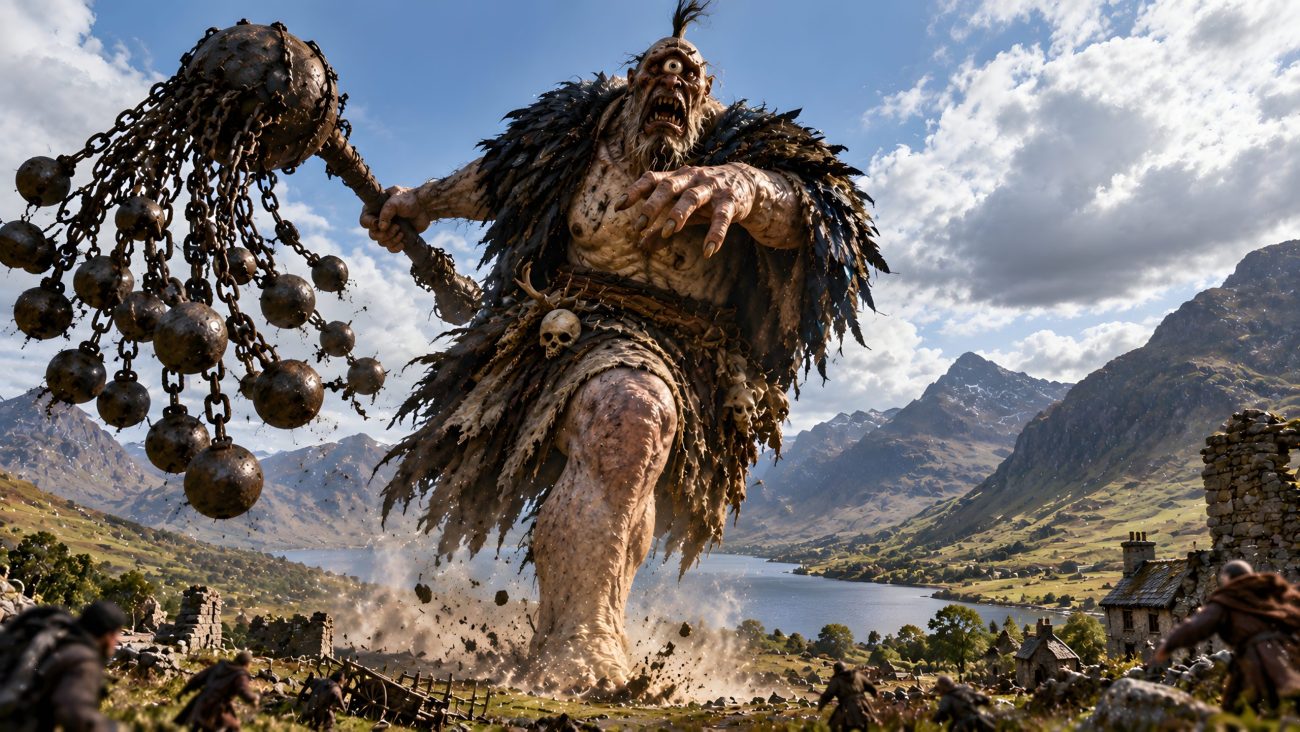
The Fachan is a terrifying monster or giant from Scottish Gaelic folklore, particularly associated with the Highlands. It possesses a grotesquely asymmetrical body, with a single eye in the middle of its face, one hand protruding from its chest instead of two arms, and one leg emerging from the center of its body. A single tuft of hair grows from the top of its head. According to folklorist John Francis Campbell, this tuft is so rigid that it would be easier to uproot an entire mountain than to bend it. The creature’s unusual anatomy makes it appear less like a human being and more like a monstrous being from another world.

The Fachan is also known by the names Direach Ghlinn Eitidh and Dithreach, translated as the dwarf of Glen Etive. Despite this association with a particular Scottish landscape, it is described as a giant-like monster rather than an ordinary dwarf. Its single leg does not necessarily make it slow or helpless: comparisons have been drawn with creatures from Arabic traditions, such as the nasnas and shiqq, which are described as half-human beings capable of hopping about on one leg with remarkable agility.

Similar creatures appear in Irish Gaelic literature. In his collection Beside the Fire, Douglas Hyde records a description of a monstrous being resembling Campbell’s Fachan. This creature has a black face with one eye in its forehead, one hairy hand emerging from its chest, and a single thick, veined leg. It carries an enormous iron flail-club from which hang twenty chains, each bearing fifty large apples enchanted with poisonous spells. Its body is wrapped in a girdle made from deer and roebuck skins and protected by a dark blue mantle of thick, twisted feathers. The description presents a being that resembles the devil more than a human.

Campbell and Hyde considered these descriptions part of a shared Gaelic tradition of monstrous beings. The name Fachan may be related to the Irish word fathach, meaning giant, and the Scottish Gaelic famhair, also meaning giant. The creature therefore belongs to a broader tradition of fearsome, physically extraordinary beings in Gaelic folklore, distinguished by its single eye, single hand, single leg, and remarkably rigid tuft of hair.


Sources

“Fachan.” Wikipedia: The Free Encyclopedia. Wikimedia Foundation. Accessed October 16, 2026. https://en.wikipedia.org/wiki/Fachan


Ujanko

Tradition: Navarrese Mythology, Spanish Mythology
Alternative Names: Uhanko, Ukhanko
Category: Giant


The Myth

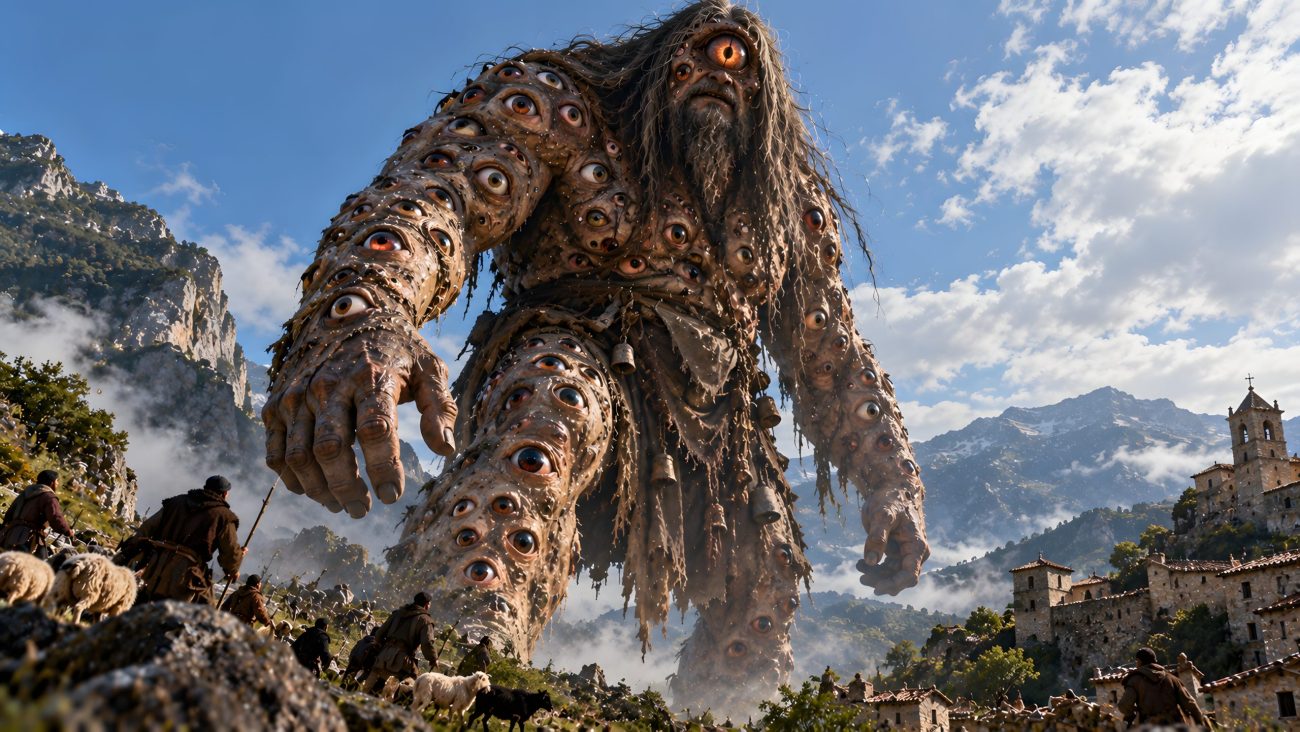
Ujanko is a strange supernatural creature from the folklore of Navarre, a region in northern Spain. It is described as an enormous, multi-eyed giant whose body is covered with numerous eyes. Each eye disappears on a particular day of the year and reappears on Christmas Eve, giving the creature an unusual connection to the passage of time and the Christmas season. In Basque-speaking communities of northeastern Spain, Ujanko is understood as the personification of a year, with its many eyes representing the days that make up the annual cycle.

According to the legend, Ujanko has a single enormous eye on its face, which is often hidden beneath a multitude of eyes covering its body. On a particular day, ten of these eyes disappear, transforming the creature’s appearance. Its many eyes are said to correspond to the days of the year, and the return of its eyes on Christmas Eve marks the completion of the cycle. This strange annual transformation connects Ujanko to seasonal change and the transition from one year to the next.

Ujanko belongs to a wider group of giant-like supernatural beings found in the folklore of the Iberian Peninsula. It has been compared to the Ombre de los Ojos, or Man of the Eyes, from Cabazuela del Valle in Extremadura, and the One-eyed Nasus from Catalonia. Its unusual anatomy also recalls Argus from ancient Greek mythology, the many-eyed giant whose numerous eyes made him an exceptional watcher. However, Ujanko’s distinctive association with the yearly calendar and Christmas Eve gives it a particular place in Navarrese folklore.


Sources

“Ukhanko.” New Bestiary (Bestiary.us). https://www.bestiary.us/ukhanko