Mizuchi

Tradition: Japanese mythology
Alternative Names: Mi-tsu-chi, Great Mizuchi, Water Dragon
Category: Dragon


The Myth

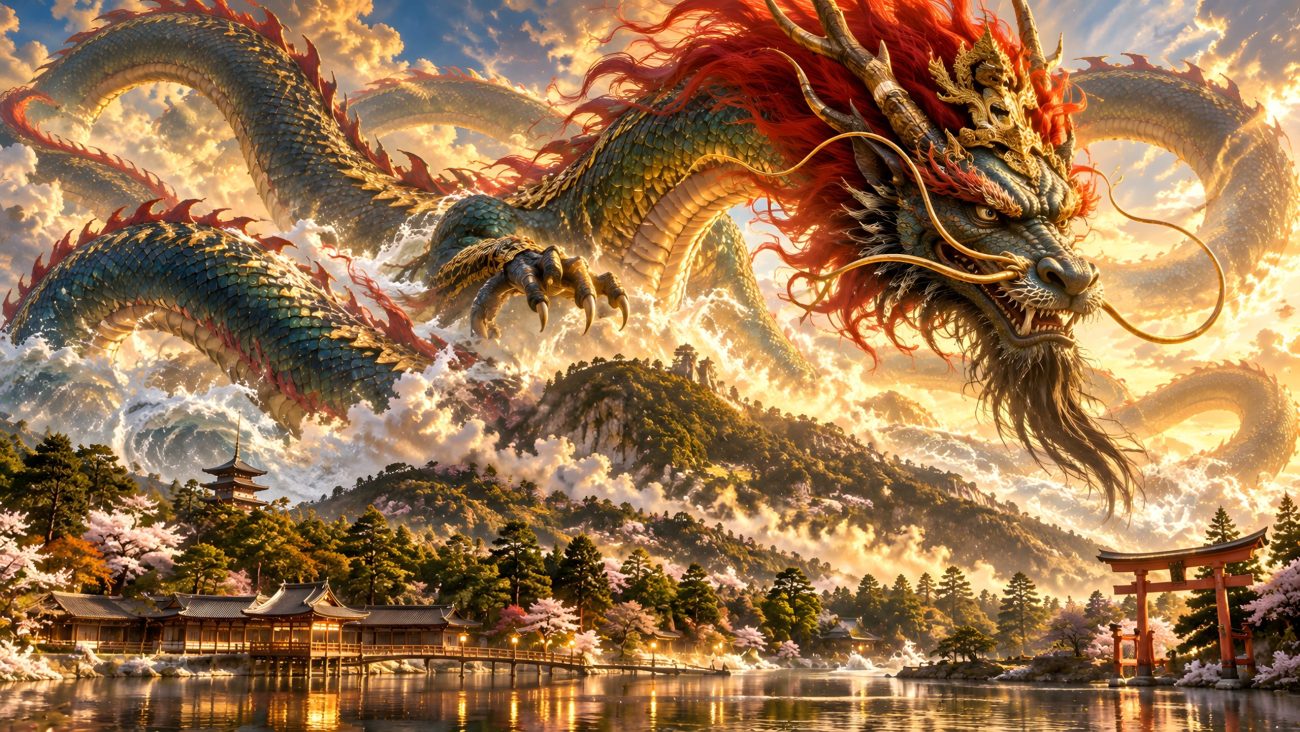
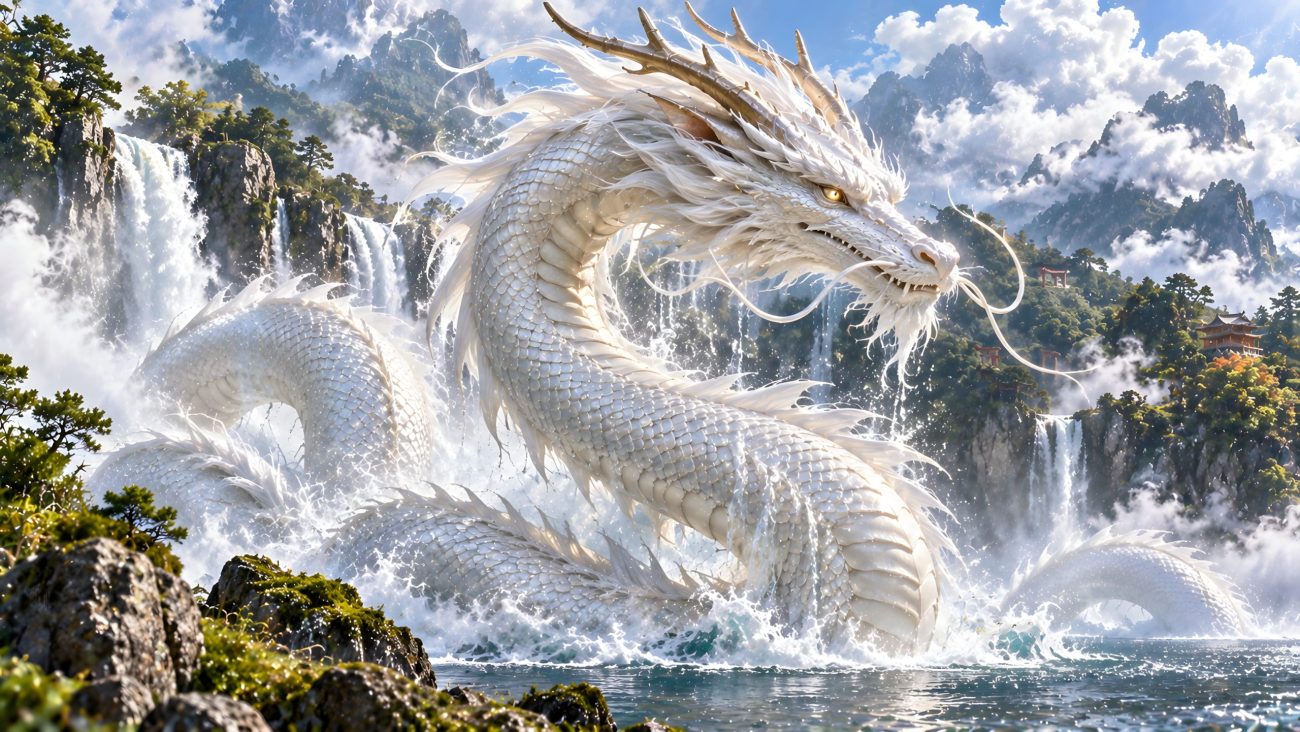
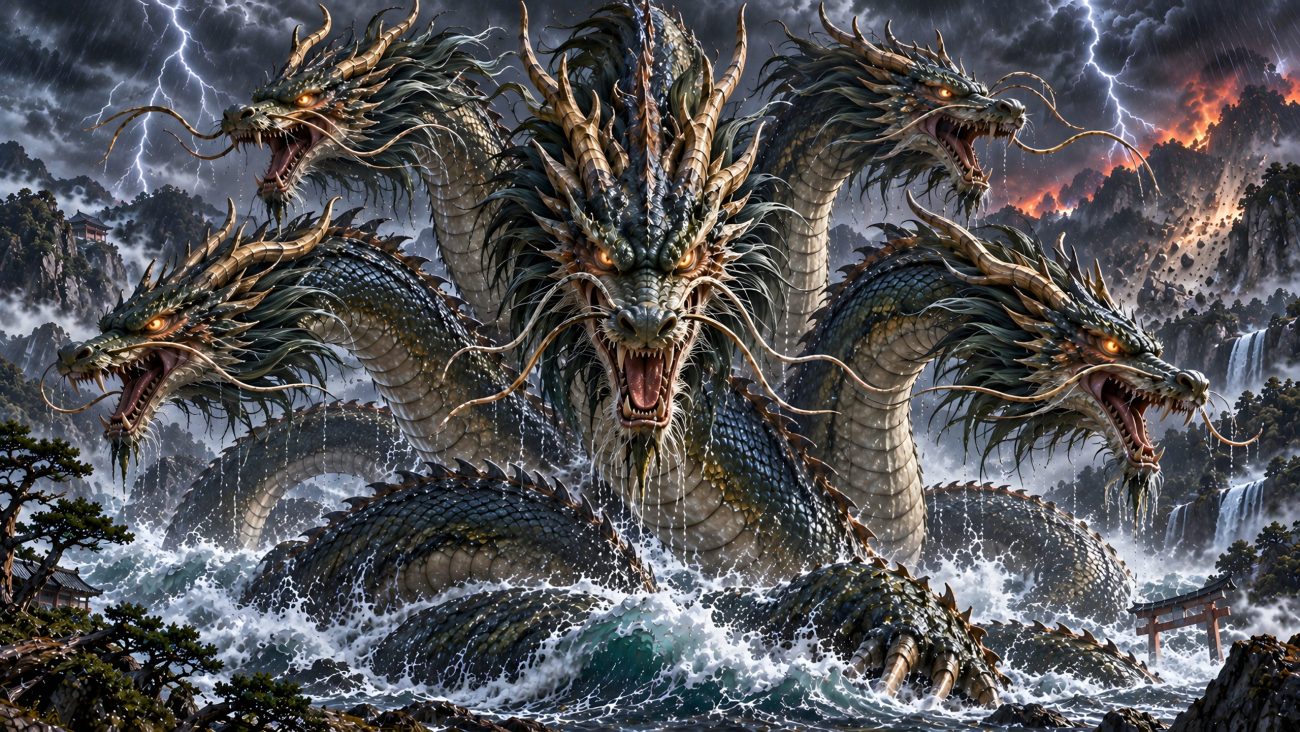
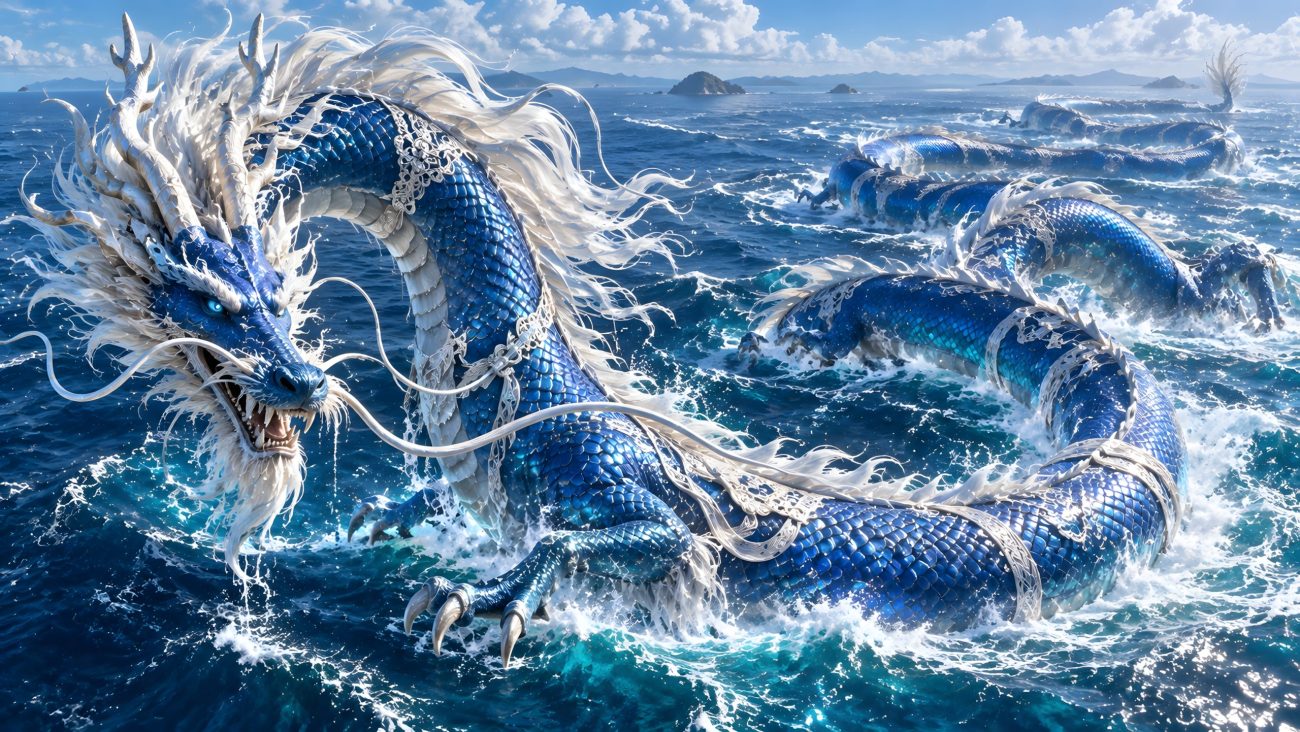
Mizuchi is a powerful water spirit appearing in the form of a great serpent or dragon, associated with rivers, pools, and dangerous waters. In ancient tradition, the creature was feared as a deadly being capable of poisoning those who came near its waters. The name itself was associated with water and spirit, and Mizuchi could be understood as a master or spirit of the water.

One of the oldest tales of the Mizuchi takes place in Kibi Province during the reign of Emperor Nintoku. At a fork in the Kawashima River lived a great water serpent that would breathe or spit venom, poisoning and killing people who passed by. The monster dwelt in a pool and had become a deadly menace to those who approached the river.

A man named Agatamori came to the pool determined to destroy the creature. Rather than simply attack it, he challenged the Mizuchi to prove its supernatural power. He threw three calabashes onto the surface of the water and declared that if the creature could make them sink, he would submit to it; if it failed, Agatamori would kill it.

The Mizuchi transformed itself into a deer and attempted to sink the floating gourds, but it could not. Agatamori then slew the monster. He searched the depths of the pool and discovered that the creature was not alone. A whole tribe of water dragons occupied a cavern beneath the water. Agatamori killed them all, and their blood turned the river red. The pool thereafter became known as Agatamori’s Pool.

Another ancient story tells of a River God whose waters repeatedly broke the great dikes along the Yodo River. An oracle commanded that two men be sacrificed to the river deity. One of them refused to accept his fate and used the same test of the floating calabash to challenge the supposed divine command. When a whirlwind came and tried to sink the gourd but failed, the man escaped his sacrifice through his own cleverness.

The River God in this story is associated by later interpreters with the Mizuchi, suggesting an ancient conception of water dragons not merely as monsters but as powerful spirits or gods of rivers who could demand offerings and even human sacrifice.

Mizuchi also appears in an ancient Japanese poem, where the speaker imagines possessing a sword powerful enough to ride into a green pool and slay the Mizuchi dwelling there. Thus the creature remained an embodiment of the dangerous and mysterious power believed to inhabit Japan’s waters.


Sources

“Mizuchi.” Wikipedia: The Free Encyclopedia. Wikimedia Foundation. Accessed October 2, 2026. https://en.wikipedia.org/wiki/Mizuchi
Kuzuryū

Tradition: Japanese mythology
Alternative Names: Nine-Headed Dragon, Kuzuryū Gongen, Kuzuryū Ōkami,
Category: Dragon


The Myth

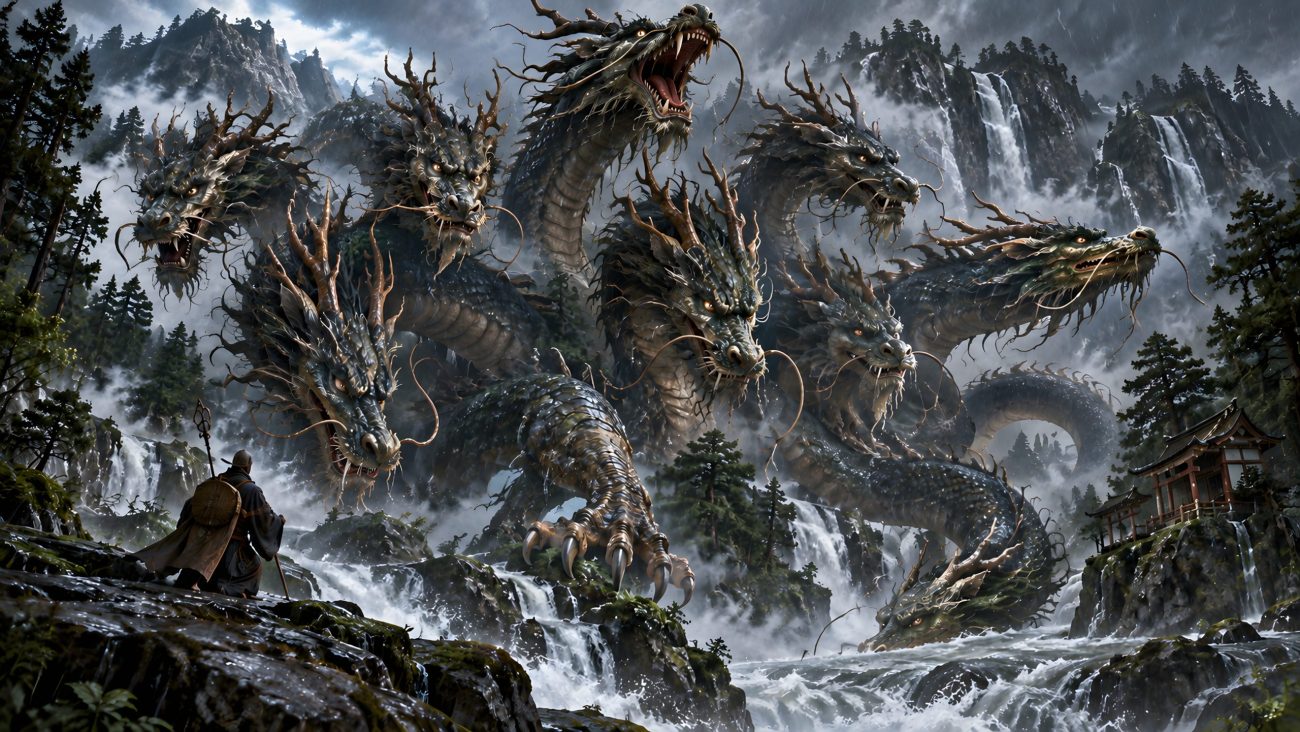
The Nine-Headed Dragon, or Kuzuryū, is a great dragon with nine heads and a single tail. It is especially associated with water, mountains, rain, and sacred places throughout Japan.

At Mount Togakushi in Shinshu, a great dragon with nine heads and one tail was said to dwell when a scholar-ascetic arrived there in search of a place where Buddhism could flourish. The dragon, also described as an oni, had become a harmful presence in the mountain. Through the power and merit of the Lotus Sutra, the ascetic overcame its harmful influence and caused the dragon to repent.

Kuzuryū then vowed to protect Mount Togakushi and urged the ascetic to establish a great temple there. Afterward, the dragon concealed itself by sealing the treasure cave with a huge rock. The cave was the place where the vajra thrown from Mount Iizuna had landed. This act was said to give Mount Togakushi its name, while the ascetic established Kenkōji Temple, later associated with Togakushi Shrine, where Kuzuryū Gongen was enshrined.

Kuzuryū became especially revered as a water god. People prayed to it for rain, and a particular ritual involved taking water from Taneike Pond to Togakushi Shrine and having prayers for rain performed over it. The water was then carried back without allowing it to touch the ground and sprinkled over the rice fields, after which rain was expected to fall.

Kuzuryū was also believed to have a fondness for pears. Offerings of pears were traditionally made to the dragon to relieve toothaches. People suffering from tooth pain could write their names and the location of the pain on pears, pray toward Mount Togakushi from a distance, and then set the pears afloat in a river.

Another legend connects the Nine-Headed Dragon directly with the creation of Mount Togakushi. When Amaterasu Ōmikami hid inside the Heavenly Rock Cave, Tajikarao no Mikoto attempted to open it. He pulled with such force that the rock was thrown down into the lower world, where it became Mount Togakushi. The Nine-Headed Dragon God appeared in response to the sound of the falling rock, and the Kuzuryū of Togakushi was regarded as a temporary manifestation of this Dragon God.

Nine-headed dragons appear in other Japanese legends as well. At Lake Ashi in Hakone, a poisonous dragon once rampaged through the waters until the monk Manmaki subdued it, after which the dragon became a god and was enshrined as Kuzuryū Daimyōjin. In Fukui, a nine-headed dragon is said to have swum along the Kuzuryū River as though carrying the floating statue of Hakusan Gongen. On Mount Onikiri in Chiba, another nine-headed dragon was defeated by Yamato Takeru and subsequently enshrined at Jinnoji Temple.

In Tadami, Fukushima, the name of the Kuguryū district is connected to another legend in which a nine-headed dragon rose from a swamp and ascended into heaven. Across these traditions, the Nine-Headed Dragon appears as a powerful supernatural being of water and mountains, sometimes dangerous and destructive, but capable of repentance and becoming a divine protector.


Sources

Takahashi, Toshihiro. “九頭竜 [くずりゅう] (Kuzuryū).” 新版TYZ 妖怪図鑑 (New TYZ Yokai Encyclopedia). October 21, 2024. https://tyz-yokai.blog.jp/archives/1082950617.html


Kurikara Ryūō

Tradition: Japanese mythology
Alternative Names: Kurikara Ryūō, Kurikara Dairyu, Kurikara Dragon King, Kurikara Fudō Myōō, Kurikara Myōō, Karaka
Category: Dragon


The Myth

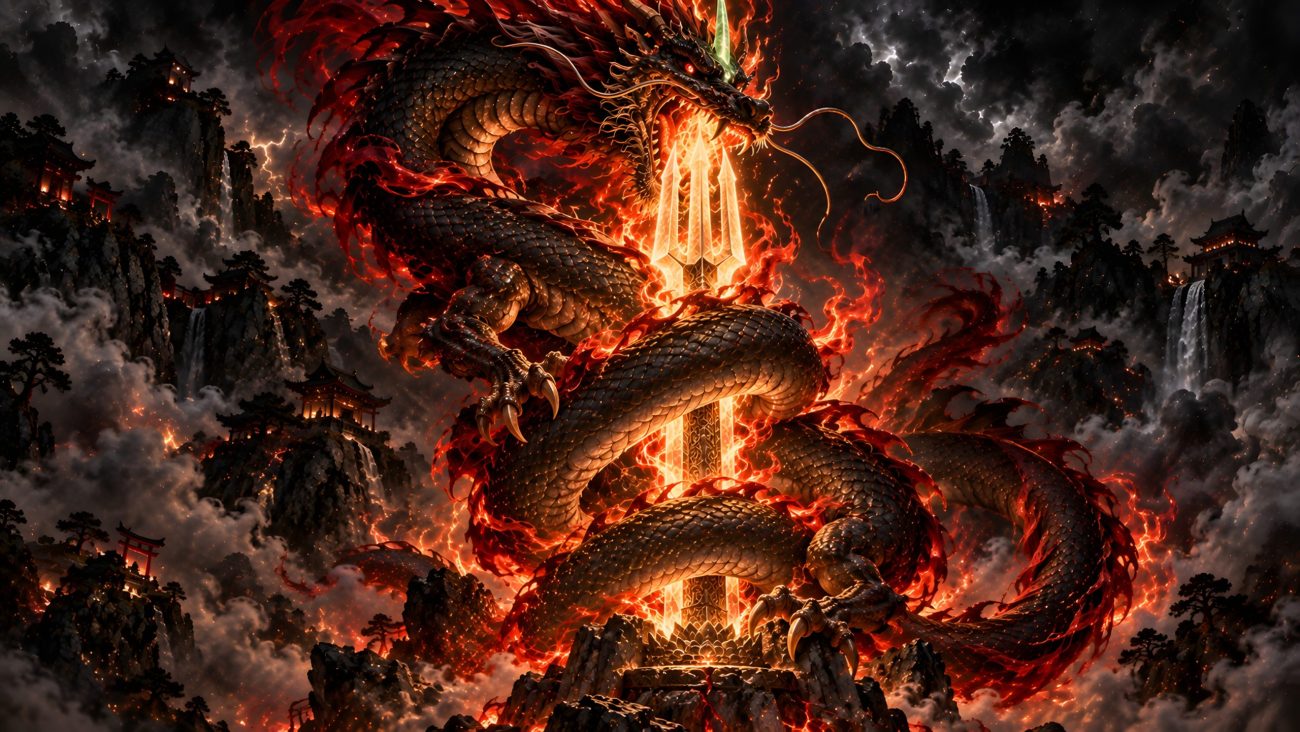
Kurikara Ryūō appears as a gigantic black dragon wrapped in flames, coiling around an upright sacred sword, usually a three-pronged sword, and attempting to swallow it from the tip. In other depictions his body is golden, with a jade horn growing from his forehead, while flames of samadhi surround his coiling body. His four legs are associated with four other Myōō: Gosanze Myōō, Gundari Myōō, Enmaten Myōō, and Kongōyasha Myōō.

Kurikara Ryūō is regarded as a manifestation of Fudō Myōō. His most famous legend tells of Fudō Myōō’s battle against heretics in Maheshura’s City, in the highest realm of the Form Realm. Fudō transformed himself into a sword of wisdom fire, while Chitatsu, leader of ninety-five kinds of heretics, likewise transformed into a sword of wisdom fire.

Fudō’s sword of wisdom fire then transformed into the enormous Kurikara Dragon. The dragon coiled itself around the heretics’ swords and attempted to swallow them. When it opened its mouth and breathed, the sound was so tremendous that it was compared to twenty billion thunderclaps roaring at once. The heretics heard the terrifying sound and abandoned their evil attachments.

The Kurikara Great Dragon was said to be 100,000 yojanas tall. His sacred dharani possessed immense magical power: those who recited it were believed to be able to remove misfortune and subdue demons. Praying to Kurikara Ryūō or chanting his name was likewise believed to dispel fear and evil obstacles and secure a peaceful afterlife.

Kurikara Ryūō was also believed to possess the power to drive away illness and disease and to summon clouds and control rainfall. His image was therefore used in prayers for protection from sickness and for rain.

Another legend tells of a demon king who once lived in the place that later became Kurikara Village and tormented its people. The monk Zenmui enshrined Kurikara Fudō there, and the deity subdued the demon king. The village and the mountain pass subsequently came to be known as Kurikara.

The legend further tells that Kurikara Fudō appeared from Kurikara Fudō Pond, where many miraculous events were said to have occurred. The deity thus became both the dragon coiled around the sword of wisdom and the divine protector who subdued demons, overcame evil, drove away disease, and brought protection to those who called upon him.


Sources

Takahashi, Toshihiro. “俱利伽羅龍王 [くりからりゅうおう] (Kurikara Ryūō).” 新版TYZ 妖怪図鑑 (New TYZ Yokai Encyclopedia). February 1, 2024. https://tyz-yokai.blog.jp/archives/1083042301.html


Lagar

Tradition: Japanese mythology
Alternative Names: Lagaru, Lagarto, Lakarta
Category: Dragon, Crocodile


The Myth

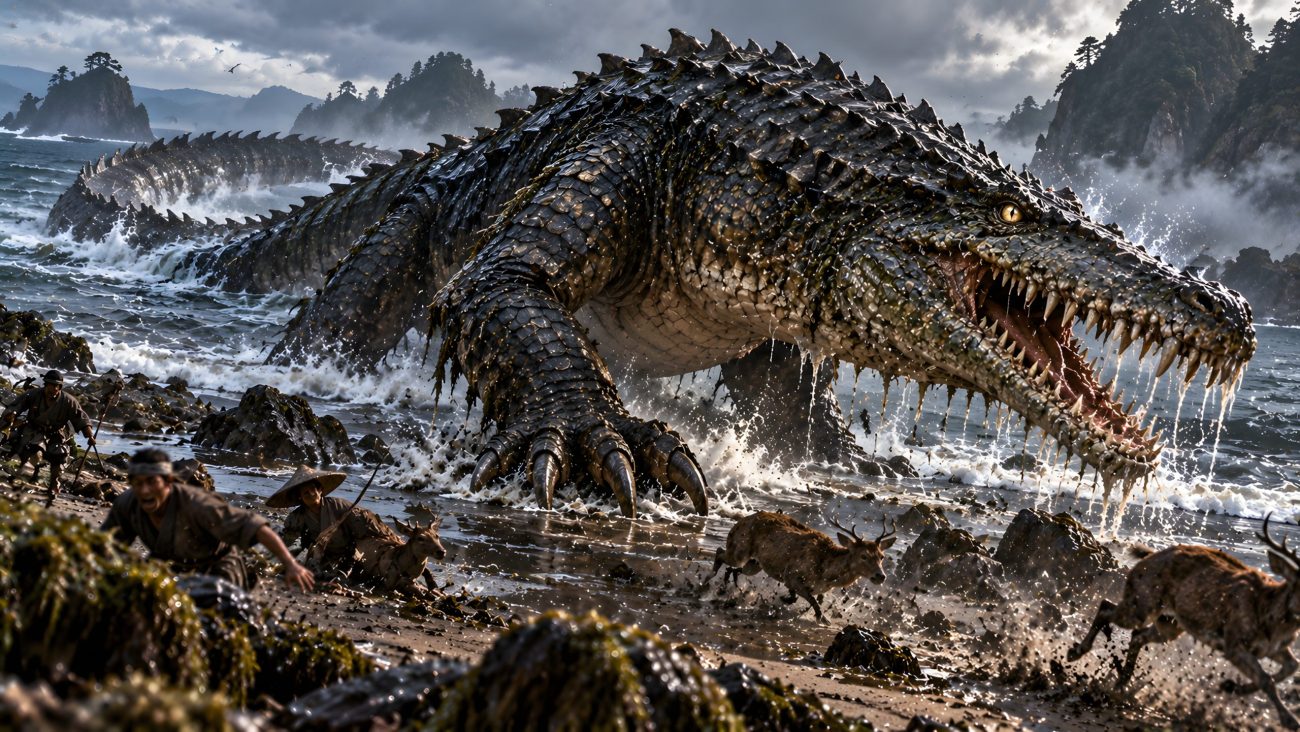
Lagar was a gigantic reptilian sea monster, described as having a crocodile-like body, four legs, a long slender tail, and a body completely covered in extraordinarily hard scales. Its claws were sharp and its teeth were like saws. The scales were said to be so hard that spears, swords, arrows, and even poisoned arrows could not penetrate them. Its belly, however, contained a soft and vulnerable spot.

Lagar could reach around twenty feet in length. It lived in the sea, where it hunted fish, but when it came ashore it attacked and devoured animals and people. Despite its terrifying strength, it was slow-moving, allowing fish to escape it and people to attempt to flee. It did not eat small fish, instead swimming behind them so that they would not become prey to other creatures.

The monster was said to lay eggs, each roughly the size of a goose egg. When Lagar came ashore, it spat saliva onto the ground. Anyone who stepped in the saliva could slip and fall, leaving them helpless before the beast, which would immediately attack and devour them. It was also said to pursue anyone who tried to flee from it, although the strange creature would itself run away if a person chased after it.

Lagar had several natural enemies. One kind of fish was said to attack the soft underside of its body and stab it to death. A smaller creature could cover itself in mud, leap directly into Lagar’s mouth, and devour its internal organs from within. The monster was also unable to approach places where a plant called Zatsuburaran had been planted.

A terrifying tale from the seas of Ezo tells of another creature believed to be the same monster. This beast was around ten feet long, with sharp claws, saw-like teeth, a crocodile-like body, and scales resembling those of a shark. Even poisoned arrows could not pierce its body. It was powerful enough to kill and devour enormous fish and would sometimes come ashore to eat animals.

Because the creature moved slowly, people attempted to capture it, though many were killed in the process. Eventually they discovered the vulnerable spot beneath its belly. By firing poisoned arrows into this soft place, they managed to kill three of the monsters. After those three were slain, no similar creature was said to appear again.

There was an even more frightening account of Lagar. It was said to imitate the sound of a human crying, luring people toward it from a distance. Once they came close, it would bite and devour them. Its saliva could make people slip and fall, while its eyes, dull and lifeless beneath the water, were said to shine brightly when it came ashore.

Lagar was also said to stop eating entirely during winter and, strangely, to possess no tongue inside its mouth.


Sources

Takahashi, Toshihiro. “ラガル (Lagar).” 新版TYZ 妖怪図鑑 (New TYZ Yokai Encyclopedia). April 14, 2018. https://tyz-yokai.blog.jp/archives/1070581868.html


Kirishitan Ryū

Tradition: Japanese mythology
Alternative Names: Kirishitan Ryū, Christian Dragon
Category: Dragon


The Myth

The Kirishitan Ryū are two great dragons said to have lived inside enormous holes on Ikeshima, a small island between Nagaurajima and Maeshima in the Amakusa Islands. One was male and the other female, and each eventually became the master of one of the ancient holes on the island.

Their appearance in the world was connected to the Shimabara–Amakusa Rebellion of 1637–1638. As the rebellion reached its bloody end, the forces of the shogunate surrounded Hara Castle, where the Christian rebels had taken refuge. After fighting desperately with whatever weapons they could find, the rebels eventually ran out of ammunition and food. Their last hope was simply to kill as many of their enemies as possible before they themselves were destroyed.

Their sixteen-year-old commander, Amakusa Shirō, was said to possess miraculous powers. He could supposedly walk across the sea from Shimabara to Yushima and perform other supernatural feats, including breathing flames from his mouth.

Late on the night of February 27, after the main keep of Hara Castle had burned, Shirō remained inside one of the inner houses. He took out a dragon jewel and raised it toward heaven, praying, “Ah, God, bestow your blessing upon us.” He then threw the jewel toward the shogunate’s warships anchored offshore.

Suddenly the sky darkened. Black clouds descended over the sea, and from them appeared two enormous dragons. A tremendous storm erupted. Two pillars of water rose from the sea all the way into the black clouds, and the warships were caught up in a gigantic waterspout. The ships were hurled into the air, overturned, and sank beneath the waves.

But the miracle could not save the rebels. At the same time, the house where Shirō had been hiding caught fire, its flames illuminating the sky.

By noon the following day, the shogunate army had finally annihilated the remaining rebels. The two dragons, riding within the black clouds, had witnessed the fall of Hara Castle. They then plunged into the sea and swam rapidly eastward. They too were grievously wounded, and their blood turned the seawater red.

Eventually the dragons reached Ikeshima. They crawled up onto the island and searched among its hills until they discovered two enormous holes that had existed there since ancient times. Each dragon entered one of the holes and disappeared from sight. From then on, the two became the guardians of the caves: the one entered by the male dragon became known as the Male Dragon Hole, while the other became the Female Dragon Hole.

Amakusa Shirō was said to have died at Hara Castle, but another tradition preserves a darker mystery: the two dragons themselves were said to be manifestations of Shirō.

After the dragons made their homes on Ikeshima, they became guardians of the island and providers of rain. Whenever drought struck Amakusa, people gathered at Ikeshima to pray for rain. Black clouds would then descend from the heavens, and rain was said to follow.


Sources

Takahashi, Toshihiro. “キリシタン竜 [きりしたんりゅう] (Kirishitan Ryū).” 新版TYZ 妖怪図鑑 (New TYZ Yokai Encyclopedia). December 22, 2014. https://tyz-yokai.blog.jp/archives/1016421998.html


Kasuga Ryūjin

Tradition: Japanese mythology
Alternative Names: Kasuga Ryūjin, Kasuga Dragon God, Ryūjin
Category:Dragon


The Myth

Kasuga Ryūjin appears as a magnificent dragon god associated with Kasuga Grand Shrine and the divine manifestations of the Kasuga deities. In the Noh play Kasuga Ryūjin, the Dragon God ultimately appears with the Eight Great Dragon Kings, accompanied by dragon women and countless supernatural beings. He is portrayed with a red wig, black beard mask, and a dragon-shaped crown.

The story begins with Myōe Hōshi, a Kegon Buddhist monk who had built a hermitage at Toganoo in Yamashiro Province. Myōe had long wished to travel to Tang China and then continue to India to visit the sacred places where Śākyamuni Buddha had lived and preached. Before beginning his journey, he went to Kasuga Grand Shrine to say farewell.

At the shrine, Myōe met an old man who served as its caretaker. The old man warned him not to leave Japan. He told Myōe that the deity of Kasuga cherished him like a son and that journeying to China and India would go against the deity’s wishes. Myōe replied that his purpose was to visit the places where the Buddha had taught, and therefore his journey could not truly be contrary to the divine will.

The old man continued to persuade him. There was no need, he said, to travel all the way to India when Japan itself contained sacred mountains that could serve as their equivalents. Mount Kasuga could be compared to Mount Tiantai, while Mount Jinpō could be compared to Mount Wutai. Myōe gradually began to understand the encounter as a divine oracle and abandoned his plan to travel abroad.

The old man then revealed the divine promise behind his words. If Myōe remained in Japan, he would show him the sacred scenes he wished to see by projecting the land of India onto Mount Mikasa. He would witness everything from the birth of Śākyamuni Buddha to his enlightenment, his preaching on Vulture Peak, and his death beneath the twin sal trees.

The old man introduced himself as Tokifū Hideyuki and suddenly vanished.

Then the mountains were flooded with light. The fields and peaks of Kasuga became a golden world, while grasses and trees transformed into the forms of Buddhas. The earth trembled, and the Eight Great Dragon Kings appeared: Nanda, Upananda, Sāgara, Vāsuki, Takṣaka, Anavatapta, together with the other great dragon kings. They were surrounded by hundreds of thousands of followers.

Other supernatural beings appeared as well, including the Kinnara King, Gandharva King, and Ashura King, each accompanied by countless followers. Dragon women danced among the waves of the ocean while the Eight Great Dragon Kings rose above the clouds of Mount Mikasa.

The Dragon Kings called upon the guardians of the flying fires and caused the entire life of Śākyamuni Buddha to appear in the heavens before Myōe: his birth, enlightenment, preaching, and finally his death beneath the twin sal trees.

The Dragon King then asked Myōe whether he still intended to travel to Tang China and onward to India. Myōe replied that he no longer wished to make the journey. The Dragon King told him that however far he might travel or whatever wonders he might seek, he would find no greater spectacle than the one before him.

The Dragon Woman then flew southward. The Dragon Gods stirred the waters of Sarusawa Pond into enormous waves and transformed themselves into a gigantic serpent a thousand fathoms long. Its immense body stretched across the heavens and the earth before the divine apparition finally vanished.

The older tale preserved in the Kokin Chomonshū tells the same basic story of Myōe abandoning his journey after receiving a divine oracle from Kasuga Myōjin. There, however, the miraculous signs take a different form: sixty deer bow before Myōe, while Kasuga Myōjin possesses Myōe’s aunt to communicate the divine will. The Tokifū Hideyuki figure, the Dragon Gods, and the heavenly recreation of Buddha’s life belong specifically to the later Noh version.


Sources

Takahashi, Toshihiro. “春日龍神 [かすがりゅうじん] (Kasuga Ryūjin).” 新版TYZ 妖怪図鑑 (New TYZ Yokai Encyclopedia). October 21, 2024. https://tyz-yokai.blog.jp/archives/1083036726.html


Hyōno-sen-shinryū

Tradition: Japanese mythology
Alternative Names: Hyōno-sen-shinryū, Divine Dragon of Mount Hyōno
Category: Dragon


The Myth

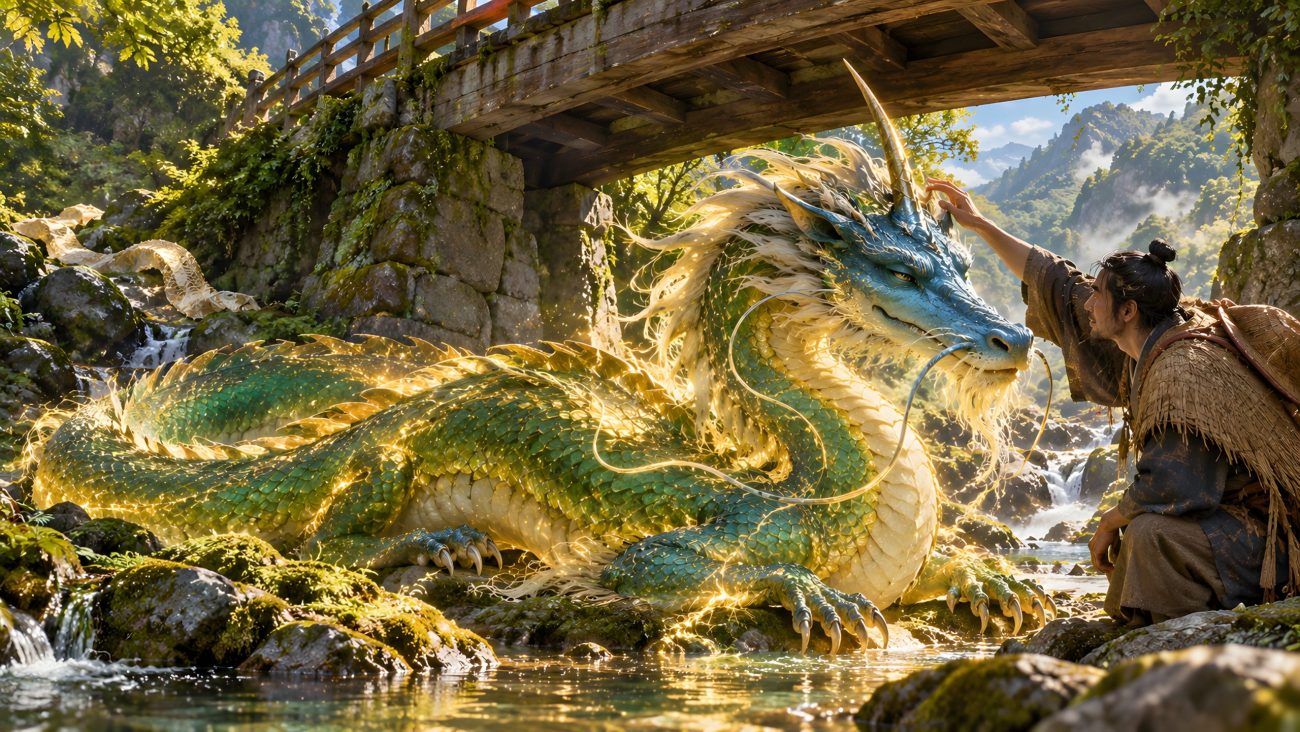
The Hyōno-sen-shinryū was a magnificent dragon said to dwell on Mount Hyōno, a sacred mountain whose territory stretched across Tajima, Harima, Mimasaka, and Inaba. It appeared as a creature about seven feet long, resembling a beautiful blue dragon from a painting. It had a single horn and four limbs, while its body was the color of leaves and seemed to shine with a golden light.

One day, a woman and child from Unawa Village went into a valley of the mountain with baskets on their backs. Beneath a bridge they encountered the strange creature and were so terrified that they immediately fled back to the village.

The villagers were experienced hunters and, upon hearing what the pair had seen, armed themselves and returned to the bridge. The creature showed neither fear nor hostility as the crowd approached. Once they examined it more closely, they realized that it was no ordinary monster but a beautiful dragon of extraordinary appearance.

One of the villagers approached the dragon and stroked its single horn. Rather than becoming angry, the creature appeared to enjoy the touch, remaining calm in the presence of the people.

Not long afterward, a golden-white hide measuring roughly eight fathoms was discovered abandoned in a valley farther into the mountains. The villagers believed that it belonged to the mysterious dragon beneath the bridge.

The creature was not regarded as an evil dragon or a venomous serpent. Instead, its appearance was taken as an auspicious sign, a divine creature that revealed itself in a peaceful and prosperous age.


Sources

Takahashi, Toshihiro. “氷野千神竜 [ひょうのせんしんりゅう] (Hyōno-sen-shinryū).” 新版TYZ 妖怪図鑑 (New TYZ Yokai Encyclopedia). September 25, 2016. https://tyz-yokai.blog.jp/archives/1061729315.html


Konryū

Tradition: Japanese mythology
Alternative Names: Konryū, Long-Nosed Kulve Taro, Konryū Under the Nose
Category: Dragon


The Myth

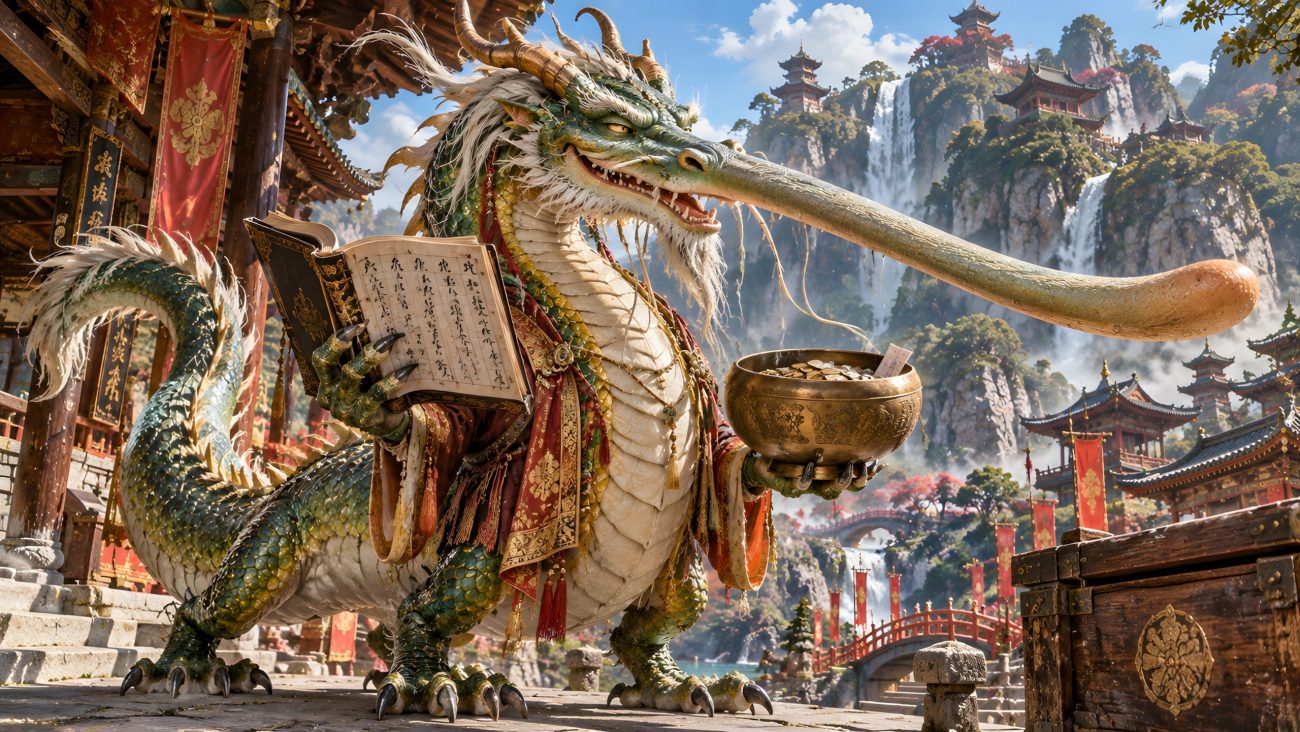
The Konryū is a long-nosed dragon depicted holding a donation ledger in one hand and a begging bowl in the other. It appears among the strange creatures of Fujyūkoku, the first fictional foreign country visited by Uritarō in Ikoku Manyū Uritarō Monogatari, a satirical journey through imaginary lands.

Fujyūkoku, also called Machigai-koku or the Unfree Country, is described as an isolated island more than 2,300 ri south of the equator. Though its civilization resembles that of contemporary Japan, it is filled with arrogant people who behave as though they own everything, timid commoners, and a society where lies, mistakes, and immorality are widespread.

Among the country’s strange inhabitants is the Konryū, known as the “Long-Nosed Kulve Taro” or the “Konryū under the nose.” Its peculiar appearance is a joke aimed at religious institutions. Temples and shrines solicit donations from people, recording the names of donors in their ledgers and receiving offerings in their begging bowls, supposedly for religious purposes but, as the satire suggests, ultimately to support the livelihoods of monks and priests themselves.

The dragon’s long nose and its association with begging and donation records turn this practice into a grotesque creature. The Konryū is therefore one of the many bizarre inhabitants of Fujyūkoku whose very appearance exposes some aspect of human behavior that the story’s satire seeks to ridicule.


Sources

Takahashi, Toshihiro. “鼻下昇竜 [はなのしたこんりゅう] (Hananoshita Konryū).” 新版TYZ 妖怪図鑑 (New TYZ Yokai Encyclopedia). October 21, 2024. https://tyz-yokai.blog.jp/archives/1082997793.html


Hakuryū

Tradition: Japanese mythology, Chinese Mythology
Alternative Names: Hakuryū, White Dragon
Category: Dragon


The Myth

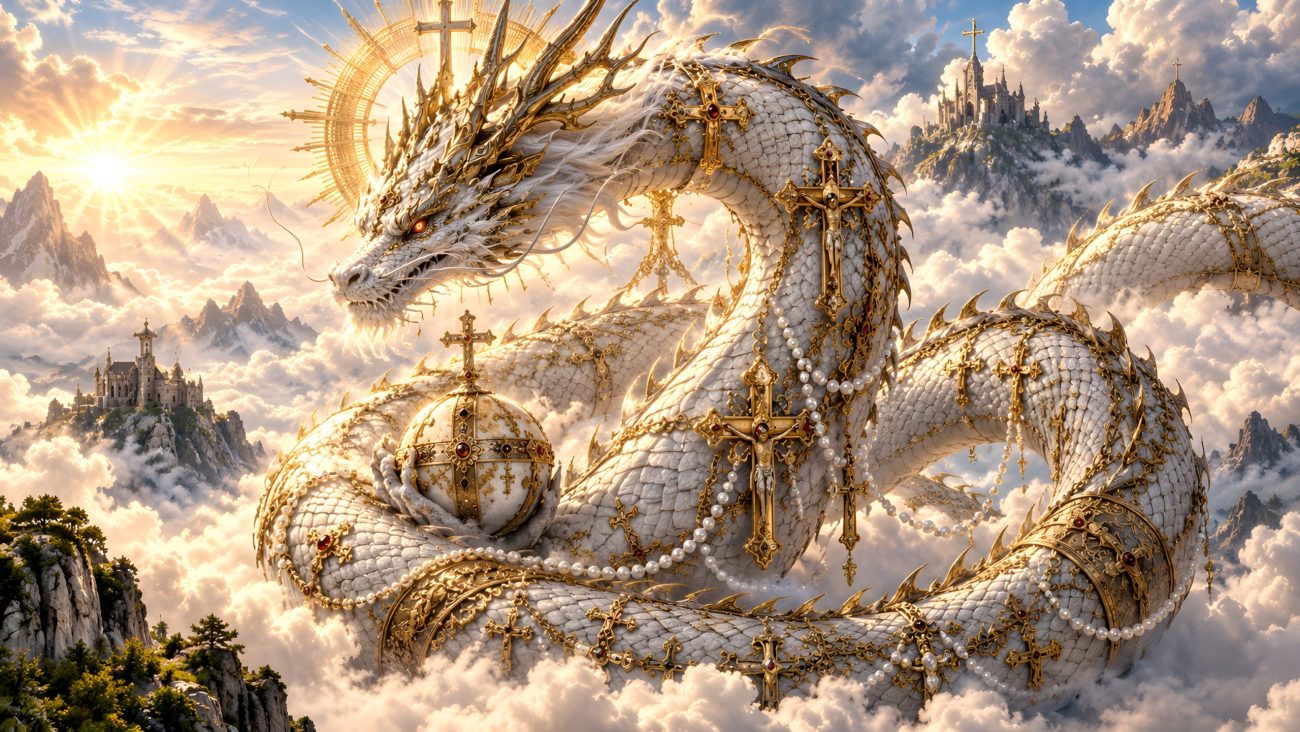
The Hakuryū is a white-bodied dragon, its pale form marking it as an auspicious and noble being. White dragons appear in legends, folktales, and the origin stories of temples and shrines, where they are often regarded as masters or gods of mountains, rivers, and lakes. In traditional dictionary definitions, the white dragon is described as a messenger of the Emperor of Heaven.

One of the oldest stories associated with the Hakuryū tells of a white dragon that descended to the Qingleng Abyss. There, it transformed itself into a fish and swam through the waters. A fisherman named Yu Qie encountered the fish and shot it in the eye.

The wounded dragon fled back to heaven and complained to the Emperor of Heaven about what had happened. But the Emperor rebuked it. Since the dragon had deliberately taken the form of a fish, he argued, it had placed itself among creatures naturally hunted by human beings. If Yu Qie had merely shot a fish, what crime had he committed?

The story was later used by Wu Zixu to warn the King of Wu. He explained that the white dragon was a noble creature of the Emperor of Heaven, while Yu Qie was merely a low-ranking official of the state of Song. Yet by disguising itself as a fish, the dragon had allowed itself to be treated like an ordinary creature. Likewise, if a ruler abandoned the dignity of his position and mingled with common people as though he were one of them, he could expose himself to dangers that would otherwise never reach him. The King of Wu was persuaded by the warning and changed his mind.

From this tale came the expression “white dragon in fish clothes,” describing a person of high status who disguises themselves in humble clothing, as well as the misfortunes that can result from such a disguise.

The Hakuryū could also appear as a terrifying force of nature. In 819, during the tenth year of the Kōnin era, a white dragon was said to have appeared in Kyoto amid a violent storm that damaged houses. White dragons were consequently associated not only with celestial power but with the destructive forces of wind and water.

The name Hakuryū could even be applied to the natural world: white, foaming streams and waterfalls were sometimes described as white dragons rushing through the landscape.


Sources

Takahashi, Toshihiro. “白竜 [はくりゅう] (Hakuryū).” 新版TYZ 妖怪図鑑 (New TYZ Yokai Encyclopedia). October 21, 2024. https://tyz-yokai.blog.jp/archives/1082944130.html


Gozuryū

Tradition: Japanese mythology
Alternative Names: Five-Headed Dragon, Dragon King, Dragon Demon, Poison Dragon
Category: Dragon


The Myth

The Gozuryū was a fearsome dragon with five heads upon a single body, always surrounded by black clouds. It lived in a lake called Fukasawa between Kamakura and Kurage and ruled over the Thunder God, Wind God, Mountain God, and other demons. For roughly seven hundred years, from the age of Emperor Jimmu to the reign of Emperor Suinin, it brought disasters upon the land, causing floods and landslides, killing living creatures, and laying waste to the countryside.

During the reign of Emperor Keikō, the dragon’s cruelty became even worse. It began raining fire upon the land and killing people, forcing terrified inhabitants to hide in caves. Its influence reached even the imperial court: during the reign of Emperor Ankō it manipulated Minister En, while under Emperor Buretsu it manipulated Minister Kanamura, using them to spread evil and bring disorder to the world.

The dragon eventually emerged from the Tsumura sluice gate south of Fukasawa and began devouring human children. The place became known as Hatsukuizawa, “the Valley of First Eating.” A wealthy man living nearby suffered an especially terrible fate: all sixteen of his children were devoured by the dragon. Overcome with grief, he abandoned his home, and the site became known as Chōjazuka, “the Wealthy Man’s Mound.” Other families likewise lost their children and fled, giving another place the name Koshigoe, “Child-Death Crossing.” The dragon’s tyranny spread across eight neighboring provinces, where people were forced to offer their children as sacrifices.

Then, during the reign of Emperor Kinmei, a celestial maiden descended from heaven accompanied by a child. Celestial beings and dragon gods cast stones down from the clouds, stirring up sand from the seabed and raising a new island from the sea. This became Enoshima.

The maiden who descended upon the newborn island was Benzaiten, daughter of the Dragon King of Anavatapta. The five-headed dragon became captivated by her and crossed the water to declare his love. Benzaiten rejected him, telling him that he was unlike the dragon who should be worthy of her: both in heart and in form, he remained a creature who had repeatedly killed living beings.

The dragon was humbled by her words. He vowed to follow her teachings and abandoned his killing. From then on he accumulated virtue through compassion and refrained from harming living creatures.

Benzaiten remained upon Enoshima as Enoshima Myōjin, while the transformed dragon eventually made a final vow. He became a mountain on the opposite shore of the island, known as Ryūkuchi Mountain, and was thereafter enshrined as Koshikata Myōjin, also called Ryūkuchi Myōjin.


Sources

Takahashi, Toshihiro. “五頭竜 [ごずりゅう] (Gozuryū).” 新版TYZ 妖怪図鑑 (New TYZ Yokai Encyclopedia). October 21, 2024. https://tyz-yokai.blog.jp/archives/1082934018.html