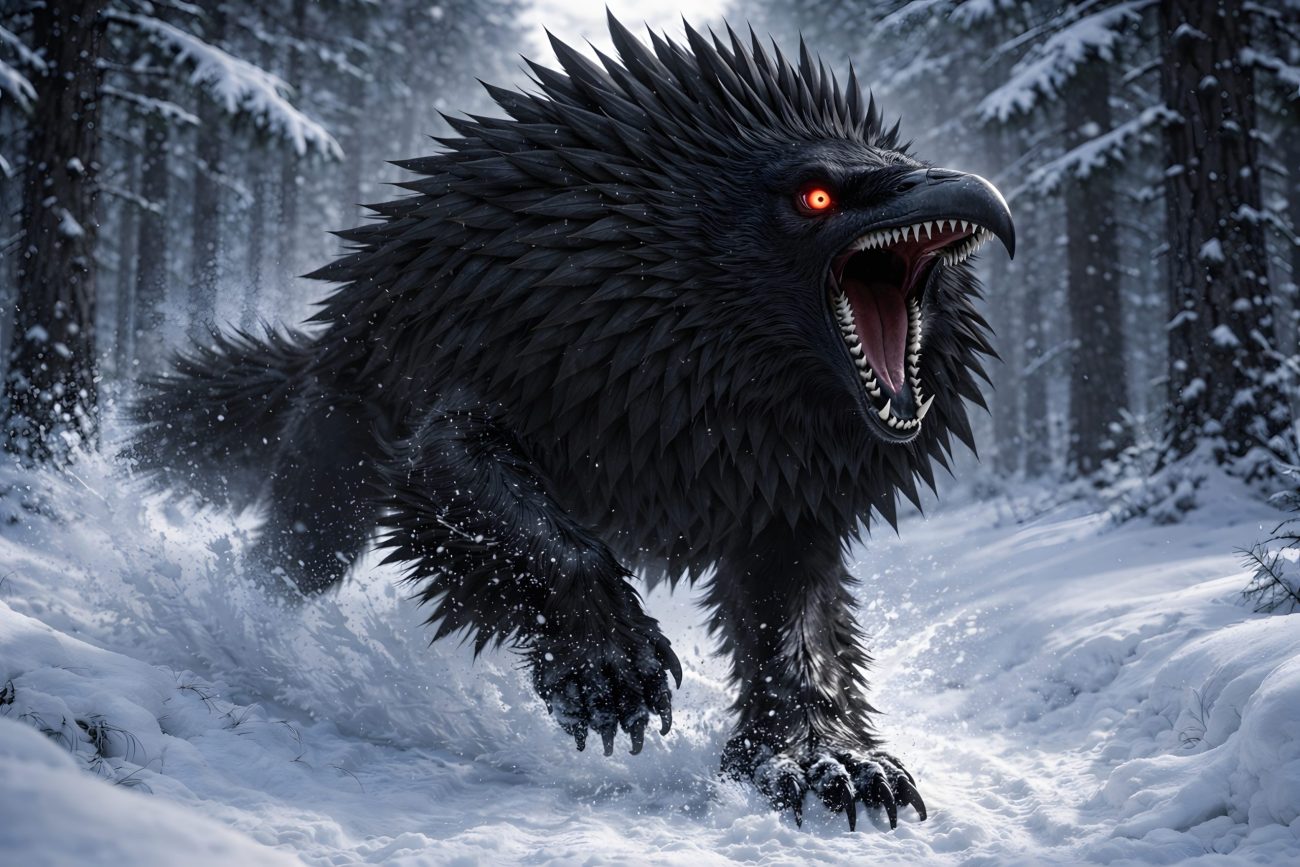
Raven Men

Tradition / Region: Czech Mythology
Alternate Names: Raven Brothers, Rabenköpfige Männer
Category: Bird


The Myth

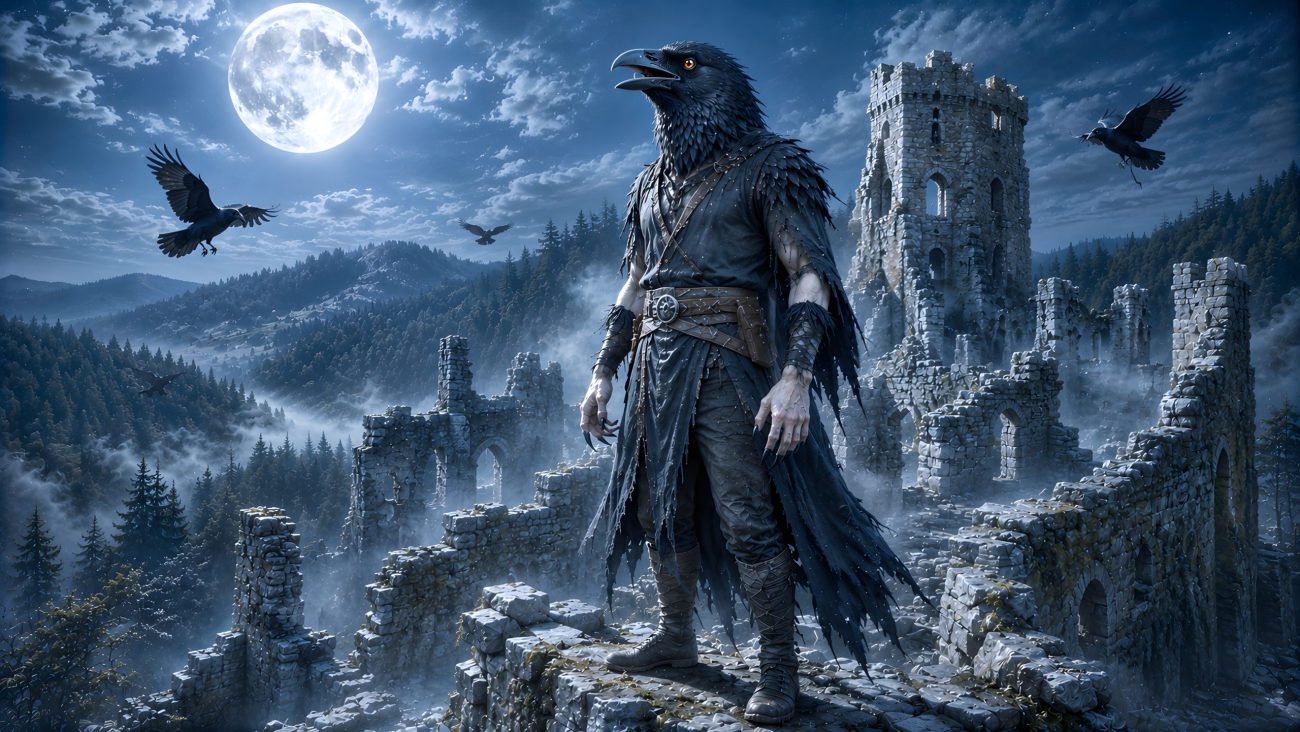
The Raven Men are the restless spirits of violent brothers who, after death, were condemned to wander as punishment for their deeds. Though their castle had long fallen into ruin, they continued to appear upon its remains.

Every Friday, they manifested in human form—but with raven heads. Their voices were harsh and unnatural, croaking so loudly that they drove all birds from the surrounding forest. People feared the place and avoided passing near the ruins.

One day, a young hunter dared to approach and fired at them. The shot struck with such force that he collapsed. When he awoke, he discovered he had been transformed—his face now bore a long, bristling raven beak.

From that moment, the curse shifted. The three brothers were no longer bound to their half-human form and instead became ordinary ravens, while the hunter carried their former burden, living in shame and isolation.

After years of suffering, the hunter died. At that moment, voices were heard from the ruins, declaring that he had freed them. With his death, the Raven Men vanished completely and were never seen again.

The Raven Men represent a powerful theme in Central European folklore:
a transferable curse, where guilt and punishment can pass from one being to another. Their story also reflects redemption through suffering—the hunter’s transformation and endurance ultimately broke the cycle and released the damned spirits.


Sources

sagen.at contributors. (n.d.). Raben und Roß. In sagen.at, from https://www.sagen.at/texte/sagen/tschechien/watzlik/rabenundross.html


Giant Falcon

Tradition / Region: Albanian Mythology
Alternate Names: —
Category: Bird


The Myth

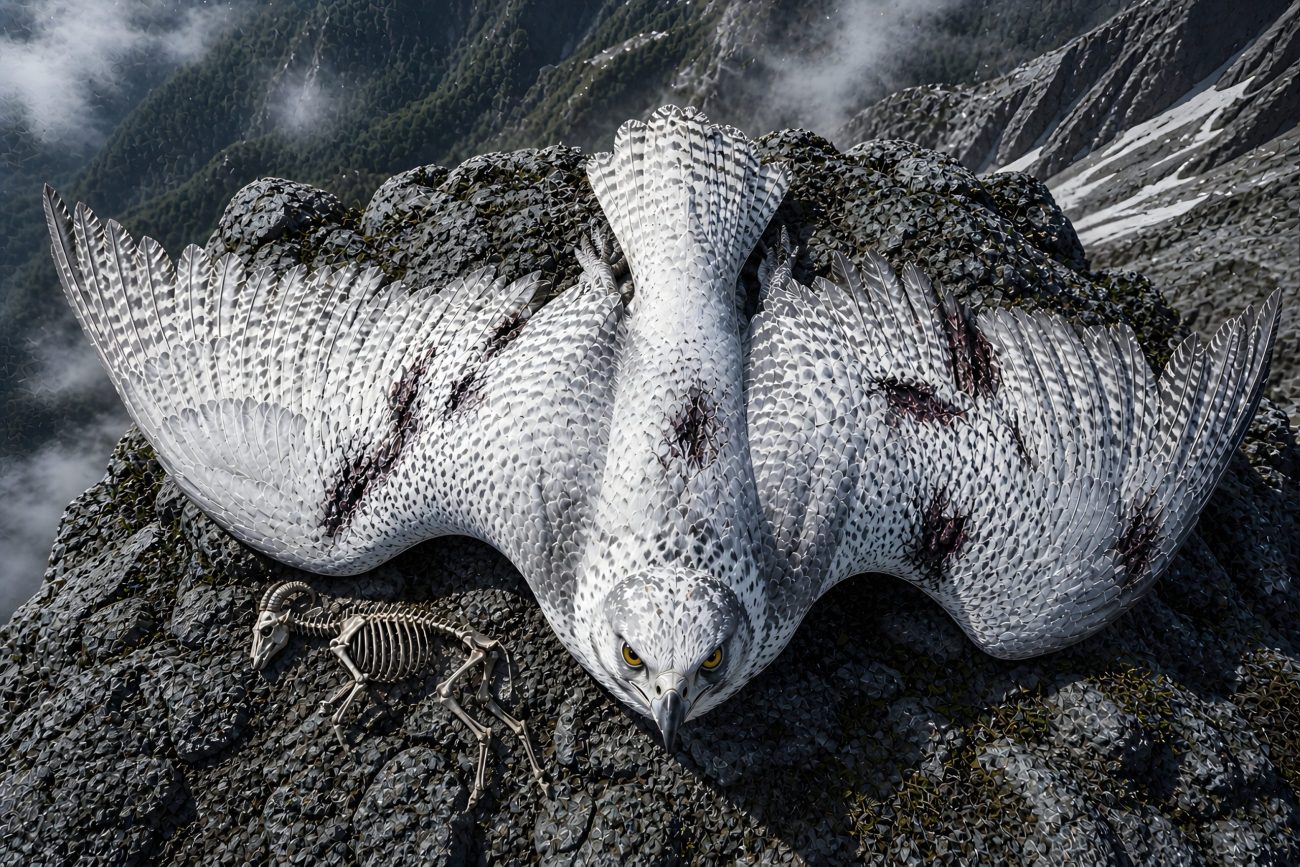
The Giant Falcon is an enormous and ancient bird encountered during a hero’s journey. It serves as a guide and means of transport to a distant, unreachable realm, but demands sustenance and assistance in return.

A young man searching for the half iron being was told by the south wind that he would find a falcon so large it could no longer fly. When he found it, he seized it and demanded information. The falcon agreed to help, but only after being fed and restored, as its wings had weakened with age.

The young man remained with the falcon and provided it with large amounts of meat until its strength returned. Once recovered, the falcon allowed him to climb onto its back and carried him across vast distances to a mountain in another world where the half iron being lived.

During the journey, the falcon required constant feeding. When the meat ran out, it demanded more, threatening to drop him. The young man cut flesh from his own body to sustain the bird until they reached their destination. Afterward, the falcon restored him by returning what it had taken, bringing him back to health.

The falcon later recognized the hero again after his death and revived him using swallow’s milk, restoring him to life and allowing him to continue his quest.


Sources

Albanian Literature contributors. (n.d.). Folktale 4. In Albanian Literature, from http://www.albanianliterature.net/folktales/tale_04.html

Dozon, A. (1879). Manuel de la langue chkipe ou albanaise: Grammaire, vocabulaire, chrestomathie. In Paris: Ernest Leroux (reprinted in Folklor shqiptar 1, Proza popullore, 1963). Translated by Elsie, R.


Eagle Maiden

Tradition / Region: Albanian Mythology
Alternate Names: —
Category: Bird, Nymph


The Myth

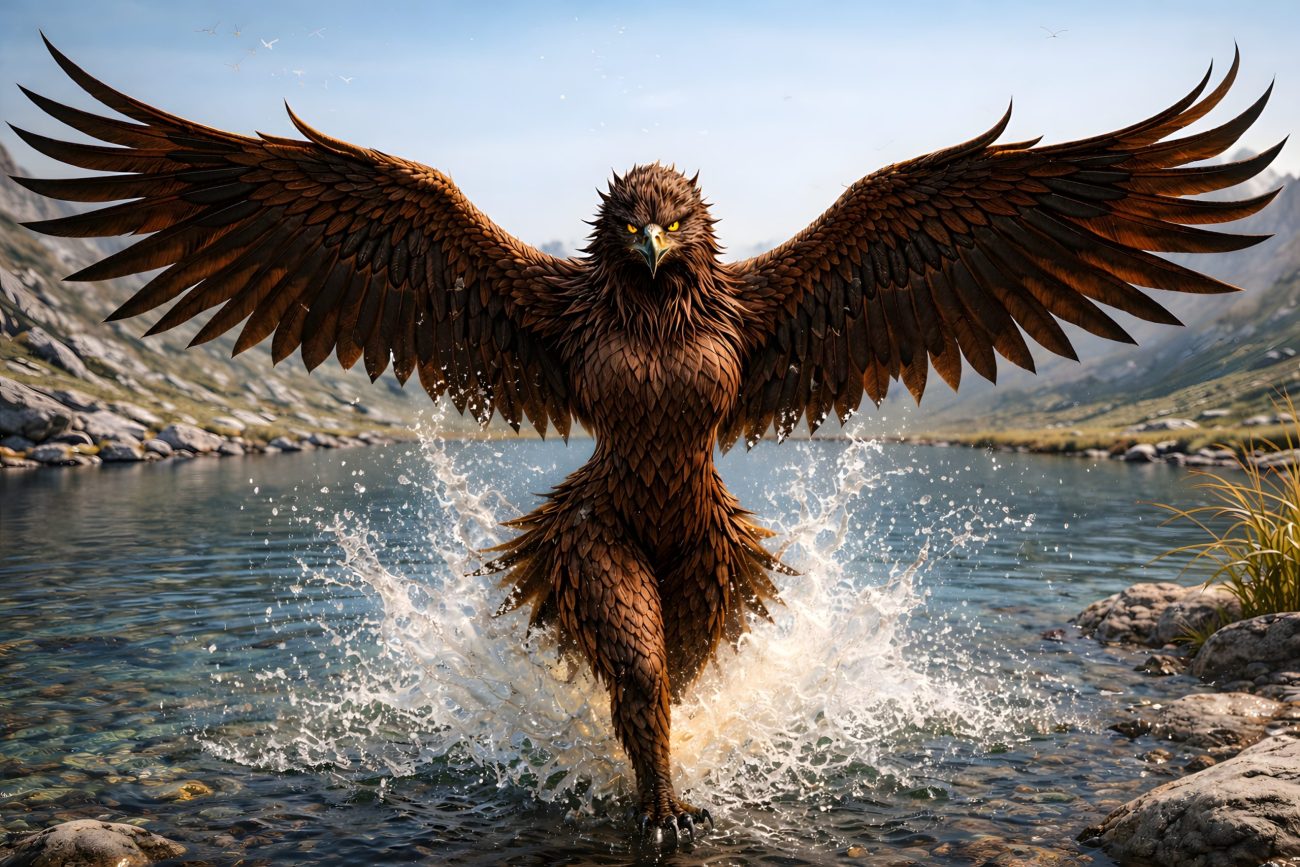
The Eagle Maidens are beings who take the form of eagles and transform into maidens by bathing in water. They are encountered by a traveler during his search for Gjizar the nightingale and possess knowledge of its location.

A youth traveling through a wilderness came upon a house where an old woman lived. She warned him that her daughters would return and devour him, then hid him in a closet with a hole through which he could see. After some time, three eagles arrived, each one wounded. They entered through the window, bathed in a bowl of water, and became maidens. They spoke with their mother and then ate.

The old woman asked what they would do if a man were present, and each maiden swore not to harm the one who had wounded her. The youth was then revealed, and he told them he was the one who had injured them. The maidens did him no harm and asked his purpose. He told them he was searching for Gjizar the nightingale. They said they knew where it was and that he could not reach it on foot.

They told him to remain with them for three months. After this time, they took him to the place where the nightingale was and left him there.


Sources

Albanian Literature contributors. (n.d.). Folktale 14. In Albanian Literature, from http://www.albanianliterature.net/folktales/tale_14.html

Pedersen, H. (1895). Albanesische Texte mit Glossar. In Abhandlungen der philologisch-historischen Classe der Königl. Sächsischen Gesellschaft der Wissenschaften, Vol. 15 (reprinted in Folklor shqiptar 1, Proza popullore, 1963). Translated by Elsie, R.


Rukh

Tradition / Region: Arabian mythology, Madagascar Mythology
Alternate Names: Roc
Category: Bird


The Myth

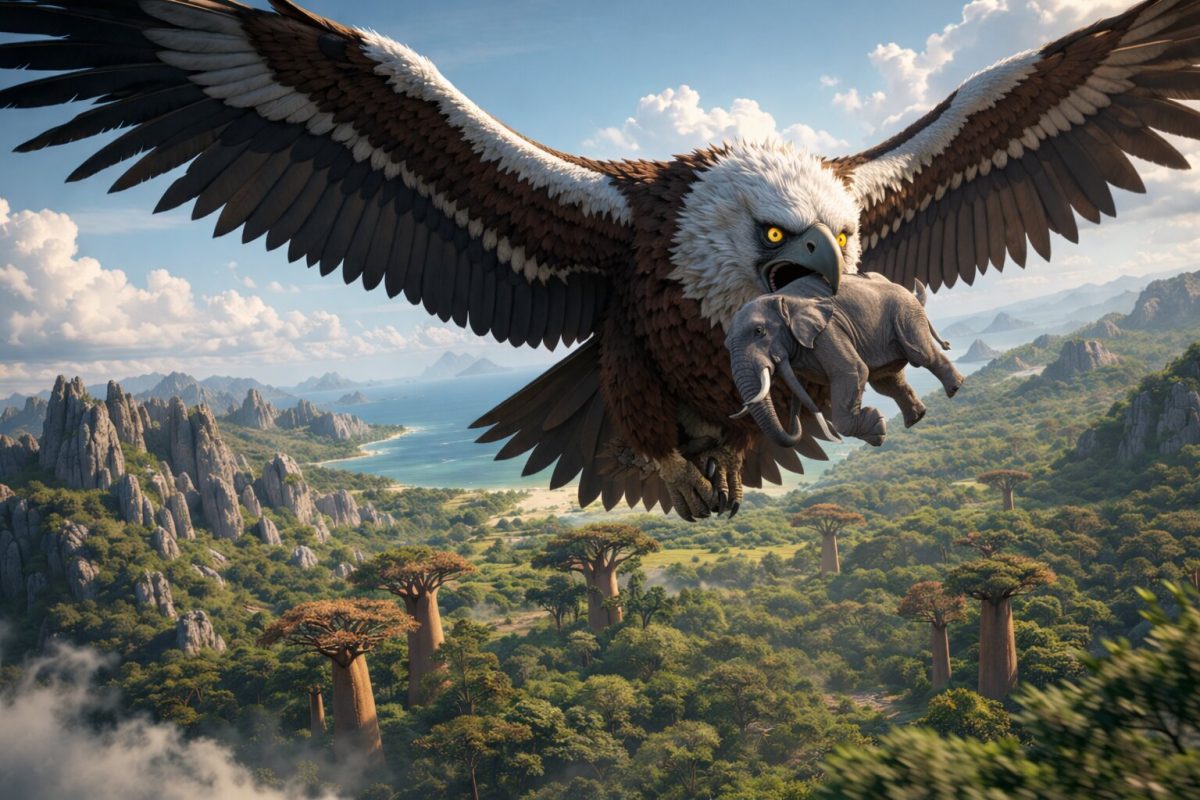
The Rukh is a colossal bird of prey said to live in distant lands, often associated with Madagascar or remote mountains. Its exact appearance is not fixed, but it is always described as enormous, sometimes so large that its wings stretch for vast distances. It preys on the largest animals, including serpents, elephants, and rhinoceroses, and is strong enough to carry them through the air. It is also said to use stones to kill prey.

The sailor Sindbad encountered the Rukh during his travels. On one voyage, he found himself stranded on an island and discovered a great white dome, which proved to be the egg of the bird. When the Rukh returned and settled upon it, Sindbad tied himself to its leg so that it might carry him away. The bird later flew off and landed elsewhere, where it seized a giant serpent before departing again, allowing Sindbad to escape.

On another journey, Sindbad’s companions landed on an island and found a similar egg. Ignoring his warning, they broke it open and killed the chick. Soon the two parent birds appeared and pursued the fleeing ship. Each carried a massive stone in its talons. One missed, but the other struck the vessel directly, destroying it and killing all aboard except Sindbad.

In another tale, a magician urged Aladdin to obtain a Rukh egg to hang in his palace. This request angered the genie, who declared it an insult and revealed that the suggestion came from an enemy.

Travellers also spoke of encounters with the bird. One man obtained a feather quill from a chick cut from an enormous egg; the parent bird attacked their ship with a falling stone, though they escaped. It was said that those who ate the chick’s flesh never grew old. Another traveller saw a distant Rukh in the sky over the seas, so vast it resembled a moving mountain. Others described the bird as able to seize elephants, lift them into the air, and drop them to the ground before feeding on them.


Sources

A Book of Creatures. (2015, October 23). Rukh. From https://abookofcreatures.com/2015/10/23/rukh/


Black Chicken of Pretai

Tradition / Region: Romanian Mythology
Alternate Names: The Money Chicken; The Hearth Chicken; Black Familiar Chicken
Category: Chicken


The Myth

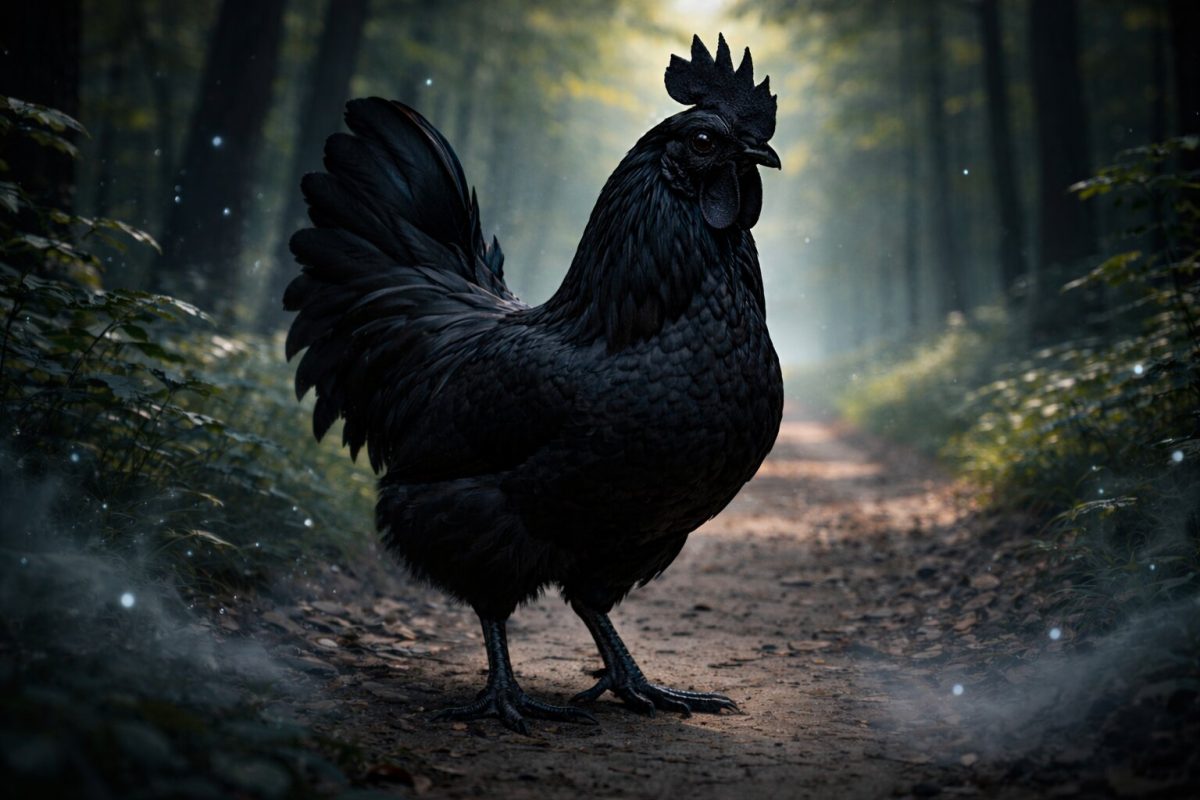
A man from Pretai was once returning home from the mill when he noticed something small and black lying by the roadside. When he bent down to look, he saw it was a chicken, entirely black. He picked it up and carried it home, placing it beneath the hearth and feeding it.

After some time, one night he heard a voice coming from the hearth. It was the chicken speaking.

“What should I bring you?” it asked.

Startled, the man muttered, “Be quiet! What could you possibly bring me?”

The following night, the chicken spoke again.
“What should I bring you?”

This time the man answered, “If you truly want to bring me something, then bring me plenty of money.”

From that night on, the chicken did exactly that, and the man soon became rich.


Sources

sagen.at contributors. (n.d.). Das schwarze Huhn. In sagen.at, from https://www.sagen.at/texte/sagen/rumaenien/siebenbuergen/dasschwarzehuhn.html


Bewitched Water Bird of Geisbusch

Tradition / Region: Luxembourg Mythology
Alternate Names: Geisbusch Night Bird
Category: Bird


The Myth

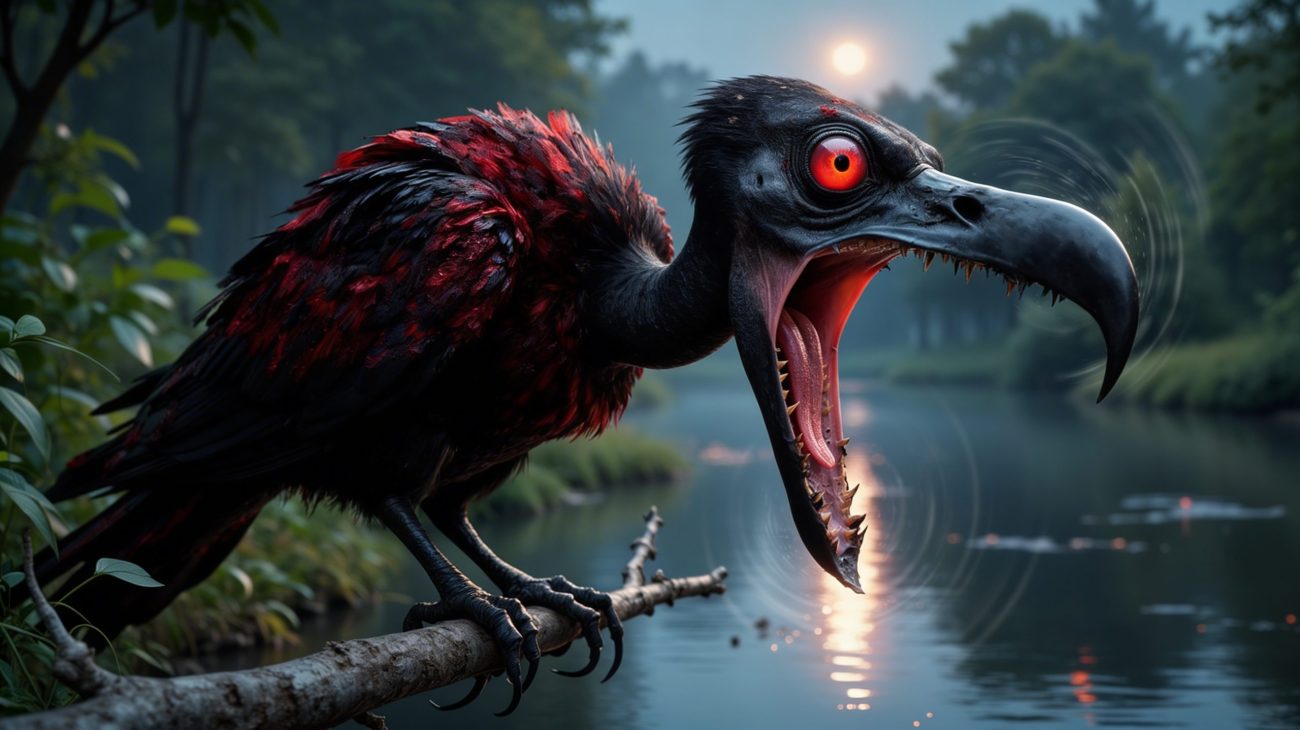
Many years ago, in the wooded area called Geisbusch between Alzingen and Itzig, there lay a large fishpond. Each evening an unknown bird appeared there, whose harsh and repulsive song frightened all who heard it.

People believed the creature possessed the power to bewitch any living being that came into its sight, luring them toward the pond where they would perish in the water. Because of this, no one dared approach it.

At last a mounted hunter decided to destroy the uncanny bird. One evening he rode into the forest with his double-barreled gun and crept close to the pond. When he thought himself near enough, he fired at the bird. Immediately afterward a pitiful cry and a dull roar were heard, and horse and rider were swallowed by the waters of the pond.

After this event, the pond was said to have turned into a wild moor. The place remained visible for a long time, but people carefully avoided it, believing that evil spirits still lingered there and sought to destroy anyone who came too near.


Sources

sagen.at contributors. (n.d.). Der verhexte Wasservogel auf dem Fischteich im Geisbusch. In sagen.at, from https://www.sagen.at/texte/sagen/luxemburg/Fischteich_Geisbusch.html


Quauhxouilin

Tradition / Region: Mexican Mythology
Category: Fish, Eagle, Bird


The Myth

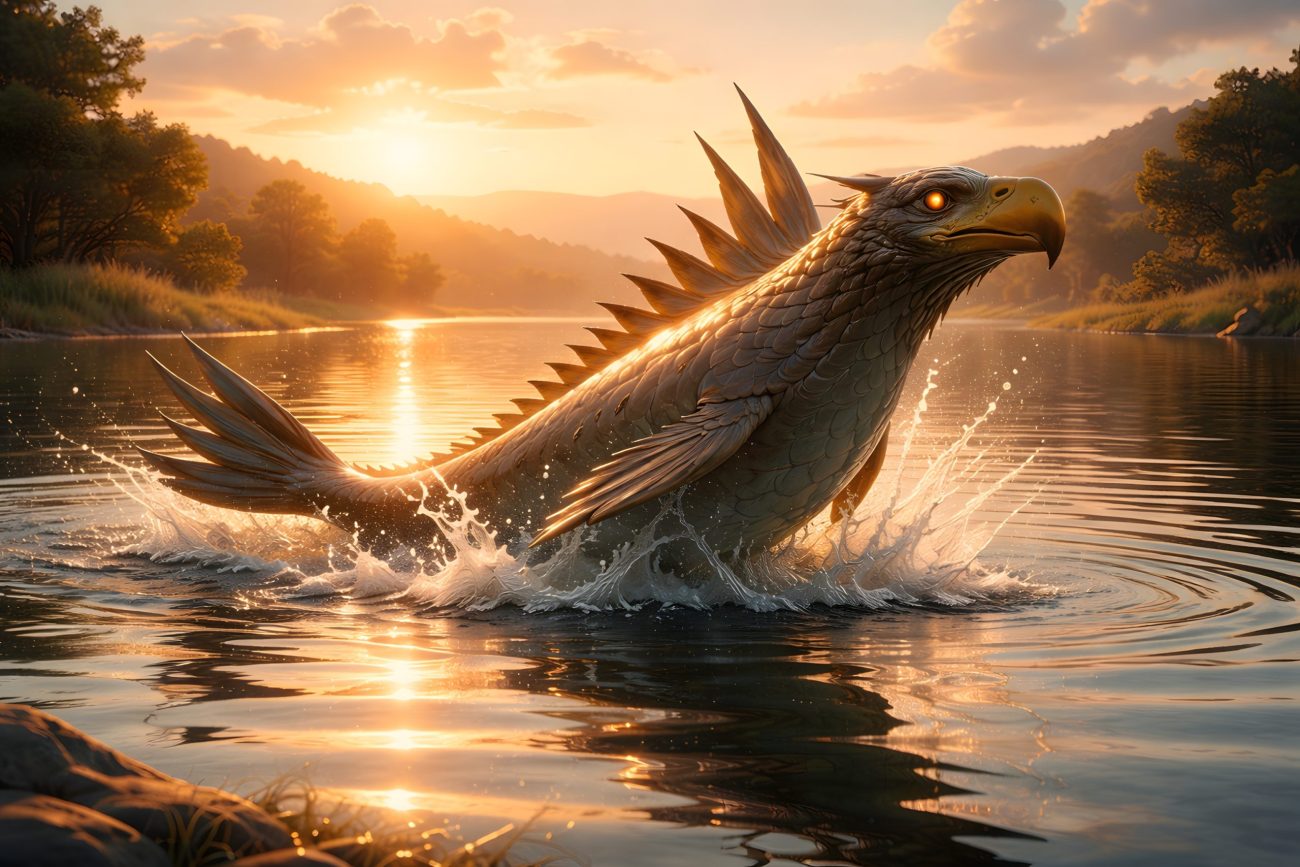
The Quauhxouilin, known as the Eagle-Fish, is a remarkable fish spoken of in Mexican tradition. Its name joins two ideas into one being: quauhtli, meaning eagle, and xouilin, a kind of fish.

This creature bears the head of an eagle, with a curved snout shining golden-yellow, giving it the look of a bird of prey risen from the water. Its body is long, large, and smooth, moving through the water with the same effortless grace as an eagle gliding through the sky.

Unlike ordinary fish, the Quauhxouilin has no scales and no bones. Its flesh is soft throughout, and for this reason it is considered good to eat, valued not only for its strange form but also for its taste.

The Quauhxouilin stands as a fusion of sky and water—a fish shaped like a bird, uniting the domains of river and air in a single living form.


Gallery


Sources

Bestiary.us contributors. (n.d.). Eterari. In Bestiary.us, from https://www.bestiary.us/eterari/


Interpretive Lenses

Religious Readings
  • Christian Ascetic Deep Dive
Philosophical Readings
  • Nietzschean Deep Dive
Psychological Readings
  • Jungian Deep Dive
Esoteric Deep Dive
  • Hermetic Deep Dive
Political / Social Readings
  • Marxist Deep Dive
Other
  • How to Invite The Quauhxouilin

Alan

Tradition / Region: Philippines Mythology
Alternate Names: Alans
Category: Forest dweller, Bird


The Myth

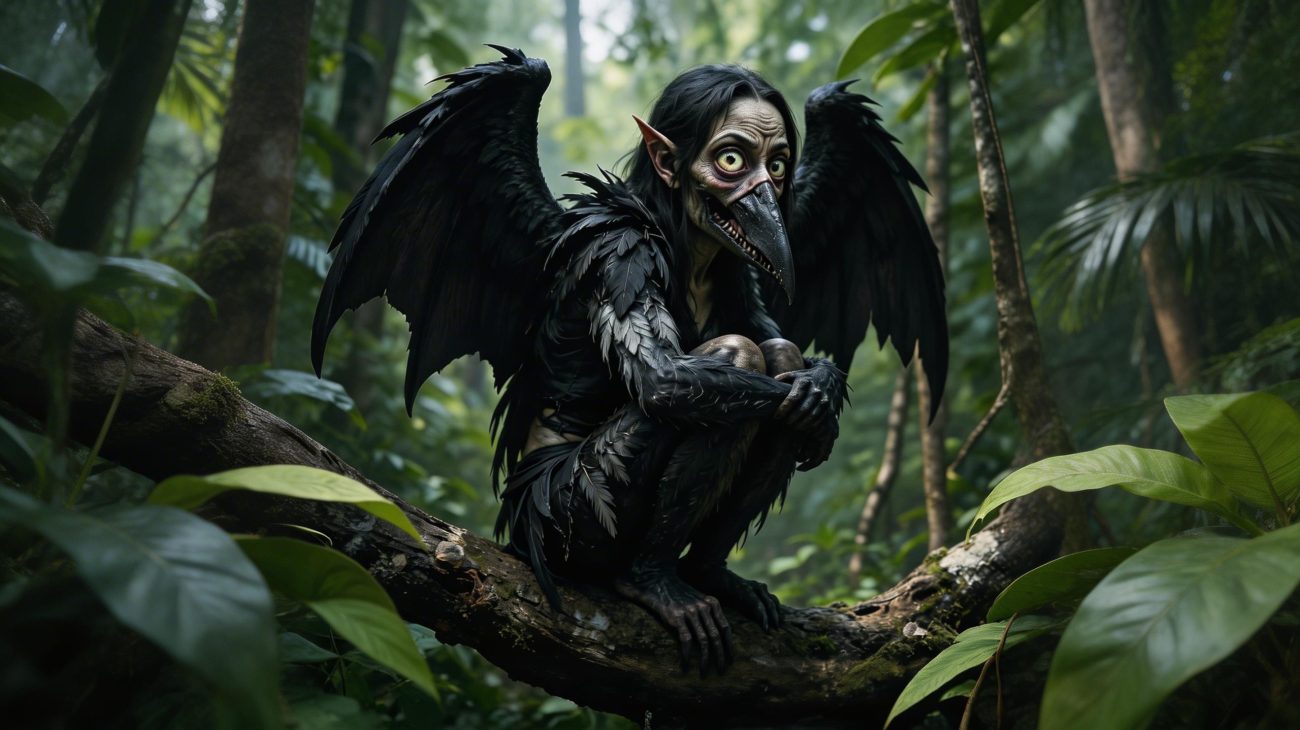
Among the Tingyan people of northwestern Luzon, the Alans are known as wild, winged female spirits who belong to a lower order of supernatural beings. They dwell deep within forests, and at times near rivers, in places seldom visited by humans.

In appearance, the Alans resemble women, but their features are disturbing. Their faces are said to be rough and deeply wrinkled, resembling the hide of a carabao buffalo. They possess wings and are able to fly. Their fingers are inverted, and their toes point backward, emerging from their heels rather than their feet, making them frightening to behold.

The Alans are believed to live in houses much like those of humans, though far more splendid and richly furnished. These dwellings are hidden within the dark forest. At night or when unseen, the Alans are said to hang upside down from tree branches, like bats.

Despite their terrifying appearance, the Alans are credited with a nurturing role. It is believed that when they find drops of menstrual blood, a placenta, or the remains of a miscarriage, they are able to raise a child from it. These children are raised secretly, without the knowledge of their human parents. Once grown, the Alans assist the children throughout their lives, offering help and protection.

Thus, the Alans are remembered not only as fearsome forest spirits, but also as mysterious foster mothers, moving between danger and care, concealment and guardianship.


Sources

Bestiary.us contributors. (n.d.). Eterari. In Bestiary.us, from https://www.bestiary.us/eterari/


Etengena

Tradition / Region: Papua New Guinea Mythology
Alternate Names:
Category: Forest Dweller, Bird, Snake


The Myth

In Kiwai Papuan folklore, etengena are mythical beings associated with particular places in the natural world. They are said to dwell in large trees, springs, and similar locations where nature is dense and undisturbed. Some etengena are believed to watch over vegetable gardens, guarding them from harm or intrusion.

Etengena do not have a single fixed appearance. At times they may take on human form, while at other times they reveal themselves as animals. They are known to appear as snakes, birds, or other creatures, depending on the situation and the person who encounters them.

The idea of the etengena overlaps in part with that of the ororarora, another class of mythical beings known in Kiwai belief. Because of this, the boundaries between these beings are not always clear, and their roles and forms may blend into one another in stories and traditions.


Gallery


Sources

Bestiary.us contributors. (n.d.). Etengena. In Bestiary.us, from https://www.bestiary.us/etengena/


Interpretive Lenses

Religious Readings
  • Christian Ascetic Deep Dive
Philosophical Readings
  • Nietzschean Deep Dive
Psychological Readings
  • Jungian Deep Dive
Esoteric Deep Dive
  • Hermetic Deep Dive
Political / Social Readings
  • Marxist Deep Dive
Other
  • How to Invite The Etengena

Lidérc

Tradition / Region: Hungarian Mythology
Alternate Names: Ludvérc
Category: Bird, Chicken, Flame, Spirit, Shapeshifter


The Myth

In the villages and marshlands of Hungary, people speak of the Lidérc, a restless and many-formed spirit that moves between fire, flesh, and shadow.

On some nights it appears as a shooting star or a wandering flame, streaking low across the sky or flickering over bogs and fields. Wherever it passes, sparks leap and fires may break out, barns and pens igniting without cause. In other places it takes the shape of a fiery rod, a blazing figure, or a marsh light that lures the unwary.

But the Lidérc is most feared for the form it takes among humans.

It seeks the lonely: widows, widowers, abandoned lovers, those whose beloveds are far away or dead. Slipping through the night, it enters their homes and assumes the exact appearance of the person they long for most. It speaks gently, knows their memories, and offers comfort, affection, and desire. Night after night it returns, lying beside its victim, feeding not on blood but on life itself. The victim grows pale and weak, dizzy and thin, until at last they waste away and die, loved to death. When its prey is spent, the Lidérc abandons the body and rises again into the sky as a star, seeking another heart to consume.

Yet the Lidérc is never perfect in its disguise. One of its legs always betrays it: a scaly goose foot, a chicken’s claw, or sometimes a horse’s iron-shod hoof. Those who scatter ashes at their threshold may see the tracks—one human footstep, one monstrous—and know what has crossed their door. Garlic, cords, and household charms can bar its entry, if the danger is recognized in time.

There is another kind of Lidérc as well, one born not from fire but from human greed. If the first egg laid by a black hen is hidden beneath a person’s armpit and warmed there, a strange, featherless creature will hatch. This Lidérc binds itself to its keeper, speaking with intelligence and obeying commands. It brings wealth, steals treasure, and works tirelessly, living on butter and favors. But it is never satisfied. If its master fails to give it constant tasks, it becomes restless and cruel, pestering day and night until it finally destroys the one who raised it.

The only escape is to give the Lidérc an impossible command: to carry water in a sieve, to squeeze through solid wood, to complete a task that cannot be done. Unable to endure failure, the creature will rage, weaken, and finally vanish.

Thus the Lidérc remains a warning whispered in Hungarian folklore: that desire, loneliness, and greed can summon something that looks like love or fortune—but feeds only on ruin.


Sources

A Book of Creatures contributors. (2021). Lidérc. In ABookOfCreatures.com, from https://abookofcreatures.com/2021/03/22/liderc/

Wikipedia contributors. (n.d.). Lidérc. In Wikipedia, The Free Encyclopedia, from https://en.wikipedia.org/wiki/Lid%C3%A9rc