Gandabherunda

Tradition / Region: Indian Mythology
Alternative names: Gaṇḍabheruṇḍa
Category: Bird


The Myth

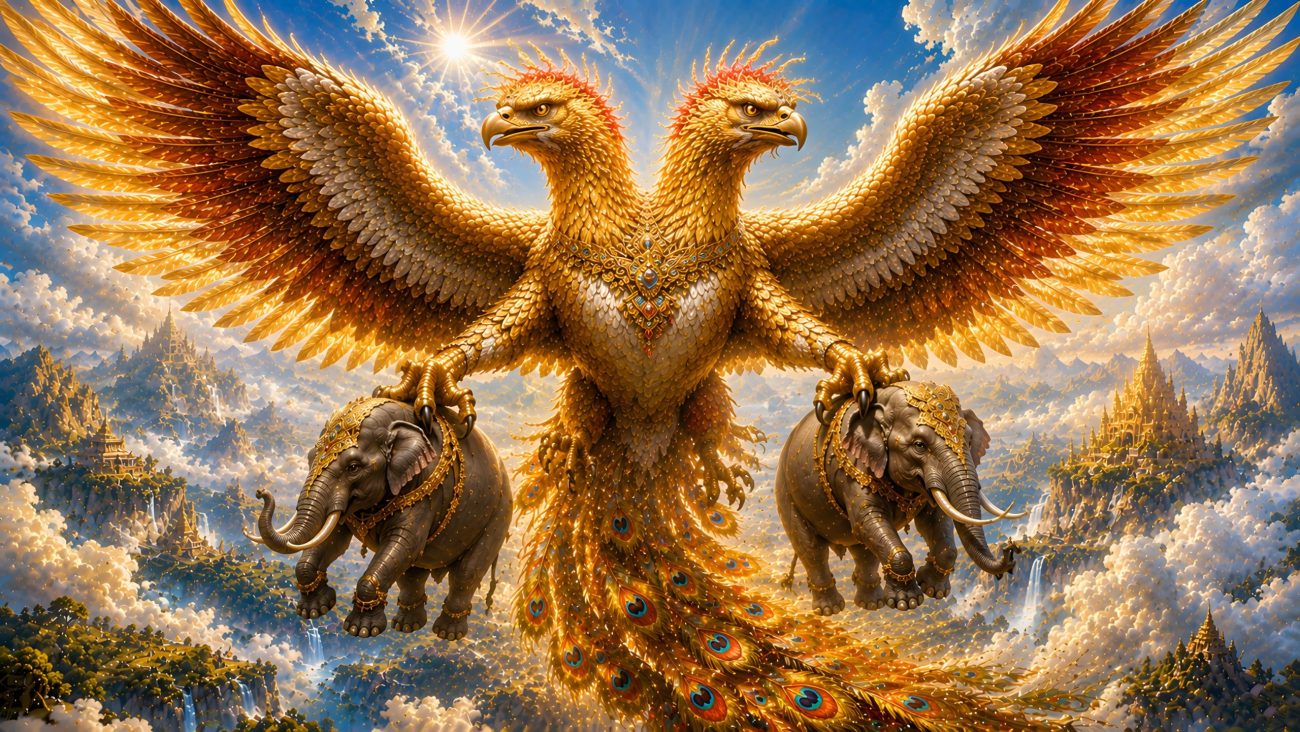
Gandabherunda is the fearsome two-headed eagle form assumed by Vishnu as Narasimha. The immense bird possesses overwhelming strength, capable of carrying elephants in its talons and beaks.

After Narasimha slew the demon king Hiranyakashipu, his terrible fury threatened the stability of the universe. To restore peace, Shiva took the form of the mighty beast Sharabha and confronted him. Narasimha answered by transforming into the colossal Gandabherunda, and the two divine beings fought a battle that lasted eighteen days.

On the final day, Gandabherunda overpowered Sharabha while also destroying Hiranyakashipu. With the conflict ended, Narasimha’s wrath subsided. Sharabha offered his own hide as a mark of respect, which Gandabherunda accepted before restoring it to him. Having brought peace back to the universe, the two resumed their true forms as Vishnu and Shiva and returned to their heavenly realms of Vaikuntha and Kailasha.


Sources

“Gandabherunda.” Wikipedia: The Free Encyclopedia. Wikimedia Foundation. Accessed July 27, 2026. https://en.wikipedia.org/wiki/Gandabherunda

Kinnara

Tradition / Region: Indian Mythology
Alternative names: Kinnari (female)
Category: Bird


The Myth

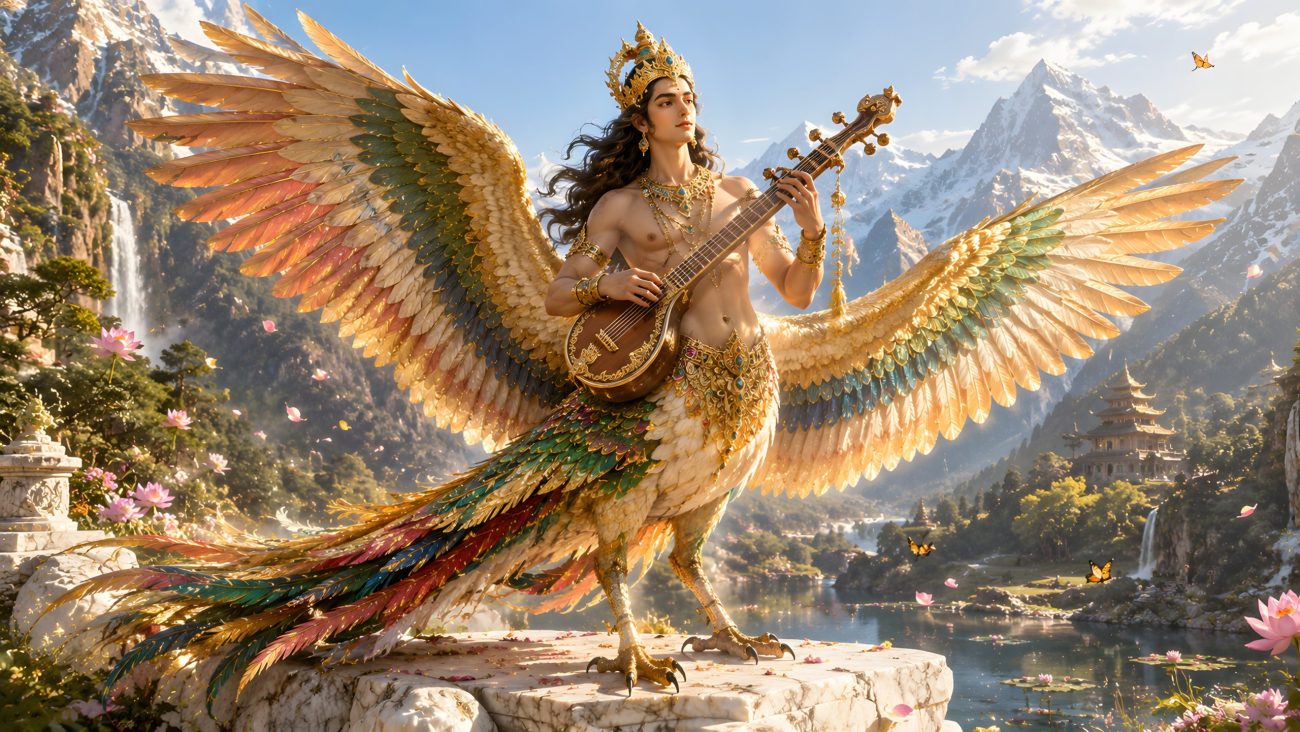
The Kinnara is a celestial being that is part human and part bird, dwelling in the forests and mountains of the Himalayas. Renowned for their beauty, music, and devotion, Kinnaras live in loving pairs, spending their lives singing, dancing, and playing heavenly instruments. They are gentle spirits who watch over humans in times of danger and are celebrated for their compassion and harmony.

According to the Mahabharata, Kinnaras are eternal lovers who never separate from one another. They remain forever husband and wife, embracing one another without seeking children or allowing anyone to come between them. Their existence is one of unending love, joy, and companionship.

Buddhist stories describe Kinnaras as innocent and harmless beings who delight in music and flowers. They nourish abandoned children, comfort the suffering, and are so trusting that hunters sometimes capture them and present them to kings as curiosities. Despite this, they never lose their gentle nature and continue to symbolize grace, love, and artistic excellence.


Sources

Wikipedia contributors. (n.d.). Kinnara. In Wikipedia. Retrieved June 29, 2026, from https://en.wikipedia.org/wiki/Kinnara


Karyōbinga

Tradition / Region: Indian Mythology, Japanese Mythology
Alternative names: Kalavinka; Kalaviṅka; Karyōbinga
Category: Bird


The Myth

The Karyōbinga is a divine bird said to dwell in the Pure Land. It has the face of a human and the body of a bird, and its voice is so beautiful that it preaches the teachings of Buddhism through its song. In Buddhist art, it is sometimes shown playing a flute or another musical instrument as it sings.

The Karyōbinga is the Japanese form of the Sanskrit Kalaviṅka, a heavenly bird renowned for its incomparable voice. It is frequently depicted in temples and on Buddhist ornaments, often appearing beside the halo of Amida Buddha. The bird is also celebrated in gagaku, Japan’s classical court music, where the dance Karyōbinga portrays the celestial bird descending from the heavens to perform its graceful dance.


Sources

TYZ. (2009, July 26). 迦陵頻伽 (Karyōbinga / Kalyobinga). In 新版TYZ 妖怪図鑑. Retrieved June 29, 2026, from https://tyz-yokai.blog.jp/archives/1010655151.html


Byangoma & Byangomi

Tradition / Region: Bengali MythologyIndian Mythology
Alternate Names: Byangoma, Byangomi
Category: Bird


The Myth

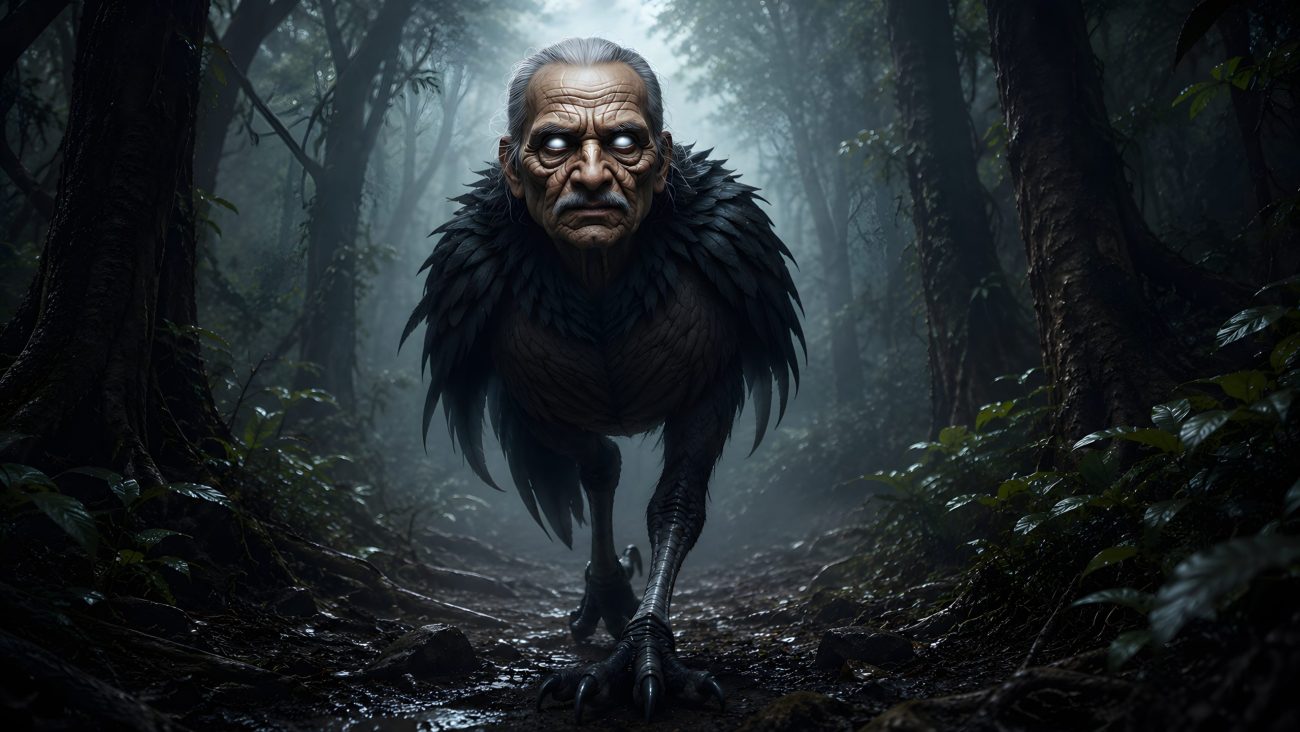
The Byangoma and Byangomi are legendary birds from Bengali folklore, most famously appearing in the tales of Thakurmar Jhuli. They are mysterious human-faced birds said to dwell far beyond the world of ordinary people, at the edge of Tepantorer Math — the “Field of Three Horizons,” a vast and dangerous expanse crossed only during great journeys and quests.

Though their bodies are those of birds, they possess human faces and the ability to speak like humans. They are regarded as wise beings with knowledge of distant lands, hidden dangers, and the paths travelers must follow. The birds rarely reveal themselves openly and are usually encountered only by those who have endured long hardships to reach their remote dwelling.

According to the stories, the Byangoma are born blind. Their young remain sightless until another living being willingly offers a few drops of blood. Only then do their eyes open and their true vision awaken. Once awakened, the birds gain the wisdom and supernatural sight for which they are known.

The Byangoma are also described as immensely powerful despite their strange appearance. In the tale Lalkamal Neelkamal, the princes reach the great tree where the birds live after crossing many dangers. The Byangoma then carry the princes upon their backs and fly them safely across the endless Tepantorer Math, a distance impossible for humans to travel alone. In this role the birds act as guides and helpers, aiding only those who prove themselves worthy through courage and endurance.

Unlike many creatures in folklore, the Byangoma are not evil spirits or monsters. They are mysterious watchers who exist between the human world and distant unknown realms. They do not alter fate or fight battles themselves, but instead reveal hidden paths and help travelers continue journeys they could never complete alone.

After guiding those they choose to help, the Byangoma return once more to their solitary tree at the edge of the world, remaining distant guardians of forgotten roads and impossible horizons.


Sources

Wikipedia contributors. (n.d.). Ghosts in Bengali culture. In Wikipedia, from https://en.wikipedia.org/wiki/Ghosts_in_Bengali_culture