Koiyamainu appears in the second part of Kyokutei Bakin’s tale Musobe Kocho Monogatari. It is described as one of the strange beings found in Bonnoukyo, a distant foreign land visited by the story’s protagonist.
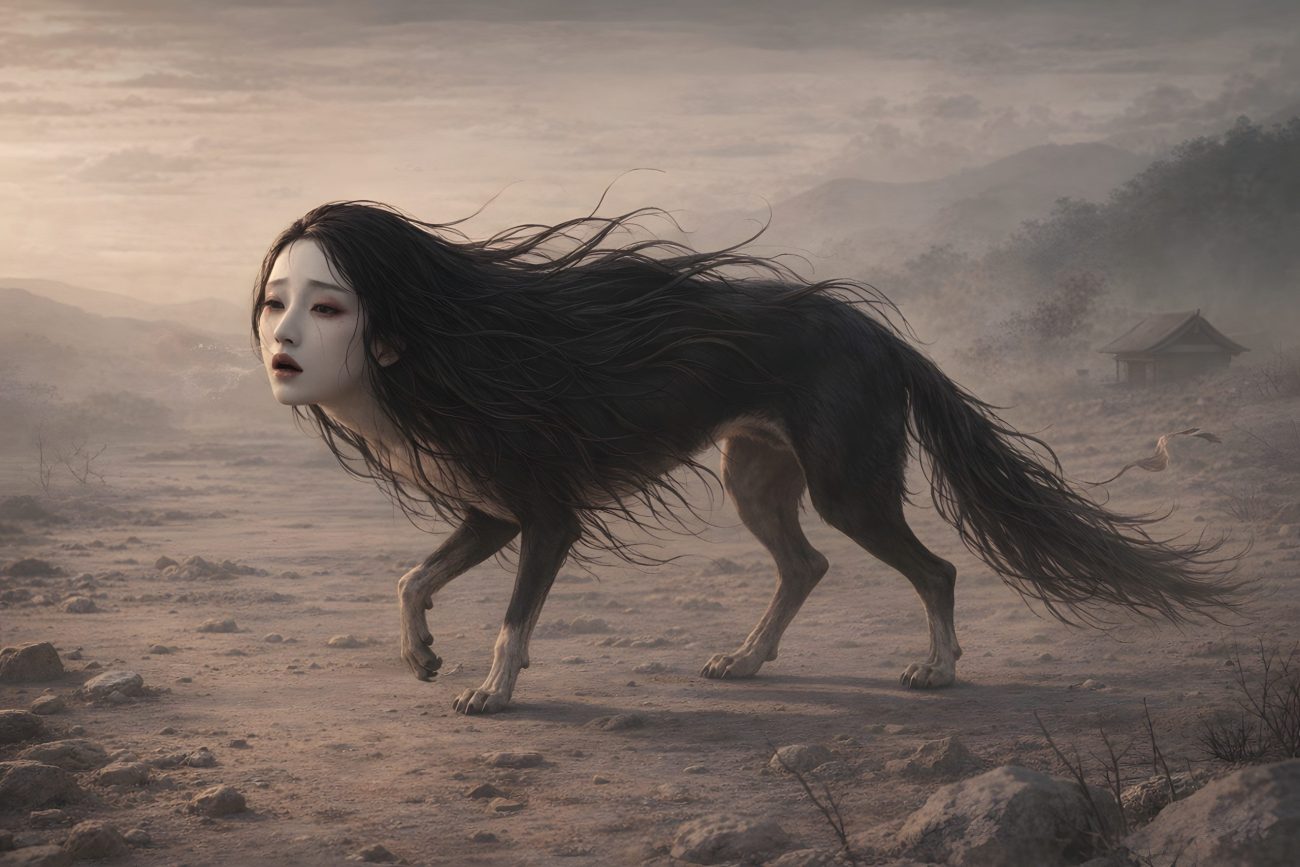
The creature is said to resemble a beast with the face of a human — sometimes that of a woman — while its long, loose hair trails down its back like a tail. Its appearance is unsettling, caught somewhere between person and animal.
Koiyamainu wanders while crying out in a mournful voice. Its call sounds like, “I want to see you, I want to see you — owwow, owwow.” The cry echoes through the land, filled with longing and sorrow.
Its name reflects this nature: a play on the idea of lovesickness and that of a diseased or troubled dog. The creature’s lament expresses yearning for someone absent, its voice carrying the pain of desire that cannot be fulfilled.
Ken’etsu appears in the humorous illustrated work Mubō Sanzai Zue. Rather than a fearsome monster, it belongs to the strange and satirical creatures sometimes described in Edo-period folklore and parody bestiaries.
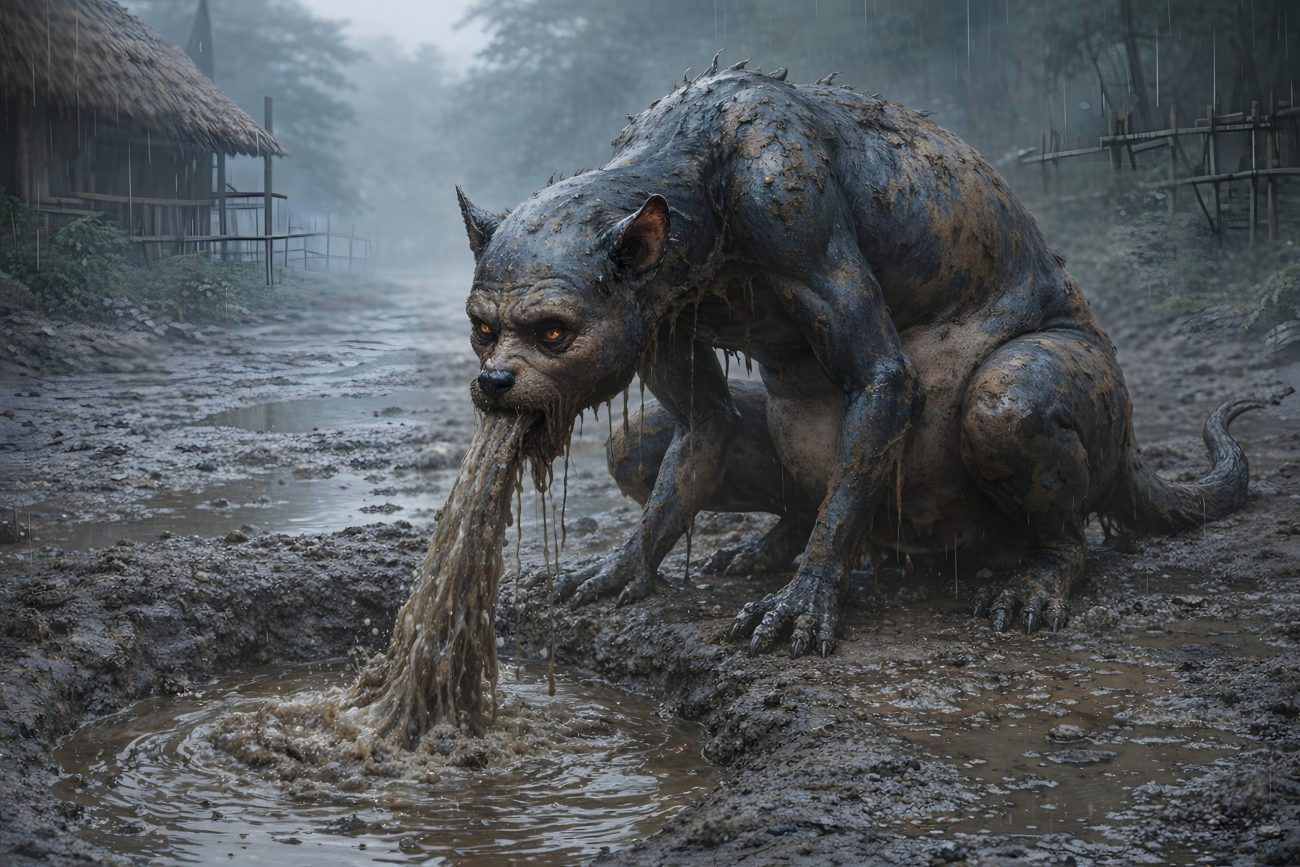
It is said that Ken’etsu was born from mud, and its body bears the color of damp earth — a bluish-black tone like wet soil. Like birds whose feathers resemble leaves or fish whose scales mirror the ripples of water, Ken’etsu’s appearance reflects the place of its origin.
The creature is described as a dog that vomits everything it eats, never needing to defecate. It drinks enormous quantities of water, and as it does so, its complexion shifts and changes. From this image comes an old saying about a dog that “vomits and changes color.”
In some depictions, Ken’etsu is shown in a more humanlike form — a figure crawling on all fours, retching repeatedly, illustrating the comparison between the creature and a drunken person who has made themselves sick. Because of this, the name “Dog’s Delight” also came to be used as a humorous expression for a drunkard who vomits and grows pale, likened to a dog contentedly eating its own sick.
Thus Ken’etsu lives on less as a terrifying spirit and more as a grotesque and comic yokai, a muddy creature of excess, sickness, and satire.
In the folklore of Okinawa, there is said to be a mysterious yokai known as Innu, a name that simply means “dog” in the local language. The creature is remembered mainly through brief written references rather than long stories, but those mentions describe it as something uncanny and supernatural.
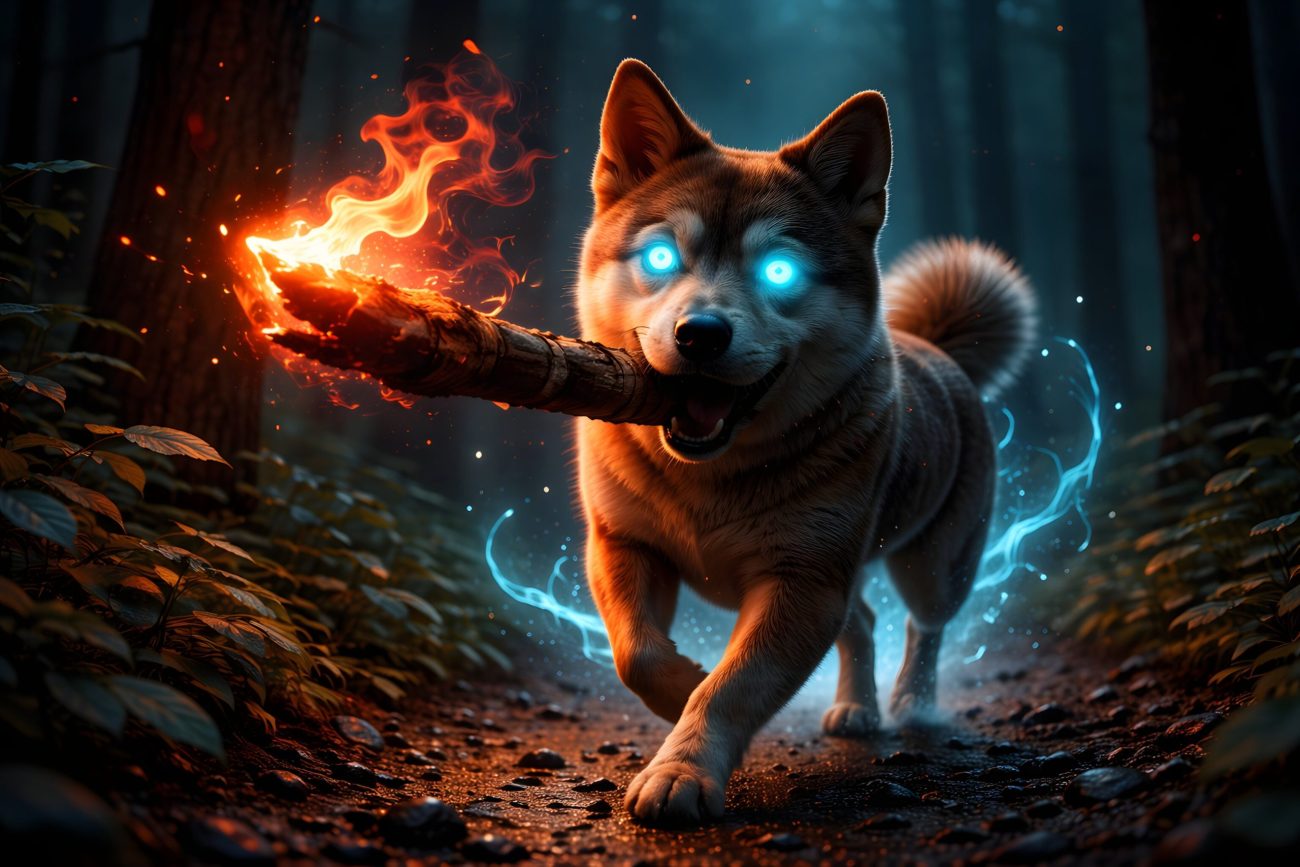
According to one early account, the Innu is a strange being that wanders about while dealing with fire. Some traditions say it roams the night devouring flames, moving from place to place as if feeding on burning light. Other interpretations describe it not as eating fire, but as carrying it, walking through the darkness with flames in its presence like a living torch.
Though little detail survives about its appearance or behavior beyond this, the Innu is remembered as a roaming, fire-associated dog spirit, moving silently through the night in the villages of Okinawa, its presence tied to mysterious lights and wandering flames.
Tradition / Region:Japanese Mythology Alternate Names: Monster Born from a Dog; Beaked Dog of Tojinmachi Category:Dog
The Myth
During the Kanpō era in the mid-18th century, a strange event was said to have occurred in Tojinmachi in Fukuoka. A household dog gave birth to a litter in which one of the newborns was unlike the others.
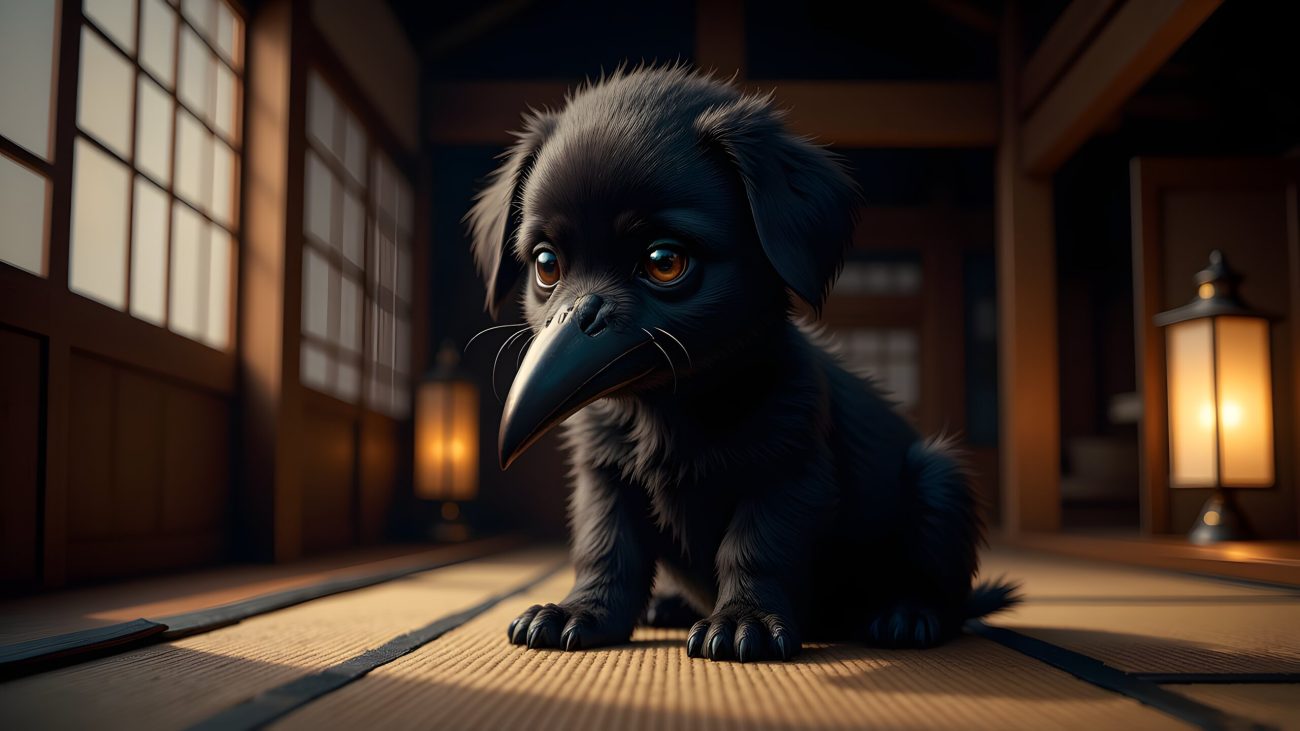
This puppy was described as having the body of a normal dog but a head shaped like the thick, curved beak of a crow. The unnatural appearance shocked those who saw it, and word spread quickly through the town. Such abnormal births were often regarded as signs or warnings, and people treated the creature with a mixture of fear and curiosity.
Despite its unusual form, the puppy was cared for. It was fed rice and fish like any other household animal, but it survived only a short time before dying.
The incident was later recorded in illustrated works such as Kaikaidan Ekotoba. Although the scroll itself did not give the creature a specific name, later sources referred to it simply as “the monster born from a dog.” In modern references, it is often called the Beaked Dog of Tojinmachi, remembered as one of the strange births and ominous wonders noted in Edo-period tales.
Sources
Tyz-Yokai Blog. (n.d.). Beaked Dog. Retrieved March 1, 2026, from https://tyz-yokai.blog.jp/archives/1069207156.html
Tradition / Region: Japanese Mythology Alternate Names: – Category: Dog
The Myth
Yatsufusa was a remarkable dog said to have been born in a village beyond Toyama in Awa Province. When he was only a week old, his mother was killed by a wolf, and the pup seemed certain to die. But a raccoon dog, appearing as a drifting will-o’-the-wisp, came and nursed him with milk. The pup survived and grew into an unusually large, powerful dog with sharp eyes and a noble bearing.
Word of this strange animal reached Satomi Yoshizane, lord of Awa, who summoned the dog to his court. The dog’s black-and-white coat bore eight peony-like markings, and so he was named Yatsufusa, “Eight Tufts.” He became the Satomi family’s cherished pet and grew deeply attached to Yoshizane’s daughter, Princess Fusehime, never leaving her side.
Years later, famine weakened the Satomi lands, and the enemy lord Anzai Kagetsura invaded. The castle stood on the brink of collapse. In desperation, Yoshizane jokingly told the starving Yatsufusa that if he killed the enemy general, he would reward him with Fusehime’s hand in marriage.
That night, Yatsufusa returned carrying the severed head of Kagetsura. The promise, made in jest, had been fulfilled in earnest. Yoshizane rewarded the dog with rich food and servants, but Yatsufusa refused all comforts, remaining beside the head as though waiting for the promised reward.
When Yoshizane realized the dog’s attachment to his daughter, he tried to drive Yatsufusa away. The dog broke loose and forced his way into the mansion, and Yoshizane prepared to kill him. Fusehime stopped her father, reminding him that a promise once spoken must be honored. Reluctantly, Yoshizane allowed her to leave with the dog.
Yatsufusa carried Fusehime into the mountains, where they lived together in a cave. She brought with her a copy of the Lotus Sutra and spent her days reciting it. Yatsufusa listened, growing calm and devoted, and never violated her. A hermit’s messenger later revealed that the dog’s true nature was bound to past grudges and karmic ties, but that the sutra’s power had begun to free him.
Through the merit of the sacred text, Fusehime conceived eight spiritual children. She later resolved that she and the dog should end their suffering and be reborn in better form. As Yatsufusa prepared to follow her into the water, a shot rang out. A warrior attempting to rescue the princess fired, and the bullet struck both dog and girl.
Fusehime died after proving her purity, and the rosary she carried burst apart, sending eight sacred beads flying into the world. From these beads would arise the Eight Dog Warriors, heroes bound by virtue.
After her death, Fusehime’s spirit was sometimes seen riding Yatsufusa, guiding the warriors who carried the beads and watching over their destinies.
Tradition / Region: Japanese Mythology Alternate Names: – Category: Dog
The Myth
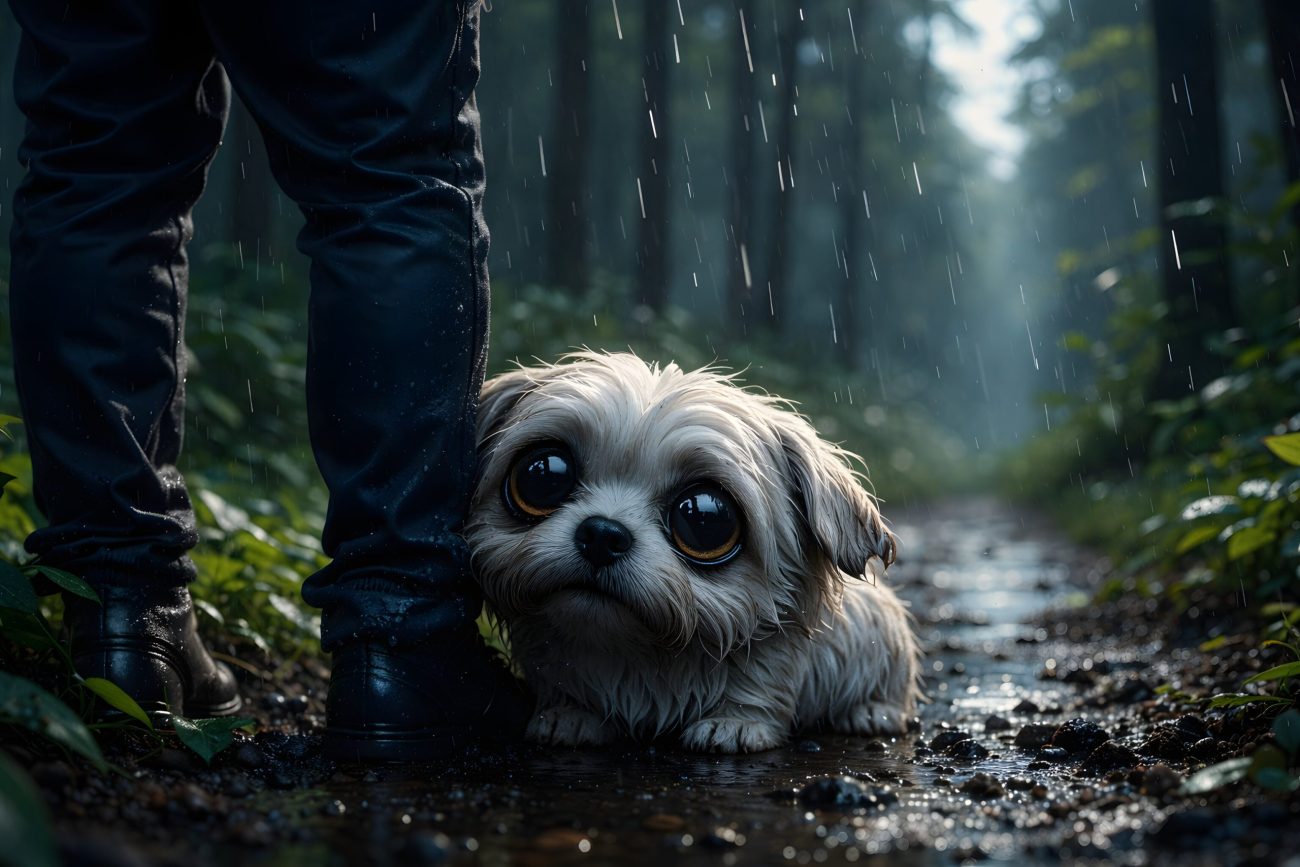
Sunekosu is a strange creature said to appear in Oda County of Okayama Prefecture. It is most often encountered on rainy nights, when the roads are quiet and visibility is poor.
Those walking alone sometimes feel something brush suddenly against their legs. Looking down, they may glimpse the shape of a small animal like a dog slipping past them in the darkness. It moves silently and quickly, weaving between the legs of travelers before vanishing into the night.
The creature does not attack, but its sudden contact startles those who encounter it. Afterward, nothing can be seen or heard, leaving only the uneasy feeling that something unseen passed close by in the rain.
Tradition / Region: Norse Mythology Alternate Names: Hati, Mánagarmr, Moon-Hound, Moon’s Dog Category: Wolf
The Myth
Hati Hróðvitnisson is one of the monstrous wolf-sons of Fenrir, born of a giantess who dwells in the dark forest of Járnviðr, east of Midgard. From that wild place came many wolves, but Hati became one of the most feared.
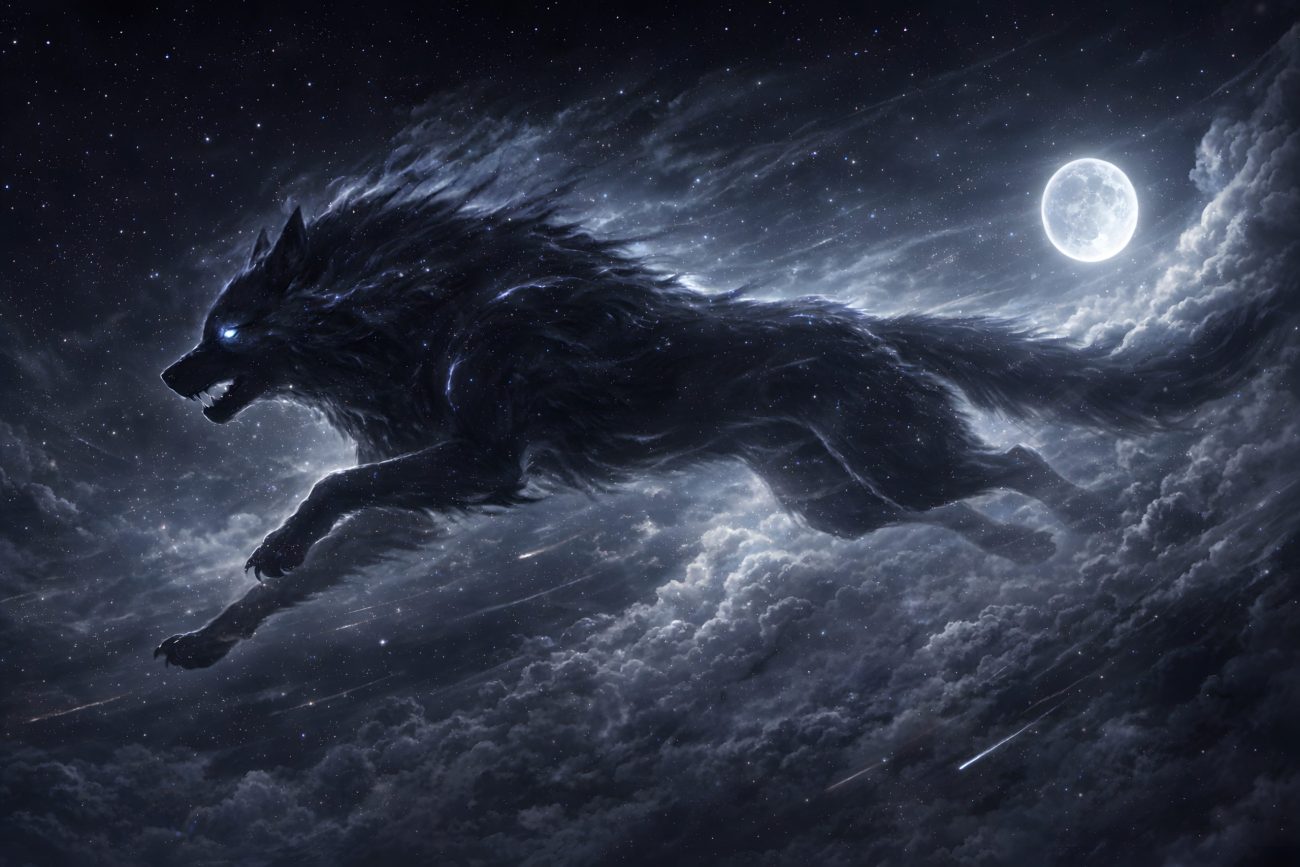
While his brother Sköll hunts the Sun across the sky, Hati pursues the Moon. Each night he runs beneath the heavens, chasing the chariot of Máni, never resting, never turning aside. The Moon flees endlessly before him, and the night sky moves in constant motion because of the wolf’s pursuit.
Prophecy says this hunt will not last forever. When Ragnarök arrives and the world begins to break apart, Hati will finally catch his prey. He will seize the Moon and swallow it whole, darkening the sky and casting the world into chaos.
Some tales say that this same wolf, called Mánagarmr, will grow fat on the flesh of the dead before the end of days. When the final battles begin, he will rush across the heavens, staining the sky with blood as the order of the cosmos collapses.
Until that destined hour, Hati runs through every night — the unseen hunter whose shadow follows the Moon.
Sköll is one of the great wolves born of Fenrir, the monstrous son of Loki. From the beginning of the world, he was set upon a relentless hunt across the sky.
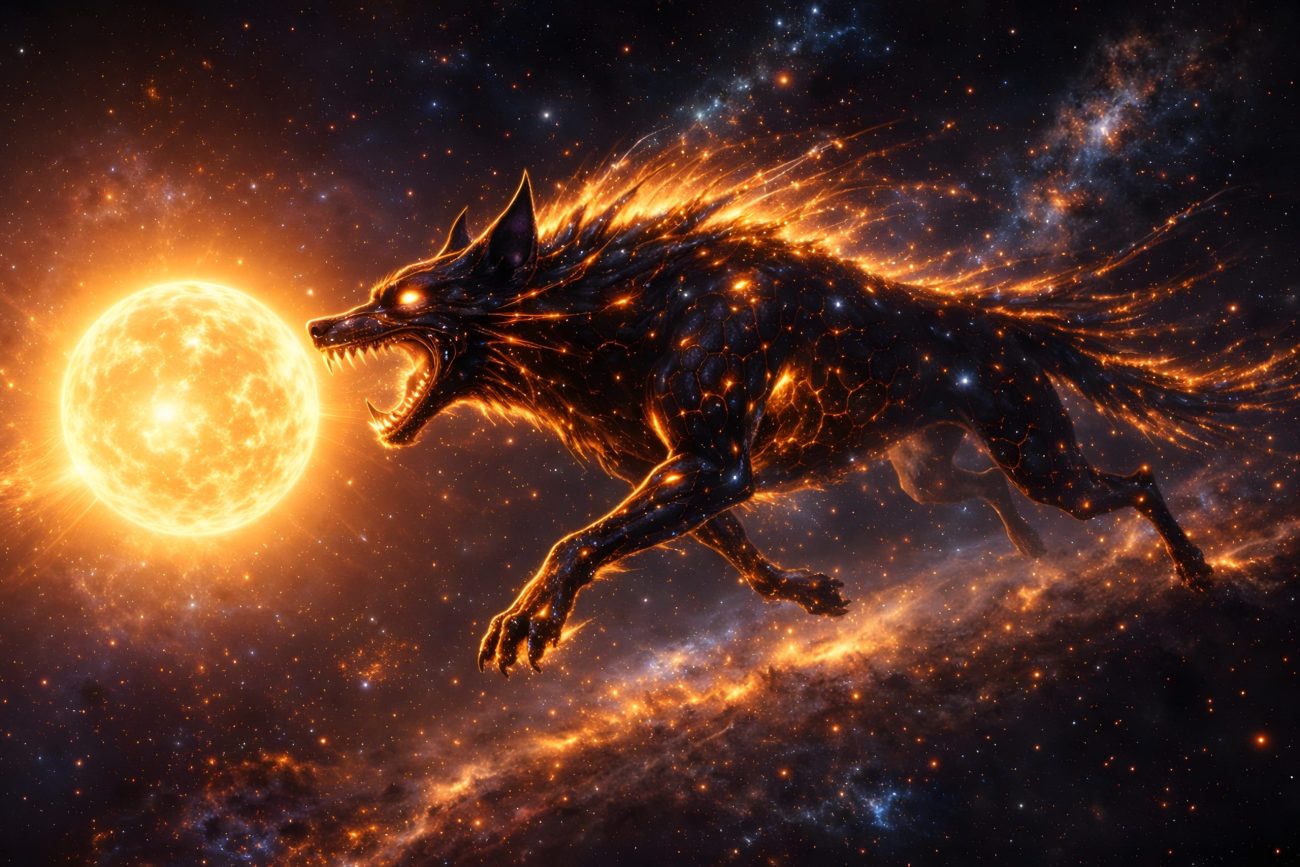
Each day, the goddess Sól drives the chariot of the Sun through the heavens, pulled by shining horses. Behind her races Sköll, a vast and tireless wolf. He runs with jaws open, always gaining, always threatening to catch her. The Sun moves swiftly, but never fast enough to escape him forever.
At night, his brother Hati hunts the Moon, pursuing Máni across the darkness in the same unending chase. Thus the sky is never still, for the wolves are always running.
This pursuit is fated to last until the end of the world. When Ragnarök comes, the order of the cosmos will fail. On that final day, Sköll will at last overtake the Sun and devour her, plunging the world into darkness. His brother will seize the Moon, and the heavens will collapse into chaos as the stars vanish from the sky.
So long as the Sun rises and sets, Sköll still runs — an eternal hunter racing toward the doom of gods and men alike.
Fenrir is the monstrous wolf born to the trickster god Loki and the giantess Angrboða. He is the brother of the world-serpent Jörmungandr and Hel, ruler of the dead. From the moment of his birth, prophecies foretold that he would bring ruin to the gods.
Because of this, the gods took Fenrir into their own realm and raised him among them, hoping to control his fate. Yet the wolf grew at an unnatural speed, becoming larger and more terrifying with each passing day. Of all the gods, only Týr had the courage to approach him and feed him.
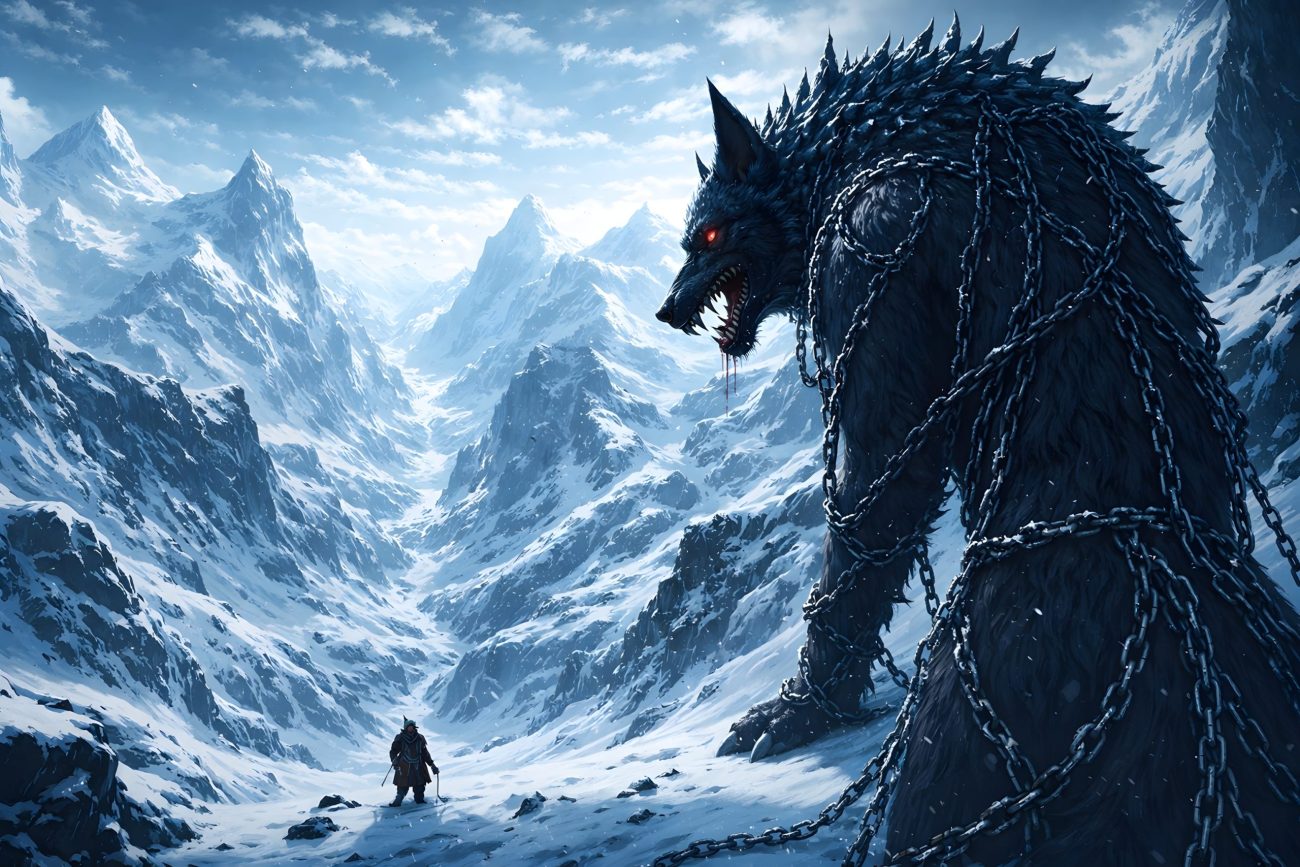
Fearing the prophecy, the gods decided to bind Fenrir before he became unstoppable. They forged a massive chain called Leyding and challenged him to test his strength. Fenrir allowed himself to be bound, but with a single effort he shattered the chain.
They forged a second, stronger fetter called Dromi, and again Fenrir agreed to be bound so his strength might win fame. This too he broke with ease, and the gods grew afraid.
Finally, Odin sent for the dwarfs to create a magical binding. They forged a silken ribbon named Gleipnir, made from impossible things: the sound of a cat’s footsteps, a woman’s beard, the roots of a mountain, the sinews of a bear, the breath of a fish, and the spittle of a bird. Though it looked soft and harmless, it was stronger than any iron.
The gods brought Fenrir to the island Lyngvi and asked him to test this ribbon. Suspicious of trickery, Fenrir demanded a pledge of good faith. He agreed only if one of the gods would place a hand inside his mouth while the fetter was tied.
None dared, except Týr. He stepped forward and placed his right hand between the wolf’s jaws.
When Fenrir struggled, Gleipnir tightened and held him fast. Realizing he had been deceived, Fenrir bit down and tore off Týr’s hand. The gods chained the ribbon to a stone buried deep in the earth and forced a sword into Fenrir’s mouth to hold his jaws open. From his drooling rage flowed the river Ván. There he remained bound, howling, until the end of the world.
At Ragnarök, when the bonds of the world break, Fenrir will finally be freed. He will stride across the land with flames in his eyes, his upper jaw scraping the sky and his lower jaw the earth. In the final battle he will confront Odin himself and swallow the All-Father whole.
But Odin’s son Víðarr will avenge him. With a mighty step he will force Fenrir’s jaws apart and tear the wolf asunder, bringing about the fall of the monster and the turning of the age.
Wepwawet is one of the oldest gods of ancient Egypt, known as the “Opener of the Ways.” He was worshiped at Asyut, a city the Greeks later called Lycopolis — the City of Wolves — and he was seen as a divine scout who clears paths for gods, kings, and the dead.
He is most often depicted as a wolf or jackal standing at the front of a procession or at the prow of the sun-boat of Ra, forever leading the way forward. In war he marches ahead of the army, opening the road to victory. In royal rituals he appears on the first standard, guiding the other sacred banners behind him and symbolizing the divine authority of the pharaoh.
The Pyramid Texts declare that the face of the king is the face of Wepwawet, for the god protects the ruler’s rise to power and accompanies him on the hunt and in battle. One inscription even proclaims that Wepwawet “opens the way” to victory itself.
Over time, his role as a war-scout expanded into the realm of death. Just as he clears the path for armies, Wepwawet also opens the roads of the Duat, the Egyptian underworld. He guides souls through the dangerous passages beyond death and stands beside funerary rites, helping the dead begin their journey into the afterlife. Because of this role, he became closely associated with Anubis and was sometimes considered his brother.
Different traditions tell of his birth in sacred places: some say he emerged from the holy shrine of the goddess Wadjet, while others claim he sprang from a tamarisk bush. In later texts he is even linked to the rising sun itself, opening the sky at the horizon as Ra ascends.
Whether leading armies, guiding kings, or escorting the dead, Wepwawet stands forever at the front — the divine pathfinder who walks first into every unknown road.