Yuki-Onna

Tradition: Japanese Mythology
Alternative Names: Snow Woman, Yuki-onna
Category: Ghost


The Myth

Yuki-Onna, the Snow Woman, is a supernatural female being who appears on snowy nights, particularly in regions where heavy snowfall blankets the mountains and countryside. She is believed to be either a spirit of the snow itself or the ghost of a woman who lost her life in a blizzard. In traditional depictions, she appears as a woman dressed in a white kimono, with a ghostly lower body and sometimes hairy hands visible beneath her sleeves.

The Snow Woman appears in many regional legends, and her visits are sometimes associated with particular nights of the year. In parts of Iwate Prefecture, she is said to appear on the night of the Little New Year or during a full moon, sometimes accompanied by numerous children. In parts of Aomori Prefecture, she appears on New Year’s Day and returns on a particular day later in the year. Encounters with her are dangerous: in Iwate and Miyagi, she is believed to drain the life force from those who meet her, while in Niigata she freezes people to death or abducts children and takes their livers.

Other traditions describe stranger encounters. In Tottori Prefecture, the Snow Woman carries a white paper streamer and cries, “Give it ice, give it hot water.” When water is poured over her, she swells in size, but when hot water is poured on her, she disappears. In some regions, she is associated with the Ubume, a spirit connected with childbirth and children. The Snow Women of Tsugaru and Akita are said to approach people while pleading, “Please hold my baby.”

Across these legends, Yuki-Onna is a mysterious and dangerous presence of the winter landscape. Sometimes she appears as a beautiful woman in white, while in other tales she is a frightening spirit capable of draining vitality, killing travelers, or stealing children. Her appearance and behavior vary from region to region, making her one of Japan’s most recognizable supernatural beings.


Sources

“雪女 (Yuki-Onna).” 新版TYZ 妖怪図鑑 (New TYZ Yokai Encyclopedia). https://tyz-yokai.blog.jp/archives/1010653475.html
Bingui

Tradition: Chinese Mythology
Alternative Names: Sick Ghost, Illness Ghost
Category: Ghost


The Myth

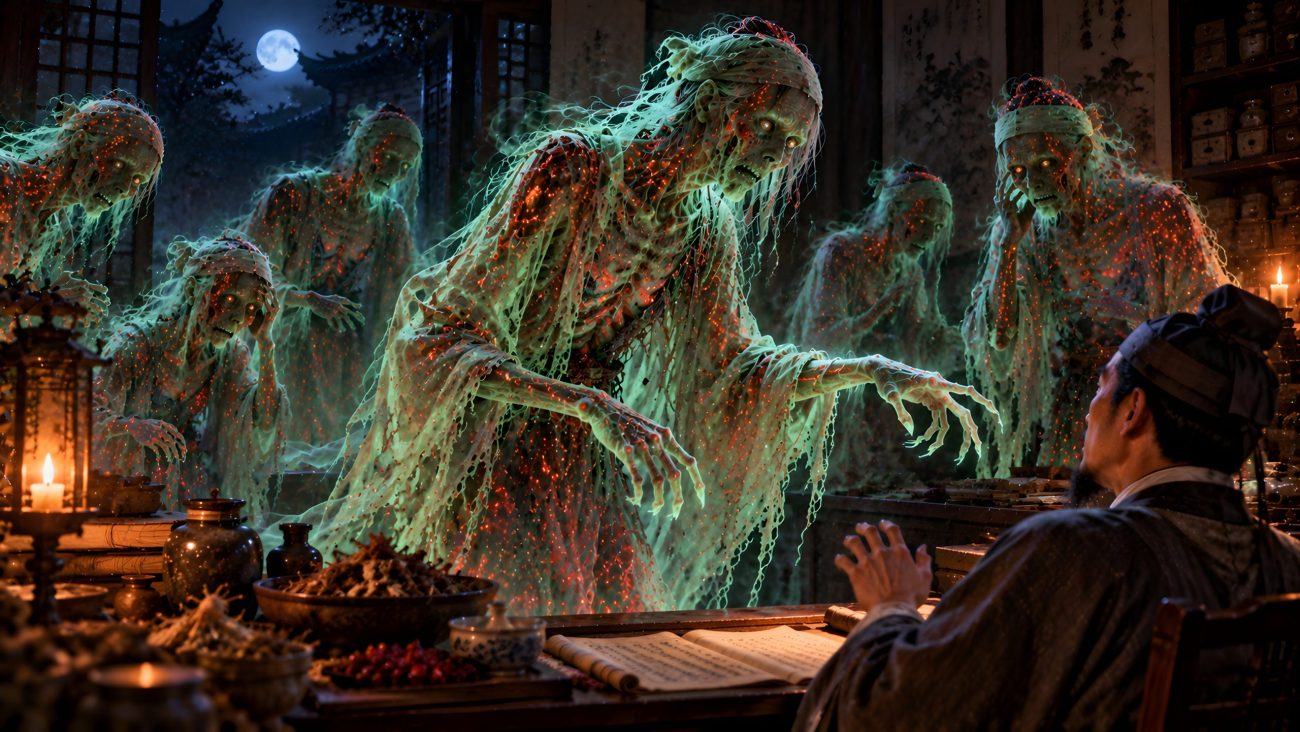
Bingui, the Sick Ghost, is a supernatural being associated with illness, ghostly patients, and encounters between the living and the dead. Tales about Bingui describe ghosts who suffer from ailments and seek medical treatment from human physicians. In some stories, a person renowned for his medical skill receives unexpected visitors at night, when ghosts arrive asking him to cure their illnesses. After receiving treatment, the spirits may feel deeply grateful for the physician’s kindness.

Other versions tell of physicians who treat ghosts but suffer misfortune as a result. One tale describes a person who is led by the ghosts of patients he had killed through mistaken treatment to the underworld, where he is beaten as punishment. These stories portray encounters with sick ghosts as dangerous, especially when a healer’s actions have caused suffering among the dead.

Stories of groups of sick ghosts seeking treatment also appear in Chinese supernatural literature. In these accounts, the boundary between medicine, death, and the underworld becomes blurred, as the living may be summoned to treat the dead or face consequences for their dealings with spirits.


Sources

“病鬼 (Bìngguǐ).” Chinese Wikipedia. Wikimedia Foundation. Accessed October 15, 2026. https://zh.wikipedia.org/wiki/%E7%97%85%E9%AC%BC


Baijia Ni

Tradition: Chinese Mythology
Alternative Names: Heavenly Ghost, Aoshani
Category: Ghost


The Myth

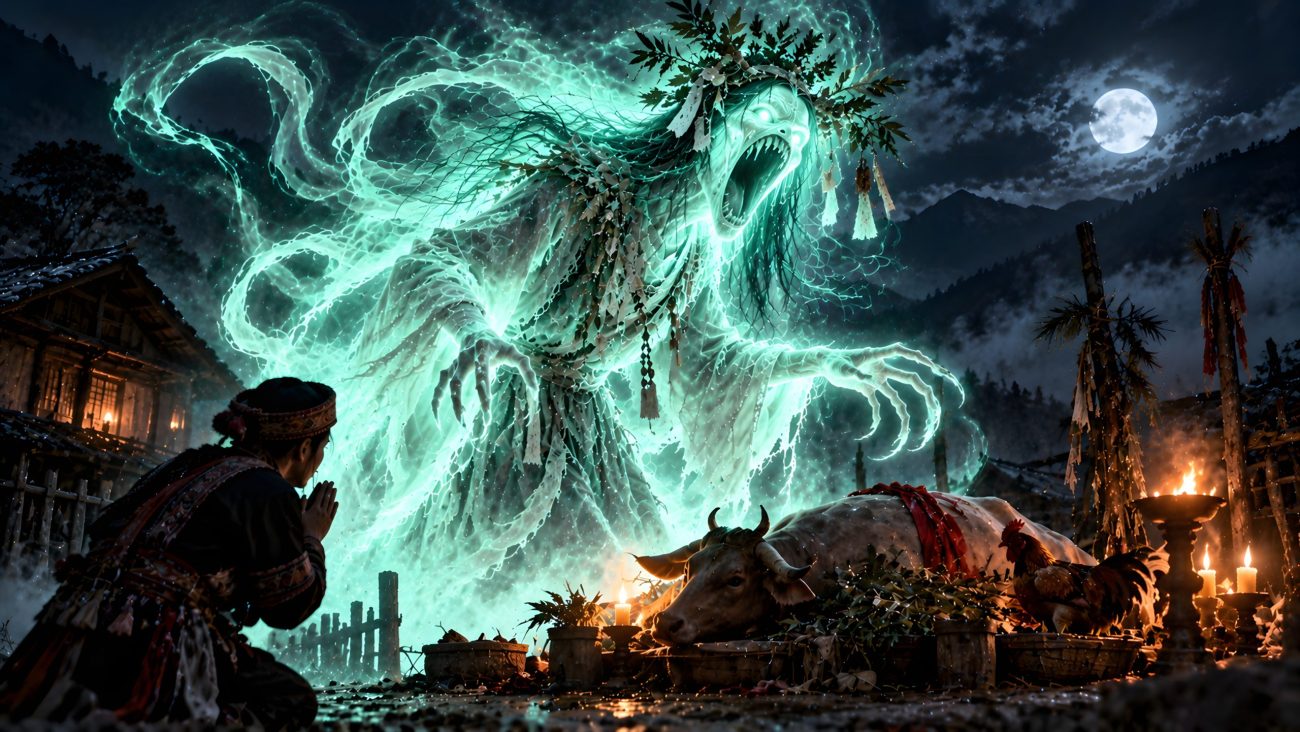
Baijia Ni, also known as the Heavenly Ghost or Aoshani, is a malevolent spirit in Lisu mythology that brings illness and suffering to the living. It can cause severe headaches, deafness, coughing, and other diseases. In the most serious cases, its influence can lead to death. It belongs to a wider group of supernatural beings known as Ni, the spirits feared by the Lisu people.

To appease Baijia Ni, people perform a sacrificial ritual involving the killing of a cow. A chicken must also be offered, with a rooster required when the sacrificed cow is a bull. The ritual includes specific plants and materials, such as poplar, pine, cypress, wild bamboo, and golden bamboo. These offerings are intended to address the spirit and protect people from the illnesses and misfortune it can bring.


Sources

“白加尼 (Báijiāní).” Chinese Wikipedia. Wikimedia Foundation. Accessed October 15, 2026. https://zh.wikipedia.org/wiki/%E7%99%BD%E5%8A%A0%E5%B0%BC


Datou Gui

Tradition: Chinese Mythology
Alternative Names: 大头鬼, Big-Headed Ghost
Category: Ghost


The Myth

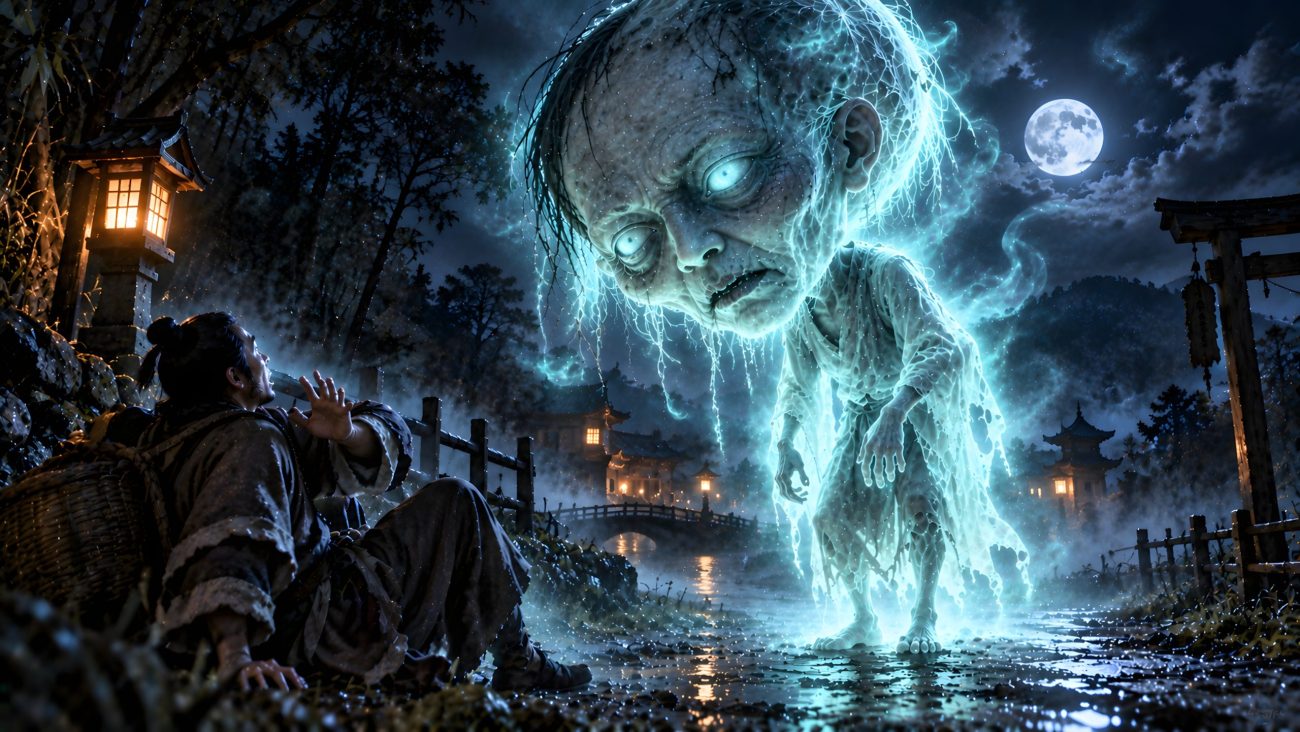
Datou Gui is a strange ghost from Chinese mythology, distinguished by its enormous head, which is far larger than an ordinary human head. It is often said to appear beside roads, where it shuffles along slowly because its oversized head is too heavy for it to move quickly. Its appearance varies between stories, but it is commonly portrayed as a human-like figure with a disproportionately large head, sometimes so enormous that it resembles a large jar or vessel.

Chinese tales describe Datou Gui in several unusual encounters. One legend tells of the scholar Fang Xiaoru frightening away a Big-Headed Ghost while reading late at night. Another story describes the official Yu Qian playing a trick on one. Other accounts portray ghosts whose heads are many times larger than their bodies, with faces as wide as windows or heads so enormous that they cannot fit through ordinary doorways.

Despite its frightening appearance, Datou Gui is not always portrayed as an omen of misfortune. In one account, encountering a Big-Headed Ghost is considered a sign that an imperial examination official will soon be promoted. These stories present the creature as an uncanny apparition whose immense head makes it both ridiculous and unsettling.


Sources

“大头鬼 (Dàtóuguǐ).” Chinese Wikipedia. Wikimedia Foundation. Accessed October 15, 2026. https://zh.wikipedia.org/wiki/%E5%A4%A7%E5%A4%B4%E9%AC%BC


Chai Gui

Tradition: Chinese Mythology
Alternative Names: 蠆鬼, Venom Ghost
Category: Ghost


The Myth

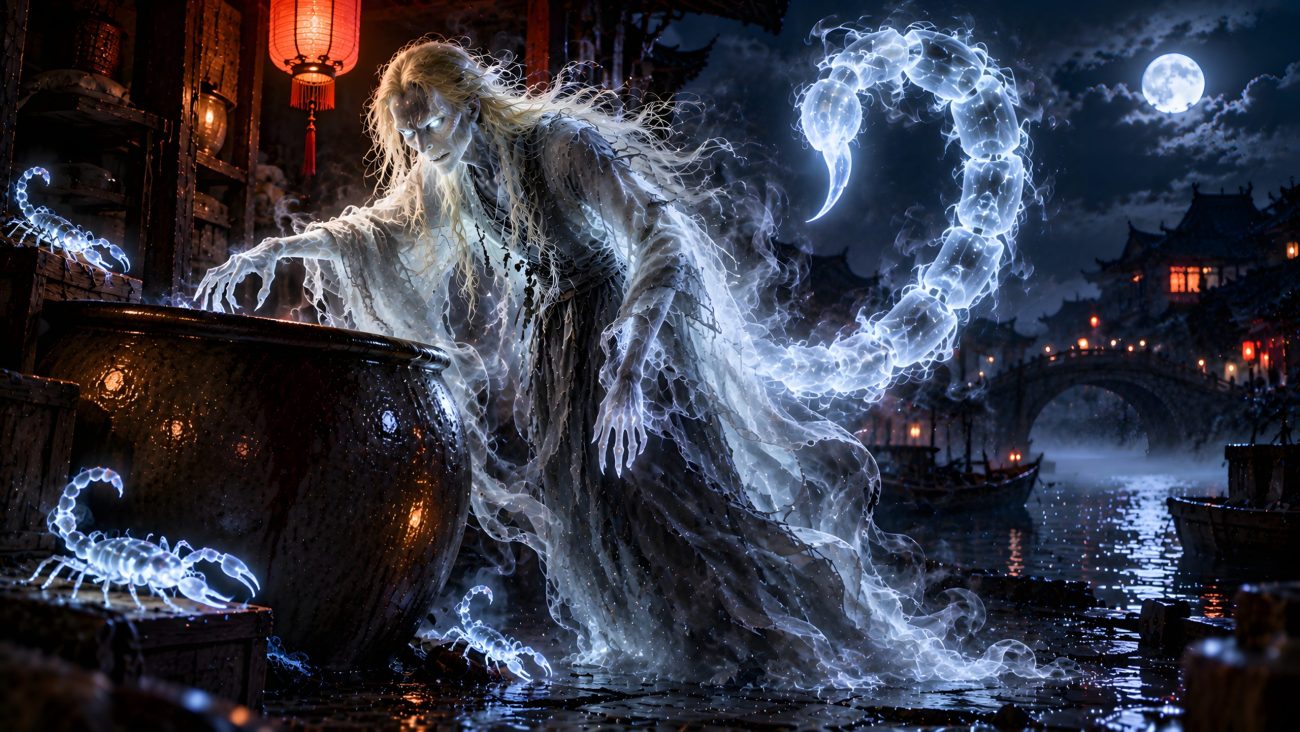
Chai Gui is a terrifying ghost described in the Chinese supernatural tale The Scorpion Merchant. It appears in human form, with yellow hair and an ugly, demonic face. Its name refers to venomous creatures such as snakes and scorpions, reflecting its sinister nature.

The legend tells of a merchant from the south who travelled from place to place selling scorpions every year. One year, when the merchant returned, he became strangely uneasy and sought refuge in a shop. Hoping to hide from whatever was troubling him, he climbed into a large vat and concealed himself inside. Shortly afterward, a frightening figure with yellow hair and a face like an evil spirit entered the shop, searching for the scorpion merchant.

Unable to find his intended victim, the yellow-haired figure eventually left. The shopkeeper then opened the vat to release the merchant, but the man had vanished. Inside, there was nothing but bloody water. The merchant had apparently been killed by the mysterious ghost, leaving behind no trace of his body. The story presents Chai Gui as a terrifying supernatural pursuer whose victims may disappear in a gruesome and inexplicable manner.


Sources

“蠆鬼.” Chinese Wikipedia. Wikimedia Foundation. Accessed October 15, 2026. https://zh.wikipedia.org/wiki/%E8%A0%86%E9%AC%BC


Headless Ghost Priest

Tradition: Swedish Mythology
Alternative Names: The Headless Priest of Hanger
Category: Ghost


The Myth

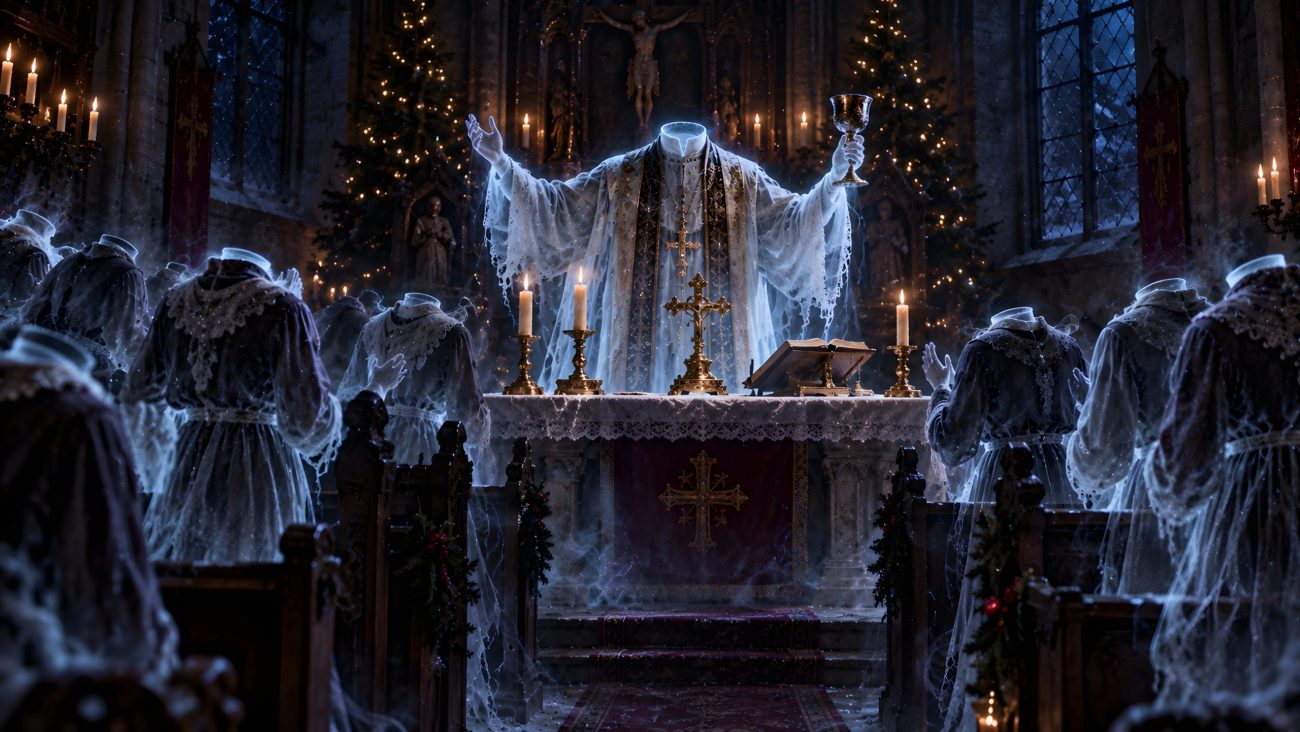
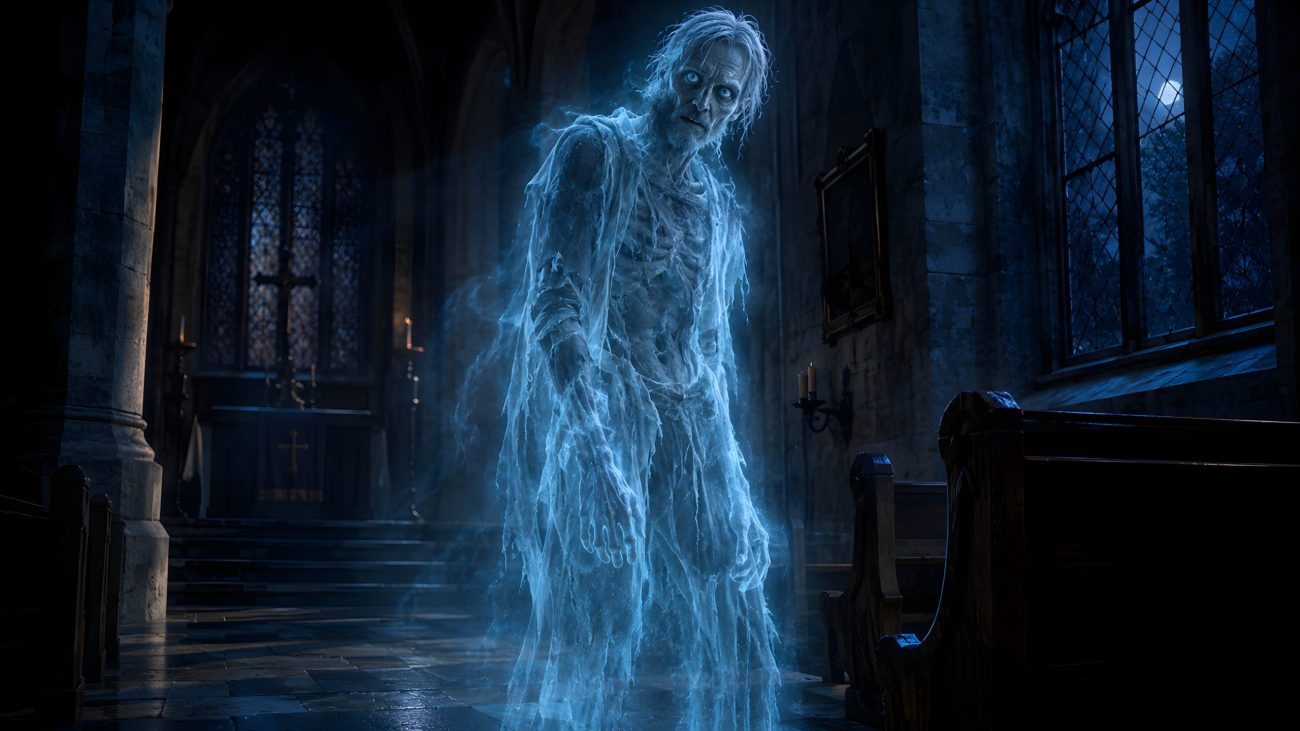
The Headless Ghost Priest appears during a phantom Christmas Mass at the church of Hanger in Sweden. He stands at the altar wearing full priestly vestments, but his head is entirely missing. The congregation gathered around him consists of headless specters, the spirits of the dead who return to worship during the night.

One Christmas night, a woman from the homestead of Vaderas rode to Hanger for Mass. After crossing a bridge where two witch trolls were washing, she reached the brightly illuminated church and entered, believing the Christmas service had begun. She sat in her usual place without immediately noticing anything unusual. Around her, the headless dead filled the pews, while the headless priest performed the service at the altar.

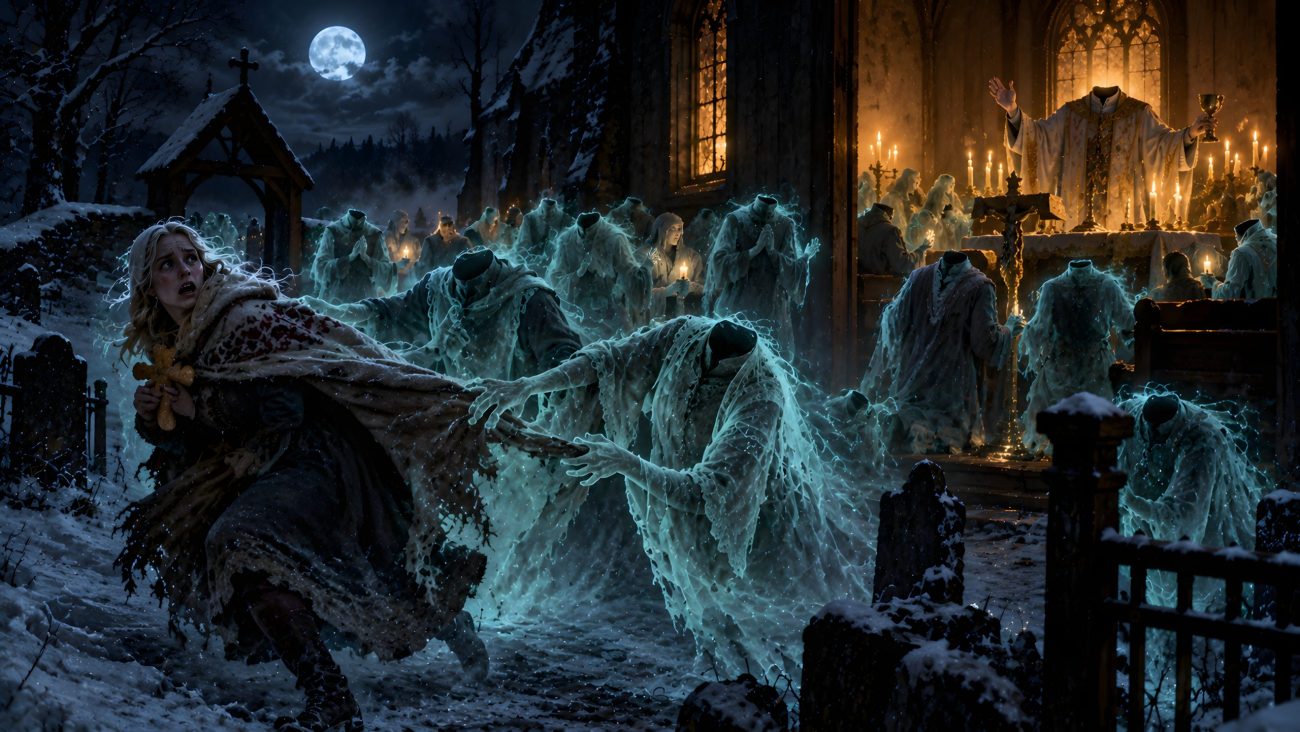
A mysterious voice warned the woman that she would have been killed had the speaker not been her godfather at her baptism. It urged her to flee before it was too late. Realizing that she had entered a gathering of the dead, the terrified woman rushed out of the church. In the churchyard, the specters seized her white woollen mantle, but she threw it off and escaped. By morning, fragments of her mantle had been found on every grave, revealing that the dead had torn it apart.

The Headless Ghost Priest belongs to the terrifying phantom service of the dead, a supernatural gathering that the living must never disturb. Those who encounter the ghostly congregation risk terrible consequences for trespassing upon the world of the dead.


Sources

Stroebe, Clara, ed. The Swedish Fairy Book. Translated by Frederick H. Martens, illustrated by George W. Hood. New York: Frederick A. Stokes Company, 1921. https://www.gutenberg.org/ebooks/37193


Yuletide Specters

Tradition: Swedish Mythology
Alternative Names: The Phantom Christmas Mass, The Service of the Dead
Category: Ghost


The Myth

At a homestead called Vaderas in Sweden, two women once agreed to ride together to Christmas night Mass. Since clocks were not available in those days, they decided that whichever woman woke at the right time would call for the other. Around midnight, one woman thought she heard her neighbor calling from outside her window, announcing that she was setting out. She hurriedly dressed, took a piece of bread shaped like a cross, and rode off to catch up with her companion. However, she could not find her anywhere along the road.

As she crossed a bridge over a stream flowing into Lake Vidostern, she encountered two witch trolls standing there and washing. One called to the other to hurry and tear the rider’s head from her shoulders. The second troll replied that she could not harm the woman because she carried a piece of cross-shaped bread in her pocket. Protected by the holy symbol, the woman continued her journey and eventually reached the church at Hanger alone.

The church blazed with lights, and the woman believed the Christmas service was already underway. She entered and sat in her usual place, but only then began to notice that something was terribly wrong. The congregation consisted entirely of headless figures, and the priest at the altar wore his full vestments but had no head. A voice warned her that she would have been killed had the speaker not stood as her godfather at her baptism. It urged her to flee immediately before it was too late.

The woman rushed out into the churchyard, where a crowd of specters surrounded her. They seized her broad white woollen mantle, but she threw it off and escaped to a nearby poorhouse, where she awakened the inhabitants. She remained there until the early Mass at four o’clock. When daylight arrived, people discovered that a small piece of her mantle lay on every grave in the churchyard, revealing that the dead had torn it apart.

A similar encounter befell a man and his wife who lived at a hut called Ingas, below Mosled. They arrived at Hanger believing that the service had begun, but found the church locked and barred. The phantom Mass was nearing its end, and they had disturbed the gathering of the dead. When the living congregation assembled for the actual service, pieces of grave earth were found scattered across the places where the specters had recently worshipped. The man and his wife subsequently fell gravely ill, punished, it was believed, for disturbing the dead during their Christmas service.


Sources

Stroebe, Clara, ed. The Swedish Fairy Book. Translated by Frederick H. Martens, illustrated by George W. Hood. New York: Frederick A. Stokes Company, 1921. https://www.gutenberg.org/ebooks/37193


Barrack Horse

Tradition: Belgian Mythology
Alternative Names: The Phantom Beast of the Falcon Barracks
Category: Horse


The Myth

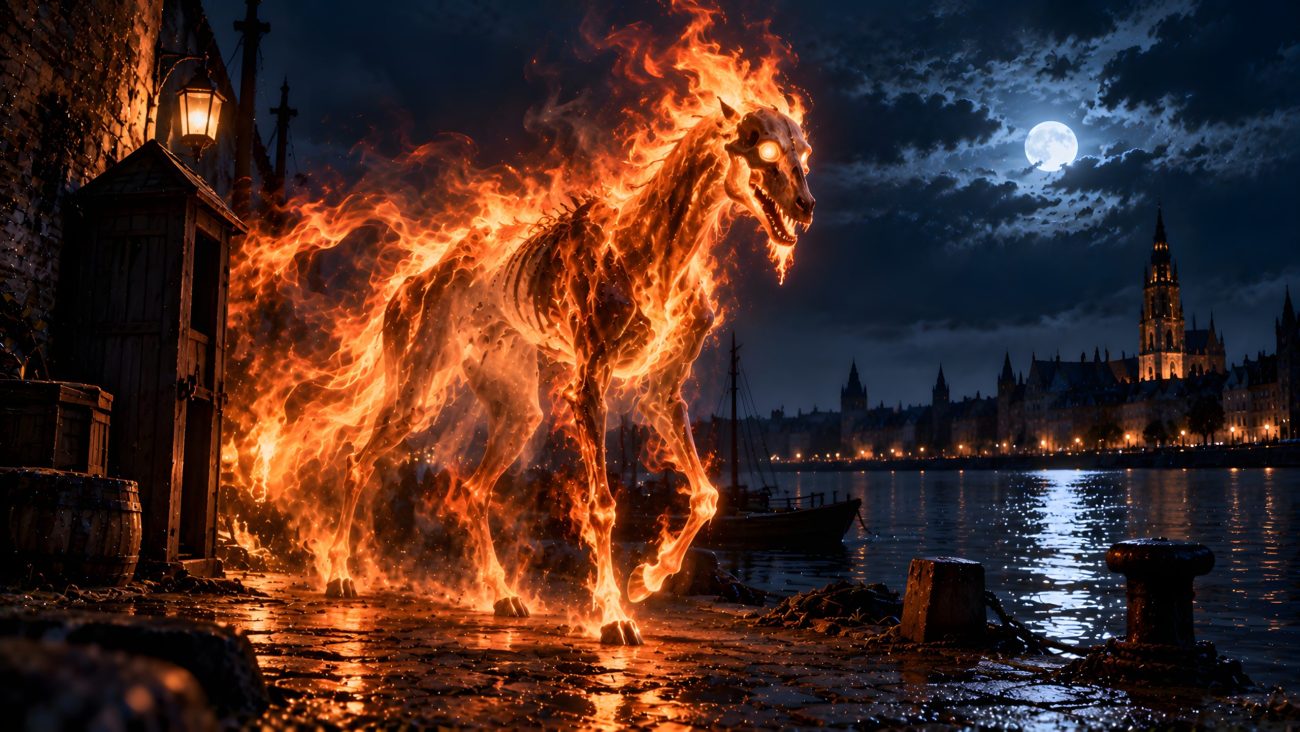
Around fifty years before the story was told, a soldier was stationed at the Falcon Barracks in Antwerp, where he and his fellow soldiers took turns guarding the banks of the Scheldt. During one eight-day period, three sentries disappeared while standing guard at the same spot beside the water. The soldiers suspected that the missing men had been thrown into the river, and fear spread throughout the barracks. Nobody dared to stand guard alone at that location anymore, so the military authorities ordered that two soldiers be stationed there together. From then on, no further incidents occurred, and eventually the soldiers forgot about the disappearances. The guard was once again reduced to a single man.

One night, while the narrator himself was on duty, a soldier came rushing into the guardroom at around one o’clock in the morning. His face was whiter than a wall, and he seemed close to death from fright. He explained that he had been standing inside his sentry box when a terrifying creature suddenly appeared beside him. It was about the size of a yearling foal and was completely engulfed in flames, with fire blazing across its entire body.

Overcome with terror, the soldier had abandoned his post and fled. His fear was so severe that he had to be put to bed and later carried to the hospital. Three days after the encounter, he died. The strange fiery beast was never explained, but its appearance brought the soldiers’ earlier fears back to life, leaving them to wonder whether a supernatural creature haunted the lonely stretch of riverbank.


Sources

De Cock, Alfons. Vlaamsche sagen uit den volksmond. Amsterdam: Maatschappij voor Goede en Goedkoope Lectuur, 1921.


Shirt of the Ghost

Tradition: Belgian Mythology
Alternative Names: The Ghost’s Shirt
Category: Ghost


The Myth

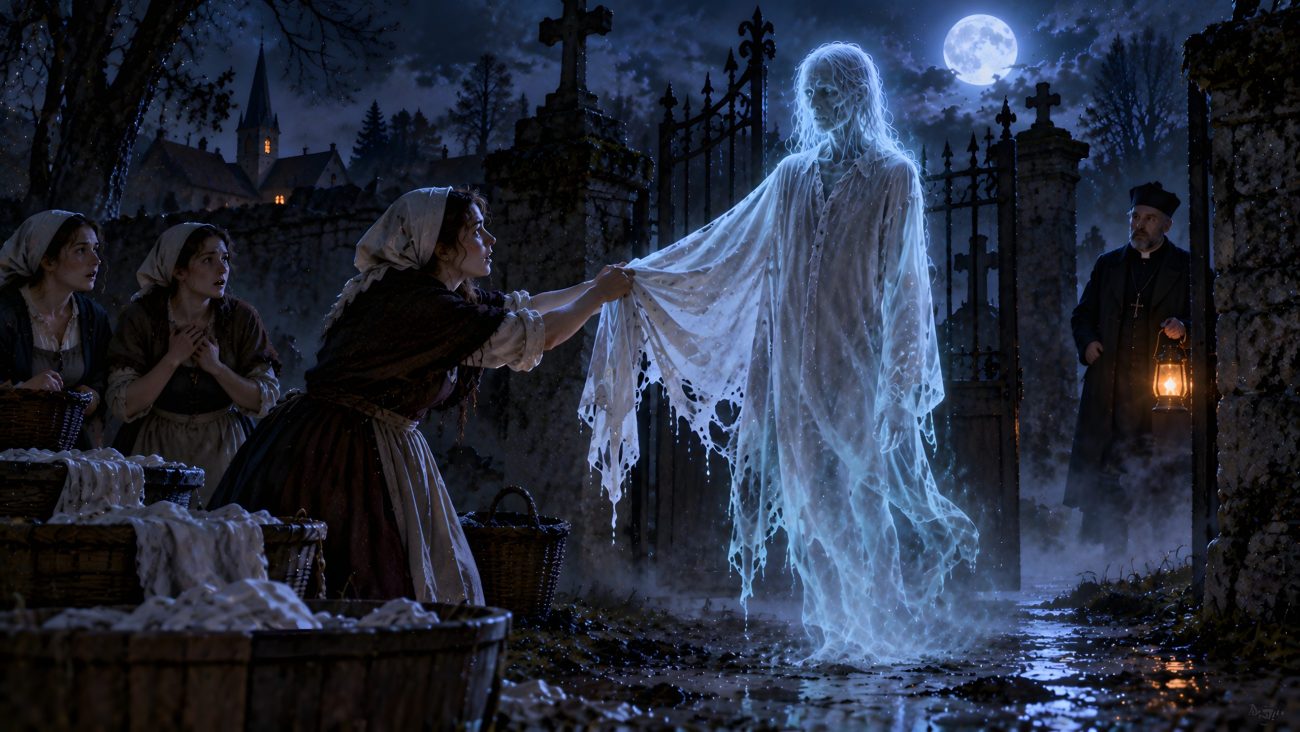
In Lebbeke, three women went out washing together every day. They began their work early in the morning, long before the sun appeared in the east. Whenever they passed the cemetery, they saw a mysterious figure standing before the entrance, wearing a white shirt. At first, the women were terrified, but after seeing the apparition so often, their fear gradually faded. They even began making mocking remarks, eventually convincing themselves that some prankster was dressing in white to frighten them.

The boldest of the three women decided that, given the next opportunity, she would pull the shirt straight off the mysterious figure’s body. A few days later, while the women were doing the washing at the priest’s house and passing the cemetery again, she carried out her plan. She seized the shirt, pulled it from the figure, and placed it in the washing tub with the other linen.

After Mass, the priest was walking through his garden when he noticed the linen laid out to bleach. One particular shirt caught his attention. Upon examining it more closely, he recognized it with horror as a ghost’s shirt. He hurried to the washing women to discover how it had come into their possession. The woman who had taken it was terrified when she learned what she had done. The priest ordered her to return the shirt to the ghost at exactly the same hour the following night. He promised to follow her from a distance and protect her from harm if necessary.

When the appointed hour arrived, the frightened woman approached the apparition with the priest following behind her. With a trembling heart, she placed the shirt back on the ghost. As soon as she had finished, the spirit turned toward her and spoke in a hollow voice, thanking her a thousand times. He explained that she had freed him from purgatory, where he had been condemned to return every night until someone removed his shirt and put it back on him. Having finally been released from his punishment, the ghost vanished and was never seen again.


Sources

De Cock, Alfons. Vlaamsche sagen uit den volksmond. Amsterdam: Maatschappij voor Goede en Goedkoope Lectuur, 1921.


Torre Jeppe

Tradition: Swedish Mythology
Alternative Names: The Undecaying Corpse
Category: Ghost


The Myth

Torre Jeppe was a restless spirit whose body sat night after night in the nave of a church. His corpse had dried out but could not decay, leaving him trapped between death and eternal rest. One night, three tailors were working at a nearby farmstead, laughing and joking with a girl who was known for her courage. They challenged her to enter the church, fetch Torre Jeppe, and bring him back to the farm. In exchange, they promised her a dress made of homespun wool. The girl accepted their offer and went to the church, where she lifted the dried-up corpse onto her back and carried him home.

When she arrived, she sat Torre Jeppe on a bench beside the tailors. The men immediately moved away in fear, but the corpse shuffled after them, staring at them with his large eyes until they were nearly driven out of their minds. Desperate to escape the apparition, the tailors begged the girl in God’s name to take him away again. They promised her another dress if she would return him to the church. She agreed, lifted Torre Jeppe onto her back once more, and carried him away.

However, when she tried to put him back in his original place, Torre Jeppe refused to release her. He wrapped his arms tightly around her neck and would not let go, no matter how many times she ordered him to. At last, he explained that he would free her only if she promised to visit a nearby brook that very night and call out three times: “Anna Perstochter, do you forgive Torre Jeppe?” The girl agreed, and he immediately released her.

Although the brook lay more than a mile away, the girl went there and called out the words three times. After the third call, a woman’s voice rose from the water and answered, “If God has forgiven him, then I, too, forgive him!” The girl returned to the church and told Torre Jeppe what the woman had said. Overjoyed, he thanked her and promised that she would receive her reward if she returned before sunrise.

At dawn, the girl came back and discovered a bushel of silver coins where Torre Jeppe had once sat. She also received the two dresses promised by the tailors. Torre Jeppe, however, had vanished and was never seen again. Having obtained forgiveness from the woman he had wronged, the restless dead man was finally released from his earthly torment and allowed to find eternal peace.


Sources

Stroebe, Clara, ed. The Swedish Fairy Book. Translated by Frederick H. Martens, illustrated by George W. Hood. New York: Frederick A. Stokes Company, 1921. https://www.gutenberg.org/ebooks/37193