Headless Ghost Priest

Tradition: Swedish Mythology
Alternative Names: The Headless Priest of Hanger
Category: Ghost


The Myth

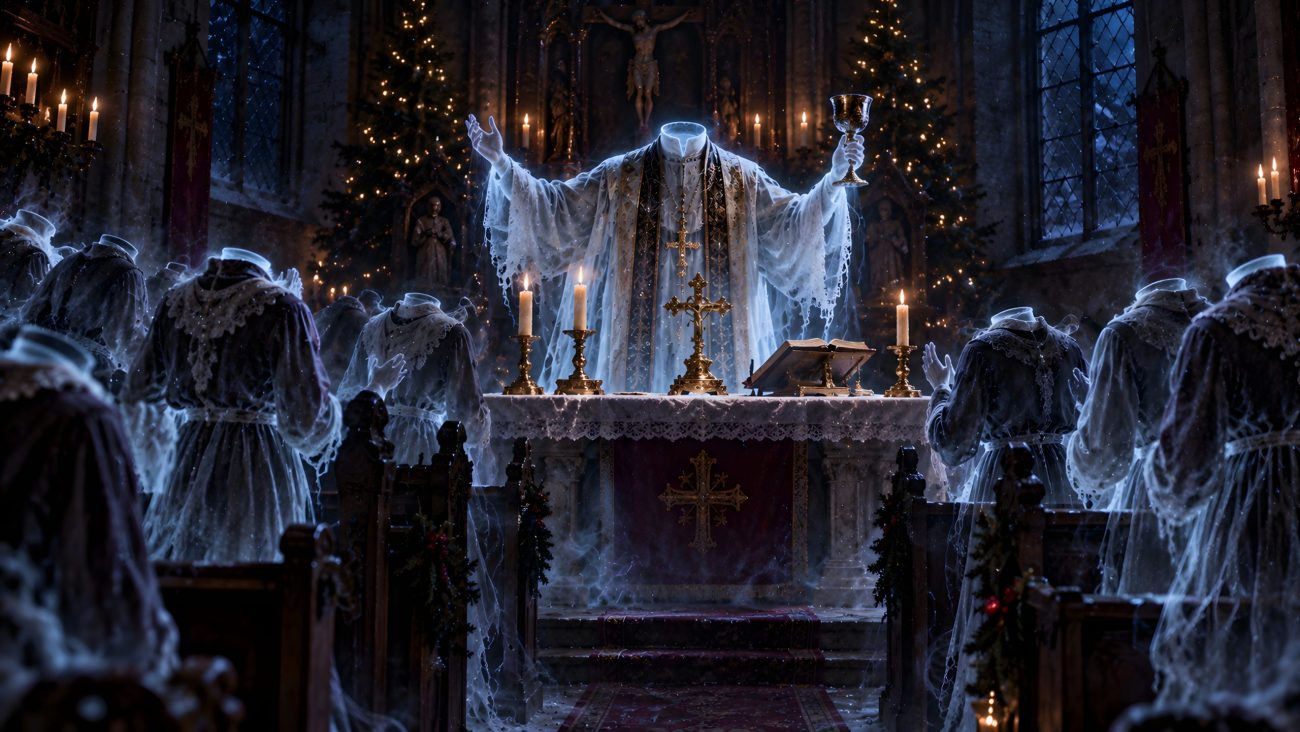
The Headless Ghost Priest appears during a phantom Christmas Mass at the church of Hanger in Sweden. He stands at the altar wearing full priestly vestments, but his head is entirely missing. The congregation gathered around him consists of headless specters, the spirits of the dead who return to worship during the night.

One Christmas night, a woman from the homestead of Vaderas rode to Hanger for Mass. After crossing a bridge where two witch trolls were washing, she reached the brightly illuminated church and entered, believing the Christmas service had begun. She sat in her usual place without immediately noticing anything unusual. Around her, the headless dead filled the pews, while the headless priest performed the service at the altar.

A mysterious voice warned the woman that she would have been killed had the speaker not been her godfather at her baptism. It urged her to flee before it was too late. Realizing that she had entered a gathering of the dead, the terrified woman rushed out of the church. In the churchyard, the specters seized her white woollen mantle, but she threw it off and escaped. By morning, fragments of her mantle had been found on every grave, revealing that the dead had torn it apart.

The Headless Ghost Priest belongs to the terrifying phantom service of the dead, a supernatural gathering that the living must never disturb. Those who encounter the ghostly congregation risk terrible consequences for trespassing upon the world of the dead.


Sources

Stroebe, Clara, ed. The Swedish Fairy Book. Translated by Frederick H. Martens, illustrated by George W. Hood. New York: Frederick A. Stokes Company, 1921. https://www.gutenberg.org/ebooks/37193
Yuletide Specters

Tradition: Swedish Mythology
Alternative Names: The Phantom Christmas Mass, The Service of the Dead
Category: Ghost


The Myth

At a homestead called Vaderas in Sweden, two women once agreed to ride together to Christmas night Mass. Since clocks were not available in those days, they decided that whichever woman woke at the right time would call for the other. Around midnight, one woman thought she heard her neighbor calling from outside her window, announcing that she was setting out. She hurriedly dressed, took a piece of bread shaped like a cross, and rode off to catch up with her companion. However, she could not find her anywhere along the road.

As she crossed a bridge over a stream flowing into Lake Vidostern, she encountered two witch trolls standing there and washing. One called to the other to hurry and tear the rider’s head from her shoulders. The second troll replied that she could not harm the woman because she carried a piece of cross-shaped bread in her pocket. Protected by the holy symbol, the woman continued her journey and eventually reached the church at Hanger alone.

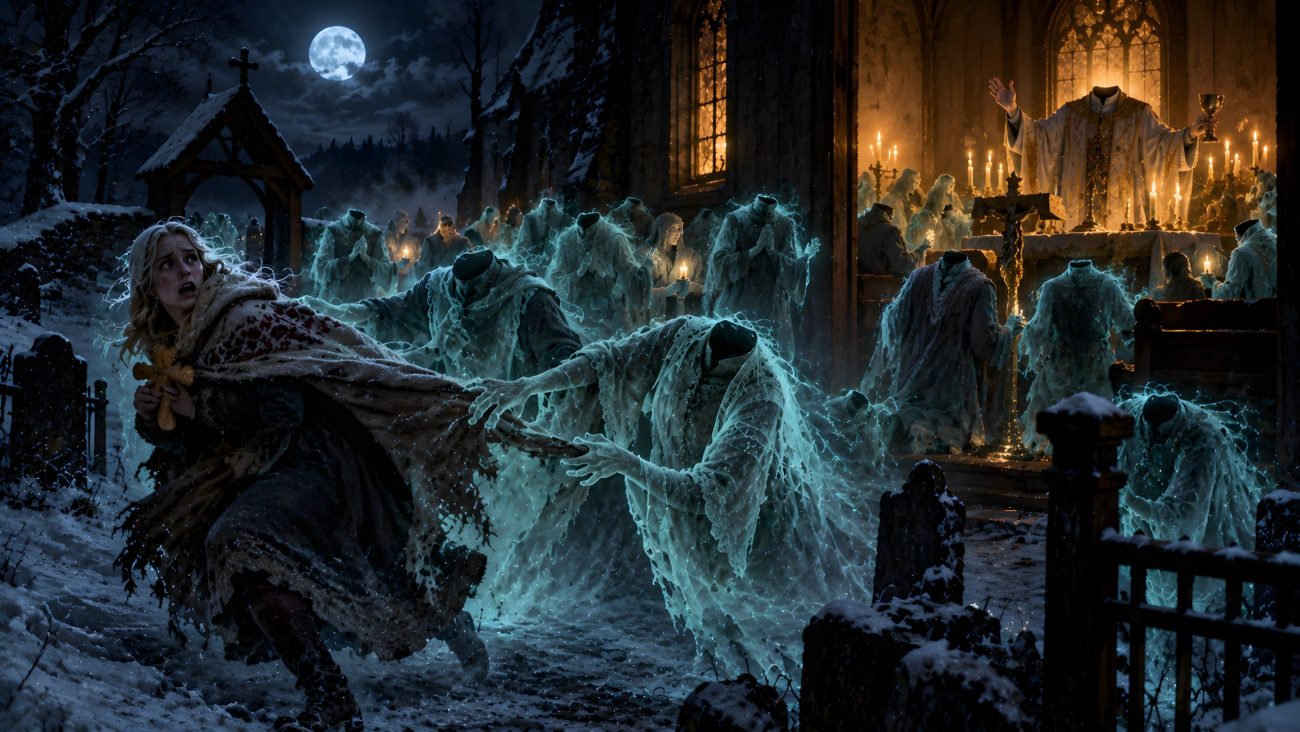
The church blazed with lights, and the woman believed the Christmas service was already underway. She entered and sat in her usual place, but only then began to notice that something was terribly wrong. The congregation consisted entirely of headless figures, and the priest at the altar wore his full vestments but had no head. A voice warned her that she would have been killed had the speaker not stood as her godfather at her baptism. It urged her to flee immediately before it was too late.

The woman rushed out into the churchyard, where a crowd of specters surrounded her. They seized her broad white woollen mantle, but she threw it off and escaped to a nearby poorhouse, where she awakened the inhabitants. She remained there until the early Mass at four o’clock. When daylight arrived, people discovered that a small piece of her mantle lay on every grave in the churchyard, revealing that the dead had torn it apart.

A similar encounter befell a man and his wife who lived at a hut called Ingas, below Mosled. They arrived at Hanger believing that the service had begun, but found the church locked and barred. The phantom Mass was nearing its end, and they had disturbed the gathering of the dead. When the living congregation assembled for the actual service, pieces of grave earth were found scattered across the places where the specters had recently worshipped. The man and his wife subsequently fell gravely ill, punished, it was believed, for disturbing the dead during their Christmas service.


Sources

Stroebe, Clara, ed. The Swedish Fairy Book. Translated by Frederick H. Martens, illustrated by George W. Hood. New York: Frederick A. Stokes Company, 1921. https://www.gutenberg.org/ebooks/37193


Torre Jeppe

Tradition: Swedish Mythology
Alternative Names: The Undecaying Corpse
Category: Ghost


The Myth

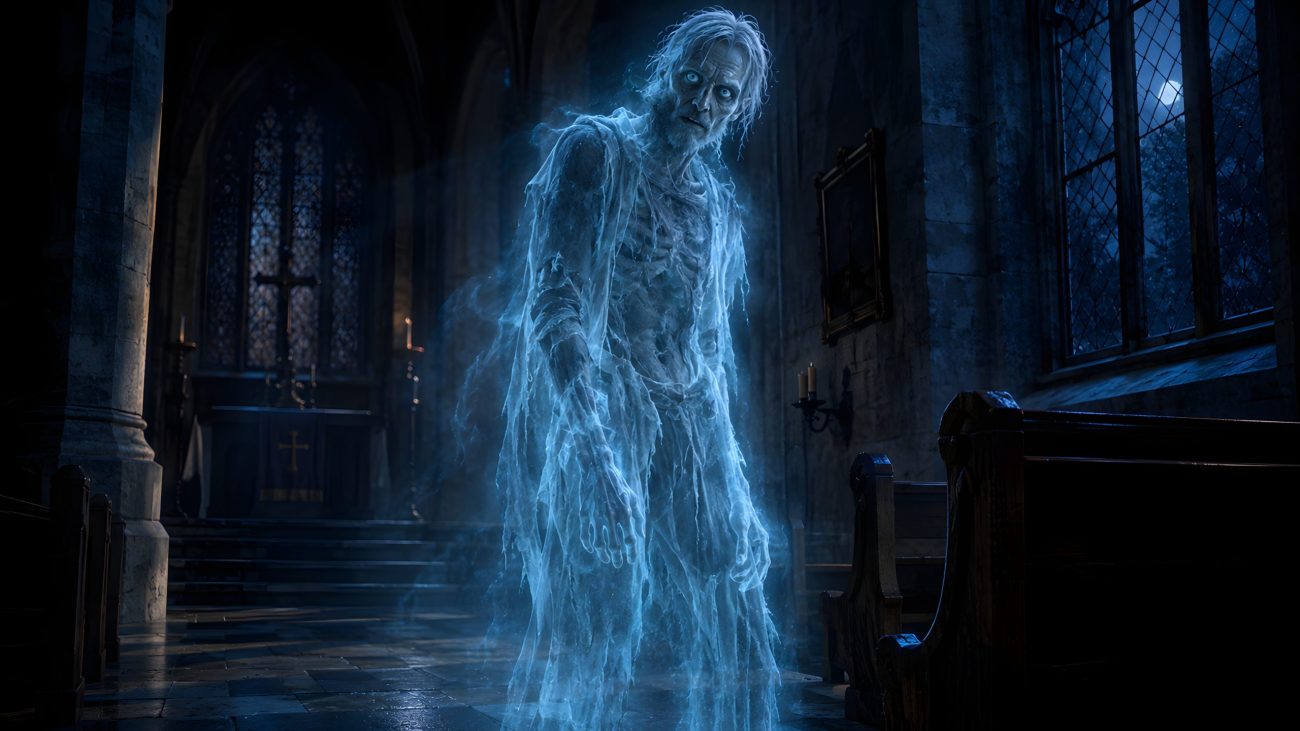
Torre Jeppe was a restless spirit whose body sat night after night in the nave of a church. His corpse had dried out but could not decay, leaving him trapped between death and eternal rest. One night, three tailors were working at a nearby farmstead, laughing and joking with a girl who was known for her courage. They challenged her to enter the church, fetch Torre Jeppe, and bring him back to the farm. In exchange, they promised her a dress made of homespun wool. The girl accepted their offer and went to the church, where she lifted the dried-up corpse onto her back and carried him home.

When she arrived, she sat Torre Jeppe on a bench beside the tailors. The men immediately moved away in fear, but the corpse shuffled after them, staring at them with his large eyes until they were nearly driven out of their minds. Desperate to escape the apparition, the tailors begged the girl in God’s name to take him away again. They promised her another dress if she would return him to the church. She agreed, lifted Torre Jeppe onto her back once more, and carried him away.

However, when she tried to put him back in his original place, Torre Jeppe refused to release her. He wrapped his arms tightly around her neck and would not let go, no matter how many times she ordered him to. At last, he explained that he would free her only if she promised to visit a nearby brook that very night and call out three times: “Anna Perstochter, do you forgive Torre Jeppe?” The girl agreed, and he immediately released her.

Although the brook lay more than a mile away, the girl went there and called out the words three times. After the third call, a woman’s voice rose from the water and answered, “If God has forgiven him, then I, too, forgive him!” The girl returned to the church and told Torre Jeppe what the woman had said. Overjoyed, he thanked her and promised that she would receive her reward if she returned before sunrise.

At dawn, the girl came back and discovered a bushel of silver coins where Torre Jeppe had once sat. She also received the two dresses promised by the tailors. Torre Jeppe, however, had vanished and was never seen again. Having obtained forgiveness from the woman he had wronged, the restless dead man was finally released from his earthly torment and allowed to find eternal peace.


Sources

Stroebe, Clara, ed. The Swedish Fairy Book. Translated by Frederick H. Martens, illustrated by George W. Hood. New York: Frederick A. Stokes Company, 1921. https://www.gutenberg.org/ebooks/37193