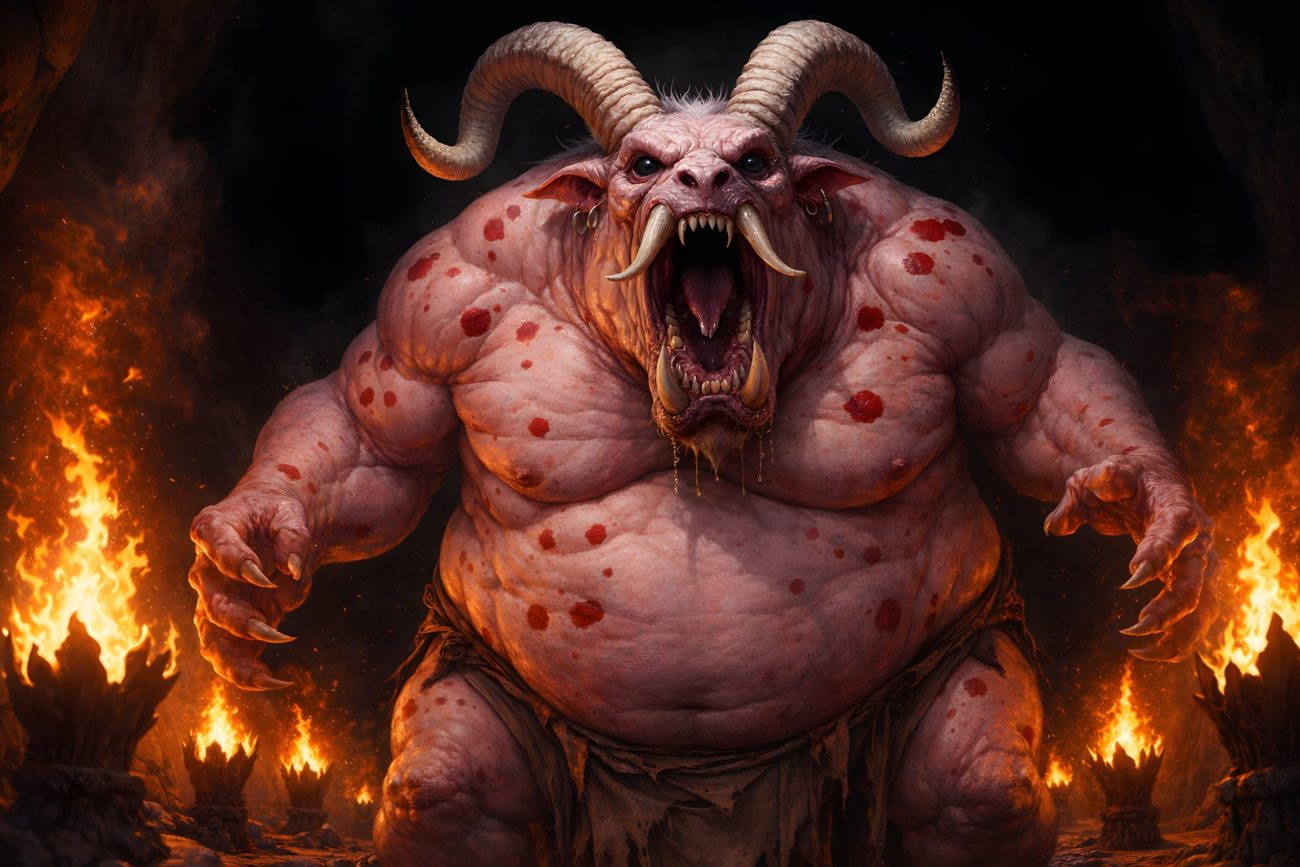
Buggane

Tradition / Region: Manx Mythology
Alternate Names: Boagane; Buggan ny Hushtey
Category: Mountain dweller, Ogre


The Myth

On the Isle of Man there once roamed a terrible being known as the Buggane—a great, hulking creature of malice and brute strength.

The Buggane was a shapeshifter. At times it appeared as a monstrous black calf, at others as a towering man with horse’s ears or hooves. In its truest and most dreadful shape it was covered in coarse black hair, with blazing eyes like torches and sharp tusks gleaming in its mouth. Some said it bore bull’s horns. It was so immense that it could tear the roof from a church as easily as a man might lift a hat.

Though powerful, the Buggane had its limits. It could not cross running water, nor could it stand upon ground made holy.

One tale tells of a Buggane that found itself accidentally carried away on a ship bound for Ireland. Furious at being taken from its island home, it whipped up a savage storm, driving the vessel toward the jagged rocks of Contrary Head. The terrified captain prayed to St. Trinian, promising to build him a chapel if they were spared. The saint guided the ship safely into Peel Harbour. Enraged, the Buggane roared, “St. Trinian shall never have a whole church in Ellan Vannin!”

True to its word, when a chapel was built in the saint’s honor, the Buggane tore its roof off—once, twice, three times—so that St. Trinian’s Church was never left complete.

Bugganes were not only destroyers of churches. They plagued farms and villages. One from Glen Maye nearly hurled a lazy housewife into a waterfall for neglecting her baking. She escaped only by slipping free of her apron strings. Another, at Gob-na-Scuit, ripped thatch from haystacks, blew smoke back down chimneys, and shoved sheep from steep grassy cliffs.

Some Bugganes lived by the sea in dark caves. The Buggan ny Hushtey was known for despising idleness, punishing those who shirked their work.

Most famous of all is the battle between the Buggane of Barrule and the Irish giant Fionn mac Cumhaill.

When Fionn came to the Isle of Man, the Buggane sought him out for combat. Fionn wished to avoid the fight, so his clever wife disguised him as a baby and laid him in a cradle. When the Buggane saw the size of the “child,” he thought, “If this is the baby, what size must the father be?” and withdrew—for a time.

But they did meet at last, near Kirk Christ Rushen. From sunrise to sunset they fought. Fionn planted one foot in the Big Sound and the other in the Little Sound, shaping the channels between the Calf of Man, Kitterland, and the main island as he struggled. The Buggane stood firm at Port Erin. In the end, the Buggane wounded Fionn so grievously that he fled toward Ireland.

The Buggane could not follow across the sea. Instead, it tore out one of its own teeth and hurled it after him. The tooth struck Fionn and fell into the water, becoming the jagged rock known today as Chicken Rock. Fionn turned and laid a mighty curse upon it, condemning it to remain there as a hazard for sailors as long as water runs and grass grows.

And so the Bugganes remain in Manx memory—wild, shape-shifting giants of fury and strength, feared for their violence and remembered in the land itself.


Gallery


Sources

Wikipedia contributors. (n.d.). Buggane. In Wikipedia, The Free Encyclopedia. Retrieved February 14, 2026, from https://en.wikipedia.org/wiki/Buggane


Interpretive Lenses

Religious Readings
  • Christian Ascetic Deep Dive
Philosophical Readings
  • Nietzschean Deep Dive
Psychological Readings
  • Jungian Deep Dive
Esoteric Deep Dive
  • Hermetic Deep Dive
Political / Social Readings
  • Marxist Deep Dive
Other
  • How to Invite The Buggane

Am fear liath mòr

Tradition / Region: Scottish Mythology
Alternate Names: Big Grey Man of Ben Macdui; The Greyman
Category: Mountain dweller


The Myth

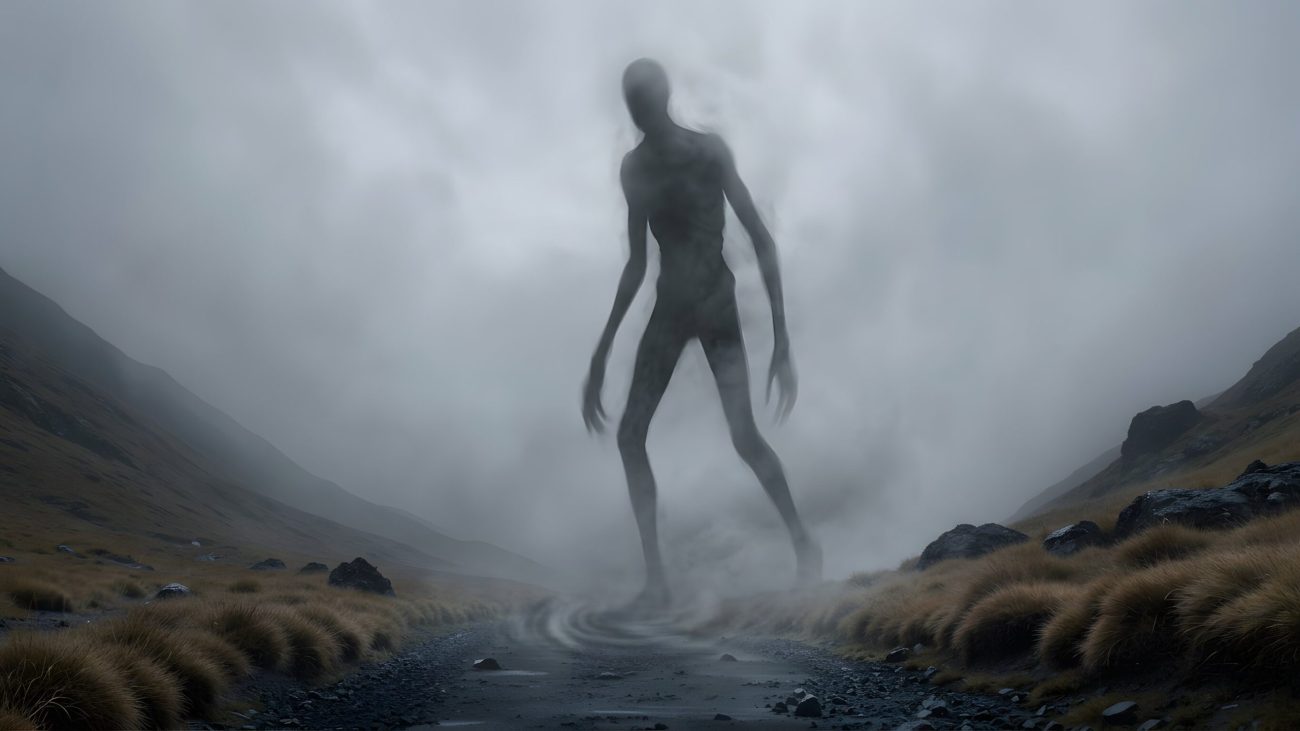
High among the mist-choked summits of Ben Macdui, in the Cairngorm Mountains, there is said to dwell a presence known as Am Fear Liath Mòr—the Big Grey Man.

He is rarely seen clearly. Those who encounter him most often speak not of sight, but of sound.

Climbers ascending the mountain alone in drifting fog begin to hear it: a crunch of gravel behind them. One heavy step. Then another. The stride is too long—three or four times the length of their own. When they stop, the steps stop. When they walk, it follows.

They turn, but the mist shows nothing.

The Greyman is said to be tall—far taller than any man—thin and looming, with long arms and broad shoulders. Some claim he stands over ten feet high. His skin and hair are dark, and he moves silently within the mountain’s fog. But most who feel his presence never see him clearly at all. Instead, they are overcome by an overwhelming dread, a certainty that something vast and watchful is near.

In 1891, a solitary climber descending from the summit cairn heard those immense footsteps trailing him in the mist. He tried to reason with himself, telling his mind it was nonsense. But the crunch, crunch continued. Terror seized him, and he fled blindly down the mountain, stumbling among boulders for miles before reaching the forest below. He swore never to return to the summit again.

Others have spoken of similar experiences. Brothers camping near the peak heard slurring footsteps circling their tent through the night, as if something paced them patiently in the dark. A rescue worker during the war felt the mist close in unnaturally tight around him and sensed pressure at his throat, as though unseen hands hovered near. Another man awoke to find a towering dark silhouette standing against the moonlight outside his tent.

One mountaineer claimed he saw a shape surge through the fog toward him. He fired his revolver at it, but the figure did not falter. He ran for his life, racing down the mountain in record time.

No photograph has ever captured the Greyman. Strange footprints once found in the snow proved to be the work of wind and meltwater. Yet the stories persist.

Some say the figure is nothing more than shadow and illusion—the Brocken spectre, a climber’s own enlarged form cast upon the mist by the rising sun. Others insist that something older and less easily explained roams the high passes.

Whatever he may be, the Big Grey Man remains in the fog of Ben Macdui, pacing silently behind those who dare to walk the summit alone.


Gallery


Sources

Wikipedia contributors. (n.d.). Am Fear Liath Mòr. In Wikipedia, The Free Encyclopedia. Retrieved February 14, 2026, from https://en.wikipedia.org/wiki/Am_Fear_Liath_M%C3%B2r


Interpretive Lenses

Religious Readings
  • Christian Ascetic Deep Dive
Philosophical Readings
  • Nietzschean Deep Dive
Psychological Readings
  • Jungian Deep Dive
Esoteric Deep Dive
  • Hermetic Deep Dive
Political / Social Readings
  • Marxist Deep Dive
Other
  • How to Invite The Am fear liath mòr

Kidoku

Tradition / Region: Japanese Mythology
Alternate Names: Oni-doku
Category: Mountain dweller, Demon


The Myth

On the thirteenth day of the eighth month in the second year of Kan’en (1749), a strange and terrifying event took place in Soma County of Hitachi Province.

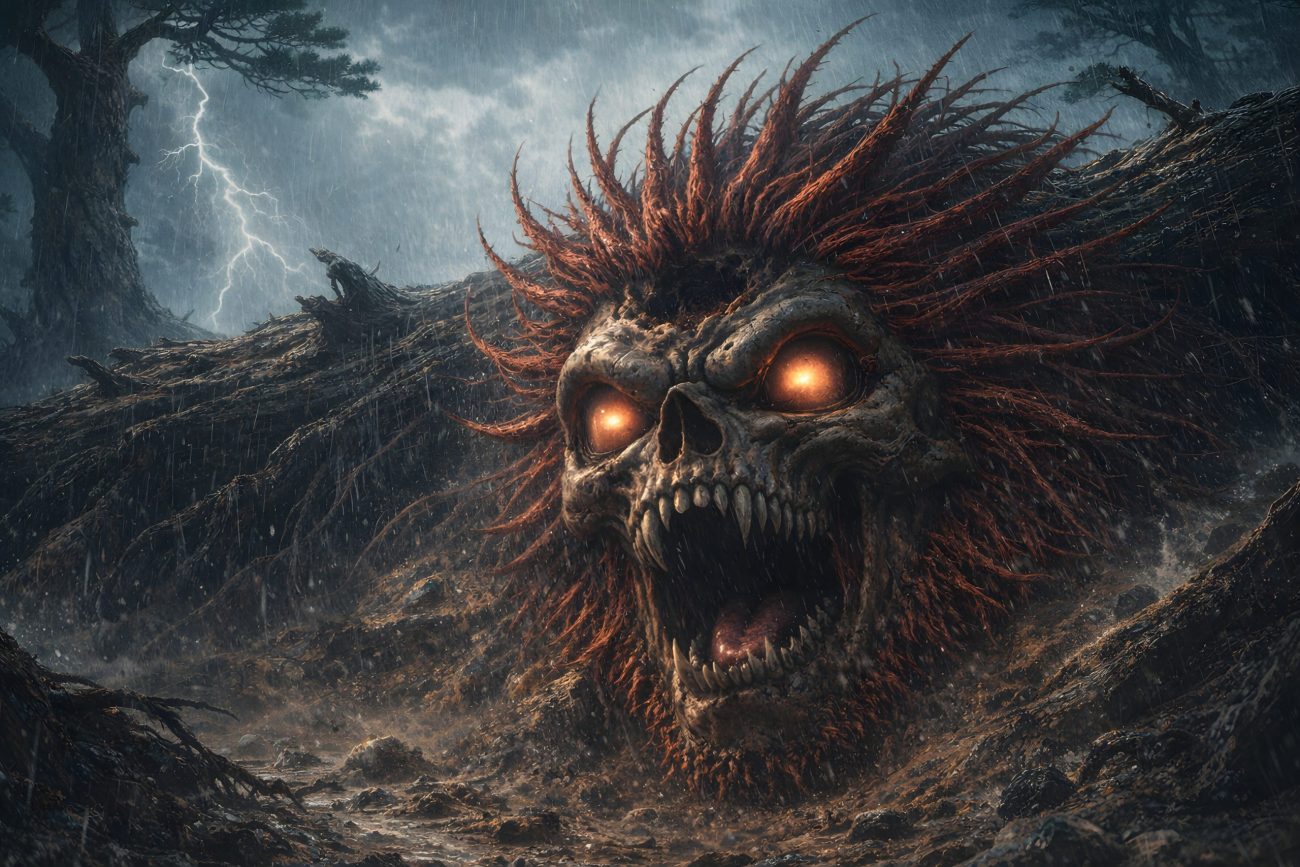
Atop Mount Masakado stood an ancient pine tree. It was said to have grown there since the days of Taira no Masakado, its roots gripping the mountain for generations. But that year, long and relentless rains soaked the land. The mountain soil eroded, and floodwaters rushed down its slopes, exposing the roots of the old pine. Then a fierce wind arose and toppled the great tree from its base.

When the pine fell, something was revealed beneath its roots.

Buried in the earth lay a monstrous being—what people called a “Kidoku,” a Demon Slayer, though no one knew its true nature. As the rain beat down upon it, the creature awoke and began to scream.

Its cries echoed across the castle town below. The sound was so dreadful that men, women, and children alike were seized with terror. Some collapsed where they stood. Others fled indoors, covering their ears. The wailing did not cease.

The castle’s commander gathered a rifle squad and marched to the mountain. The creature, fully exposed now, writhed and shrieked beneath the fallen pine. It was immense—said to be the size of eight tatami mats laid side by side.

Those who saw it described a form like a monstrous ogre mixed with a crab. Its eyes were round and bowl-like, shining with an eerie light. The top of its head was sunken inward. Crimson hair, stiff and sharp like palm leaves, bristled from its scalp, and beneath its chin grew spiky strands like thorns. Its teeth were bared in rage.

The riflemen fired again and again. After several shots, the monster finally fell silent.

Thus the Kidoku was slain, and the mountain returned to stillness. But people long remembered the day when the ancient pine fell, and a screaming demon rose from the earth beneath its roots.


Gallery


Sources

tyz-yokai.blog.jp contributors. (n.d.). Kidoku. In tyz-yokai.blog.jp, from https://tyz-yokai.blog.jp/archives/1077741605.html


Interpretive Lenses

Religious Readings
  • Christian Ascetic Deep Dive
Philosophical Readings
  • Nietzschean Deep Dive
Psychological Readings
  • Jungian Deep Dive
Esoteric Deep Dive
  • Hermetic Deep Dive
Political / Social Readings
  • Marxist Deep Dive
Other
  • How to Invite The Kidoku

Grand mononoke

Tradition / Region: Japanese Mythology
Alternate Names: Gurannumono no Kai
Category: Mountain dweller


The Myth

In the mountains of Tohoku there is said to dwell a vast and terrible being known as the Grand Mononoke.

Long ago, in a remote region whose name was later said to echo that of a foreign missionary who once passed through during the Azuchi–Momoyama period, strange rumors began to spread. Shepherds whispered of livestock vanishing without a trace. Hunters spoke of something immense moving through the forest with unnatural speed. Yet no ordinary beast could have done such things.

The creature was described as a fusion of many spirits, as if the mountain itself had gathered its most fearsome yokai and bound them into one body. It stretched ten meters in length. Its form seemed to combine the long coils of a giant serpent, the cunning face of a shapeshifting cat, the features of a tengu, and the watery hints of a kappa. It was neither one thing nor another, but a union of spirits.

Despite its enormous size, the Grand Mononoke moved swiftly. When hunger stirred it, it descended from its hidden lair to seize cattle or horses, carrying them off into the forest to be devoured. These attacks were rare but unforgettable.

Most of the time, however, it remained secluded deep in the mountains. It did not wander openly, nor did it terrorize villages without reason. Because of its reclusive nature and overwhelming presence, the people came to regard it not only with fear but with reverence. Some believed it was no mere monster but a mountain god in a terrible form. Offerings were made in quiet places. Prayers were whispered to appease it.

Thus the Grand Mononoke became a hidden sovereign of the high peaks—an emperor of demons who ruled unseen, dwelling in shadow, appearing only when the balance between humans and the wild was disturbed.


Gallery


Sources

tyz-yokai.blog.jp contributors. (n.d.). Grand Mononoke. In tyz-yokai.blog.jp, from https://tyz-yokai.blog.jp/archives/1073956690.html


Interpretive Lenses

Religious Readings
  • Christian Ascetic Deep Dive
Philosophical Readings
  • Nietzschean Deep Dive
Psychological Readings
  • Jungian Deep Dive
Esoteric Deep Dive
  • Hermetic Deep Dive
Political / Social Readings
  • Marxist Deep Dive
Other
  • How to Invite The Grand mononoke

Badalisc

Tradition / Region: Italian Mythology
Alternate Names:
Category: Mountain dweller, Sheep


The Myth

High in the southern Alps, around the village of Andrista, there is said to live a strange creature called the Badalisc. It dwells in the dark forests above the settlement, hidden among rocks, snow, and twisted trees. It has a great head wrapped in goat skin, small horns, a vast gaping mouth, and glowing eyes that shine in the night.

The Badalisc does not live quietly. Throughout the year it troubles the people of the village. It lurks in the woods, watching, listening, knowing their secrets. Though rarely seen, its presence is felt—mischief, unease, whispers of wrongdoing. The villagers know it must be dealt with.

So every year, on the eve of Epiphany, when winter lies deep upon the mountains, the men of the village go out to capture the creature.

They enter the forest masked and disguised. Among them are hunters, sweepers who clear the way, an old man and old woman, a hunchback who strikes the ground with his stick, and a young maiden who serves as bait, for the Badalisc is said to be stirred by desire. After searching the woods, they bind the creature with a rope and drag it down from the mountains into the village.

It is led into the square before the gathered community.

The Badalisc itself does not speak. It is wild and dumb. But through an interpreter its words are given voice. A long speech is read aloud—its “confession.” In this speech the creature reveals the hidden faults, scandals, petty sins, and foolish schemes of the villagers. Nothing escapes it. It mocks, exposes, and ridicules the community. As the words are spoken, the hunchback beats his stick rhythmically, marking the weight of each accusation.

The villagers listen. They laugh, they wince, they recognize themselves in the creature’s gossip.

When the speech is finished, the mood shifts. Singing begins. Dancing follows. Food is shared, especially the great dish of polenta prepared for the occasion. The Badalisc sits in a place of honor during the feast, no longer a menace but part of the celebration.

On the following day, its time among humans ends. The rope is removed. The Badalisc is released and allowed to return to the forest, back to its mountain home.

There it waits through another year—watching, listening, gathering secrets—until once again winter comes, and the villagers climb into the woods to bring it down.


Gallery


Sources

Wikipedia contributors. (n.d.). Badalisc. In Wikipedia, The Free Encyclopedia. Retrieved February 14, 2026, from https://en.wikipedia.org/wiki/Badalisc


Interpretive Lenses

Religious Readings
  • Christian Ascetic Deep Dive
Philosophical Readings
  • Nietzschean Deep Dive
Psychological Readings
  • Jungian Deep Dive
Esoteric Deep Dive
  • Hermetic Deep Dive
Political / Social Readings
  • Marxist Deep Dive
Other
  • How to Invite The Badalisc

Pichal peri

Tradition / Region: Indian Mythology, Pakistani Mythology
Alternate Names: Pichhal pairī
Category: Mountain dweller


The Myth

In the mountains and forests of northwestern South Asia there wanders a being called the Pichal peri—the reverse-footed woman. By day she is unseen, but at night, when mist coils between trees and lonely paths wind through the hills, she appears.

At first she seems beautiful. A young woman stands alone beneath the trees, her long black hair flowing over her face. She may be weeping softly, or calling gently for help. Travelers who see her often feel compelled to approach, thinking her lost or in need of protection.

But there is one sign that betrays her true nature.

Her feet are turned backward.

Those who notice too late say that she walks smoothly despite this unnatural form, gliding over the earth without sound. When a man draws near, she lifts her face from behind the curtain of her hair. Her beauty may seem perfect—until the moment she reveals her true shape.

In some tales, her form stretches and twists into something tall and monstrous. Her limbs grow long, her face contorts, and her voice becomes inhuman. In others, she remains outwardly fair, luring her victim deeper into the forest before striking. She preys especially on lone men who wander at night, separating them from the safety of village and firelight.

Most stories are told by those who claim to have escaped. A traveler may notice her reversed footprints in the dust, or glimpse her transformation just in time to flee. Some say she cannot cross certain boundaries, or that calling upon divine names will break her hold. Others insist that once she fixes her gaze upon a man, his fate is sealed.

In the villages of the Punjab and the mountainous regions of Khyber Pakhtunkhwa and the Himalayas, elders warn the young not to roam alone after dark. For somewhere in the night woods, a woman with backward feet may be waiting—her hair hiding her face, her steps leaving tracks that lead the wrong way.


Gallery


Sources

Wikipedia contributors. (n.d.). Pichal Peri. In Wikipedia, The Free Encyclopedia. Retrieved February 14, 2026, from https://en.wikipedia.org/wiki/Pichal_Peri


Interpretive Lenses

Religious Readings
  • Christian Ascetic Deep Dive
Philosophical Readings
  • Nietzschean Deep Dive
Psychological Readings
  • Jungian Deep Dive
Esoteric Deep Dive
  • Hermetic Deep Dive
Political / Social Readings
  • Marxist Deep Dive
Other
  • How to Invite The Pichal peri

Nai tiki

Tradition / Region: Fijian mythology
Alternate Names:
Category: Forest dweller


The Myth

In the deep forests and high mountains of Fiji there is said to dwell a being called Nai Tiki, a creature neither fully man nor fully beast. Those who claim to have glimpsed him describe a powerful figure moving between the trees with unnatural speed, his form shifting between human outline and animal shadow.

Nai Tiki lives far from villages, in the wild places where thick roots twist across the earth and mist clings to the ridges. Hunters speak of sudden silence in the forest before his passing. Birds cease their calls. Leaves shudder though no wind blows. Then a shape darts through the undergrowth—faster than any boar, stronger than any warrior.

It is said that Nai Tiki possesses immense strength. He can uproot trees, split stones, and cross valleys in moments. No one can outrun him. Yet he does not appear without purpose. Some say he watches over the balance of the land, punishing those who disrespect the forest. Others whisper that he is unpredictable, dangerous to any who wander too far alone.

Nai Tiki is also believed to command the sky itself. When drought grips the land, sudden rain may fall after his presence is sensed in the hills. When storms threaten, the clouds may part without warning. Elders tell of times when the sun blazed after days of darkness, and they would murmur that Nai Tiki had chosen to calm the heavens.

Few have survived close encounters. Those who return speak in hushed voices of glowing eyes in the shadowed canopy and the feeling of being measured by something ancient and wild. Whether guardian or menace, Nai Tiki remains a powerful presence in the stories of Fiji—a reminder that the forests and mountains are not empty, and that forces older than mankind still move within them.


Gallery


Sources

mythicalencyclopedia.com contributors. (n.d.). Fiji mythical creatures. In mythicalencyclopedia.com, from https://mythicalencyclopedia.com/fiji-mythical-creatures/


Interpretive Lenses

Religious Readings
  • Christian Ascetic Deep Dive
Philosophical Readings
  • Nietzschean Deep Dive
Psychological Readings
  • Jungian Deep Dive
Esoteric Deep Dive
  • Hermetic Deep Dive
Political / Social Readings
  • Marxist Deep Dive
Other
  • How to Invite The Nai tiki

Karnabo

Tradition / Region: French Mythology
Alternate Names:
Category: Mountain dweller


The Myth

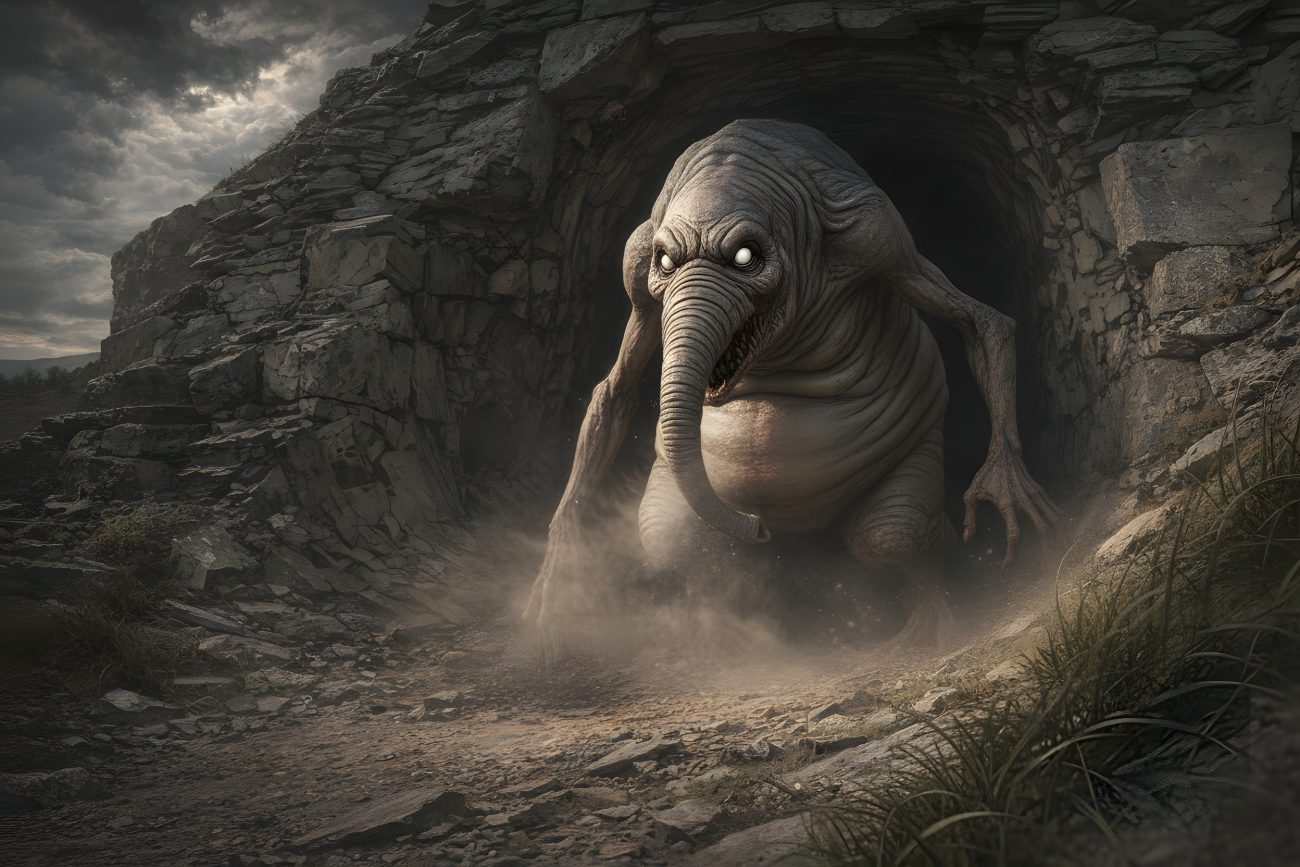
On the Rocroi plateau near the village of Regniowez lies an abandoned slate quarry, its entrance sealed and avoided. The people of the Ardennes say that within that dark place lives the Karnabo.

The Karnabo is a creature dreadful to behold. Its shape is almost human, yet twisted and unnatural. Its eyes gleam like those of a basilisk, cold and deadly. From its face hangs a long, trunk-like nose, and when it breathes, it produces a terrible whistling through its nostrils.

It is said that the Karnabo came long ago from the region of Rièzes. Some whisper that it was born of an itinerant sorcerer and an aged ghoul, conceived in secrecy and raised in shadow. From its father it inherited dark powers; from its mother, a hunger for harm. Its crimes are too many to count.

The whistling of the Karnabo is feared above all. When it echoes across the plateau, anyone foolish enough to wander near the quarry feels their limbs grow stiff, their breath catch in their throat. Some fall paralyzed. Others suffocate where they stand. Livestock that stray too close are found lifeless, as if struck down by the sound alone.

Yet the creature is not only a bringer of harm. On Good Fridays, it is said to chant strange formulas learned from its sorcerer father. With these whispered spells, it can cure certain afflictions of the flesh. Those brave—or desperate—enough to approach the sealed quarry on that holy day might find relief from illness, though they risk never returning.

Once, a young girl wandered near the quarry, daring to play where she had been warned never to go. As she neared the tunnel’s entrance, the Karnabo sprang from the darkness and dragged her underground. She was never seen again.

After that, the entrance to the quarry was sealed.

On stormy nights, when wind sweeps across the Rocroi plateau, villagers say they still hear it: the nasal roaring of the Karnabo rising from beneath the earth—and the faint, sorrowful sobbing of the girl echoing in the dark.


Gallery


Sources

abookofcreatures.com contributors. (n.d.). Karnabo. In abookofcreatures.com, from https://abookofcreatures.com/2021/03/19/karnabo/


Interpretive Lenses

Religious Readings
  • Christian Ascetic Deep Dive
Philosophical Readings
  • Nietzschean Deep Dive
Psychological Readings
  • Jungian Deep Dive
Esoteric Deep Dive
  • Hermetic Deep Dive
Political / Social Readings
  • Marxist Deep Dive
Other
  • How to Invite The Karnabo

Isitwalangcengce

Tradition / Region: Zulu mythology, South African Mythology
Alternate Names: Basket-bearer
Category: Mountain dweller, Hyena


The Myth

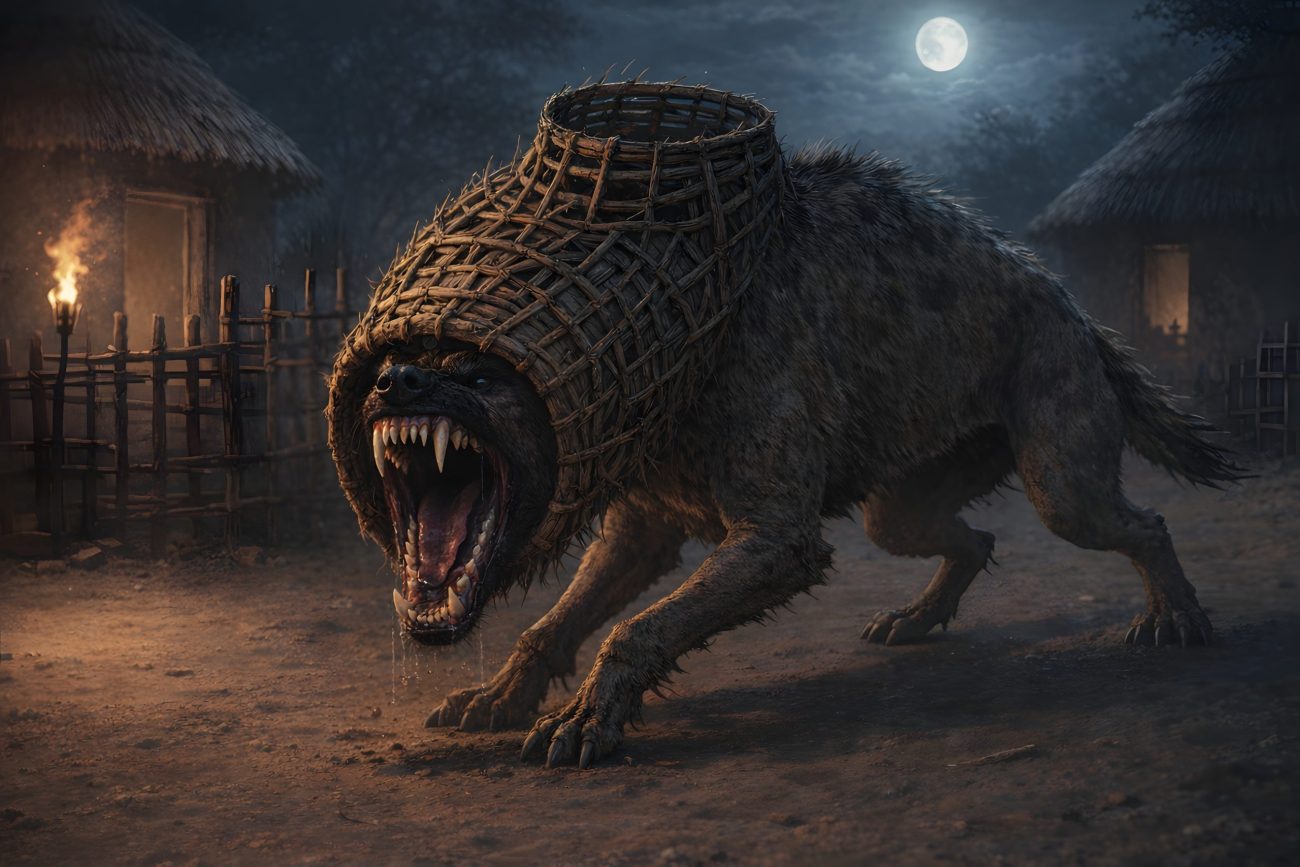
Among the Zulu people there was once a feared creature called the Isitwalangcengce—the Basket-bearer.

It was shaped somewhat like a hyena, low and powerful, but its most terrible feature was its head. Its skull was shaped like a woven basket, hollow within, with an opening at the top. Into this living basket it placed its victims.

The Isitwalangcengce was immensely strong. Even the bravest warrior could be overcome by it. It did not attack at random, but chose its moments carefully. On feast days, when meat was freshly butchered and children carried portions from house to house, the monster crept near the village. It hid beside doorways or behind fences, waiting in silence.

When a child passed close enough, the Isitwalangcengce would seize them in an instant and thrust them into the hollow of its basket-head. Then it would run off into the bush before anyone realized what had happened.

The creature did not eat its prey whole. It had a favorite rock somewhere in the wilderness. There it would smash the heads of its captives against the stone and lap up their brains, leaving the rest of the body behind.

Yet for all its strength, the Isitwalangcengce was foolish.

Once, a man was captured and carried away inside the creature’s head. As they passed through thick bush, he reached out quietly and snapped off branches, stuffing them into the hollow around him. When the cavity was filled with twigs and leaves, he grasped a tree and pulled himself free, leaving the basket-head still heavy with branches.

The Isitwalangcengce noticed nothing. It continued on to its rock. Only when it tipped its head to pour out its meal did a heap of branches tumble onto the stone instead of a victim. By then, the man was long gone.

When he returned safely to the village, he told everyone exactly how he had escaped. Word spread quickly. From then on, if anyone was seized, they knew what to do—fill the monster’s head with branches and slip away.

With its trick discovered, the Isitwalangcengce lost much of its terror. Over time it became little more than a warning told to children: behave, or the Basket-bearer will carry you off.

And the children, hearing the tale, smile quietly—because they know the way out.


Gallery


Sources

abookofcreatures.com contributors. (n.d.). Isitwalangcengce. In abookofcreatures.com, from https://abookofcreatures.com/2015/03/23/isitwalangcengce/


Interpretive Lenses

Religious Readings
  • Christian Ascetic Deep Dive
Philosophical Readings
  • Nietzschean Deep Dive
Psychological Readings
  • Jungian Deep Dive
Esoteric Deep Dive
  • Hermetic Deep Dive
Political / Social Readings
  • Marxist Deep Dive
Other
  • How to Invite The Isitwalangcengce

Nadubi

Tradition / Region: Australian Mythology
Alternate Names:
Category: Mountain dweller


The Myth

On the rocky plateaus of Arnhem Land there move, in the cold hours of night, the nadubi—evil spirit people who haunt the bush.

They look almost human at first glance, but their bodies betray them. From their elbows and knees sprout sharp barbed spines. Some are said to bear spines on other parts of their bodies as well. In ancient rock shelters, figures painted on stone show these strange beings: a woman marked with spines, and creatures with jagged tails and protrusions like weapons grown from flesh.

The nadubi do not wander in daylight. They wait for darkness, when the air turns chill and travelers grow weary. They watch for those who move alone through the bush, far from the safety of campfires and companions.

When a lone traveler passes through their territory, a nadubi creeps silently behind. Without warning, it thrusts one of its barbed spines into the victim’s body. The spine lodges deep within the flesh. At first the wound may seem small, but sickness soon follows. Fever rises, strength fades, and death creeps closer with each passing hour.

Only a medicine man can see the nadubi and understand what has happened. Only he can draw out the hidden spine before the poison spreads too far. But often the help comes too late. The wounded traveler weakens, and by morning another life has been taken by the spirits of the night.

Because of the nadubi, people warn one another never to walk alone in the bush after dark. And though medicine men keep watch and drive the spirits away from encampments, sometimes their vigilance fails. Then, in the silence of the plateau, a sudden scream pierces the night—proof that the nadubi still roam.


Gallery


Sources

abookofcreatures.com contributors. (n.d.). Nadubi. In abookofcreatures.com, from https://abookofcreatures.com/2019/05/03/nadubi/


Interpretive Lenses

Religious Readings
  • Christian Ascetic Deep Dive
Philosophical Readings
  • Nietzschean Deep Dive
Psychological Readings
  • Jungian Deep Dive
Esoteric Deep Dive
  • Hermetic Deep Dive
Political / Social Readings
  • Marxist Deep Dive
Other
  • How to Invite The Nadubi