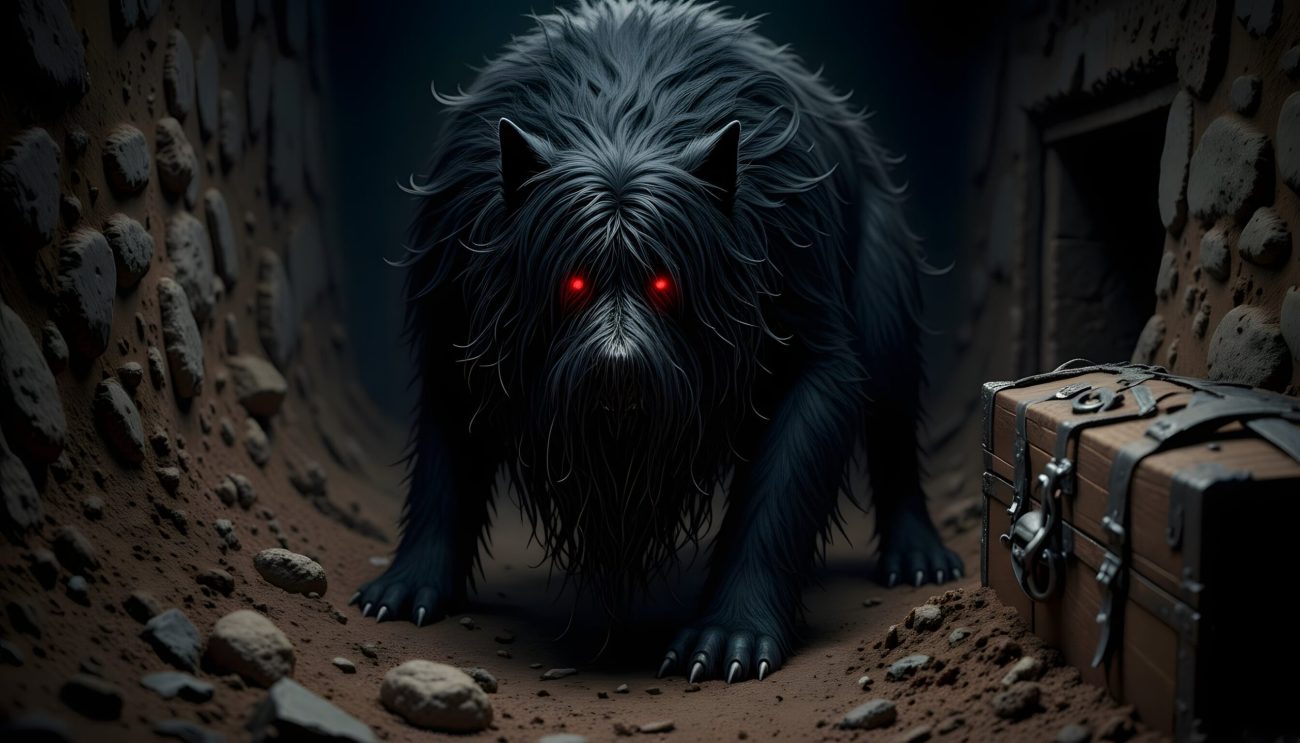
Igtuk

Tradition / Region: Inuit mythology
Alternate Names: The Boomer
Category: Mountain spirit


The Myth

In the far northern lands, when the mountains echo with deep, hollow booming sounds, the Inuit say it is Igtuk who is moving. The sound rolls across the country without warning, rising from the rocks and valleys as if the land itself were breathing.

No one knows where Igtuk lives. He has no fixed dwelling and no trail that can be followed. He is said to be made unlike any other living thing. His arms and legs grow from the back of his body, twisted in a way no human or animal could endure. His great single eye sits level with his arms, staring outward, while his nose is hidden inside his mouth. Beneath his mouth, on his chin, hangs a thick tuft of hair, and his ears lie strangely aligned with his eye.

When Igtuk opens his mouth, it reveals not teeth or a tongue, but a dark, endless abyss. As his jaws move, the booming begins. The sound spreads across the mountains and tundra, shaking the silence and reminding those who hear it that something vast and unnatural is present, though unseen.

The Inuit do not hunt Igtuk, nor do they seek him out. He is not a creature to be challenged or approached. He is simply there—an unseen force whose voice rolls through the land. When the booming echoes across the mountains, people know it is Igtuk making himself known, even if no one will ever see where he stands.


Gallery


Sources

Rasmussen, K. (1930). Intellectual culture of the Hudson Bay Eskimos.


Interpretive Lenses

Religious Readings
  • Christian Ascetic Deep Dive
Philosophical Readings
  • Nietzschean Deep Dive
Psychological Readings
  • Jungian Deep Dive
Esoteric Deep Dive
  • Hermetic Deep Dive
Political / Social Readings
  • Marxist Deep Dive
Other
  • How to Invite The Igtuk

Kimanaueze

Tradition / Region: Ambundu mythology, Angolan Mythology
Alternate Names: Na Kimanaueze; Na Kimanaueze Kia-Tumb’a Ndala
Category: Mountain dweller


The Myth

Long ago, there lived a man named Kimanaueze, whose name belonged both to a father and a son. The elder Kimanaueze wished to see his son married, but the younger refused all women of the earth. His ambition was greater than that of ordinary men: he declared that he would take as his wife the daughter of the Sun and the Moon, who lived far above the world, in the heavens.

To make this possible, Kimanaueze sought a way to reach her. He first asked the Antelope to carry his message, but the Antelope could not fly. He then asked the Hawk, but the Hawk could not rise high enough to reach the dwelling of the Sun and the Moon. The Vulture tried next, but even he could only fly part of the way. At last, Kimanaueze encountered the Frog, named Mainu. Though small and unimpressive, Mainu claimed he knew a hidden path.

Mainu explained that the servants of the Sun and Moon often visited a well on earth. He swallowed Kimanaueze’s letter and hid himself inside a water jug carried by one of these heavenly attendants. In this way, Mainu was carried straight into the house of the Sun King, where he slipped the letter onto the king’s desk. When a second letter appeared in the same mysterious way, the Sun King realized its importance and sent word back, asking Kimanaueze to present himself with a dowry so his worth could be judged.

Since Kimanaueze could not travel to heaven, Mainu again carried the dowry in secret. Pleased, the Sun King finally agreed to the marriage and ordered that his daughter be brought to earth. But there was still one obstacle: how to remove her from the heavens. This time, Mainu stole the girl’s eyes and hid himself. Chaos broke out among the heavenly beings, and the diviner Ngombo was summoned. Ngombo declared that the girl must be married immediately, or she would perish.

Fearing this fate, the Sun King sent his daughter down to earth with the help of the Spider. Mainu followed and returned her eyes to her once she reached the ground. At last, Kimanaueze received the daughter of the Sun and the Moon and took her as his wife, fulfilling his impossible ambition.

In later times, tragedy struck the family. While the younger Kimanaueze was away, the elder Kimanaueze was killed by fearsome multi-headed monsters called Makishi. Generations later, Kimanaueze’s grandson, the hero Sudika-mbambi, would hunt down and slay the Makishi to avenge his grandfather, ensuring that the name of Kimanaueze endured among the people.


Gallery


Sources

Wikipedia contributors. (n.d.). Tantugou. In Wikipedia, The Free Encyclopedia (French), from https://fr.wikipedia.org/wiki/Tantugou


Interpretive Lenses

Religious Readings
  • Christian Ascetic Deep Dive
Philosophical Readings
  • Nietzschean Deep Dive
Psychological Readings
  • Jungian Deep Dive
Esoteric Deep Dive
  • Hermetic Deep Dive
Political / Social Readings
  • Marxist Deep Dive
Other
  • How to Invite The Kimanaueze

Tantugou

Tradition / Region: French Mythology
Alternate Names:
Category: Mountain dweller


The Myth

In the high valleys of the Pyrenees, where forests press close to pasture and stone outcrops overlook grazing land, there lives an ancient figure known as Tantugou. He is said to appear as a tall old man with a long beard, wrapped in a hooded tunic or dressed in animal skins, carrying a heavy club. He moves quietly through the hills and woods, sometimes sleeping on bare rock, always watching.

Tantugou is the unseen guardian of the land. He keeps watch over crops and herds, driving away thieves, wolves, and any force that threatens the balance of pastoral life. Shepherds believe he knows the hidden laws of nature—the ways of animals, the seasons, and the land itself. Though few have seen him clearly, his presence is felt in the safety of flocks and the steady rhythm of the fields.

When he does appear, it is brief and unsettling. A woman once saw him for three days in a row in the woods, where he spoke to her before vanishing again among the trees. A shepherd who fell asleep while tending his sheep awoke to see Tantugou running back into the forest, as if discovered mid-watch. Encounters like these were spoken of quietly, with respect and a trace of fear.

Though Tantugou was never said to harm honest people, later generations began to speak of him as a figure of warning. Parents told children that he prowled near lakes and lonely places, ready to seize those who wandered too far, carrying them off to his cave. Whether this was truth or a way to teach caution, no one could say.

To the people of the valleys, Tantugou remains a shadow at the edge of the fields: neither cruel nor kind, but ancient, vigilant, and bound to the land itself—a silent watcher ensuring that the old ways of pasture and harvest endure.


Gallery


Sources

Wikipedia contributors. (n.d.). Tantugou. In Wikipedia, The Free Encyclopedia (French), from https://fr.wikipedia.org/wiki/Tantugou


Interpretive Lenses

Religious Readings
  • Christian Ascetic Deep Dive
Philosophical Readings
  • Nietzschean Deep Dive
Psychological Readings
  • Jungian Deep Dive
Esoteric Deep Dive
  • Hermetic Deep Dive
Political / Social Readings
  • Marxist Deep Dive
Other
  • How to Invite The Tantugou

The Snow Woman of the Kintama Curve

Tradition / Region: Japanese mythology
Alternate Names: Snow Woman of Hikoya, Yuki-onna of Kintama Curve
Category: Ghost, Mountain dweller


The Myth

Long ago, on a winter day when the snow fell thick and heavy, the headman of the mountain village of Hikoya was returning home from the town of Hashimoto. The mountain road was narrow and winding, and the snowfall was so fierce that each step felt uncertain. As he climbed a steep S-shaped curve along the path, a flicker of white caught his eye.

Thinking he had found another traveler, he called out. From the snow emerged a young woman dressed in a long white kimono that trailed across the ground. Her face was pale as snow, her obvious lips blood-red, her hair deep black, and her eyes shone with an eerie golden light. She looked at the headman with an expression that was both sorrowful and afraid and softly called to him, “Mayor… come with me.”

Entranced by her voice, the headman followed her barefoot into the snow, unaware of the cold biting into his skin. Step by step, she led him deeper along the curve. Suddenly, snow fell from the branches overhead, striking him and breaking the spell. Terror seized him. Realizing something was wrong, he turned and fled back toward the village as fast as he could.

The next day, the headman returned to the bend in the road. There, he found his discarded sandals and the tree from which the snow had fallen. Hanging from one of its branches was the body of a young woman. She was Kayo, a girl from Akatsuka Village, who had been betrayed by her lover from Osaka and driven to despair. Whether she died before or after the headman’s encounter was never known.

The headman would later recount the story again and again, always ending it by saying that the fear had made his body shrivel with terror. From then on, villagers began calling that sharp bend in the mountain road the “Kintama Curve.” To this day, the Snow Woman of that curve is remembered not only as a frightening apparition, but as a sorrowful figure, caught between the world of the living and the dead, wandering the snow in silence.


Gallery


Sources

TYZ-Yokai Blog contributors. (n.d.). 雪女 (Yuki-onna / Snow Woman). In TYZ-Yokai Blog, from https://tyz-yokai.blog.jp/archives/1084249383.html


Interpretive Lenses

Religious Readings
  • Christian Ascetic Deep Dive
Philosophical Readings
  • Nietzschean Deep Dive
Psychological Readings
  • Jungian Deep Dive
Esoteric Deep Dive
  • Hermetic Deep Dive
Political / Social Readings
  • Marxist Deep Dive
Other
  • How to Invite The The Snow Woman of the Kintama Curve

Kirin

Tradition / Region: Japanese mythology
Alternate Names: Qilin, Lin
Category: Mountain dweller


The Myth

In ages when the world was ruled by wisdom and virtue, a gentle and radiant beast was said to walk the land: the Kirin. It did not appear in times of chaos or cruelty, but only when a ruler governed with benevolence and justice. Its arrival was not announced by thunder or fear, but by quiet wonder, for the Kirin harmed no living thing and carried peace wherever it stepped.

The Kirin was said to resemble no single animal. It bore the body of a deer, the tail of an ox, the hooves of a horse, and a single horn upon its brow. Its voice rang like a bell, clear and solemn. Though powerful, it never trampled grass or crushed insects beneath its feet, and it walked alone, never gathering in herds. Nets could not ensnare it, nor traps catch it, for it came only of its own will.

People believed the Kirin embodied perfect compassion. It would not fight, nor kill, nor even step where life might be harmed. When it appeared, sages rejoiced and kings trembled with humility, knowing its presence judged their virtue. If the ruler was just, the Kirin remained. If corruption spread, it vanished without a trace.

In Japan, the Kirin was known not from sightings, but from signs. Once, a horn said to belong to a Kirin was discovered in the mountains and presented to the imperial court. This alone was taken as a heavenly message: the land was under moral watch, and harmony must be preserved.

Thus the Kirin became a symbol of ideal rule and moral order. It was painted beside the phoenix, carved into robes and banners, and spoken of in stories as a reminder that true power lies not in force, but in virtue. The Kirin still walks only in legend, waiting for a world worthy of its steps.


Gallery


Sources

TYZ-Yokai Blog contributors. (n.d.). 麒麟 (Kirin). In TYZ-Yokai Blog, from https://tyz-yokai.blog.jp/archives/1078433264.html


Interpretive Lenses

Religious Readings
  • Christian Ascetic Deep Dive
Philosophical Readings
  • Nietzschean Deep Dive
Psychological Readings
  • Jungian Deep Dive
Esoteric Deep Dive
  • Hermetic Deep Dive
Political / Social Readings
  • Marxist Deep Dive
Other
  • How to Invite The Kirin

Yamajiji

Tradition / Region: Japanese mythology
Alternate Names: Yamajijii, Yamachiji, Yamajichi
Category: Mountain dweller


The Myth

Deep in the mountains of Shikoku, travelers speak in hushed voices of an old man who belongs not to any village, but to the wilderness itself. He is called Yamajiji—the Mountain Old Man—and those who meet him rarely forget the encounter.

Yamajiji appears as a tall, gaunt elder, sometimes with only a single eye and a single arm or leg, though some say he has two eyes, one so small it is barely visible. He wanders the deep forests, watching those who trespass into his domain. It is said that he can read human thoughts as easily as hearing spoken words, answering questions before they are asked and revealing secrets people believed were hidden in their hearts.

Many tales warn of his cruelty. Yamajiji may harm travelers or horses, mislead them deeper into the mountains, or disguise himself as a spider to slip unseen into a home. In some stories, he lives alongside a Yamauba, and if Yamajiji is defeated or killed, the mountain hag will later appear to avenge him, stalking the one who dared challenge the mountain’s master.

His voice is feared above all. When Yamajiji shouts, leaves fall from the trees as if struck by a storm, stones tremble, and the forest itself seems to recoil. In one well-known tale, a man lost in the mountains was challenged by Yamajiji to a contest of shouting. Knowing he could not match such a voice, the man waited until his turn, raised his gun, and fired it beside Yamajiji’s ear. The thunderous blast sent the mountain spirit reeling, and the man escaped while Yamajiji raged in confusion.

Yet the story does not always end there. In some versions, Yamajiji later returns in another form—often as a spider—seeking revenge for the trick played upon him.

Thus Yamajiji remains a figure of warning and dread: a living embodiment of the mountains themselves, ancient, watchful, and dangerous to those who enter his realm without caution or respect.


Gallery


Sources

TYZ-Yokai Blog contributors. (n.d.). 山爺 (Yamajiji). In TYZ-Yokai Blog, from https://tyz-yokai.blog.jp/archives/1077741578.html


Interpretive Lenses

Religious Readings
  • Christian Ascetic Deep Dive
Philosophical Readings
  • Nietzschean Deep Dive
Psychological Readings
  • Jungian Deep Dive
Esoteric Deep Dive
  • Hermetic Deep Dive
Political / Social Readings
  • Marxist Deep Dive
Other
  • How to Invite The Yamajiji

Hito-jizo

Tradition / Region: Japanese mythology
Alternate Names: Kidnapper Jizo
Category: Mountain dweller


The Myth

Long ago, a master marksman, said to be the finest shooter in all of Japan, lost his way while traveling through the mountains. As night fell, he noticed a single house glowing with lamplight and went inside, hoping to find shelter.

Within the house he found a young girl sitting alone, weeping. When he asked what troubled her, she told him of a dreadful fate that haunted the village. Each night at midnight, a mysterious being came to take one villager away. No one knew where they were taken, and now the turn had fallen upon her.

The marksman told her not to fear. He hid the girl inside a closet and resolved to face the creature himself. Through the long night he waited, motionless. Then, at exactly three in the morning, a heavy thud echoed from the doorway. In that instant, the marksman fired his gun.

At dawn, he stepped outside and froze. Standing before the house was a Jizō statue, spattered with blood.

The statue spoke. It said that it had never wished harm upon the villagers. Long ago, it had asked only for a roof to protect it from rain and dew, but no one had built one. Left exposed to the elements year after year, it had decided to repay the neglect by taking the villagers away, subjecting them to the same suffering it endured. Yet it insisted that none had been killed.

The Jizō declared that if the villagers purified themselves and repented, all would be set right. When this was done, the statue raised its left hand, and the missing men returned. When it raised its right hand, the women emerged, unharmed.

Ashamed of their neglect, the villagers begged forgiveness. They built a fine shrine for the Jizō and enshrined it with care and reverence. From that time on, the kidnappings ceased, the harvests were plentiful, and the village prospered.

Thus Hito-jizō remained—not as a kidnapper, but as a reminder that even silent spirits must be treated with respect, lest neglect turn guardians into judges.


Gallery


Sources

TYZ-Yokai Blog contributors. (n.d.). ヒト地蔵 (Hito-Jizō). In TYZ-Yokai Blog, from https://tyz-yokai.blog.jp/archives/1077383013.html


Interpretive Lenses

Religious Readings
  • Christian Ascetic Deep Dive
Philosophical Readings
  • Nietzschean Deep Dive
Psychological Readings
  • Jungian Deep Dive
Esoteric Deep Dive
  • Hermetic Deep Dive
Political / Social Readings
  • Marxist Deep Dive
Other
  • How to Invite The Hito-jizo

Hiderigami

Tradition / Region: Japanese mythology
Alternate Names: Hideri no Kami, Batsu, Hiderimo
Category: Mountain dweller, One eyed


The Myth

Long ago, it was said that drought was not merely the absence of rain, but the presence of a being. Wherever this being lingered, the land dried, rivers shrank, and crops withered under an unforgiving sun. This being came to be known in Japan as Hiderigami, the god of drought.

The origin of this power reaches back to ancient tales from the continent. In the Classic of Mountains and Seas, there is a goddess named Ni, daughter of the Yellow Emperor. After quelling a great storm caused by the dragon Yinglong and the wind god Feng Bo, Ni lost her place in heaven. Wherever she walked upon the earth thereafter, rain ceased to fall. The land cracked and dried beneath her feet. To protect the world, the emperor ordered her to dwell far to the north, beyond the Red River. Yet at times she escaped, and when people chased after her, they cried out, “God, please return to the north,” knowing that her presence meant ruin.

Other ancient writings speak of drought spirits living deep in the mountains. They are described as strange beings—part human, part beast—with twisted forms. Some had only one arm and one leg, their bodies covered in hair, basking openly beneath the burning sun. Others were said to be small, naked creatures with eyes set high upon their heads, able to run as fast as the wind. When these beings appeared, rain vanished, and severe drought followed.

In Japan, these stories were gathered and given form. The drought spirit was called Hideri no Kami, and it was believed to dwell on remote mountains, descending unseen to spread heat and desolation. Some said the drought god crept into human homes, stealing food and goods, draining not only the land but the fortune of families as well.

People feared Hiderigami deeply. When rain failed and rice fields cracked, offerings were made and prayers spoken, begging the god to depart. It was believed that only by appeasing or driving away this being could the sky be moved to weep again.

Thus Hiderigami remained in memory—not always seen, but always felt—an invisible god of heat and hunger, whose presence turned fertile land into dust and reminded people that drought itself could walk the world.


Gallery


Sources

TYZ-Yokai Blog contributors. (n.d.). 干天神 (Hiderigami). In TYZ-Yokai Blog, from https://tyz-yokai.blog.jp/archives/1076296168.html


Interpretive Lenses

Religious Readings
  • Christian Ascetic Deep Dive
Philosophical Readings
  • Nietzschean Deep Dive
Psychological Readings
  • Jungian Deep Dive
Esoteric Deep Dive
  • Hermetic Deep Dive
Political / Social Readings
  • Marxist Deep Dive
Other
  • How to Invite The Hiderigami

Jubusen-Kikai

Tradition / Region: Japanese Mythology
Alternate Names: Demon of Mount Jubusen
Category: Mountain dweller


The Myth

Long ago, a man and his companion set out on a pilgrimage to Mount Jubusen. They climbed the mountain together, following the sacred paths until the day began to fade and dusk crept across the peaks. As evening fell, they turned back toward the descent, eager to leave the mountain before darkness fully claimed it.

As they looked toward a distant summit, something unnatural appeared in the sky. Riding upon a cloud, a strange being rose into view. Its form was half-hidden in the mist, its lower body swallowed by the cloud itself, while its upper body loomed above it. The creature lifted its arms and breathed fire as it drifted through the air, moving toward them from the far peak.

The sight struck the two travelers with terror. Without thinking, they fled in panic, tumbling and rolling down the mountain slope as fast as they could, desperate to escape the approaching presence. They did not look back, nor did they stop until they were far from the heights of Mount Jubusen.

No further encounter is recorded, and no explanation is given for what the creature truly was. It is remembered only as a terrifying apparition of the mountain—an omen glimpsed at twilight, rising from cloud and flame, reminding those who walk sacred peaks that not all beings there welcome human eyes.


Gallery


Sources

TYZ-Yokai Blog contributors. (n.d.). ジュブセン奇怪 (Jubusen-Kikai). In TYZ-Yokai Blog, from https://tyz-yokai.blog.jp/archives/1074775095.html


Interpretive Lenses

Religious Readings
  • Christian Ascetic Deep Dive
Philosophical Readings
  • Nietzschean Deep Dive
Psychological Readings
  • Jungian Deep Dive
Esoteric Deep Dive
  • Hermetic Deep Dive
Political / Social Readings
  • Marxist Deep Dive
Other
  • How to Invite The Jubusen-Kikai

Mouryō

Tradition / Region: Chinese mythology
Alternate Names: Hōryō, Hōliang, Hōxiang, Hongliang, Mizuha
Category: Mountain dweller, Zombie, Demon


The Myth

In the deep places of the world—where mountains rise thick with trees and rivers slip silently through stone—there dwell beings known as the mouryō. They are not born as humans are, but arise from the spirit of the land itself: from forests, streams, roots, and shadows beneath the earth.

Ancient texts say that the mouryō appear like small children, no taller than three-year-olds, yet their forms are unsettling. Their skin is dark and reddish, their eyes glow red, their ears are long, and their hair is strangely beautiful. Though they resemble children, they are not innocent. They linger near graves, riverbanks, and old pine trees, places where the boundary between life and death is thin.

At night, the mouryō creep from the roots of trees or from wet earth. They dig into burial grounds and feast upon the livers of corpses, sustaining themselves on the remains of the dead. Because of this, people once feared them greatly, believing that graves left unguarded would invite these beings. Some said that when a corpse vanished, carried away in the night, it was not the work of hellfire or demons from below, but the mouryō dragging the body back into the forest.

In later tales, the mouryō became confused with other corpse-stealing monsters. Some claimed they were the same as the fiery kasha, while others insisted they were water spirits, haunting rivers and marshes. Still others said they were kin to the kappa, born of stagnant waters and rot. No matter the explanation, the fear remained the same: the mouryō were creatures that thrived where decay met neglect.

Travelers avoided old trees at night, and families guarded their dead, for it was said that once a mouryō had tasted a corpse, it would return again and again. Silent, patient, and hungry, the mouryō endured as a reminder that the land itself remembers death—and that some spirits feed upon what humans leave behind.


Gallery


Sources

TYZ-Yokai Blog contributors. (n.d.). 魍魎 (Mouryō). In TYZ-Yokai Blog, from https://tyz-yokai.blog.jp/archives/1072334859.html


Interpretive Lenses

Religious Readings
  • Christian Ascetic Deep Dive
Philosophical Readings
  • Nietzschean Deep Dive
Psychological Readings
  • Jungian Deep Dive
Esoteric Deep Dive
  • Hermetic Deep Dive
Political / Social Readings
  • Marxist Deep Dive
Other
  • How to Invite The Mouryō