Maupun

Tradition / Region: Polish Mythology, Ukranian Mythology
Alternate Names: Maoupunu, Maupunu
Category: Mermaid, Zombie


The Myth

In the marshlands and river regions of eastern Polesia, it is said that not only girls become rusalki after death. Sometimes a boy may share their fate.

If a child dies before baptism, his soul cannot rest. Such a boy may return as a wandering spirit, bound to the waters and the fields. One such spirit is known as Maupun.

Maupun was once an unbaptized boy. After death he did not pass into the world of the dead, but instead came to dwell among the rusalki—the restless spirits of girls who died before receiving baptism. Over time, he became their leader and chief, ruling over them as they wandered the wetlands and meadows.

The rusalki under Maupun’s command are said to appear as pale girls with bright, shining eyes and wild, shaggy hair. During Trinity Week they leave the waters and roam the rye fields and grassy places, laughing loudly, singing, and playing together beneath the open sky.

But their laughter is dangerous. Anyone who encounters them must flee at once. If they catch a person, they will tickle and clutch them until they die.

And it is Maupun who leads them—
the boy who never received baptism,
now lord of the wandering mermaids of the marsh.


Gallery


Sources

Bestiary.us contributors. (n.d.). Maupun. In Bestiary.us, from https://www.bestiary.us/maupun/


Interpretive Lenses

Religious Readings
  • Christian Ascetic Deep Dive
Philosophical Readings
  • Nietzschean Deep Dive
Psychological Readings
  • Jungian Deep Dive
Esoteric Deep Dive
  • Hermetic Deep Dive
Political / Social Readings
  • Marxist Deep Dive
Other
  • How to Invite The Maupun

Mouryō

Tradition / Region: Chinese mythology
Alternate Names: Hōryō, Hōliang, Hōxiang, Hongliang, Mizuha
Category: Mountain dweller, Zombie, Demon


The Myth

In the deep places of the world—where mountains rise thick with trees and rivers slip silently through stone—there dwell beings known as the mouryō. They are not born as humans are, but arise from the spirit of the land itself: from forests, streams, roots, and shadows beneath the earth.

Ancient texts say that the mouryō appear like small children, no taller than three-year-olds, yet their forms are unsettling. Their skin is dark and reddish, their eyes glow red, their ears are long, and their hair is strangely beautiful. Though they resemble children, they are not innocent. They linger near graves, riverbanks, and old pine trees, places where the boundary between life and death is thin.

At night, the mouryō creep from the roots of trees or from wet earth. They dig into burial grounds and feast upon the livers of corpses, sustaining themselves on the remains of the dead. Because of this, people once feared them greatly, believing that graves left unguarded would invite these beings. Some said that when a corpse vanished, carried away in the night, it was not the work of hellfire or demons from below, but the mouryō dragging the body back into the forest.

In later tales, the mouryō became confused with other corpse-stealing monsters. Some claimed they were the same as the fiery kasha, while others insisted they were water spirits, haunting rivers and marshes. Still others said they were kin to the kappa, born of stagnant waters and rot. No matter the explanation, the fear remained the same: the mouryō were creatures that thrived where decay met neglect.

Travelers avoided old trees at night, and families guarded their dead, for it was said that once a mouryō had tasted a corpse, it would return again and again. Silent, patient, and hungry, the mouryō endured as a reminder that the land itself remembers death—and that some spirits feed upon what humans leave behind.


Gallery


Sources

TYZ-Yokai Blog contributors. (n.d.). 魍魎 (Mouryō). In TYZ-Yokai Blog, from https://tyz-yokai.blog.jp/archives/1072334859.html


Interpretive Lenses

Religious Readings
  • Christian Ascetic Deep Dive
Philosophical Readings
  • Nietzschean Deep Dive
Psychological Readings
  • Jungian Deep Dive
Esoteric Deep Dive
  • Hermetic Deep Dive
Political / Social Readings
  • Marxist Deep Dive
Other
  • How to Invite The Mouryō

Hrökkáll

Tradition / Region: Icelandic Mythology
Alternate Names: Coil-eel
Category: Fish, Eel, Zombie


The Myth

Long ago, a malicious wizard in Iceland defied the natural order. From polluted water he drew up a dead eel, half-rotted and foul, and by dark arts forced it back into motion. Thus was born the first Hrökkáll, the coil-eel—an unnatural thing animated by corruption and spite.

Though the wizard himself vanished with time, the creature did not. The Hrökkáll bred, and its descendants spread into stagnant ponds, still waters, and sluggish rivers, thriving wherever decay and filth gathered.

A Hrökkáll is about two feet long and shaped like an eel, but its body is armored with flexible scales as hard as iron. Along its sides run sharp, saw-toothed fins. Like many fearsome fishes of Iceland, it exudes a corrosive venom, and its flesh is deadly to eat. When captured, Hrökkálls have been known to melt through soil and stone alike, dissolving their escape and slipping back into the water.

They wait unseen beneath the surface until a person steps into their domain. Then the Hrökkáll strikes, coiling tightly around a leg. With crushing force and slicing edges, it cuts through flesh and bone, severing the limb entirely. Whether it is the acid of its venom, the blades of its fins, or both together that accomplish this horror is unknown.

Men and horses alike fall victim to the Hrökkáll, but sheep are spared, for their legs are too slender for the creature to grasp.

In later times, the name Hrökkáll passed into common speech, and came to be used for electric eels as well—but in old tales, it is remembered as a thing born of sorcery, rot, and water gone bad.


Gallery


Sources

A Book of Creatures contributors. (n.d.). Hrokkall. In A Book of Creatures, from https://abookofcreatures.com/2015/08/12/hrokkall/


Interpretive Lenses

Religious Readings
  • Christian Ascetic Deep Dive
Philosophical Readings
  • Nietzschean Deep Dive
Psychological Readings
  • Jungian Deep Dive
Esoteric Deep Dive
  • Hermetic Deep Dive
Political / Social Readings
  • Marxist Deep Dive
Other
  • How to Invite The Hrökkáll

Aderyn y Corff

Tradition / Region: Welsh mythology
Alternate Names: Corpse Bird
Category: Bird, Zombie


The Myth

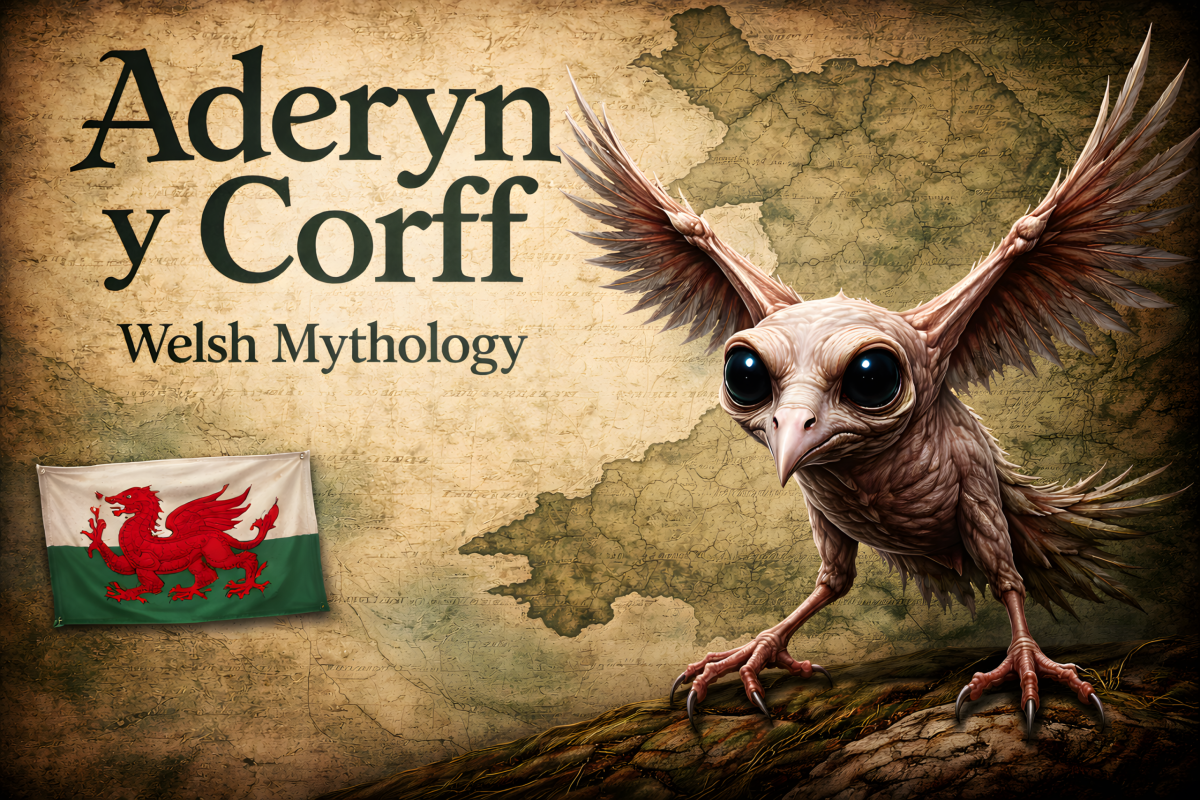
The Aderyn y Corff, the “corpse bird,” appears at the very edge of life, when death is no longer distant but imminent. In Welsh tradition, it does not wander the countryside at random nor bring vague ill fortune. It comes with purpose. When a person is near death, the bird is said to arrive outside the house, perching near a door or window, and calling softly into the night.

Its cry is described as sounding like dewch, dewch—“come, come.” This is not a threat or a warning meant to be avoided. It is a summons. The call is directed not to the living, but to the soul of the dying, inviting it to leave the body and pass onward. In this role, the Aderyn y Corff acts as a messenger between worlds, announcing that the moment of crossing has arrived.

The creature’s form marks it as something profoundly unnatural. It is said to have no feathers and no wings, yet it flies. This impossibility places it outside ordinary creation, identifying it as a being that does not belong fully to the physical world. Its movement obeys no natural law, only the logic of death and transition, reinforcing its status as a liminal presence suspended between life and the otherworld.

When it is not calling to the dying, the Aderyn y Corff is believed to dwell in another realm entirely—a plane of illusion or unreality that exists alongside the human world but rarely touches it. Death is one of the few moments when the boundary thins enough for the bird to cross over. It does not linger after its task is done. Once the soul has departed, the bird vanishes.

In many tellings, the Aderyn y Corff is closely associated with the screech owl, whose piercing nocturnal cry has long been linked to death across Europe. In Welsh usage, the name itself can refer to such owls, blurring the line between natural bird and supernatural herald. Yet folklore insists that when the call comes at the right moment, it is no ordinary owl but the corpse bird itself.

The Aderyn y Corff is feared, but not hated. It does not kill, curse, or deceive. It simply announces what cannot be changed. Its presence affirms a belief deeply rooted in Welsh tradition: death does not arrive silently. The otherworld sends a messenger first, and when the corpse bird calls, the soul is already being gathered.


Gallery


Sources

Sikes, W. (1881). British Goblins: Welsh Folk-lore, Fairy Mythology, Legends and Traditions. Sampson Low, Marston, Searle, & Rivington, p. 213.

Wikipedia contributors. (n.d.). Aderyn y Corff. In Wikipedia, The Free Encyclopedia, from https://en.wikipedia.org/wiki/Aderyn_y_Corff


Interpretive Lenses

Religious Readings
Philosophical Readings
  • Nietzschean Deep Dive
Psychological Readings
  • Jungian Deep Dive
Esoteric Deep Dive
  • Hermetic Deep Dive
Political / Social Readings
  • Marxist Deep Dive
Other
  • How to Invite The Spirit