Usagimuko

Tradition: Japanese Mythology
Alternative Names: 兎婿, Rabbit Son-in-Law, Rabbit Bridegroom
Category: Rabbit


The Myth

Usagimuko, meaning “rabbit son-in-law,” is a figure in Japanese folktales found across regions from Tōhoku to Kantō. The stories follow a marriage between a rabbit and a human woman, usually arranged after the rabbit helps an old man with agricultural work. In exchange for its assistance, the rabbit demands marriage to one of the man’s daughters. Although the older daughters refuse, the youngest often agrees, only to use her cleverness to escape the unwanted marriage and defeat the rabbit. The tale resembles the broader Japanese story type of the monkey son-in-law.

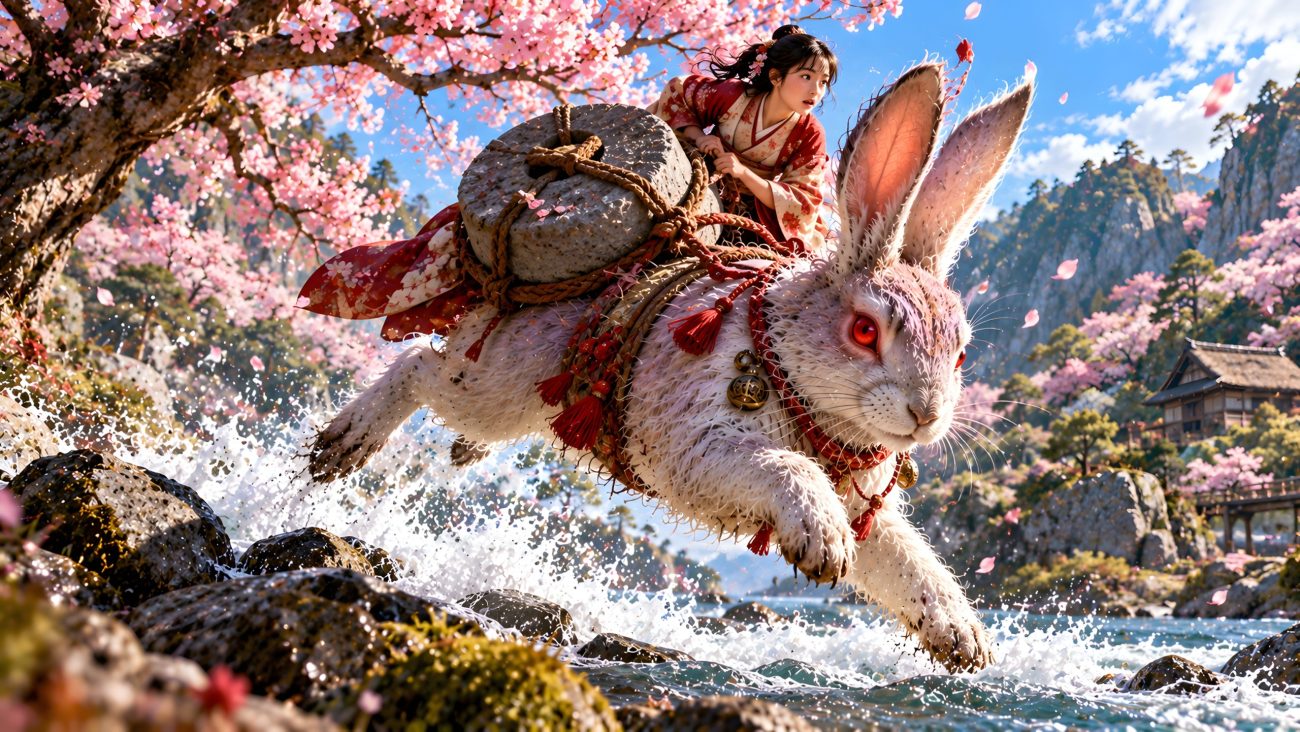
In a version from Mutsu City, Aomori Prefecture, an old man is weeding his bean field when a rabbit offers to help. Grateful for its work, the old man promises that the rabbit may marry one of his three daughters. When the man later regrets his promise and becomes ill with worry, his eldest and second daughters refuse to marry an animal, but the youngest agrees. She asks her grandfather to make a mortar and carries it on the rabbit’s back when it comes to take her into the mountains. During cherry-blossom season, she persuades the rabbit to climb a tree beside a river to collect branches as a gift for her grandfather. With the heavy mortar still on its back, the rabbit climbs high into the tree, breaks a branch, and falls into the river. Unable to escape, it dies, and the youngest daughter returns home to continue caring for her parents.

A similar story was recorded in Niihari Village, Tone District, Gunma Prefecture. There, a rabbit helps an old man digging carrots and demands marriage to his daughter in return for pulling up a long carrot. The eldest daughter rejects the rabbit because of its long ears, while the second also refuses. The youngest becomes its bride and is taken into the mountains. When she later prepares to return home, she carries a heavy stone millstone filled with rice cakes on the rabbit’s back. She then persuades the rabbit to climb a cherry tree to gather branches. The rabbit breaks a branch and falls into the river, where the weight of the millstone prevents it from escaping. In both versions, the youngest daughter outwits the rabbit and returns safely to her family.


Sources

“Usagimuko.” 新版TYZ 妖怪図鑑 (New TYZ Yokai Encyclopedia). https://tyz-yokai.blog.jp/archives/1084241464.html

Usagi no Tatari

Tradition: Japanese Mythology
Alternative Names: 兎の祟り, Curse of the Rabbit, Hare’s Curse
Category: Rabbit


The Myth

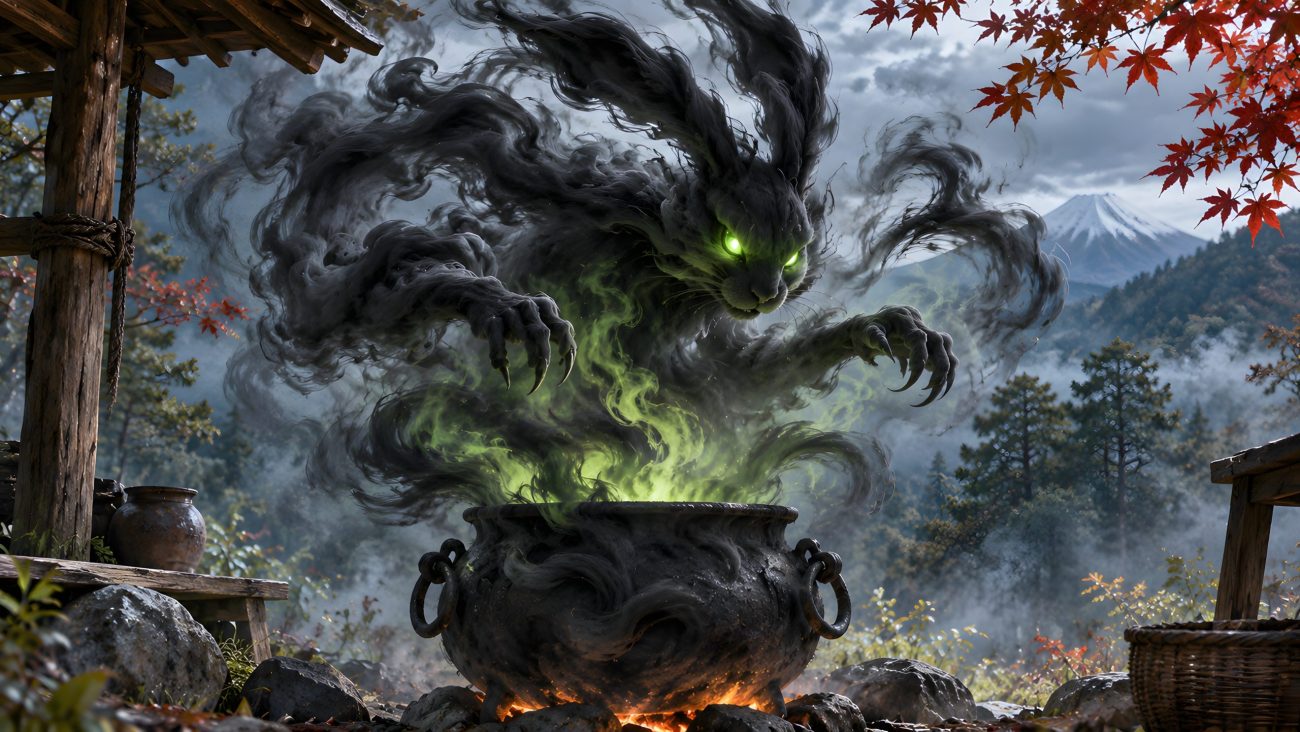
Usagi no Tatari, meaning “the curse of the rabbit,” refers to Japanese folk beliefs associating the consumption of wild rabbits with illness and supernatural retribution. A 1937 article in the medical journal Kansai Ikai Jihō recounts an incident in Kawasaki Village, Shibata District, Miyagi Prefecture. On the twenty-eighth day of the twelfth lunar month, four young men caught a rabbit at the foot of Mount Zaō and ate it. Shortly afterwards, their tonsils became swollen and they developed lumps as large as chicken eggs. Medical examinations revealed that they had contracted tularemia, an infectious disease associated with wild rabbits. Local people, however, feared that the illness was a manifestation of the rabbit’s curse.

The physician and tularemia researcher Ōhara Hachirō (1882–1943), who came from Fukushima Prefecture, recorded several regional beliefs concerning rabbits in his book Yato-byō (Tularemia). In Oguni Village, Date District, dead wild rabbits were reportedly found in the mountains from late autumn through the beginning of the new year. Although people had once eaten them without apparent consequences, illnesses resembling fever reportedly became common after larch trees were planted on the mountainside. In Ōura Village, Iwaki District, rabbits that ate young wheat shoots in spring were said to die, and eating them was believed to cause fever. Other accounts attributed rabbit deaths to red berries, claiming that people who ate the affected animals could suffer severe vomiting, diarrhoea, and even death.

In Nakamura Town, Sōma District, people believed that preparing a dead wild rabbit for food would inevitably cause chills and swollen lymph nodes. Rabbits that had lain dead on the ground for an entire night were considered unfit to eat, regardless of the cause of death. These traditions reflect the dangers associated with consuming diseased wild animals. Although the illnesses were interpreted locally as a rabbit’s curse, the historical accounts suggest that folk prohibitions against eating certain rabbits may have preserved practical warnings about a disease that was not yet fully understood.


Sources

“Usagi-tata.” 新版TYZ 妖怪図鑑 (New TYZ Yokai Encyclopedia). https://tyz-yokai.blog.jp/archives/1081457824.html


Isepo Tereke

Tradition: Japanese Mythology
Alternative Names: イセポテレケ, Isepo Tereke, Leaping Rabbit
Category: Rabbit


The Myth

Isepo Tereke is a belief in Ainu tradition connecting rabbits with waves and the dangers of the sea. The name combines isepo, meaning “rabbit,” and tereke, meaning “to jump.” White waves breaking across the sea were described as rabbits leaping. Because speaking the word for rabbit while at sea was believed to bring rough waves and storms, people avoided saying it offshore. Instead, they sometimes used the expression kai kuma, meaning “broken stick,” as a substitute.

In the Horobetsu region, the image of rabbits leaping along the shore also appeared in a traditional lullaby used to soothe babies. Caregivers showed infants the waves breaking against the beach and sang, “Ota ka ta isepo pon tereke,” meaning “A little rabbit jumps on the seashore.”

A local legend tells of a large Ainu settlement at Tonkeshi, near Horobetsu, which was governed by six chiefs. One day, a man named Tonuuwoushi from Hidaka saw a rabbit standing on a hill near the settlement. The animal stretched its forelegs toward the sea as though beckoning something from offshore. Suspecting that a tsunami was approaching, Tonuuwoushi shouted a warning and urged the inhabitants to flee. The chiefs ignored him, and the settlement was soon overwhelmed by the waves.

Another tradition from the Shiraoi region describes the kamuy, or divine spirit, of an old rabbit driving a plague spirit resembling dense fog back out to sea. This tale is also known as Isepo Tereke, further associating the rabbit with the sea and its potentially destructive forces.


Sources

“Isepotereke.” 新版TYZ 妖怪図鑑 (New TYZ Yokai Encyclopedia). https://tyz-yokai.blog.jp/archives/1081441215.html


Skvader

Tradition: Swedish Mythology
Alternative Names: Skvadern, Tetrao lepus pseudo-hybridus rarissimus
Category: Rabbit


The Myth

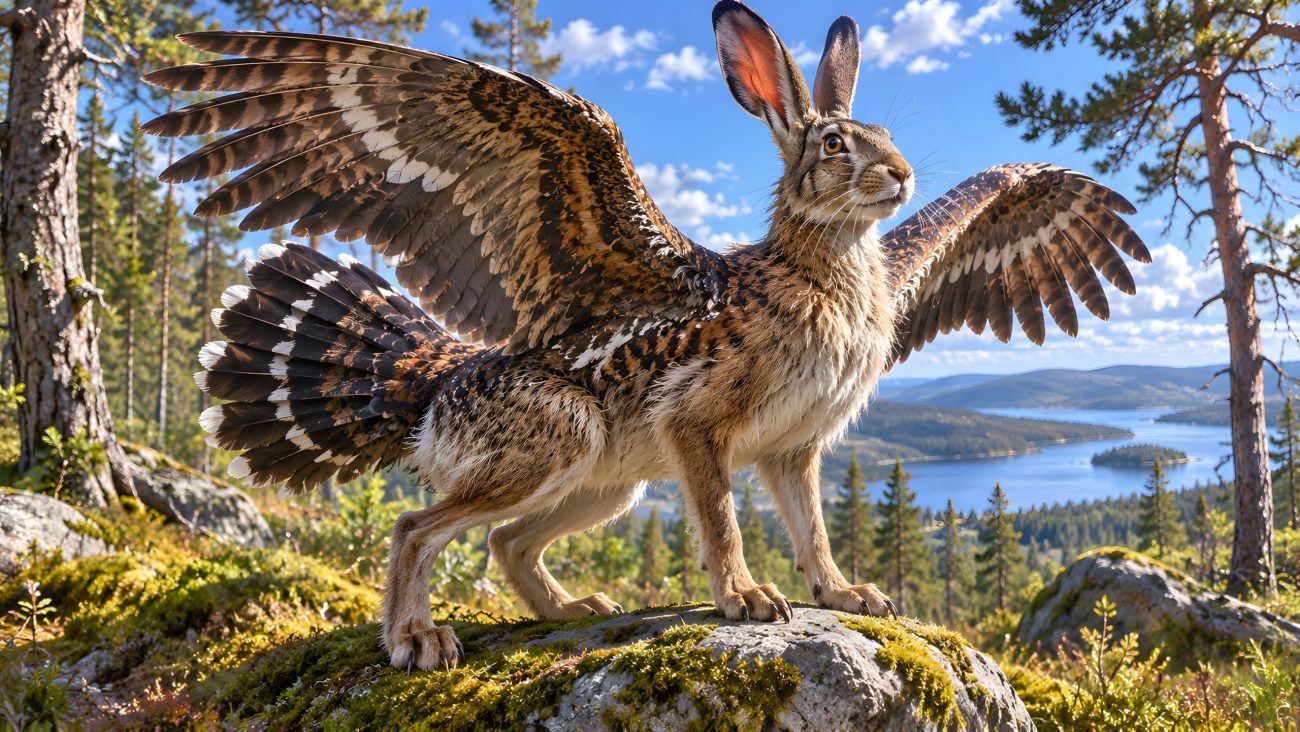
The Skvader is a fictional hybrid creature created in Sweden in 1918 by taxidermist Rudolf Granberg. Permanently displayed at the museum on Norra Berget in Sundsvall, it combines the head, forequarters, and hind legs of a European hare with the back, wings, and tail of a female western capercaillie, a large forest grouse. It was later jokingly assigned the Latin name Tetrao lepus pseudo-hybridus rarissimus L. The creature’s name combines elements of Swedish words associated with the sounds of birds and the capercaillie.

The Skvader originated in a tall hunting tale told by Håkan Dahlmark at a restaurant in Sundsvall in the early twentieth century. Dahlmark amused his companions by claiming that he had shot such an animal while hunting north of Sundsvall in 1874. In 1907, his housekeeper presented him with a painting of the supposed creature, made by her nephew. Shortly before his death in 1912, Dahlmark donated the painting to a local museum. During an exhibition in Örnsköldsvik in 1916, the museum’s manager met Granberg and asked him to reconstruct the animal based on the story and painting. Granberg completed the taxidermy specimen in 1918, and it quickly became a popular museum attraction.

Although the Skvader has no basis in zoological reality, its fame has extended beyond the museum. The word has entered Swedish usage as a humorous term for a combination of two disparate or incompatible elements, often suggesting an awkward or unsuccessful mixture. The Skvader thus represents the playful transformation of a fabricated hunting story into a celebrated cultural curiosity.


Sources

“Skvader.” Wikipedia: The Free Encyclopedia. Wikimedia Foundation. https://en.wikipedia.org/wiki/Skvader


Tokaku

Tradition: Chinese Mythology
Alternative Names: 龟毛兔角, Turtle Hair and Rabbit Horns, Tortoise-Furred Rabbit Horns
Category: Rabbit


The Myth

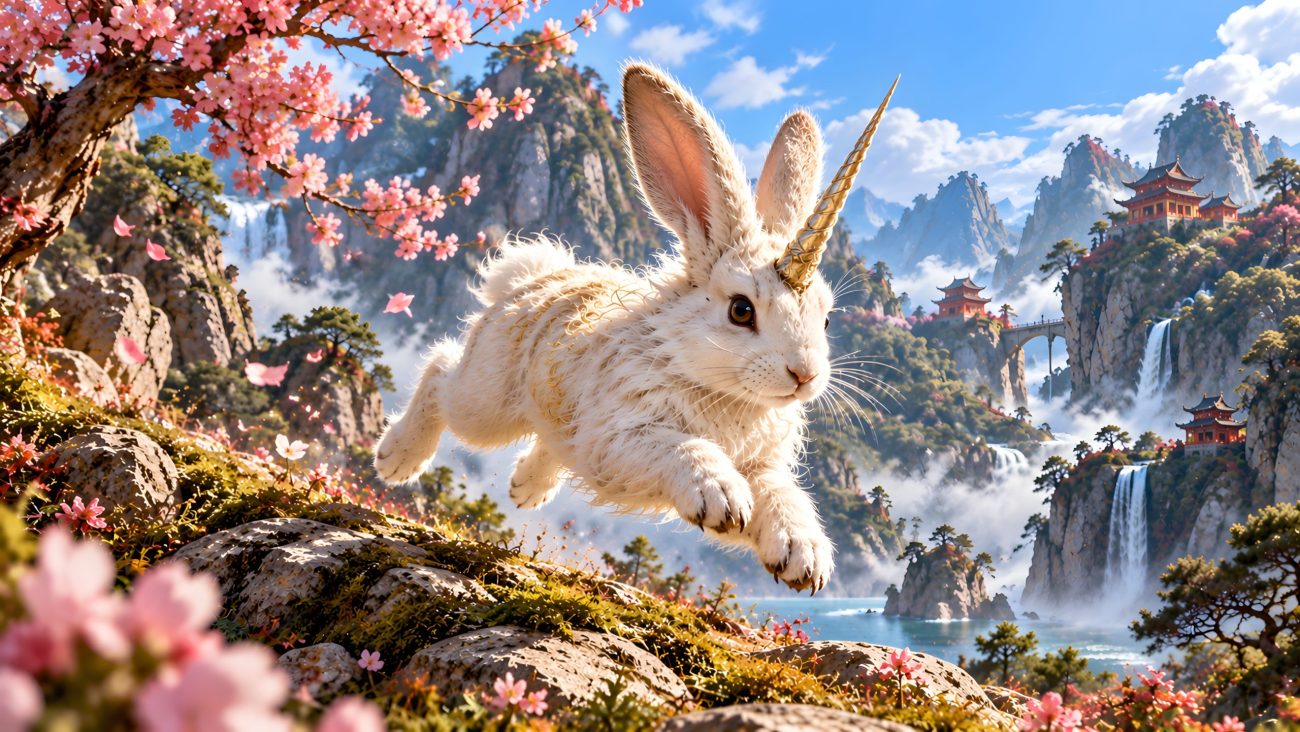
Tokaku refers to the expression “turtle hair and rabbit horns,” describing two impossible phenomena: turtles growing hair and rabbits developing horns. According to the Soushen Ji, drawing on works such as the Wuxing Zhi and Jingbo Yi Zhuan, unusual occurrences in nature were sometimes interpreted as ominous signs for the state. During the reign of King Zhou of Shang, a large turtle was said to have grown hair and rabbits were said to have grown horns. These phenomena were regarded as portents of war.

The expression subsequently became a metaphor for things considered impossible or beyond ordinary understanding. A similar expression, “black crow and white horse horns” (烏白馬角), likewise describes unnatural combinations that cannot exist in the ordinary world. Both expressions use extraordinary physical features to represent events that defy common sense.

In Buddhist writings, turtle hair and rabbit horns also serve as examples of things that exist in name but have no actual substance. Texts such as the Mahāprajñāpāramitā Śāstra and Mohe Zhiguan employ the imagery to explain the emptiness of all phenomena, teaching that neither the self nor other things possess a fixed, independently attainable existence. Other Buddhist works similarly list turtle hair, rabbit horns, and other nonexistent things as illustrations of the insubstantial nature of reality.


Sources

“Tokaku.” 新版TYZ 妖怪図鑑 (New TYZ Yokai Encyclopedia). https://tyz-yokai.blog.jp/archives/1084081649.html


Moon Rabbit

Tradition: Chinese Mythology, Japanese Mythology, Korean Mythology, Vietnamese Mythology, American Mythology
Alternative Names: Jade Rabbit, Yutu, 玉兔, Moon Hare, Lunar Rabbit
Category: Rabbit


The Myth

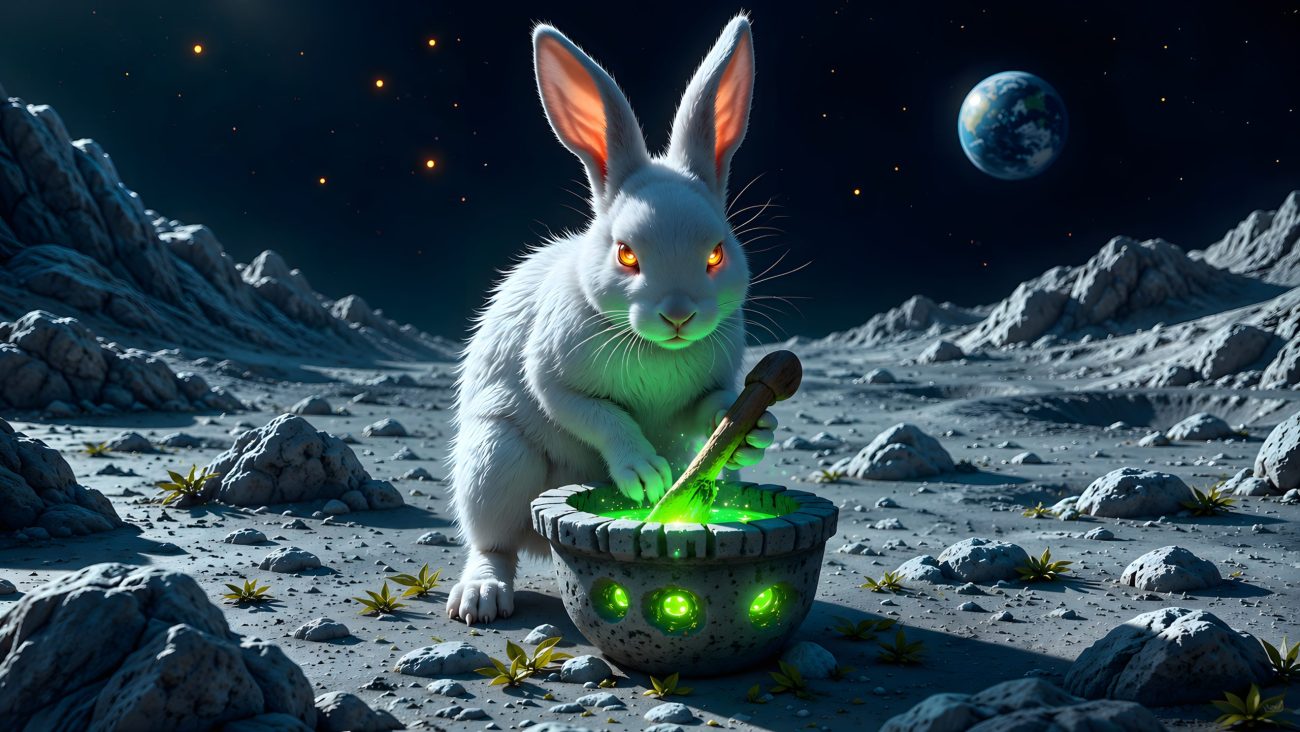
The Moon Rabbit, also known as the Jade Rabbit or Moon Hare, is a mythical rabbit or hare believed to inhabit the Moon. Its image originates from interpretations of the dark markings on the lunar surface, which resemble a rabbit. The creature appears in traditions across East Asia, including China, Japan, Korea, and Vietnam, as well as in some Indigenous American cultures. In East Asian mythology, the Moon Rabbit is commonly depicted pounding ingredients with a mortar and pestle. The substance it prepares varies between traditions: Chinese and Vietnamese accounts often describe it making the elixir of immortality, while Japanese and Korean versions commonly portray it preparing rice cakes, such as mochi or tteok. Some Chinese depictions also show the rabbit making medicine for mortals or preparing mooncakes.

In Chinese tradition, the Moon Rabbit is frequently associated with Chang’e, the goddess of the Moon, for whom it prepares the elixir of life. References to a lunar hare appear in early Chinese literature, including the Chu Ci, a collection of poems compiled during the Western Han period. Later sources also mention the Jade Hare and Gold Hare, names used poetically for the animal on the Moon and, by extension, for the Moon itself. The image of the rabbit preparing medicine remained influential in Chinese poetry and art, including depictions embroidered on imperial robes.

A Buddhist story offers another explanation for the rabbit’s presence on the Moon. In the Jataka tales, a monkey, an otter, a jackal, and a rabbit resolve to practise charity on the full-moon day. When an old man asks them for food, the other animals gather what they can find, but the rabbit can offer only grass. To demonstrate its generosity, it throws itself into a fire so that the man can eat its flesh. The rabbit remains unharmed, and the old man reveals himself to be Śakra, king of the gods. Moved by the rabbit’s selflessness, he places its likeness on the Moon so that its virtue will be remembered. The rabbit is consequently regarded in this story as a Bodhisattva. A Japanese version recorded in the Konjaku Monogatarishū features a fox and a monkey as the rabbit’s companions.

The Moon Rabbit also appears in the Chinese novel Journey to the West. In one episode, a celestial rabbit escapes from the Moon Palace and disguises herself as a woman, intending to marry the monk Tang Sanzang and absorb his vital yang essence. Sun Wukong discovers her identity and battles her. Before he can defeat her, the celestial figure Taiyin Xingjun arrives and reveals that the creature is the Jade Rabbit, a guardian of the mystical elixir in the Moon Palace. Taiyin Xingjun explains that the rabbit secretly escaped from the palace and asks Sun Wukong to spare her. The Monkey King agrees, and the rabbit is returned to the Moon. The Moon Rabbit is also closely connected with lunar festivals across Asia, including China’s Mid-Autumn Festival, Japan’s Tsukimi, Korea’s Chuseok, and Vietnam’s Tết Trung Thu, where it forms part of the imagery and traditions associated with the Moon.


Sources

“Moon Rabbit.” Chinese Wikipedia. Wikimedia Foundation. https://zh.wikipedia.org/wiki/%E6%9C%88%E5%85%94


Three-Legged Rabbit

Tradition: Czech Mythology
Alternate Names: –
Category: Rabbit


The Myth

The Three-Legged Rabbit appears as a strange and unsettling creature tied to a tragic rural legend. It is not described as a natural animal, but as something uncanny that manifests at a critical moment.

In a village, a group of boys argued whether a person could hang themselves from a simple straw if fate—or the devil—willed it. One boy, determined to prove it, tied a straw to a beam and hanged himself, telling the others to cut him down if he began to suffocate.

At that exact moment, a rabbit with only three legs suddenly ran through the barn. Its unnatural appearance startled the boys, who chased after it in confusion and excitement, completely forgetting their friend.

By the time they returned, it was too late—the boy had died.

The three-legged rabbit is not directly identified as a demon, but its timing and abnormal form strongly suggest a supernatural role. It functions as a distraction or omen, appearing precisely when needed to lead the boys away from the hanging.

In this way, the creature is often interpreted as a manifestation of dark fate or a subtle agent of evil—possibly linked to the devil mentioned earlier—ensuring that the tragic outcome could not be prevented.


Sources

sagen.at contributors. (n.d.). Der Dreifüßige. In sagen.at, from https://www.sagen.at/texte/sagen/tschechien/watzlik/derdreifuessige.html


Utixo’s Rabbit

Tradition / Region: Botwana Mythology, Namibia Mythology, South African Mythology
Alternate Names: Tiqua
Category: Rabbit


The Myth

Utixo is a benevolent sky god of the Khoi people, dwelling above the world and speaking through thunder. He sends rain to nourish the land and watches over human life. In one well-known story, Utixo decided to send a message to humanity concerning death.

Utixo declared that death would not be eternal and that humans would one day rise again. To deliver this message, he chose a rabbit as his messenger and sent it down from the sky to the people.

As the rabbit traveled, it became confused and forgot the message it had been entrusted with. When it finally reached humanity, the rabbit spoke the opposite of Utixo’s words, telling people that death was final and that they would not rise again.

Because of the rabbit’s mistake, death became permanent in the world. From that time onward, humans were said to die forever, and the rabbit was remembered as the bearer of the wrong message, whose error changed the fate of humankind.

In Khoi tradition, this story explains why death is irreversible and why the rabbit holds a special place in myth as a divine messenger whose failure shaped the human condition.


Sources

“Utixo.” Wikipedia: The Free Encyclopedia. Wikimedia Foundation. https://en.wikipedia.org/wiki/Utixo


Centzon Tōtōchtin

Tradition / Region: Aztec Mythology, Mexcian Mythology
Alternate Names: Centzontōtōchtin (“Four Hundred Rabbits”)
Category: Rabbit, deity


The Myth

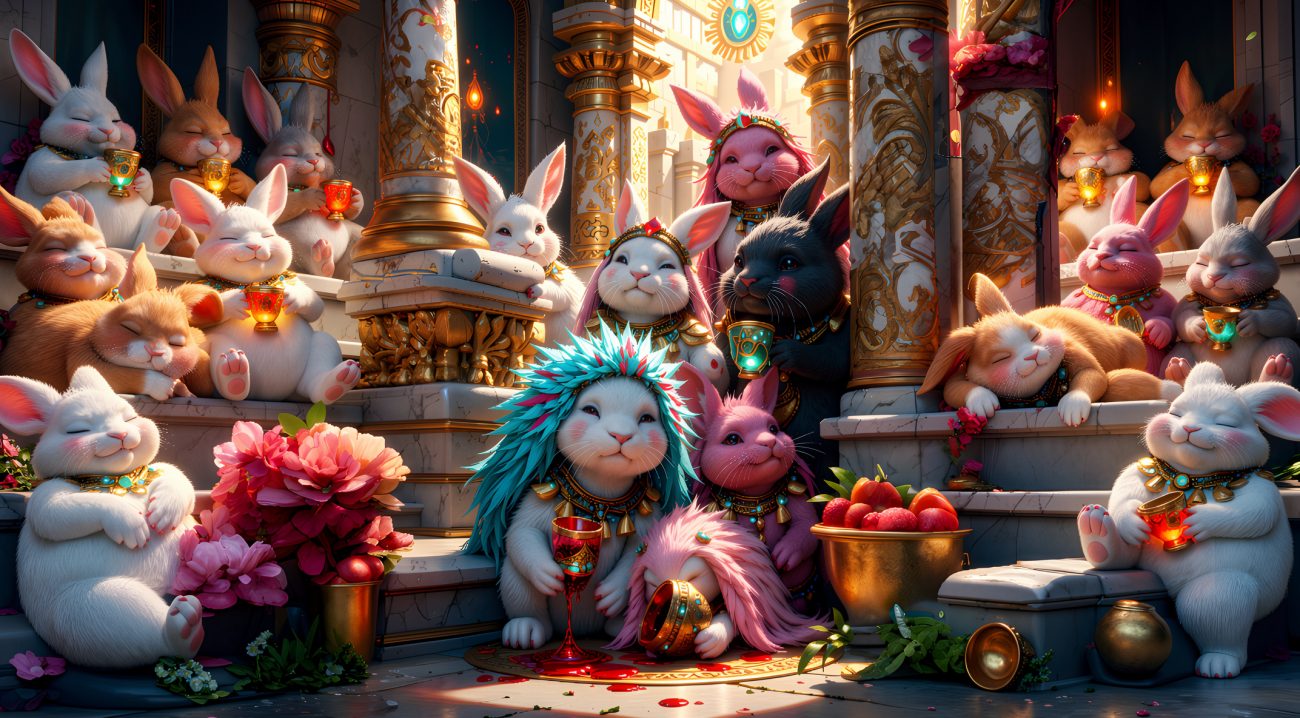
In Mexica mythology, the Centzon Tōtōchtin are a great company of divine rabbits known as the Four Hundred Rabbits. They are gods associated with pulque, the fermented drink made from the maguey plant, and they are said to gather frequently for feasts and drunken celebrations. The number four hundred does not signify a precise count, but rather an uncountable multitude.

The Centzon Tōtōchtin are the children of Mayahuel, the goddess of the maguey plant, and Patecatl. Mayahuel was believed to nourish her children with the sap of the maguey, which became pulque. Through this parentage, the rabbits are bound to the plant and its intoxicating drink.

Each of the Centzon Tōtōchtin embodies a different aspect of drunkenness and behavior brought on by pulque. Among them are Tepoztecatl, Texcatzonatl, Colhuatzincatl, and Macuiltochtli, whose name means “Five Rabbit.” Tepoztecatl is often described as their leader and is closely associated with ritual calendars and sacred festivals.

The rabbits are said to assemble together, drinking pulque and celebrating noisily. In these gatherings, they represent the many forms intoxication can take, from joy and laughter to disorder and excess. Their presence explains why different people react differently when they drink, each one being touched by a different rabbit god.

The Centzon Tōtōchtin appear in myths surrounding the discovery and ritual use of pulque. In some stories, a rabbit is involved in revealing the maguey’s hidden properties, linking the animal directly to the sacred drink. Shrines and temples, including those dedicated to Tepoztecatl, honored these gods through offerings of pulque during festivals and ceremonies.

Thus, the Centzon Tōtōchtin remain remembered as a divine multitude of rabbit gods, born from the maguey, gathering endlessly in celebration, and inseparably bound to pulque and its effects among gods and humans alike.


Interpretive Lenses

Religious Readings
Philosophical Readings
Psychological Readings
Esoteric Deep Dive
Political / Social Readings
Other