Tradition: Swedish Mythology
Alternative Names: Skvadern, Tetrao lepus pseudo-hybridus rarissimus
Category: Rabbit
The Myth
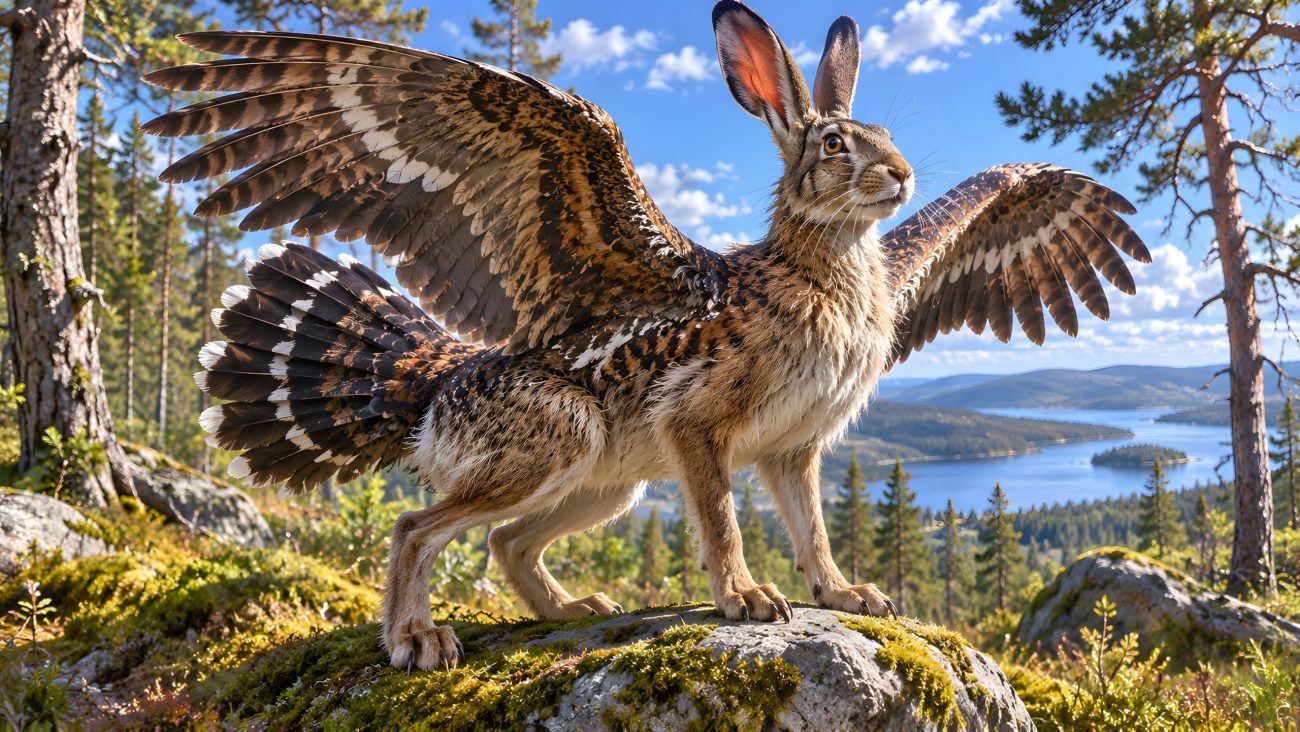
The Skvader is a fictional hybrid creature created in Sweden in 1918 by taxidermist Rudolf Granberg. Permanently displayed at the museum on Norra Berget in Sundsvall, it combines the head, forequarters, and hind legs of a European hare with the back, wings, and tail of a female western capercaillie, a large forest grouse. It was later jokingly assigned the Latin name Tetrao lepus pseudo-hybridus rarissimus L. The creature’s name combines elements of Swedish words associated with the sounds of birds and the capercaillie.
The Skvader originated in a tall hunting tale told by Håkan Dahlmark at a restaurant in Sundsvall in the early twentieth century. Dahlmark amused his companions by claiming that he had shot such an animal while hunting north of Sundsvall in 1874. In 1907, his housekeeper presented him with a painting of the supposed creature, made by her nephew. Shortly before his death in 1912, Dahlmark donated the painting to a local museum. During an exhibition in Örnsköldsvik in 1916, the museum’s manager met Granberg and asked him to reconstruct the animal based on the story and painting. Granberg completed the taxidermy specimen in 1918, and it quickly became a popular museum attraction.
Although the Skvader has no basis in zoological reality, its fame has extended beyond the museum. The word has entered Swedish usage as a humorous term for a combination of two disparate or incompatible elements, often suggesting an awkward or unsuccessful mixture. The Skvader thus represents the playful transformation of a fabricated hunting story into a celebrated cultural curiosity.
Sources
“Skvader.” Wikipedia: The Free Encyclopedia. Wikimedia Foundation. https://en.wikipedia.org/wiki/Skvader