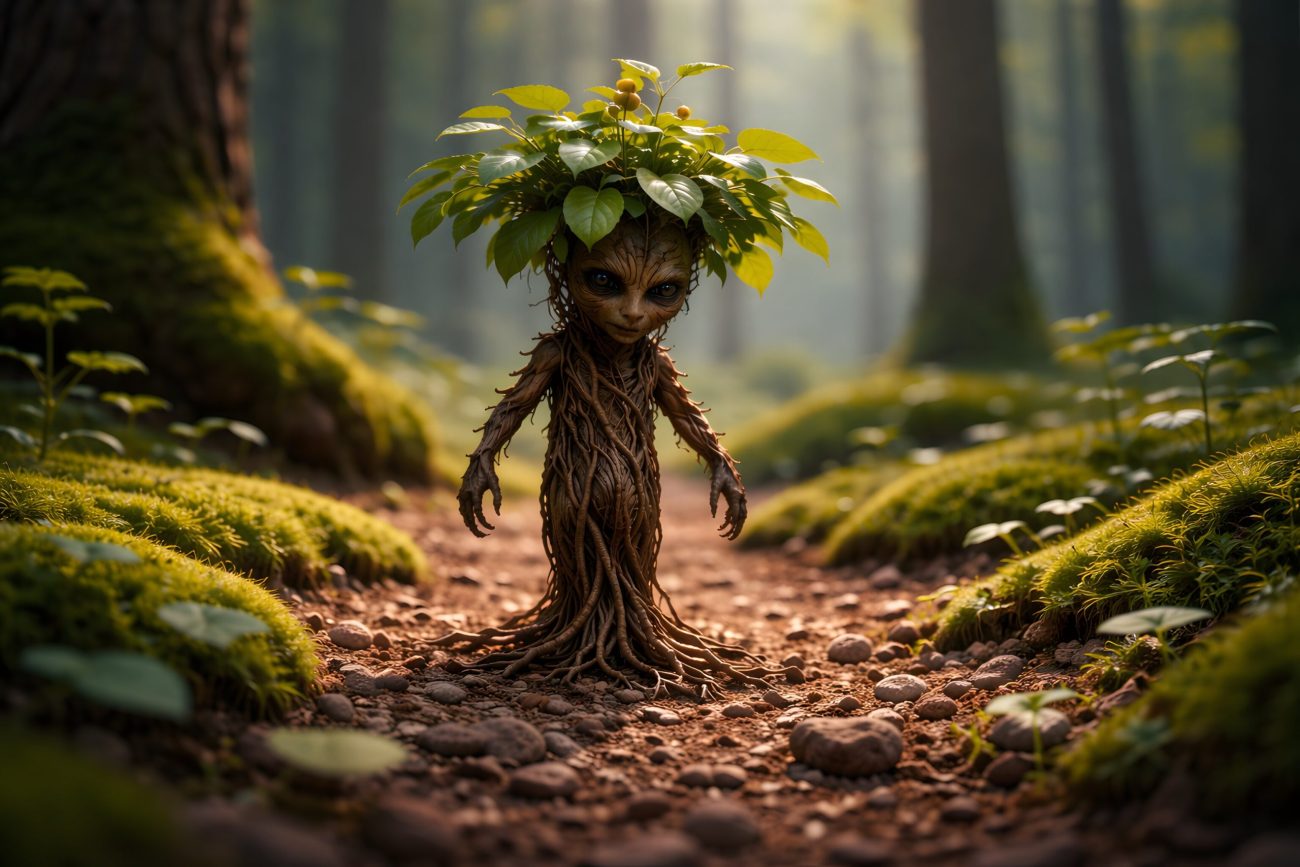
Tree of Waq Waq

Tradition / Region: Arabic mythology
Alternate Names: Waqwaq Tree, Tree of Women, Waq Waq Islands Tree
Category: Plant


The Myth

Far beyond the known seas, on distant and mysterious islands, travelers spoke of a marvelous tree unlike any other. This was the Tree of Waq Waq, a tree said not to bear fruit, but living beings.

From its branches grew figures shaped like humans. In some tellings they were small children, hanging from the limbs like strange blossoms. In others, especially in the western Islamic lands, the fruits of the tree were beautiful women. They formed gradually, swelling and ripening as if nourished by the tree itself, until they were complete.

When the time came, the figures would detach and fall to the ground. As they dropped, they gave out a sharp cry — “Waq! Waq!” — the sound from which the tree took its name. Some were said to live after falling, while others perished the moment they struck the earth, like fruit that had ripened only to spoil.

Sailors, merchants, and scholars repeated stories of these islands, placing them somewhere at the edges of the world, beyond India or near the lands of the rising sun. Some described entire shores lined with these trees, their branches heavy with human forms swaying in the wind.

Because the tree produced only women in certain accounts, it was said that this was how the island’s people reproduced, the tree itself sustaining their lineage generation after generation.

Thus the Tree of Waq Waq stood in legend as one of the wonders of the world — a living tree whose fruit was human life itself.


Gallery


Sources

Sibree, J. (1896). Madagascar before the conquest: The island, the country, and the people, with chapters on travel and topography, folk-lore, strange customs and superstitions, the animal life of the island, and mission work and progress among the inhabitants. New York: Macmillan; London: T. F. Unwin.


Interpretive Lenses

Religious Readings
  • Christian Ascetic Deep Dive
Philosophical Readings
  • Nietzschean Deep Dive
Psychological Readings
  • Jungian Deep Dive
Esoteric Deep Dive
  • Hermetic Deep Dive
Political / Social Readings
  • Marxist Deep Dive

Alruinmannetje

Tradition / Region: Dutch Mythology
Alternate Names: Galgenmannetje, Pismannetje, Alruin
Category: Plant


The Myth

The Alruinmannetje is said to be the root of the poisonous mandrake plant, shaped vaguely like a tiny human figure. Because of this form, people believed the plant was not merely a root but a being with a spirit living inside it.

It was feared above all when pulled from the earth. The Alruinmannetje was said to scream with such a terrible, piercing cry that anyone who heard it would fall dead on the spot. Only those who managed to survive this dreadful moment could claim the root. If they then treated it well — giving it a small bed, dressing it in cloth, and feeding it milk and food — the spirit within would become loyal to its keeper.

Once cared for properly, the Alruinmannetje was believed to whisper secrets to its owner and reveal hidden knowledge. It could also bring wealth. At night, it would fetch money for the household, and coins placed beside it in the evening would be found doubled by morning.

The root was sometimes called Pismannetje because people believed it sprang from the urine of a freshly hanged man beneath the gallows. From this grim origin, the plant gained its connection to death, magic, and the unseen world.

In Friesland, the name Alrún was also used for a witch from Raerd who possessed the power to heal people and lift enchantments, showing how the name of the root became linked not only to a plant, but to human magic as well.


Sources

Abe de Verteller. (n.d.). Van aardmannetje tot zwarte juffer: Een lijst van Nederlandse en Vlaamse elfen en geesten. Retrieved March 1, 2026, from https://abedeverteller.nl/van-aardmannetje-tot-zwarte-juffer-een-lijst-van-nederlandse-en-vlaamse-elfen-en-geesten/

Petrykivka Mara

Tradition / Region: Ukrainian Mythology
Alternate Names: Petrikov Mara
Category: Plant, Forest dweller


The Myth

The Petrykivka Mara is a strange and grotesque figure from the folklore of Eastern Polesia. Unlike many beings called mara in Slavic traditions—where the name usually refers to a dangerous or demonic entity—this mara is considered harmless, though deeply unsettling in appearance and presence.

She is described as resembling a thick, upright log or resinous stump, standing vertically on very short legs shaped like badger paws. Her body is massive and heavy-looking, while her legs are disproportionately small. She is always described as black in color. Though frightening to look at, she does not attack or harm people. At most, she startles children or causes confusion and fear, sometimes even becoming a hazard simply by standing in the way.

When the mara moves, she emits metallic sounds, compared to distant blows on a cast-iron cauldron. These noises announce her presence before she is fully seen. Despite her intimidating size, she is said to be terrified of children, reacting to them with fear rather than aggression.

In later times, the mara came to be represented as a straw scare figure, dressed in rags. In this form, she appears suddenly, stands motionless, or slowly follows people who are walking. She never commits any harmful act, but her presence is described as oppressive, filling those who encounter her with a heavy sadness, as if their heart were being clawed at and their soul weighed down.

One well-known story comes from the town of Petrikov, where during the summer months, at dawn each day, a mara appeared at the entrance to the town. She took the form of a log twice the height of a man, standing on short badger-like legs. She would remain motionless, moaning with a human voice, and vanish again at dawn. How the people eventually rid themselves of her is unknown.

The memory of this being lived on not only in stories but also in speech. A saying arose that later became a proverb. When someone is annoying or persistently clinging, people say:
“I’m tired of you like the Petrikov mara. Why are you clinging to me like the Petrikov mara? Get off me, Petrikov mara.”

In this way, the Petrykivka Mara remains in folklore as a figure of silent oppression and strange persistence, frightening not through violence, but through her unsettling presence alone.


Sources

Bestiary.us contributors. (n.d.). Mara Petrikovskaya. In Bestiary.us, from https://www.bestiary.us/mara-petrikovskaya


Coconut Ghost of Wutumara

Tradition / Region: Papua New Guinea Mythology
Alternate Names: Wutumara
Category: Ghost, Coconut, Plant


The Myth

Wutumara was a woman of great force and determination, a culture heroine whose life became entwined with the world of spirits. She was married to a man who also took a second wife—a ghost from the underworld. This ghost-wife often visited, and each time she came, she drew the husband away from the human world for long stretches of time. Wutumara grew resentful and jealous, angered that her rival’s presence disrupted her household and marriage.

Seeking to resolve this, Wutumara persuaded her husband to bring the ghost-wife permanently into the world of the living, believing that if they all lived together, harmony might be restored. Secretly, however, Wutumara intended to murder the ghost, unaware that spirits cannot be killed in the way humans can.

She attacked her rival and left her body in the jungle. But the ghost was not destroyed. Instead, she returned in vengeance, using powerful magic. She exchanged the genitals of Wutumara and her husband, a transformation meant to humiliate and confuse, and then killed Wutumara. After this, the ghost transformed herself into a pubic hair growing on the husband’s groin, hiding in plain sight.

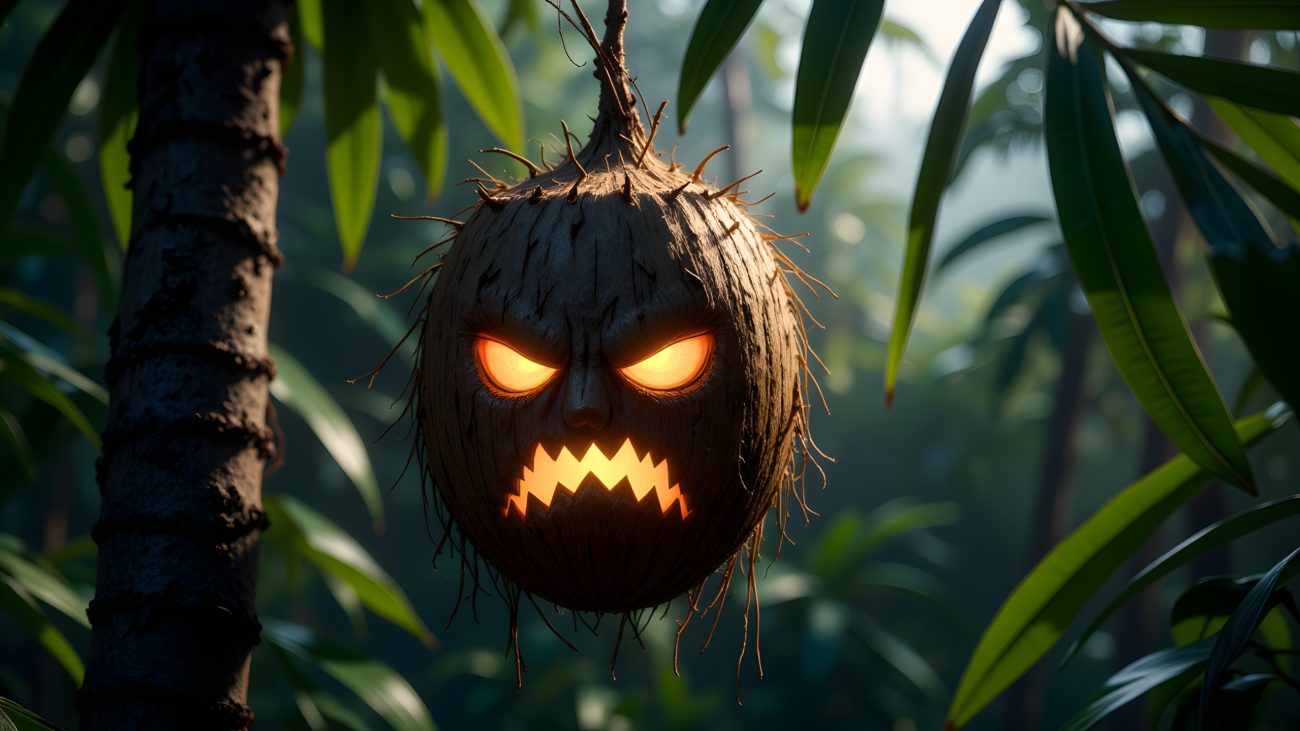
Eventually, the husband tricked the ghost into revealing herself and managed to destroy her. Yet even this was not the end. Shortly afterward, the ghost reappeared once more, transformed into a coconut palm. To this day, it is said that the face of the angry ghost can still be seen in the coconut, watching from within its shell.

Thus the coconut palm became a lasting reminder of jealousy, rivalry, and the persistence of spirits beyond death—a living monument to Wutumara’s tragic conflict with the unseen world.


Gallery


Sources

Landtman, G. (1970). The Kiwai Papuans of British New Guinea: A nature-born instance of Rousseau’s ideal community.


Interpretive Lenses

Religious Readings
  • Christian Ascetic Deep Dive
Philosophical Readings
  • Nietzschean Deep Dive
Psychological Readings
  • Jungian Deep Dive
Esoteric Deep Dive
  • Hermetic Deep Dive
Political / Social Readings
  • Marxist Deep Dive
Other
  • How to Invite The Coconut Ghost of Wutumara

Flower Spirit

Tradition / Region: Chinese Folklore
Alternate Names: Huā Yāo (花妖), Huā Xiān (花仙), Huā Jīng (花精)
Category: Spirit


The Myth

In Chinese folklore, flowers are not lifeless plants but beings endowed with spirit and awareness. It is said that flowers which survive for a hundred years may awaken consciousness and become flower spirits. After a thousand years of cultivation, such beings may ascend further and become immortals. These spirits are known as Huā Yāo or Huā Jīng when their nature is closer to demons, and Huā Xiān when they attain a purer, immortal state.

Flower spirits often appear in human form, usually as young women of extraordinary beauty whose appearance reflects the flower from which they were born. Their lives are bound to the cycles of nature: blooming, fading, and renewal. Though rooted in the soil, they can walk, speak, love, and suffer like humans, while retaining a deep connection to their original plant form.

One of the most famous accounts appears in “Xiangyu” from Strange Tales from a Chinese Studio by Pu Songling of the Qing dynasty. In this story, a peony flower spirit forms a relationship with a scholar surnamed Huang. The spirit is gentle and affectionate, yet vulnerable to the forces of the human world, illness, and spiritual imbalance. Her existence demonstrates both the beauty and fragility of flower spirits, who live between nature and humanity.

Earlier sources trace the idea of flower spirits back to Taiping Guangji, where flowers transforming into conscious beings are recorded as marvels of the natural world. These stories present flower spirits not as monsters, but as manifestations of the living earth itself—natural entities capable of emotion, loyalty, and moral action.

Poetry further reinforces their presence in the cultural imagination. Writers of the Tang, Song, and Ming dynasties frequently invoked flower fairies as unseen guests descending among blossoms, dancing beneath moonlight or moving with the wind through gardens. Their arrival often marked moments when the boundary between the human world and the spirit realm grew thin.

Flower spirits were also associated with imbalance in nature. Historical records sometimes attributed strange winds, unseasonal darkness, or disturbances among flowers to the activity of flower demons, suggesting that when the harmony of earth was disrupted, these spirits manifested visibly.

Across all accounts, flower spirits remain bound to impermanence. If their flower is destroyed, neglected, or uprooted, the spirit weakens or dies. Their stories serve as reminders that beauty, life, and spirit arise from patience and time, and that nature itself is alive, observant, and capable of transformation.


Interpretive Lenses

Religious Readings
  • Christian Ascetic Deep Dive
Philosophical Readings
  • Nietzschean Deep Dive
Psychological Readings
  • Jungian Deep Dive
Esoteric Deep Dive
Political / Social Readings
  • Marxist Deep Dive
Other