Hayauri-dokke

Tradition / Region: Japanese folklore and medieval court legend
Alternate Names: Poisoned Melon of Seimei, Snake Melon
Category: Plant


The Myth

On the first day of the fifth month, during a time of ritual austerity for the regent Fujiwara no Michinaga, several notable men were gathered in seclusion. Among them were the onmyōji Abe no Seimei, a learned monk, a court physician, and the warrior Minamoto no Yoshiie.

That day, a tribute arrived from Nara — a gift of early melons. Yet because the court was observing strict ritual purity, doubt arose about whether the offering should be accepted. Michinaga ordered that the matter be divined, and Seimei was asked to determine whether the fruit was safe.

After examining the melons, Seimei declared that one among them carried danger. To confirm this, the monk began to chant prayers over the fruit. As his voice continued, one of the melons began to move on its own, swaying slightly as if something inside it stirred.

The physician was then ordered to treat the melon. He lifted it, studied it carefully, and without a word inserted two needles into its rind. At once the movement ceased.

Finally, Minamoto no Yoshiie was told to open it. Drawing his sword, he split the melon cleanly in two. Inside, coiled tightly in the flesh, was a small snake. The needles had pierced both of its eyes, and Yoshiie’s cut had neatly severed its neck.

The gathering understood that the fruit had concealed a hidden danger, and that only careful divination, prayer, and skill had revealed and destroyed it.

Another tale tells of a similar event at the imperial court, when melons sent from Yamato were examined by Seimei, a physician, and a monk. They too sensed an unnatural force within the fruit. As prayers were spoken, one melon split open, and a snake longer than a foot burst forth, dying at once.

Such stories spread widely, and the strange melons became known as signs that even the simplest offering from the earth might hide unseen forces within it, revealed only by wisdom, ritual, and a steady hand.


Gallery


Sources

Tyz-Yokai Blog. (n.d.). Hayauri-dokke. Retrieved March 1, 2026, from https://tyz-yokai.blog.jp/archives/1084458875.html


Interpretive Lenses

Religious Readings
  • Christian Ascetic Deep Dive
Philosophical Readings
  • Nietzschean Deep Dive
Psychological Readings
  • Jungian Deep Dive
Esoteric Deep Dive
  • Hermetic Deep Dive
Political / Social Readings
  • Marxist Deep Dive

Naki

Tradition / Region: Japanese Mythology
Alternate Names: Crying Tree, Weeping Tree
Category: Plant


The Myth

Along National Route 234 in Sakuragaoka, Kuriyama Town, there once stood a great Japanese elm known as the Naki — the Crying Tree. For many years it grew beside the road near the Kuriyama Tunnel, and travelers came to know it as a place where something unseen lingered.

During the Taishō era, when the road was being widened, workers tried to cut the tree down to straighten the route. As their saws bit into the trunk, a strange sound was said to echo from the wood — a thin, drawn-out cry like “squeak, squeak” or a long, wavering wail. Word spread quickly, and soon people whispered that the tree itself was crying out.

Misfortune followed those who tried to harm it. Men who struck it with axes fell ill, others were injured when they tried to pull it down, and some were said to have died. Fearing a curse, the workers abandoned the attempt and left the tree standing. The road was completed with a bend around it, as if the tree had forced the path to yield.

People believed the tree was inhabited by restless spirits. Some said it held the souls of prisoners from the Ichikichi Penal Colony who had died during the brutal labor of tunnel construction in the Meiji era. Others spoke of a cook who hanged herself after mistreatment, or of a young Ainu girl and a Japanese man who had taken their lives together. The tree became known as a place where grief had taken root.

Stories gathered around it. There were tales of accidents in front of the tree, of a taxi driver who vanished nearby, and of travelers who felt watched as they passed. When the branches were cut away after the trunk was felled, those who took the wood home were said to meet with misfortune. One old man burned a branch he had taken, only to die before winter passed. Another who tried to keep a piece of the stump dreamed of dreadful visions and hurried to return it.

In time, even construction work elsewhere was linked to the tree’s spirit. When concrete refused to harden during tunnel building in the late 1940s, workers offered sacred sake and prayers at the tree. Afterward, the work was said to proceed without trouble.

Though feared, the Crying Tree was also cherished by locals, who saw it as a witness to the hardships and tragedies of the past. In 1970, a drunken worker finally cut it down with a chainsaw, dismissing the old stories as superstition. Rumors later spread of misfortune following him, though some said he lived on without harm.

The stump remained, and the road’s curve stayed in place as if still honoring the tree. Years later, a young elm believed to have grown from its seed was planted nearby and called the Second Crying Tree, so that the memory of the old one — and the stories rooted in it — would not disappear.


Gallery


Sources

Tyz-Yokai Blog. (n.d.). Naki. Retrieved March 1, 2026, from https://tyz-yokai.blog.jp/archives/1078430827.html


Interpretive Lenses

Religious Readings
  • Christian Ascetic Deep Dive
Philosophical Readings
  • Nietzschean Deep Dive
Psychological Readings
  • Jungian Deep Dive
Esoteric Deep Dive
  • Hermetic Deep Dive
Political / Social Readings
  • Marxist Deep Dive

Hitogataimo

Tradition / Region: Japanese folklore and ascetic traditions
Alternate Names: Ningyoimo, Doll Potato
Category: Plant, immortality food, sacred root


The Myth

Among the foods said to nourish those who walk the path of immortality, there is a mysterious root known as the Hitogataimo, the Doll Potato. It was counted among the natural foods favored by hermits and ascetics who lived in the mountains and sought long life beyond the ordinary span of humans.

These seekers of immortality gathered their sustenance from the wilderness — nuts, herbs, mushrooms, and roots — believing that untouched natural foods carried the pure strength of heaven and earth. Among these, some were said to take on strange and meaningful shapes. One such wonder was the Doll Potato.

The root was said to resemble a tiny human figure, as though the earth itself had shaped it in the likeness of a person. Because of this form, it was thought to hold unusual vitality. Those who found it treated it with care, believing that it was not an ordinary food but something touched by the same mysterious forces that grant long life to immortals.

Stories say that hermits who discovered such a root would dry it, preserve it, or consume it in ritual fashion. Eating it was believed to strengthen the body, purify the spirit, and bring one closer to the hidden state of transcendence sought in the mountains.

Thus the Hitogataimo remained known as one of the secret foods of the immortals — a root shaped like a person, growing unseen in the earth, waiting for the one destined to find it.


Gallery


Sources

Tyz-Yokai Blog. (n.d.). Hitogataimo. Retrieved March 1, 2026, from https://tyz-yokai.blog.jp/archives/1074589195.html


Interpretive Lenses

Religious Readings
  • Christian Ascetic Deep Dive
Philosophical Readings
  • Nietzschean Deep Dive
Psychological Readings
  • Jungian Deep Dive
Esoteric Deep Dive
  • Hermetic Deep Dive
Political / Social Readings
  • Marxist Deep Dive

Money Tree

Tradition / Region: Japanese Mythology
Alternate Names: Kane-ki
Category: Plant


The Myth

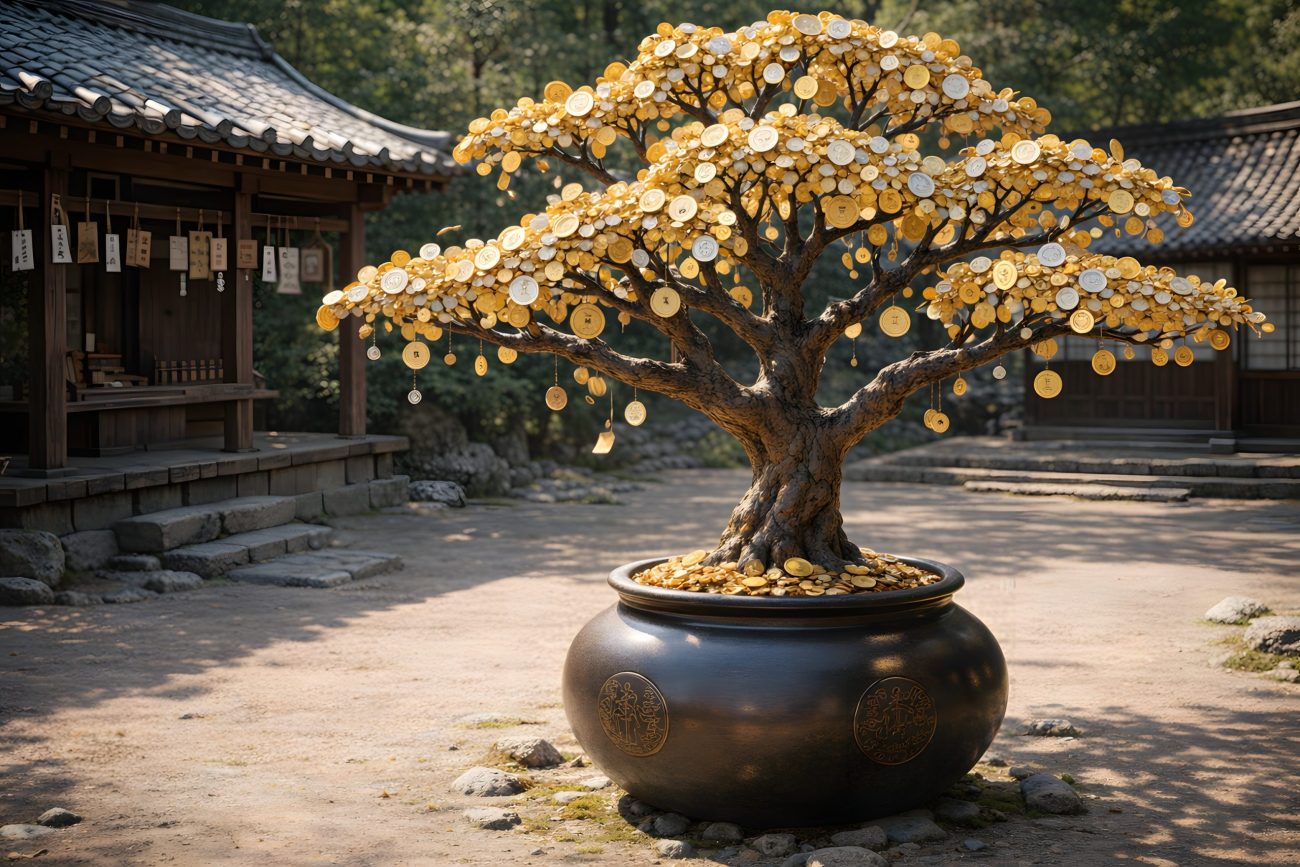
People spoke of a wondrous tree known as the Money Tree, a plant said to bring wealth instead of fruit. In pictures and tales, its branches did not bear leaves or blossoms, but coins of gold and silver that glittered in place of flowers.

Some images showed the tree standing tall while the gods Ebisu and Daikoku, bringers of fortune, watched over it. Its trunk and branches were sometimes inscribed with words about careful living — warnings against carelessness and praise for good planning — as though the tree itself taught the secrets of prosperity.

One tale tells of a lecturer who gathered a crowd before a large pot marked with the words “abundance is here.” He explained that although people believed money trees did not exist in the world, this was not true. The seeds of such trees, he said, were already in every household.

Yet those seeds rarely sprouted. People neglected their duties, forgot their work, and allowed the soil of their livelihood to dry and weaken. When the ground of effort was barren, no tree could grow, no matter how good the seed.

The lecturer said that great wealth may belong to heaven, but smaller fortunes grow from human labor. Merchants, craftsmen, farmers, and even warriors all possess their own money trees, shaped by the tools of their trade. If they care for their work as one tends a plant, the tree will surely grow.

Hearing this, the listeners realized that the money tree was not something distant or magical, but something already within their reach. And they agreed among themselves that the tree of wealth stands not in some hidden land, but in their own homes, waiting to be tended.


Gallery


Sources

Tyz-Yokai Blog. (n.d.). Money Tree. Retrieved March 1, 2026, from https://tyz-yokai.blog.jp/archives/1074477691.html


Interpretive Lenses

Religious Readings
  • Christian Ascetic Deep Dive
Philosophical Readings
  • Nietzschean Deep Dive
Psychological Readings
  • Jungian Deep Dive
Esoteric Deep Dive
  • Hermetic Deep Dive
Political / Social Readings
  • Marxist Deep Dive

Corn Spirit

Tradition / Region: Japanese folklore
Alternate Names: Nanban Millet, Korean Millet, Chinese Millet
Category: Plant, Corn


The Myth

Corn was brought to Japan long ago by ships arriving from the southern seas. First planted in Kyushu, it gradually spread across the country. Because of its foreign origin, people called it Nanban millet, linking it to distant lands beyond the horizon.

As it became more common, strange stories began to gather around the plant. Some fields were said to grow ears with kernels so large they seemed unnatural, as though the crop had taken on a life of its own. In one tale, a lotus flower bloomed from a cornfield in memory of a girl whose devotion had outlived her death, and the field was said to hold her spirit. In another story, a stalk of corn bent and twisted until it resembled a farmer’s beloved chicken, as if the plant were trying to imitate the living creature it had watched each day.

Because of such occurrences, people in some regions grew wary of planting corn near their homes. Certain families believed the crop brought misfortune, and in a few places it was said that only particular households — or those bearing certain surnames — must never grow it at all.

Artists and storytellers also imagined the crop taking on more visible forms. In popular illustrated tales and games, corn sometimes appeared as a yōkai. One well-known depiction shows a ghost shaped from corn rising from a riverbank, confronting a murderer as though the plant itself had taken the role of an avenging spirit.

So corn, though an ordinary food, came to be remembered in story and image as a plant touched by the uncanny — a foreign grain that could grow strangely, take on forms of memory and emotion, and even appear as a spirit among the living.


Gallery


Sources

Tyz-Yokai Blog. (n.d.). Corn Spirit. Retrieved March 1, 2026, from https://tyz-yokai.blog.jp/archives/1067224019.html


Interpretive Lenses

Religious Readings
  • Christian Ascetic Deep Dive
Philosophical Readings
  • Nietzschean Deep Dive
Psychological Readings
  • Jungian Deep Dive
Esoteric Deep Dive
  • Hermetic Deep Dive
Political / Social Readings
  • Marxist Deep Dive

Matsutake-bakemono

Tradition / Region: Japanese Mythology
Alternate Names: Matsutake Monster
Category: Plant, mushroom


The Myth

Long ago, on a distant place known as Dwarf Island, there lived tiny creatures skilled in transformation. Yet they grew bored of practicing their tricks in a land where nothing seemed new. Wanting to improve their powers, they decided to travel to Japan, where many famous spirits and monsters were said to live.

They hid themselves inside a hollow in the mast of a great ship and at last reached Osaka. When they stepped ashore, they were stunned by what they saw. Everything was enormous — the houses, the streets, and above all the people. Still, they did not abandon their plan.

They journeyed to Mount Yoshino, hoping to learn from well-known monsters there. They sought out Imohoribo of Mount Imoyama and Semushibo of Mount Seyama, but the two only laughed at them. Mocking their small size, they joked that the little creatures should crawl into their ears and clean out the dirt. Ashamed and discouraged, the travelers left.

They went on to visit other famous beings, including a monster of Saga and the mighty Fuji Daitahoshi. Yet everywhere they went, their size made them seem insignificant, and they could only flee from the towering figures they met.

At last they reached Miho no Matsubara. There, from the forest floor, appeared a strange being — a Matsutake-bakemono, a monster in the form of a matsutake mushroom. It called out, “Who am I? I am only a small thing.”

Hearing this, the tiny travelers explained their journey. The matsutake monster welcomed them kindly and told them that being small could be an advantage, since people would not easily fear them. It gave them careful directions toward Mount Hakone and urged them to continue their training.

But when they arrived in Hakone, the monster there refused to take them as students. Instead, it warned them that their fate in Japan was uncertain and advised them to return home while they still could.

Before leaving, the little creatures went down to Edo, hoping at least to frighten the townspeople and prove their abilities. Yet their plan failed. Their bodies were so small that people treated them like toys, picking them up and playing with them. After being handled and tossed about, they were finally captured.

In the end, the tiny monsters saw a painted crane by the artist Sesshū and, believing it to be real, were so startled that they vanished completely, disappearing without a trace. Thus their journey ended, remembered only as a curious tale of wandering spirits and the small mushroom monster who alone had treated them with kindness.


Gallery


Sources

Tyz-Yokai Blog. (n.d.). Matsutake-bakemono. Retrieved March 1, 2026, from https://tyz-yokai.blog.jp/archives/1013072024.html


Interpretive Lenses

Religious Readings
  • Christian Ascetic Deep Dive
Philosophical Readings
  • Nietzschean Deep Dive
Psychological Readings
  • Jungian Deep Dive
Esoteric Deep Dive
  • Hermetic Deep Dive
Political / Social Readings
  • Marxist Deep Dive

Ghost Shimeji

Tradition / Region: Japanese Mythology
Alternate Names: Transforming Shimeji, Phantom Shimeji
Category: Plant, mushroom


The Myth

In the mountains near Shiroishi, there once stood a small, poor temple where a priest lived alone. The forest around it was deep and silent, and few people ever came that way.

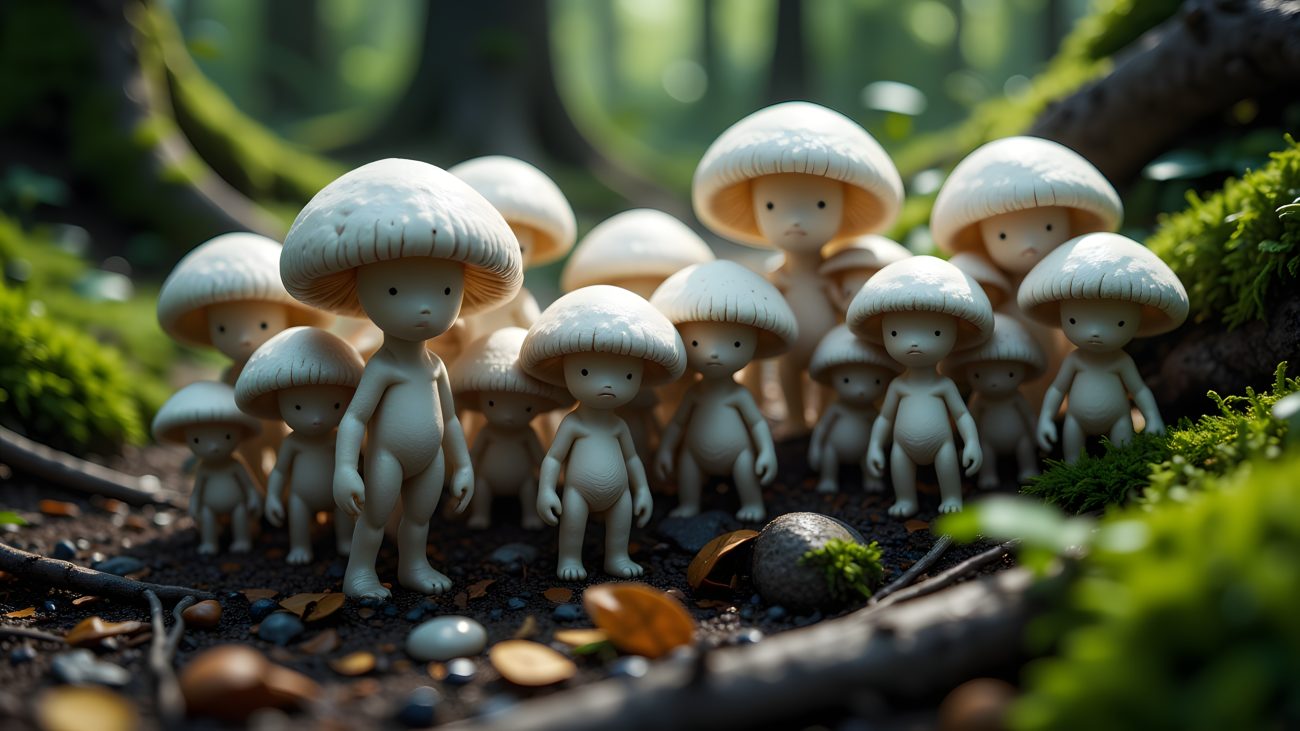
One night, after the priest lay down to sleep, he noticed movement in his room. A group of figures had appeared, all dressed in white kimonos and white hats. They walked in a slow circle around his bed, again and again, without speaking. Terrified, the priest pulled his futon over himself and watched through a small gap, hardly daring to breathe.

Only one of the figures made a sound. As the group circled, that person repeated in a low voice, “Salt and miso, how frightening… salt and miso, how frightening…”

The same thing happened the next night. And the night after that as well. Each time the silent procession returned, circling his bed while the same voice muttered its strange warning.

At last, the priest resolved to discover who they were. Before sleeping, he prepared a needle threaded with string and kept it hidden beside him. When the figures appeared again, he quietly reached out and stitched the thread into the hem of the robe of the one who spoke of salt and miso.

Soon after, the figures left as always.

The next morning, the priest gathered the thread and began to follow it. It led him out of the temple, through the forest, and into a grove of towering cedars. There, behind the temple grounds, stood an enormous old stump. All around it grew countless clusters of shimeji mushrooms, packed so thickly they seemed to cover the wood like a living carpet.

The priest understood then that the white-clad visitors had been these mushrooms in disguise. They had come each night hoping he would eat them, for it was said that if salt or miso were sprinkled on shimeji mushrooms, they would stop growing.

And so the priest left the forest undisturbed, knowing that the silent guests of the night were not spirits of the dead, but mushrooms seeking a place at his table.


Gallery


Sources

Tyz-Yokai Blog. (n.d.). Ghost Shimeji. Retrieved March 1, 2026, from https://tyz-yokai.blog.jp/archives/1013072022.html


Interpretive Lenses

Religious Readings
  • Christian Ascetic Deep Dive
Philosophical Readings
  • Nietzschean Deep Dive
Psychological Readings
  • Jungian Deep Dive
Esoteric Deep Dive
  • Hermetic Deep Dive
Political / Social Readings
  • Marxist Deep Dive

Shadow Wood

Tradition / Region: Chinese mythology
Alternate Names: Gall Wood
Category: Plant


The Myth

Shadow Wood is a mysterious tree said to grow on Yingzhou Island, a distant and sacred place filled with steep mountains and the dwellings of immortals. Among these divine peaks, the tree stands as one of the island’s wonders.

Its leaves shine in an unusual way. When seen beneath the sun, their clustered forms resemble stars scattered across the sky, so that the tree appears as though it holds a fragment of the heavens within its branches.

The Shadow Wood grows slowly, and centuries pass before it offers its gift. Only once in a thousand years does it bear fruit. When it finally ripens, the fruit resembles a melon, with a green skin and dark, black flesh inside. Those fortunate enough to eat it are said to feel their bodies grow light, as if freed from earthly weight, and some claim it brings them closer to the state of immortals.

Because of its strange nature, the tree is also associated with gall wood, the knotted growths that sometimes form on tree roots. These natural swellings were thought to share in the tree’s power, and so the name Shadow Wood came to be used for them as well.

Thus the tree of Yingzhou remained a sign of the immortal realms — a plant whose fruit ripened only once in an age, and whose taste could lift a mortal body toward the heavens.


Gallery


Sources

Wikipedia contributors. (n.d.). 影木. In Wikipedia. Retrieved March 1, 2026, from https://zh.wikipedia.org/wiki/影木


Interpretive Lenses

Religious Readings
  • Christian Ascetic Deep Dive
Philosophical Readings
  • Nietzschean Deep Dive
Psychological Readings
  • Jungian Deep Dive
Esoteric Deep Dive
  • Hermetic Deep Dive
Political / Social Readings
  • Marxist Deep Dive

Longqi Grass

Tradition / Region: Chinese mythology
Alternate Names: Dragon Beard Grass, Jinyun Grass, Dragon Fodder
Category: Plant


The Myth

On Donghai Island, in the waters of the Longju River, there was said to grow a remarkable and powerful grass known as Longqi. The place was already famous in legend as the pasture where King Mu of Zhou once raised his eight extraordinary horses, and it was believed that this grass was the source of their unmatched strength.

Longqi grew among stones and shallow water along the riverbanks and roadsides. Its shoots rose straight from the ground without branches, slender and upright. In summer, small spikes formed at the tips, blooming into flowers that later produced tiny red fruits.

To ordinary eyes it was only a plant, yet its power was known to animals and people alike. Horses that grazed on Longqi became swift beyond measure, able to run thousands of miles in a single day. Because of this, people said that the grass carried the breath of dragons, and an old saying spread: a dragon plant can turn a horse into a dragon foal.

The grass was also valued for its medicinal qualities. It was said to be slightly cold in nature and not poisonous. When used as a remedy, it could drive out harmful forces from the heart, ease troubled urination, cure swelling and sores, and relieve rheumatism. Those who consumed it regularly were believed to grow stronger, their bodies becoming lighter, their sight and hearing sharper, and their lives longer.

Because it could be harvested, tied into bundles, and fed to horses, people also called it Dragon Fodder. Travelers and scholars wrote that wherever water met stone, the grass might be found, quietly growing while carrying the hidden strength of dragons within it.

Thus Longqi was remembered as a humble plant with extraordinary gifts — a grass that could grant speed, health, and long life to those who knew its secret.


Gallery


Sources

Wikipedia contributors. (n.d.). 龙剑. In Wikipedia. Retrieved March 1, 2026, from https://zh.wikipedia.org/wiki/龙剑


Interpretive Lenses

Religious Readings
  • Christian Ascetic Deep Dive
Philosophical Readings
  • Nietzschean Deep Dive
Psychological Readings
  • Jungian Deep Dive
Esoteric Deep Dive
  • Hermetic Deep Dive
Political / Social Readings
  • Marxist Deep Dive

Ninmenju

Tradition / Region: Japanese Mythology
Alternate Names: Jinmenju
Category: Plant


The Myth

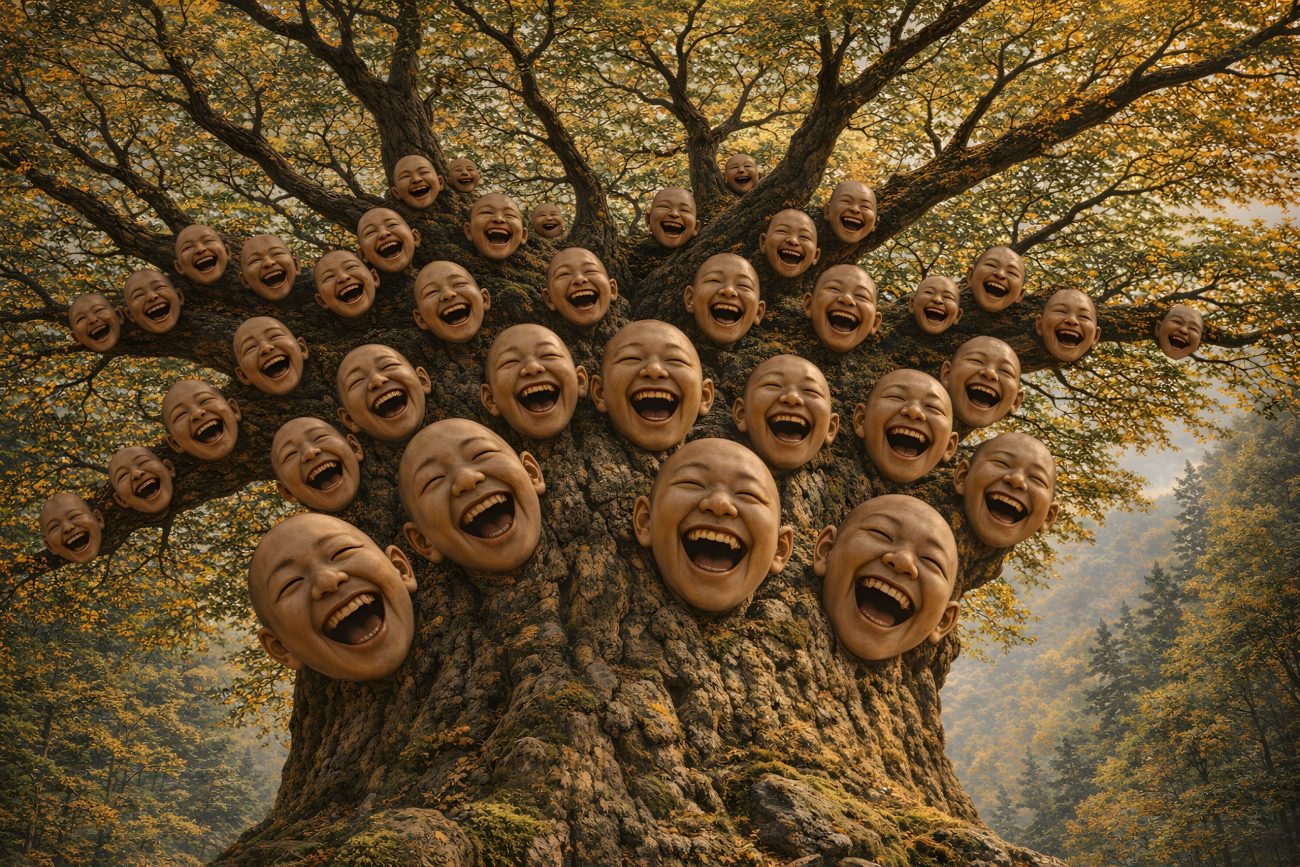
In remote mountain valleys there grows a strange and unsettling tree known as the Ninmenju, the Human-Face Tree. At first glance it appears ordinary, its trunk and branches no different from any other woodland tree. But when it blossoms, its true nature is revealed.

Instead of normal flowers, the Ninmenju produces heads shaped like human faces. These faces cannot speak, yet they are alive in their own way. They smile constantly, their expressions gentle and curious, and sometimes they even laugh softly among themselves as they sway in the wind.

When autumn comes, the tree bears fruit shaped like these same human faces. Travelers who dared taste them said the fruit was sweet and sour, pleasant despite its eerie form.

The tree reacts to those who pass beneath it. If a traveler laughs at the strange sight of the smiling heads, the flowers will laugh in return. Their laughter echoes back from the branches, as though the tree itself is mocking the person below. But if the laughter grows too loud or too harsh, the delicate heads begin to wither. One by one they wilt, loosen, and fall from the tree to the ground.

Stories say that this tree did not originate in Japan. It was said to have come from distant lands far to the west, beyond deserts and foreign kingdoms, in territories known only from travelers’ tales. From there, its legend journeyed across countries and centuries until it became known in the mountains of Japan, where the smiling faces still bloom in hidden valleys.


Gallery


Sources

Wikipedia contributors. (n.d.). Jinmenju. In Wikipedia. Retrieved March 1, 2026, from https://en.wikipedia.org/wiki/Jinmenju


Interpretive Lenses

Religious Readings
  • Christian Ascetic Deep Dive
Philosophical Readings
  • Nietzschean Deep Dive
Psychological Readings
  • Jungian Deep Dive
Esoteric Deep Dive
  • Hermetic Deep Dive
Political / Social Readings
  • Marxist Deep Dive