Zaqqum

Tradition / Region: Arabic Mythology
Alternate Names: Tree of Hell, Infernal Tree
Category: Plant


The Myth

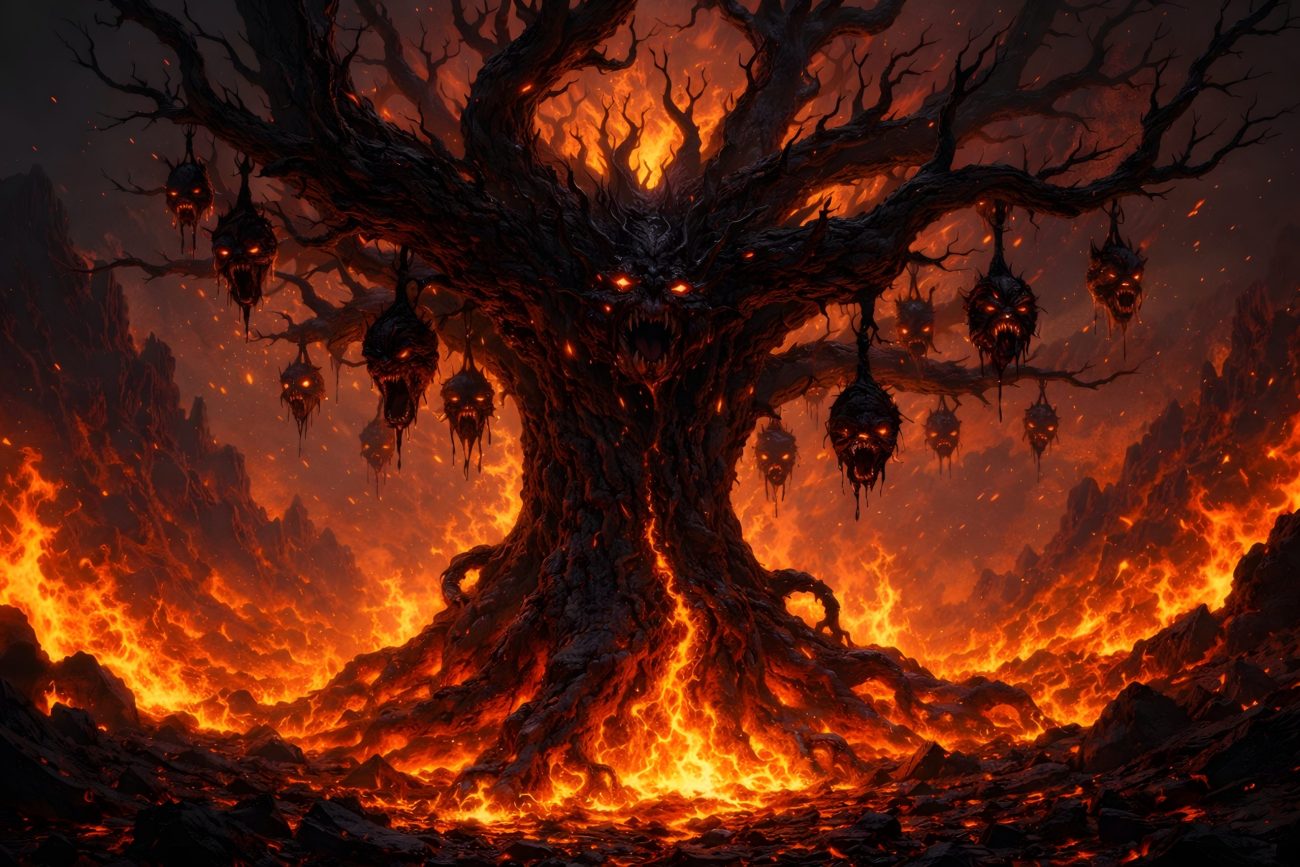
Deep in the center of Hell there is said to grow a dreadful tree known as Zaqqum. Its roots sink into the fire itself, and its trunk rises from the depths of torment, nourished not by water or soil but by flame and suffering.

The tree bears fruit, yet its fruit is not a blessing. Its growths are said to resemble twisted heads, foul and terrifying to behold. The damned are driven by hunger to eat from it, though they know what awaits them. When they swallow the fruit, it burns inside their bodies, scorching their stomachs like molten metal. Afterward they are forced to drink boiling liquid, which only deepens their torment.

The tree stands as part of the landscape of punishment, feeding those who cannot escape it. Its branches spread through the infernal realm, and its presence reminds the inhabitants of Hell that their suffering is unending.

Thus Zaqqum is remembered as the tree of fire and bitterness — a plant rooted in the depths of the unseen world, whose fruit is not life but the taste of punishment itself.


Gallery


Sources

Wikipedia contributors. (n.d.). Zaqqum. In Wikipedia. Retrieved March 1, 2026, from https://en.wikipedia.org/wiki/Zaqqum.


Interpretive Lenses

Religious Readings
  • Christian Ascetic Deep Dive
Philosophical Readings
  • Nietzschean Deep Dive
Psychological Readings
  • Jungian Deep Dive
Esoteric Deep Dive
  • Hermetic Deep Dive
Political / Social Readings
  • Marxist Deep Dive

O-ude

Tradition / Region: Japanese Mythology
Alternate Names: Big Arm
Category: Plant


The Myth

In Shisō County of Banshū there once lived a man named Yamanaka Zen’emon. He was known as honest and kind, but poverty weighed heavily on him. Hoping to improve his fortunes, he set out on foot toward Kobe to look for work.

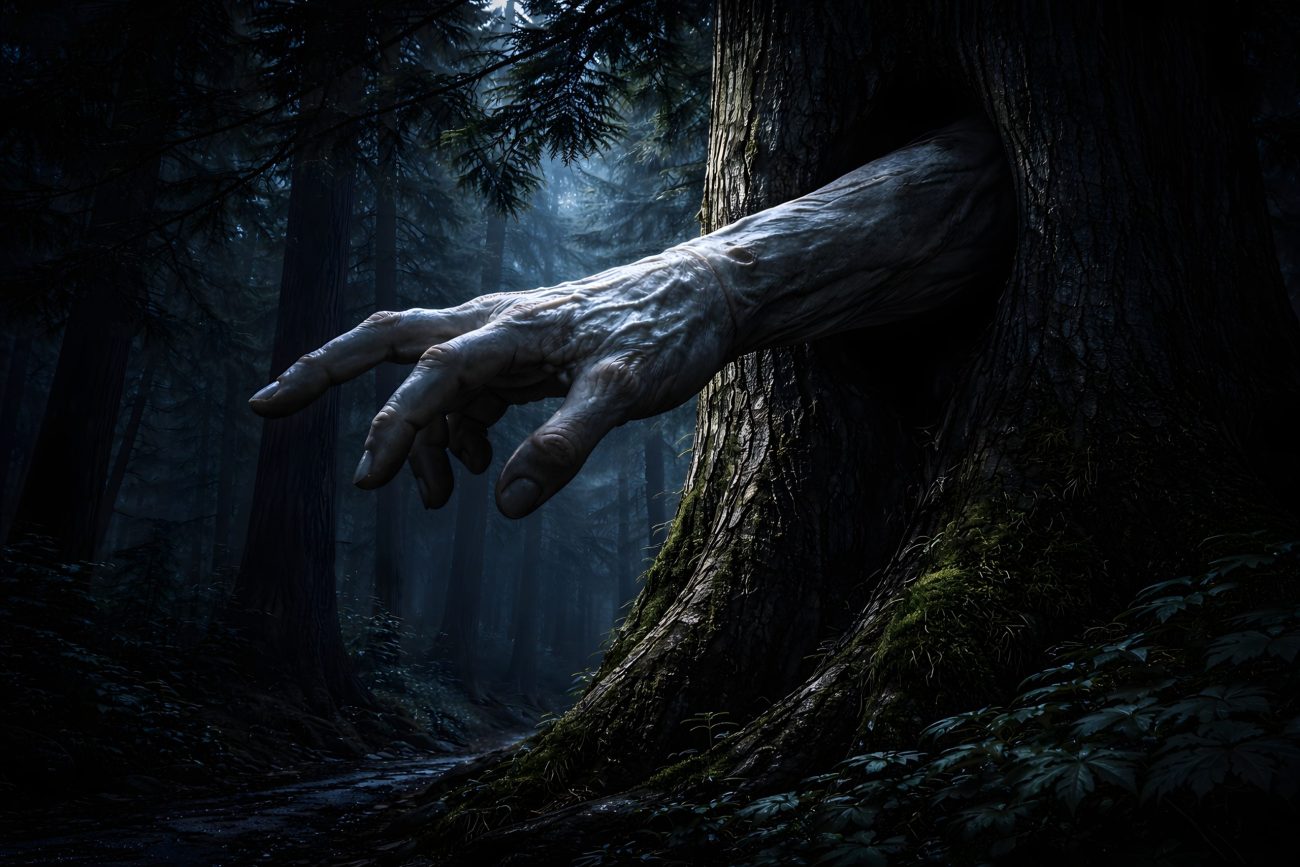
As he crossed into the deep mountain roads, night fell around him. The forest grew dark and still, and only the sound of his own steps followed him. Then, without warning, something emerged from a grove of cedars beside the path — a gigantic arm, stretching out toward him from the trees.

The sight was so sudden and unnatural that Zen’emon collapsed in terror. After a short time he came to, scrambled to his feet, and fled down the road as fast as he could.

Not long afterward, he saw someone sitting in a roadside tree. Drawing closer, he recognized the man as Gen’ya, a childhood friend he had not seen in years. Gen’ya greeted him calmly and said he had been waiting for him. Still shaken, Zen’emon told him about the monstrous arm he had just encountered.

Gen’ya listened, then held out his own arm with a strange smile.
“This one is much bigger than yours,” he said.

Zen’emon stared in horror. Gen’ya’s arm had grown enormous, swelling until it seemed as large as the arm of the Great Buddha of Nara itself. The sight nearly made him faint again. As he watched, his friend suddenly vanished like smoke, leaving nothing behind.

Terrified, Zen’emon ran until he found shelter at a nearby house and stayed there through the night. The next day he continued on to Kobe, but though he searched, no good work came his way.

And so the story remained — a tale told in the region of how, in the mountain forests, even a familiar face may hide something uncanny, and how the deep woods can stretch ordinary things into frightening shapes.


Gallery


Sources

Tyz-Yokai Blog. (n.d.). O-ude. Retrieved March 1, 2026, from https://tyz-yokai.blog.jp/archives/1010653


Interpretive Lenses

Religious Readings
  • Christian Ascetic Deep Dive
Philosophical Readings
  • Nietzschean Deep Dive
Psychological Readings
  • Jungian Deep Dive
Esoteric Deep Dive
  • Hermetic Deep Dive
Political / Social Readings
  • Marxist Deep Dive

The Silver Tree

Tradition / Region: Swiss Mythology
Alternate Names: Silver Mountain Tree
Category: Plant, treasure tree, hidden wonder


The Myth

On the steep rock face above the valley between Bärschis and Tscherlach, where the cliff falls sheer into the depths below, there runs a narrow line of damp stone. From a crevice on the western side of the wall, water sometimes seeps out, leaving a long, dark trail down the rock.

Long ago, a traveler from Venice passed along Lake Walen on his way from Weesen. Seeing the strange mark upon the cliff, he stopped and took out a mountain mirror. For a long time he studied the rock face through it, watching the place where the water emerged.

At last he lowered the mirror and spoke with certainty. Behind that wall, he said, not far from where the water flows, there stands a gigantic tree made entirely of pure silver. Whoever could reach it and claim it would gain immeasurable wealth.

Yet the cliff is steep, the way uncertain, and the place difficult to reach. No one has ever found the path that leads behind the stone. And so the silver tree is said to remain there still, hidden within the mountain, waiting for the one who dares to seek it.


Sources

SAGEN.at. (n.d.). Der silberne Baum. Retrieved March 1, 2026, from https://www.sagen.at/texte/sagen/schweiz/st_gallen/silberne_baeume.html


Appelman

Tradition / Region: Dutch Mythology
Alternate Names: Appelmannetje, Appleman
Category: Plant


The Myth

In the orchards of Limburg, people once warned children and adults alike not to eat too many apples. If someone grew greedy and devoured more than their share, they were told, “The Appelman will get you,” or, “The Appleman will come to collect what is owed.”

The Appelman was believed to be the spirit of the apple tree itself, a quiet presence watching over the orchard. He was not often seen, but people felt that he noticed when someone showed too much hunger or greed. Those who ignored the warning risked misfortune, illness, or some other small punishment sent by the spirit of the tree.

A similar belief was known in England, where people said the final apple on a tree should never be picked. That fruit was left behind as the share belonging to the Appleman. To take it would be to rob the spirit who guarded the tree, and doing so might bring bad luck upon the household.

Thus the Appelman was remembered as a guardian of balance in the orchard — a spirit who reminded people that the fruits of the earth should be taken with moderation, and that greed might awaken the watchful soul of the tree.


Gallery


Sources

Abe de Verteller. (n.d.). Van aardmannetje tot zwarte juffer: Een lijst van Nederlandse en Vlaamse elfen en geesten. Retrieved March 1, 2026, from https://abedeverteller.nl/van-aardmannetje-tot-zwarte-juffer-een-lijst-van-nederlandse-en-vlaamse-elfen-en-geesten/


Interpretive Lenses

Religious Readings
  • Christian Ascetic Deep Dive
Philosophical Readings
  • Nietzschean Deep Dive
Psychological Readings
  • Jungian Deep Dive
Esoteric Deep Dive
  • Hermetic Deep Dive
Political / Social Readings
  • Marxist Deep Dive

Mamejuu

Tradition / Region: Japanese modern folklore / yōkai tradition
Alternate Names: Bean Beast
Category: Plant


The Myth

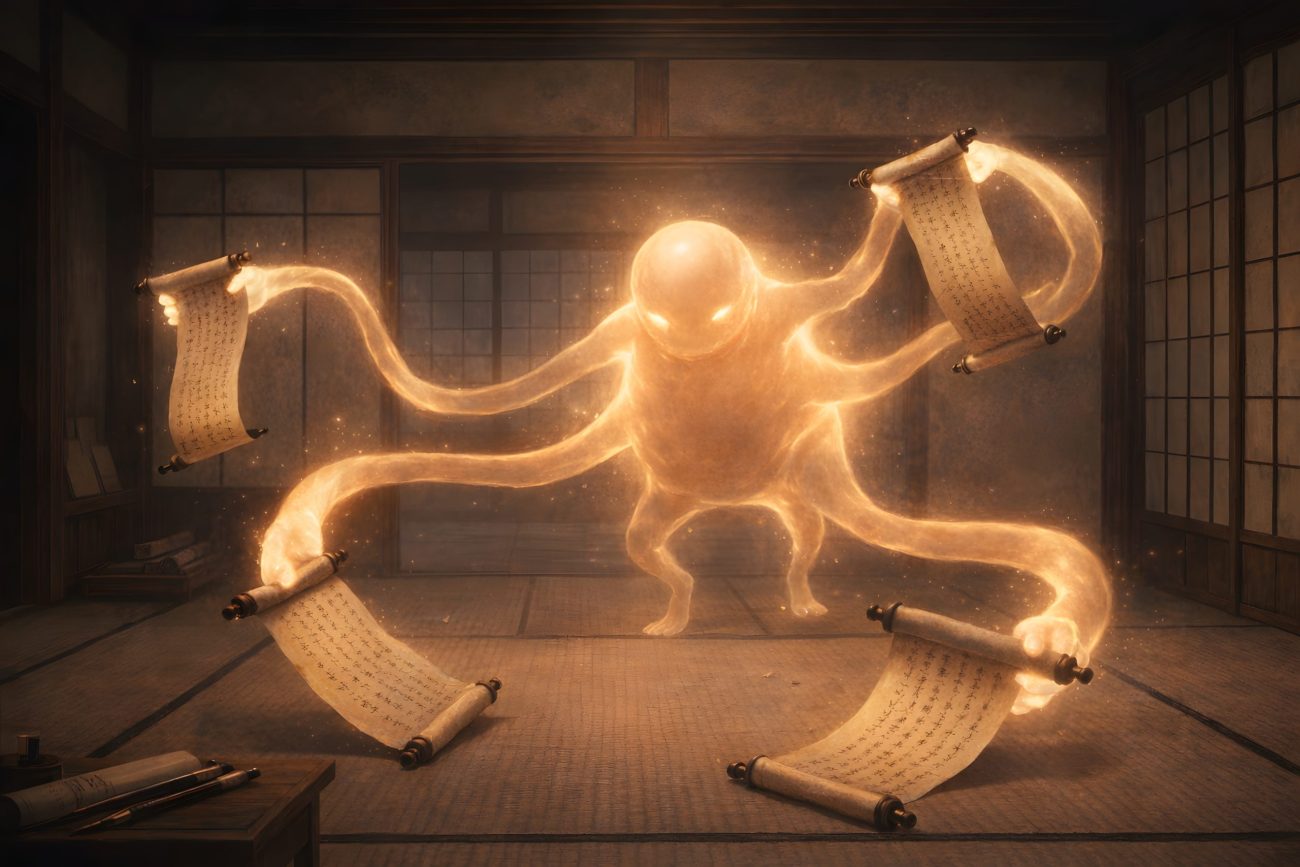
There is said to be a strange being called the Mamejuu, a small creature soft like a bean and lacking eyes, yet filled with a quiet and watchful presence.

Unlike most spirits, the Mamejuu is not found in forests or rivers, but within the human heart itself. It sleeps there unnoticed, hidden deep inside a person. Only through discipline, study, and careful training can it be drawn out into the world.

When it emerges, the creature grows and becomes a loyal servant to the one who awakened it. People compare it to a shikigami of the onmyōji or to the spirit servants said to have followed mountain ascetics. Once fully formed, the Mamejuu can act on behalf of its master and may even influence others, carrying out quiet tasks that ordinary hands cannot perform.

Some say the creature is ancient and wise, able to whisper knowledge of hidden matters — the secrets of long life, the ways to gain wealth, and the paths by which fortune draws near. Yet its appearance is humble, and it remains close to the one who called it forth, like a spirit born from the soul itself.

Thus the Mamejuu is remembered as a being not found in the outer world, but grown within — a small, unseen creature waiting in the heart until someone learns how to bring it to life.


Gallery


Sources

Tyz-Yokai Blog. (n.d.). Mamejuu. Retrieved March 1, 2026, from https://tyz-yokai.blog.jp/archives/1076296172.html


Interpretive Lenses

Religious Readings
  • Christian Ascetic Deep Dive
Philosophical Readings
  • Nietzschean Deep Dive
Psychological Readings
  • Jungian Deep Dive
Esoteric Deep Dive
  • Hermetic Deep Dive
Political / Social Readings
  • Marxist Deep Dive

Mozousu-sama

Tradition / Region: Japanese Mythology
Alternate Names: Mozosu-sama
Category: Plant, Ghost


The Myth

Long ago in Kitsunezuka of Kami Ongata, there lived a farmer named Yamamoto. He was unmarried, gentle in manner, and admired by many of the village girls. Yet his heart belonged to one woman alone, a beautiful lover with whom he had pledged his life.

Near the Yamamoto home stood a temple where a monk called Mozousu lived. He was known throughout the village as a troublesome man — coarse, selfish, and fond of chasing women. He meddled in the lives of widows and flirted shamelessly with visitors to the temple, earning a poor reputation among the people.

Before long, Mozousu set his sights on Yamamoto’s beloved. When Yamamoto was away, the monk began secretly visiting her, pressing her with unwanted attention and making threatening demands. The woman endured this harassment in silence until Yamamoto finally learned the truth.

Furious but troubled, Yamamoto hesitated. The monk was tied to the temple of his own family, and confronting him openly would not be simple. After much brooding, he resolved on a darker course. One night, as Mozousu made his way toward the woman’s house, Yamamoto lay in wait and killed him.

From that night onward, peace left the house. Each evening, the ghost of Mozousu came to Yamamoto’s bedside, whispering bitterly and tormenting him without rest.

At last Yamamoto prepared to face the spirit. He lay down with a sword at his pillow and waited. When the ghost appeared again and began its complaints, Yamamoto struck in a single motion, cutting it down.

The next morning, he went out to check his fields. There he found one of his onions split cleanly in two, as though struck by a blade. From the cut surface seeped a reddish fluid like blood. Only then did he understand that what he had struck in the night had not been a ghost in human form, but something tied to the earth itself.

Afterward, misfortune followed the Yamamoto family. Ill luck and trouble came one after another, and the household believed the dead monk’s resentment had not faded. To calm his spirit, they built a small shrine and enshrined him as Mozousu-sama, praying for his peace.

Even so, the family kept one rule for generations afterward: no onions were to be grown in their fields, lest the spirit remember and return once more.


Gallery


Sources

Tyz-Yokai Blog. (n.d.). Mozōsu. Retrieved March 1, 2026, from https://tyz-yokai.blog.jp/archives/1071221874.html


Interpretive Lenses

Religious Readings
  • Christian Ascetic Deep Dive
Philosophical Readings
  • Nietzschean Deep Dive
Psychological Readings
  • Jungian Deep Dive
Esoteric Deep Dive
  • Hermetic Deep Dive
Political / Social Readings
  • Marxist Deep Dive

Sansho-birashi

Tradition / Region: Japanese folklore (Shima, Mie Prefecture)
Alternate Names: Sansho Kurage
Category: Plant


The Myth

Among the women divers of Shima, who for generations descended into the sea to gather abalone and seaweed, there were stories of a feared presence beneath the water known as the Sansho-birashi.

When the divers worked along the reefs, they sometimes felt a sudden sting, sharp as a needle. At first it was only a small pain, but soon it spread through the body, tightening the chest and making it hard to breathe. Some said the shock could even cloud the mind, leaving the diver confused or helpless in the water.

In earlier times, such attacks were believed to be the work of a demon that lurked among the reefs. The creature was said to be small and difficult to see, nearly transparent, hiding where the seaweed cast shadows. It struck silently and vanished just as quickly.

Because of this, divers took precautions. They crushed the leaves of the sanshō plant and smeared the sharp-scented juice across their skin before entering the sea. Others tucked sprigs of sanshō into their hair as charms, believing the plant’s power would repel the unseen attacker.

Another creature feared in the same waters was called the Sansho Kurage, a jellyfish-like being said to drift beneath seaweed beds. Its sting was said to bring burning pain and fever, and it too became part of the stories told among the divers before they slipped beneath the waves.

Even as time passed and people learned ways to treat the stings, the name Sansho-birashi remained, a reminder that the sea was never empty, and that unseen things could still wait among the rocks for those who entered their realm.


Gallery


Sources

Tyz-Yokai Blog. (n.d.). Sanshō-birashi. Retrieved March 1, 2026, from https://tyz-yokai.blog.jp/archives/1056156792.html


Interpretive Lenses

Religious Readings
  • Christian Ascetic Deep Dive
Philosophical Readings
  • Nietzschean Deep Dive
Psychological Readings
  • Jungian Deep Dive
Esoteric Deep Dive
  • Hermetic Deep Dive
Political / Social Readings
  • Marxist Deep Dive

Namakubitake

Tradition / Region: Japanese Mythology
Alternate Names: Flesh Head Mushroom
Category: Plant, Mushroom


The Myth

At the Teranishi Shimodai residence there once stood a mound with a troubling story behind it. The tale began generations earlier, in the time of the monk Wakasa Nyūdō Sōkan.

One night, a strange and foul odor suddenly filled the monk’s sleeping chamber. He searched carefully through the room but could find nothing that might explain it. At last he looked upward and saw, resting against the ceiling, something impossible — the severed head of a young boy.

The head appeared to belong to a refined youth of fourteen or fifteen years. Its face looked fresh and lifelike, wearing a faint smile that made the sight even more unsettling. No one could explain where it had come from, and nothing else in the house seemed disturbed.

Unsure what else to do, the household buried the head in a corner of the estate grounds. Over the spot they raised a small mound and planted a tree to mark it.

Years passed.

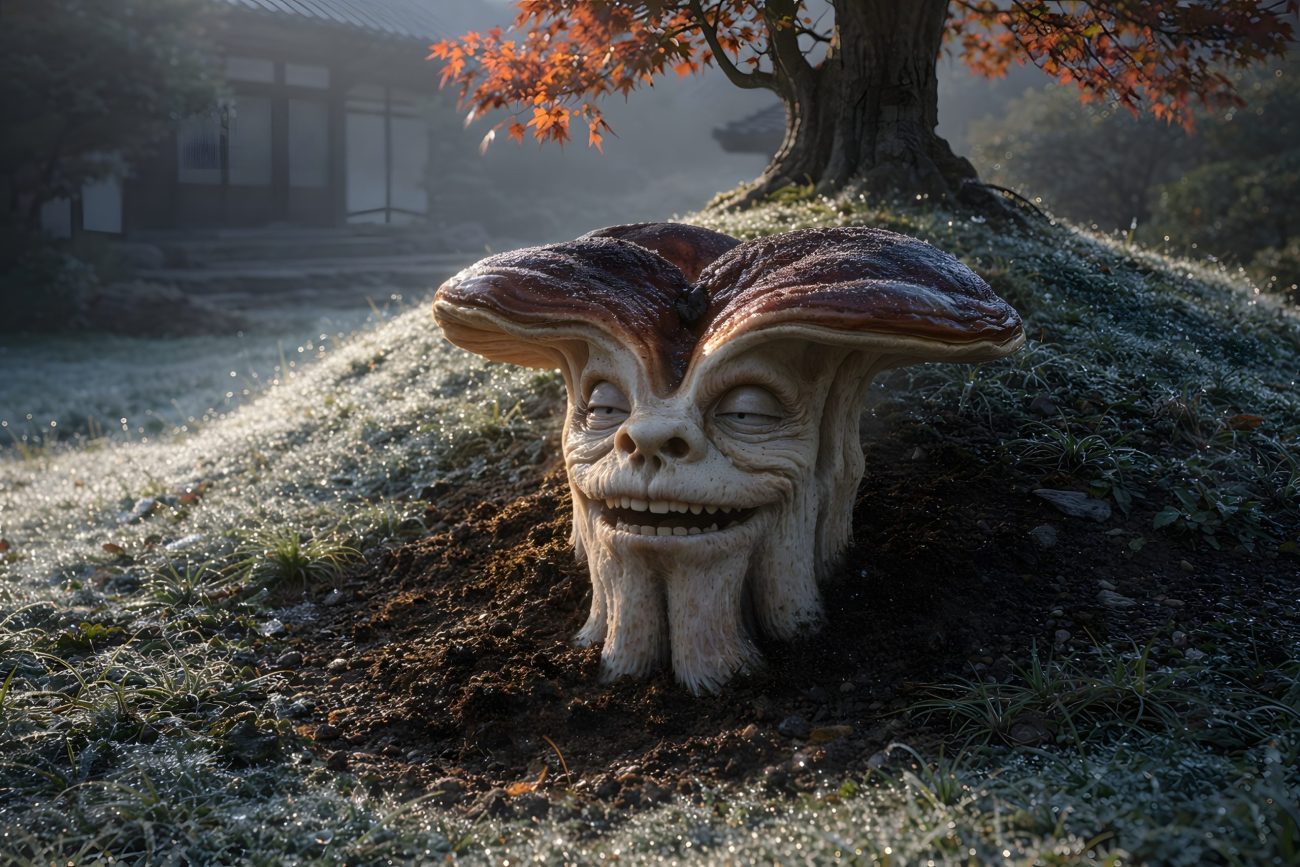
Then, one autumn morning during the Hōreki era, as white dew lay thick on the ground, something unusual appeared on the mound. A mushroom had pushed its way up through the earth.

Its shape was elegant, somewhat like a reishi mushroom. Yet its stalk forked in an odd way, and when it was split open, people saw that the surface bore the likeness of a boy’s face. Eyes, ears, nose, and mouth all seemed formed in the flesh of the fungus, as if the earth had remembered what lay buried beneath it.

No one knew what the mushroom truly was or how it came to grow there. The strange fungus remained a mystery, and the mound where it appeared was remembered thereafter as a place where something buried had returned in another form.


Gallery


Sources

Tyz-Yokai Blog. (n.d.). Namakubitake. Retrieved March 1, 2026, from https://tyz-yokai.blog.jp/archives/1013072021.html


Interpretive Lenses

Religious Readings
  • Christian Ascetic Deep Dive
Philosophical Readings
  • Nietzschean Deep Dive
Psychological Readings
  • Jungian Deep Dive
Esoteric Deep Dive
  • Hermetic Deep Dive
Political / Social Readings
  • Marxist Deep Dive

Basho no Sei

Tradition / Region: Chinese Mythology, Vietnamese Mythology
Alternate Names: Basho Essence, Banana Spirit, Plantain Ghost
Category: Plant


The Myth

In old stories it is said that even plants may awaken into spirits if they endure long enough in the world. Among the most well known of these is the Basho no Sei, the spirit of the bashō, or plantain tree.

When a banana plant grows old and stands for many years, people believed it could gather strange energy from wind, rain, and moonlight. Over time, this energy would give rise to a spirit within the trunk and leaves. At last, the tree might shed its stillness and take on a ghostly life of its own.

Such spirits were said to appear most often in the form of a woman. In Chinese tales, the banana essence sometimes took human shape to approach travelers or householders at night. Some versions say it deceived people with beauty and soft speech, only to bring harm once it had drawn close.

One story tells of a young monk studying late into the night in a quiet temple in Shinshu. As he read, a beautiful woman entered and spoke gently to him, trying to charm him with her presence. The monk sensed something unnatural and grew angry. Grasping a short blade, he struck at her, and she fled into the darkness, leaving a trail of blood.

At dawn, the monk followed the drops of blood into the courtyard. There he found that the temple’s plantain tree had been cut deeply into its trunk, and its sap ran down like the blood he had seen. From this he understood that the visitor of the night had been the spirit of the bashō itself.

Such tales spread across lands and generations, and people came to say that the banana plant, though soft and harmless in appearance, might hide a spirit if it lived long enough. For this reason, groves of old plantains were sometimes regarded with caution, as places where a quiet tree might one day step into the world in human form.


Gallery


Sources

Wikipedia contributors. (n.d.). 菟菟鬼. In Wikipedia. Retrieved March 1, 2026, from https://zh.wikipedia.org/wiki/%E8%8A%AD%E8%95%89%E9%AC%BC


Interpretive Lenses

Religious Readings
  • Christian Ascetic Deep Dive
Philosophical Readings
  • Nietzschean Deep Dive
Psychological Readings
  • Jungian Deep Dive
Esoteric Deep Dive
  • Hermetic Deep Dive
Political / Social Readings
  • Marxist Deep Dive

Sunamura no onryō

Tradition / Region: Japanese Mythology
Alternate Names: Ghost of Sunamura
Category: Plant


The Myth

In the farming village of Sunamura, a place once known for its wide pumpkin fields, people spoke of a restless spirit that wandered the patches after dark.

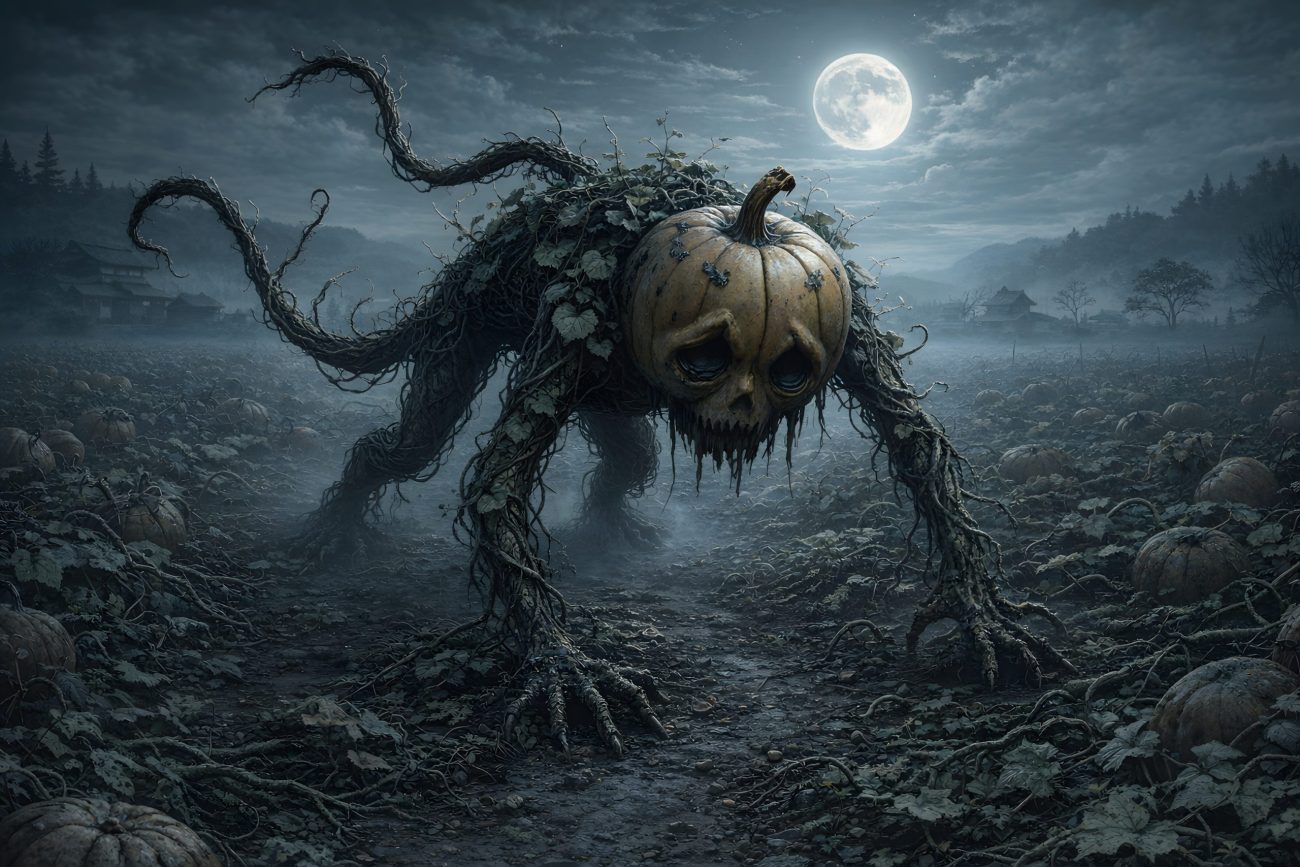
The being was said to be shaped from the very plants that grew there. Its body twisted together from pumpkin vines and leaves, forming thin limbs that crept and dragged across the soil. Atop this fragile frame it carried a large, heavy pumpkin for a head — bright orange and swollen, as if freshly cut from the field. The spirit seemed burdened by it, clutching the great fruit in its arms as it moved.

Night after night, villagers claimed the creature emerged among the rows of pumpkins. It would shuffle through the fields, its vines rustling in the wind, and when it saw a person it would lurch forward in pursuit. Those who fled said they could hear the scraping of vines and the dull thump of the pumpkin as it struggled to follow.

No one knew whose spirit it was or why it had taken root there. Some believed it was tied to the land itself, born from the fields that fed the village. Others thought it might be the ghost of someone whose life had ended in sorrow among the farms, now bound to the harvest forever.

Whatever its origin, the pumpkin spirit became part of the village’s night stories, a reminder that even the most ordinary crops might conceal something uncanny once the sun had set. And though Sunamura itself faded with time, the tale of the vine-bound ghost lingered like a shadow in the fields that once grew there.


Gallery


Sources

yokai.com. (n.d.). Sunamura no onryō. Retrieved March 1, 2026, from https://yokai.com/sunamuranoonryou/?srsltid=AfmBOoqa20CQnB3x0lnLhtRVs2ujtNF7zgGjpZQFF0c5MqokSOgFsGEZ


Interpretive Lenses

Religious Readings
  • Christian Ascetic Deep Dive
Philosophical Readings
  • Nietzschean Deep Dive
Psychological Readings
  • Jungian Deep Dive
Esoteric Deep Dive
  • Hermetic Deep Dive
Political / Social Readings
  • Marxist Deep Dive