Adamastor

Tradition: Portuguese Mythology
Alternative Names: The Giant of the Cape of Storms, The Spirit of the Cape of Good Hope
Category: Giant


The Myth

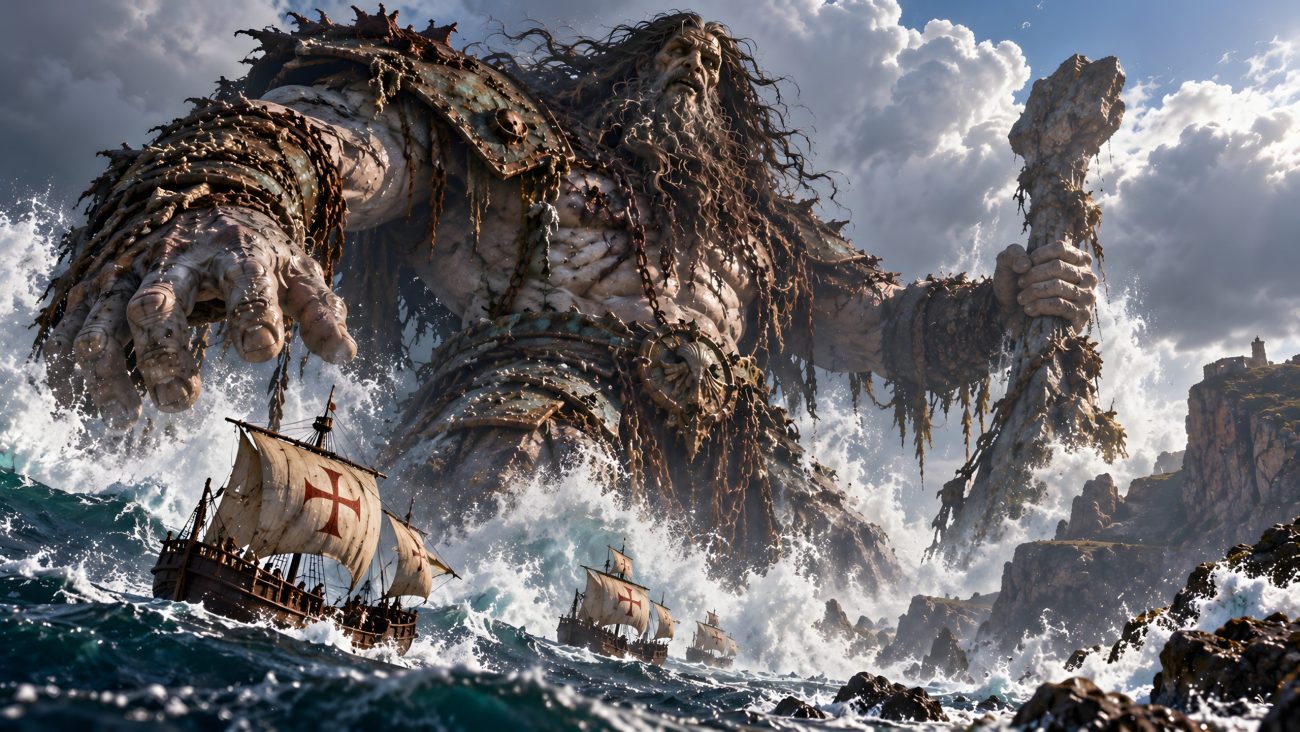
Adamastor is a fearsome giant created by the Portuguese poet Luís de Camões in his epic poem Os Lusíadas, first published in 1572. He personifies the Cape of Good Hope and the dangers faced by Portuguese sailors during the Age of Discovery. Appearing from a storm cloud, Adamastor embodies the formidable forces of nature that threatened ships attempting to sail around the southern tip of Africa and enter the Indian Ocean.

In Camões’s poem, Adamastor is one of the giants of Greek mythology, banished to the Cape of Good Hope by the sea goddess Doris after falling in love with her daughter, Thetis. Condemned to remain at the edge of Africa, he becomes the supernatural guardian of the surrounding waters. He threatens to destroy any sailors daring enough to cross his domain, using violent storms and the terrifying power of the sea to challenge their passage.

Adamastor appears before the Portuguese expedition led by Vasco da Gama as the fleet approaches the Cape. He manifests as an enormous, grotesque figure with an unnaturally pale complexion, hollow eyes, a tangled beard, matted hair, and decaying yellow teeth. His terrifying appearance reflects the dangers of the unexplored ocean. When Vasco da Gama demands to know his identity, the giant declares himself the vast promontory that the Portuguese call the Cape of Storms, a place unknown to the ancient geographers and a boundary that their daring expedition has challenged.

The giant’s anger is intertwined with his tragic personal history. His love for Thetis brought him into conflict with the divine powers, resulting in his punishment and transformation into the spirit of the Cape. His story reveals that beneath his threatening appearance lies a being condemned to an existence of frustration and loss. After recounting his fate, Adamastor is deeply moved and eventually disappears, the storm clouds disperse, and the sea grows calm. The Portuguese ships are then able to continue their voyage toward India.

Adamastor became a powerful literary symbol of the dangers of maritime exploration. Through him, Camões personified the storms, uncertainty, and immense natural forces that Portuguese sailors confronted when rounding the Cape of Storms, later known as the Cape of Good Hope. Although the giant ultimately fails to prevent their passage, his appearance dramatizes the courage required to cross the ocean and the formidable challenges that stood between Portugal and its expanding maritime ambitions.


Sources

“Adamastor.” Wikipedia: The Free Encyclopedia. Wikimedia Foundation. Accessed October 16, 2026. https://en.wikipedia.org/wiki/Adamastor
Busya

Tradition: Udmurt Mythology, Russian Mythology
Alternative Names: Busy, Бусе
Category: Giant


The Myth

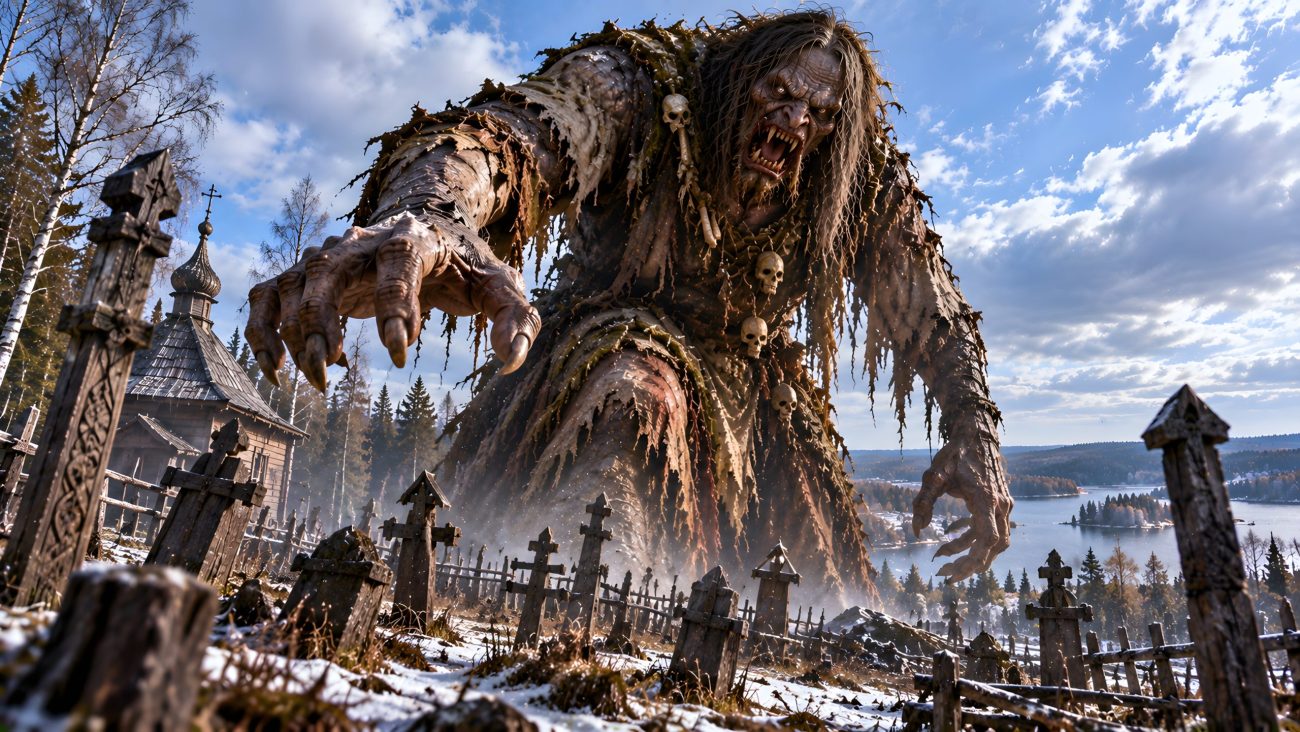
Busya is an evil spirit in Udmurt mythology, particularly associated with the belief that it preys upon the souls of the dead. It is described as a frightening supernatural being that attacks people and animals, especially in places where the dead are buried. The name also appears in the variant spelling Busy.

According to traditional accounts, Busya may appear in the form of a large, fearsome creature with prominent teeth and claws. It is associated with graveyards and places connected to death, where it is believed to attack or devour the souls of the deceased. Its terrifying appearance and predatory behavior make it a dangerous presence in the supernatural world.

Despite its frightening nature, Busya is not considered invulnerable. Traditional accounts advise people to remain cautious and avoid confronting the spirit carelessly. The creature belongs to a broader body of Udmurt beliefs about malevolent beings that threaten the living and the dead, reflecting anxieties surrounding death, burial places, and the fate of the soul.


Sources

“Busije.” New Bestiary (Bestiary.us). https://www.bestiary.us/busije


Ojáncanu

Tradition: Cantabrian Mythology, Spanish Mythology
Alternative Names: Ojancanu, Ojáncana (female counterpart)
Category: Giant


The Myth

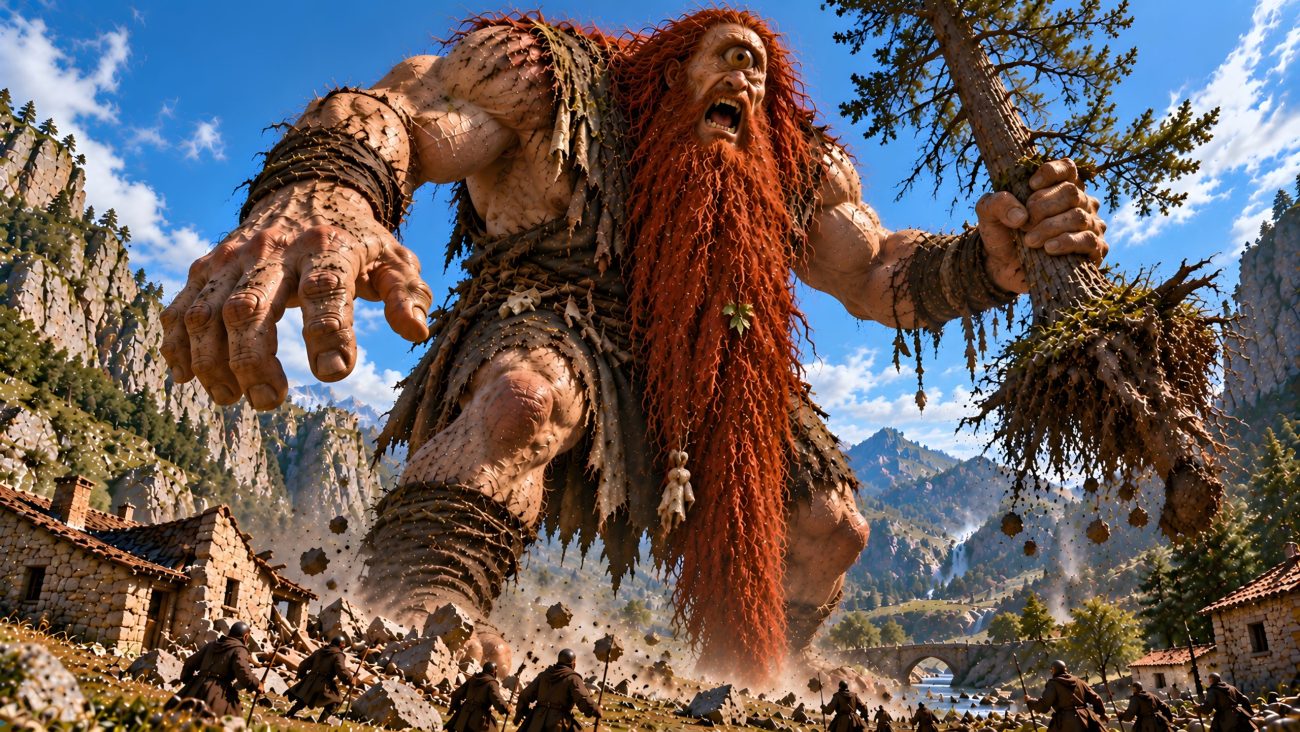
The Ojáncanu is a monstrous, one-eyed giant in Cantabrian mythology, embodying cruelty, brutality, and destructive power. It stands approximately ten to twenty feet tall and possesses superhuman strength, ten digits on each hand and foot, and two rows of teeth. Its appearance is wild and beast-like, with a long mane of red hair and an enormous beard that can nearly reach the ground.

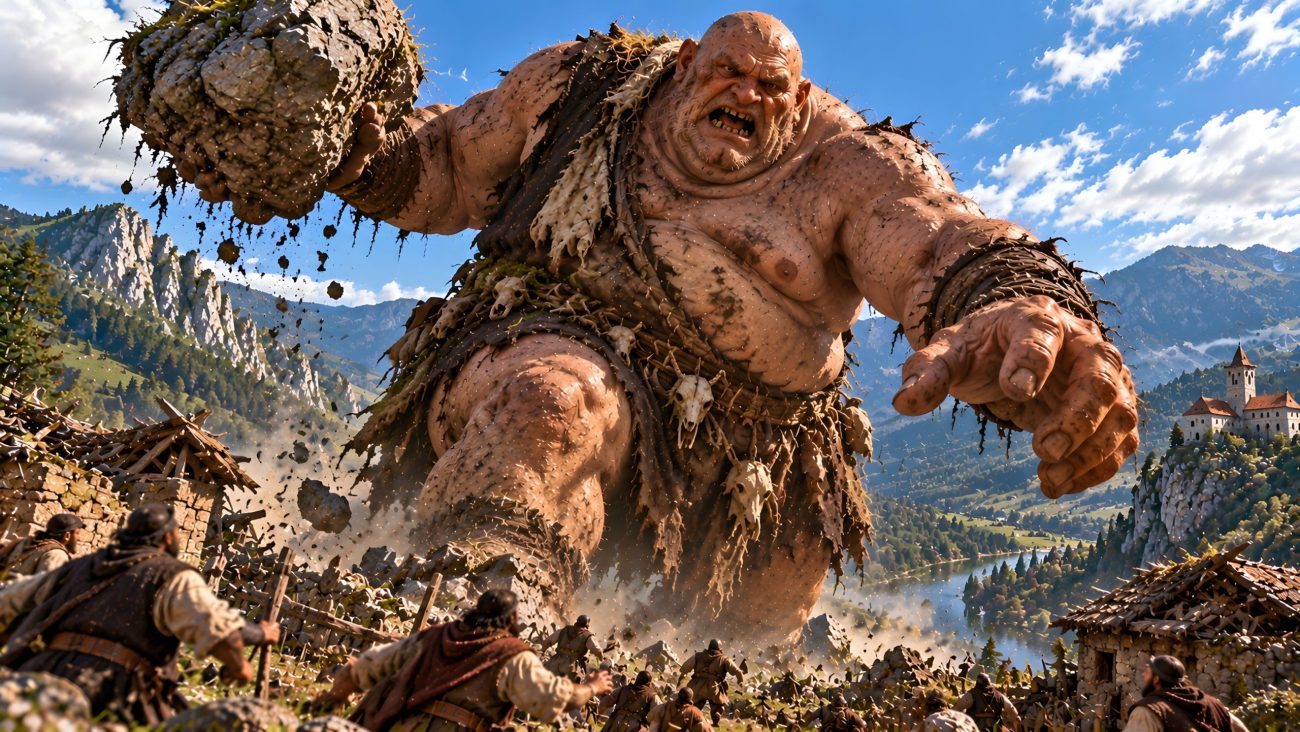
The Ojáncanu constantly performs acts of destruction. It uproots rocks, demolishes huts, tears down trees, and blocks water sources, bringing hardship to the people who live nearby. It also fights Cantabrian brown bears and Tudanca bulls, defeating them through its extraordinary strength. Among the supernatural beings of Cantabria, it represents a violent and uncontrollable force that threatens both human settlements and the natural landscape.

Despite its immense power, the Ojáncanu has a peculiar weakness. Hidden among the tangled hair of its beard is a single white hair, and pulling it is said to be the easiest way to kill the giant. The creature therefore possesses a vulnerability that can be exploited by someone who knows its secret.

The female counterpart, known as the Ojáncana, resembles the male but has no beard. Instead, she has long, drooping breasts that reach the ground. When she runs, she must carry them over her shoulders. The Ojáncanu and Ojáncana also have an unusual reproductive tradition: when an old male dies, the other giants distribute his internal organs and bury his corpse beneath an oak or yew tree.

The Ojáncanu fears only the Anjanas, the benevolent fairies of Cantabrian mythology. These good supernatural beings stand in opposition to the giant’s cruelty and destructive nature, representing one of the few forces capable of inspiring fear in this otherwise formidable monster.


Sources

“Ojáncanu.” Wikipedia: The Free Encyclopedia. Wikimedia Foundation. Accessed October 16, 2026. https://en.wikipedia.org/wiki/Oj%C3%A1ncanu


Tartaro

Tradition: Basque Mythology, Spanish Mythology
Alternative Names: Tartalo, Tartaroa, Torto, Alarabi, Anxo, Ancho
Category: Giant


The Myth

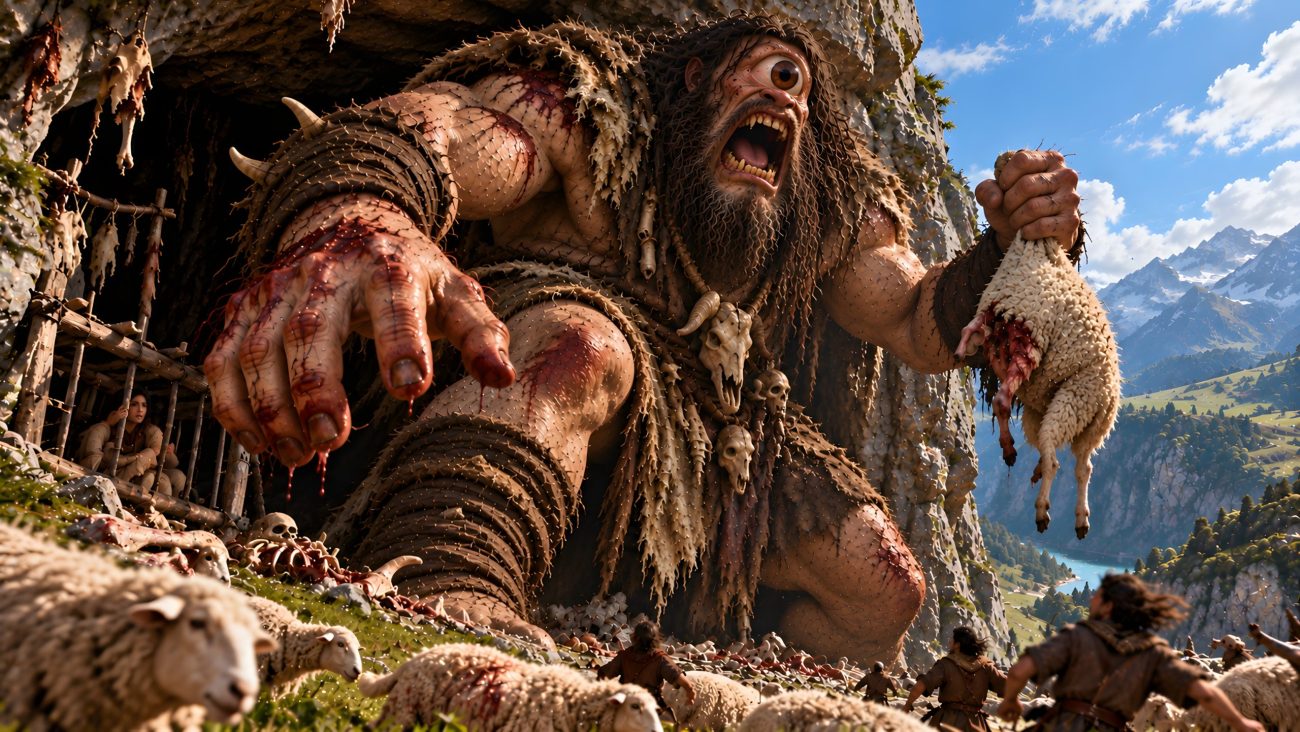
Tartaro is a gigantic, immensely strong, one-eyed monster in Basque mythology. He is commonly described as a cave-dwelling giant who captures and devours young people, especially those who wander into his lair or seek shelter there. In some accounts, he also eats sheep, consuming an entire sheep each day. His single eye and man-eating nature make him closely resemble the Greek Cyclops Polyphemus, encountered by Odysseus in Homer’s Odyssey.

In traditional tales, Tartaro lives in caves in the mountains, where he waits for unsuspecting victims. Stories about him often involve a captive who must find a way to escape the giant’s lair. Some versions closely parallel the story of Odysseus and Polyphemus: the giant is blinded with a heated spit, and the captive escapes by concealing himself beneath a sheep’s fleece. These similarities have led to comparisons between the Basque monster and the Greek Cyclops, although a direct derivation from Homer’s epic has not been established.

The creature’s name appears in several forms across Basque storytelling. Tartaro and Tartaroa occur in translated tales and older commentary, while Torto, Alarabi, and Anxo are recorded as regional names. Tartalo is particularly associated with the Zegama region. The name Anxo or Ancho is sometimes identified with Tartaro, although other accounts treat it as an alternative name for Basajaun, another supernatural being in Basque folklore.

Tartaro also appears in Basque adaptations of European fairy tales. In some versions of stories resembling Cinderella, Hop-o’-My-Thumb, and Donkeyskin, a giant called Tartaroa takes the role of the man-eating ogre. In one account, instead of smelling fresh meat, he detects the presence of Christians, whom he intends to eat. These variations show how the figure could be incorporated into stories beyond the traditional cave-monster narrative.

The origin of the name Tartaro remains uncertain. One nineteenth-century explanation connected it with the Tatar peoples, while other commentators compared the name with the European word “ogre.” These theories remain speculative. Across the different versions of the tradition, Tartaro is chiefly remembered as a powerful, one-eyed man-eater whose victims must rely on courage and cunning to escape him.


Sources

“Tartalo.” Wikipedia: The Free Encyclopedia. Wikimedia Foundation. Accessed October 16, 2026. https://en.wikipedia.org/wiki/Tartalo


Datsueba

Tradition: Japanese Mythology
Alternative Names: Sōzugawaba, Shōzukaba, The Old Woman Who Strips Clothes, The Old Woman with the Cotton
Category: Giant


The Myth

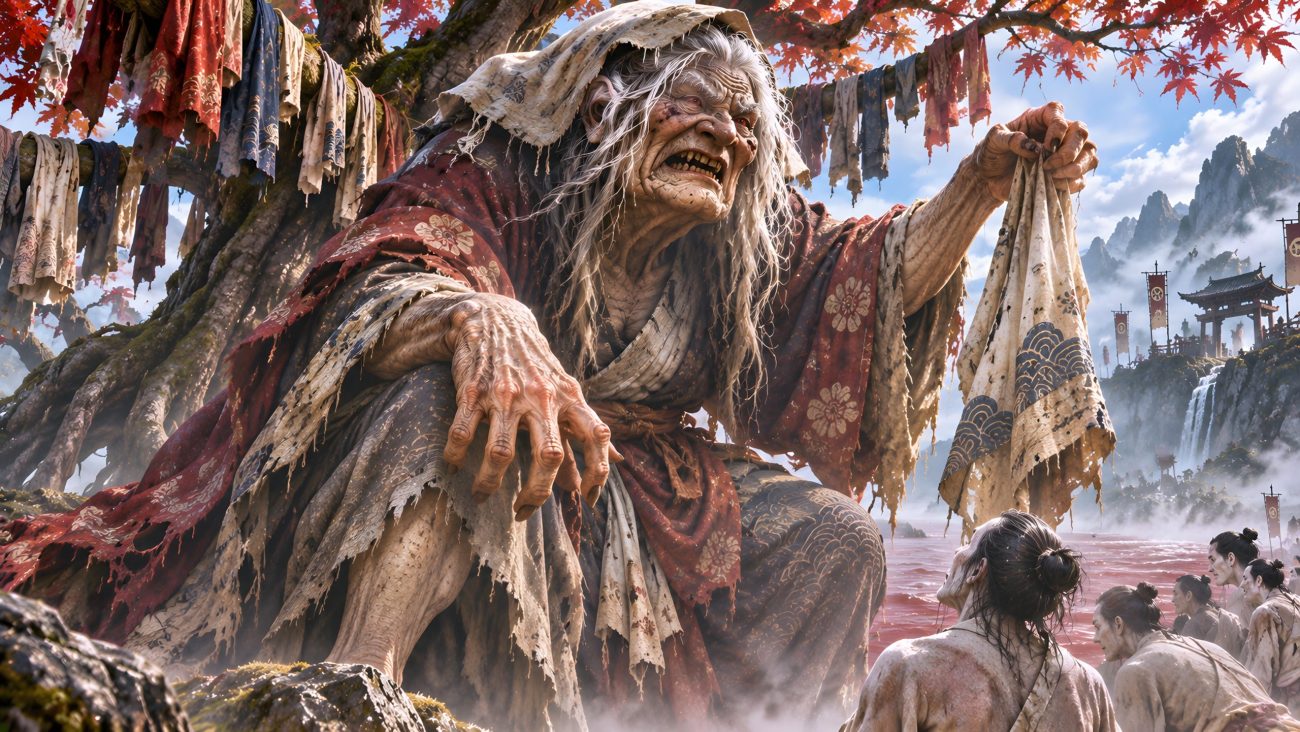
Datsueba is an elderly demon who dwells beside the Sanzu River, the boundary between the world of the living and the world of the dead in Japanese Buddhist tradition. When the deceased arrive at the riverbank, she strips them of their clothes. She is also known as Sōzugawaba or Shōzukaba and is commonly depicted as a terrifying old woman associated with the judgment of the dead.

According to the Jizō Bosatsu Hoshin In’en Jūō Kyō, a Buddhist text concerning the Ten Kings of the underworld, government offices stand along the banks of Hatsue, in front of which flows the great river Sōzugawa, another name associated with the Sanzu River. A large tree called Eryōju grows before these offices, beneath which Datsueba lives alongside another demon named Ken’eō, also known as Kenneō.

Datsueba removes the garments of the dead, while Ken’eō hangs them on the branches of the Eryōju tree. The degree to which the branches bend under the garments reveals the severity of the sins committed by the deceased. Their actions therefore form part of the supernatural process through which the dead are assessed after crossing into the afterlife.

In traditional depictions of hell, Datsueba often sits beneath a tree with one knee raised, clutching a garment in one hand and wearing a frightening expression. Some images portray her with her breasts exposed. Statues of the demon can be found at temples throughout Japan, where she is represented with similar features.

One particularly famous statue is enshrined at Shōjuin Temple in Shinjuku. It became popular around 1849, when rumours spread that it could grant wishes. Alongside other religious figures that attracted devotion during the same period, Datsueba became a subject of woodblock prints. The statue was especially associated with curing coughs and warding off epidemics. Worshippers who recovered from coughs offered cotton to the statue, placing it over her head like a hood. This custom gave her the additional name “the Old Woman with the Cotton.”


Sources

“Datsueba.” 新版TYZ 妖怪図鑑 (New TYZ Yokai Encyclopedia). https://tyz-yokai.blog.jp/archives/1010655131.html


Uriași

Tradition: Romanian Mythology
Alternative Names: Uriaș (singular), Jidovi, Novaci
Category: Giant


The Myth

The Uriași are giants in Romanian folklore, appearing in legends across the country’s historical regions. The term uriaș is the common Romanian word for a giant, while uriași is its plural form. Although these beings share many characteristics, their names and the traditions associated with them vary from one region to another.

In Oltenia, giants are commonly known as Jidovi. According to local legends, they created enormous mounds across the landscape. Some stories portray them as malevolent beings, suggesting that their immense size and power could be dangerous to humans.

In Muntenia, the giants are often called Novaci and are particularly associated with the Southern Carpathians. Their connection with this mountainous region forms part of the wider Romanian tradition of giants whose presence is reflected in local legends and landscape features.

The Uriași encompass several regional traditions rather than a single, uniformly described race of giants. Their different names reflect the diversity of Romanian folklore, in which stories about gigantic beings explain unusual features of the landscape and preserve local beliefs about the ancient inhabitants of the land.


Sources

“Uriaș.” Wikipedia: The Free Encyclopedia. Wikimedia Foundation. Accessed October 16, 2026. https://en.wikipedia.org/wiki/Uria%C8%99


Lintao Giant

Tradition: Chinese Mythology
Alternative Names: Lintao Giants, The Twelve Golden Giants
Category: Giant


The Myth

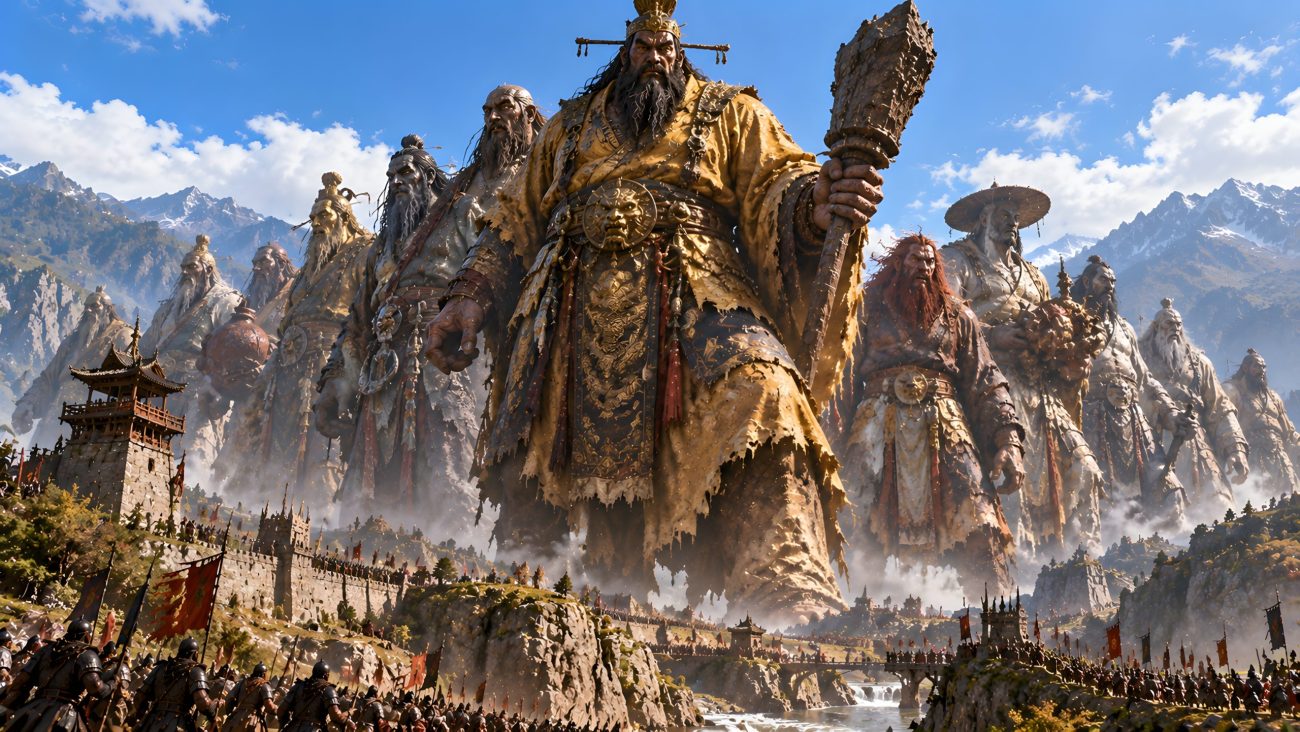
The Giants of Lintao are legendary giants recorded in Chinese historical and supernatural literature. According to the Soushen Ji (In Search of the Supernatural), during the twenty-sixth year of Qin Shi Huang’s reign, a giant appeared who stood five zhang tall and had feet measuring six chi in length. These traditional Chinese units of measurement varied historically, making the giant’s exact height uncertain.

Other accounts describe twelve giants appearing at Lintao, in what is now Gansu Province in northwestern China, during the twenty-sixth year of the reign of King Zheng of Qin, who later became Qin Shi Huang, the First Emperor of China. These twelve figures are mentioned in the Records of the Grand Historian (Shiji) and the Book of Han (Hanshu).

The literary work Qin’e Yi also refers to twelve golden giants seen at Lintao. Using a traditional conversion of ten chi to one zhang, the giants have been estimated to have stood approximately eight metres tall. The accounts differ in their descriptions, with one referring to a single enormous giant and others recording twelve figures, including the twelve golden giants. Together, they preserve a tradition of extraordinary beings associated with Lintao during the early Qin imperial period.


Sources

“临洮巨人.” Chinese Wikipedia. Wikimedia Foundation. Accessed October 16, 2026. https://zh.wikipedia.org/wiki/%E4%B8%B4%E6%B4%AE%E5%B7%A8%E4%BA%BA


Olentzero

Tradition: Basque Mythology, Spanish Mythology
Alternative Names: Olentzaro, Olantzaro, Olenchero, Onenzaro, Onentzaro, Ononzaro, Orentzago
Category: Giant


The Myth

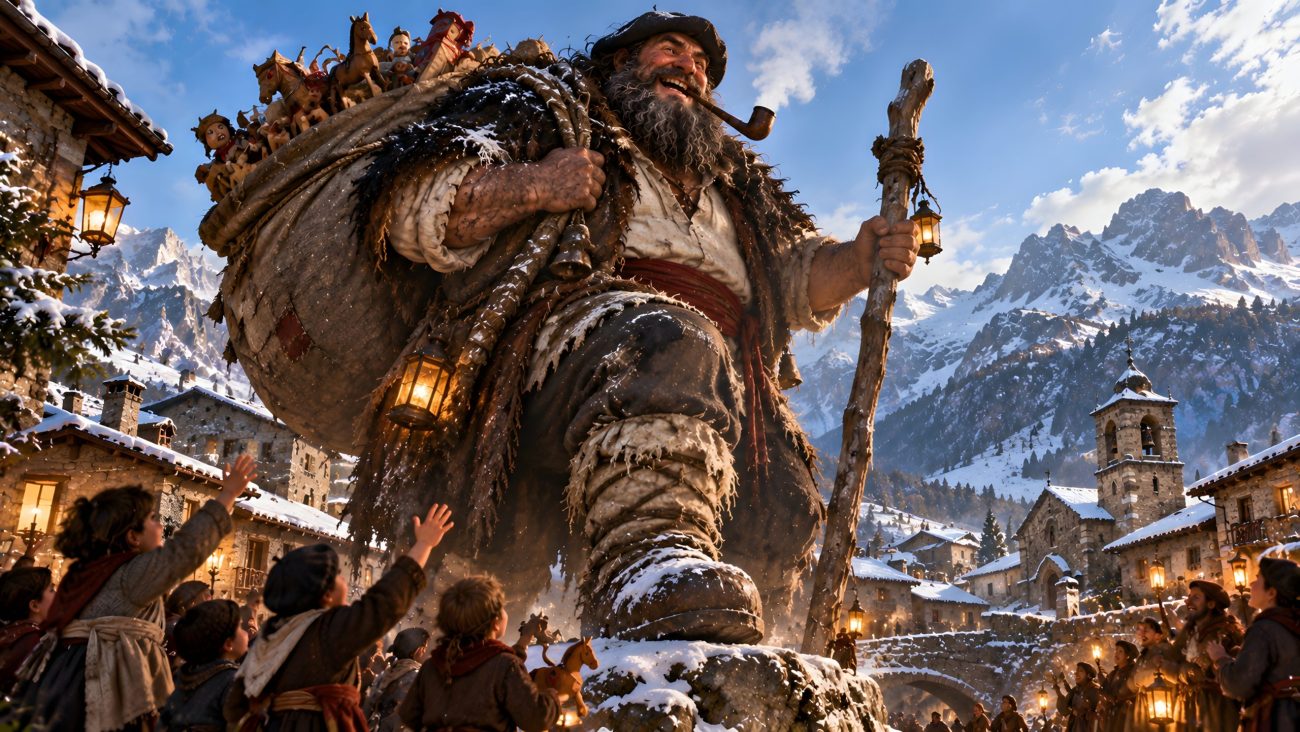
Olentzero is a traditional Basque Christmas figure who visits towns and villages to bring presents to children on Christmas Eve, 24 December. Depending on local custom, his arrival may take place on a different date, such as 27 December in Ochagavía or 31 December in Ermua. The name appears in several forms, including Olentzaro, Olantzaro, and Onenzaro. One widely accepted explanation derives it from the Basque word on, meaning “good,” combined with a plural genitive ending and the seasonal suffix -zaro, giving the approximate meaning “season of the good ones.” The earliest written reference dates to the seventeenth century, when the name was used for Christmas Eve.

In one traditional legend, Olentzero is the sole survivor of the Jentillak, a race of giants who lived in the Pyrenees. One day, the giants witnessed a mysterious, glowing cloud in the sky. Unable to look directly at it, they asked an elderly, nearly blind giant to examine it. He recognized the cloud as a sign that Jesus would soon be born, heralding the arrival of Christianity. In some versions, the old giant asked the others to throw him from a cliff so that he would not have to witness the coming transformation. After they fulfilled his request, the giants stumbled and died, leaving Olentzero as the only survivor. Other versions simply say that the Jentillak departed, while Olentzero remained and embraced Christianity.

Another version of the legend describes Olentzero as an abandoned child discovered in the woods by a fairy. She named him Olentzero, gave him the gifts of strength and kindness, and entrusted him to an elderly, childless couple who lived in the forest. As he grew up, he became a strong and skilled charcoal burner who carved wooden toys. Carrying the toys in a large charcoal sack, he distributed them to the children of nearby villages. According to this story, he died while rescuing children from a burning house. The fairy who had found him then granted him eternal life so that he could continue bringing happiness to children and adults.

Olentzero’s older traditions also include darker and more frightening customs. In some villages, adults dressed as Olentzero to frighten children who stayed outdoors too late or refused to go to bed. He was sometimes represented by a straw effigy carrying a sickle, hung from a church tower, chimney, or window. In these traditions, he threatened to punish disobedient children or those who broke the traditional Christmas fast. In parts of Navarre, related seasonal celebrations were known as xubilaro or subilaro, names connected with the Yule log. Other local versions depicted Olentzero as a three-eyed figure with red eyes, sometimes portrayed as a drunkard dressed like a scarecrow. Over time, these varied regional traditions developed into the familiar Christmas gift-bringer who visits Basque children.


Sources

“Olentzero.” Wikipedia: The Free Encyclopedia. Wikimedia Foundation. Accessed October 16, 2026. https://en.wikipedia.org/wiki/Olentzero


Bulgu

Tradition: Ethiopian Mythology
Alternative Names: Bulgu, Bulguu
Category: Giant


The Myth

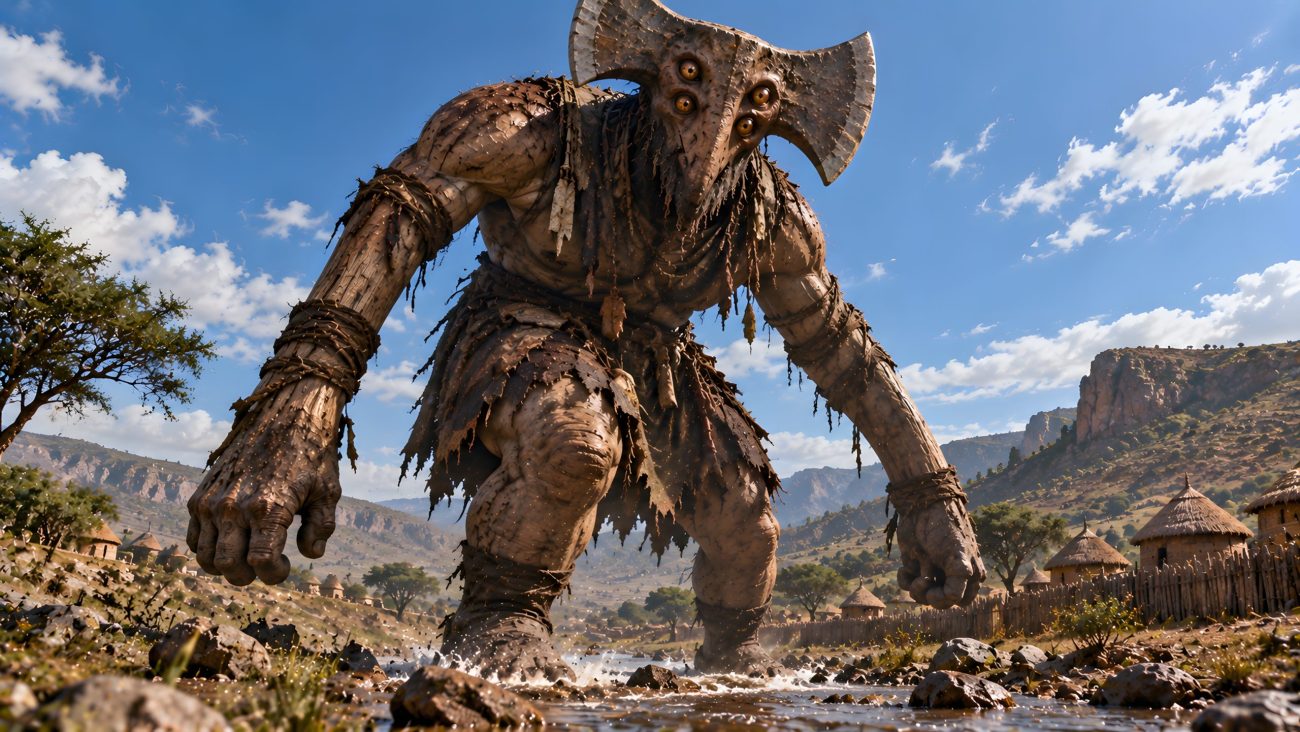
The Bulgu is a fearsome cannibalistic ogre in the folklore of the Guji Oromo people of Ethiopia. It has four eyes, a head shaped like an axe blade, arms resembling axe handles, and short, thick legs like pestles. Its frightening appearance reflects its monstrous nature and its appetite for human flesh.

In one tale, a brother and sister go to a river to fetch water, where they encounter a Bulgu. Before the children can react, the ogre seizes and devours the boy. After licking its lips, it threatens the surviving girl, warning that it will eat her and her entire family if she tells anyone what she has witnessed.

Terrified, the girl returns home in tears. When her father asks what happened to her brother, she claims that he wandered away into the brush. Unable to forget the boy’s death or the ogre’s threat, she refuses to eat for several days and grows dangerously weak. Eventually, she calls her father to her bedside and asks him to build nine tall, thick fences around their house. Once the nine palisades have been constructed from juniper, she finally reveals the truth. Enraged, her father builds a platform of branches above the hut to conceal her, takes his lance, and sets out to kill the Bulgu.

However, the Bulgu has overheard the girl’s confession. After the father leaves, the ogre approaches the house and mutters ten magical formulae, causing the nine gates and the door to burst open. It searches everywhere for the girl, who might have remained hidden if she had not broken wind in terror and revealed her position. When her parents return, they find that the Bulgu has devoured her, leaving behind only her middle finger.


Sources

“Bulgu.” A Book of Creatures, May 15, 2017. https://abookofcreatures.com/2017/05/15/bulgu/


Gumira

Tradition: Ossetian Mythology, Russian Mythology
Alternative Names: Gumirs, Humira
Category: Giant


The Myth

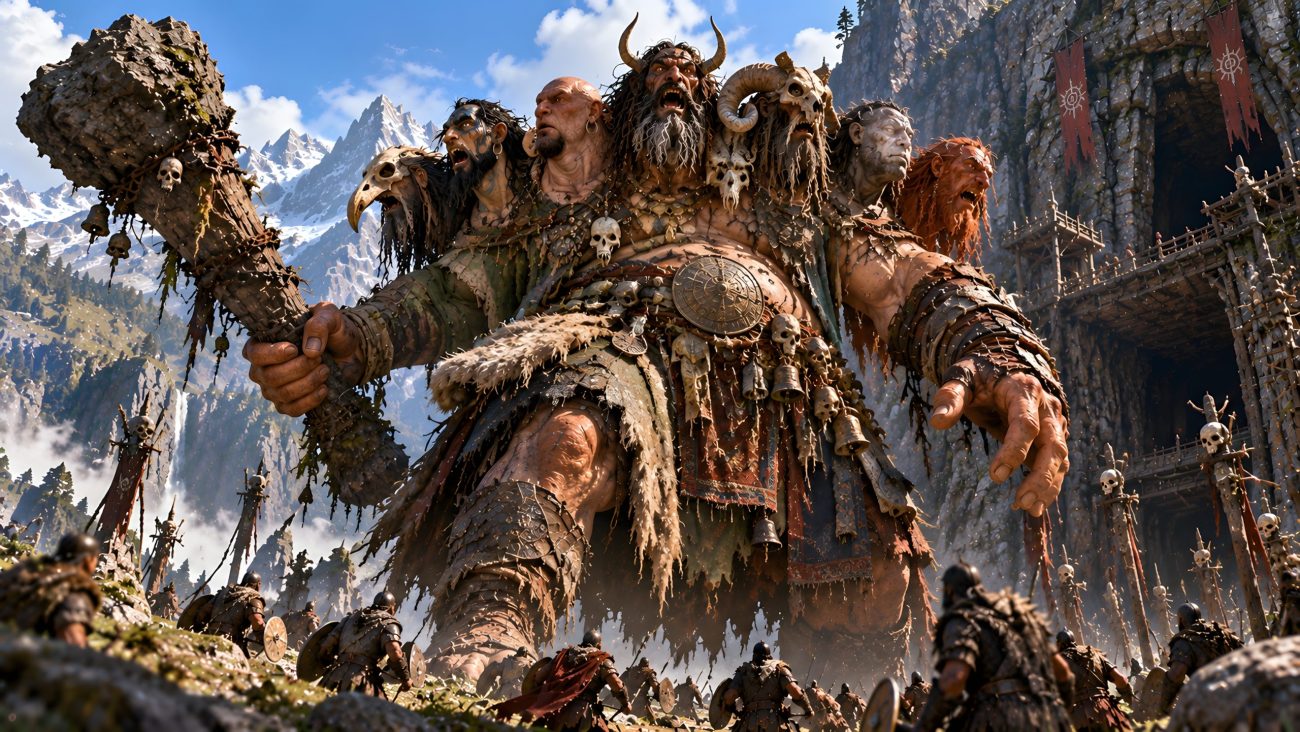
The Gumirs are monstrous seven-headed giants in Ossetian mythology, described as rough, powerful, and immensely strong beings. They dwell in caves and impregnable fortresses, inhabiting places that are difficult for ordinary people to reach. Their multiple heads and formidable strength distinguish them as fearsome figures in the supernatural world of Ossetian folklore.

In the Nart epic, the Gumirs appear as enemies of the Nart heroes, who are renowned for their courage and strength. The giants are described as constantly at odds with the Narts, placing them among the monstrous adversaries whom the heroes must confront.

The name Gumirs has been associated with the ancient Cimmerians. This proposed connection links the giants of Ossetian mythology with the name of an ancient people, although the precise origin of the mythological figures is not established by the tradition described here.


Sources

“Uaiugi.” New Bestiary (Bestiary.us). https://www.bestiary.us/uaiugi