Tradition: Basque Mythology, Spanish Mythology
Alternative Names: Olentzaro, Olantzaro, Olenchero, Onenzaro, Onentzaro, Ononzaro, Orentzago
Category: Giant
The Myth
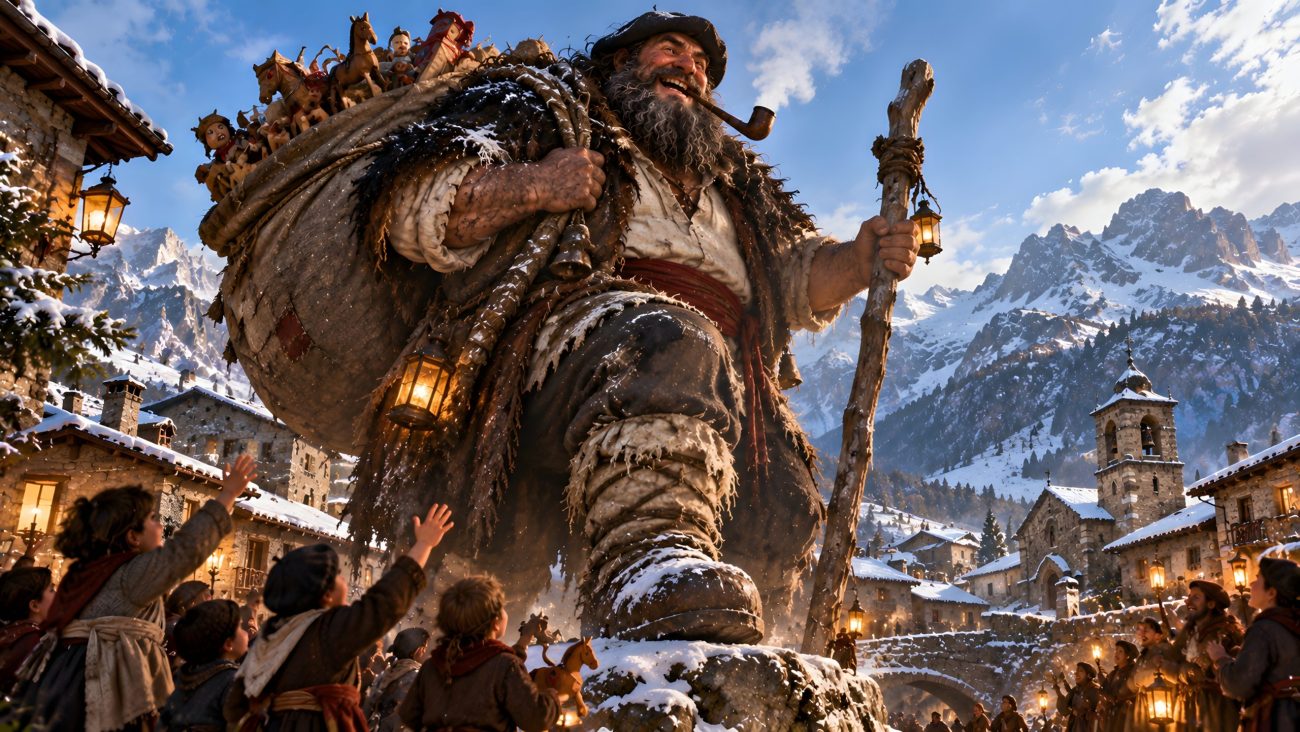
Olentzero is a traditional Basque Christmas figure who visits towns and villages to bring presents to children on Christmas Eve, 24 December. Depending on local custom, his arrival may take place on a different date, such as 27 December in Ochagavía or 31 December in Ermua. The name appears in several forms, including Olentzaro, Olantzaro, and Onenzaro. One widely accepted explanation derives it from the Basque word on, meaning “good,” combined with a plural genitive ending and the seasonal suffix -zaro, giving the approximate meaning “season of the good ones.” The earliest written reference dates to the seventeenth century, when the name was used for Christmas Eve.
In one traditional legend, Olentzero is the sole survivor of the Jentillak, a race of giants who lived in the Pyrenees. One day, the giants witnessed a mysterious, glowing cloud in the sky. Unable to look directly at it, they asked an elderly, nearly blind giant to examine it. He recognized the cloud as a sign that Jesus would soon be born, heralding the arrival of Christianity. In some versions, the old giant asked the others to throw him from a cliff so that he would not have to witness the coming transformation. After they fulfilled his request, the giants stumbled and died, leaving Olentzero as the only survivor. Other versions simply say that the Jentillak departed, while Olentzero remained and embraced Christianity.
Another version of the legend describes Olentzero as an abandoned child discovered in the woods by a fairy. She named him Olentzero, gave him the gifts of strength and kindness, and entrusted him to an elderly, childless couple who lived in the forest. As he grew up, he became a strong and skilled charcoal burner who carved wooden toys. Carrying the toys in a large charcoal sack, he distributed them to the children of nearby villages. According to this story, he died while rescuing children from a burning house. The fairy who had found him then granted him eternal life so that he could continue bringing happiness to children and adults.
Olentzero’s older traditions also include darker and more frightening customs. In some villages, adults dressed as Olentzero to frighten children who stayed outdoors too late or refused to go to bed. He was sometimes represented by a straw effigy carrying a sickle, hung from a church tower, chimney, or window. In these traditions, he threatened to punish disobedient children or those who broke the traditional Christmas fast. In parts of Navarre, related seasonal celebrations were known as xubilaro or subilaro, names connected with the Yule log. Other local versions depicted Olentzero as a three-eyed figure with red eyes, sometimes portrayed as a drunkard dressed like a scarecrow. Over time, these varied regional traditions developed into the familiar Christmas gift-bringer who visits Basque children.
Sources
“Olentzero.” Wikipedia: The Free Encyclopedia. Wikimedia Foundation. Accessed October 16, 2026. https://en.wikipedia.org/wiki/Olentzero