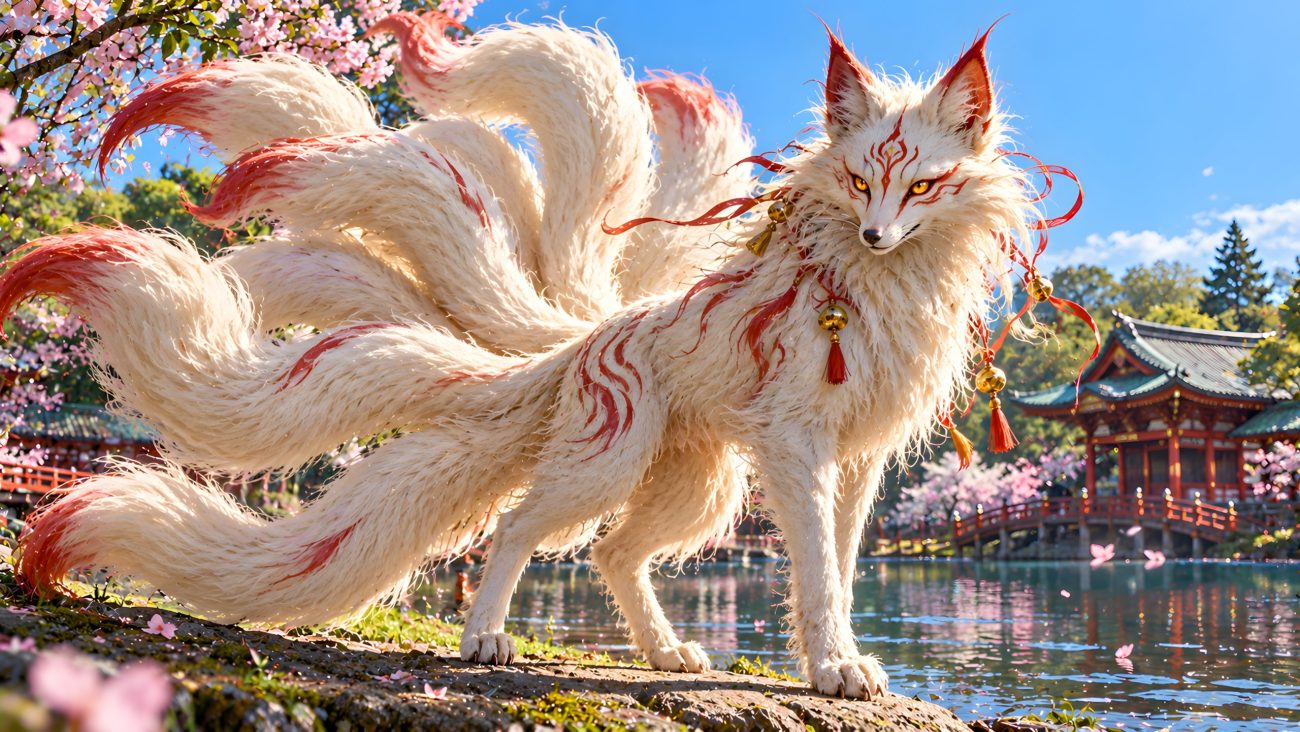
Keukegen

Tradition / Region: Japanese Mythology
Alternate Names: 毛羽毛現, Keugegen (variant reading)
Category: Dog, Yokai


The Myth

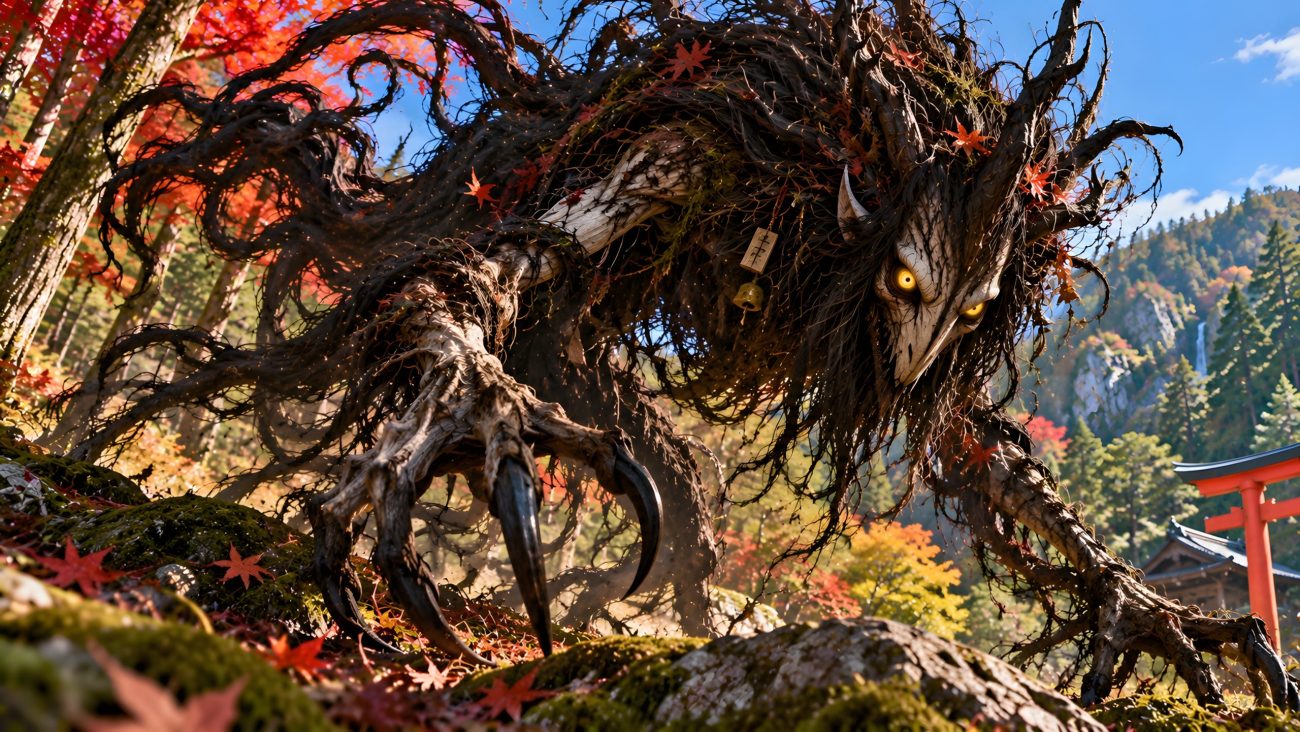
Keukegen are strange little creatures said to dwell in neglected homes and damp places where dirt gathers and sickness lingers.

They are described as being about the size of a small dog, but their true form is hard to see clearly. From a distance they appear as nothing more than a lump of long, filthy hair. Up close, the mass shifts and moves, revealing a living creature hidden beneath the tangled fur.

These beings prefer cool, dark, and moist places. They settle beneath floorboards, inside moldy closets, or in abandoned corners of houses where dust, rot, and still air collect. Gardens choked with weeds and damp refuse are also said to attract them.

Though they may seem harmless, Keukegen are not welcome visitors. Wherever they settle, sickness soon follows. People in the house begin to fall ill, fevers spread, and misfortune seems to cling to the place. Because the creatures are shy and rarely show themselves, many only realize they are present when illness has already taken hold.

They do not attack openly and usually avoid being seen. Some who claim to have glimpsed one are dismissed as imagining things, yet the signs of its presence — sickness, weakness, and bad luck — are said to be unmistakable.

The only sure way to drive a Keukegen away is simple: clean the house. Fresh air, sunlight, and order force the creature to leave, for it cannot live where a home is well kept.

Thus Keukegen are remembered as small, filthy spirits that creep into neglected places, bringing disease in their wake, and fleeing wherever cleanliness and care take root.


Gallery


Sources

Foster, M. D. (n.d.). Keukegen. In yokai.com, from https://yokai.com/keukegen/


Interpretive Lenses

Religious Readings
  • Christian Ascetic Deep Dive
Philosophical Readings
  • Nietzschean Deep Dive
Psychological Readings
  • Jungian Deep Dive
Esoteric Deep Dive
  • Hermetic Deep Dive
Political / Social Readings
  • Marxist Deep Dive

Eshō

Tradition / Region: Japanese Mythology
Alternate Names:
Category: Cow


The Myth

At Enkō-ji Temple there once lived a monk named Shaku Eshō. During his lifetime, he took a bundle of firewood belonging to the temple—wood meant for boiling water—and gave it away to another person. Not long after this act, Eshō died.

Some time later, a cow at the temple gave birth to a calf. As it grew, the animal was put to work pulling carts and hauling heavy loads of firewood each day without rest.

One day, while the ox strained beneath its burden, a monk unknown to the temple appeared at the gate. Watching the animal struggle, he said quietly:

“Monk Eshō may have been skilled in reciting the Nirvana Sutra, but it seems he is not very good at pulling a cart.”

At these words, the ox burst into tears, gave a deep sigh, and fell down dead.

The driver accused the visiting monk of causing the animal’s death and had him seized and reported. Yet the monk’s appearance was noble and radiant, unlike that of an ordinary person. Artists were summoned to paint him, and each portrait they made resembled Kannon Bodhisattva. Soon afterward, the monk vanished, and it was said that Kannon had appeared in human form and then departed.

From that time on, people told that the ox had been none other than Monk Eshō reborn, condemned to labor for his wrongdoing. Similar stories were also told of other monks who misused temple goods and were reborn as cattle, forced to pull carts and bear burdens as punishment.

Thus the tale endured as a warning that even small acts of theft could bind a soul to a life of toil, and that the lowing of a weary ox might carry the regret of a human past.


Gallery


Sources

Keikai. (822). Nihon-koku genpō zen’aku ryōiki [日本国現報善悪霊異記, Miraculous Stories of Reward and Punishment in This World]. Nara: Yakushiji Temple.

TYZ Yokai Encyclopedia. 恵勝, from https://tyz-yokai.blog.jp/archives/1078437911.html


Interpretive Lenses

Religious Readings
  • Christian Ascetic Deep Dive
Philosophical Readings
  • Nietzschean Deep Dive
Psychological Readings
  • Jungian Deep Dive
Esoteric Deep Dive
  • Hermetic Deep Dive
Political / Social Readings
  • Marxist Deep Dive

Cowpox Baby

Tradition / Region: Japanese Mythology
Alternate Names:
Category: Cow


The Myth

In later times in Japan, people spoke of a strange child known as the Cowpox Baby.

He was shown as a young boy from distant lands, said to be Dutch-born, riding upon the back of a great white cow. On his arm were red marks, signs of a mysterious protection he carried. In his hand he held a sharp needle like a spear.

Before him fled the red smallpox god, a fearful spirit believed to bring sickness to children. The god was shown with a fierce, demon-like face and wore a straw sack decorated with red rice cakes, offerings linked to his worship. The Cowpox Baby chased this spirit, driving it away and shielding the children it pursued.

In some tellings, the child reaches out to save another boy or girl from the smallpox god, placing himself between the spirit and its victim. Songs were sung of him, praising the child who lived without fear of the illness and who brought safety to others.

Images of this strange rider spread far and wide, and the Cowpox Baby came to be seen as a protector who rode the white cow against the spirit of disease, guarding children from harm and driving away the red god wherever he appeared.


Gallery


Sources

TYZ Yokai Encyclopedia. (2021, December 31). 牛痘児 (Cow pox baby), from https://tyz-yokai.blog.jp/archives/1079978230.html


Interpretive Lenses

Religious Readings
  • Christian Ascetic Deep Dive
Philosophical Readings
  • Nietzschean Deep Dive
Psychological Readings
  • Jungian Deep Dive
Esoteric Deep Dive
  • Hermetic Deep Dive
Political / Social Readings
  • Marxist Deep Dive

Cow-Like Pitchfork Monster

Tradition / Region: Japanese Mythology
Alternate Names:
Category: Cow


The Myth

In old Japanese imagery there is shown a strange creature with the form of a cow yet standing upright like a man.

It bears two horns upon its head and holds a pitchfork in its grasp. The fork is unlike any ordinary tool, for its three points end not in iron tips but in the curved claws of a raven. Around its neck it wears a blue scarf, hanging loosely as it stands.

Its legs are not like those of cattle, but end instead in bird-like feet, each with two sharp toes. No wings are shown, and no extra limbs appear beyond those needed to hold the fork.

No tale explains where this being came from or what it seeks. The scroll that preserves its image tells nothing of its deeds, its home, or its purpose. It simply presents the figure alone, a cow-like monster standing with its clawed pitchfork, silent and unexplained.


Gallery


Sources


Youkai Gazou Database. (2006). 熊手 ;クマデ International Research Center for Japanese Studies (Nichibunken). Retrieved from https://www.nichibun.ac.jp/cgi-bin/YoukaiGazou/card.cgi?identifier=U426_nichibunken_0054_0001_0005


Interpretive Lenses

Religious Readings
  • Christian Ascetic Deep Dive
Philosophical Readings
  • Nietzschean Deep Dive
Psychological Readings
  • Jungian Deep Dive
Esoteric Deep Dive
  • Hermetic Deep Dive
Political / Social Readings
  • Marxist Deep Dive

Cow-Headed Torch Demon

Tradition / Region: Japanese Mythology
Alternate Names:
Category: Cow


The Myth

In old Japanese imagery there is shown a strange demon with the head of a cow set upon a human body.

Its skin is dark, and from its bovine head grow two forward-curving horns. Its ears sit low beneath them, and its broad nose and heavy features give it clearly the look of cattle rather than man. Its eyes appear watchful, and its expression is stern and purposeful.

The creature is not shown raging or fighting, but walking. In one hand it carries a burning torch, whose flame lights the darkness before it, as if it travels by night or moves through shadowed places. It is clothed in layered garments — a bright red jacket, blue hakama trousers, brown leggings, and strong footwear — dressed for steady movement rather than for battle.

No story tells where it came from or what task it performs. The image leaves only the sight of a cow-headed demon striding forward with fire in its hand, a silent figure whose path and purpose remain unknown, marked only by the glow of the torch it carries into the dark.


Gallery


Sources


Interpretive Lenses

Religious Readings
  • Christian Ascetic Deep Dive
Philosophical Readings
  • Nietzschean Deep Dive
Psychological Readings
  • Jungian Deep Dive
Esoteric Deep Dive
  • Hermetic Deep Dive
Political / Social Readings
  • Marxist Deep Dive

Cow-Faced Monster

Tradition / Region: Japanese Mythology
Alternate Names:
Category: Cow


The Myth

In old Japanese lore there is mention of a strange being shown only in image, known as the Cow-Faced Monster.

It is depicted with the face of a cow and skin of a deep blue color. Upon its head rests an upside-down trivet like a curious crown. Its eyes are large and round, its nose crooked, and its mouth stretches wide to the ears. The creature has no arms and wears only a simple loincloth.

No tale survives explaining where it came from, what it did, or what became of it. Instead, the record that preserves its image speaks of other things.

It tells of a quiet day at the beginning of the year, when the world seems calm and time passes unnoticed. It reflects that people change while memories remain, that regret arises though the past cannot be returned, and that fortune and misfortune shift without warning. Joy and sorrow, it says, never last, and the heart moves in ways beyond reason, stirred by wind, rain, and memory.

The monster itself stands silent beside these thoughts, neither acting nor speaking. It remains only as an image — strange, unmoving, and unexplained — lingering like a symbol beside reflections on time, impermanence, and the restless human mind.


Gallery


Sources


Youkai Gazou Database. (n.d.). Ushi; Goto-ku (牛;ウシ,五徳;ゴトク). International Research Center for Japanese Studies (Nichibunken). Retrieved from https://www.nichibun.ac.jp/cgi-bin/YoukaiGazou/card.cgi?identifier=U426_nichibunken_0056_0002_0002


Interpretive Lenses

Religious Readings
  • Christian Ascetic Deep Dive
Philosophical Readings
  • Nietzschean Deep Dive
Psychological Readings
  • Jungian Deep Dive
Esoteric Deep Dive
  • Hermetic Deep Dive
Political / Social Readings
  • Marxist Deep Dive

Chuchedi

Tradition / Region: Japanese Mythology
Alternate Names: Teuchedy, Tencheday, Tenchadema
Category: Mermaid, Ghost


The Myth

In old accounts told by travelers to Japan, there was said to be a strange idol worshipped in the eastern lands, known as Chuchedi.

People from every rank of life came to its temple day and night, making offerings and prayers. The idol was feared as a powerful and dangerous spirit, one that demanded a terrible rite. Each month, it was said, the most beautiful maiden in the land would be chosen and brought to the temple.

She would be placed alone inside a private chamber and left there in silence. The doors were shut, and the girl waited through the darkness.

At some point in the night, Chuchedi itself was believed to appear. None saw how it came or what form it took in full, but the spirit would visit the girl and lie with her. When morning came, the spirit had vanished again, leaving behind strange fish-like scales as proof of its presence.

Another maiden would be chosen the following month, yet no one spoke openly about what became of the girls afterward. That remained a mystery whispered among the people.

It was also said that before the ritual, priests could ask Chuchedi questions, and the spirit would give answers to them, as though it possessed knowledge beyond human reach.

Thus Chuchedi was remembered as a hidden temple power—
a being that came in the night,
left scales behind,
and was served by fearful devotion from those who believed in it.


Gallery


Sources

tyz-yokai.blog.jp contributors. (n.d.). Chuchedi. In tyz-yokai.blog.jp, from https://tyz-yokai.blog.jp/archives/1084115860.html


Interpretive Lenses

Religious Readings
  • Christian Ascetic Deep Dive
Philosophical Readings
  • Nietzschean Deep Dive
Psychological Readings
  • Jungian Deep Dive
Esoteric Deep Dive
  • Hermetic Deep Dive
Political / Social Readings
  • Marxist Deep Dive
Other
  • How to Invite The Chuchedi

Terutou

Tradition / Region: Japanese Mythology
Alternate Names: Terukagoyo; Terikabugyo-san (local name of the sacred carp)
Category: Mermaid, Carp


The Myth

In the year 1646, a kind man named Otani Jinnai lived in Matsue with his wife Oryo. The couple longed for a child, and after many years of disappointment they prayed at temples and shrines throughout the land. At last they heard that Ogamiyama Shrine on Mount Oyama in Izumo was famed for granting children, and so they climbed the mountain to pray there.

As they descended, a thick fog suddenly swallowed the path. Out of the mist appeared a beautiful young woman who guided the lost couple safely down the trail. When she learned they had prayed for a child, she handed Jinnai a small bottle of water. She explained that it was sacred water made from dew gathered near Akamatsu Pond and offered at the shrine on New Year’s Day, and that drinking it would surely bring them the blessing they sought. Oryo drank it at once, feeling a strange certainty that their wish would be fulfilled. When they looked again, the girl had vanished.

The following year, Oryo gave birth to a daughter. The child was named O-Chiyo, and she grew into a girl of uncommon beauty and intelligence. When she reached sixteen, Jinnai’s nephew Tamaki asked for her hand in marriage. Though O-Chiyo felt troubled and uncertain, she could not bring herself to refuse her parents, and the engagement was arranged.

Before the wedding date was set, O-Chiyo made a request. She wished to visit Ogamiyama Shrine once more to report her coming marriage to the gods. Her parents agreed, and she set out for Mount Oyama with her nurse, Osuma. After offering her prayers at the shrine, the two began their return journey and passed by Akamatsu Pond—the very place where the mysterious girl had once given Jinnai the sacred water.

O-Chiyo stood gazing into the water for a long time. Then she walked to the edge and bent down. Suddenly steam rose from the pond, and her expression grew grave. She turned to Osuma, thanked her gently, and spoke in a calm voice. She said that although she had lived as a human, it had only been a temporary form. In truth she was a carp of that region, and the pond was her real home.

She gave Osuma a letter for her parents and words of gratitude, then leapt into the water and vanished. As Osuma cried out in shock, a huge golden carp surged to the surface. The creature turned toward her, and its face was unmistakably that of O-Chiyo. Overcome, Osuma fell to her knees in prayer as the carp slipped back beneath the water.

When Osuma returned and told Jinnai and Oryo what had happened, they were filled with grief. In the letter, O-Chiyo explained that she was the sacred carp Terukagoyo and could never marry a human. She thanked them for raising her and said that if they ever wished to see her, they need only call her name by the pond.

Jinnai remembered hearing of a sacred carp said to dwell in Akamatsu Pond, and he realized that the gods of Mount Oyama had given that spirit to him as a daughter. He built a small shrine and placed O-Chiyo’s letter there. Soon after, he and his family went to the pond and called her name three times from the shore. A thunderous roar answered from beneath the water, but she did not appear.

From that time on, visitors to the pond began calling the carp’s name in the same way. The shrine became a place where young men and women prayed for blessings in love, and in the region the carp themselves came to be respectfully called Terikabugyo-san.


Gallery


Sources

tyz-yokai.blog.jp contributors. (n.d.). Terutou. In tyz-yokai.blog.jp, from https://tyz-yokai.blog.jp/archives/1077741621.html


Interpretive Lenses

Religious Readings
  • Christian Ascetic Deep Dive
Philosophical Readings
  • Nietzschean Deep Dive
Psychological Readings
  • Jungian Deep Dive
Esoteric Deep Dive
  • Hermetic Deep Dive
Political / Social Readings
  • Marxist Deep Dive
Other
  • How to Invite The Terutou

Umidebito

Tradition / Region: Japanese Mythology
Alternate Names: Kaidzu-nin; sometimes simply called a mermaid or sea-being
Category: Mermaid


The Myth

In Echigo Province, near the lagoon of Fukushimagata, strange lights began appearing over the water at night. From within the glow came a woman’s voice calling across the shore, echoing over the waves and unsettling the nearby villages. People whispered that something not of this world had come up from the sea, and most were too frightened to go near it.

At last a ronin named Shibata Dan, who was training as a warrior, resolved to witness the being for himself. Carrying a torch, he went to the water’s edge and waited. Before long, a radiant figure rose from the sea and faced him. It spoke calmly, introducing itself as Umidebito, a dweller of the sea.

Its form was uncanny. From the head to the chest it resembled a human woman, but below that its body became scaled and unnatural, long and folding like some creature of the deep. The lower half of its body rested within a great conch shell, which floated upon the surface as if it were a small boat.

Umidebito then delivered its prophecy. It declared that the land would enjoy five years of rich harvests, but after that a terrible sickness would spread in the twelfth month, a plague so vast that it would kill most of the world’s people. It warned that the only way to avoid this fate was to paint its image, place the picture in one’s home, and pray to it each morning and evening.

When the message was finished, the being withdrew. The light faded, the sea closed over it, and Umidebito vanished into the darkness of the lagoon. Afterward, tales of the sea-woman spread, and images of her form were copied and kept by those who feared the coming disease.


Gallery


Sources

tyz-yokai.blog.jp contributors. (n.d.). Umidetto. In tyz-yokai.blog.jp, from https://tyz-yokai.blog.jp/archives/1077286511.html


Interpretive Lenses

Religious Readings
  • Christian Ascetic Deep Dive
Philosophical Readings
  • Nietzschean Deep Dive
Psychological Readings
  • Jungian Deep Dive
Esoteric Deep Dive
  • Hermetic Deep Dive
Political / Social Readings
  • Marxist Deep Dive
Other
  • How to Invite The Umidebito

Sato

Tradition / Region: Japanese Mythology
Alternate Names: Hachimangū no kannushi no musume Sato
Category: Mermaid


The Myth

In Hizen Province there once lived a girl named Sato, the daughter of the chief priest of a Hachiman shrine. When she was seventeen years old, she drowned in a large pond, and her body was never recovered. The villagers mourned her, and with time the story faded into memory.

Years later, on the twenty-sixth day of the second month in 1819, something strange occurred. The waters of the pond stirred, and Sato’s body rose from the depths.

She was no longer human.

Her form had become long and fish-like, covered in scales, with flippered limbs, a human face framed by long hair, and two horns upon her head. From her abdomen hung three shining jewels.

When people gathered in fear and wonder, she spoke:

“I am a messenger from the gods. For eight or nine years there will be a rich harvest. But after that, a great illness will come, and thirty to fifty out of every hundred people will die. Those who see my image will be spared from this calamity.”

As she finished speaking, the sky darkened. Black clouds gathered, rain fell in torrents, and the waters of the pond surged upward.

Then Sato rose into the sky and vanished.

Afterward, her likeness was copied and spread among the people, who kept her image as a charm against disease, remembering the drowned girl who returned from the water as a messenger of the gods.


Gallery


Sources

yokai.com contributors. (n.d.). Sato. In yokai.com, from https://yokai.com/sato/


Interpretive Lenses

Religious Readings
  • Christian Ascetic Deep Dive
Philosophical Readings
  • Nietzschean Deep Dive
Psychological Readings
  • Jungian Deep Dive
Esoteric Deep Dive
  • Hermetic Deep Dive
Political / Social Readings
  • Marxist Deep Dive
Other
  • How to Invite The Sato