Tradition: Japanese Mythology
Alternative Names: Nine-Colored Deer,
Category: Deer
The Myth
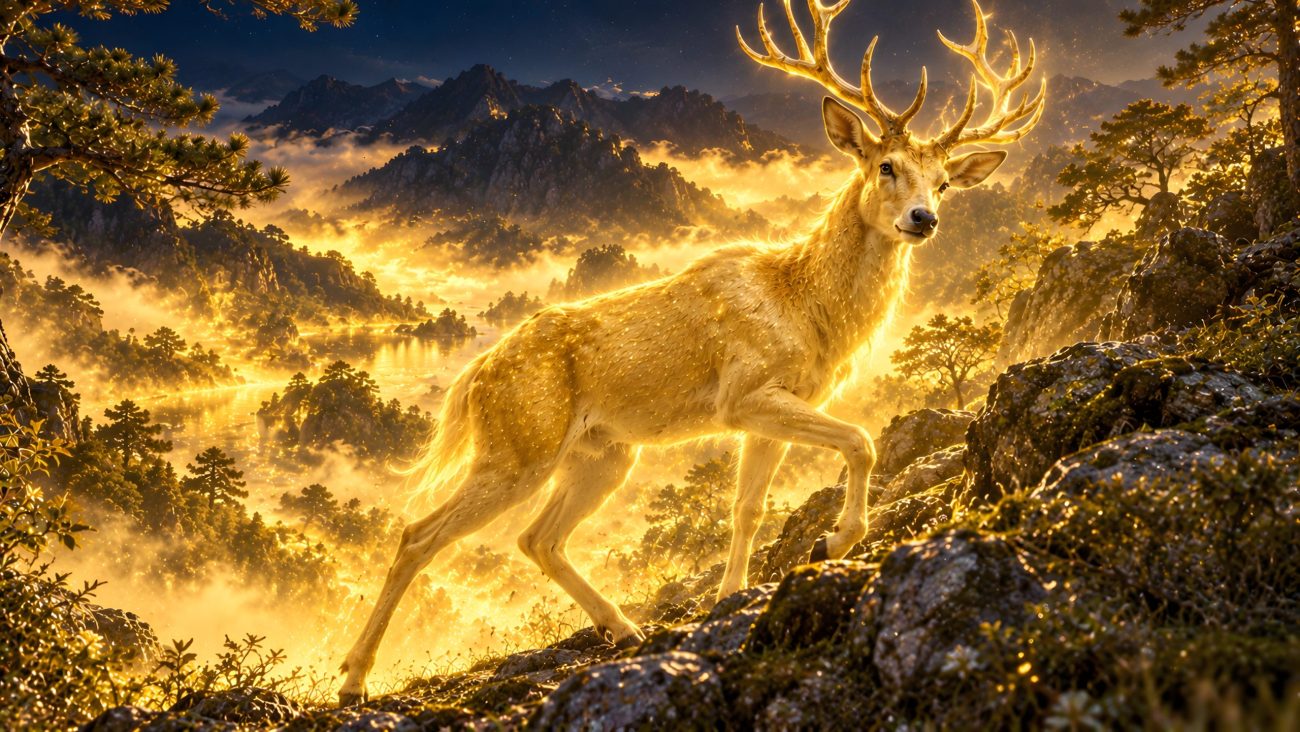
The Nine-Colored Deer is a remarkable deer with nine-colored fur and antlers as white as snow. It lived hidden from humans in a mountain in India, where it was rarely seen. A crow also lived near the river at the foot of the mountain and had a deep bond with the deer.
One day, a man was swept away by the river and was close to drowning. Clinging desperately to a branch, he cried out to the mountain god, tree god, heavenly beings, and dragon god, asking why none of them would save him.
Hearing his cries, the Nine-Colored Deer came to the riverbank. It told the man not to be afraid and instructed him to climb onto its back and hold onto its antlers. The deer then carried him safely to land.
The man wept with gratitude and asked how he could ever repay the deer. The deer asked for only one thing: that the man never reveal that it lived on the mountain.
The deer explained that its nine-colored body and snow-white antlers were unlike anything else in the world. If people discovered it, they would surely kill it for its beautiful fur and antlers. Because of this, it had hidden itself deep within the mountains. Yet when it heard the man’s cries, pity overcame its fear and it came to rescue him.
The man promised never to reveal the deer’s whereabouts and returned home.
Some time later, the queen of the country dreamed of a deer with nine-colored fur and snow-white antlers. She became captivated by the creature and developed such a strong desire to possess its fur and antlers that she fell ill and was confined to her bed. She begged the king to find the deer, convinced that such a creature truly existed.
The king announced a great reward of gold, silver, and other treasures for anyone who could capture the Nine-Colored Deer.
The man who had been rescued knew exactly where the deer lived. At first, he kept the secret. But when he heard of the king’s reward, greed overcame his gratitude. He revealed the deer’s hiding place to the king, forgetting that the creature had saved his life.
The king immediately gathered many soldiers and took the man with him as their guide. They surrounded the valley where the deer lived.
The crow saw what was happening and flew to the cave where the Nine-Colored Deer was sleeping. It cried out a warning, telling the deer that the king had come with an army seeking its rare fur and that the valley had been surrounded.
The deer awoke and came out of its cave, but by then the king and his soldiers were already directly before it. There was nowhere left to escape.
Rather than flee, the deer walked fearlessly toward the king’s palanquin. The soldiers prepared to shoot it with arrows, but the king was moved by the creature’s fearless approach and ordered them to stop.
The deer knelt before the king and asked how he had discovered its hiding place. The king answered that the man standing beside him had led him there.
The deer looked at the man. A bruise had appeared on his face, perhaps as punishment for breaking his promise.
The deer then reminded him of what had happened. It had risked its own life to rescue him from the river, and he had promised never to reveal its existence. Yet he had forgotten the kindness shown to him and had betrayed the deer in exchange for a reward.
The man was unable to answer.
Seeing this, the king understood the man’s ingratitude. He issued a decree forbidding the killing of deer anywhere in his kingdom. Anyone who violated the decree would be executed, and their family would also be destroyed. The king then withdrew his soldiers and returned to his palace.
The Nine-Colored Deer had escaped death. It returned joyfully to its mountain, and afterwards the country prospered. Moderate rains fell, there were no destructive winds or epidemics, the harvests were abundant, and nobody lived in poverty.
The story concludes by contrasting human ingratitude with the kindness of animals: forgetting kindness is found among humans, while helping humans is found among animals. Such things, the story says, have happened both in the past and in the present.
The Nine-Colored Deer is also identified with the Buddha in one of his previous lives. The crow is identified with Ananda, the queen with Sundari, and the ungrateful drowned man with Devadatta. The Nine-Colored Deer Sutra additionally tells that the king scolded the man after learning the truth, and that thousands of deer gathered around the departing Nine-Colored Deer and followed it.
Sources
Takahashi, Toshihiro. “九色鹿 [くしきろく] (Kushikiroku).” 新版TYZ 妖怪図鑑 (New TYZ Yokai Encyclopedia). December 31, 2019. https://tyz-yokai.blog.jp/archives/1076296180.html