Tradition: Japanese mythology
Alternative Names: Cow Woman
Category: Cow
The Myth
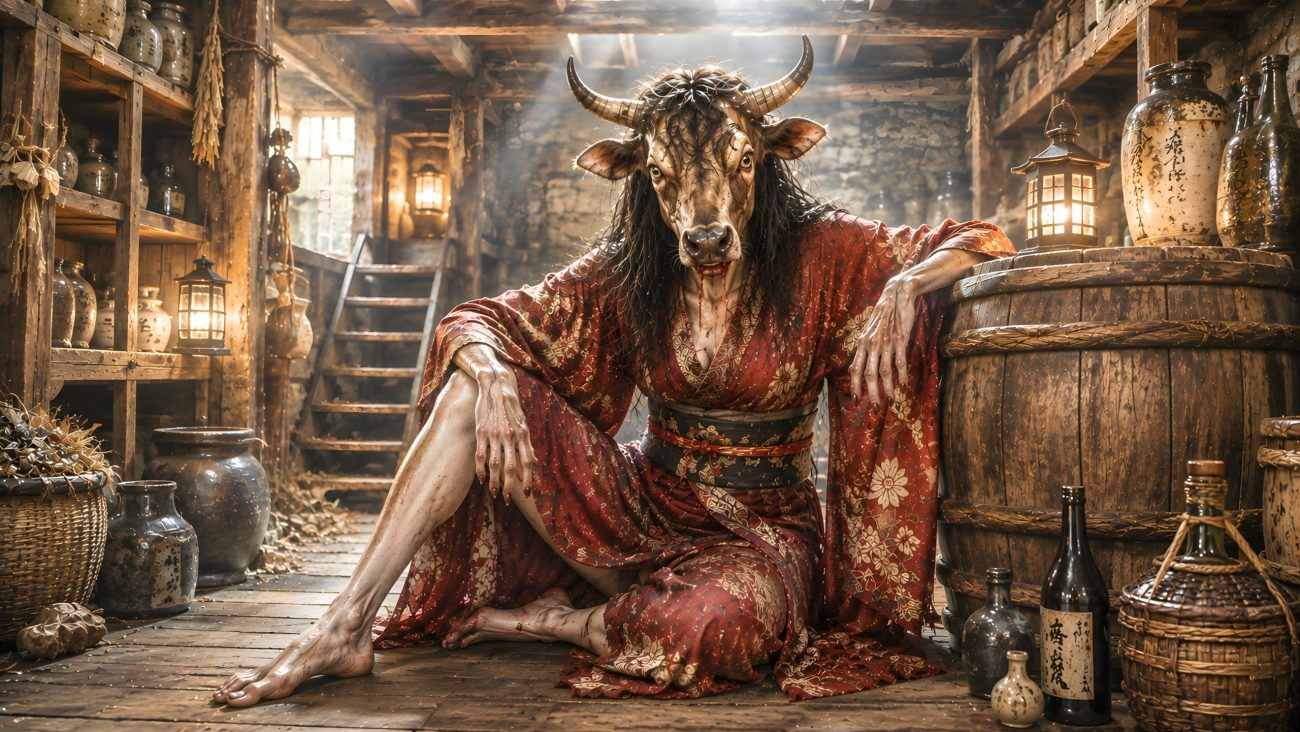
The Ushi-onna is a frightening yokai said to have appeared around Mount Rokko in Hyogo Prefecture. It is described as a woman with the head of a cow and the body of a human, usually wearing a red kimono. Encountering her was believed to bring misfortune or cause an accident.
One version of the legend tells of a girl born before the Second World War with the head of a cow and the body of a human. She was supposedly born in a certain mansion or at a place connected with the slaughtering of cattle. Because of her strange appearance, she was imprisoned inside a room and kept hidden from the outside world.
When the air raids devastated the Ashiya and Nishinomiya areas, the buildings where she had been confined were destroyed. According to the rumor, the cow-woman escaped from the ruins and disappeared into the surrounding area.
Other stories placed her around Mount Kabuto in Nishinomiya. In one account, a person encountered what appeared to be a cow wearing a red kimono, with blood dripping from its mouth. Another rumor claimed that after the Great Kobe Air Raid, a woman wearing a kimono and possessing the face of a cow was seen eating animal carcasses among the ruins of a shrine on Mount Kabuto.
Further rumors connected the creature to a house that had dealt in beef cattle before the war. According to this version, a calf was born with part of its body possessing an abnormal human-like form. The creature was locked inside a room, but after the air raids destroyed the surrounding area, it escaped.
The stories were later associated with the motif of Sakyo Komatsu’s 1968 short story Kudan no Haha, which was set in Ashiya. The exact relationship between the story and the earlier rumors is uncertain, but the two traditions share the disturbing image of a human-cow hybrid appearing in the Ashiya and Nishinomiya region.
The legend eventually became particularly associated with Washirinji Temple in Nishinomiya. From around the late 1970s onward, young people began visiting the temple at night as a test of courage, hoping to encounter the cow-woman.
A rumor spread that the Ushi-onna would appear if someone walked around the shrine on the temple grounds three times. As more people began visiting at night and causing disturbances, the temple attempted to stop them by putting up a sign claiming that, unfortunately, the cow-woman had moved away.
Thus the Ushi-onna became a modern Japanese urban legend: a cow-headed woman in a red kimono, associated with wartime destruction, abandoned ruins, blood, and nighttime encounters around the mountains of Hyogo.
Sources
Takahashi, Toshihiro. “牛女 [うしおんな] (Ushi-onna).” 新版TYZ 妖怪図鑑 (New TYZ Yokai Encyclopedia). July 25, 2021. https://tyz-yokai.blog.jp/archives/1078437909.html