In the lands around Junglinster, small hidden folk known as the Wichtelcher were once said to live close to humans, though rarely seen by them. They dwelled not in houses, but in quiet places where field, forest, and village met: the forest of Echels between Gonderingen, Junglinster, and Burglinster; the field called Gêschelt near Gonderingen; and the marshy ground of Bruchlach near Junglinster.
The Wichtelcher were tireless workers. At night, when human voices faded and lamps went dark, they emerged to tend fields, repair tools, and set right what had been left unfinished. By morning, tasks were mysteriously complete, as if done by invisible hands. No thanks was spoken aloud, for gratitude shown too directly might drive them away.
They lived close to the earth, slipping easily between soil, roots, and stone. When the land was disturbed or their places cleared away, they vanished without complaint, retreating deeper into the ground or leaving the area altogether. No one ever saw them depart; one day the help simply stopped.
Even after they were gone, people remembered the Wichtelcher as quiet helpers of an older time, beings who worked alongside humanity without reward, bound to the forests and fields as long as those places remained whole.
Tradition / Region: British Mythology Alternate Names: — Category: Gnome, House dweller
The Myth
In the borderlands between England and Scotland, old mills were said not to work by human hands alone. Hidden among the gears, beams, and sacks of grain lived a strange spirit known as the Kilmoulis.
The Kilmoulis was a cousin to the brownie, but far uglier. He was described as having an enormous nose and no mouth at all. Because of this, he could not eat in any ordinary way. Instead, he inhaled his food through his nose, drawing in meal, porridge, or scraps left behind in the mill. This grotesque habit made his presence unmistakable to those who knew the signs.
Despite his appearance, the Kilmoulis was a diligent worker. By night, when the mill was quiet, he labored tirelessly—turning wheels, cleaning stones, and keeping the machinery in order. Millers who treated their mills with respect often found their work mysteriously eased, grain ground faster, and breakdowns fewer.
Yet the Kilmoulis was also a trickster. He delighted in pranks: hiding tools, scattering grain, making strange noises, or confusing workers by rearranging things overnight. These tricks could be maddening, but they were rarely malicious. The spirit’s mischief was part of his nature, as inseparable from him as his labor.
So long as the miller tolerated the disturbances and left small offerings of food, the Kilmoulis remained a net blessing. His work outweighed his trouble. But if insulted, mocked, or driven away, the mill might fall into disrepair, its luck souring as suddenly as it once flourished.
Thus the Kilmoulis was remembered as both nuisance and necessity: an ugly, nose-sniffing mill spirit whose hard work and mischief turned endlessly together, like the millstone itself.
Gallery
Sources
Wikipedia contributors. (n.d.). Kilmoulis. In Wikipedia, The Free Encyclopedia, from https://en.wikipedia.org/wiki/Kilmoulis
Belun is a field spirit in Belarusian mythology, most often described as a kind and benevolent being. He appears in the form of an old man with a long white beard, dressed in white and carrying a white staff. Though his appearance is humble and sometimes odd, Belun is associated with good fortune, guidance, and quiet help.
According to common belief, Belun appears to poor people working or walking in rye fields. He is said to show himself as an elderly man with snot running from his nose and a bag hanging around his neck. When he meets someone, he asks them to wipe his nose. If the person agrees and does so, gold pours from Belun’s bag, after which he immediately disappears. The amount of money received depends on what is used to wipe his nose: wiping it with the hand yields only a small amount, while using a scarf, hat, or the hem of a coat allows more gold to spill out—only as much as the chosen cloth can hold.
This belief is reflected in Belarusian sayings. The phrase “Posyabrivsya z Belunom”—“I became friends with Belun”—means that someone has suddenly become wealthy or fortunate. Another saying, “It’s dark in the forest without Belun,” expresses the belief that Belun serves as a guide for those who lose their way.
Beyond granting wealth, Belun is also believed to help travelers who are lost in forests. Without speaking or revealing himself clearly, he is said to lead people back to the right path, guiding them safely to roads or villages. During harvest time, Belun is thought to be present in the fields, silently helping reapers work successfully.
In one story, a man spent the night sleeping in a rye field within a forest clearing. At dawn, he awoke to find a short, gray-haired old man bending a stalk of rye and brushing its ear against his face. The old man squinted and smiled slyly, and a large drop of dew glistened on the tip of his nose. The man immediately realized this was Belun and prepared to wipe his nose to gain wealth. But before he could act, the old man dissolved into a light cloud of pollen and vanished into the clear morning sky.
Thus, Belun remains a figure of quiet generosity and elusive fortune—a spirit who helps the humble, rewards kindness, and disappears as suddenly as he appears.
In the Arkhangelsk region of northern Russia, Efimon is known as a frightening figure used to warn and restrain children on the eve of Great Lent. Parents and elders would invoke his name to signal the end of carefree winter pleasures and the arrival of a strict, joyless time.
Children were told that while sledding and play were still allowed today, tomorrow Lent would arrive—and with it, Efimon. Adults would say that once Efimon began to walk, there would be no more games or fun. In this way, Efimon became a figure associated with restraint, silence, and the loss of festive freedom.
The origin of Efimon lies not in folklore alone, but in Christian ritual. In church tradition, Efimon is the name of an evening service held during Lent, derived from the Hebrew phrase meaning “God is with us.” Over time, this liturgical term entered popular speech and was transformed into a personified image of Lent itself.
Unlike the lively and celebratory Maslenitsa, Lent was seen as dull, strict, and unwelcome. This contrast is reflected in sayings in which people symbolically drive Efimon away, sending him to distant places. In this sense, Efimon represents the oppressive side of fasting—the quiet, discipline, and abstinence that follow carnival excess.
Among many European peoples, the transition from carnival to fasting is marked by ritualized opposition between two characters. Maslenitsa or carnival figures are often defeated, expelled, or destroyed, while Lent always emerges victorious. Similar traditions appear across Europe: among the Czechs, Maslenitsa ends with the burial of Myasopust; among the Serbs, Lent is personified as Baba Korizma; in England, a ragged figure called Jack-o’-Lent was paraded and abused throughout the fasting season. Medieval Europe also preserved stories of symbolic battles between Don Carnal and Doña Cuaresma, representing excess and abstinence.
Within East Slavic folklore, however, such personifications of Lent are rare. Efimon stands as a limited but notable example of this tradition. Earlier records from the Mezen region, dating to 1839, show Efimon in a less frightening role. At that time, boys gathered on the church porch at the end of the Efimon service, tossing their caps into the air and chanting for Efimon to leave, marking the nearing end of fasting. In these early accounts, Efimon is not yet a monster, but a ritual figure tied closely to church practice.
Over time, as the original religious meaning faded, Efimon’s image shifted. His role became simplified and generalized, turning him into a vague but unsettling presence—a figure of warning rather than worship. This transformation, from sacred ritual term to household bogeyman, reflects a common process in folklore, where abstract concepts gradually take on human or monstrous form in popular imagination.
Efimon thus survives not as a detailed creature, but as a name filled with meaning: the arrival of Lent, the end of play, and the quiet authority of discipline looming just beyond the threshold of childhood freedom.
In Slavic folklore, Bomka is a vague and unnamed terror used by adults to frighten disobedient children. It belongs to the broad class of bogeymen—creatures invoked in warnings rather than described in stories.
Parents would threaten naughty children with words such as: “I’ll put you in the golbets, and the Bomka will snatch you from there.” The golbets, a dark storage space beneath the house or stove, was imagined as a place where Bomka could reach its victims.
Bomka has no fixed appearance. No specific shape, size, or features are known. It exists more as an idea than a creature—an unseen presence associated with darkness, hiding places, and punishment for misbehavior.
The power of Bomka lies not in what it is, but in what it represents: an unknown danger waiting in the dark, ready to take children who do not listen.
Gallery
Sources
Bestiary.us contributors. (n.d.). Bomka. In Bestiary.us, from https://www.bestiary.us/Bomka/
In Mordvin and Chuvash folklore, kuygorozh are mythical beings that bring wealth, goods, and prosperity to a household. They serve their owner by secretly delivering grain, money, livestock benefits, and other valuables—often by stealing these things from neighboring households. Because of this, families believed to possess a kuygorozh were often regarded with suspicion and hostility by others in the community.
A kuygorozh is not always acquired by chance. According to Moksha tradition, one way to obtain such a being is through a long and deliberate process. A rooster must be kept for seven years, after which it will lay two small eggs. These eggs are then incubated by the owner—an old man or woman—by keeping them under the arm for three, five, six, or seven weeks, depending on the account. From these eggs hatch kuigorysh, small spirits of enrichment and theft.
Kuigorysh are described as small, cat-sized beings that move unseen. Though invisible to most people, they are physical and active. They walk about stealing grain from other barns and carrying it back to their master. Their cheeks contain natural pouches that expand when filled, each capable of holding a considerable amount of grain or goods. When empty, they are barely noticeable; when full, their cheeks swell like bladders.
Other traditions describe different origins. A kuigorysh may hatch from the egg of a red rooster, the first egg of spring, an owl’s egg stolen from the forest, or the egg of a black hen—producing a black, invisible spirit. In some villages, kuigorozhi are not hatched from eggs at all but are invited. In such cases, the owner must go to a cemetery on the first dark night of spring and call out to the spirits. Small humanoid beings then rise from the ground, surrounding the petitioner and pleading in thin voices to be taken. The chosen ones follow the person home, while the others cry as they fade away.
These cemetery-invited kuigorozhi are often understood as ancestral spirits who continue to help their descendants. They must be fed and treated with care, just as ancestors once were. Kuigorozhi are tireless workers: they demand constant tasks and cannot remain idle. In a single night, they are said to be capable of building houses, barns, plowing and sowing fields, harvesting crops, caring for livestock, and preparing enormous quantities of food.
Although generally helpful, kuigorozhi are demanding. If neglected, treated harshly, or left without work, they may become destructive—spoiling food, mixing grain with manure, scattering sand into meals, or stealing excessively and bringing ruin upon their owner. Driving them away is difficult. One method involves assigning them an impossible task, such as weaving a rope from sand or scooping water from a swamp. If this succeeds, the kuigorozh departs, taking all wealth it brought with it.
It was widely believed that households keeping kuigorozhi could be identified by signs of disorder or by ritual tests. One such belief held that kuigorozhi always consumed festive porridge beneath the crust, leaving the surface intact. Priests were sometimes said to press the crust during visits; if the hand sank in, the household was suspected of keeping such spirits.
Kuigorozhi were believed to have individual personalities—some mischievous, some obedient, some bold, others timid—and even individual physical traits. Legends tell of people attempting to acquire new kuigorozhi only to find that the same ones returned, recognizable by defects such as a missing eye or a limp.
Over time, many Mordvins came to regard kuigorozhi as fairy-tale beings rather than literal spirits. Still, until the twentieth century, widespread belief held that unexplained wealth was often the work of such helpers. Similar figures appear in neighboring traditions under different names, but the kuygorozh remains one of the most detailed and persistent images of a spirit that brings prosperity—at a cost.
Baga is one of the frightening figures used in children’s horror stories in the Russian countryside. Like many such beings, it belongs to the group of bogeymen invoked to scare children into obedience.
In the folk beliefs of the Nizhny Novgorod province, Baga is described as hunchbacked, a detail that sets it apart from other similar scare-figures such as the bogeyman or vova. Beyond this, little is said about its appearance or actions.
Baga does not appear in long legends or heroic tales. Its role is practical and immediate: a threat spoken aloud to warn children away from misbehavior or dangerous places. The creature’s power lies in fear itself, not in deeds or stories.
Like many rural bogeymen, Baga exists more as a warning than a character—an unseen presence shaped by imagination, meant to keep children cautious and obedient.
Among the Belarusian Budak people living in the Nizhny Novgorod region, Babar was a creature known primarily as a figure of fear used to discipline children.
Babar was not part of heroic tales or elaborate legends. Instead, it existed in everyday speech and warning. Parents and elders invoked Babar’s name to frighten children into obedience, especially when they misbehaved or refused to listen.
No detailed appearance or specific actions are recorded. Babar functioned as an unseen presence, defined by fear rather than form. Its power lay in suggestion—the idea that something dangerous was watching or waiting.
Through Babar, children learned where they should not go and how they should behave. The creature remained vague and undefined, which made it more effective, as imagination filled in what stories did not describe.
In Polish and Silesian folklore, the bebok is a supernatural being associated with darkness and fear. It belongs to the family of bogeymen—creatures invoked to warn, threaten, and discipline, rather than to be seen directly.
In Upper Silesia in particular, the bebok is the most familiar and widely used bogeyman. Parents invoke its name to frighten disobedient or unruly children, warning that the bebok will come for those who misbehave or wander where they should not.
According to legend, beboks dwell in places avoided by people: forests thick with shadow, swamps and marshy ground, dark basements, cellars, and similar hidden or neglected spaces. These are places where light fades and sound carries strangely, and where the presence of the bebok is felt rather than seen.
The bebok is not described in detail, for its power lies in suggestion. It exists as a warning embodied—a lurking threat tied to darkness itself. Through fear of the bebok, children are taught caution, obedience, and respect for the boundaries between safety and danger.
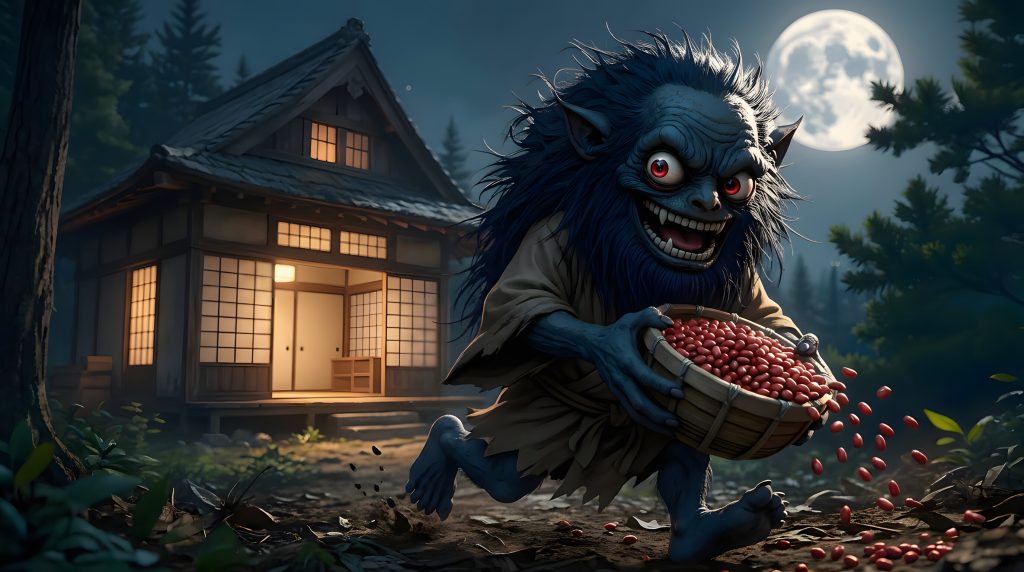
In the quiet hours after midnight, when houses settle and the world grows still, the Azuki Hakari makes itself known—not by sight, but by sound.
It is said to dwell in rural homes, temples, and old buildings, hiding in attics, ceilings, or garden shadows. No one has ever seen an Azuki Hakari. Its presence is announced only through a sequence of noises that unfold with deliberate precision, as though following a ritual known only to the spirit itself.
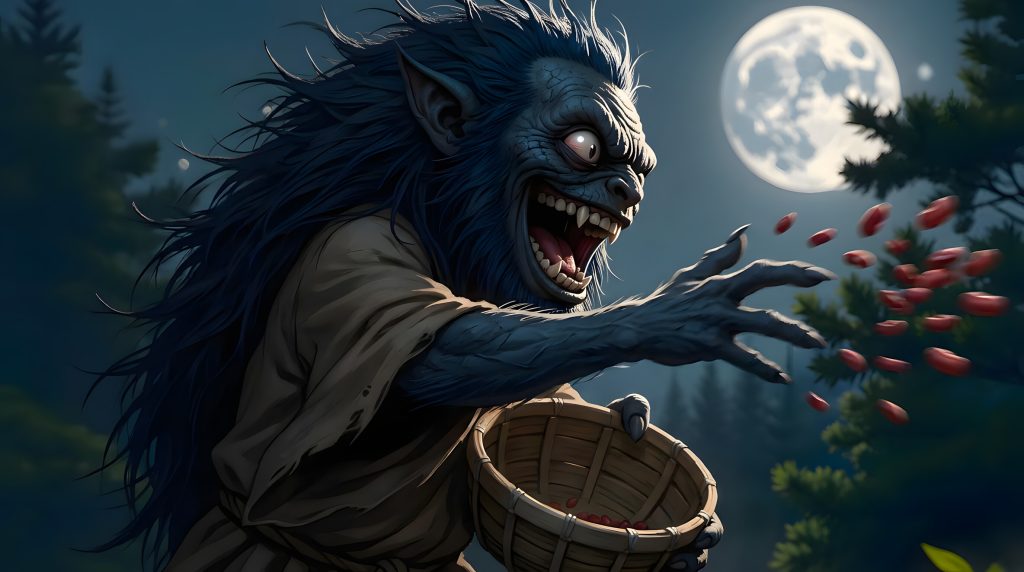
An encounter often begins with heavy footsteps above the room, pacing slowly in the narrow space between ceiling and roof. The steps are deliberate, neither hurried nor random, as if someone were measuring the house from above. Soon after, another sound joins the steps: the dry, rhythmic scattering of azuki beans, striking against windows or sliding doors. The sound repeats steadily, like counting—bean after bean—growing louder with time.
As the night deepens, the noises change. The dry patter of beans becomes the sound of splashing water, as though something unseen were washing or pouring liquid nearby. Finally, the rhythm resolves into the unmistakable clack of geta—wooden sandals—walking just outside the room, circling the house.
Those who dare to open the door or window in response are met with sudden silence. The footsteps vanish. The beans are gone. No water remains. There are no tracks, no marks, no sign that anything was ever there.
In older accounts, it is said that the Azuki Hakari may sometimes cause dust or scraps of paper to fall from the ceiling, but it never harms the residents. It does not steal, attack, or speak. Its purpose is unknown. It simply performs its nocturnal counting and departs.
Because the Azuki Hakari is never seen, its true nature remains uncertain. Some believe it is related to other azuki spirits, while others insist it is something separate—an invisible presence made entirely of sound. In many stories, encounters once attributed to river-dwelling azuki yōkai are now believed to have taken place within homes, pointing instead to the silent work of the bean counter.
Thus the Azuki Hakari endures in folklore as a reminder that not all spirits announce themselves with form or violence. Some are known only by rhythm and repetition, by footsteps in the dark and beans that were never there—proof that even an empty house is never truly empty.