Nine-Eared Dog

Tradition / Region: Chinese Mythology
Alternate Names:
Category: Dog


The Myth

In old tales from southern China, hunters spoke of a strange and wondrous animal known as the Nine-Eared Dog.

This creature looked like an ordinary hunting dog at first glance, but it possessed nine ears. It was said to be a spiritual animal whose ears revealed the outcome of a hunt. Whenever the dog’s ears moved, it foretold what its master would gain that day. If one ear twitched, one animal would be caught. If several ears stirred, several beasts would fall. The more ears that moved, the richer the hunt would be.

One story tells of a hunter named Chen from Leizhou, a man who had no children and made his living by hunting. He owned such a dog, and it never failed him. Before each hunt, he would watch its ears to learn what fortune awaited him in the wilds.

One day, as he prepared to set out, all nine ears of the dog suddenly moved at once. Chen was overjoyed, believing he would return with more game than ever before. Certain of great success, he followed the dog deep into the wilderness.

But instead of leading him to prey, the dog brought him into a thorny and tangled place where it circled restlessly, unable to move onward. Confused, Chen searched the ground and discovered something hidden among the brush — a massive egg, nearly a foot across.

He carried the strange object home. When the egg finally opened, it did not reveal a bird or beast but a human child. On the child’s hands were markings, and upon them were written the characters for “Thunder” and “Zhou.”

Thus the Nine-Eared Dog did not lead its master to animals that day, but to a discovery of far greater mystery — a sign that the spirit-dog’s gifts did not always point to the hunt, but sometimes to fate itself.


Gallery


Sources

Wikipedia contributors. (n.d.). 九耳犬. In Wikipedia, from https://zh.wikipedia.org/wiki/%E4%B9%9D%E8%80%B3%E7%8A%AC


Interpretive Lenses

Religious Readings
  • Christian Ascetic Deep Dive
Philosophical Readings
  • Nietzschean Deep Dive
Psychological Readings
  • Jungian Deep Dive
Esoteric Deep Dive
  • Hermetic Deep Dive
Political / Social Readings
  • Marxist Deep Dive

Chiyou

Tradition / Region: Chinese Mythology
Alternate Names:
Category: Cow, God


The Myth

In the ancient age before the rise of dynasties, when the tribes of the world still fought for dominion, there ruled a powerful leader named Chiyou, chief of the Nine Li.

From birth he was unlike other men. His body was human, but his head was that of a bull, crowned with great horns. His brow was said to be as hard as bronze or iron, and his strength was immense. Some said his limbs were like those of a beast, and that he carried many weapons, wielding them with unstoppable force. Wherever he marched, it was as though a great animal thundered across the land.

Chiyou led his people into battle as a bull lowers its head before the charge. He possessed knowledge of ancient magic and commanded the powers of wind and storm. In war he called down rain and thick, blinding fog that swallowed entire armies.

At the great Battle of Zhuolu, he used this power against the Yellow Emperor. A vast mist covered the battlefield so that soldiers wandered helplessly, unable to find their way. Under this shroud Chiyou fought fiercely, supported by his many followers, whether counted as eighty-one brothers or eighty-one tribes bound to him.

Yet in the end the Yellow Emperor overcame him through skill and divine aid. Chiyou fell, and the power of his people was broken.

Though defeated, he was not forgotten. In later times warriors honored him as a spirit of battle, remembering the bull-headed lord whose strength shook the earth and whose fury in war was like that of a charging ox.


Gallery


Sources

Wikipedia contributors. (n.d.). Chiyou. In Wikipedia, The Free Encyclopedia, from https://en.wikipedia.org/wiki/Chiyou


Interpretive Lenses

Religious Readings
  • Christian Ascetic Deep Dive
Philosophical Readings
  • Nietzschean Deep Dive
Psychological Readings
  • Jungian Deep Dive
Esoteric Deep Dive
  • Hermetic Deep Dive
Political / Social Readings
  • Marxist Deep Dive

Jiao Jing

Tradition / Region: China
Alternate Names: Jiaoshou
Category: Mermaid, Shapshifter, Shark


The Myth

In ancient Chinese legend there is a creature called the Jiao Jing, also known as Jiaoshou. The name “jiao” is associated with the shark, and the being is said to dwell in deep waters.

It is told that the Jiao Jing is no ordinary beast of the sea, but a spirit capable of transformation. In certain accounts, the mermaid spirit can assume the form of a beautiful woman, or even that of a man. In this guise it walks among human beings, hiding its true nature beneath flawless skin and graceful form.

One tale speaks of a young woman who appeared before a household bearing sorrowful claims. She said she had been mistreated and abused by her stepmother, and a kindly couple of the Zhao family took pity on her and offered her shelter. She was quiet, strange, and unlike other women. In time it was discovered that she was not human at all, but a shark spirit in disguise.

Thus the Jiao Jing is remembered as a being of the waters who may rise from the depths wearing human beauty as a mask, moving silently between sea and shore.


Gallery


Sources

Wikipedia contributors. (n.d.). 鲛精. In Wikipedia, The Free Encyclopedia. Retrieved February 14, 2026, from https://zh.wikipedia.org/wiki/%E9%B2%9B%E7%B2%BE


Interpretive Lenses

Religious Readings
  • Christian Ascetic Deep Dive
Philosophical Readings
  • Nietzschean Deep Dive
Psychological Readings
  • Jungian Deep Dive
Esoteric Deep Dive
  • Hermetic Deep Dive
Political / Social Readings
  • Marxist Deep Dive
Other
  • How to Invite The Jiao Jing

Mouryō

Tradition / Region: Chinese mythology
Alternate Names: Hōryō, Hōliang, Hōxiang, Hongliang, Mizuha
Category: Mountain dweller, Zombie, Demon


The Myth

In the deep places of the world—where mountains rise thick with trees and rivers slip silently through stone—there dwell beings known as the mouryō. They are not born as humans are, but arise from the spirit of the land itself: from forests, streams, roots, and shadows beneath the earth.

Ancient texts say that the mouryō appear like small children, no taller than three-year-olds, yet their forms are unsettling. Their skin is dark and reddish, their eyes glow red, their ears are long, and their hair is strangely beautiful. Though they resemble children, they are not innocent. They linger near graves, riverbanks, and old pine trees, places where the boundary between life and death is thin.

At night, the mouryō creep from the roots of trees or from wet earth. They dig into burial grounds and feast upon the livers of corpses, sustaining themselves on the remains of the dead. Because of this, people once feared them greatly, believing that graves left unguarded would invite these beings. Some said that when a corpse vanished, carried away in the night, it was not the work of hellfire or demons from below, but the mouryō dragging the body back into the forest.

In later tales, the mouryō became confused with other corpse-stealing monsters. Some claimed they were the same as the fiery kasha, while others insisted they were water spirits, haunting rivers and marshes. Still others said they were kin to the kappa, born of stagnant waters and rot. No matter the explanation, the fear remained the same: the mouryō were creatures that thrived where decay met neglect.

Travelers avoided old trees at night, and families guarded their dead, for it was said that once a mouryō had tasted a corpse, it would return again and again. Silent, patient, and hungry, the mouryō endured as a reminder that the land itself remembers death—and that some spirits feed upon what humans leave behind.


Gallery


Sources

TYZ-Yokai Blog contributors. (n.d.). 魍魎 (Mouryō). In TYZ-Yokai Blog, from https://tyz-yokai.blog.jp/archives/1072334859.html


Interpretive Lenses

Religious Readings
  • Christian Ascetic Deep Dive
Philosophical Readings
  • Nietzschean Deep Dive
Psychological Readings
  • Jungian Deep Dive
Esoteric Deep Dive
  • Hermetic Deep Dive
Political / Social Readings
  • Marxist Deep Dive
Other
  • How to Invite The Mouryō

Junren

Tradition / Region: Chinese mythology
Alternate Names: People of Small Stature
Category: Gnome


The Myth

Beyond the familiar lands of humankind, in the far and unnamed regions of the world, there live the Junren, a race of people small in body yet fully human in form. They dwell in distant wildernesses where mountains, forests, and seas stretch beyond the reach of ordinary travelers.

The Junren are said to live together as their own people, forming small kingdoms hidden at the edges of the world. Though diminutive in size, they walk upright, speak, labor, and order their lives as humans do. Their lands mirror the greater world, only scaled down—fields, dwellings, and communities shaped to their stature.

They are rarely seen, not because they are spirits or illusions, but because their homes lie far from known roads. Those who glimpse them often do so only briefly, mistaking them at first for children, birds, or moving shadows among grass and stone. By the time the eye adjusts, the Junren have already withdrawn.

In the old telling, the Junren serve as a reminder that the world is vast and layered, filled with peoples unseen by most. Humanity is not alone in shaping civilization; even in the remotest wilderness, lives unfold according to their own customs and rhythms.

Thus the Junren endure in story as the small people of the far lands, quiet proof that the earth holds more nations than those whose names are commonly known.


Gallery


Sources

Wikipedia contributors. (n.d.). 茜人. In Wikipedia, The Free Encyclopedia, from https://zh.wikipedia.org/wiki/%E8%8F%8C%E4%BA%BA


Interpretive Lenses

Religious Readings
  • Christian Ascetic Deep Dive
Philosophical Readings
  • Nietzschean Deep Dive
Psychological Readings
  • Jungian Deep Dive
Esoteric Deep Dive
  • Hermetic Deep Dive
Political / Social Readings
  • Marxist Deep Dive
Other
  • How to Invite The Junren

Red Willow Children

Tradition / Region: Chinese Mythology
Alternate Names: Red Willow Boys, Tamarisk Children
Category: Gnome


The Myth

In the deep mountains near Urumqi, herders tell of tiny people who appear when the red willows bloom. They are no taller than a foot or two and resemble miniature men, women, and children. When spring comes and the willow branches redden, these beings break off the twigs, bend them into small hoops, and wear them as crowns upon their heads.

They gather in groups and dance among the valleys, moving in circles and making soft, musical sounds, like a distant song carried by the wind. Their dancing is joyful but fleeting, and they vanish as suddenly as they appear.

At times, the Red Willow Children creep into camps or tents to steal food. When caught, they do not resist. Instead, they fall to their knees and weep like frightened children. If tied or imprisoned, they refuse all food and soon die. If released, they move away timidly at first, walking only a short distance before turning back to look. If shouted at or chased, they kneel again and cry. Only when they are far enough away to know they are safe do they finally flee, crossing streams and mountains and disappearing into the wilderness.

No one has ever found their nests or homes. They seem to belong neither fully to the forest nor to the mountains, and their true nature is uncertain. Some say they are neither spirits nor beasts, but something in between.

One tale tells of a local magistrate who once captured a Red Willow Child and brought it away for closer inspection. Its hair, eyebrows, and beard were said to be indistinguishable from those of a human. This discovery led some to believe that the ancient stories of little people hidden in the wild places of the world might be true after all.

Thus the Red Willow Children remain beings of song and sorrow—small, elusive figures who dance beneath blooming willows and vanish before they can ever be fully understood.


Gallery


Sources

Wikipedia contributors. (n.d.). 红柳娥. In Wikipedia, The Free Encyclopedia, from https://zh.wikipedia.org/wiki/%E7%BA%A2%E6%9F%B3%E5%A8%83


Interpretive Lenses

Religious Readings
  • Christian Ascetic Deep Dive
Philosophical Readings
  • Nietzschean Deep Dive
Psychological Readings
  • Jungian Deep Dive
Esoteric Deep Dive
  • Hermetic Deep Dive
Political / Social Readings
  • Marxist Deep Dive
Other
  • How to Invite The Red Willow Children

Ear People

Tradition / Region: Chinese mythology
Alternate Names: Man in the Ear
Category: Gnome


The Myth

There was once a man named Tan Jinxuan who devoted himself to inner cultivation. He practiced breathing and stillness, enduring heat and cold alike, believing that persistence would bring insight. For many months nothing happened—until one day, as he sat quietly, he heard a faint whisper inside his ear, as soft as the buzzing of a fly.

The voice said, “You can see me.”

When Tan opened his eyes, the sound vanished. When he closed them and calmed his mind, the whisper returned. Each time he sat in meditation, the tiny voice spoke again, and Tan grew convinced that something truly lived within his ear.

One day, when the voice spoke once more, Tan answered it. At that moment, a tiny being leapt out from his ear and fell spinning onto the ground. It was no more than three inches tall, shaped like a small man with a fierce face like a yaksha, savage and sharp-eyed despite its size.

Tan stared in astonishment as the little creature whirled about, real and solid, no longer hidden. Before he could grasp it or speak further, it vanished as suddenly as it had appeared, leaving Tan alone with the certainty that unseen beings dwell closer to humans than anyone suspects.

Thus it was said that some spirits live not in forests or mountains, but within the body itself—heard only in silence, seen only by those who dare to listen.


Gallery


Sources

Wikipedia contributors. (n.d.). 耳中人. In Wikipedia, The Free Encyclopedia, from https://zh.wikipedia.org/wiki/%E8%80%B3%E4%B8%AD%E4%BA%BA


Interpretive Lenses

Religious Readings
  • Christian Ascetic Deep Dive
Philosophical Readings
  • Nietzschean Deep Dive
Psychological Readings
  • Jungian Deep Dive
Esoteric Deep Dive
  • Hermetic Deep Dive
Political / Social Readings
  • Marxist Deep Dive
Other
  • How to Invite The Ear People

Bull Demon King

Tradition / Region: Chinese mythology
Alternate Names: Niú Mówáng
Category: Cow


The Myth

The Bull Demon King was one of the greatest demon lords of the age, feared across mountains and valleys for his immense strength and terrifying presence. He ruled from his cavern on Thunder-Accumulating Mountain, commanding legions of lesser demons and living as a sovereign in his own right. He was the husband of Princess Iron Fan and the father of Red Boy, a fearsome child-demon whose power rivaled that of seasoned warriors.

In the days before Sun Wukong’s rebellion against Heaven, the Bull Demon King stood among a brotherhood of seven mighty demon kings. Together they swore oaths of loyalty, each proclaiming himself a ruler equal to Heaven. Among them, the Bull Demon King was the eldest and most respected, a figure of authority even the Monkey King acknowledged.

Later, when Tang Sanzang and his disciples journeyed westward, they came upon the Flaming Mountains, where fire burned endlessly and blocked their path. To extinguish the flames, Sun Wukong sought the Banana Leaf Fan, a powerful artifact owned by Princess Iron Fan. Trickery and persuasion failed, and the conflict drew out the Bull Demon King himself.

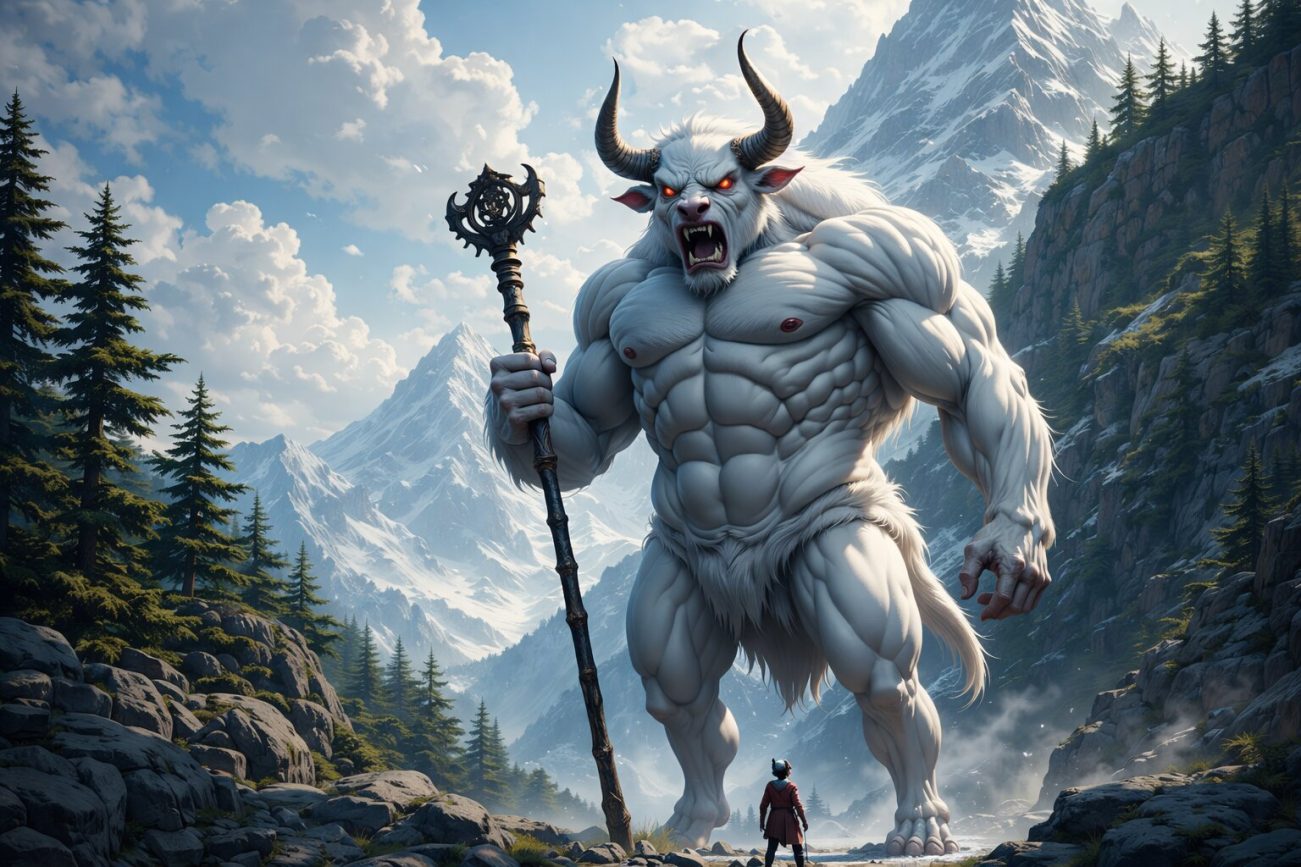
When he entered battle, the Bull Demon King revealed his true form: a colossal white bull, towering hundreds of feet tall, shaking the land with each step. He fought Sun Wukong with overwhelming force, wielding weapons and magic alike. Like the Monkey King, he could change his shape, using disguise and deception to outwit his enemies, even taking on the form of others to reclaim what was taken from him.

The struggle between the two shook mountains and skies, but even the Bull Demon King’s strength was not limitless. At last, the heavens intervened. Celestial generals descended, surrounding him and breaking his resistance. Bound and subdued, the Bull Demon King was taken away to face judgment under higher divine authority.

Thus ended the reign of one of the greatest demon sovereigns of the age—a being of immense power and pride, whose clash with Sun Wukong became one of the most fearsome and unforgettable trials on the journey to the West.


Gallery


Sources

Cheng’en, W. (1987). Journey to the West.
Wikipedia contributors. (2025a, August 14). Bull Demon King. Wikipedia. https://en.wikipedia.org/wiki/Bull_Demon_King#cite_ref-1


Interpretive Lenses

Religious Readings
  • Christian Ascetic Deep Dive
Philosophical Readings
  • Nietzschean Deep Dive
Psychological Readings
  • Jungian Deep Dive
Esoteric Deep Dive
  • Hermetic Deep Dive
Political / Social Readings
  • Marxist Deep Dive
Other
  • How to Invite The Bull Demon King

Aoyin

Tradition / Region: Chinese mythology
Alternate Names:
Category: Cow, Mountain dweller


The Myth

Far to the west, beyond the reach of familiar roads, rises Three-Dangers Mountain, a place long feared by travelers. The mountain spans a hundred li around, and its three peaks are known to shelter beings both strange and deadly.

There lives a monster called Aoyin.

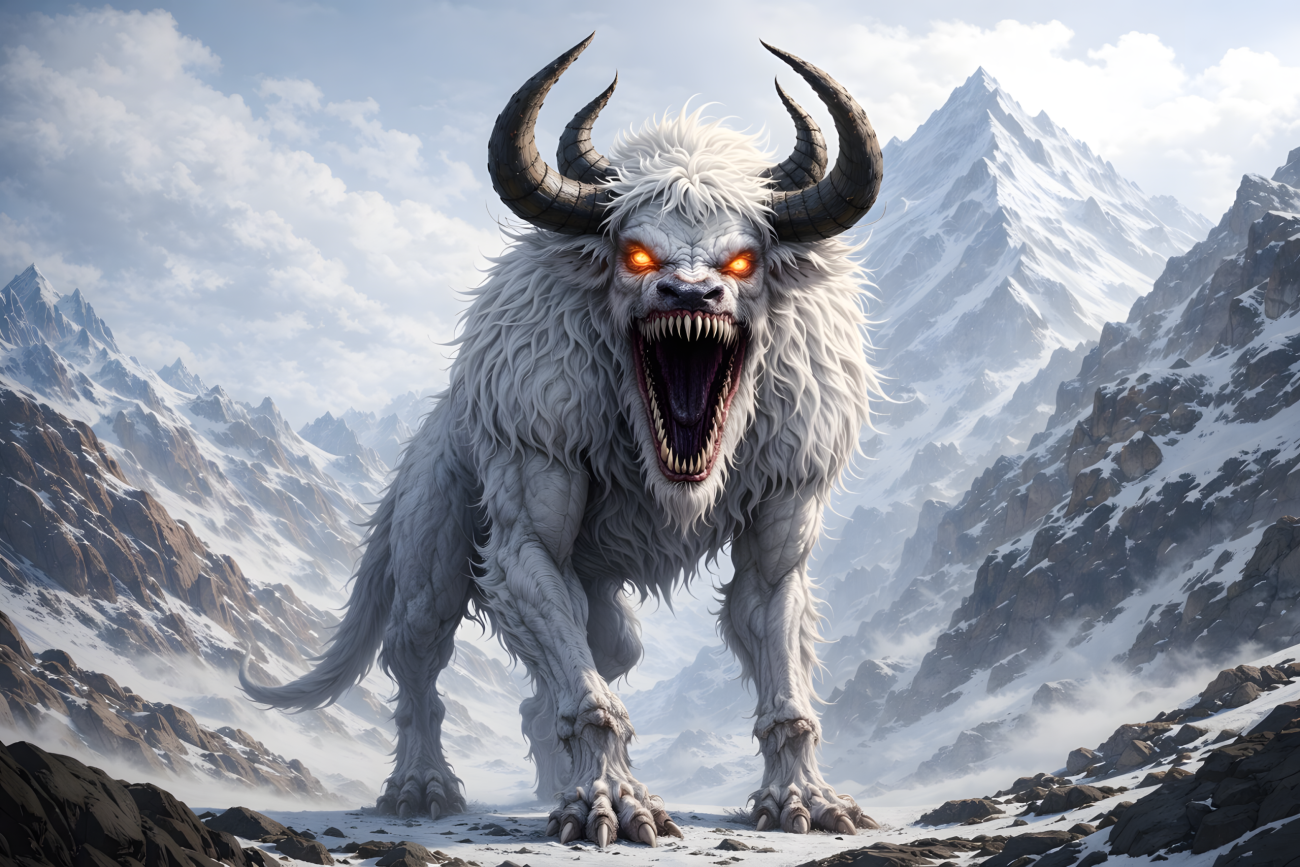
Its body is shaped like that of an ox, yet its hide is white as bone. Four horns rise from its head, and its body is covered in long, coarse hair like straw woven into rain capes. Though it bears the form of cattle, Aoyin is no gentle beast. It feeds on human flesh, preying on those who cross the mountain or linger too long beneath its peaks.

Three Green Birds are also said to dwell upon Three-Dangers Mountain. In later times they would be known as divine messengers, but here they share the heights with the man-eating Aoyin, marking the mountain as a place where sacred forces and mortal peril exist side by side.

Some say that Three-Dangers Mountain was also a land of exile. After rebelling against the ancient ruler Shun, the Three-Sprouts People were driven there and cast out to the edge of the world. Surrounded by barren land and deadly creatures, they disappeared from history.

Thus Aoyin became the living terror of Three-Dangers Mountain—a white, four-horned ox-beast that devours humans, standing as a warning that not all creatures shaped like cattle are meant to sustain life.


Gallery


Sources

Strassberg, R. E. (2002). A Chinese bestiary: Strange Creatures from the Guideways Through Mountains and Seas. Univ of California Press, p. 112.


Interpretive Lenses

Religious Readings
  • Christian Ascetic Deep Dive
Philosophical Readings
  • Nietzschean Deep Dive
Psychological Readings
  • Jungian Deep Dive
Esoteric Deep Dive
  • Hermetic Deep Dive
Political / Social Readings
  • Marxist Deep Dive
Other
  • How to Invite The Aoyin

Kun

Tradition / Region: Chinese mythology
Alternate Names: Peng; Dapeng; Pengniao; Kunpeng
Category: Fish


The Myth

In the Northern Sea there lives a fish called Kun. It is so vast that no one knows how many thousands of miles it spans. Its body fills the deep, and when it moves, the waters of the sea are set in motion.

When the time comes, Kun rises from the depths and transforms.

Its scales become feathers, and it becomes the great bird Peng. The Peng’s back is immeasurable, and when it spreads its wings they hang across the sky like drifting clouds. With a single beat of those wings, storms are born and the sea churns below.

When the oceans surge, the Peng takes flight, leaving the Northern Sea behind and journeying toward the Southern Sea, the Heavenly Pool. As it ascends, the small birds of the world laugh and mock it, unable to comprehend a being whose path stretches beyond the horizon. Yet the Peng does not answer them. It rises higher and higher, until earth and sky fall away beneath it.

Thus Kun and Peng are one being—fish and bird, depth and height—moving freely between sea and sky, embodying boundless transformation and the vastness of the world itself.


Gallery


Sources

Wikipedia contributors. (n.d.). 鯉魚. In Wikipedia, The Free Encyclopedia, from https://zh.wikipedia.org/wiki/%E9%AF%A4%E9%B5%AC


Interpretive Lenses

Religious Readings
  • Christian Ascetic Deep Dive
Philosophical Readings
  • Nietzschean Deep Dive
Psychological Readings
  • Jungian Deep Dive
Esoteric Deep Dive
  • Hermetic Deep Dive
Political / Social Readings
  • Marxist Deep Dive
Other
  • How to Invite The Kun