Heluo Zhi Yu

Tradition / Region: Chinese Mythology
Alternate Names: Heluo-fish
Category: Fish


The Myth

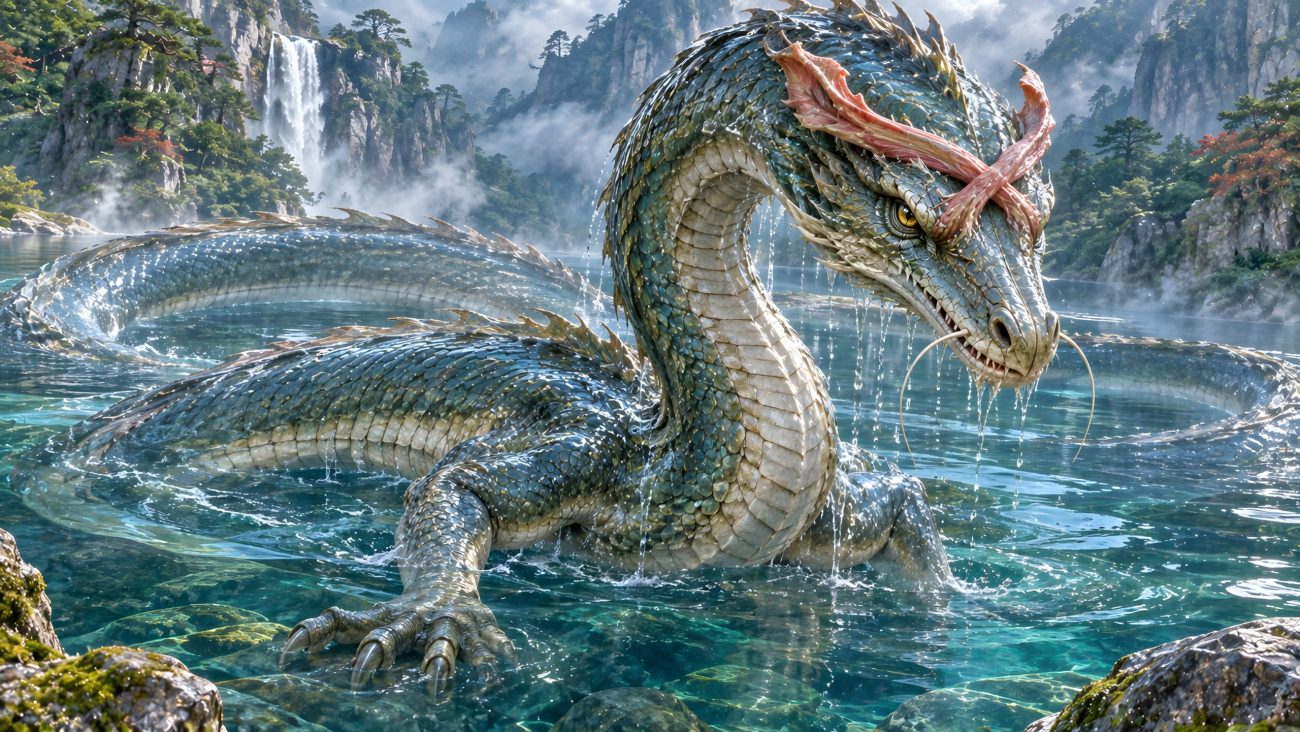
The Heluo Zhi Yu, or Heluo Fish, is said to live in the waters of the Tower River. It is a strange and unsettling creature, described as having one head and ten bodies, all moving together as a single being. When it cries out, its voice does not sound like a fish at all, but like the barking of a dog.

The flesh of the Heluo Fish is believed to possess powerful healing qualities. Those who eat it are said to be cured of tumors and severe internal illnesses, making it a creature both feared and sought after.

According to legend, the Heluo Fish is not bound to a single form. At times, it is said to transform into a Never-Old Bird, a mysterious creature that steals grains of rice from threshing tools. The bird flutters down into a mortar while stealing grain and dies there, completing its strange cycle of transformation.

Thus, the Heluo Fish is remembered as a being of many bodies and shifting shapes, whose presence links water, land, and air, and whose flesh holds both strangeness and healing power.


Gallery


Sources

A Book of Creatures contributors. (n.d.). Heluo-zhi-yu. In A Book of Creatures, from https://abookofcreatures.com/2019/08/26/heluo-zhi-yu/


Interpretive Lenses

Religious Readings
  • Christian Ascetic Deep Dive
Philosophical Readings
  • Nietzschean Deep Dive
Psychological Readings
  • Jungian Deep Dive
Esoteric Deep Dive
  • Hermetic Deep Dive
Political / Social Readings
  • Marxist Deep Dive
Other
  • How to Invite The Heluo Zhi Yu

Ran Yi Fish

Tradition / Region: Chinese mythology
Category: Fish, Mountain dweller


The Myth

The Ran Yi fish lives in the Wan River, which flows from Yingdi Mountain. This mountain is unlike any other: its slopes are thick with lacquer trees, metal ores and jade lie at its base, and all the birds and beasts that dwell there are said to be entirely white. From this place the Wan River rises and runs northward into Lingyang Marsh, and within its waters the Ran Yi fish can be found.

The Ran Yi fish has a fish’s body, but its head is that of a snake, and from its sides grow six legs. Its eyes resemble the ears of a horse, giving it a strange and unsettling appearance. Though it moves through water like a fish, its form marks it as something unnatural and powerful.

People believe that eating the Ran Yi fish brings protection. Those who consume it are said to be free from nightmares, untouched by disturbing dreams, and shielded from evil influences. Because of this, the Ran Yi fish is regarded not as a threat, but as a creature of warding and spiritual defense.

It remains hidden in the waters of the Wan River, tied to the strange mountain where white creatures roam and precious substances lie buried, a guardian presence within an uncanny landscape.


Gallery


Sources

Wikipedia contributors. (n.d.). 冷遺魚. In Wikipedia, The Free Encyclopedia, from https://zh.wikipedia.org/wiki/%E5%86%89%E9%81%97%E9%B1%BC


Interpretive Lenses

Religious Readings
  • Christian Ascetic Deep Dive
Philosophical Readings
  • Nietzschean Deep Dive
Psychological Readings
  • Jungian Deep Dive
Esoteric Deep Dive
  • Hermetic Deep Dive
Political / Social Readings
  • Marxist Deep Dive
Other
  • How to Invite The Ran Yi Fish

Wangyu Fish

Tradition / Region: Chinese mythology
Alternate Names: Wuyu Kuai, Wu Wang Kuaiyu, Kuaican
Category: Fish


The Myth

The Wangyu fish is a strange and sorrowful creature, known for having only half a body. Legend says that long ago, during the time of the Kingdom of Wu, a king—most often named King Helü, though some say it was King Sun Li—was eating a fish and left it unfinished. Displeased or careless, he cast the remaining half into the water. From this act, the fish did not die, but instead transformed, becoming the Wangyu fish, forever incomplete.

Because of this origin, the Wangyu swims through the water as a half-bodied being, a living reminder of abandonment and loss. It is said to dwell in city ponds and enclosed waters rather than open rivers or seas.

One tale tells of a Wangyu fish living in a pond within the eastern city. When the pond burst and the water drained away, the fish was left stranded and close to death, unable to escape on its own. A person nearby held up a mirror, allowing the fish to see its own reflection in the water’s surface. Mistaking its reflection for another of its kind, the Wangyu believed it had found a companion. Encouraged by the sight of what it thought was its missing half, the fish gathered its strength and leapt away, escaping side by side with its reflected image.

Thus, the Wangyu fish survives not through strength, but through illusion—forever seeking wholeness, even if only in reflection.


Gallery


Sources

Wikipedia contributors. (n.d.). 王鬱魚. In Wikipedia, The Free Encyclopedia, from https://zh.wikipedia.org/wiki/%E7%8E%8B%E9%A6%80%E9%B1%BC


Interpretive Lenses

Religious Readings
  • Christian Ascetic Deep Dive
Philosophical Readings
  • Nietzschean Deep Dive
Psychological Readings
  • Jungian Deep Dive
Esoteric Deep Dive
  • Hermetic Deep Dive
Political / Social Readings
  • Marxist Deep Dive
Other
  • How to Invite The Wangyu Fish

Lingyu

Tradition / Region: Chinese mythology
Category: Fish


The Myth

Lingyu is a strange fish of the sea, known for its human-like face and barbels shaped like hands. Its body moves through the water like an ordinary fish, yet its features mark it as something far from natural.

Lingyu lives in the sea near Lieguye Mountain, appearing and disappearing among the waves. When it emerges, the sea does not remain calm. It is said that whenever Lingyu appears, violent winds rise and storms suddenly break out, churning the water and darkening the sky.

Because of this, Lingyu is feared as an omen of chaos and upheaval. Sailors and coastal people believe its presence signals danger, and its human face is seen as a warning rather than a comfort.

Lingyu does not attack ships or people directly. Instead, it moves the sea itself, bringing sudden storms as it travels, leaving destruction in its wake before vanishing again into the depths.


Gallery


Sources

Wikipedia contributors. (n.d.). 陸魚. In Wikipedia, The Free Encyclopedia, from https://zh.wikipedia.org/wiki/%E9%99%B5%E9%B1%BC


Interpretive Lenses

Religious Readings
  • Christian Ascetic Deep Dive
Philosophical Readings
  • Nietzschean Deep Dive
Psychological Readings
  • Jungian Deep Dive
Esoteric Deep Dive
  • Hermetic Deep Dive
Political / Social Readings
  • Marxist Deep Dive
Other
  • How to Invite The Lingyu

Dan Fish

Tradition / Region: Chinese mythology
Category: Fish


The Myth

The Dan fish is a legendary fish surrounded by a red, glowing aura. When it appears, its body shines as if lit by fire, and the light rises above the water. It is said to live in deep pools and only comes close to the surface at certain times.

According to belief, if a person cuts the Dan fish and smears its blood on their feet, they gain the power to walk across the surface of water. Because of this ability, the fish is regarded as extraordinary and dangerous to approach.

In some stories, people who see the glowing fish are filled with awe and fear. They believe it is not an ordinary creature, and many refuse to touch or eat it, considering it a sacred or divine being.


Gallery


Sources

Wikipedia contributors. (n.d.). 丹鱼. In Wikipedia. Retrieved March 1, 2026, from https://zh.wikipedia.org/wiki/%E4%B8%B9%E9%B1%BC.


Interpretive Lenses

Religious Readings
  • Christian Ascetic Deep Dive
Philosophical Readings
  • Nietzschean Deep Dive
Psychological Readings
  • Jungian Deep Dive
Esoteric Deep Dive
  • Hermetic Deep Dive
Political / Social Readings
  • Marxist Deep Dive
Other
  • How to Invite The Dan Fish

Red Carp

Tradition / Region: Chinese mythology
Category: Fish, Carp


The Myth

The Red Carp is a strange and unusual fish described in Chinese legend. It has the body of a fish but the face of a human, making it both familiar and unsettling in appearance. The creature is said to live in the Winged Marsh, a remote and mysterious wetland.

When the Red Carp cries out, its voice is said to resemble the call of a mandarin duck. Despite its uncanny form, the fish is associated with healing rather than danger. According to tradition, eating the Red Carp can cure scabies.

The Red Carp is recorded in the Classic of Mountains and Seas, specifically in the Southern Mountains Classic, where it appears as one of the many strange beings inhabiting distant and mythical landscapes.


Gallery


Sources

Wikipedia contributors. (n.d.). 赤鱬. In Wikipedia, The Free Encyclopedia, from https://zh.wikipedia.org/wiki/%E8%B5%A4%E9%B1%AC


Interpretive Lenses

Religious Readings
  • Christian Ascetic Deep Dive
Philosophical Readings
  • Nietzschean Deep Dive
Psychological Readings
  • Jungian Deep Dive
Esoteric Deep Dive
  • Hermetic Deep Dive
Political / Social Readings
  • Marxist Deep Dive
Other
  • How to Invite The Red Carp

Flower Spirit

Tradition / Region: Chinese Folklore
Alternate Names: Huā Yāo (花妖), Huā Xiān (花仙), Huā Jīng (花精)
Category: Spirit


The Myth

In Chinese folklore, flowers are not lifeless plants but beings endowed with spirit and awareness. It is said that flowers which survive for a hundred years may awaken consciousness and become flower spirits. After a thousand years of cultivation, such beings may ascend further and become immortals. These spirits are known as Huā Yāo or Huā Jīng when their nature is closer to demons, and Huā Xiān when they attain a purer, immortal state.

Flower spirits often appear in human form, usually as young women of extraordinary beauty whose appearance reflects the flower from which they were born. Their lives are bound to the cycles of nature: blooming, fading, and renewal. Though rooted in the soil, they can walk, speak, love, and suffer like humans, while retaining a deep connection to their original plant form.

One of the most famous accounts appears in “Xiangyu” from Strange Tales from a Chinese Studio by Pu Songling of the Qing dynasty. In this story, a peony flower spirit forms a relationship with a scholar surnamed Huang. The spirit is gentle and affectionate, yet vulnerable to the forces of the human world, illness, and spiritual imbalance. Her existence demonstrates both the beauty and fragility of flower spirits, who live between nature and humanity.

Earlier sources trace the idea of flower spirits back to Taiping Guangji, where flowers transforming into conscious beings are recorded as marvels of the natural world. These stories present flower spirits not as monsters, but as manifestations of the living earth itself—natural entities capable of emotion, loyalty, and moral action.

Poetry further reinforces their presence in the cultural imagination. Writers of the Tang, Song, and Ming dynasties frequently invoked flower fairies as unseen guests descending among blossoms, dancing beneath moonlight or moving with the wind through gardens. Their arrival often marked moments when the boundary between the human world and the spirit realm grew thin.

Flower spirits were also associated with imbalance in nature. Historical records sometimes attributed strange winds, unseasonal darkness, or disturbances among flowers to the activity of flower demons, suggesting that when the harmony of earth was disrupted, these spirits manifested visibly.

Across all accounts, flower spirits remain bound to impermanence. If their flower is destroyed, neglected, or uprooted, the spirit weakens or dies. Their stories serve as reminders that beauty, life, and spirit arise from patience and time, and that nature itself is alive, observant, and capable of transformation.


Interpretive Lenses

Religious Readings
  • Christian Ascetic Deep Dive
Philosophical Readings
  • Nietzschean Deep Dive
Psychological Readings
  • Jungian Deep Dive
Esoteric Deep Dive
Political / Social Readings
  • Marxist Deep Dive
Other