Lumpeguin

Tradition / Region: Wabanaki Mythology, American Mythology
Alternate Names: Lampeqin, Lampekwin, Lumpegwen, Lumpeguinuwok (plural)
Category: Mermaid


The Myth

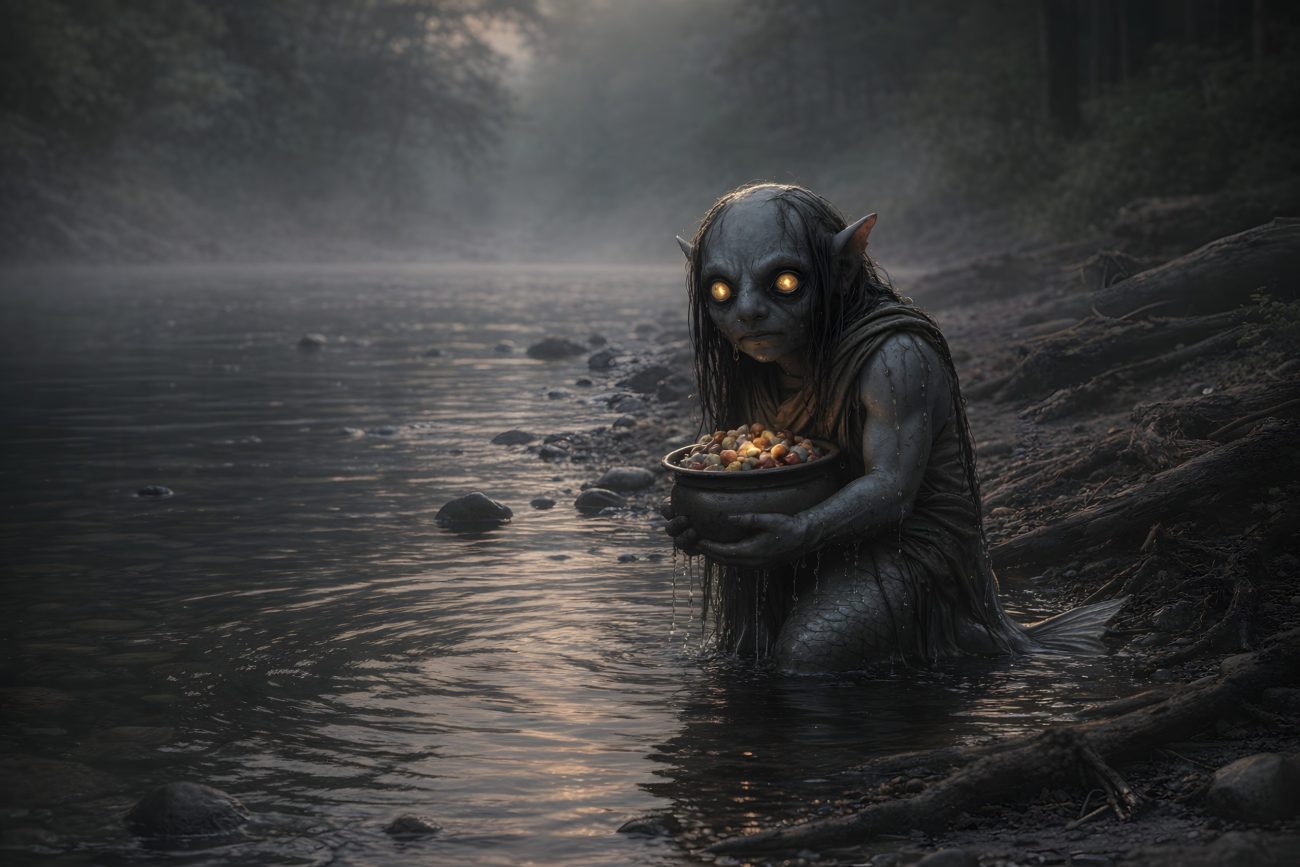
In the rivers and coastal waters of Wabanaki lands dwell the Lumpeguin, small and powerful water spirits. Some say they appear as little people with shining eyes and long hair dripping with river water. Others say they are like tiny mermaids, with human faces and fish tails flashing silver beneath the surface. They move easily between water and shore, belonging fully to neither.

The Lumpeguin are beings of quiet magic. They can multiply food from almost nothing. A scrap of bread may become a feast in their hands. A handful of snow may be baked into warm loaves. Some carry enchanted pots that never empty, feeding those they favor. Their gifts, however, are never given lightly.

Like many nature spirits, a Lumpeguin’s power is bound to a magical garment—an article of clothing that allows them to move between worlds. If that garment is stolen, the Lumpeguin falls under the power of the thief. In old tales, men—and sometimes even animals—have hidden these garments and forced Lumpeguin women to remain on land as wives. Though they may live for a time among humans, their hearts remain with the water. If they ever recover their hidden clothing, they return at once to the rivers and are never seen again.

One tale tells of two Lumpeguin sisters who were captured in this way by Marten, a clever forest being. He hid their magical garments and claimed them as wives. The sisters lived with him, but they did not forget who they were. Through patience and cunning, they eventually regained their garments and set off on journeys of their own, traveling through forest and water alike, neither fully captive nor fully free until they reclaimed their power.

The Lumpeguin remind those who hear their stories that the spirits of the rivers cannot be possessed without consequence. Water gives life and sustenance, but it belongs first to itself. Those who try to bind it may hold it for a while—yet in the end, it always slips back to its own depths.


Gallery


Sources

native-languages.org contributors. (n.d.). Lumpeguin. In native-languages.org, from https://www.native-languages.org/lumpeguin.htm


Interpretive Lenses

Religious Readings
  • Christian Ascetic Deep Dive
Philosophical Readings
  • Nietzschean Deep Dive
Psychological Readings
  • Jungian Deep Dive
Esoteric Deep Dive
  • Hermetic Deep Dive
Political / Social Readings
  • Marxist Deep Dive
Other
  • How to Invite The Lumpeguin

Sabawaelnu

Tradition / Region: Micmac Mythology, American Mythology
Alternate Names: Sapowanilnu, Sapoqwanilnu; Halfway People
Category: Mermaid


The Myth

In the rivers, coves, and ocean inlets of Mi’kmaq lands live the Sabawaelnu—the Water People. They are called the Halfway People because they are neither fully human nor fully fish. From the waist up they appear as men and women, with long hair that flows like currents in the tide. From the waist down they bear the powerful tail of a fish, swift and strong in the water.

They dwell beneath the waves, in places where the water turns dark and green and deep. Sometimes they rest among kelp forests that sway like underwater trees. Sometimes they gather near rocky shores where the sea breathes in and out with the tide.

The Sabawaelnu are masters of storms. When the wind rises suddenly and the waves grow sharp and angry, it is said that the Water People are moving beneath the surface. A flick of a tail can churn the sea. A song rising from the depths can call the clouds together.

Yet they are not wicked spirits. They do not trouble those who honor them. Fishermen who greet the waters with respect, who never mock the sea or boast against it, are left unharmed. Some elders say that if you listen carefully to the wind over the water, you can hear the Sabawaelnu singing. Their songs carry warnings—of coming rain, of shifting winds, of dangerous tides.

Those who understand the meaning hidden in their voices can prepare before the storm arrives.

On calm evenings, when the surface of the water lies smooth as glass, a watcher might glimpse a shape moving just below. A pale arm breaking the surface. A dark head slipping between the swells. Then nothing—only ripples spreading outward.

They are the people of the water, halfway between worlds, powerful and watchful. The Sabawaelnu remind all who live near the sea that the waters are alive, and that respect is the price of safe passage.


Gallery


Sources

native-languages.org contributors. (n.d.). Sabawaelnu. In native-languages.org, from https://www.native-languages.org/sabawaelnu.htm


Interpretive Lenses

Religious Readings
  • Christian Ascetic Deep Dive
Philosophical Readings
  • Nietzschean Deep Dive
Psychological Readings
  • Jungian Deep Dive
Esoteric Deep Dive
  • Hermetic Deep Dive
Political / Social Readings
  • Marxist Deep Dive
Other
  • How to Invite The Sabawaelnu

Buffalo Woman

Tradition / Region: Pawnee mythology, American Mythology
Alternate Names: —
Category: Cow, Hybrid


The Myth

In the earliest days, when the Pawnee still wandered and lived on roots and wild plants, a strange woman appeared at dusk near their gambling grounds. She moved in silence, her body wrapped in a covering that hid her hair, and she passed through the place where the people played before vanishing over the hills.

The next morning, her tracks were found—but they were not human footprints. They were the split hooves of an animal. Still, the people continued their games.

On another evening, the woman returned. This time she ran across the gambling ground and circled it. As she fled over the hills, a man saw her transform before his eyes into a buffalo. He pursued her for many days, until he reached a place where there was nothing but water. There, exhausted, he lost consciousness.

When he awoke, the Buffalo Woman touched him and led him into a lodge. Inside sat four ancient men, the gods of the west. They told him that the buffalo were being given to the people so they might live. They taught him how the buffalo were to be prepared and honored, showing him that the heart and tongue were sacred and must be offered in gratitude. They also entrusted him with seeds—corn, beans, squash, and tobacco—tied in buffalo hide, gifts meant to sustain the people.

Thus the Buffalo Woman was revealed as a messenger between worlds. She crossed between human and animal, bringing food, life, and sacred instruction. From that time on, the Pawnee lived by the buffalo and honored the western gods first in their offerings, remembering the woman who came at dusk and changed the fate of the people.


Sources

Dorsey, G. A. (1906). The Pawnee Mythology (Part I).


Babe

Tradition / Region: American Mythology
Alternate Names: Babe the Blue Ox
Category: Cow


The Myth

Babe the Blue Ox was the faithful companion of Paul Bunyan, the greatest lumberjack the world had ever known.

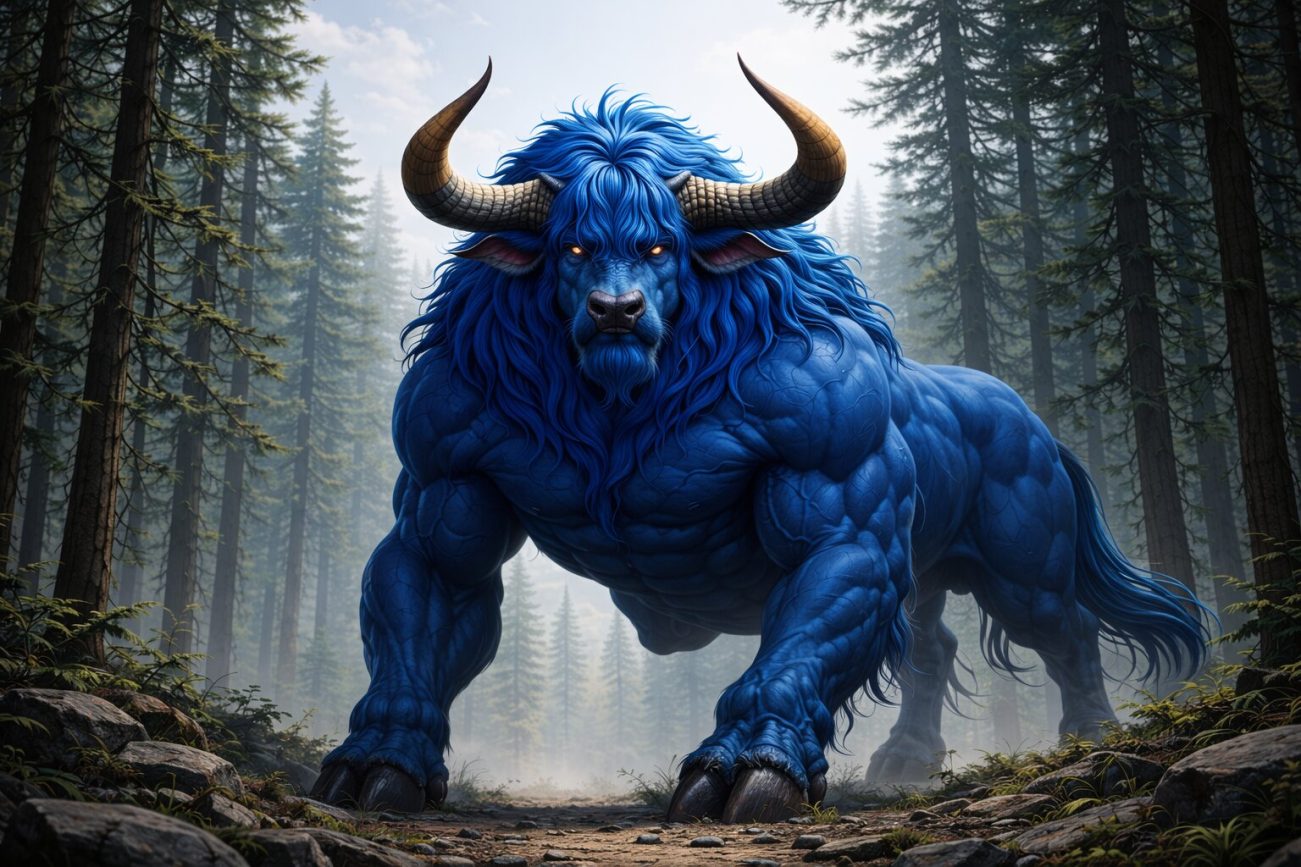
During the legendary Winter of Blue Snow, when cold gripped the land more fiercely than ever before, Paul Bunyan found a small ox calf trapped and close to freezing in the wilderness. He lifted the calf in his arms and carried it back to his camp, warming it by the fire until it survived. Though the cold left its body, it never left its hide, and the calf remained forever blue. Because of this, Bunyan named him Babe.

Babe grew with astonishing speed. Before long he became so large that his height was said to equal forty-two axe handles stacked end to end. His horns stretched so far apart that a crow would take an entire day to fly from one tip to the other.

Wherever Paul Bunyan went, Babe followed. Together they hauled entire forests, dragged logs across continents, and reshaped the land itself. It is said that their travels carved the Black Hills and that their labors tore open the earth to form the Grand Canyon. Babe moved steadily at Bunyan’s side, silent and immense, his blue form standing out against the open sky.

Thus Babe the Blue Ox became part of the legend of the land itself—a symbol of enormous strength, endless work, and the vast scale of the American frontier, where even animals could grow as large as the stories told about them.


Sources

Dixon-Kennedy, M. (1996). Native American Myth & Legend: An A–Z of People and Places. p. 35.

Encyclopedia Mythica. (n.d.). Babe. Retrieved from https://pantheon.org/articles/b/babe.html


The Slide-Rock Bolter

Tradition / Region: American Mythology
Alternate Names: —
Category: Fish, Mountain dweller


The Myth

High in the mountains of Colorado, where the slopes are steep and the ground falls away at terrifying angles, there lives a monstrous creature known as the Slide-Rock Bolter. It inhabits only the most dangerous terrain, where the mountainsides tilt sharper than forty-five degrees and a misstep can mean death.

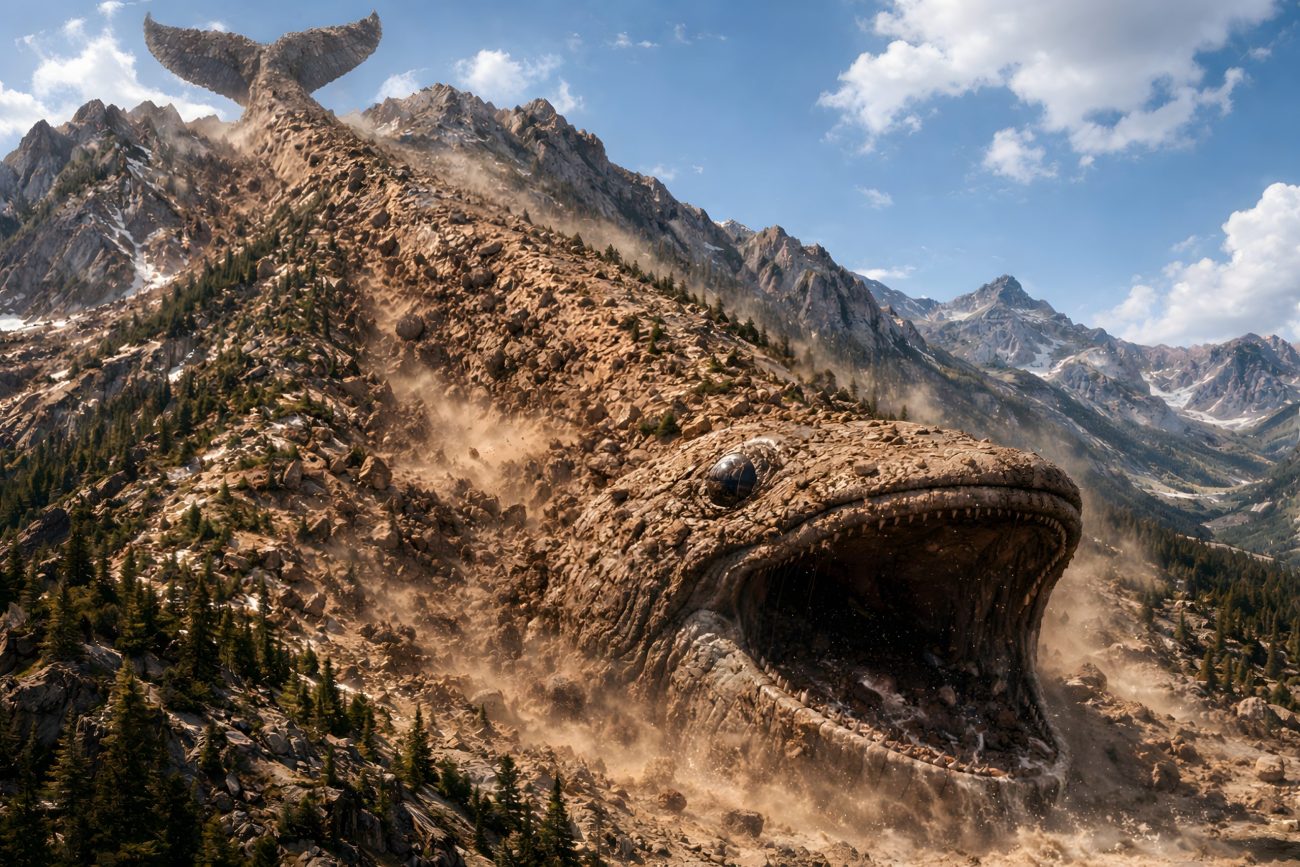
The Slide-Rock Bolter has an enormous head with small, intent eyes and a vast mouth that stretches far back beyond its ears. Its tail ends in a split flipper armed with massive hooks. With these, the creature fastens itself to the crest of a mountain or ridge, clinging there motionless for days at a time while it watches the gulches below.

When a tourist—or any other unlucky creature—wanders into view, the Bolter prepares to strike. It loosens its grip, lifts its hooked tail, and launches itself downhill like a living avalanche. As it slides, thin grease drools from the corners of its mouth, slicking the rock and increasing its speed. In a single roaring descent, it scoops up its victim, gulps them whole, and uses its own momentum to surge up the opposite slope. There it hooks its tail over a new ridge and waits once more.

Some say entire parties of tourists have vanished in a single sweep. Others tell of forested slopes scoured bare, where spruce trees were torn out by the roots or sliced down as cleanly as if by a giant scythe when a Bolter thundered through from the heights above.

One tale tells of a forest ranger who dared to fight the monster with cunning rather than fear. He constructed a lifelike dummy tourist, dressed in plaid jacket and knee breeches, clutching a guidebook to Colorado. The figure was packed with explosives and placed in plain sight on a slope beneath Lizzard Head, where a Slide-Rock Bolter had been waiting for days.

The next day, the Bolter struck.

The explosion that followed was said to flatten half the buildings in the town of Rico, which were never rebuilt. For the rest of the summer, buzzards circled the surrounding hills, feeding on what remained.

And so the Slide-Rock Bolter lives on in mountain lore: a patient predator of slopes and shadows, forever waiting above the trail for the careless step below.


Gallery


Sources

Cox, W. T. (1910). Fearsome Creatures of the Lumberwoods: With a Few Desert and Mountain Beasts. Press of Judd & Detweiler, Inc.


Interpretive Lenses

Religious Readings
  • Christian Ascetic Deep Dive
Philosophical Readings
  • Nietzschean Deep Dive
Psychological Readings
  • Jungian Deep Dive
Esoteric Deep Dive
  • Hermetic Deep Dive
Political / Social Readings
  • Marxist Deep Dive
Other
  • How to Invite The The Slide-Rock Bolter

Rubberado

Tradition / Region: American Mythology
Alternate Names: —
Category: Forest dweller


The Myth

The Rubberado is a strange and comical creature known for its unusual body and peculiar way of moving. It cannot leap, fly, jump, climb, swim, run, walk, creep, or crawl. Instead, the Rubberado moves in only one way: it bounces.

From the moment it begins moving, the Rubberado bounces endlessly from place to place. Each time it lands, it laughs, and then springs up again, continuing this motion without pause. Its movement is uncontrollable and repetitive, as though its body were made entirely of rubber.

The Rubberado is said to have a tasty smell, though it is not edible. Anyone foolish enough to try to eat it is warned of the consequences. If a person does so, they will begin to bounce and laugh uncontrollably, just like the Rubberado itself. This condition does not pass quickly—the victim will continue to bounce and laugh for days and days, unable to stop.

Because of this, the Rubberado is regarded less as a dangerous creature and more as a source of endless trouble and ridicule. Its presence brings chaos not through violence, but through uncontrollable motion and laughter, turning anyone who interferes with it into a living reflection of its own absurd nature.

The Rubberado remains a reminder that not all monsters threaten with teeth or claws—some punish curiosity with laughter that never ends.


Gallery


Sources

Schwartz, A., & Rounds, G. (1978). Kickle Snifters and Other Fearsome Critters.


Interpretive Lenses

Religious Readings
  • Christian Ascetic Deep Dive
Philosophical Readings
  • Nietzschean Deep Dive
Psychological Readings
  • Jungian Deep Dive
Esoteric Deep Dive
  • Hermetic Deep Dive
Political / Social Readings
  • Marxist Deep Dive
Other
  • How to Invite The Rubberado

The Tote-Road Shagamaw

Tradition / Region: American Mythology
Alternate Names: —
Category: Forest dweller


The Myth

The Tote-Road Shagamaw is a strange forest creature spoken of by loggers and woodsmen from the Rangeley Lakes to the Allagash, and across into New Brunswick. Its existence is said to explain a long-standing mystery that has caused confusion, arguments, and even fistfights among experienced men of the woods.

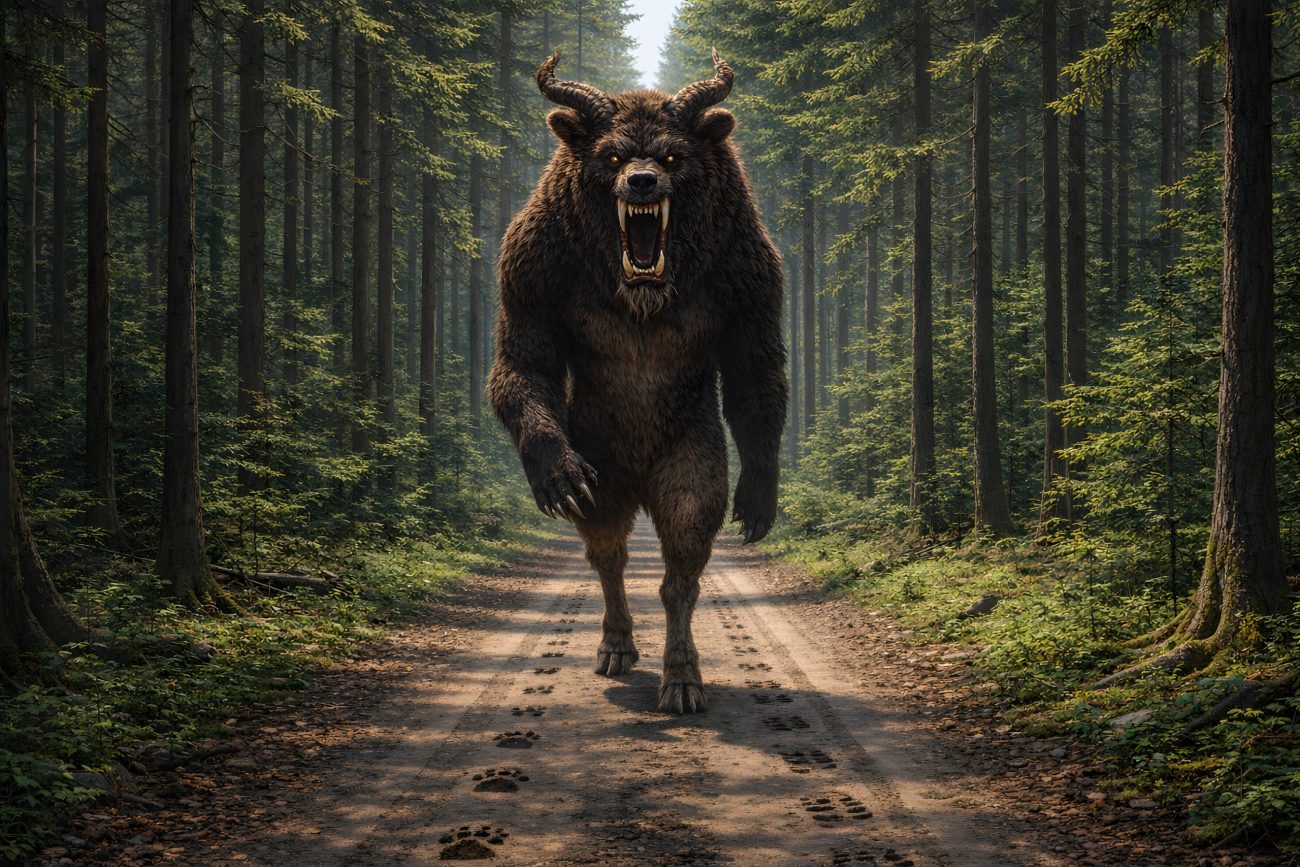
The trouble begins with tracks. One day, men swear they have found bear tracks near camp. Soon after, these reports are denied and replaced by claims that the tracks belong to a moose instead. Such disagreements are taken seriously, since accusing a woodsman of confusing bear and moose tracks is considered a grave insult. Only a few old timber cruisers and rivermen are said to know the true explanation.

One such man was Gus Demo of Oldtown, Maine, who had hunted, trapped, and logged in the woods for forty years. While traveling through the forest, he came upon tracks that were clearly those of a moose. After following them for about eighty rods, the tracks abruptly became unmistakable bear tracks. After another eighty rods, they changed back again into moose tracks. Gus soon noticed that this change occurred exactly every quarter of a mile, and that the tracks always followed a tote road or blazed survey line through the forest.

Eventually, Gus came close enough to see the creature itself. He observed that it had front feet like a bear’s and hind feet like those of a moose. It moved with great care, pacing steadily and taking exactly one yard per step. After walking for a time, the creature suddenly stopped, looked all around, and then turned sharply as if pivoting on a point. It then inverted itself, walking on its front feet alone, and continued on its measured path.

By examining the witness trees, Gus realized that the place where the Shagamaw inverted itself was a section corner. From this, he reasoned that the creature must once have been a highly imitative animal. By watching surveyors, timber cruisers, and trappers patiently follow straight lines through the forest, it had taken on the same habit.

According to this explanation, the Shagamaw can count only as high as 440, which equals a quarter of a mile measured in yards. When it reaches that limit, it must turn itself over to continue counting again from the beginning. Thus, the creature endlessly walks the tote roads, confusing men by leaving alternating bear and moose tracks, and quietly measuring the forest one quarter-mile at a time.

The Tote-Road Shagamaw remains a symbol of the woods’ ability to deceive even experienced eyes, and a reminder that not every mystery in the forest can be solved by tracks alone.


Gallery


Sources

Cox, W. T. (1910). Fearsome Creatures of the Lumberwoods: With a Few Desert and Mountain Beasts.


Interpretive Lenses

Religious Readings
  • Christian Ascetic Deep Dive
Philosophical Readings
  • Nietzschean Deep Dive
Psychological Readings
  • Jungian Deep Dive
Esoteric Deep Dive
  • Hermetic Deep Dive
Political / Social Readings
  • Marxist Deep Dive
Other
  • How to Invite The The Tote-Road Shagamaw

Mishipeshu

Tradition / Region: Algonquian Mythology, American Mythology
Alternate Names: Mishibijiw, Mishipeshu
Category: Cat


The Myth

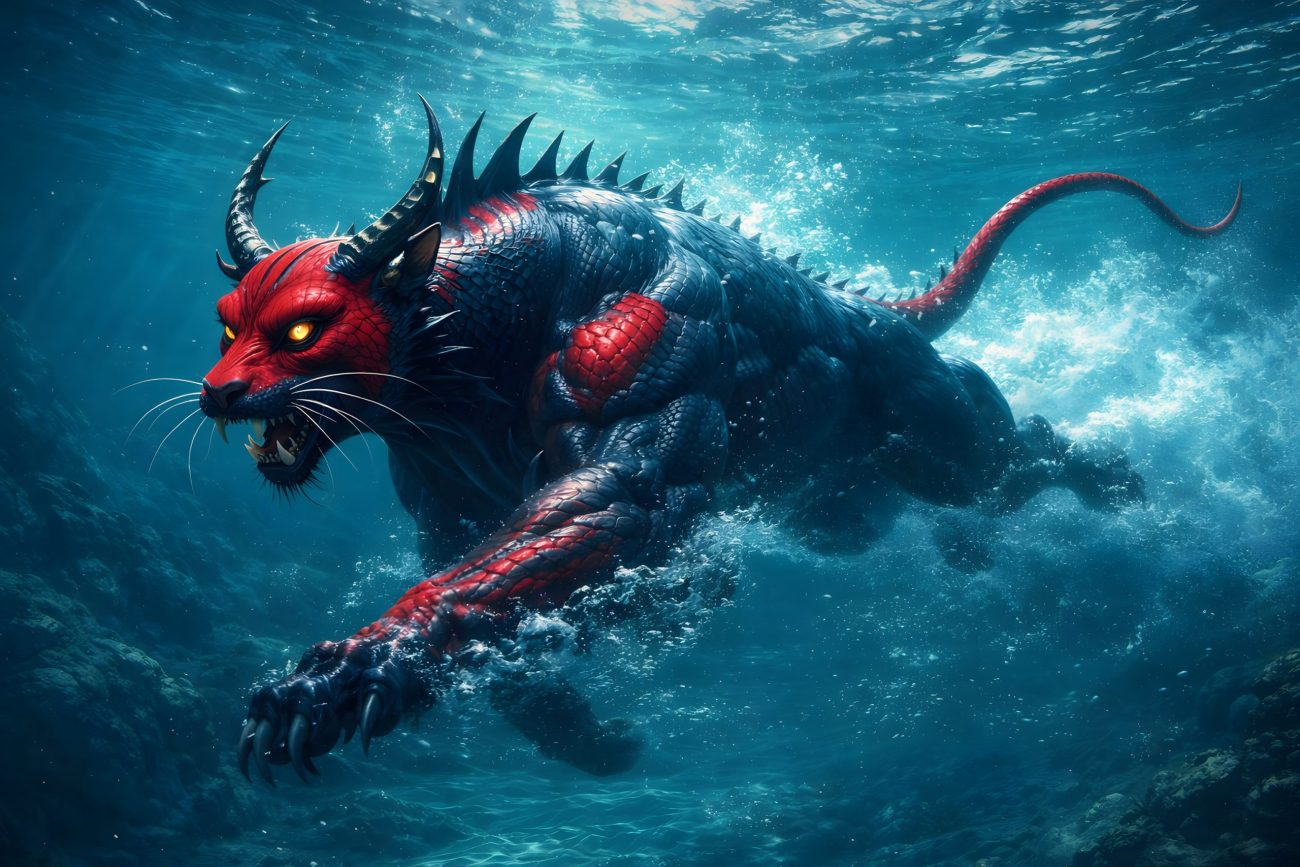
The Micibichi is a powerful being said to dwell in deep lakes, rivers, and underground waters. It is most often described as a great feline, resembling a lynx or panther, but far larger and more dangerous than any ordinary animal. Its body is sleek and muscular, armed with sharp claws, and it moves with sudden speed. Though it is a creature of the water, it also inhabits caves and places beneath the earth.

In many tellings, the Micibichi has a humanoid head, sometimes bearing horns, and its eyes shine with unnatural awareness. It is closely associated with copper and other riches hidden within the earth, and is said to guard these resources fiercely. For this reason, it is both feared and respected as a powerful spirit tied to survival and wealth.

The Micibichi rules liminal places where land, water, and the underground meet. It creates whirlpools, sudden storms, and dangerous currents, and is blamed for drownings and disappearances. Canoes that pass over its domain without proper respect may be overturned, and travelers pulled beneath the surface. Yet the Micibichi is not always hostile. Fishermen and travelers who offer tobacco, food, or other gifts may pass safely, believing the spirit has accepted their acknowledgment.

The creature is said to change in size. At times it may appear no larger than a common lynx; at other times it grows into a monstrous panther capable of crushing canoes and dragging prey into the depths. Its presence is often known before it is seen, through disturbances in the water or unexplained sounds rising from below.

In the wider order of the world, the Micibichi is understood as a counterpart to the great sky beings, dwelling below while others rule above. Its power balances the forces of the heavens, and its actions shape the fate of those who depend on water for travel, food, and life itself.

Thus the Micibichi remains a feared and revered spirit of the deep—guardian of waters and hidden riches, a being that punishes carelessness and rewards respect, and whose domain marks the boundary between the human world and forces far older and stronger than humankind.


Sources

Wikipedia contributors. (n.d.). Underwater panther. In Wikipedia. Retrieved June 29, 2026, from https://en.wikipedia.org/wiki/Underwater_panther