Hunen

Tradition: Dutch Mythology
Alternative Names: Huinen, Hunnen, Hunewief (giant’s wife), Hunewiven (giant women)
Category: Giant


The Myth

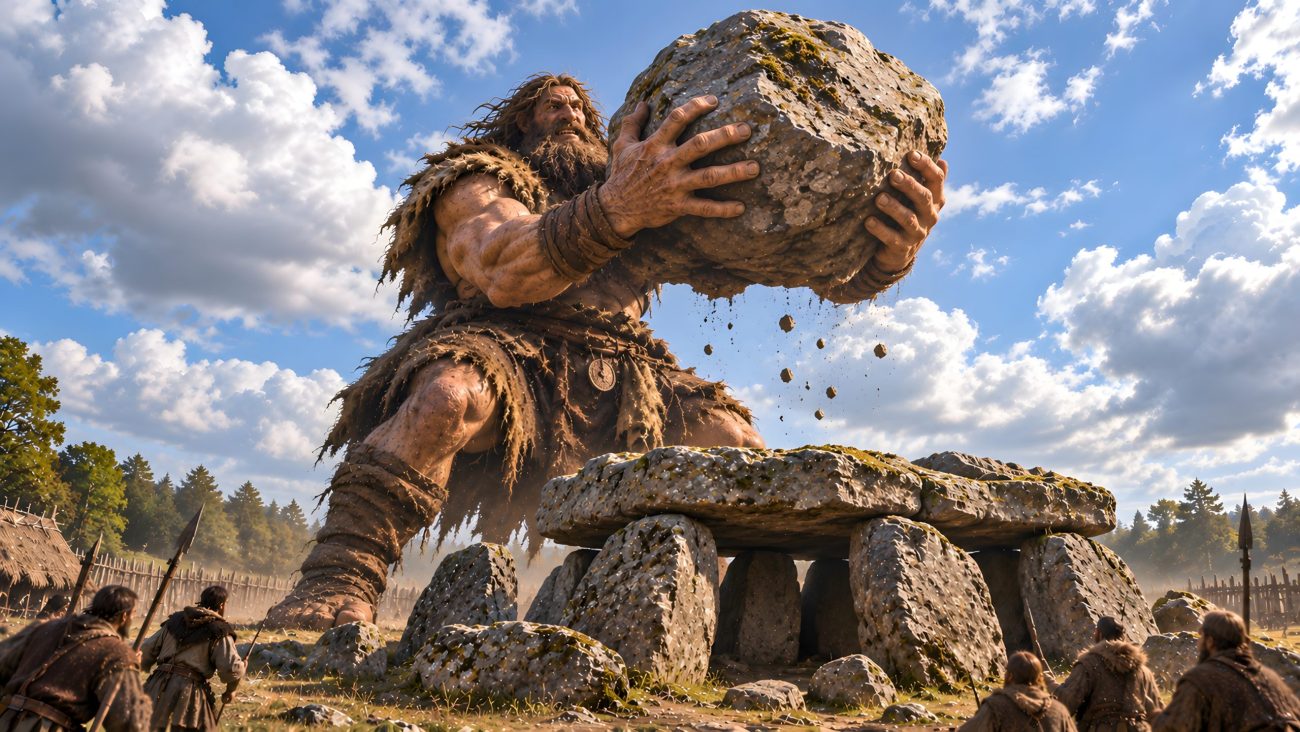
Hunen are giants from the folklore of Drenthe and Overijssel in the eastern Netherlands. They are credited with building the region’s ancient megalithic tombs, known as hunebedden, as well as huneborgen and huneschanzen. They were enormous, powerful men capable of extraordinary feats of strength, including pulling entire trees out of the ground. Their immense strength made them dangerous to ordinary people, even during seemingly harmless encounters.

People had to be careful when a hune offered to shake their hand, as the giant’s grip could crush a person’s hand. In one tale, a farmer anticipated this danger by offering the hune the wooden handle of a manure fork instead. The giant squeezed it so forcefully that he ground the handle into powder. The story illustrates the extraordinary strength of the hunen and the need for ordinary people to use their wits when dealing with them.

The female hunen, known as hunewiven or hunewiefs, were associated with witchcraft. They could use their powers to heal people, but they could also inflict illness through magic. Their frightening reputation extended into family life, particularly in stories about protecting children. A Twents lullaby warns a hunewief to stay away from a baby’s cradle, threatening to beat her if she approaches. The song reflects the fear that a hunewief might make a child sick or steal it away.

The hunen thus occupy an important place in regional Dutch folklore as both legendary builders and powerful supernatural beings. While the male giants were known chiefly for their immense physical strength, their female counterparts possessed magical abilities that could bring either healing or harm. Their association with the ancient megalithic monuments of Drenthe and Overijssel connects these beings to the mysterious origins of the region’s prehistoric landscape.


Sources

Van der Veen, Abe. “Van aardmannetje tot zwarte juffer: Een lijst van Nederlandse en Vlaamse elfen en geesten.” Abe de Verteller. https://abedeverteller.nl/van-aardmannetje-tot-zwarte-juffer-een-lijst-van-nederlandse-en-vlaamse-elfen-en-geesten/
Fachan

Tradition: Scottish Mythology
Alternative Names: Fachin, Fachen, Direach Ghlinn Eitidh, Dithreach, Dwarf of Glen Etive
Category: Giant


The Myth

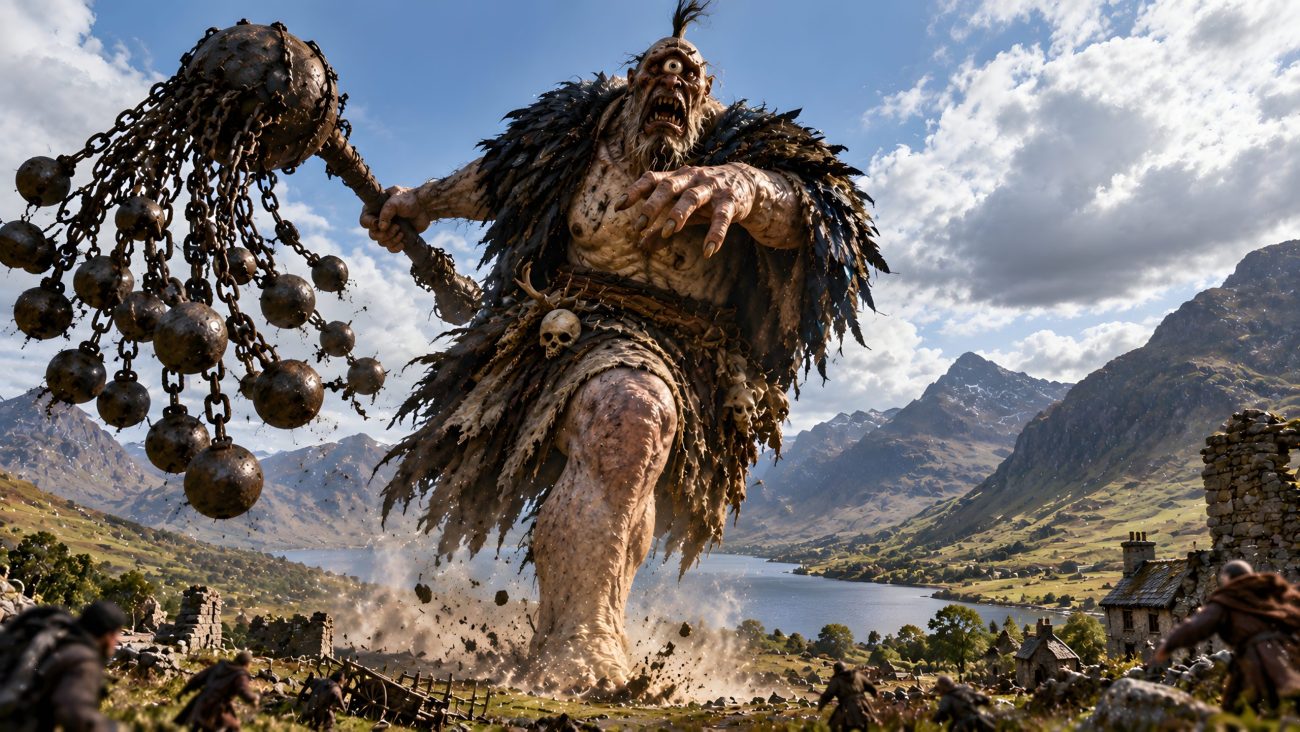
The Fachan is a terrifying monster or giant from Scottish Gaelic folklore, particularly associated with the Highlands. It possesses a grotesquely asymmetrical body, with a single eye in the middle of its face, one hand protruding from its chest instead of two arms, and one leg emerging from the center of its body. A single tuft of hair grows from the top of its head. According to folklorist John Francis Campbell, this tuft is so rigid that it would be easier to uproot an entire mountain than to bend it. The creature’s unusual anatomy makes it appear less like a human being and more like a monstrous being from another world.

The Fachan is also known by the names Direach Ghlinn Eitidh and Dithreach, translated as the dwarf of Glen Etive. Despite this association with a particular Scottish landscape, it is described as a giant-like monster rather than an ordinary dwarf. Its single leg does not necessarily make it slow or helpless: comparisons have been drawn with creatures from Arabic traditions, such as the nasnas and shiqq, which are described as half-human beings capable of hopping about on one leg with remarkable agility.

Similar creatures appear in Irish Gaelic literature. In his collection Beside the Fire, Douglas Hyde records a description of a monstrous being resembling Campbell’s Fachan. This creature has a black face with one eye in its forehead, one hairy hand emerging from its chest, and a single thick, veined leg. It carries an enormous iron flail-club from which hang twenty chains, each bearing fifty large apples enchanted with poisonous spells. Its body is wrapped in a girdle made from deer and roebuck skins and protected by a dark blue mantle of thick, twisted feathers. The description presents a being that resembles the devil more than a human.

Campbell and Hyde considered these descriptions part of a shared Gaelic tradition of monstrous beings. The name Fachan may be related to the Irish word fathach, meaning giant, and the Scottish Gaelic famhair, also meaning giant. The creature therefore belongs to a broader tradition of fearsome, physically extraordinary beings in Gaelic folklore, distinguished by its single eye, single hand, single leg, and remarkably rigid tuft of hair.


Sources

“Fachan.” Wikipedia: The Free Encyclopedia. Wikimedia Foundation. Accessed October 16, 2026. https://en.wikipedia.org/wiki/Fachan


Ujanko

Tradition: Navarrese Mythology, Spanish Mythology
Alternative Names: Uhanko, Ukhanko
Category: Giant


The Myth

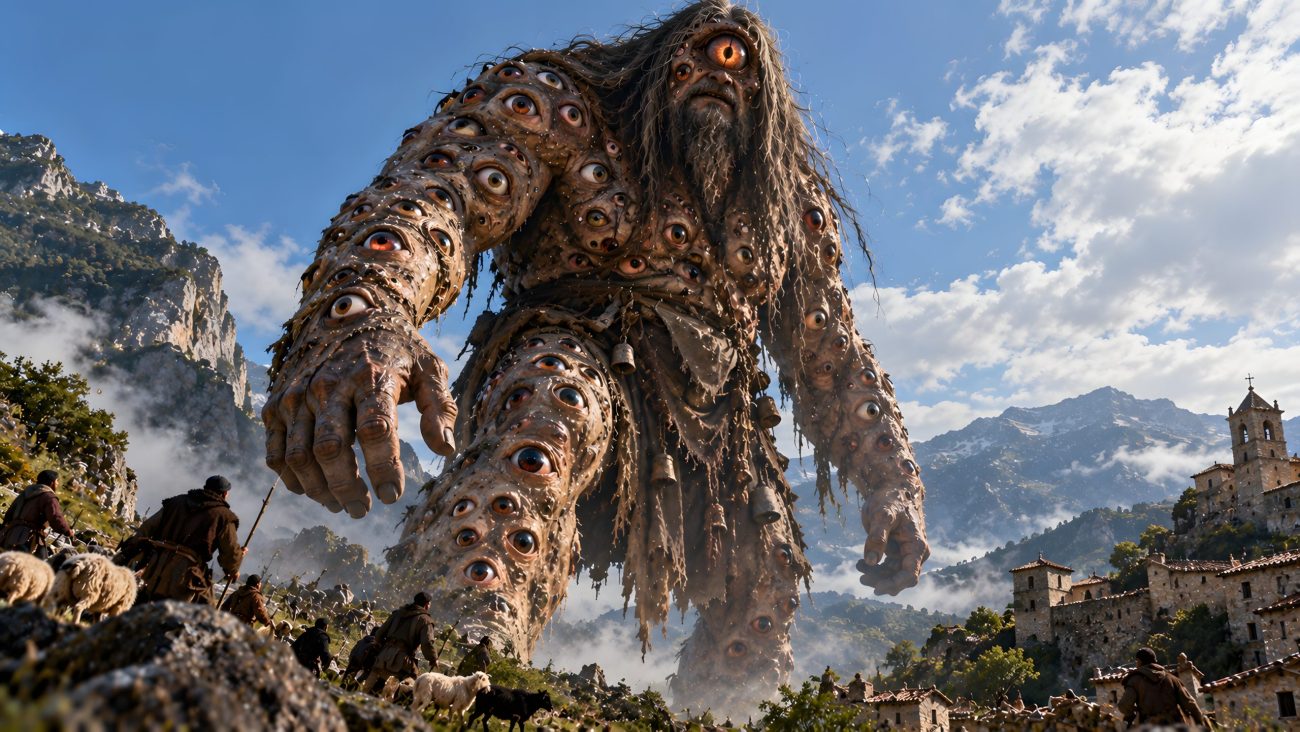
Ujanko is a strange supernatural creature from the folklore of Navarre, a region in northern Spain. It is described as an enormous, multi-eyed giant whose body is covered with numerous eyes. Each eye disappears on a particular day of the year and reappears on Christmas Eve, giving the creature an unusual connection to the passage of time and the Christmas season. In Basque-speaking communities of northeastern Spain, Ujanko is understood as the personification of a year, with its many eyes representing the days that make up the annual cycle.

According to the legend, Ujanko has a single enormous eye on its face, which is often hidden beneath a multitude of eyes covering its body. On a particular day, ten of these eyes disappear, transforming the creature’s appearance. Its many eyes are said to correspond to the days of the year, and the return of its eyes on Christmas Eve marks the completion of the cycle. This strange annual transformation connects Ujanko to seasonal change and the transition from one year to the next.

Ujanko belongs to a wider group of giant-like supernatural beings found in the folklore of the Iberian Peninsula. It has been compared to the Ombre de los Ojos, or Man of the Eyes, from Cabazuela del Valle in Extremadura, and the One-eyed Nasus from Catalonia. Its unusual anatomy also recalls Argus from ancient Greek mythology, the many-eyed giant whose numerous eyes made him an exceptional watcher. However, Ujanko’s distinctive association with the yearly calendar and Christmas Eve gives it a particular place in Navarrese folklore.


Sources

“Ukhanko.” New Bestiary (Bestiary.us). https://www.bestiary.us/ukhanko


Giant of Penhill

Tradition: English Mythology
Alternative Names: The Giant of Penhill, The Penhill Giant
Category: Giant


The Myth

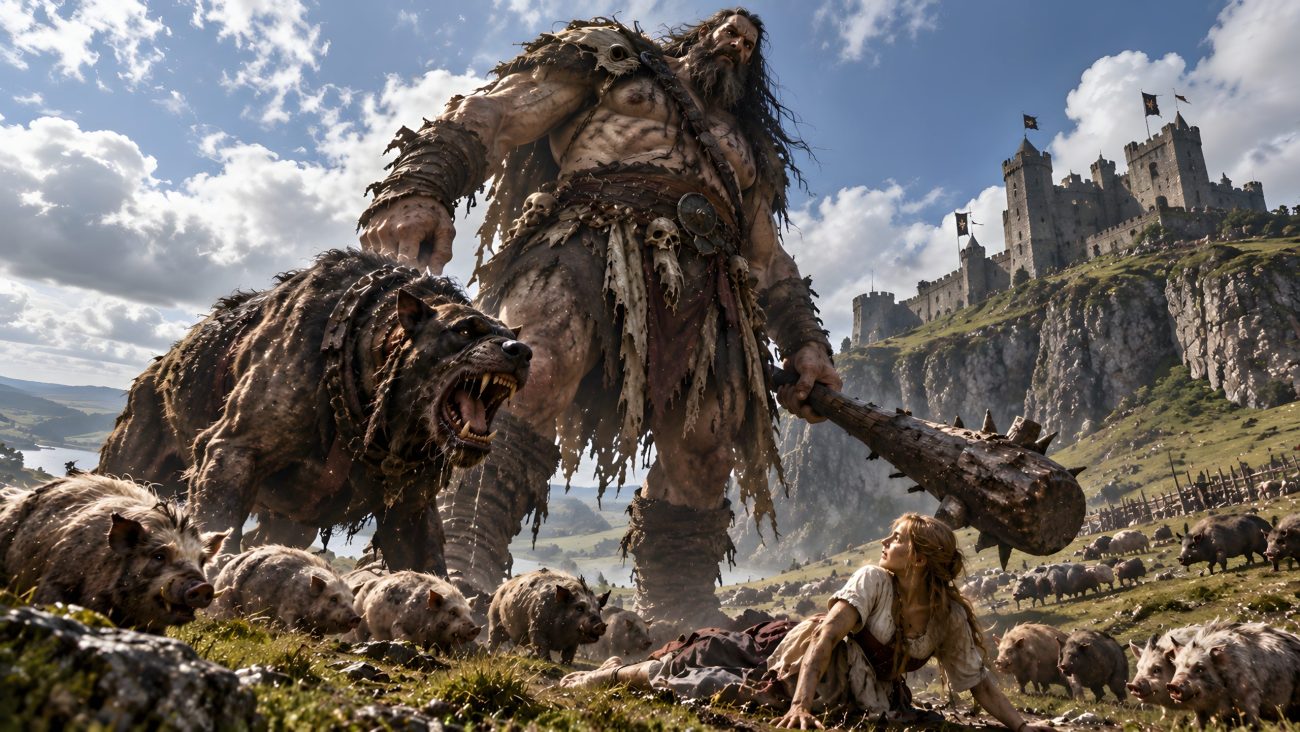
The Wicked Giant of Penhill was a monstrous figure said to have terrorized the countryside around Penhill and Bolton Castle in Yorkshire before the Norman Conquest. According to the legend, he was descended from Thor, the Norse god of thunder and storms, and retained a fierce, violent nature worthy of his divine ancestry. He lived in a castle on Penhill and devoted himself to raising a vast herd of pigs. His closest companion was Wolfhead, a powerful boarhound that helped him guard his livestock. The giant’s enormous strength and cruel temperament made him a source of fear throughout the surrounding countryside.

One day, the giant encountered a flock of sheep belonging to a young shepherdess named Gunda. Finding amusement in the animals’ helplessness, he ordered Wolfhead to attack them. As the hound tore through the flock, Gunda begged the giant to spare her father’s sheep, which represented everything her family possessed. Rather than show mercy, the giant delighted in her distress and attempted to assault her. Gunda managed to escape his grasp, but the enraged giant sent Wolfhead after her. When she struck the hound on the nose with a stone to defend herself, the giant caught up with her and killed her with his club.

Some weeks later, the giant discovered that one of his young boars had been killed by an arrow. Furious, he demanded that every man in the dale who could draw a bow appear before him on Penhill within a week. When Wolfhead tracked down the dead boar but failed to return promptly, the giant threatened the hound and eventually killed his only companion with an arrow. The giant then confronted the assembled men, demanding that they identify the person responsible for killing his boar. When nobody could answer, he ordered every father to return the following day carrying his youngest child, threatening to spill the blood of the entire community if they continued to defy him.

An elderly hermit confronted the giant and warned him that the following day was Thor’s day. If the giant spilled blood or caused any child to cry from pain or fear, the hermit declared, he would never enter his castle again, whether alive or dead. The giant dismissed the warning and prepared to torment the villagers. Meanwhile, a servant who had long endured his master’s cruelty tried to warn him about ominous dreams and the ravens and crows circling the castle. The giant responded by kicking the servant so violently that he left him for dead. In desperation, the servant dragged straw, wood, and peat into the castle’s main hall and set them alight.

As the giant approached the gathering of villagers and their children, he discovered dead boars lying along his path, with another nine appearing after every nine steps. Enraged, he threatened to slaughter the children and stain the hillside with the blood of every living person present. The hermit refused to submit to him and challenged him to look behind. There, the giant saw his castle engulfed in flames. But an even more terrible sight awaited him: Gunda, the shepherdess he had murdered, stood beside Wolfhead, the hound he had killed. She held the hound on a long rope before releasing it. As Wolfhead sprang at the giant’s throat, the giant stumbled backward over the edge of Penhill cliff. Both plunged over the precipice and were never seen again. The wicked giant’s reign of terror thus ended through the return of those he had wronged.


Sources

“The Wicked Giant of Penhill.” Yorkshire Folk Tales, March 4, 2019. https://yorkshirefolktales.home.blog/2019/03/04/the-wicked-giant-of-penhill/


Longbo

Tradition: Chinese Mythology
Alternative Names: Longbo Kingdom Giant, Longbo Fisherman, Longbo Guo
Category: Giant


The Myth

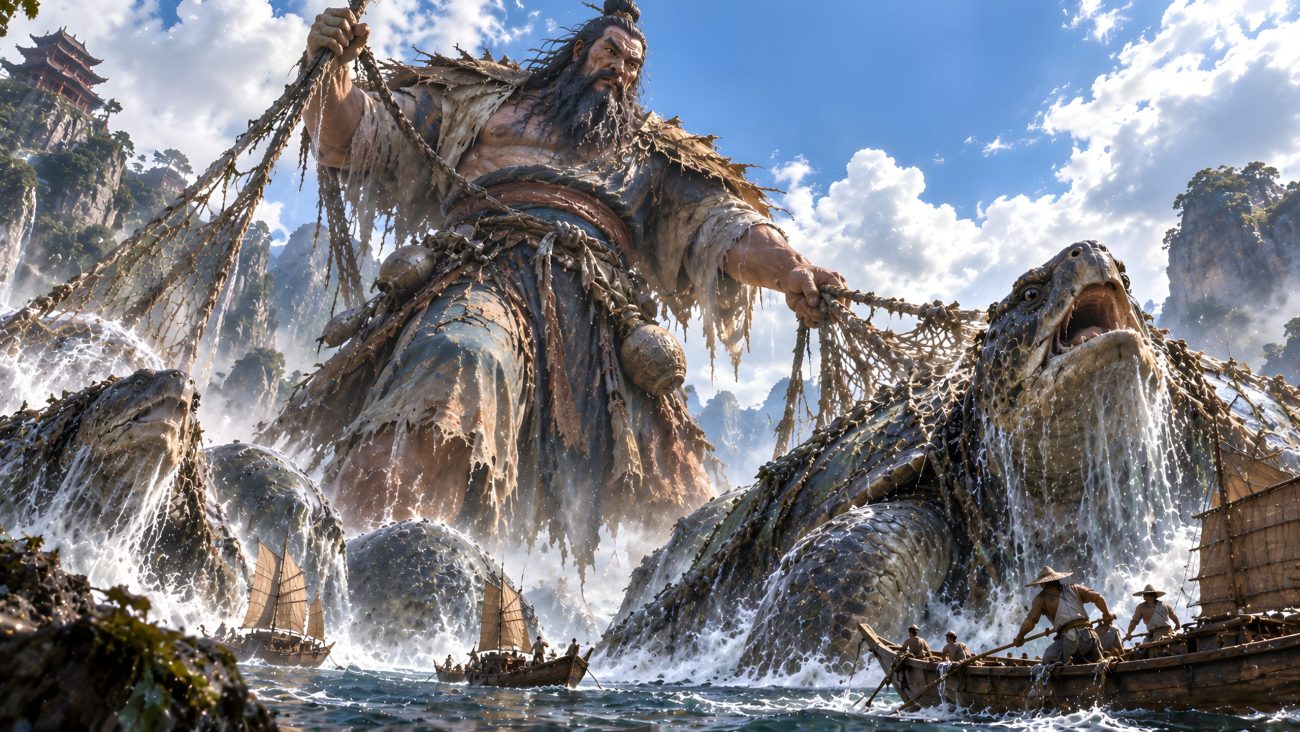
Longbo is a giant associated with the Longbo Kingdom in Chinese mythology. The name can refer both to an individual giant and to the people of his legendary kingdom. Longbo giants are renowned for their immense stature and extraordinary strength, particularly their ability to travel enormous distances in a few steps and catch gigantic sea creatures with a fishing line. In the Liezi, a great man from the Kingdom of Longbo is described as being able to reach five mountains in only a few steps and catch six giant turtles while fishing.

Descriptions of the Longbo people emphasize their extraordinary size and longevity. According to a commentary by Guo Pu of the Jin dynasty, a text called the Hetu Yuban describes the inhabitants of the Longbo Kingdom as thirty zhang tall and living for eighteen thousand years before dying. Their immense proportions made them figures of wonder in Chinese literature, where their fishing exploits became symbols of superhuman power. Tang dynasty poet Zhang Shuo described Longbo fishing with a single line and catching two turtles at once, while Li Bai’s Ode to the Great Hunt similarly refers to Longbo fishing for a spirit turtle.

Longbo also appears in broader literary depictions of a world filled with supernatural creatures. In Romance of the Three Kingdoms, Longbo is mentioned alongside Hai Ruo, Jiang Fei, the Water Mother, a thousand-foot whale, a nine-headed centipede, and various ghosts and monsters. Later poets continued to use Longbo as an image of enormous size and overwhelming power. Qing dynasty poet Wei Yuan, for example, evoked a man from the Dragon Kingdom whose immense presence seemed capable of overturning heaven and earth and unleashing waves.

The Longbo giant is therefore remembered chiefly through literary references to his extraordinary stature and legendary fishing abilities. The surviving accounts associate him with a kingdom of giants and with the capture of enormous turtles and fish, making him a striking example of the gigantic beings found in Chinese mythological literature.


Sources

“龍伯.” Chinese Wikipedia. Wikimedia Foundation. Accessed October 16, 2026. https://zh.wikipedia.org/wiki/%E9%BE%8D%E4%BC%AF


Amayuryuk

Tradition: Canadian Mythology
Alternative Names: Amayuryuk, Amayuruk, Amayujuk, Amarajuk, Amajurjuk, Amautalik, Amayuq, Amautalik (Amayuryuk)
Category: Giant


The Myth

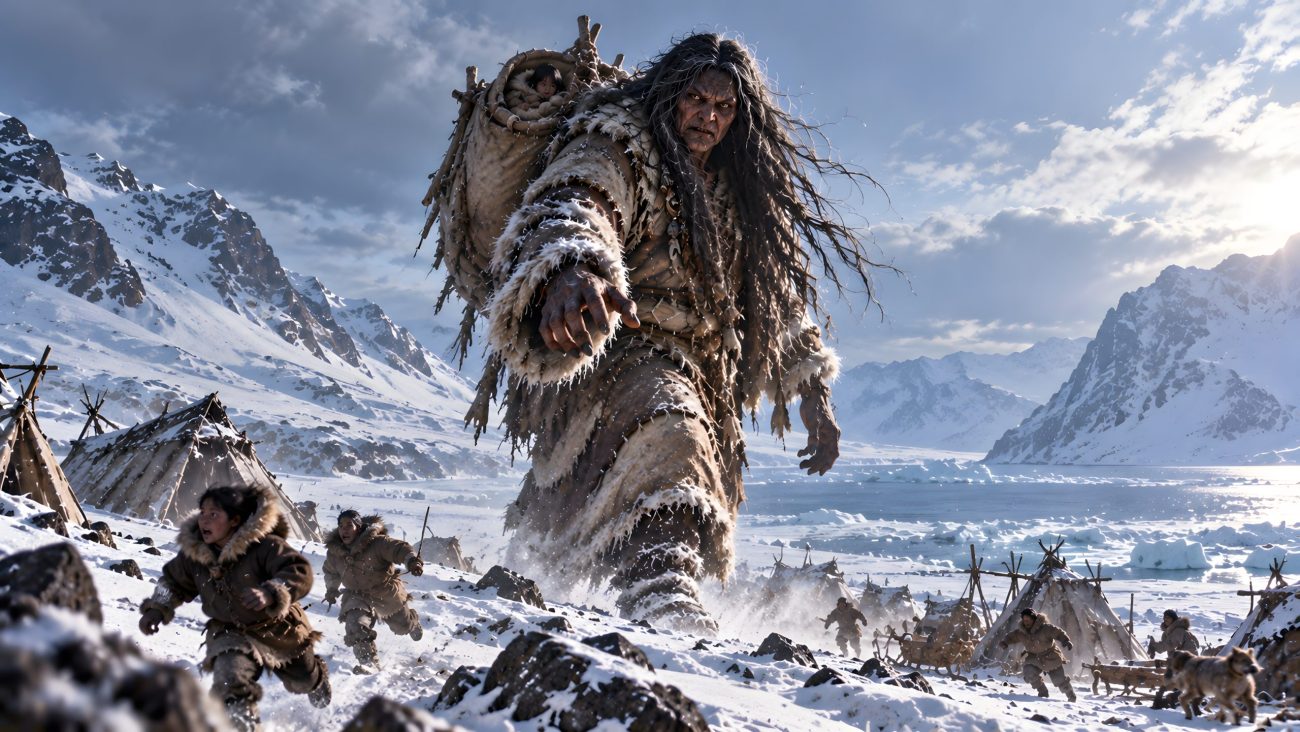
Amayuryuk is a giant woman in Canadian Inuit folklore who kidnaps children and carries them away in a large pouch on her back. She is described as wearing an amauti, a traditional Inuit woman’s garment designed to carry a child. In some accounts, the pouch is not part of her clothing but is formed from driftwood or driftwood-like material. Her enormous size and fearsome appearance make her a frightening figure in Inuit stories, where she is said to steal children and take them far from their homes.

In Inuit accounts recorded in the Kivalliq region, Amayuryuk is also known as Amautalik. She is described as a giantess living inland, sometimes in a large amaut or pouch. According to one account, she places people she has stolen inside this pouch and carries them away. Her immense size is emphasized in stories that describe her as so large that adults can look like small children beside her. Other accounts portray her as a terrifying old woman whose presence frightens children into behaving, warning them that she will take them away if they misbehave.

Although Amayuryuk is said to have once kidnapped children and appeared near human settlements, some traditions hold that such creatures no longer steal children or approach human dwellings. Nevertheless, reports of encounters persisted into modern times. In 1999, a resident of Rankin Inlet in Nunavut reportedly claimed to have seen an enormous woman wearing an amauti made of caribou hide. The account describes her as having a pouch on her back and approaching a person before disappearing. Amayuryuk is sometimes compared with the Qalupalik of Inuit folklore and the Dzunukwa of the mythology of the Canadian Kwakwaka’wakw people, both of whom are associated with taking children.


Sources

“Amajuruq.” New Bestiary (Bestiary.us). https://www.bestiary.us/amajurjuk


Kuafu

Tradition: Chinese Mythology
Alternative Names: 夸父, Kuafu-shi, 夸父氏, Clan of Kuafu
Category: Giant


The Myth

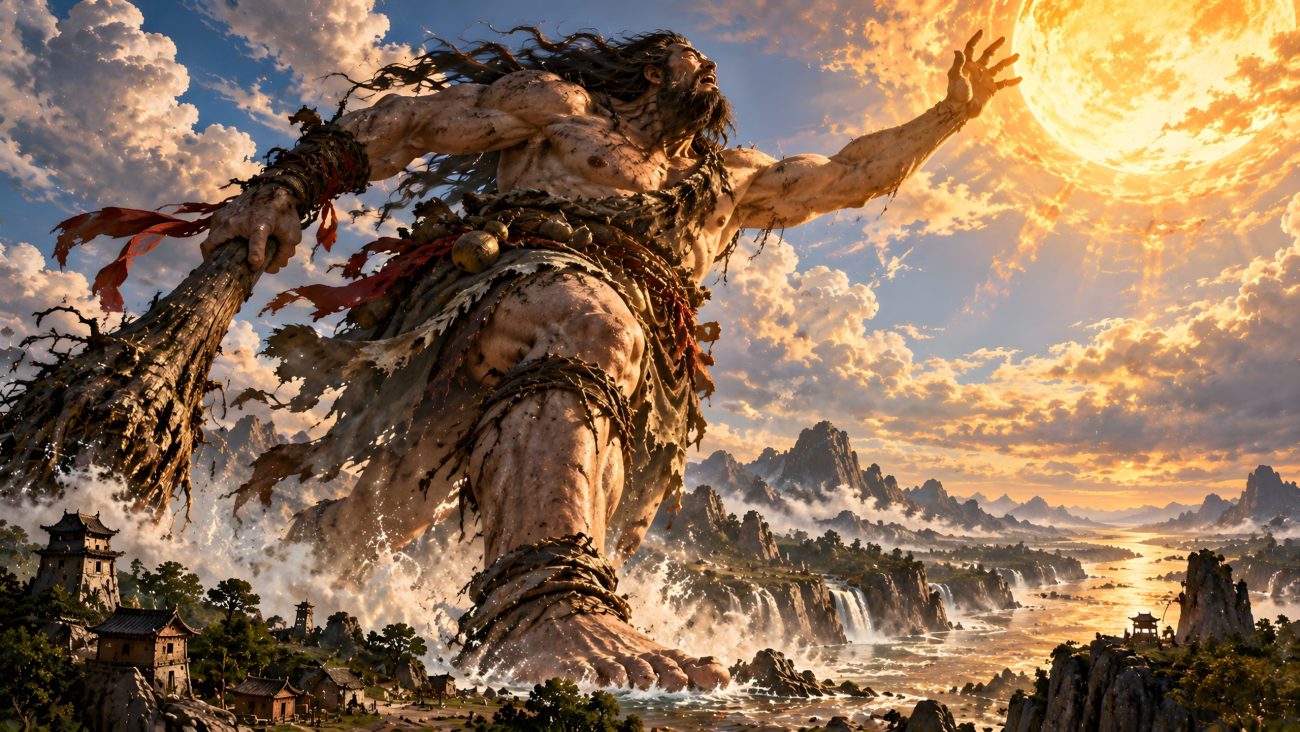
Kuafu is a giant in Chinese mythology, a grandson of Houtu, who became famous for his attempt to capture the Sun. Determined to catch the celestial body, he pursued it across the sky, following its course from east to west. His extraordinary strength and ambition allowed him to cross vast distances, but his quest exposed him to the Sun’s overwhelming heat and left him desperately thirsty.

During his pursuit, Kuafu drank the waters of the Yellow River and the Wei River, along with other rivers and lakes that lay along his path. Even these immense sources of water could not quench his thirst. He continued searching for more water, but before he could satisfy his need, he died of dehydration. His failed attempt to seize the Sun became one of the best-known stories of perseverance and the limits of mortal strength.

After Kuafu’s death, the wooden club he carried transformed into a vast forest of peach trees known as the Deng Forest. In another version of the legend, Kuafu himself became a mountain range. Both the peach forest and the mountain range are associated with the area of present-day Lingbao in China. His transformation ensures that his journey leaves a lasting mark on the landscape, even though he never achieved his original goal.

The name Kuafu can also refer to the Kuafu-shi, or Clan of Kuafu, whose people appear in accounts of ancient tribal conflicts. During the Battle of Banquan, the tribes allied with Chi You joined forces with the Kuafu tribe and the Sanmiao tribe to attack the tribe of the Yan Emperor, driving it into the lands of the Yellow Emperor. In modern Chinese usage, the expression Kuafu chasing the Sun (夸父追日) describes someone who pursues an ambitious goal with courage and determination, but overestimates their abilities and ultimately fails to achieve it.


Sources

“Kuafu.” Wikipedia: The Free Encyclopedia. Wikimedia Foundation. Accessed October 16, 2026. https://en.wikipedia.org/wiki/Kuafu


Mikoshi Nyūdō

Tradition: Japanese Mythology
Alternative Names: 見越入道, みこしにゅうどう, Mikoshi, Miage Nyūdō, Taka Bōzu, Anticipating Priest
Category: Giant


The Myth

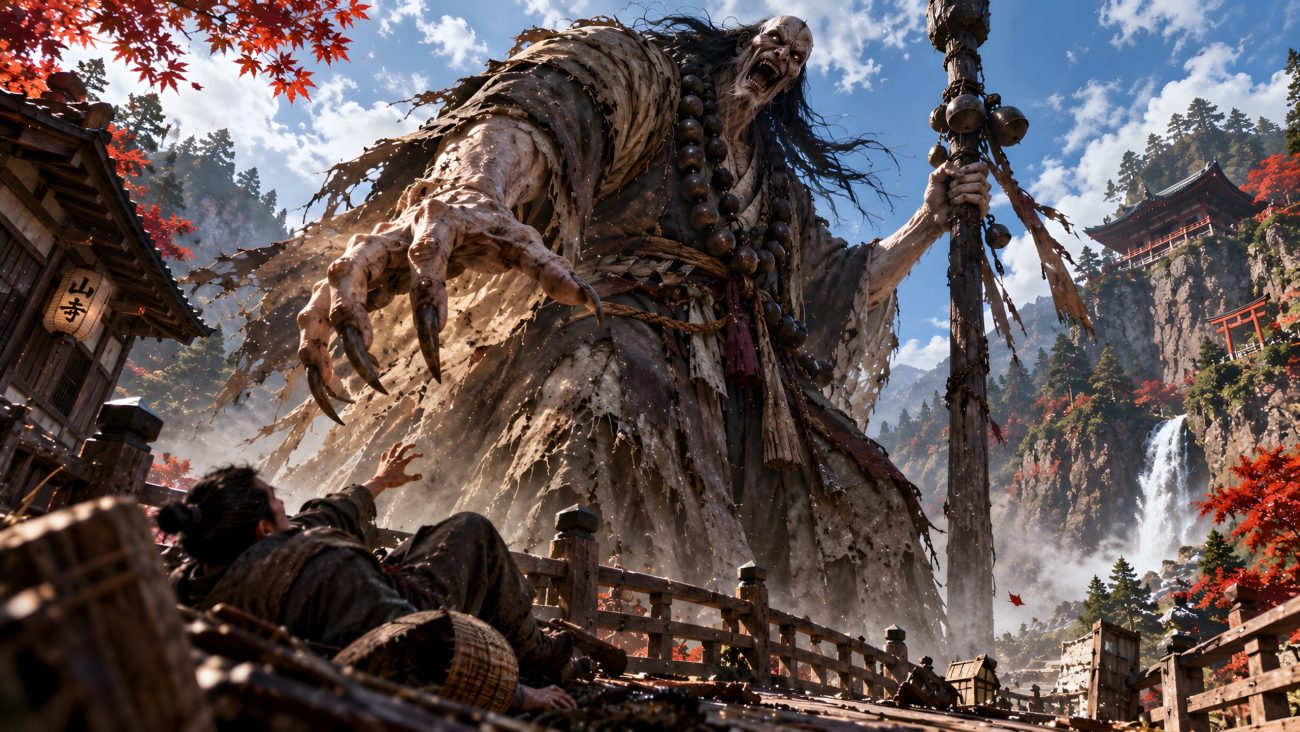
Mikoshi nyūdō are fearsome Japanese yōkai that appear to lone travelers on deserted roads, at crossroads, and on bridges, particularly at night. They initially resemble ordinary Buddhist priests or monks, seemingly harmless and no taller than an average person. However, when someone looks directly at them, they begin to grow at an unnatural speed. As they increase in height, their appearance becomes increasingly monstrous, with long claws and hair resembling that of a wild beast.

The mikoshi nyūdō grows as high as its observer can raise their eyes, compelling the unfortunate traveler to look upward in an attempt to follow its towering form. This sudden movement can cause the victim to lose their balance and fall backward, giving the giant an opportunity to attack. It lunges at fallen travelers and may bite their throats with its teeth. Those who encounter this cruel yōkai rarely survive. Attempting to ignore it or walk past can provoke the giant to crush the traveler or impale them with bamboo spears and branches. Running away is equally dangerous, while those who remain frozen in fear may simply drop dead in its terrifying presence.

The only way to escape is to anticipate the giant’s trick, which explains the meaning of its name, Anticipating Priest. A traveler must face the mikoshi nyūdō directly, meet its gaze without fear, and look downward from its head to its feet rather than beginning at the feet and looking upward. If performed correctly, this reverses the creature’s advantage and drains its ability to grow. Declaring, “You lost! I anticipated your trick!” can cause the giant to vanish in anger, allowing the traveler to continue safely. The encounter therefore demands courage, composure, and the ability to recognize the yōkai’s deception before it gains the upper hand.

Mikoshi nyūdō can also be the transformed forms of certain animals, particularly itachi (weasels) and tanuki (raccoon dogs), which assume the shape of these giants to hunt humans. Kitsune (foxes) and mujina (badgers or other badger-like animals) may occasionally take this form as well. Unlike other mikoshi nyūdō, those created through shapeshifting often carry an object such as a bucket or lantern. This object contains the shapeshifter’s true body and sustains its disguise. If a traveler manages to seize it before the giant attacks, the transformation is broken, leaving the yōkai vulnerable to its captor.


Sources

“Mikoshi Nyūdō.” Yokai.com. https://yokai.com/mikoshinyuudou/


Papinijuwari

Tradition: Tiwi Mythology, Australian Mythology
Alternative Names: Papinijuwaris
Category: Giant


The Myth

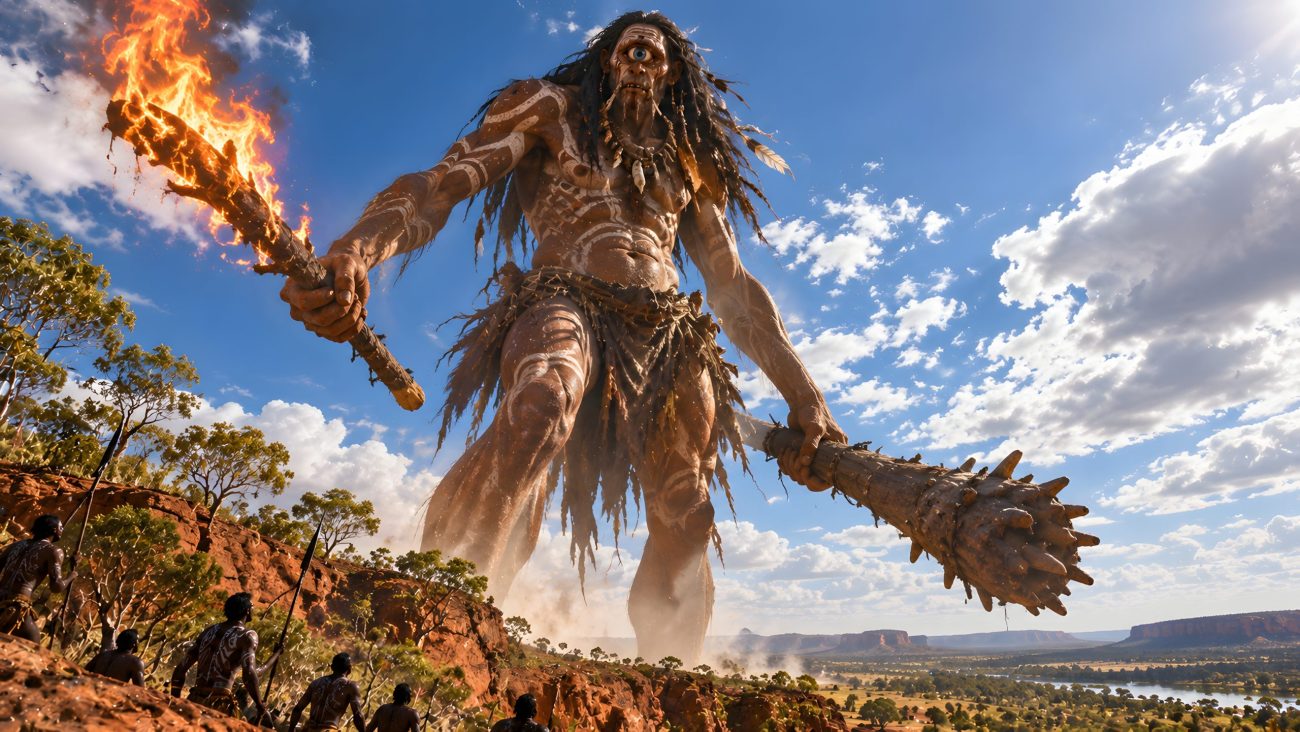
Papinijuwari are one-eyed giants in the mythology of the Tiwi people of northern Australia. They live in a great hut located where the sky ends, beyond the familiar world. These fearsome beings are associated with shooting stars, which are believed to represent Papinijuwari stalking across the heavens. As they travel through the sky, they carry a burning firestick in one hand and a fighting club in the other.

Papinijuwari feed on the bodies of the dead and the blood of the sick. They possess an extraordinary sense of smell that allows them to detect illness and track down vulnerable people. Upon finding a sick person, a Papinijuwari makes itself invisible and secretly sucks the victim’s blood without leaving any visible wound. The victim gradually grows weaker as the giant continues to feed.

As the sick person approaches death, the Papinijuwari becomes small enough to enter the victim’s body through the mouth. Once inside, it drinks the remaining blood from within, completing its gruesome feeding. These giants are therefore associated with sickness, death, and the mysterious loss of blood, while their appearance as shooting stars connects their predatory activity to movements across the night sky.


Sources

“Papinijuwari.” Wikipedia: The Free Encyclopedia. Wikimedia Foundation. Accessed October 16, 2026. https://en.wikipedia.org/wiki/Papinijuwari


Mashurdaly

Tradition: Romanian Mythology, Hungarian Mythology
Alternative Names: Mashurdalo, Mashurdalov, Mashurdals, Mashurdalo (Latin spelling)
Category: Giant


The Myth

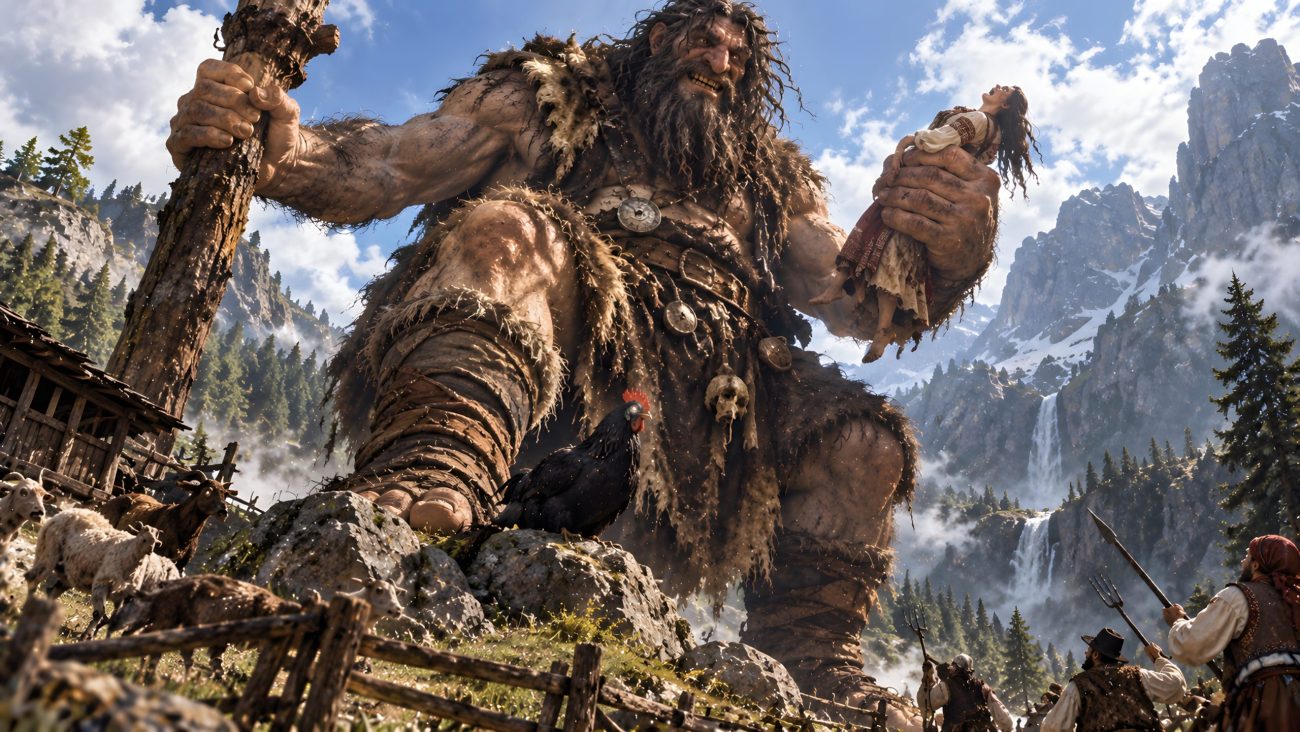
Mashurdaly are foolish mountain giants in Romani folklore, particularly in traditions associated with Hungarian, Romanian, and Balkan Romani’s. They inhabit mountains, forests, and wastelands, where they wait for animals or people to pass by. They are described as stupid and easily deceived, often kidnapping women and children or stealing livestock. Their lack of intelligence makes them vulnerable to cunning humans, who can trick them, rob them, or even kill them.

Each Mashurdal has a giant wife and several children, and every member of the family possesses a magical black chicken. Each chicken holds the life and health of its owner within its own body. If a Mashurdal is injured or killed, its chicken swallows an egg laid by a black hen, restoring the giant to health. To defeat one permanently, a person must first find and destroy its black chicken. Although this weakness makes the giants vulnerable, discovering it requires considerable cunning, since the Mashurdaly are dangerous despite their stupidity.

Mashurdaly are also associated with strange magical transformations. A Mashurdal’s wife can transform into a thin, swift horse if a magical bridle is placed around her neck. Anyone who drinks the blood of a Mashurdal gains immense strength. In one tale, a Mashurdal gives his helpful guest a heroic horse with a bridle made from a magical vine, whose growth is guarded by nine black dogs and a dragon called the Ushap. The Mashurdal’s family also owns the egg of a thousand-year-old owl, which contains a worm of happiness.

Stories about these giants sometimes portray them as both dangerous and strangely vulnerable to ordinary tricks. One account describes a family of Mashurdaly whose father has hair that shines like the Sun. When questioned about it, he explains that it burns day and night and takes away his sight. In another story, a Mashurdal lives in a dark forest with a magical iron cave, sleeps on a sheepskin rug, and speaks only in grunting sounds. Some traditions say that Mashurdaly visit villages at night to inspect people’s homes, although dogs can sense their presence and cause them to flee.


Sources

“Mashurdaly.” New Bestiary (Bestiary.us). https://www.bestiary.us/mashurdaly