Isiququmadevu

Tradition / Region: Zulu Mythology, South African Mythology
Alternate Names: Smelly Whiskers; Unomabunge; O’gaul’-iminga; O-nsiba-zimakqembe
Category: Mountain dweller


The Myth

When Untombinde, the king’s daughter, set out for the sacred pools of the Ilulange River, her parents warned her not to go. She ignored them and traveled there with two hundred maidens as her escort.

At the river they bathed and played in the water. But when they came out, their clothes, jewels, and bracelets were gone. They had been taken by Isiququmadevu.

The monster was a vast, bloated being with an enormous mouth, said to be large enough to swallow whole villages. Terrified, the maidens begged for their possessions back. One by one, as they pleaded, the monster returned their things. At last only Untombinde remained.

The others urged her to beg the creature for mercy, but she refused proudly, saying she would not humble herself before it. At once Isiququmadevu seized her and dragged her into the pool.

When King Usikulumi heard what had happened, he sent his army to kill the monster. But Isiququmadevu rose up and swallowed the entire force in one gulp. She then went to the village and devoured everyone there—men, women, children, and cattle—leaving only one man alive. Among the swallowed were his twin children.

The man armed himself with a spear and went in search of the creature. Along the way he asked the animals he met where she had gone, and each told him, “Forward, forward.”

At last he found Isiququmadevu, swollen from all she had eaten and resting in the forest. When he declared that he had come for his children, the monster again tried to mislead him, saying only, “Forward, forward.” But he attacked her with his spear and killed her.

He cut open her body, and from inside came the army, the villagers, and the cattle, all alive. Untombinde came out last.

Other tales tell how a young woman named Usitungusobenthle once cut open the sleeping monster and freed a village she had swallowed, and how a princess named Uluthlazase escaped her by refusing to release her clothes and fleeing while the creature went to seek help.

Thus Isiququmadevu is remembered as a devouring monster who swallows whole communities, yet can be overcome by courage and determination.


Gallery


Sources

abookofcreatures.com contributors. (n.d.). Isiququmadevu. In abookofcreatures.com, from https://abookofcreatures.com/2015/12/04/isiququmadevu/


Interpretive Lenses

Religious Readings
  • Christian Ascetic Deep Dive
Philosophical Readings
  • Nietzschean Deep Dive
Psychological Readings
  • Jungian Deep Dive
Esoteric Deep Dive
  • Hermetic Deep Dive
Political / Social Readings
  • Marxist Deep Dive
Other
  • How to Invite The Isiququmadevu

Waawu

Tradition / Region: Japanese Mythology
Alternate Names: Wau, Wauawu
Category: Mountain dweller, Yokai


The Myth

In the mountains near Karimata, at the foot of Mount Hotaka, there is said to be a strange being called Waawu, named for the cry it makes in the night.

Long ago, a hunter from a nearby village went into the mountains and stayed overnight in a small hut. In the middle of the night he heard a terrifying voice echo through the darkness.

“Wauawu! Wauawu!”

Something rushed toward the hut and began to shake it violently. The walls rattled and the beams creaked, but the hunter could not see what attacked him. Frozen with fear, he waited for morning and fled back to the village, telling everyone a Waawu had appeared.

Some days later, several villagers went into the mountains to gather lumber and stayed in the same hut. As night fell, they heard the same cry approaching through the forest.

“Waawu… Wauawu…”

The sound grew louder and louder until their bodies seemed to go numb. Too frightened to leave, they remained inside the hut for several days.

One night the creature returned again, screaming “Waa-woo! Waa-woo!” and shaking the hut so violently it seemed it would collapse. The men huddled together and chanted, “Far-off Kuwabara, far-off Kuwabara,” praying for safety until dawn.

When morning finally came, they fled back to the village and told what had happened.

From then on, the place where the cries were heard was called Waa-woo Sawa—Wau Valley—named after the unseen monster whose voice once shook the mountain huts in the night.


Gallery


Sources

tyz-yokai.blog.jp contributors. (n.d.). Waawu. In tyz-yokai.blog.jp, from https://tyz-yokai.blog.jp/archives/1077741604.html


Interpretive Lenses

Religious Readings
  • Christian Ascetic Deep Dive
Philosophical Readings
  • Nietzschean Deep Dive
Psychological Readings
  • Jungian Deep Dive
Esoteric Deep Dive
  • Hermetic Deep Dive
Political / Social Readings
  • Marxist Deep Dive
Other
  • How to Invite The Waawu

Jengu

Tradition / Region: Sawabantu Mythology, Cameroon Mythology
Alternate Names: Miengu (plural), Bisima; Liengu (Bakweri), Maengu (plural)
Category: Mermaid


The Myth

In the rivers, lakes, and along the shores of the sea in Cameroon dwell the jengu—water spirits of beauty and power.

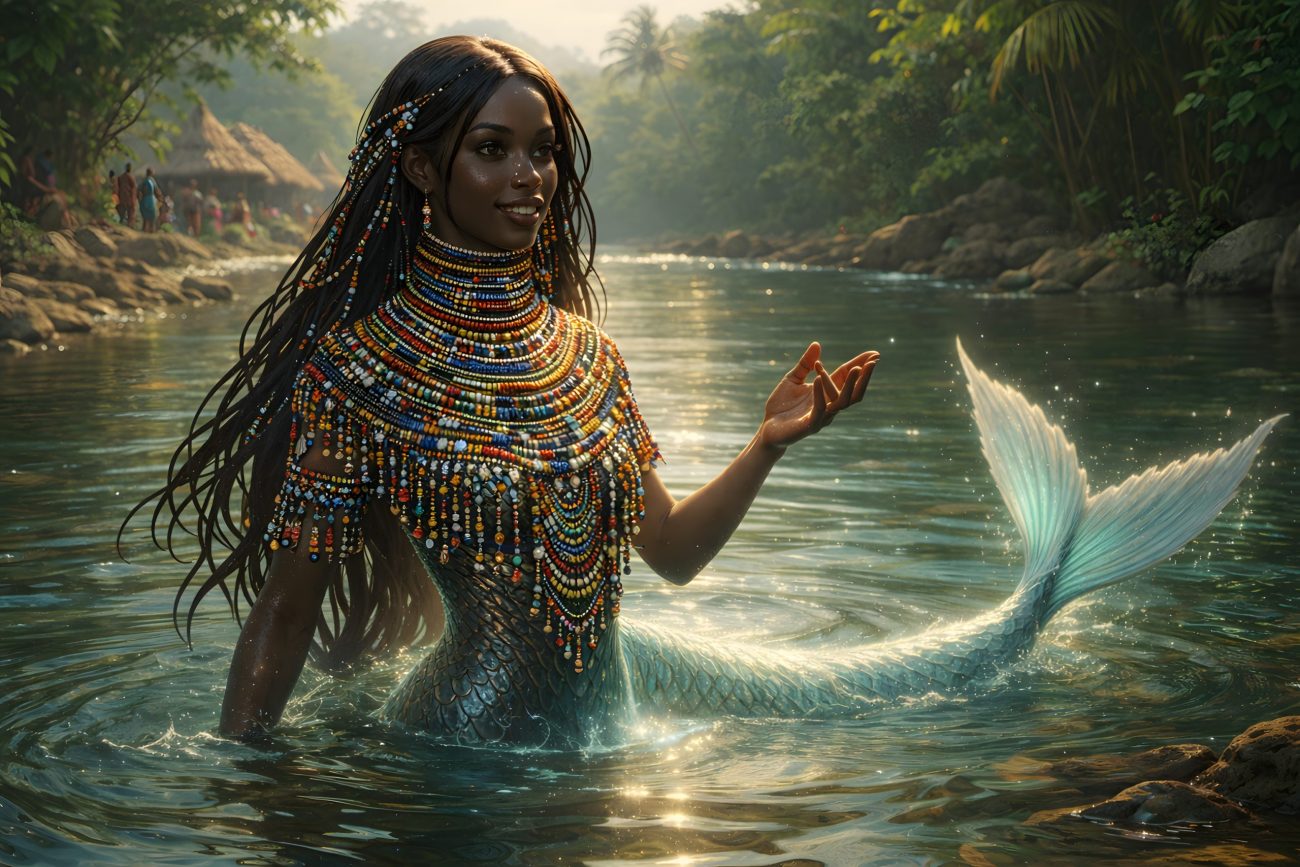
They are said to appear as radiant beings, often like mermaids, with long flowing hair and shining gap-toothed smiles. Their presence is linked to clear waters and hidden depths. They live beneath the surface, in the currents and tidal places where the worlds of the living and the spirits meet.

The jengu are guardians of the waters and intermediaries between humanity and the ancestors. When illness strikes, when fate turns uncertain, or when guidance is needed, people call upon them. They are believed to heal disease, grant prosperity, and influence destiny. Those who honor them with devotion receive good fortune; those who neglect them may lose their favor.

Among the Duala and other Sawabantu peoples, the jengu are honored through sacred rites and festivals. When the ruling families of the Ngondo declare that the time has come, offerings are gathered from the villages. Trained spiritual specialists prepare themselves through ritual purification and ceremony.

On the night before the festival, these priests perform sacred rites on the islands of the Wouri River. At dawn, the tribute is displayed before the chiefs. Then a jengu specialist carries the offering into the water, swimming out beyond sight. There, beneath the surface, the gift is presented to the miengu.

When the priest returns, he brings back a message from the spirits—a prophecy concerning the year to come.

Among the Bakweri, the jengu also play a role in a young girl’s passage into womanhood, marking her transformation and linking her life to the power of the waters.

Thus the jengu remain: spirits of the deep, bringers of healing and fortune, moving unseen between the living and the ancestral world.


Gallery


Sources

Wikipedia contributors. (n.d.). Jengu. In Wikipedia, The Free Encyclopedia. Retrieved February 14, 2026, from https://en.wikipedia.org/wiki/Jengu


Interpretive Lenses

Religious Readings
  • Christian Ascetic Deep Dive
Philosophical Readings
  • Nietzschean Deep Dive
Psychological Readings
  • Jungian Deep Dive
Esoteric Deep Dive
  • Hermetic Deep Dive
Political / Social Readings
  • Marxist Deep Dive
Other
  • How to Invite The Jengu

Nibiinaabe

Tradition / Region: Anishinabe Mythology, American Mythology
Alternate Names: Nibinabe, Nibanaba, Nibanabe, Nibiinaabeg (plural), Nibiinabekwe (female form)
Category: Mermaid


The Myth

In the lakes and rivers of the Anishinaabe lands live the Nibiinaabe, the water people.

They are shaped like human beings from the waist up, but below they bear the tail of a fish. They dwell beneath the surface of deep waters, moving silently through reeds and currents where the light fades into shadow.

The Nibiinaabe are seldom seen. At times, a ripple in still water or a fleeting shape beneath the surface is said to be one of them watching. They are not drawn to villages, nor do they linger near busy shores. Loud noises drive them away, and the crash of drums or shouting will send them retreating into the depths.

Some say that on quiet evenings, when mist lies low over the water, they rise near the surface and sing softly to one another in voices that blend with the sound of waves against the shore.

Among the Ojibwe, the Nibiinaabe are honored as a clan symbol. The Mermaid Clan bears their name, and their totem remembers these beings of the water—guardians of lakes and rivers, neither wholly human nor wholly fish, but belonging to the living spirit of the waters themselves.


Gallery


Sources

native-languages.org contributors. (n.d.). Nibiinaabe. In native-languages.org, from https://www.native-languages.org/nibiinaabe.htm


Interpretive Lenses

Religious Readings
  • Christian Ascetic Deep Dive
Philosophical Readings
  • Nietzschean Deep Dive
Psychological Readings
  • Jungian Deep Dive
Esoteric Deep Dive
  • Hermetic Deep Dive
Political / Social Readings
  • Marxist Deep Dive
Other
  • How to Invite The Nibiinaabe

Nommo

Tradition / Region: Dogon Mythology, Malian Mythology
Alternate Names: Nummo
Category: Mermaid


The Myth

In the beginning, the sky god Amma created the first living being: Nommo.

Nommo was not like humankind. He was amphibious and radiant, formed with both male and female nature within him. He belonged to the waters and carried within himself the life of the world.

After his creation, Nommo transformed and multiplied, becoming four pairs of twin beings. These were the Nommos, the first ancestors.

But one of the twins rebelled. This being sought to break free from the harmony Amma had established and brought disorder into the universe.

To restore balance, Amma made a sacrifice. One of the Nommos was offered up. His body was dismembered and scattered across the world. Wherever a piece of him fell upon the earth, sacred places were established. These became shrines, marking the spots where the life of Nommo touched the land.

Yet Nommo was not destroyed.

He descended from the sky in a great vessel, accompanied by fire and thunder. When he reached the earth, he created water and entered it, for he could not live without it. The waters became his dwelling.

Nommo then divided himself again, giving his own body to humankind as sustenance. The world drank of him, and in doing so, received life. He gave human beings their vital force and the principles by which they live.

From him came order, knowledge, and sacred authority. From him also came the first Hogon, the spiritual leader of the Dogon.

Thus Nommo remains the ancestor of humanity, the master of water, the one whose body became the nourishment of the world.


Gallery


Sources

Wikipedia contributors. (n.d.). Nommo. In Wikipedia, The Free Encyclopedia. Retrieved February 14, 2026, from https://en.wikipedia.org/wiki/Nommo


Interpretive Lenses

Religious Readings
  • Christian Ascetic Deep Dive
Philosophical Readings
  • Nietzschean Deep Dive
Psychological Readings
  • Jungian Deep Dive
Esoteric Deep Dive
  • Hermetic Deep Dive
Political / Social Readings
  • Marxist Deep Dive
Other
  • How to Invite The Nommo

Ekke Nekkepenn

Tradition / Region: Danish Mythology
Alternate Names: Ekkehard Nekkepenn, Eke Nekepen, Eckeneckepenn
Category: Mermaid


The Myth

Beneath the waves of the North Sea lived Ekke Nekkepenn, a merman who dwelt on the seabed with his wife, Rahn.

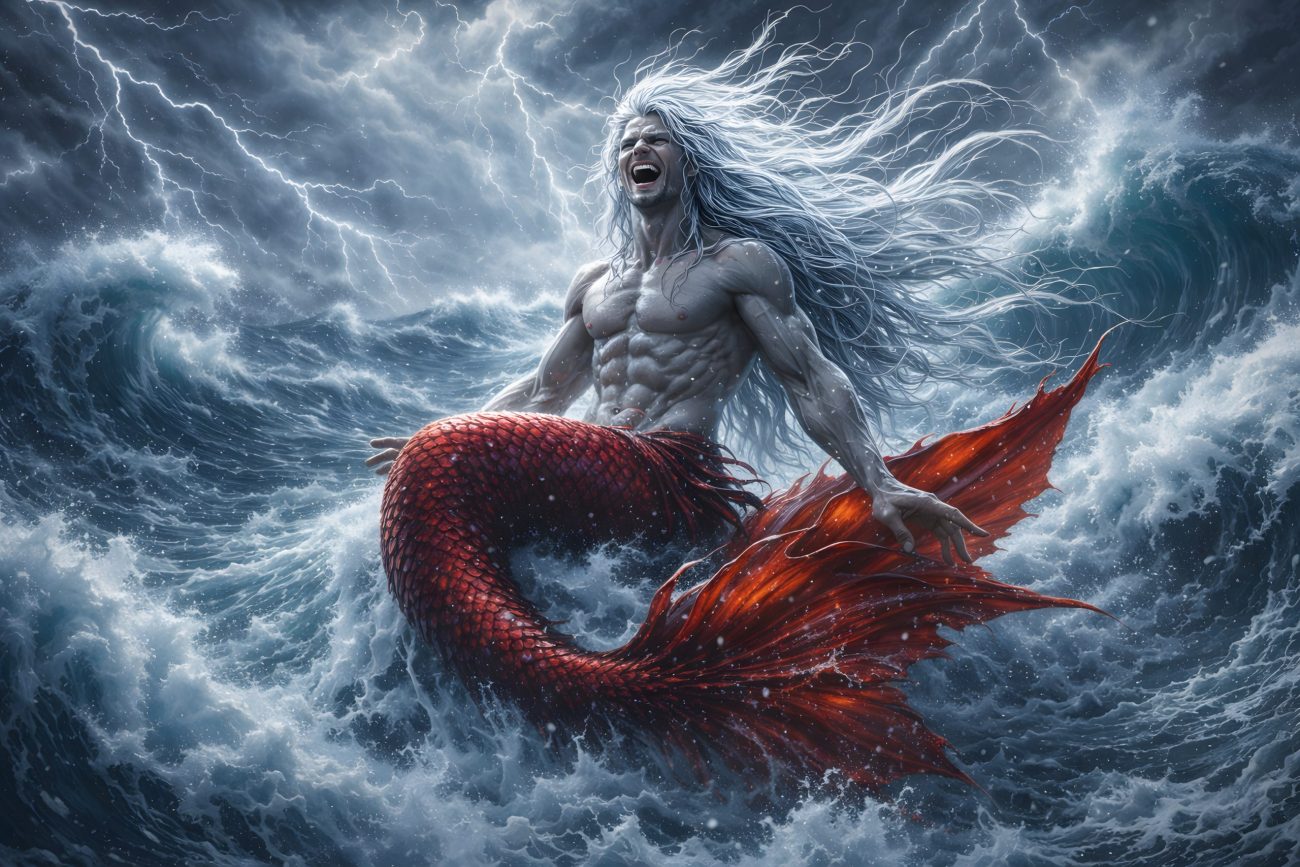
One day, a ship bound for England was caught in a violent storm. As the vessel struggled against the waves, Ekke Nekkepenn rose from the depths and called to the captain, begging for help. His wife Rahn was about to give birth, and he needed a human woman skilled and kind to assist her.

The captain’s wife, brave and compassionate, agreed. The merman led her down into the depths, to his home beneath the sea. There she helped Rahn deliver the child safely. In gratitude, Ekke Nekkepenn gave her gold and silver before returning her unharmed to the surface.

The captain and his wife reached their home in Rantum on the island of Sylt, safe and prosperous.

Years passed. Rahn grew old, and Ekke Nekkepenn began to remember the beautiful woman who had helped him. Desire stirred in him. He resolved to claim the captain’s wife for himself.

One day, when the captain’s ship sailed again, Ekke Nekkepenn persuaded Rahn to grind salt upon the seabed. As she worked, a great whirlpool formed in the sea. The vortex seized the ship and dragged it down, along with its crew.

Now free to pursue his plan, Ekke Nekkepenn rose from the sea, taking the form of a handsome sailor. On the shore at Rantum, he met Inge, the captain’s young daughter. Against her will, he placed golden rings upon her fingers and hung a chain about her neck.

“You shall be my bride,” he declared.

Inge wept and begged to be released. Ekke Nekkepenn answered that she could win her freedom only if she learned his name by the next night.

No one on the island knew the stranger’s name. In despair, Inge wandered along the shore the following evening. From the distant dunes at Hörnum she heard a voice singing:

Today I brew,
Tomorrow I bake,
The day after that my wedding I’ll make.
My name is Ekke Nekkepenn,
My bride is Inge of Rantum,
And none know my name when I am alone.

Inge hurried back to the meeting place. When the sailor appeared, she faced him and said, “Your name is Ekke Nekkepenn, and I remain Inge of Rantum.”

At the sound of his true name, the merman’s power over her was broken. Enraged and thwarted, Ekke Nekkepenn vanished back into the sea.

Yet it is said that when storms rise suddenly off the coast of Sylt, and whirlpools churn the water, Ekke Nekkepenn still stirs in anger beneath the North Sea.


Gallery


Sources

Wikipedia contributors. (n.d.). Ekke Nekkepenn. In Wikipedia, The Free Encyclopedia. Retrieved February 14, 2026, from https://en.wikipedia.org/wiki/Ekke_Nekkepenn


Interpretive Lenses

Religious Readings
  • Christian Ascetic Deep Dive
Philosophical Readings
  • Nietzschean Deep Dive
Psychological Readings
  • Jungian Deep Dive
Esoteric Deep Dive
  • Hermetic Deep Dive
Political / Social Readings
  • Marxist Deep Dive
Other
  • How to Invite The Ekke Nekkepenn

Ningyo

Tradition / Region: Japanese Mythology
Alternate Names: Mermaid, human-fish
Category: Mermaid


The Myth

In ancient times, strange beings were said to appear in the waters of Japan—creatures neither fully human nor fully fish.

The Nihon Shoki tells that in the year 619, during the reign of Empress Suiko, a human-like creature appeared in the Gamo River in Ōmi Province. In another account, a fisherman from Settsu caught something in his net that was neither fish nor human. These were said to be ningyo.

In Ise Province, a fisherman once drew up a fish with a human head. When people approached it, the creature cried and made sounds like a person. Those who cut and ate its flesh found it delicious, and no harm came to them.

Ningyo were sometimes washed ashore or caught in nets. Because they were rare, they were offered as gifts to powerful lords. One caught in Bungo Province in 1559 was presented to the shogun.

They also appeared in temple legends. At Kannonshōji Temple in Ōmi, it is said that a fisherman who had committed murder in a previous life was reborn as a hideous ningyo. Prince Shōtoku built a temple there in response to its prayer for salvation.

Another tale tells of Yao Bikuni, a woman who ate ningyo flesh and gained extraordinary longevity.

The appearance of a ningyo was often taken as an omen. When one washed ashore in Akita in 1213, a diviner declared it a sign of war. That same year, rebellion broke out. When another was seen in Tsugaru in 1222, prayers were offered, yet unrest followed.

Some said killing a ningyo brought disaster. In Wakasa Province, a fisherman slew one, and soon a great storm and earthquake destroyed the village. The creature was believed to have been a messenger of a sea deity.

At other times, a ningyo was considered auspicious. One that washed ashore in Hakata was taken as a sign of long life for the nation and believed to be a messenger from the Dragon Palace. It was buried, and the temple there was named Ryūgū-ji.

In later times, stories spread that seeing a ningyo’s image could ward off illness, and that its flesh could grant long life. Even so, whether blessing or disaster, the ningyo remained a mysterious being of the waters—human-faced, fish-bodied, and never entirely of this world.


Gallery


Sources

tyz-yokai.blog.jp contributors. (n.d.). Ningyo. In tyz-yokai.blog.jp, from https://tyz-yokai.blog.jp/archives/1077741608.html


Interpretive Lenses

Religious Readings
  • Christian Ascetic Deep Dive
Philosophical Readings
  • Nietzschean Deep Dive
Psychological Readings
  • Jungian Deep Dive
Esoteric Deep Dive
  • Hermetic Deep Dive
Political / Social Readings
  • Marxist Deep Dive
Other
  • How to Invite The Ningyo

Mélusine

Tradition / Region: French Mythology, Luxembourg Mythology
Alternate Names: Melusine, Melusina
Category: Mermaid


The Myth

Long ago, the fairy Pressine married a mortal king on the condition that he would never look upon her while she gave birth. He broke his promise, and Pressine left him, taking their daughters to the Isle of Avalon. When her daughter Mélusine learned of her father’s betrayal, she punished him with magic. For this act, Pressine cursed her: every Saturday, from the waist down, Mélusine would become a serpent. Only if a husband swore never to look upon her on that day could she live in peace.

Years later, a nobleman named Raymondin, grieving after accidentally killing his uncle, met Mélusine beside a forest spring. She comforted him and promised him prosperity and glory if he would marry her and swear never to seek her out on Saturdays. Raymondin agreed.

Their marriage brought great fortune. Mélusine built magnificent castles in a single night and bore many sons. The lands flourished under her care. For years Raymondin kept his oath, but at last suspicion overcame him. He spied upon her on a Saturday and saw her in her bath, beautiful above but coiled into a serpent below.

Though he kept silent at first, he later denounced her publicly in anger, calling her a monster. With a terrible cry, Mélusine transformed into a dragon and flew from the castle tower, vanishing from the world of men.

It is said she still returns to watch over her children, and that her wailing is heard around the towers of her descendants whenever death approaches their house.


Gallery


Sources

Wikipedia contributors. (n.d.). Melusine. In Wikipedia, The Free Encyclopedia. Retrieved February 14, 2026, from https://en.wikipedia.org/wiki/Melusine


Interpretive Lenses

Religious Readings
  • Christian Ascetic Deep Dive
Philosophical Readings
  • Nietzschean Deep Dive
Psychological Readings
  • Jungian Deep Dive
Esoteric Deep Dive
  • Hermetic Deep Dive
Political / Social Readings
  • Marxist Deep Dive
Other
  • How to Invite The Mélusine

Grindylow

Tradition / Region: British Mythology
Category:
Related figures: Mermaid, Swamp dweller


The Myth

In the marshes and stagnant ponds of northern England, something waits beneath the surface.

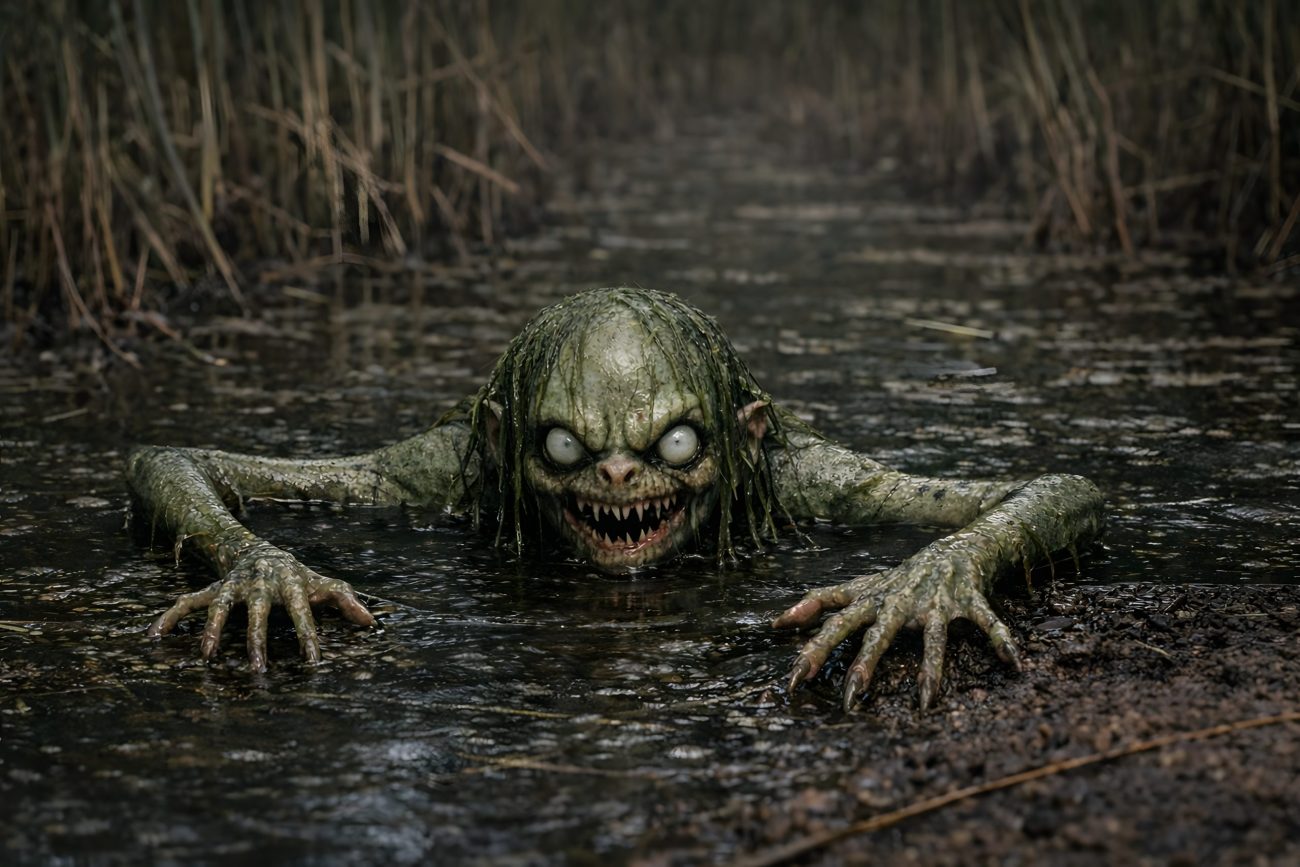
The Grindylow is said to dwell in meres, bogs, and reed-choked pools—especially in Yorkshire and Lancashire. It is described as a small, humanoid creature with scaly green skin, sharp claws, pointed teeth, and long, sinewy arms ending in unnaturally long fingers. Those arms are its most feared feature.

The Grindylow does not roam far from water. It hides below the murky surface, patient and unseen. When a child wanders too close to a pond’s edge, when small feet slip on wet stones or lean too far over still water, the creature strikes. With its powerful grip, it seizes the victim and drags them down into the dark.

Few tales describe what happens beneath the water. The horror lies in the suddenness—the splash, the grasp, the disappearance.


Gallery


Sources

Wikipedia contributors. (n.d.). Grindylow. In Wikipedia, The Free Encyclopedia. Retrieved February 14, 2026, from https://en.wikipedia.org/wiki/Grindylow


Interpretive Lenses

Religious Readings
  • Christian Ascetic Deep Dive
Philosophical Readings
  • Nietzschean Deep Dive
Psychological Readings
  • Jungian Deep Dive
Esoteric Deep Dive
  • Hermetic Deep Dive
Political / Social Readings
  • Marxist Deep Dive
Other
  • How to Invite The Grindylow

Amabie

Tradition / Region: Japanese Mythology
Alternate Names: Amabiko, Amahiko
Category: Mermaid, Yokai


The Myth

In the third year of Kōka, in the middle of the fourth month (1846), strange lights were seen shining upon the sea in Higo Province. Night after night the glowing shape appeared offshore, casting an eerie radiance over the waves.

At last, a local official went to investigate. Approaching the coast, he beheld a mysterious being rise from the water. It had long hair and a mouth shaped like a bird’s beak. Its body was covered in scales from the neck downward, and from beneath it extended three legs—or three fin-like limbs—supporting it at the shore.

The creature spoke.

“I dwell in the sea,” it said. “For six years from this year, the harvest will be abundant. But after that, an epidemic will spread across the land.”

The official listened in fear as the being continued:

“If disease spreads, draw a picture of me and show it to the sick. Those who see my likeness will be protected.”

Having delivered its prophecy, the creature returned to the sea and vanished beneath the waves.

News of the encounter spread quickly through printed bulletins. Woodblock sheets bearing the creature’s image were copied and distributed so that people might keep them as charms against illness. The strange being was called Amabie.

In other tellings, similar creatures appeared under the name Amabiko or Amahiko—three-legged prophetic beasts who likewise warned of plague and commanded that their portraits be displayed to avert disaster. Some were described as ape-like, some as bird-like, some glowing in the night. But the Amabie of Higo remained the most vividly remembered: the long-haired, scaled messenger of the sea who promised both abundance and pestilence.

And so her image endured—drawn and redrawn—whenever fear of sickness rose, her strange form offered as protection against unseen calamity.


Gallery


Sources

Wikipedia contributors. (n.d.). Amabie. In Wikipedia, The Free Encyclopedia. Retrieved February 14, 2026, from https://en.wikipedia.org/wiki/Amabie


Interpretive Lenses

Religious Readings
  • Christian Ascetic Deep Dive
Philosophical Readings
  • Nietzschean Deep Dive
Psychological Readings
  • Jungian Deep Dive
Esoteric Deep Dive
  • Hermetic Deep Dive
Political / Social Readings
  • Marxist Deep Dive
Other
  • How to Invite The Amabie