Marie-Morgane

Tradition: French Mythology
Alternative Names: Morgane, Morganed, Morganezed
Category: Mermaid


The Myth

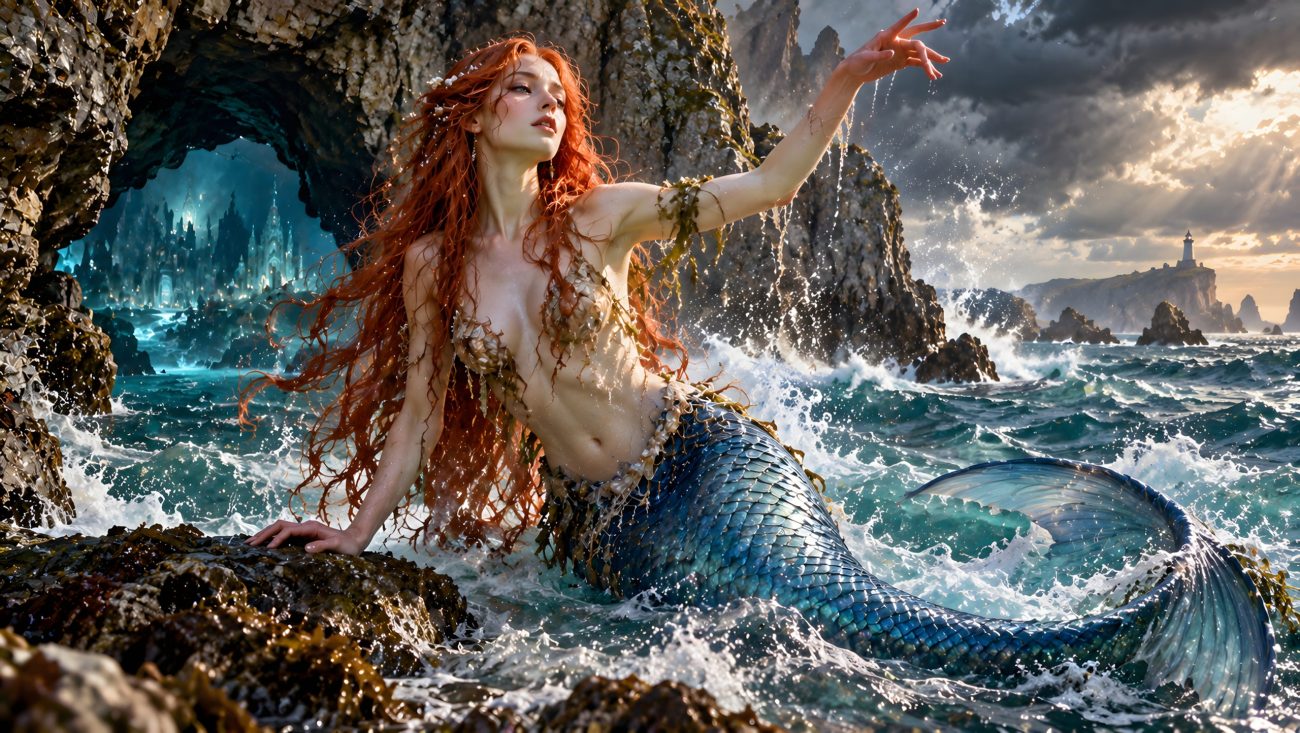
The Marie-Morgane are beautiful female water fairies who live beneath the sea along the coast of Brittany, particularly around the shores of Ouessant and Finistère. They are described as small men and women who inhabit a magnificent underwater kingdom ruled by a king whose palace is said to surpass anything found upon the land. The Marie-Morgane themselves are extraordinarily beautiful and sometimes come ashore at night to play upon the beaches beneath the moon. Their appearances are fleeting: at the slightest blink, they can vanish completely. Although naturally peaceful and benevolent, they are also capable of deceiving humans, appearing in seductive forms to lure men into the water and carry them away to their underwater realm.

The Marie-Morgane are particularly dangerous to young fishermen and sailors. They are said to pursue young men with their romantic attentions, and any man who gives in to their advances may be drawn beneath the waves and never return. They dwell especially near the Breton coast, around caves, river mouths, and other places where land and sea meet, and their underwater palaces can become eternal prisons for the lovers they abduct. In coastal communities, their presence could also explain a boat that failed to return: if relatives waited anxiously for fishermen who had not come home, people might say that a Marie-Morgane had held their vessel motionless offshore. Some Marie-Morgane were also believed capable of stirring up terrible storms, while others could calm the wind.

One of the most famous Marie-Morgane is Ahès-Dahut, the doomed daughter of King Gradlon. After the destruction and drowning of Ys, Dahut became a mermaid and remained beneath the sea, where she enchanted sailors and was associated with violent storms. According to the legend of Ys, Saint Guénolé once attempted to celebrate Mass for the drowned city after the waters had become calm. As he raised his chalice, the white torso of a girl with copper-colored hair rose from the sea, one arm reaching toward the heavens, while the rest of her body ended in a blue-scaled tail. It was Ahès-Dahut in her Marie-Morgane form. Guénolé’s hand trembled and the chalice fell onto the rocks, preventing the Mass from being completed and leaving Ys cursed. Whenever Dahut appears again, the sea is said to answer with a terrible storm. Another Breton tale tells of a mysterious girl discovered abandoned in a basket of reeds near Crozon. Raised by a noble couple, she repeatedly disappeared during the night and later vanished for weeks whenever a strange folgoat horse came to collect her. Eventually she never returned, and she was said to have gone to the cave of Crozon, where the Marie-Morgane were believed to dwell.


Sources

“Marie Morgane.” Wikipédia, l’encyclopédie libre (French Wikipedia). Wikimedia Foundation. Accessed October 4, 2026. https://fr.wikipedia.org/wiki/Marie_Morgane

Mélusine

Tradition / Region: French Mythology, Luxembourg Mythology
Alternate Names: Melusine, Melusina
Category: Mermaid


The Myth

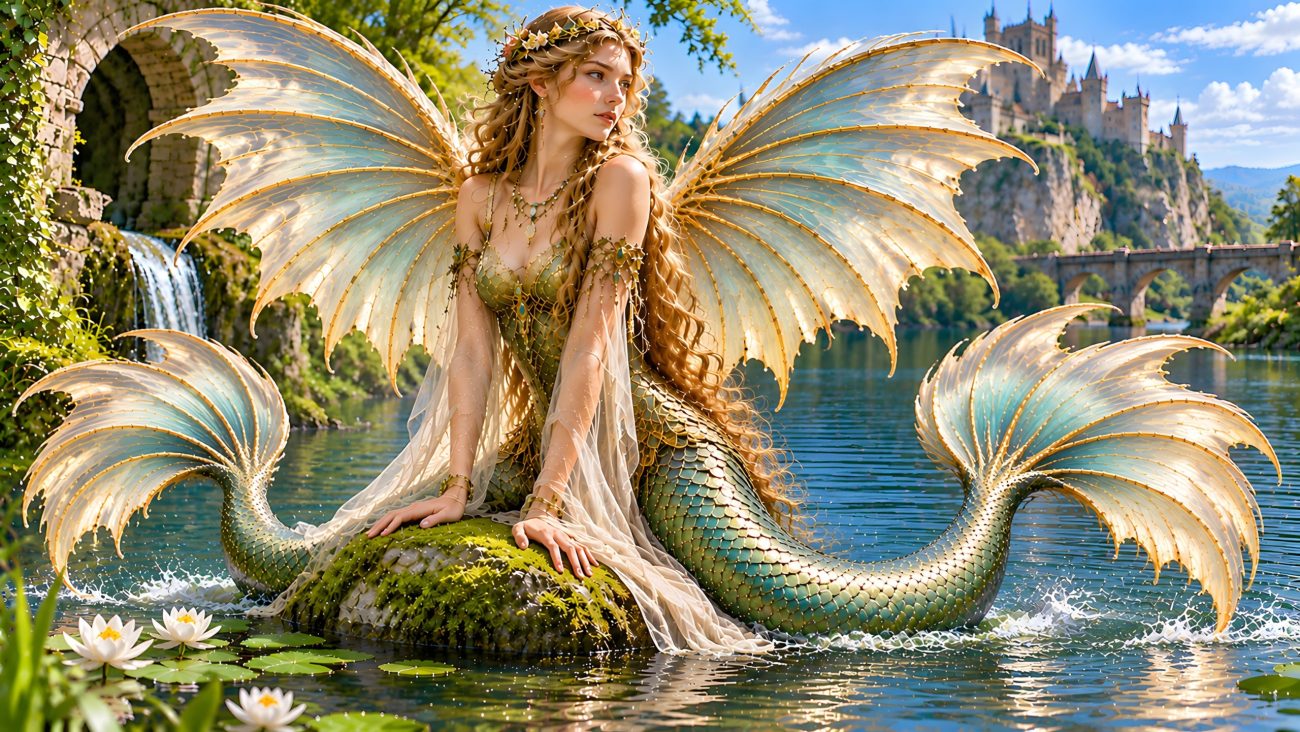
Mélusine is a female freshwater spirit associated with holy wells and rivers. She is usually depicted as a beautiful woman with the lower body of a serpent or fish. Some depictions give her wings, two tails, or both. Her legends are particularly associated with northern and western France, Luxembourg, and the Low Countries.

In the literary tradition recorded by Jean d’Arras in 1393, Mélusine is the eldest of three daughters born to Pressine, a fairy, and Elinas, the King of Albany. When Elinas breaks his promise never to see Pressine while she is giving birth to or bathing their children, Pressine leaves him and takes her daughters to the Isle of Avalon.

On her fifteenth birthday, Mélusine learns why her mother abandoned their father. Seeking revenge, she persuades her sisters to help her imprison Elinas and his riches inside a mountain. Pressine is furious that her daughters have punished their father and imposes different punishments upon them. Mélusine is banished from Avalon and cursed to take the form of a two-tailed serpent from the waist down every Saturday. If a man marries her, he must promise never to see her on that day. Should he keep his promise, she can live contentedly with him. If he breaks it, she will remain a serpent and appear in her monstrous form to the noble family, lamenting for three days whenever a descendant dies or the family’s fortress changes hands.

Mélusine settles in a forest near Coulombiers, by a stream close to Poitiers. There she encounters Raymondin, Count of Poitiers, who is distraught after accidentally killing his uncle. She comforts him, and they eventually marry after he agrees never to see her on a Saturday.

For ten years, Raymondin honours his promise. During this time, Mélusine bears him ten sons and oversees the construction of magnificent castles, bringing her husband wealth, lands, and power. Some versions describe their sons as physically deformed, although their parents love them.

Eventually, Raymondin’s family encourages him to grow suspicious of Mélusine’s private activities on Saturdays. He breaks his promise and secretly watches her bathing, discovering that her lower body has taken the form of a serpent. He initially conceals what he has seen. However, after one of their adult sons murders his brother, Raymondin publicly blames Mélusine and calls her a serpent.

Mélusine transforms into a dragon, gives Raymondin two magical rings, and flies away, never to be seen again in public. According to the tale, she returns at night to nurse her two youngest children, who are still infants.

Mélusine’s story became associated with several European ruling dynasties. Medieval literature and folklore claimed that the House of Lusignan, the House of Anjou and its descendants the Plantagenets, and the Limburg-Luxemburg dynasty descended from her. Her legend combines motifs of water nymphs, mermaids, guardian spirits, fairies, and supernatural women whose mysterious nature becomes a source of conflict when their human partners violate a forbidden condition.


Sources

Wikipedia contributors. (n.d.). Melusine. In Wikipedia, The Free Encyclopedia. Retrieved February 14, 2026, from https://en.wikipedia.org/wiki/Melusine