Tradition: French Mythology
Alternative Names: Morgane, Morganed, Morganezed
Category: Mermaid
The Myth
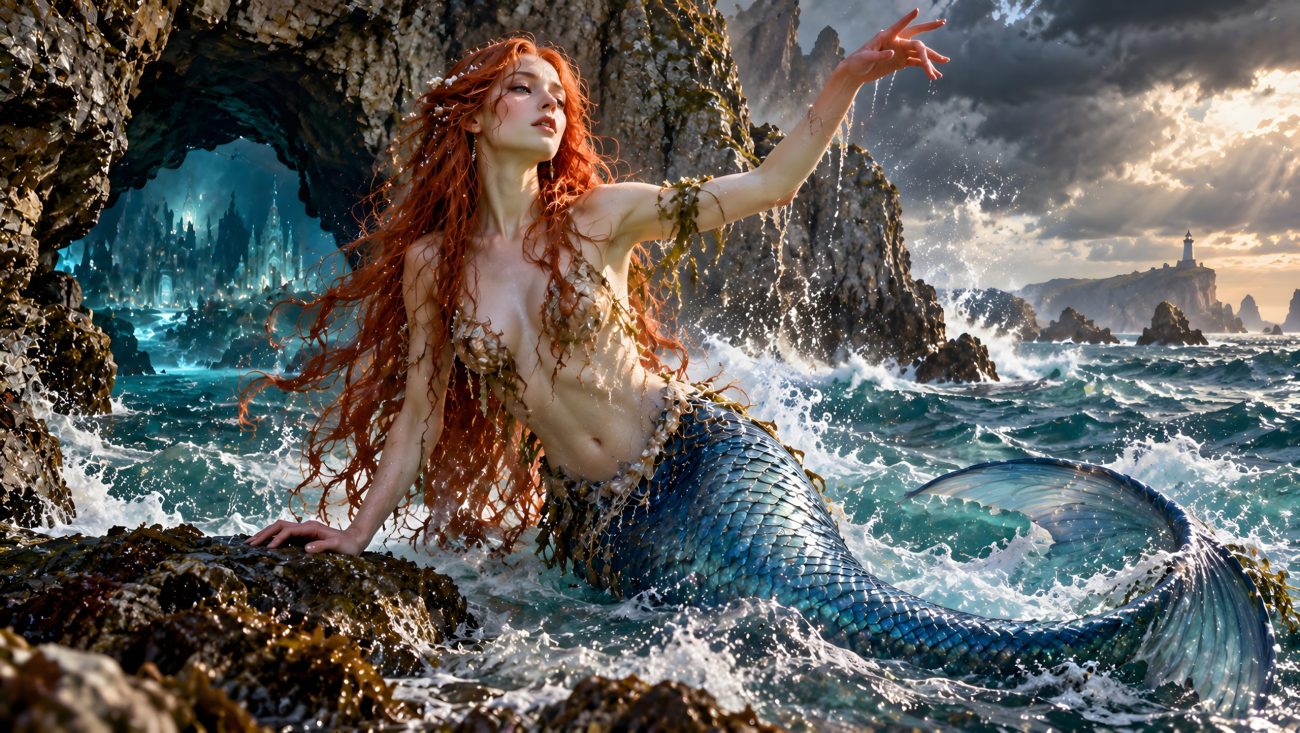
The Marie-Morgane are beautiful female water fairies who live beneath the sea along the coast of Brittany, particularly around the shores of Ouessant and Finistère. They are described as small men and women who inhabit a magnificent underwater kingdom ruled by a king whose palace is said to surpass anything found upon the land. The Marie-Morgane themselves are extraordinarily beautiful and sometimes come ashore at night to play upon the beaches beneath the moon. Their appearances are fleeting: at the slightest blink, they can vanish completely. Although naturally peaceful and benevolent, they are also capable of deceiving humans, appearing in seductive forms to lure men into the water and carry them away to their underwater realm.
The Marie-Morgane are particularly dangerous to young fishermen and sailors. They are said to pursue young men with their romantic attentions, and any man who gives in to their advances may be drawn beneath the waves and never return. They dwell especially near the Breton coast, around caves, river mouths, and other places where land and sea meet, and their underwater palaces can become eternal prisons for the lovers they abduct. In coastal communities, their presence could also explain a boat that failed to return: if relatives waited anxiously for fishermen who had not come home, people might say that a Marie-Morgane had held their vessel motionless offshore. Some Marie-Morgane were also believed capable of stirring up terrible storms, while others could calm the wind.
One of the most famous Marie-Morgane is Ahès-Dahut, the doomed daughter of King Gradlon. After the destruction and drowning of Ys, Dahut became a mermaid and remained beneath the sea, where she enchanted sailors and was associated with violent storms. According to the legend of Ys, Saint Guénolé once attempted to celebrate Mass for the drowned city after the waters had become calm. As he raised his chalice, the white torso of a girl with copper-colored hair rose from the sea, one arm reaching toward the heavens, while the rest of her body ended in a blue-scaled tail. It was Ahès-Dahut in her Marie-Morgane form. Guénolé’s hand trembled and the chalice fell onto the rocks, preventing the Mass from being completed and leaving Ys cursed. Whenever Dahut appears again, the sea is said to answer with a terrible storm. Another Breton tale tells of a mysterious girl discovered abandoned in a basket of reeds near Crozon. Raised by a noble couple, she repeatedly disappeared during the night and later vanished for weeks whenever a strange folgoat horse came to collect her. Eventually she never returned, and she was said to have gone to the cave of Crozon, where the Marie-Morgane were believed to dwell.
Sources
“Marie Morgane.” Wikipédia, l’encyclopédie libre (French Wikipedia). Wikimedia Foundation. Accessed October 4, 2026. https://fr.wikipedia.org/wiki/Marie_Morgane