Cocollona

Tradition / Region: Catalan Mythology, Spanish Mythology
Alternative names: –
Category: Crocodile


The Myth

The Cocollona is a legendary creature from the city of Girona. According to tradition, it was once a novice nun who sincerely embraced the religious life while the other nuns in her convent neglected their vows and lived carelessly.

The novice repeatedly reproached the other nuns for their behavior. In response, they imprisoned her in a dark, damp cell beneath the convent, where she remained for many years. The constant darkness and humidity gradually transformed her body, causing scales to grow until she became like a crocodile.

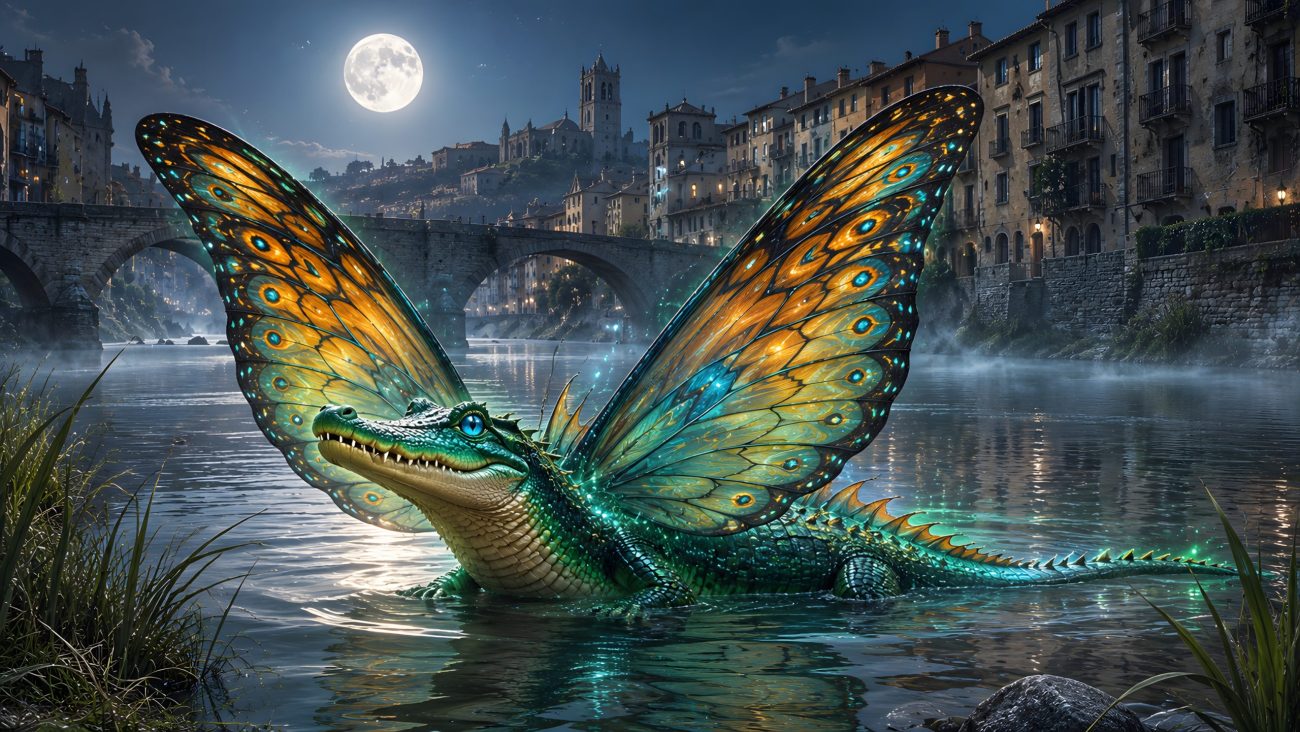
Because of her purity and holiness, however, she also developed beautiful butterfly wings upon her back. In this way, she became the Cocollona, a creature that was half crocodile and half butterfly.

After her death, the Cocollona returned as a ghost. It is said to swim through the waters of the Onyar River near the place where she had been imprisoned. According to the legend, only on nights of the full moon, just before dawn, can those with sensitive souls glimpse the ghostly Cocollona gliding silently along the river before disappearing with the first light of day.


Sources

Wikipedia contributors. (n.d.). Cocollona. In Wikipedia. Retrieved June 29, 2026, from https://en.wikipedia.org/wiki/Cocollona
Hoaya

Tradition / Region: Japanese Mythology
Alternative names: Boaya
Category: Crocodile


The Myth

Hoaya is a fearsome river monster described in the Edo-period works Nankai Kibun and Hyōryū Tenjiku Monogatari, which recount the travels of the sailor Sontaro after he drifted to foreign lands. The creature was said to inhabit the rivers of Banjarmasin in southern Borneo, where the local people greatly feared it and believed that killing one would inevitably bring misfortune.

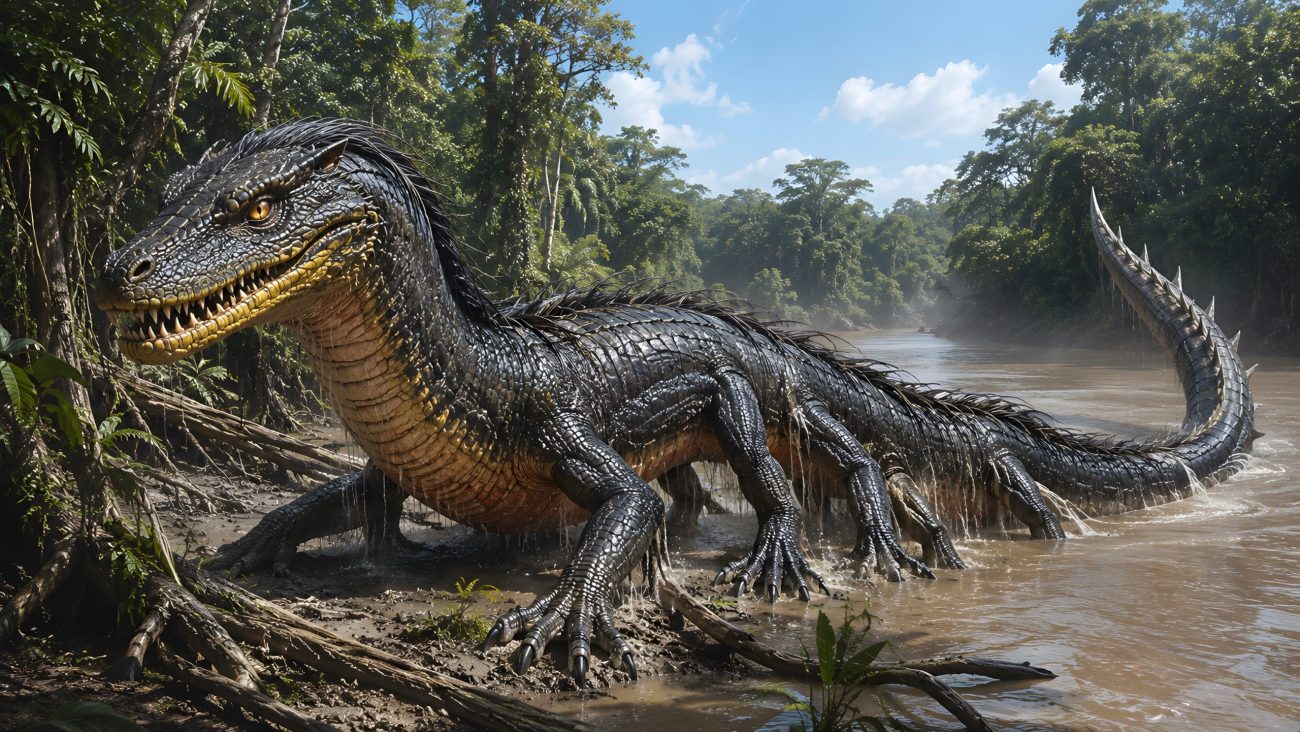
The monster was described as resembling a hornless dragon, with a stern face, long manes and ears, four arms, four legs ending in four claws each, and a body measuring between six and thirteen fathoms in length. It often clung to passing boats, frightening those aboard. In another account, its body is said to have been pale black with a yellow belly and lips, extremely hard scales, and a pointed tail ending in three ridges.

According to local belief, Hoaya climbed into the mountains each spring to lay thirty-six eggs, each about the size of a temari ball. After the young hatched and entered the rivers, the parent relentlessly pursued and devoured them until only one remained. That final offspring was then raised by the parent. Boats avoided Hoaya with their young, as they were believed to become especially aggressive.

One night, a Hoaya broke through the decaying fence surrounding a riverside bathing area and attacked a night watchman, biting off one of his legs. The creature became trapped inside the enclosure, where dozens of people eventually killed it after gunfire failed to penetrate its thick scales. The wounded watchman died the following day. Although the Hoaya’s body was thrown back into the river, no further misfortunes followed, despite the widespread belief that killing one of the creatures would bring disaster.

In Nankai Kibun, the creature is identified as Boaya, which is explained to be a crocodile, although its appearance and behavior are described in a far more legendary manner. The account also suggests that the hornless river dragons described in stories from Siam may have been the same creature.


Sources

Landtman, G. (1970). The Kiwai Papuans of British New Guinea; a nature-born instance of Rousseau’s ideal community. New York: Johnson Reprint Corp., p. 302.


Biasd Na Srogaig

Tradition / Region: Scottish Mythology
Alternative names: Biasd Na Sgrogag, Béist Na Sgrogaig, The Beast of the Lowering Horn
Category: Horse


The Myth

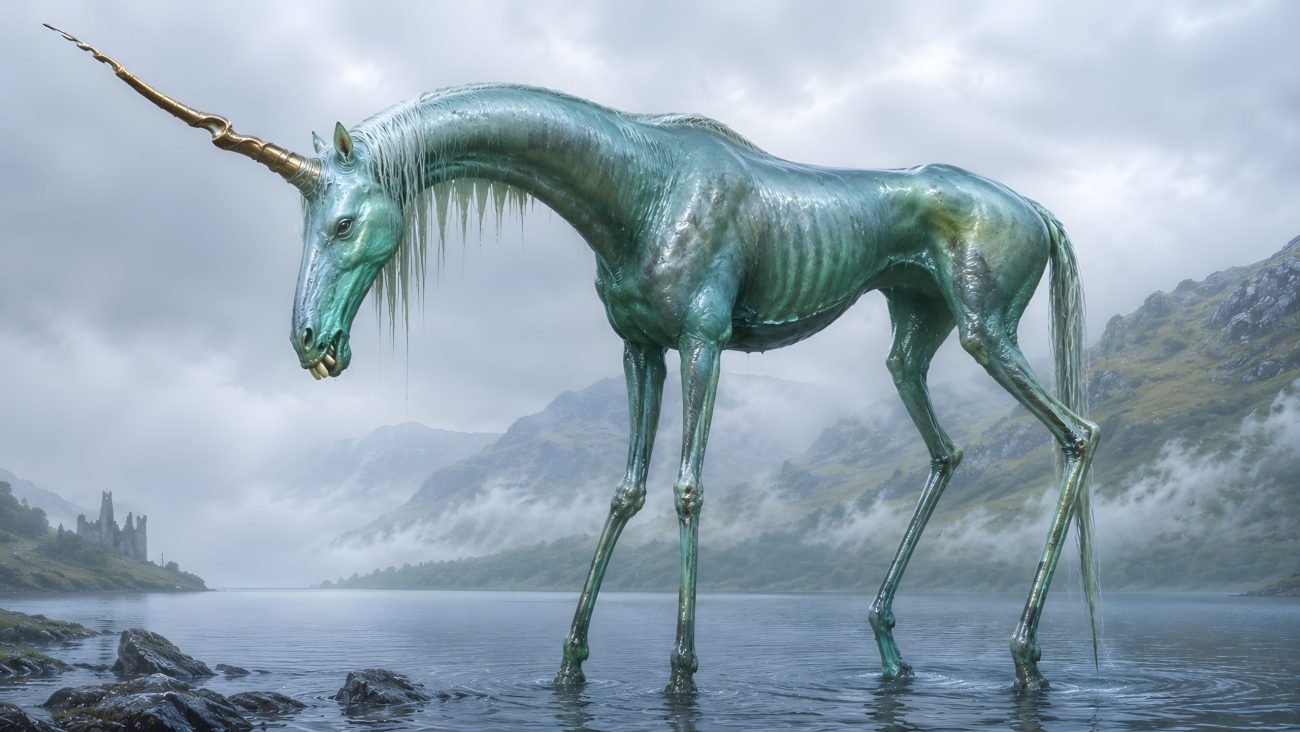
The Biasd Na Srogaig, or “Beast of the Lowering Horn,” is a legendary creature said to inhabit the lochs of the Isle of Skye in Scotland.

Although sometimes described as a unicorn, it bears little resemblance to the graceful unicorn of later tradition. The creature is portrayed as tall and ungainly, with long, gangly legs, an awkward gait, and a single large horn projecting from its forehead.

The Biasd Na Srogaig is believed to have originated as a nursery bogey used to frighten children. Over time, however, the creature became an established figure of local folklore as stories about it continued to be told into adulthood.

Its name is derived from the Gaelic sgrogag, meaning “crumpled horn.” In later usage, the name Béist Na Sgrogaig was also applied to the heraldic unicorn.


Sources

Campbell, J. G. (1900). Superstitions of the Highlands & Islands of Scotland: Collected entirely from oral sources. James MacLehose and Sons. Retrieved June 29, 2026, from https://www.gutenberg.org/ebooks/61728.


Spookhoeve van Exaarde

Tradition / Region: Belgian Mythology
Alternative names: –
Category: Horse


The Myth

A farmhouse in the village of Exaarde was long believed to be haunted. One night, when a cow was about to calve, the household went to the stable and found a monstrous horse lying in front of the door. As they approached, the creature quietly moved aside to let them pass. After they had finished their work in the stable, the horse calmly returned to its original place.

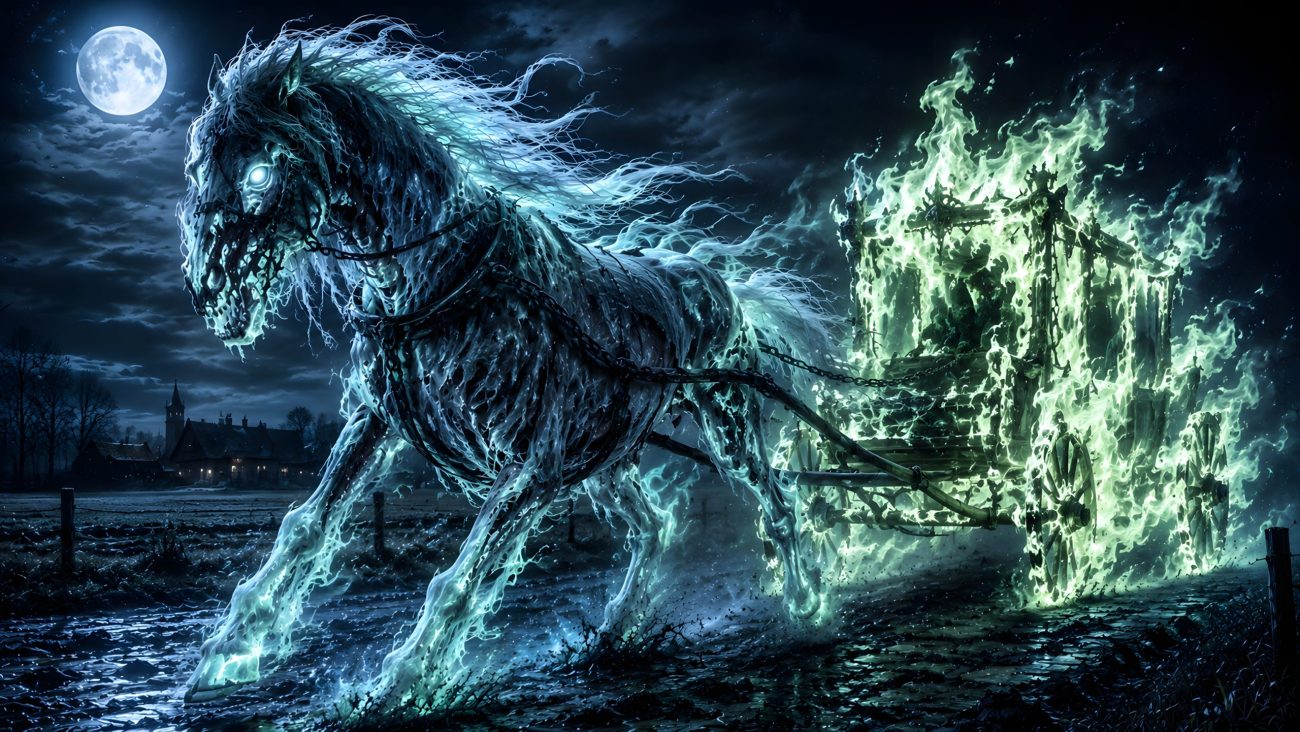
In the nights that followed, the hauntings changed. Around midnight, the farmer often looked from his window and saw a fiery carriage drawn by two horses racing around the farmyard. The blazing apparition illuminated the entire courtyard as it thundered past.

The frightened family sought the advice of local priests. They instructed the farmer to search the farm carefully for any unusual sign. One morning he discovered the imprint of a horse’s hoof in the middle of the path. After hearing this, the priests nailed a horseshoe to the inside of the farm gate facing the road.

From that day onward, the haunting ceased. Years later, when the old gate was replaced, the family neglected to transfer the horseshoe to the new gate. The ghostly manifestations soon returned and continued until the horseshoe was once again fastened to the entrance, after which the haunting disappeared.


Sources

de Cock, A. (1921). De Nachtkoets (p. 114). In Vlaamsche sagen uit den volksmond. Maatschappij voor Goede en Goedkoope Lectuur. Retrieved June 29, 2026, from https://www.dbnl.org/tekst/cock001vlaa01_01/


Raul’s Phantom Horse

Tradition / Region: Luxembourgish Mythology
Alternative names: The Black Phantom Horse
Category: Horse


The Myth

According to a Luxembourgish legend, the robber knight Raul lived with his brothers in the castle of Gräfingen, where they enriched themselves through theft and plunder. Raul possessed an extraordinary coal-black horse that surpassed all others in speed and intelligence. It could sense enemies and danger, safely carry its master across the most treacherous paths, and leap over ditches and rivers with ease.

At last, the robber knights were defeated. Raul’s brothers were captured by armed peasants, tied to the tails of their own horses, and dragged to death before being brought back to the castle. As the attackers stormed the fortress and set it ablaze, they drove the horses carrying the corpses through the gates.

Rather than surrender, Raul mounted his faithful horse and rode along the top of the castle walls while the flames consumed the fortress. Startled by the fire, the horse leapt from the high wall into the burning courtyard. Raul’s clothes caught fire, but the horse escaped unharmed and burst through the castle gate.

Witnesses saw Raul riding like a blazing meteor through the astonished crowd. Horse and rider raced across the plain before plunging down the steep hillside into the River Eisch, where the flames were extinguished and both vanished beneath the water.

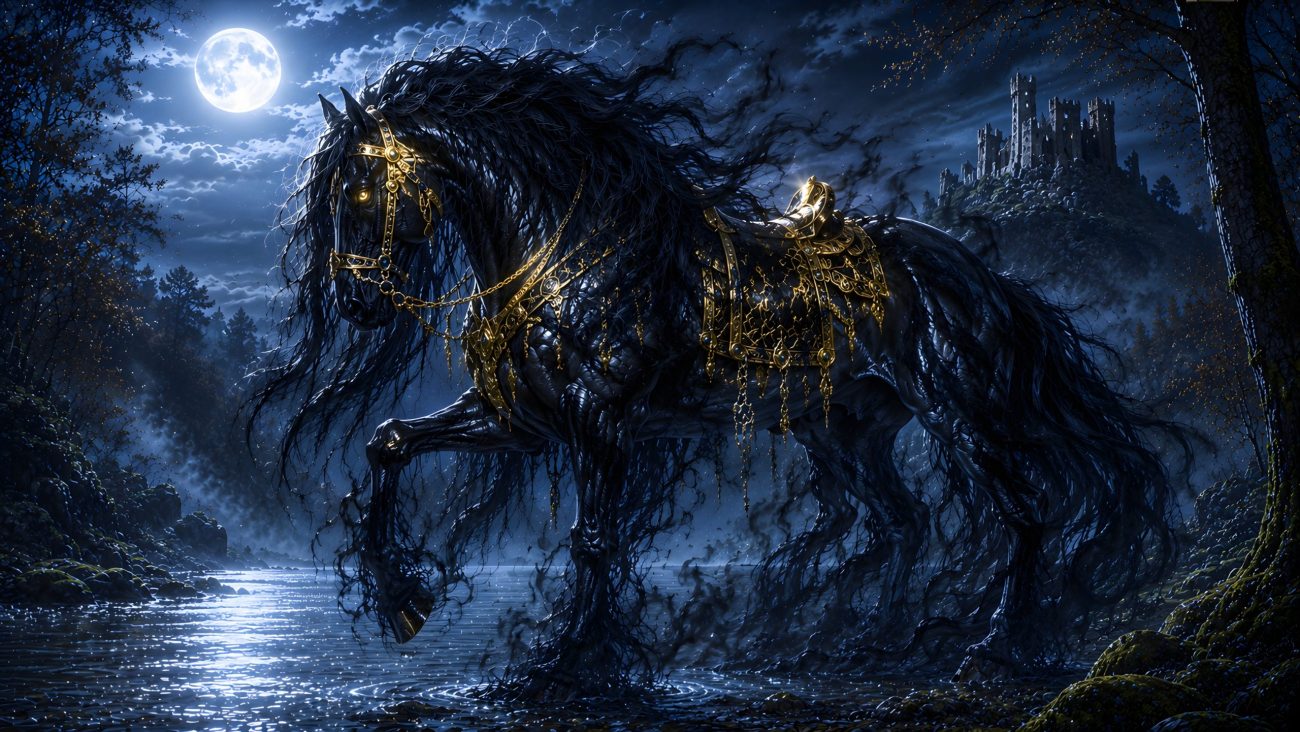
From that day onward, Raul’s horse has wandered the quiet banks of the Eisch searching for its lost master. It appears as a coal-black stallion with a mane so long it reaches its hooves, though when it runs the mane rises into the air with a whistling sound. Its golden bridle and saddle shine in the darkness.

Anyone who is frightened by the phantom horse becomes so confused that they inevitably fall into the river. Those who remain fearless cause the black horse to flee and disappear beneath the water. Legend also says that whoever dares to mount the ghostly steed will be carried to the hidden underground vault where Raul and his brothers concealed their immense treasure.


Sources

de la Fontaine, E. (1882). Nr. 134. Die Schätze der Raubritter. (pp. 66–68). In Luxemburger Sagen und Legenden. Jos. Beffort.


Hellish Stallion

Tradition / Region: Czech Mythology
Alternative names: –
Category: Horse


The Myth

A farmer from the parish of Stritschitz once bought a stallion from a traveling horse dealer. Soon afterward, he noticed that the horse shied away from every roadside shrine and every crossroads.

When the farmer finally harnessed the animal to work in a field, the stallion suddenly went wild. It smashed the wagon’s drawbar, tore apart the harness, and attacked its master, mauling him so severely that he was left lying in a pool of blood.

The wounded farmer was carried home, but his injuries were so severe that he knew he was dying. Gathering his last strength, he dragged himself into the stable, thrust a slaughter knife into the stallion’s belly, and cried, “You shall not kill me alone, Satan!”

The stallion collapsed dead at once. Immediately afterward, a terrible roaring arose, as though thunder were rumbling beneath the earth. The farmer himself died in the same hour.


Sources

Watzlik, H. (1921). Hellish tool. In Bohemian Forest Legends (Bohemian Forest Village Books, 5th issue). Retrieved June 29, 2026, from https://www.sagen.at/texte/sagen/tschechien/watzlik/hoellischeswerkzeug.html


Three-Legged Horse

Tradition / Region: Austrian Mythology
Alternative names: –
Category: Horse


The Myth

A legend from the Rohrwald Forest in Lower Austria tells of the origin of a mysterious three-legged horse ridden by the devil.

Two farmers became lost while gathering firewood in the Kaltenberg section of the forest. After wandering for a long time, they encountered a man dressed in a black cloak and round black hat. When he lifted his hat, they saw that he had two horns and realized he was the devil.

The stranger offered to guide them back to the proper road if they would lend him one of their horses. While the farmers unharnessed a black horse, the devil offered them a bottle of wine, which they eagerly drank. He then mounted the horse and led them through the forest until they reached the correct path.

When the devil turned to ride away with the borrowed horse, the farmers chased after him with their hoes. One of them swung his hoe at the devil but missed, striking the horse’s left hind leg instead. The leg immediately turned to stone and fell to the ground, where it remained as a stone shaped like a horse’s hoof.

From that night onward, the devil’s horse was said to have only three legs whenever it was seen riding through the forest after dark.

The two farmers returned home and told their families what had happened. Both died that same night, and it was said that by drinking the devil’s wine they had unknowingly sold their souls to him.


Sources

Vernaleken, T. (1859). Das dreibeinige Pferd (Nr. 13). In Mythen und Bräuche des Volkes in Österreich: Als Beitrag zur deutschen Mythologie, Volksdichtung und Sittenkunde. Retrieved June 29, 2026, from https://www.sagen.at/texte/sagen/oesterreich/allgemein/vernaleken/wuotan_13.html.


Gunya

Tradition / Region: Sudanese Mythology
Alternative names: –
Category: Horse


The Myth

Gunya was the legendary warhorse of Ismaila, one of the greatest fighting chiefs of Argungu. The horse was believed to possess supernatural powers and served as an oracle before battle.

Before leading his warriors into combat, Ismaila would consult Gunya. If the horse neighed three times, victory was considered certain. If it remained silent, defeat was believed to be inevitable.

When Gunya died, it was honored with a state funeral, reflecting the extraordinary respect and reverence accorded to the remarkable animal.


Sources

Tremearne, A. J. N. (1913). Hausa superstitions and customs: An introduction to the folk-lore and the folk. Bale, Sons & Danielsson, Ltd, p. 130.


Vazila

Tradition / Region: Belarusian Mythology
Alternative names: Vazil, Vasil, Bicychik, Basina, Visusnik, Kankach, Tabunnik, Talbunnik, Khlevnik, Xneyhik
Category: Horse


The Myth

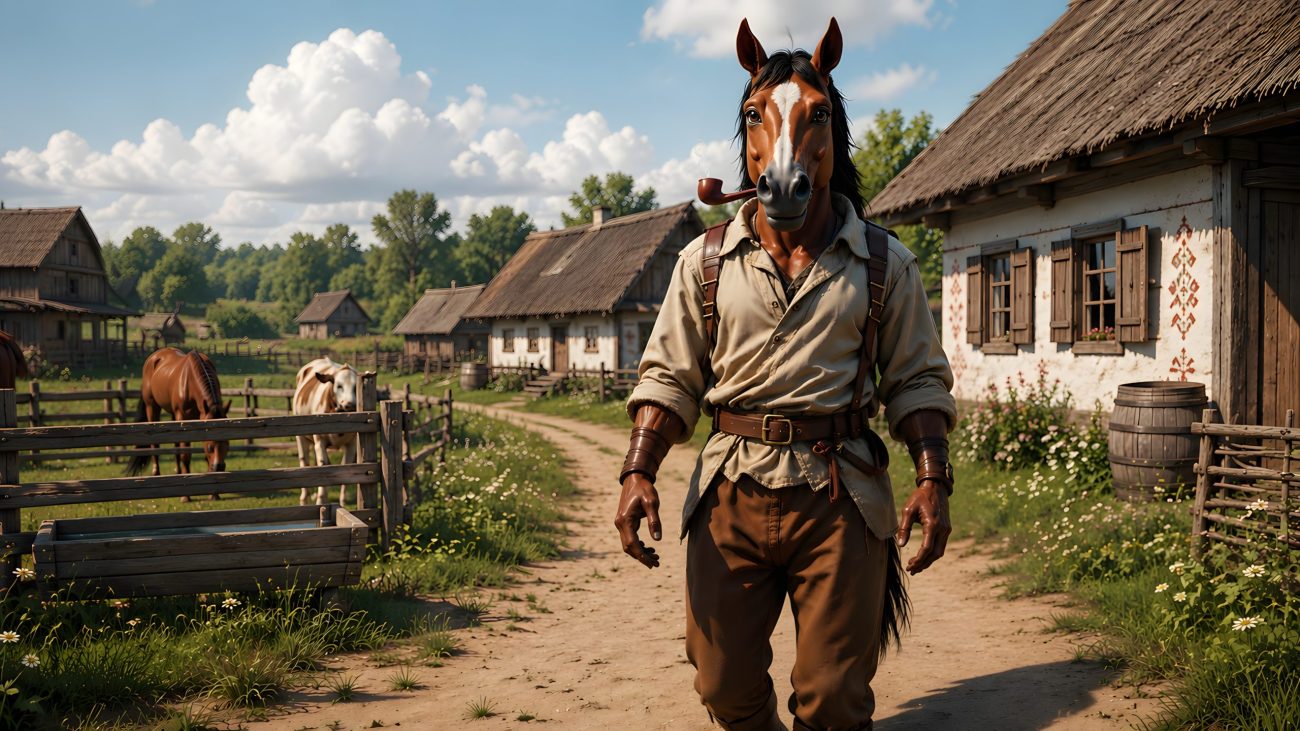
Vazila is the patron spirit of horses in Belarusian folklore. Unlike the horse demon Kumelgan, Vazila appears in human form, but with the ears and hooves of a horse. He is said to live in horse stables and accompanies horses when they graze in distant meadows or remain outdoors overnight.

Belarusian tradition holds that Vazila protects horses from disease, seizures, wolves, and other wild predators. Shepherds and horse owners trusted him to watch over their animals, sometimes leaving horses to graze at night without a guard because they believed Vazila would protect the herd.

A common custom was to drive a pole into the ground at the grazing place and attach the skeleton of a horse’s head to it. This symbolic image was believed to invite Vazila’s protection and keep Kumelgan, the evil spirit of horses, away. Neither Kumelgan nor ordinary wolves were thought to approach a place guarded by Vazila.

Vazila was also believed to carry a special herb on his back, which he mixed into the horses’ feed during the night. This herb was said to strengthen the animals, making them healthy, strong, and tall. Some Belarusian farmers claimed to have found this mysterious herb in the manger and kept it for future use.

Many stories tell of fierce battles between Vazila and Kumelgan. During these struggles, people claimed they could hear loud thundering and stamping as the two spirits fought to protect or claim the horses. Because of his role as the guardian of horses, Vazila was highly respected throughout Belarus, and people invoked his name when seeking the safety and well-being of their animals.


Sources

Bestiary.us. (n.d.). Vazila. In New Bestiary: Encyclopedia of Imaginary Beings. Retrieved June 29, 2026, from https://www.bestiary.us/vazila


Nouma

Tradition / Region: Japanese Mythology
Alternative names: Wild Horse
Category: Horse


The Myth

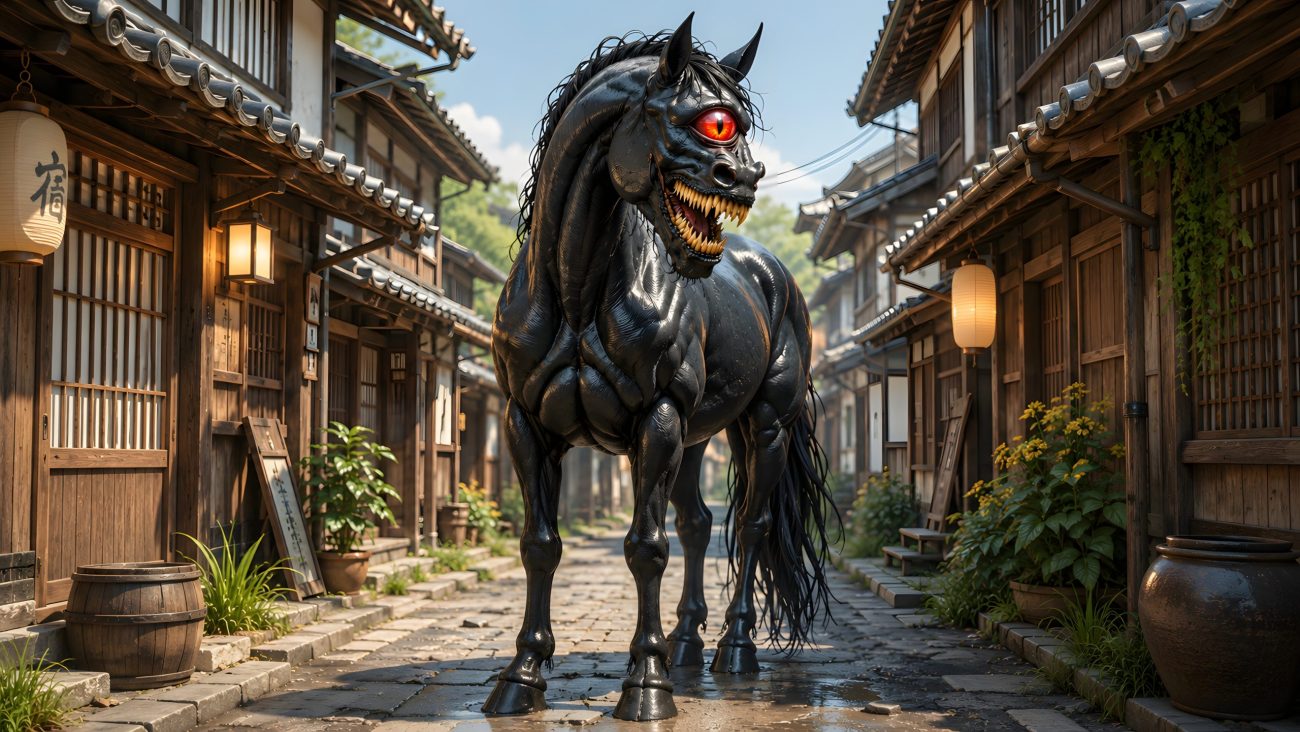
Nouma is a one-eyed man-eating yōkai from the folklore of Hinui Village in Ōchi District, Shimane Prefecture.

The creature is associated with the time when iron was produced in local tatara furnaces. One night, while a worker was sleeping at a smelting site, a mysterious woman suddenly appeared and lay over his body.

At the same time, the eerie neighing of the Nouma echoed in the distance. The creature gradually approached the furnace and peered inside through a high window. However, the moment it saw the woman, it immediately fled in terror.

The mysterious woman was later believed to have been Kanayago, the goddess of ironworking and metallurgy, whose presence protected the worker from the man-eating Nouma.


Sources

TYZ. (n.d.). 野馬 (Nouma). In 新版TYZ 妖怪図鑑. Retrieved June 29, 2026, from https://tyz-yokai.blog.jp/archives/1010655022.html