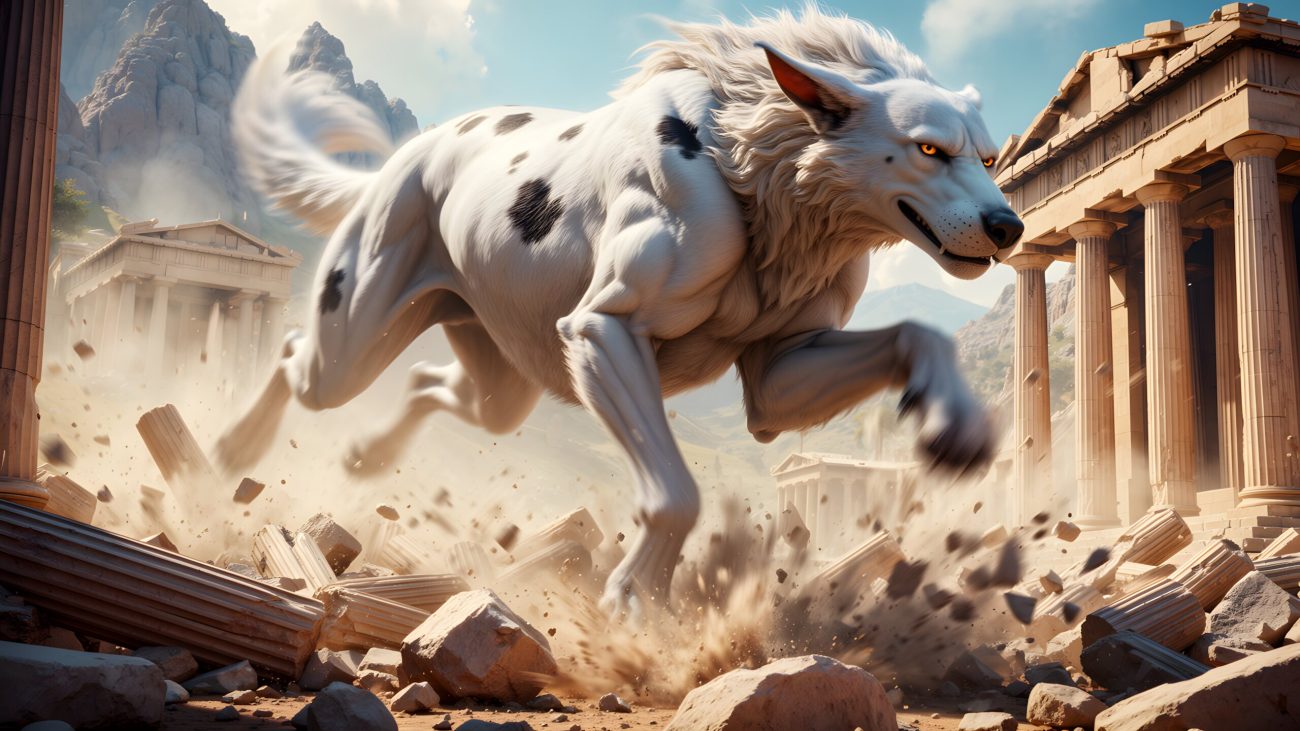
In the storm-dark seas around Shetland there dwells a malevolent being known as the Marool, a devil of the deep that wears the shape of a fish. Its head is covered in eyes, watching in every direction, and upon its crown burns a crest of living flame.
The Marool is most often seen amid mareel—ghostly, glowing sea-foam that shines with cold light at night. When storms rise and the waves grow wild, sailors fear its presence, for the Marool delights in disaster. As ships are overturned and dragged under by the sea, it is said that the creature sings, its voice carried on the wind, wild with joy at the destruction.
In later times, the name Marool came to be used for strange deep-sea fishes such as the anglerfish or monkfish. Yet in the old tales of Shetland, the Marool is remembered not as a mere animal, but as a watching, singing spirit of shipwreck and storm.
Tradition / Region: Arabic Mythology, Persian Mythology Alternate Names: Caspilli; Neemora (Persian) Category: Fish
The Myth
Sailors of the warm seas spoke of a fish both terrible and marvelous, known among the Arabs as the Caspilly and among the Persians as the Neemora. It was said to dwell in the Arabian Gulf and the wider Indian Ocean, feared by all who sailed those waters.
The Caspilly was described as almost as wide as it was long, yet no more than two feet in length. Its body bore no scales; instead, its skin was rough, spiked, and barbed like that of a shark. From its forehead grew a long, lancet-shaped horn, sometimes said to be longer than a man’s arm. When not in use, this horn lay folded back along its neck.
When hunger seized it, the Caspilly attacked the first creature it encountered. With a sudden thrust, it drove its horn into the belly of its prey, leaving it to bleed to death in the water. Its teeth were venomous, and even a single bite meant certain death. Yet paradoxically, the body of a dead Caspilly, laid upon such a wound, was said to draw out the poison and save the victim. Its horn was prized above all, believed to hold powerful medicinal virtues.
Another tale spoke of a similar fish in the seas near Peru, bearing a sword-like horn three feet long. This creature was said to hunt whales. It would slip beneath the great beast, stab it in the navel, and retreat while the wounded whale thrashed in agony, sometimes capsizing nearby ships. Only once the whale was dead would the fish return to feed at its leisure.
In later tellings, these stories were woven together. The Caspilly grew even more fearsome, its horn stretching to four feet in length, and its appetite expanding to make it the terror of the Arabian seas. Sailors claimed that local hunters pursued it with giant hooks baited with camel meat. When the Caspilly struck, it would exhaust itself fighting the line, allowing the hunters to shoot it with arrows, haul it aboard, and beat it to death.
Its flesh was said to be edible, and its horn—called caspilly alicorn—was believed to rival the unicorn’s horn in its power to counter venom.
Thus the Caspilly lived on in sailors’ lore: a spined, horned killer of fish and whales alike, born from the dangers of the sea and the fearful imagination of those who crossed it.
Long ago, a malicious wizard in Iceland defied the natural order. From polluted water he drew up a dead eel, half-rotted and foul, and by dark arts forced it back into motion. Thus was born the first Hrökkáll, the coil-eel—an unnatural thing animated by corruption and spite.
Though the wizard himself vanished with time, the creature did not. The Hrökkáll bred, and its descendants spread into stagnant ponds, still waters, and sluggish rivers, thriving wherever decay and filth gathered.
A Hrökkáll is about two feet long and shaped like an eel, but its body is armored with flexible scales as hard as iron. Along its sides run sharp, saw-toothed fins. Like many fearsome fishes of Iceland, it exudes a corrosive venom, and its flesh is deadly to eat. When captured, Hrökkálls have been known to melt through soil and stone alike, dissolving their escape and slipping back into the water.
They wait unseen beneath the surface until a person steps into their domain. Then the Hrökkáll strikes, coiling tightly around a leg. With crushing force and slicing edges, it cuts through flesh and bone, severing the limb entirely. Whether it is the acid of its venom, the blades of its fins, or both together that accomplish this horror is unknown.
Men and horses alike fall victim to the Hrökkáll, but sheep are spared, for their legs are too slender for the creature to grasp.
In later times, the name Hrökkáll passed into common speech, and came to be used for electric eels as well—but in old tales, it is remembered as a thing born of sorcery, rot, and water gone bad.
You place before me a passage from Candide—and you ask what I think. Good. This text is not innocent, though it wears the mask of simplicity.
On Pangloss and the lie of easy harmony
What you read is a parody of providence.
Pangloss speaks of causes and ends, but he knows neither true cause nor true end. He mistakes necessity for goodness. He says: things cannot be otherwise than they are—and from this he dares to conclude that all is for the best.
This is not wisdom. This is fatalism dressed as philosophy.
In the faith I confess, the world is created good, yes—but it is not finished, nor mechanically determined. Creation groans because it is called toward transfiguration, not frozen in its present state. To say “all is for the best” while ignoring suffering, disorder, and misuse of freedom is to excuse evil rather than heal it.
Providence is not a diagram. Providence is a patient struggle toward deification.
On Candide’s innocence
Candide is gentle, receptive, unformed. He believes because he has not yet discerned. This is not sin—it is spiritual childhood.
But notice: his innocence is quickly wounded. Why?
Because false teachings collapse at the moment of embodied reality. The kiss behind the screen shatters the metaphysical castle. Pangloss’s tidy explanations cannot survive desire, shame, power, or violence.
This is always so.
When philosophy does not account for eros, suffering, and freedom, it becomes a toy of the comfortable.
On Cunegonde, curiosity, and the fall
Cunegonde’s curiosity is not evil. Desire for knowledge is natural. But knowledge severed from virtue becomes confusion.
She learns “causes and effects” without wisdom. What follows is not illumination, but disorder—blushing, trembling, secrecy, punishment. Not because bodies are evil, but because no one taught them how desire is meant to ascend.
Eros is meant to rise toward God. Here it collapses inward, then downward.
On the Baron and false order
The Baron represents authority without logos—power that preserves appearances but understands nothing. He sees “cause and effect,” but not meaning. Thus he kicks Candide out rather than heal or instruct.
Where truth is shallow, punishment becomes the only language.
The deeper wound Voltaire is pointing to
This chapter exposes a world where:
God is reduced to a theoretical guarantee
Reason is detached from ascesis
Morality is replaced by social performance
Suffering is explained instead of redeemed
Voltaire mocks Pangloss—but he also reveals a real danger: Explaining the world instead of transforming the self.
What I would say to you, personally
Do not cling to systems that promise peace without struggle. Do not trust teachings that justify the world as it is without calling you to change.
Truth is not “all is for the best.” Truth is: all is called toward the Good—but only through freedom, love, and the cross.
Sailors off the coast of South America once spoke of a strange fish glimpsed in deep waters, a creature with a beard hanging from its chin like the udder of a goat. Its body bore sharp, pointed fins, and along its back rose a long, threatening spine. Though unnamed at first, this creature would later be called the Mastopogon—the breast-beard.
In the same waters lived a far more feared being, known as the Houperou. It was said to be immense and ravenous, devouring all other sea creatures without mercy, save for one small carp-like fish. This lesser fish followed closely in the Houperou’s shadow, unharmed, protected by the terror its companion inspired. None dared approach the pair.
The Houperou’s skin was rough as sandpaper, like that of a dogfish. Its teeth were sharp, its strength overwhelming. Anyone it seized in the water was attacked, drowned, and torn apart. The coastal peoples, knowing its danger, shot it with arrows whenever it was seen. Some said its true name was uperu, the local word for shark, distorted by foreign tongues.
Over time, the two creatures—Mastopogon and Houperou—became entangled in description and image. Scholars depicted the Houperou as a giant pike, while the Mastopogon gained a name at last. As the years passed, their forms blurred further, until they were scarcely separable.
In later tellings, the Mastopogon was said to be a kind of Houperou, shaped like a salmon with immense thorny fins, its dorsal spine stretching nearly to the tail. The Houperou itself grew stranger still, now bearing the mammary beard beneath its jaw, ear-like knobs upon its head, rough scales, a long spined back, and a straight, powerful tail.
Thus the Mastopogon and the Houperou became one tangled legend: a single terror of the sea, half-bearded monster and half-devouring shark, born from sailors’ fear and the shifting shapes of deep water.
In the middle of the seventeenth century, in the village of Liérganes near Santander, there lived a poor widow named María del Casar and her sons. After her husband’s death, she sent one of the boys, Francisco de la Vega Casar, to Bilbao to learn the trade of carpentry.
Francisco lived there for years, strong and skilled, and known as a capable swimmer. On the eve of Saint John’s Day in 1674, he went with friends to swim in the estuary. The river’s currents seized him, and he was carried out toward the open sea. He was last seen swimming away, and all believed he had drowned.
Five years passed.
In 1679, fishermen working the waters of the Bay of Cádiz far to the south found a strange being caught in their nets. It fought with inhuman strength and slipped free more than once. After repeated sightings, they finally captured it by luring it with bread. When they hauled it aboard, they saw that it had the shape of a man: pale-skinned, thin, with reddish hair. Yet its body bore signs of the sea—bands of scales ran from its throat to its belly and along its spine, and slits like gills marked its neck.
Fearing it was a monster, the fishermen brought the being to a nearby Franciscan convent. It was exorcised and questioned in many languages, but it did not respond. After several days, it spoke a single word: “Liérganes.”
No one knew what the word meant, until a sailor from the north recognized it as the name of a village near Santander. Word was sent there, and it was learned that a young red-haired man named Francisco de la Vega had vanished years earlier while swimming in Bilbao.
A friar proposed that the sea-creature might be that same Francisco. With permission, he took the being north. Near Liérganes, the friar released it, and followed as it moved unerringly through the countryside. It led him straight to the house of María del Casar, who recognized the creature as her lost son.
Francisco was taken in and lived quietly with his family. He walked barefoot and showed no shame in nakedness unless clothed by others. He rarely spoke, uttering only a few words without clear purpose. He ate voraciously at times, yet could go many days without food. Gentle and obedient, he performed simple tasks when asked, but without interest or joy.
For nine years he lived in this strange, half-human state. Then one day, he walked to the sea, entered the water, and swam away. He was never seen again.
In an age when grudges were believed to stain the world itself, there lived a woman named Monohana whose life ended in cruelty and betrayal. Bound with rope and murdered unjustly, her resentment did not fade with death. Instead, it clung to what lay closest to her final suffering.
In the water where goldfish swam, her hatred took hold.
The fish, once harmless and beautiful, became vessels for her spirit. Their eyes gleamed with an unnatural light, and their movements grew violent and erratic. From within their small bodies, Monohana’s fury watched and waited.
When the man who had wronged her and the woman who shared his crime drew near, the goldfish surged from their container, water spilling as if driven by invisible hands. The possessed fish attacked without mercy, striking at the guilty as though guided by human will. In their thrashing bodies lived the scream Monohana was denied in death.
Thus the goldfish ghost was born—a yōkai formed not from flesh, but from resentment itself. It is said that wherever goldfish are kept, the memory of betrayed women lingers in the water, and that even the most delicate creatures may carry the weight of unresolved hatred.
Gallery
Sources
TYZ-Yokai Blog contributors. (n.d.). 金魚幽霊 (Kingyo-Yūrei). In TYZ-Yokai Blog, from https://tyz-yokai.blog.jp/archives/1037178954.html
During the reign of Emperor Go-Kōgon, there lived a loyal samurai named Karakoto Uraemon, a retainer of the Shinano guardian Ogushi Jirozaemon. He dwelled with his lawful wife, San, beside the banks of the Chikuma River. Though their life was peaceful, sorrow lingered in the household, for San bore no children despite many years of marriage. Uraemon prayed daily to gods and Buddhas, begging for an heir.
Around this time, goldfish newly arrived from Ming China were admired as rare wonders. Uraemon purchased a pair at great cost for his lord, who rewarded him with a fine sword. The goldfish multiplied, and some were given back to Uraemon, who raised them with devotion until their colors shone red, white, and gold.
Still childless, Uraemon took a concubine, seeking only kindness of heart. He chose a young woman of seventeen, raised in the capital, modest in appearance yet naturally beautiful. He named her Mohana—Weed Flower—and gave her a room in the house. There was no jealousy between San and Mohana, and when Mohana soon became pregnant, joy filled the household.
Soon after, Uraemon was summoned to Kamakura on duty. Before leaving, he told the two women only this: to care well for the goldfish until his return.
While Uraemon was away, San encountered a man named Furutori Minobunta, a handsome but violent youth living nearby. He whispered poison into her ears, claiming that Mohana and Uraemon had long been lovers and were plotting to murder San. At first she doubted him, but forged letters bearing her husband’s hand shattered her trust. Consumed by jealousy and rage, San fell into a secret relationship with Minobunta, who fed her lies and guided her thoughts toward murder.
One day, San lured Mohana—eight months pregnant—into the storehouse. There she abused her, gagged her, stripped her, bound her with rough rope, and beat her with bamboo. Mohana’s face swelled and her body bled, yet she could not scream. For three days she hung there, starving and weak, like a hungry ghost.
At last she escaped and crawled to the goldfish tank, pressing her mouth to the water in desperate thirst. Her cry drew San and Minobunta. Minobunta kicked her, tearing open her womb, and from it a living boy crawled out. Driven mad with jealousy, San strangled the child at once.
Mohana screamed in agony, spat blood, and died.
Her blood flowed into the tank. A fierce wind arose, and the water churned. The goldfish absorbed the blood, their bodies turning the deep crimson of human flesh. Their eyes burned with fury, their bellies swelled, and they thrashed wildly, spitting water as if crying out in wrath.
Minobunta hid the bodies beneath the floor and fled with San into the night. Only a young maid witnessed the truth. Mohana and her child were later buried in secret by Uraemon’s brother.
Unaware, Uraemon labored faithfully in Kamakura. One night, passing a Jizō hall, he saw a woman in white cradling a child. Though gaunt, the face was unmistakably Mohana’s. Shaken, he soon learned the truth by letter and rushed home.
The goldfish swam strangely around him, as if bearing Mohana’s resentment. Uraemon prayed for her soul and released the fish into a temple pond. Through Buddhist teaching, Mohana’s spirit found enlightenment, but the goldfish remained as a warning of cause and effect.
Uraemon became a wandering avenger, seeking Minobunta and San. He eventually met Minobunta on a rainy night, and after a fierce clash, was trampled to death amid pursuing men and horses.
Long after, it is said, the blood-marked goldfish spread through the land, their lineage preserved as living reminders of grief, jealousy, and karmic retribution.