Türst

Tradition: Swiss Mythology
Alternative Names: Türst, The Dreadful Huntsman
Category: Forest Dweller


The Myth

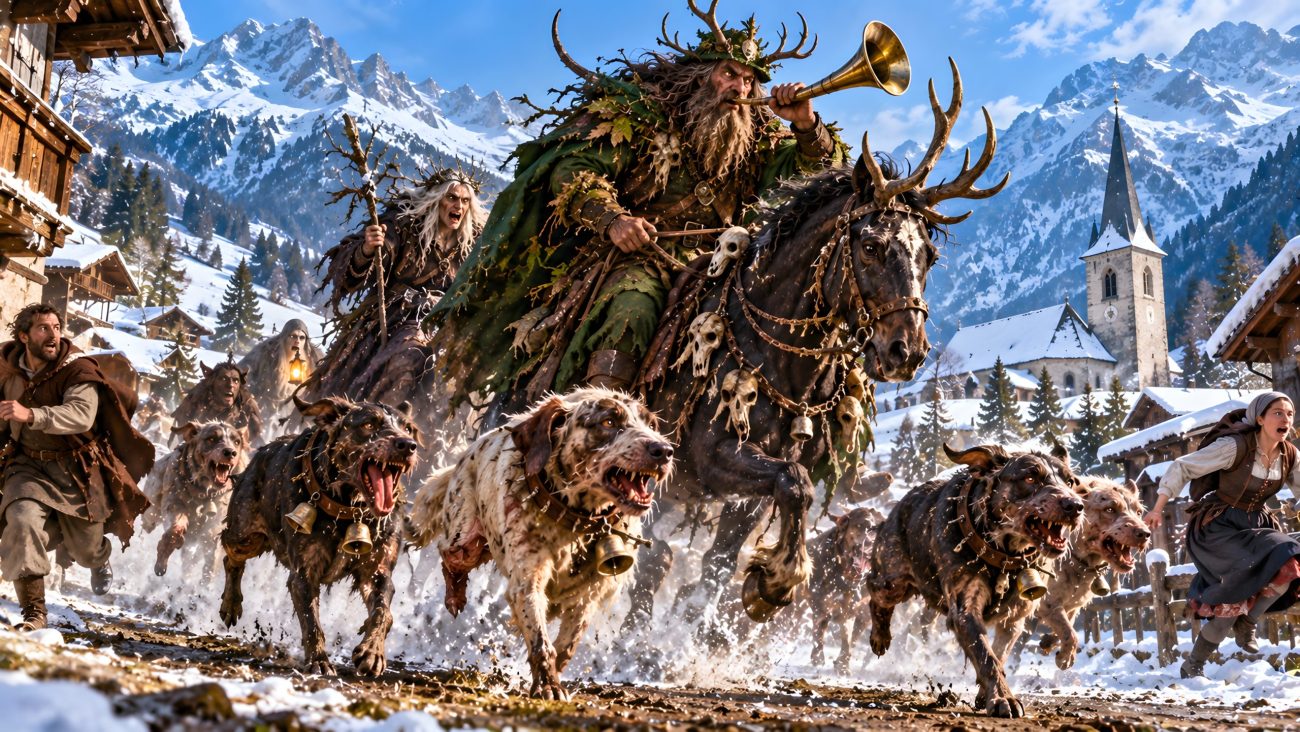
Türst is a terrifying supernatural huntsman from the agricultural communities of Lucerne, Switzerland. He appears during the stormy months leading up to Epiphany, riding through villages while blowing his hunting horn. He is accompanied by a fearsome pack of hunting dogs, each with only three legs. In some regions, he wears a green hunting costume, while his followers take the form of strange beasts that are half dog and half pig. His arrival is marked by violent weather, the sound of his horn, and the baying of his supernatural hounds.

Türst is dangerous to anyone who crosses his path. He warns careless pedestrians to move aside, shouting, “Three steps to the right, get out of my way!” Anyone who fails to obey in time risks being swept into the hunting procession and transformed into one of his three-legged dogs. His wild hunt can also terrorize livestock, particularly dairy cows, frightening them so severely that they become sick and stop producing milk. Farmers therefore fear his passage and take precautions to protect their animals and property.

Türst is sometimes accompanied by his wife, Sträggele, a hideous witch who shares his frightening nature. In Horw, his retinue also includes a one-eyed leading hound and the ghost of a deceased parson’s mistress, whose eyes glow in the darkness. To protect themselves, people in some villages erect crosses, believing that these can ward off the huntsman and his followers. If a cross falls, misfortune is expected to continue until it is restored. In Ettiswil, farmers leave their barn doors open so that Türst can pass through unhindered, fearing that his invisible forces might otherwise tear them apart. His stormy procession remains a dreaded presence, bringing terror to villages, threatening livestock, and punishing anyone who obstructs his hunt.


Sources

“Türst.” Wikipedia: The Free Encyclopedia. Wikimedia Foundation. Accessed October 12, 2026. https://en.wikipedia.org/wiki/T%C3%BCrst

Wild’ Bauerng’fahr

Tradition: Swiss Mythology
Alternative Names: The Wild Farmers’ Ride, Wild Peasant Procession
Category: Ghost


The Myth

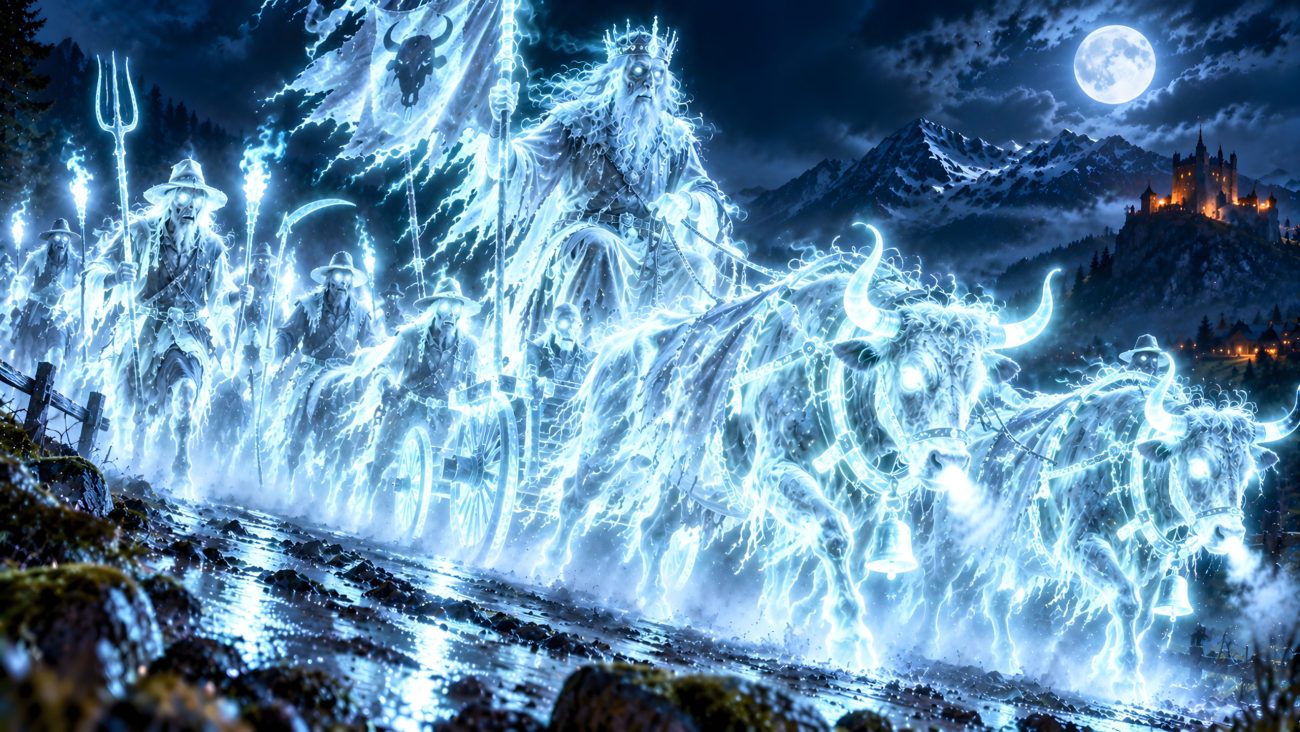
Wild’ Bauerng’fahr, meaning “The Wild Farmers’ Ride,” is a terrifying supernatural procession said to haunt the road between Nauders and Ramis in the Engadine region. During its passage, violent storms disturb the air, while the dreadful bellowing of oxen echoes through the darkness. The procession is believed to consist of the ghost of a cruel lord, his oxen, and the evil spirits of his servants. Its appearance recalls a grim episode of tyranny, murder, and rebellion from long ago.

In former times, a fierce and miserly lord lived in the great castle at Ramis and another castle at Nauders. He held the farmers of Nauders and other Tyrolean communities in captivity, treating them worse than cattle. The farmers secretly planned to free themselves from his oppression. One day, a farmer borrowed the lord’s oxen in exchange for a sack of grain, intending to keep them until his fieldwork was finished. When the lord demanded their return, the farmer delayed him with promises of more grain. Two days later, the lord himself arrived to collect the oxen and payment.

The farmer led the lord into his barn and showed him a pile of rye. As the lord bent down to inspect the grain, the farmer struck him over the head, killing him. His blood spilled across the rye. The farmer then raised a flag, and the neighbouring farmers rushed to the lord’s castle, broke through its defences, defeated the garrison, and won their freedom. Yet the memory of the violent lord and his servants did not disappear. Their evil spirits continue to haunt the road in a stormy procession, accompanied by the bellowing of oxen—a supernatural reminder of the tyrant’s cruelty and the farmers’ bloody struggle for liberation.


Sources

“Bauerngfahr.” SAGEN.at – Tiroler Sagen. Reproduced by SAGEN.at. https://www.sagen.at/texte/sagen/oesterreich/tirol/alpenburg/bauerngfahr.html


Herwisch

Tradition: Swiss Mythology, German Mythology
Alternative Names: Herwisch
Category: Flame


The Myth

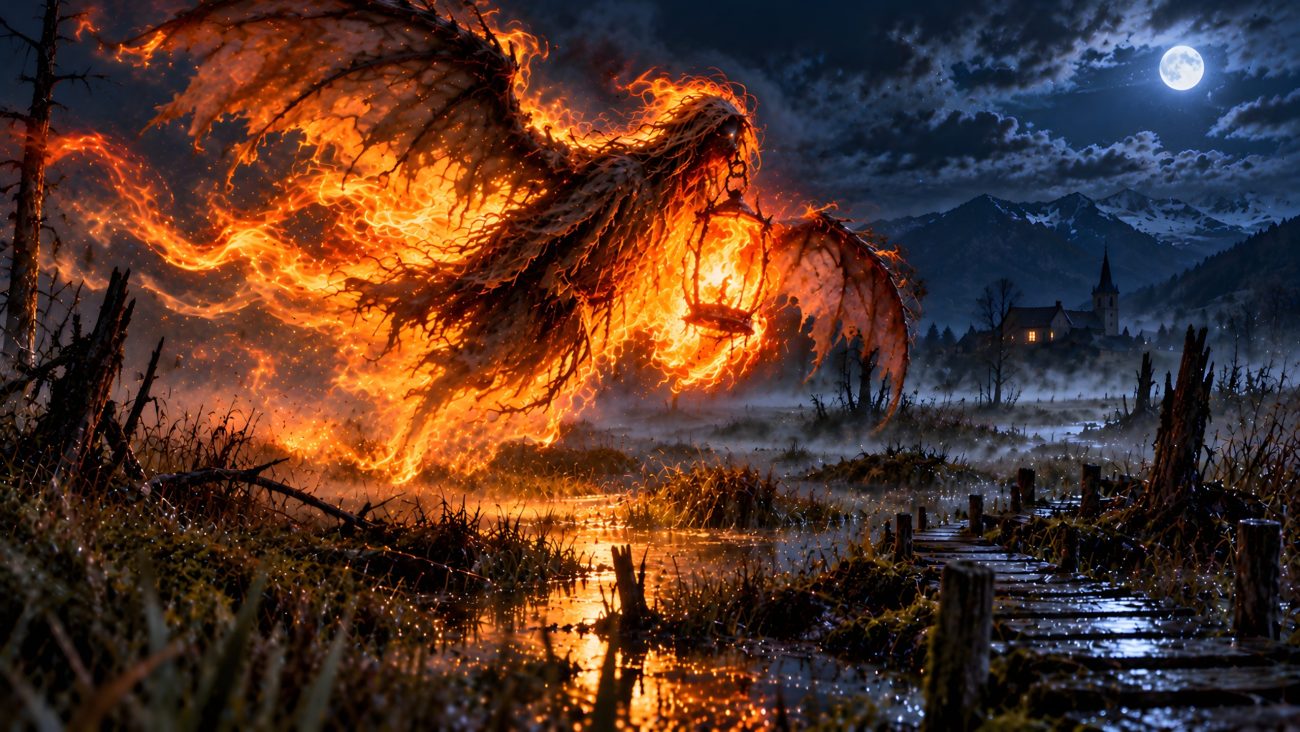
The Herwisch is a mysterious supernatural being resembling a will-o’-the-wisp, known in the folklore of Switzerland and Germany. It inhabits marshes and other waterlogged landscapes, emerging at night with a lantern-like light. By illuminating the darkness, the Herwisch lures unsuspecting travellers away from safe paths and into treacherous waters, where they may stumble, become trapped, or struggle helplessly in the marsh.

The Herwisch is not always content merely to mislead travellers. Those who mock or anger it risk provoking its more frightening nature. In such cases, the creature chases its offender and flaps its wings directly into their face, terrifying them with its sudden pursuit. Its combination of deceptive lights and aggressive behaviour makes the Herwisch a dangerous presence in the darkness, particularly for people crossing isolated wetlands at night.


Sources

“Swiss folklore.” Wikipedia: The Free Encyclopedia. Wikimedia Foundation. Accessed October 11, 2026. https://en.wikipedia.org/wiki/Swiss_folklore


Fairy of Vallorbe

Tradition: Swiss Mythology
Alternative Names: The White Lady
Category: Fairy


The Myth

The fairies of the Jura near Vallorbe were beautiful women who lived in a great subterranean grotto hidden among the steep cliffs. They were tall and graceful, wearing long white dresses that covered their feet, and their most remarkable feature was their abundant golden hair, which flowed around their shoulders like a cloak. They possessed beautiful voices and could sing the local songs of Vallorbe and Romainmôtier. One fairy could sometimes be seen on Palm Sunday leading a white lamb when the coming year would be prosperous, or a black goat when hardship and famine were approaching. Another bathed at midnight in the blue pool of the Orbe spring, guarded by two powerful wolves. During the cold winter months the fairies sometimes entered the deserted village smithy after the apprentices had gone home, warming themselves by the fire until a rooster’s crow warned them that the blacksmiths were returning.

Among the people of Vallorbe lived an eighteen-year-old blacksmith’s apprentice named Donat. He was handsome, skilled, and daring, but also boastful, cheeky, and unable to keep a secret. Having heard many stories about the fairies in the cliffs, he secretly decided to enter their grotto. One Sunday morning he climbed through the rocks and brambles and entered the cave, eventually reaching a second chamber where he found a simple bed of moss and bracken. He fell asleep there, only to awaken before a beautiful white-clad fairy with golden hair and two delicate greyhounds beside her. She offered him a place beside her and promised that she would make him happy for a hundred years, teach him the secrets of precious metals and healing herbs, and introduce him to her sisters in the caves of Montcherand. Donat accepted. She gave him two purses, promising to place a gold coin in one and a pearl in the other each day that he pleased her. At midday, a small locked tomb opened and allowed him into her hidden dining chamber, where she served him an extraordinary feast of trout, venison, cream, honey, wine, and mountain fruits. She entertained him with stories and songs, but after every meal she disappeared through a particular door and strictly forbade him from following her. She warned that if he entered the chamber without permission, she would be forced to send him away forever.

Donat’s curiosity eventually became stronger than his obedience. On the sixteenth day, after the fairy had been especially kind to him, he followed her through the forbidden door, which she had deliberately left slightly open. Inside he found her sleeping peacefully on a bed of red velvet. Her white dress had shifted slightly, revealing that one of her feet had no heel and was shaped like a goose’s foot. One of her greyhounds suddenly barked, waking her. The fairy saw Donat and sadly told him that he had failed her test. Had he remained faithful for the entire month, she would have made him her husband and shared her power, secrets, and riches with him. Instead, she ordered him to return to his life at the smithy, though she allowed him to keep the two purses and warned him never to reveal what he had seen. As he left the grotto, a voice called after him: “Donat, secrecy or punishment!” But when Donat returned to Vallorbe, he immediately boasted to the other apprentices about the fairy, her treasures, and even her strange foot. When they mocked him and demanded proof, he opened the two purses. The gold he had been given had become nothing but lingonberry leaves, while the pearls had turned into juniper berries. Overcome with shame, Donat left Vallorbe, and nothing more was ever heard of him.


Sources

“Feengrotte.” SAGEN.at – Traditionelle Sagen aus der Schweiz. Reproduced by SAGEN.at.
https://www.sagen.at/texte/sagen/schweiz/allgemein/feengrotte.html


Little Man of Iwi

Tradition: Swiss Mythology
Alternative Names: The Rent
Category: Dwarf


The Myth

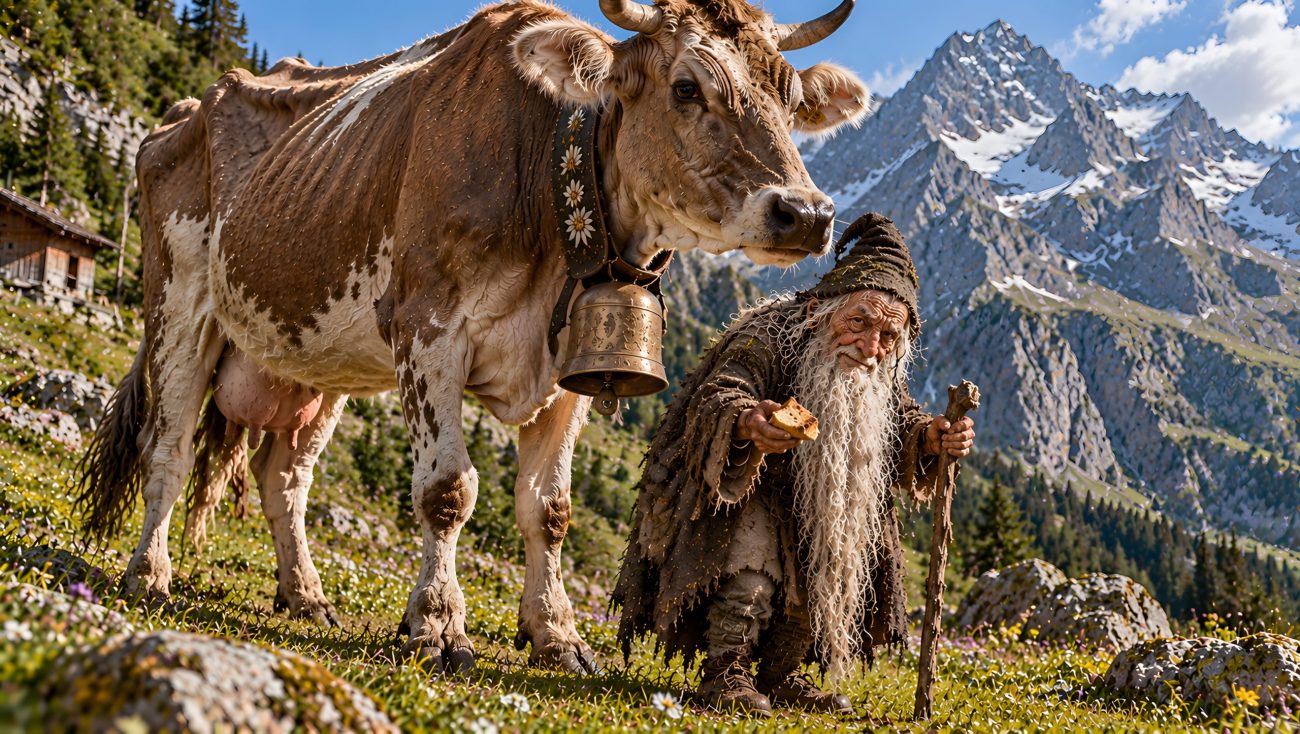
Beneath the gloomy Giswil mountain in Unterwalden lies the beautiful alpine pasture of Iwi, covered throughout the summer with mountain flowers. One day, a prosperous farmer brought his herd of thirty cows up to the pasture. While he was preparing to milk them, a strange little man emerged from the Giswil Stock. He had a long white beard, an ancient face, and old-fashioned clothing. The little man politely asked the farmer to lease him a cow for the summer. The farmer was reluctant, but remembered a thin, sickly cow from Uri that he expected would soon die anyway. He agreed to give it to the little man, provided that both the cow and its rent were returned on Michaelmas. The farmer even wanted to remove the cow’s bell, but finally allowed the little man to take it as well. He watched the strange figure disappear up the mountain with the scrawny animal, convinced he would never see either of them again.

Yet the little cow did not die. Later that summer the farmer spotted it grazing high among the steep chamois pastures of the Giswil mountain, apparently thriving where he thought only chamois could safely graze. Meanwhile, the farmer’s own herd prospered wonderfully. His cows became strong, plump, and glossy, while the cattle of his neighbors suffered from sickness and became thin and bristly. When Michaelmas arrived and the farmer had returned to the lower Iwi pasture, he suddenly heard the beautiful ringing of a cowbell. The little mountain man came walking toward him with a magnificent cow whose coat shone like silk and whose back was perfectly straight. He reminded the farmer that this was the cow he had taken for the summer and asked how much rent he now owed. The farmer could hardly believe that the splendid animal was the same miserable cow he had given away in spring. Astonished, he refused to demand any payment and even offered another cow for the following summer. But the little man said he had no need of another, for he now possessed enough milk and cheese for the rest of his life.

Instead, the little man handed the farmer a small piece of roasted cheese as the rent for the cow. He warned him never to eat it all, because it would always replenish itself. The farmer laughed in disbelief, but the little man exclaimed, “Thio and liog!”—“Do it, and then you’ll see!”—and vanished, running nimbly up the Giswil Stock like a little spider. That evening the farmer and his wife tasted the cheese and found it extraordinarily delicious. Whenever they ate some, the piece became whole again, exactly as it had been before. They shared it with their neighbors, and the miraculous cheese continued to replenish itself for about two years. But eventually the farmer had a tailor and a shoemaker working in his house at the same time. He served them the enchanted cheese for supper, and they enjoyed it so much that, while the farmer was not looking, they ate the entire piece. The magic immediately failed, and no matter how much the farmer scolded them, the cheese would never grow back again.


Sources

“Lehenzins.” SAGEN.at – Traditionelle Sagen aus der Schweiz. Reproduced by SAGEN.at. https://www.sagen.at/texte/sagen/schweiz/allgemein/lehenzins.html


Mountain Man of Schillingsdorf

Tradition: Swiss Mythology
Alternative Names: The Little Mountain Man
Category: Dwarf


The Myth

The Little Mountain Man was a small, ancient man with a long gray beard, a black feathered hat, and kind blue eyes. He carried a walking stick and wore a coat that was soaked through by the rain. He appeared during a terrible storm that descended upon the village of Schillingsdorf, where thunder shook the mountains, lightning filled the sky, and torrents of water rushed down the valleys.

As the storm raged, the little man entered the village seeking shelter. He went from house to house, asking only for a place to spend the night, but the inhabitants repeatedly turned him away. Some spoke harshly to him, calling him a beggar, while one farmer even drove him away with blows. At last, the little man reached a poor cottage belonging to an old couple. Unlike everyone else, they welcomed him warmly, gave him dry clothes, milk and cheese, baked him a cake, and prepared a warm bed for him. Deeply moved by their kindness, the little man stepped outside before going to sleep and called out through the storm: “The castle is split! Schlegel and Weggen are dead, Schillingsdorf must perish!” He then returned to the cottage and stayed with the old couple through the night.

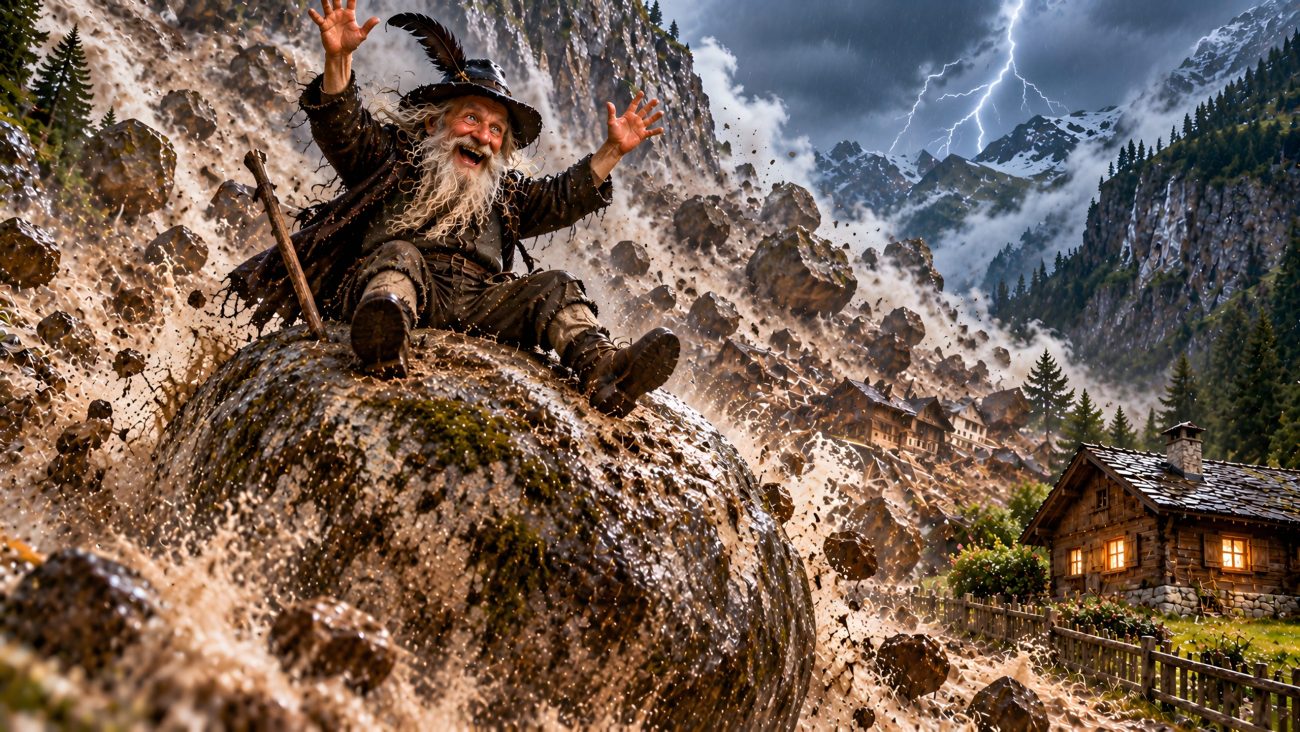
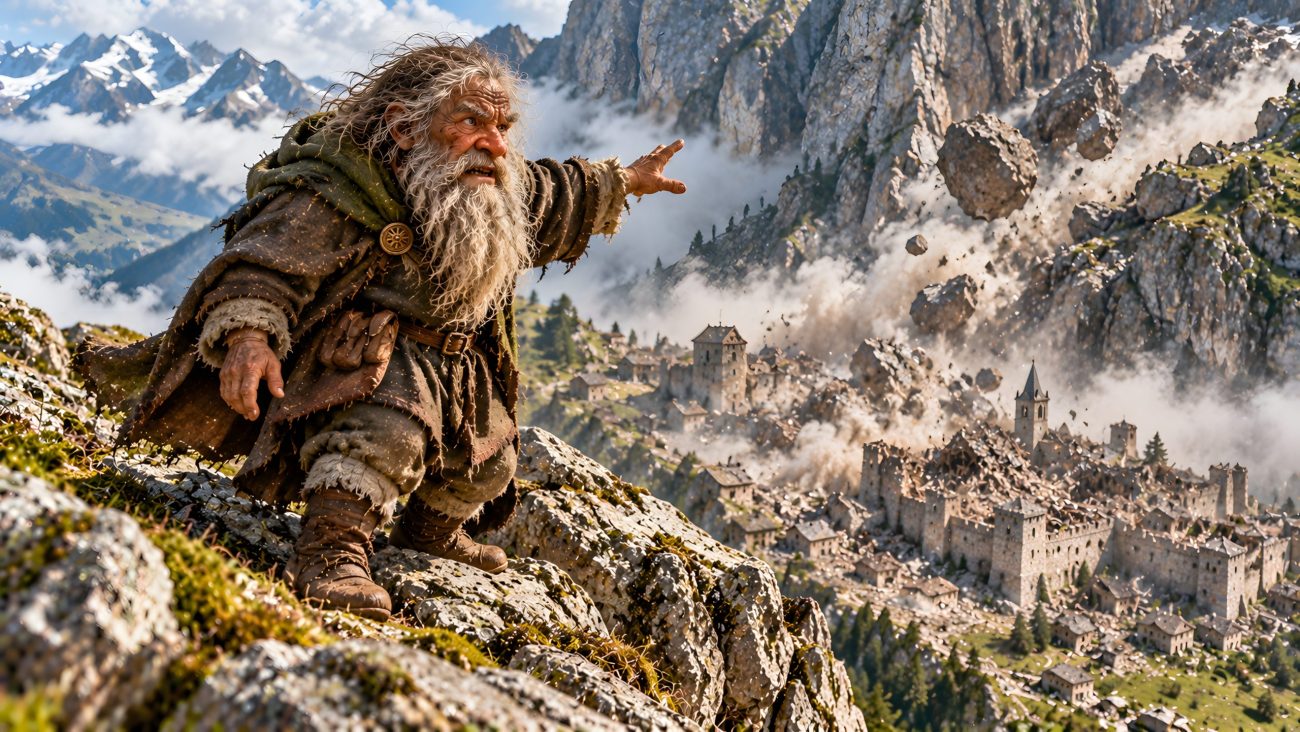
By morning, the strange guest had disappeared. The rain had continued throughout the night, and the people of Schillingsdorf gathered at their doors to see the devastation around them. Suddenly the mountains began to shake, and a gigantic section of rock broke loose above the village. The landslide came crashing down toward Schillingsdorf, while the little mountain men hidden among the cliffs cried out in triumph. Amid the enormous rocks, the villagers saw the old man sitting upon a gigantic boulder, steering it downhill with his walking stick like an oar. The great boulder rolled directly toward the cottage of the poor couple who had sheltered him. When it reached their home, the little man planted his stick before it, and the enormous stone stopped as though it had grown into the ground. The landslide then divided around the cottage and swept over the rest of Schillingsdorf, burying its houses, barns, people, and livestock beneath the rubble. Only the kind-hearted couple and their cottage were spared, while the rest of the village disappeared forever beneath the stones.


Sources

“Schillingsdorf.” SAGEN.at – Traditionelle Sagen aus der Schweiz. Reproduced by SAGEN.at. https://www.sagen.at/texte/sagen/schweiz/allgemein/schillingsdorf.html


Earth Dwarf

Tradition: Swiss Mythology
Alternative Names: Erdmännchen, Erdmanndli
Category: Dwarf


The Myth

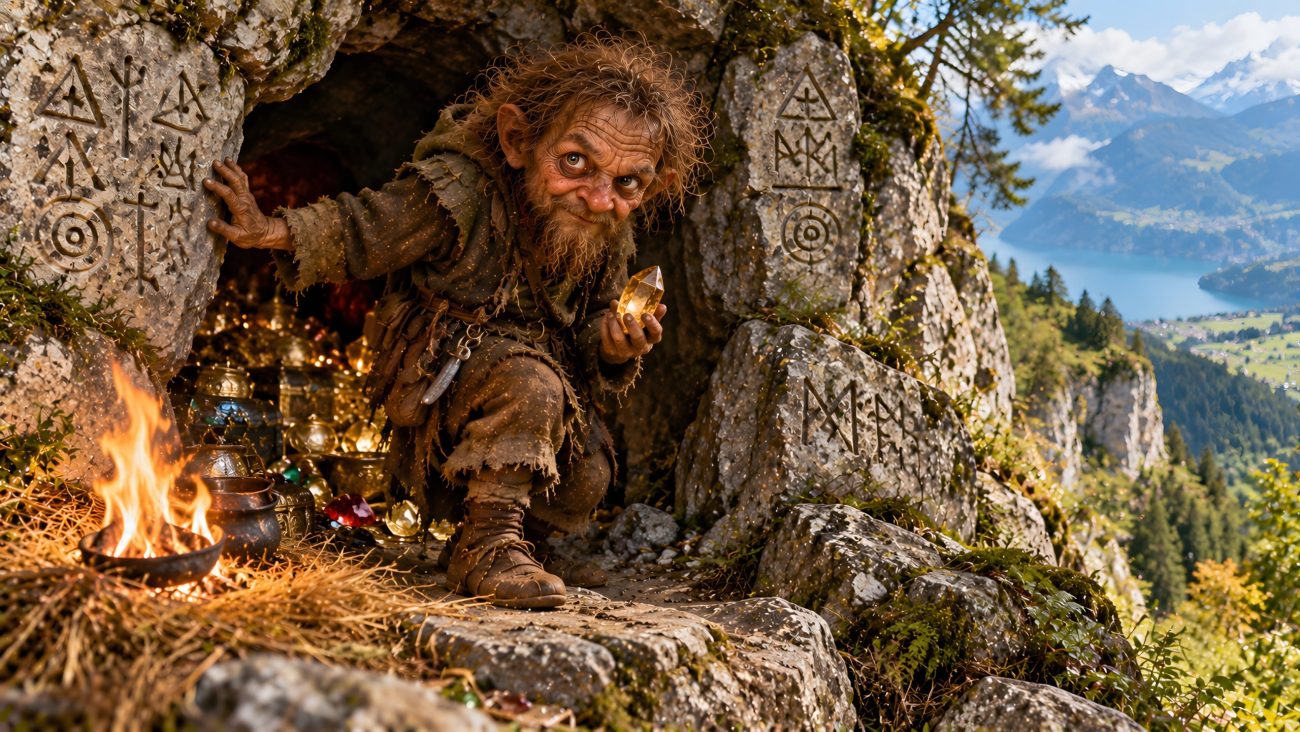
The Earth Dwarfs were small, nut-brown beings who lived in rocky caves and crevices throughout the Zug region. They were especially associated with the Baarburg and the rocky areas of the Walchwilerallmend near the Gniepenfluh, where they made their homes among the bushes and holes in the stone. They were incredibly agile, able to climb trees with the speed of an arrow and slip into their caves as quickly as a weasel. The dwarfs were also known for carving mysterious letters and signs into the surrounding rock.

The Earth Dwarfs were skilled in strange and unusual arts. They could cook their food on hay and straw without setting it alight, and in Menzingen they were even said to burn the Wied on a bundle of straw without causing the straw itself to catch fire. Beneath the rocks they maintained extensive networks of caves, where they carefully guarded enormous treasures of gold and silver together with countless glittering precious stones.

The dwarfs did not all treat their treasure in the same way. Some were generous and gave from their immense wealth to poor and needy people, while others guarded their riches jealously and watched over them with great suspicion. Anyone who ventured too close to their hidden hoards could be frightened away by these secretive dwarfs, who were determined to keep their underground treasures out of human hands.


Sources

“Das Erdmännchen.” SAGEN.at – Traditionelle Sagen aus der Schweiz (Kanton Zug). Reproduced by SAGEN.at. https://www.sagen.at/texte/sagen/schweiz/zug/erdmaennchen.html


Dwarf of Roll

Tradition: Swiss Mythology
Alternative Names: The Mountain Sprite of Roll
Category: Dwarf


The Myth

The dwarf of Roll was a little mountain sprite who lived among the mountains above Lake Thun. One evening, just before the inhabitants of the town of Roll went to bed, the little dwarf came down from the mountain and asked the townspeople for lodging. The people of Roll turned him away, refusing to offer the stranger a place to stay. Only the inhabitants of Rallig Castle welcomed him and gave him shelter for the night.

The following morning, the dwarf climbed to the summit of the pointed Giebelfluh cliff and delivered a terrible warning to the people below:

“City of Roll, come with your people!
The pointed peace is split;
mallet and path are held,
come on, to the Stampach!”

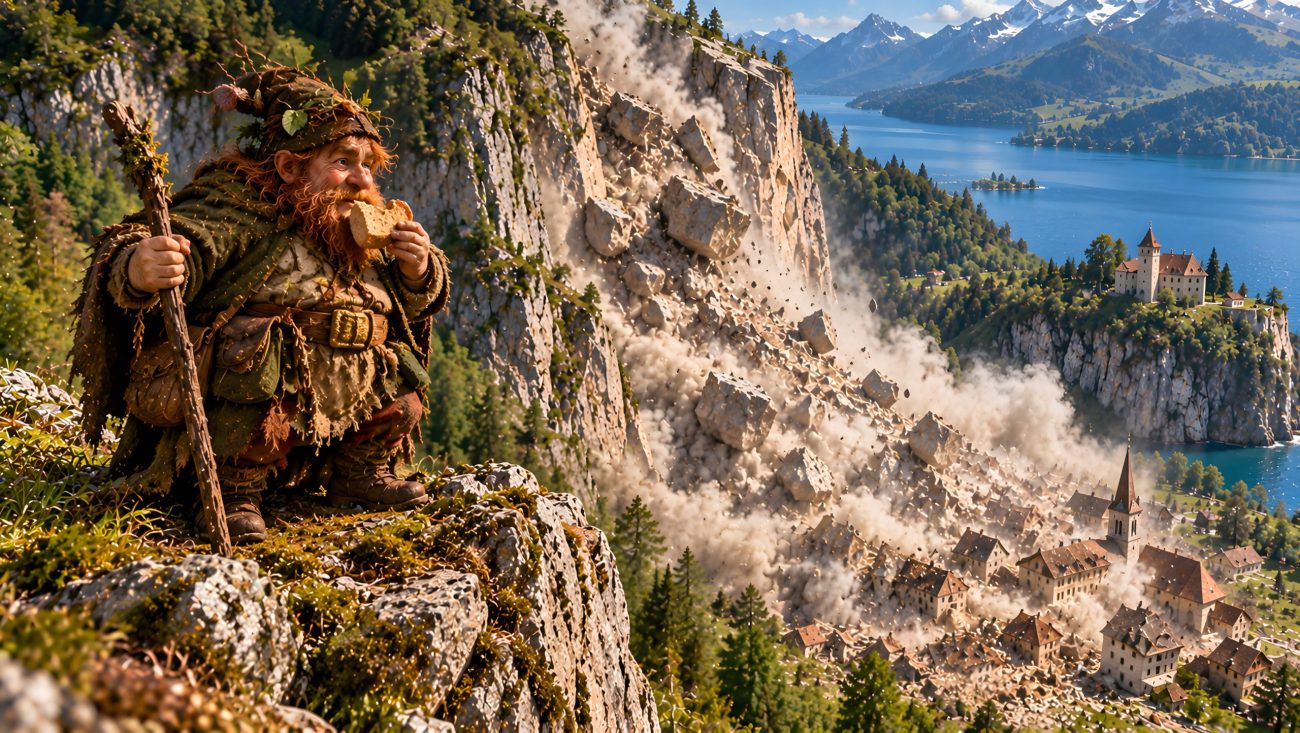
But the people of Roll paid no attention to his words. Soon afterward, the great cliff began to break apart. A massive section of the fractured mountain tore loose and came crashing down upon the town, burying Roll and its inhabitants beneath the enormous landslide. The destruction was so complete that only a wasteland remained where the town had once stood.

The inhabitants of Rallig Castle were the only people spared, saved because they had shown hospitality to the little mountain dwarf when everyone else had rejected him. Even afterward, the ruined place remained almost empty, with only a shepherd and his flock moving across the sparse pasture where the town had once stood.


Sources

Theodor Vernaleken. “Roll.” In Kinder- und Hausmärchen in den Alpenländern. Vienna, 1863. Reproduced by SAGEN.at. https://www.sagen.at/texte/sagen/vernaleken/roll.html


Dwarf of Bösälgäu

Tradition: Swiss Mythology
Alternative Names: The Mountain Men of Bösälgäu
Category: Dwarf


The Myth

The mountain dwarfs of Bösälgäu lived among the high mountains of the Bernese Oberland, where an ancient city once stood on the mountain terrace where only small alpine huts remain today. The dwarfs were said to protect the city and occasionally came down from the mountains to visit its people. They helped the inhabitants, encouraged peace and unity, and watched over the city as long as its people lived well together.

But eventually greed, arrogance, quarrels, and immorality spread through the city. The mountain dwarfs saw what was happening and warned the inhabitants that disaster was coming. Their terrible warning was:

“D’Furggefluh is split,
Schlegel and Wegge are cold,
whoever wants to flee, run!”

Those who understood the warning fled from the city as quickly as they could. The others remained behind, and soon the mountains themselves seemed to turn against them. The city collapsed beneath a tremendous fall of rock, burying its inhabitants beneath the rubble. The old city disappeared completely, leaving only the small mounds of earth that shepherds later pointed out as the supposed remains of its walls.

After the destruction of Bösälgäu, the mountain dwarfs vanished as well. They were never again seen among the people, and the ancient city remained buried beneath the mountains.


Sources

Theodor Vernaleken. “Böselgäu.” In Kinder- und Hausmärchen in den Alpenländern. Vienna, 1863. Reproduced by SAGEN.at. https://www.sagen.at/texte/sagen/vernaleken/boeselgaeu.html


Dwarf of Gadmen

Tradition: Swiss Mythology
Alternative Names: –
Category: Dwarf


The Myth

The dwarfs of Gadmen had a custom of sitting together on a large rock, where they could watch the farmers working in the surrounding countryside. The little mountain folk regularly came to the rock and quietly observed the people below.

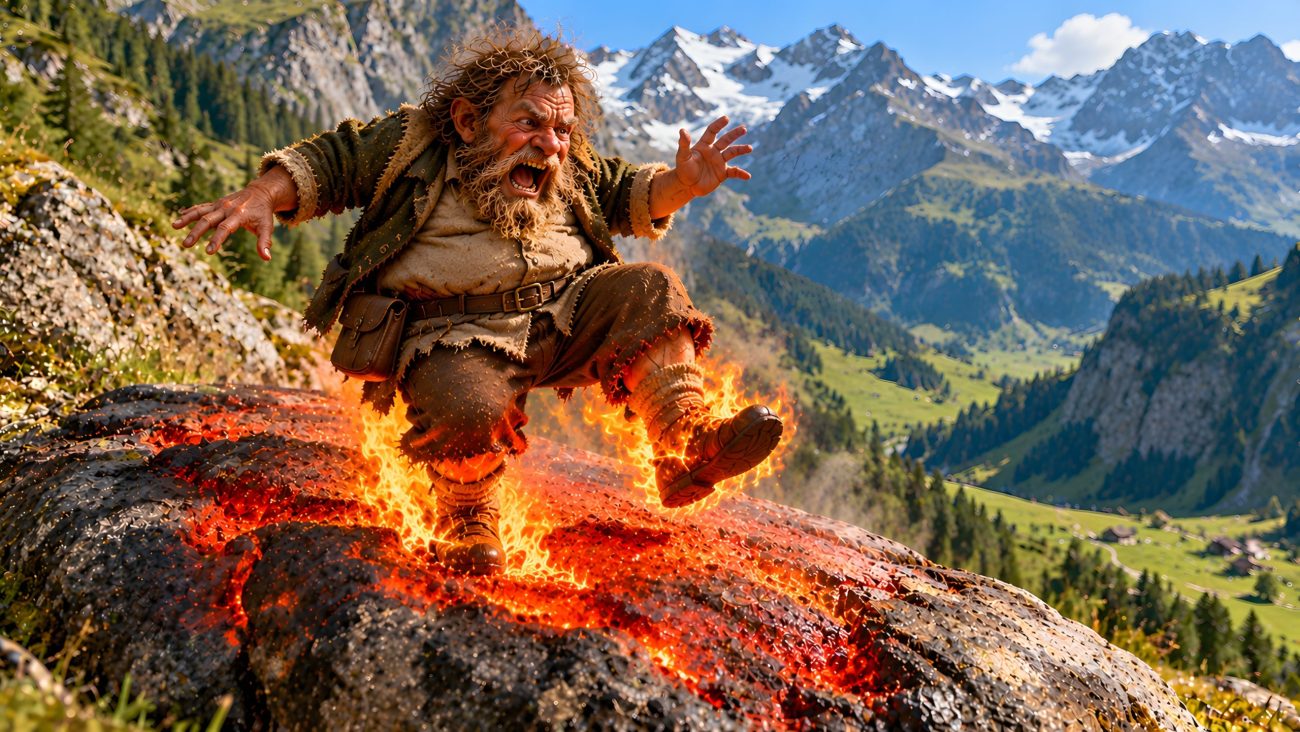
One day, a few scoundrels decided to play a cruel trick on them. They built a fire directly on the rock and allowed it to burn until the stone became red-hot. They then swept away the coals and left the place looking completely harmless. The next morning, the unsuspecting dwarfs returned to their usual rock and sat down upon it, only to burn themselves terribly on the heated stone.

The dwarfs cried out in anger at the treachery, but the surviving account ends with their angry reaction and gives no further details of what became of them.


Sources

“Die Zwerge auf dem Felsstein.” SAGEN.at – Traditionelle Sagen aus Deutschland. Reproduced by SAGEN.at. https://www.sagen.at/texte/sagen/grimm/zwergeaufdemfelsstein.html