Little Man of Iwi

Tradition: Swiss Mythology
Alternative Names: The Rent
Category: Dwarf


The Myth

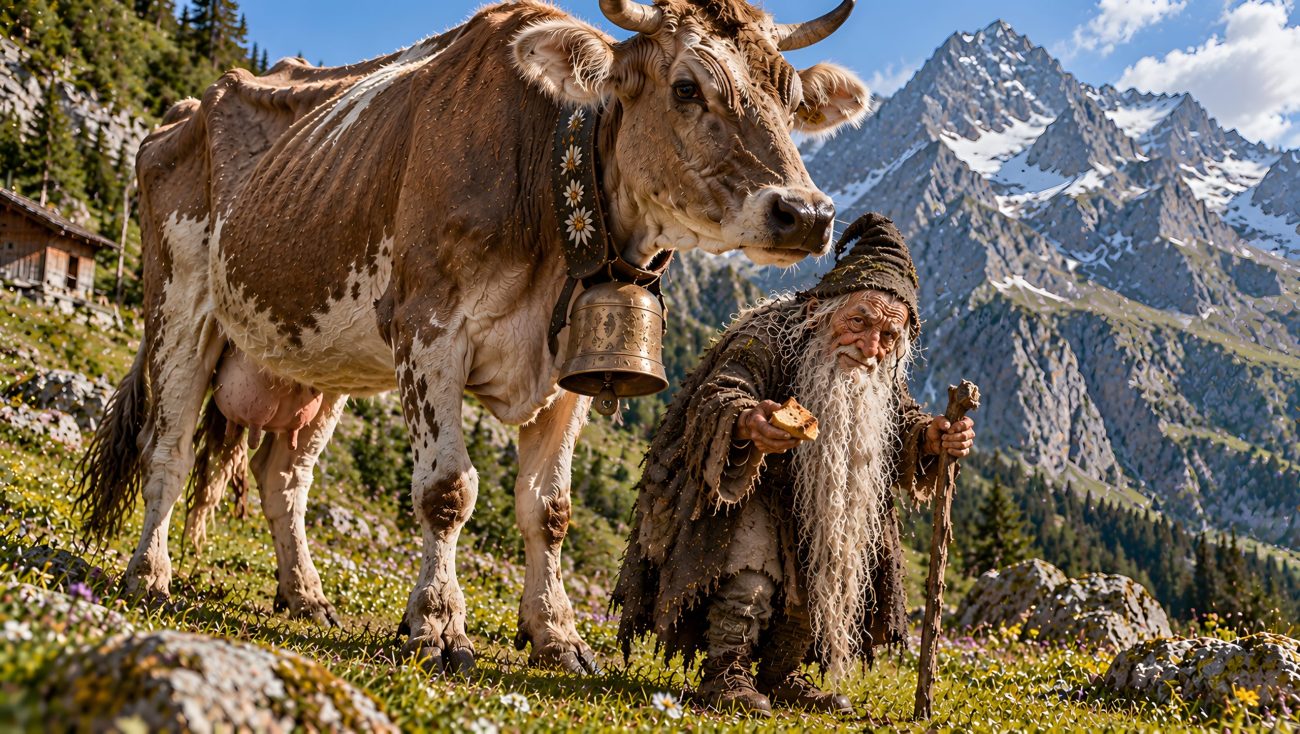
Beneath the gloomy Giswil mountain in Unterwalden lies the beautiful alpine pasture of Iwi, covered throughout the summer with mountain flowers. One day, a prosperous farmer brought his herd of thirty cows up to the pasture. While he was preparing to milk them, a strange little man emerged from the Giswil Stock. He had a long white beard, an ancient face, and old-fashioned clothing. The little man politely asked the farmer to lease him a cow for the summer. The farmer was reluctant, but remembered a thin, sickly cow from Uri that he expected would soon die anyway. He agreed to give it to the little man, provided that both the cow and its rent were returned on Michaelmas. The farmer even wanted to remove the cow’s bell, but finally allowed the little man to take it as well. He watched the strange figure disappear up the mountain with the scrawny animal, convinced he would never see either of them again.

Yet the little cow did not die. Later that summer the farmer spotted it grazing high among the steep chamois pastures of the Giswil mountain, apparently thriving where he thought only chamois could safely graze. Meanwhile, the farmer’s own herd prospered wonderfully. His cows became strong, plump, and glossy, while the cattle of his neighbors suffered from sickness and became thin and bristly. When Michaelmas arrived and the farmer had returned to the lower Iwi pasture, he suddenly heard the beautiful ringing of a cowbell. The little mountain man came walking toward him with a magnificent cow whose coat shone like silk and whose back was perfectly straight. He reminded the farmer that this was the cow he had taken for the summer and asked how much rent he now owed. The farmer could hardly believe that the splendid animal was the same miserable cow he had given away in spring. Astonished, he refused to demand any payment and even offered another cow for the following summer. But the little man said he had no need of another, for he now possessed enough milk and cheese for the rest of his life.

Instead, the little man handed the farmer a small piece of roasted cheese as the rent for the cow. He warned him never to eat it all, because it would always replenish itself. The farmer laughed in disbelief, but the little man exclaimed, “Thio and liog!”—“Do it, and then you’ll see!”—and vanished, running nimbly up the Giswil Stock like a little spider. That evening the farmer and his wife tasted the cheese and found it extraordinarily delicious. Whenever they ate some, the piece became whole again, exactly as it had been before. They shared it with their neighbors, and the miraculous cheese continued to replenish itself for about two years. But eventually the farmer had a tailor and a shoemaker working in his house at the same time. He served them the enchanted cheese for supper, and they enjoyed it so much that, while the farmer was not looking, they ate the entire piece. The magic immediately failed, and no matter how much the farmer scolded them, the cheese would never grow back again.


Sources

“Lehenzins.” SAGEN.at – Traditionelle Sagen aus der Schweiz. Reproduced by SAGEN.at. https://www.sagen.at/texte/sagen/schweiz/allgemein/lehenzins.html
Mountain Man of Schillingsdorf

Tradition: Swiss Mythology
Alternative Names: The Little Mountain Man
Category: Dwarf


The Myth

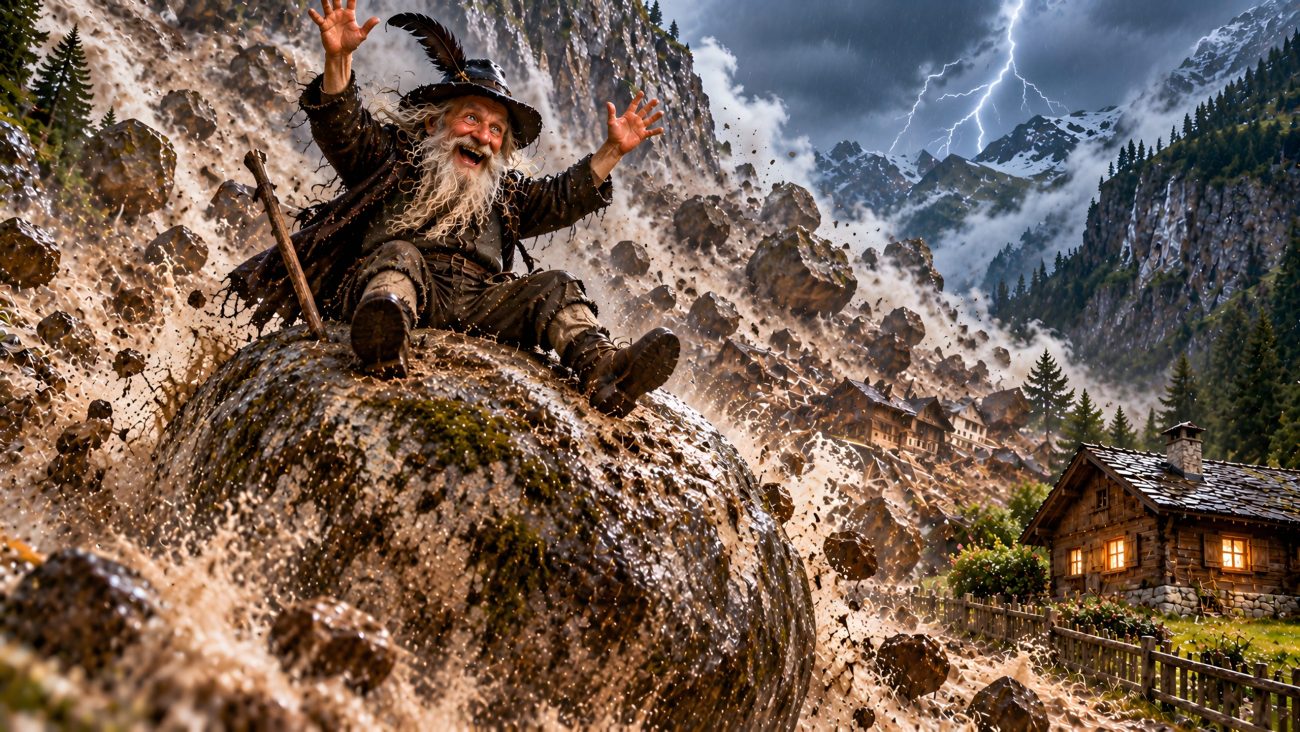
The Little Mountain Man was a small, ancient man with a long gray beard, a black feathered hat, and kind blue eyes. He carried a walking stick and wore a coat that was soaked through by the rain. He appeared during a terrible storm that descended upon the village of Schillingsdorf, where thunder shook the mountains, lightning filled the sky, and torrents of water rushed down the valleys.

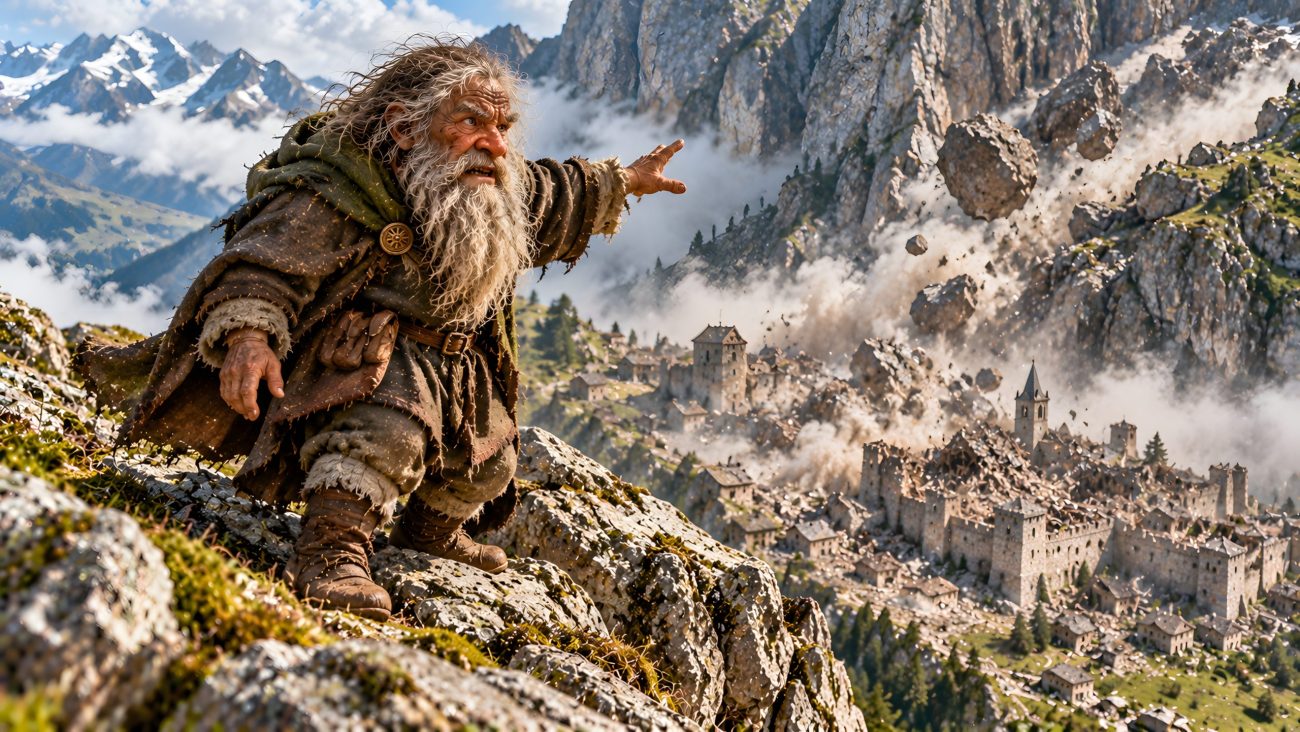
As the storm raged, the little man entered the village seeking shelter. He went from house to house, asking only for a place to spend the night, but the inhabitants repeatedly turned him away. Some spoke harshly to him, calling him a beggar, while one farmer even drove him away with blows. At last, the little man reached a poor cottage belonging to an old couple. Unlike everyone else, they welcomed him warmly, gave him dry clothes, milk and cheese, baked him a cake, and prepared a warm bed for him. Deeply moved by their kindness, the little man stepped outside before going to sleep and called out through the storm: “The castle is split! Schlegel and Weggen are dead, Schillingsdorf must perish!” He then returned to the cottage and stayed with the old couple through the night.

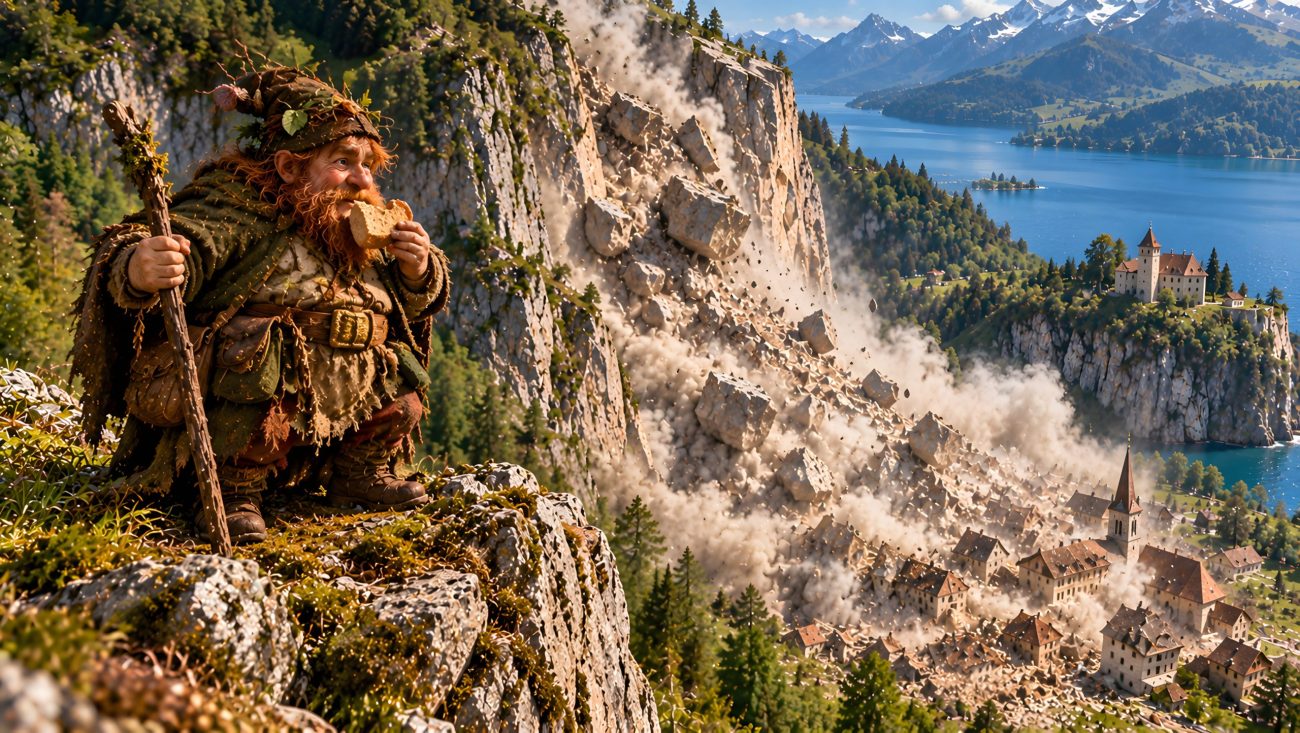
By morning, the strange guest had disappeared. The rain had continued throughout the night, and the people of Schillingsdorf gathered at their doors to see the devastation around them. Suddenly the mountains began to shake, and a gigantic section of rock broke loose above the village. The landslide came crashing down toward Schillingsdorf, while the little mountain men hidden among the cliffs cried out in triumph. Amid the enormous rocks, the villagers saw the old man sitting upon a gigantic boulder, steering it downhill with his walking stick like an oar. The great boulder rolled directly toward the cottage of the poor couple who had sheltered him. When it reached their home, the little man planted his stick before it, and the enormous stone stopped as though it had grown into the ground. The landslide then divided around the cottage and swept over the rest of Schillingsdorf, burying its houses, barns, people, and livestock beneath the rubble. Only the kind-hearted couple and their cottage were spared, while the rest of the village disappeared forever beneath the stones.


Sources

“Schillingsdorf.” SAGEN.at – Traditionelle Sagen aus der Schweiz. Reproduced by SAGEN.at. https://www.sagen.at/texte/sagen/schweiz/allgemein/schillingsdorf.html


Earth Dwarf

Tradition: Swiss Mythology
Alternative Names: Erdmännchen, Erdmanndli
Category: Dwarf


The Myth

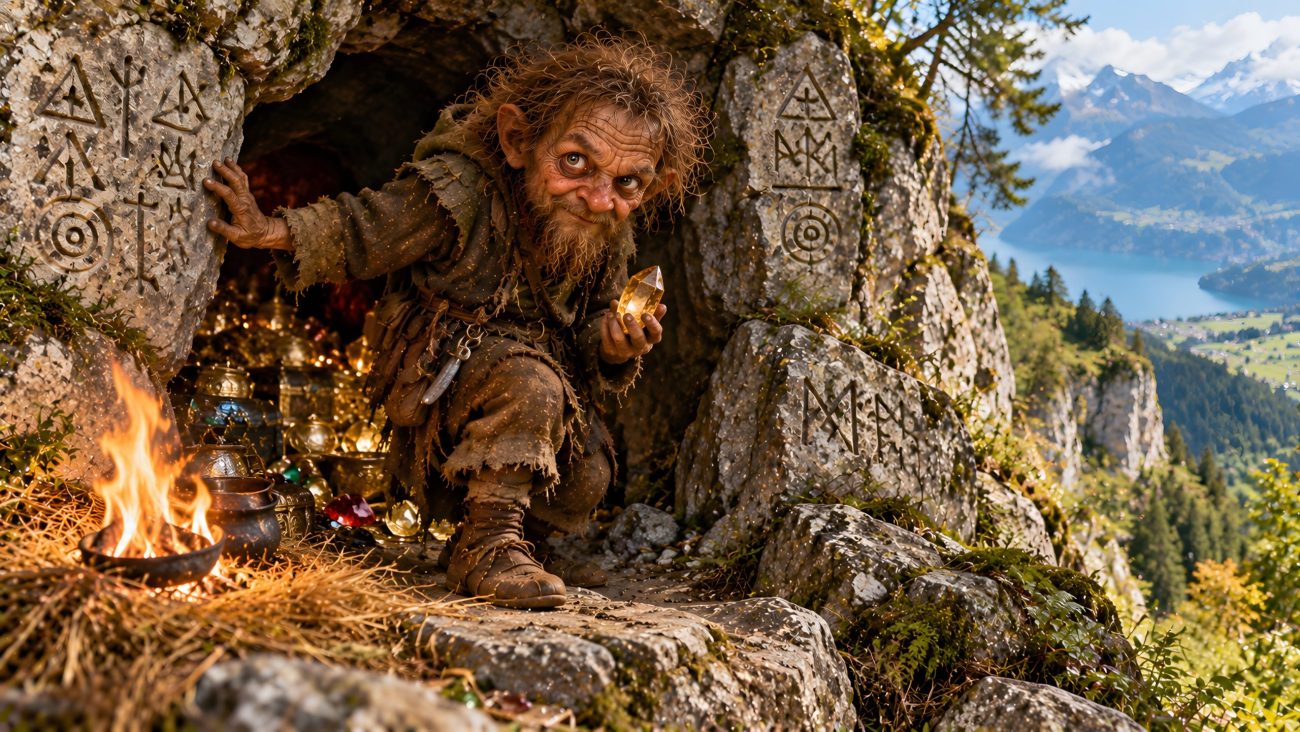
The Earth Dwarfs were small, nut-brown beings who lived in rocky caves and crevices throughout the Zug region. They were especially associated with the Baarburg and the rocky areas of the Walchwilerallmend near the Gniepenfluh, where they made their homes among the bushes and holes in the stone. They were incredibly agile, able to climb trees with the speed of an arrow and slip into their caves as quickly as a weasel. The dwarfs were also known for carving mysterious letters and signs into the surrounding rock.

The Earth Dwarfs were skilled in strange and unusual arts. They could cook their food on hay and straw without setting it alight, and in Menzingen they were even said to burn the Wied on a bundle of straw without causing the straw itself to catch fire. Beneath the rocks they maintained extensive networks of caves, where they carefully guarded enormous treasures of gold and silver together with countless glittering precious stones.

The dwarfs did not all treat their treasure in the same way. Some were generous and gave from their immense wealth to poor and needy people, while others guarded their riches jealously and watched over them with great suspicion. Anyone who ventured too close to their hidden hoards could be frightened away by these secretive dwarfs, who were determined to keep their underground treasures out of human hands.


Sources

“Das Erdmännchen.” SAGEN.at – Traditionelle Sagen aus der Schweiz (Kanton Zug). Reproduced by SAGEN.at. https://www.sagen.at/texte/sagen/schweiz/zug/erdmaennchen.html


Dwarf of Roll

Tradition: Swiss Mythology
Alternative Names: The Mountain Sprite of Roll
Category: Dwarf


The Myth

The dwarf of Roll was a little mountain sprite who lived among the mountains above Lake Thun. One evening, just before the inhabitants of the town of Roll went to bed, the little dwarf came down from the mountain and asked the townspeople for lodging. The people of Roll turned him away, refusing to offer the stranger a place to stay. Only the inhabitants of Rallig Castle welcomed him and gave him shelter for the night.

The following morning, the dwarf climbed to the summit of the pointed Giebelfluh cliff and delivered a terrible warning to the people below:

“City of Roll, come with your people!
The pointed peace is split;
mallet and path are held,
come on, to the Stampach!”

But the people of Roll paid no attention to his words. Soon afterward, the great cliff began to break apart. A massive section of the fractured mountain tore loose and came crashing down upon the town, burying Roll and its inhabitants beneath the enormous landslide. The destruction was so complete that only a wasteland remained where the town had once stood.

The inhabitants of Rallig Castle were the only people spared, saved because they had shown hospitality to the little mountain dwarf when everyone else had rejected him. Even afterward, the ruined place remained almost empty, with only a shepherd and his flock moving across the sparse pasture where the town had once stood.


Sources

Theodor Vernaleken. “Roll.” In Kinder- und Hausmärchen in den Alpenländern. Vienna, 1863. Reproduced by SAGEN.at. https://www.sagen.at/texte/sagen/vernaleken/roll.html


Dwarf of Bösälgäu

Tradition: Swiss Mythology
Alternative Names: The Mountain Men of Bösälgäu
Category: Dwarf


The Myth

The mountain dwarfs of Bösälgäu lived among the high mountains of the Bernese Oberland, where an ancient city once stood on the mountain terrace where only small alpine huts remain today. The dwarfs were said to protect the city and occasionally came down from the mountains to visit its people. They helped the inhabitants, encouraged peace and unity, and watched over the city as long as its people lived well together.

But eventually greed, arrogance, quarrels, and immorality spread through the city. The mountain dwarfs saw what was happening and warned the inhabitants that disaster was coming. Their terrible warning was:

“D’Furggefluh is split,
Schlegel and Wegge are cold,
whoever wants to flee, run!”

Those who understood the warning fled from the city as quickly as they could. The others remained behind, and soon the mountains themselves seemed to turn against them. The city collapsed beneath a tremendous fall of rock, burying its inhabitants beneath the rubble. The old city disappeared completely, leaving only the small mounds of earth that shepherds later pointed out as the supposed remains of its walls.

After the destruction of Bösälgäu, the mountain dwarfs vanished as well. They were never again seen among the people, and the ancient city remained buried beneath the mountains.


Sources

Theodor Vernaleken. “Böselgäu.” In Kinder- und Hausmärchen in den Alpenländern. Vienna, 1863. Reproduced by SAGEN.at. https://www.sagen.at/texte/sagen/vernaleken/boeselgaeu.html


Dwarf of Gadmen

Tradition: Swiss Mythology
Alternative Names: –
Category: Dwarf


The Myth

The dwarfs of Gadmen had a custom of sitting together on a large rock, where they could watch the farmers working in the surrounding countryside. The little mountain folk regularly came to the rock and quietly observed the people below.

One day, a few scoundrels decided to play a cruel trick on them. They built a fire directly on the rock and allowed it to burn until the stone became red-hot. They then swept away the coals and left the place looking completely harmless. The next morning, the unsuspecting dwarfs returned to their usual rock and sat down upon it, only to burn themselves terribly on the heated stone.

The dwarfs cried out in anger at the treachery, but the surviving account ends with their angry reaction and gives no further details of what became of them.


Sources

“Die Zwerge auf dem Felsstein.” SAGEN.at – Traditionelle Sagen aus Deutschland. Reproduced by SAGEN.at. https://www.sagen.at/texte/sagen/grimm/zwergeaufdemfelsstein.html


Cherry Tree Dwarf

Tradition: Swiss Mythology
Alternative Names: The Dwarfs of the Bernese Mountains
Category: Dwarf


The Myth

The dwarfs who lived among the ravines and hills of the Bernese countryside were friendly and kind to the people of the valley, often carrying out difficult work during the night. Farmers would arrive in the morning with their wagons and tools only to discover that much of their work had already been completed. The dwarfs would hide among the bushes nearby, laughing as the people wondered who had helped them. Sometimes their help seemed strange, for they would cut down grain before it was fully ripe, angering the farmers. But when hail and thunderstorms soon swept across the fields and destroyed everything in their path, the people understood that the dwarfs had been protecting their crops and gratefully accepted their mysterious assistance.

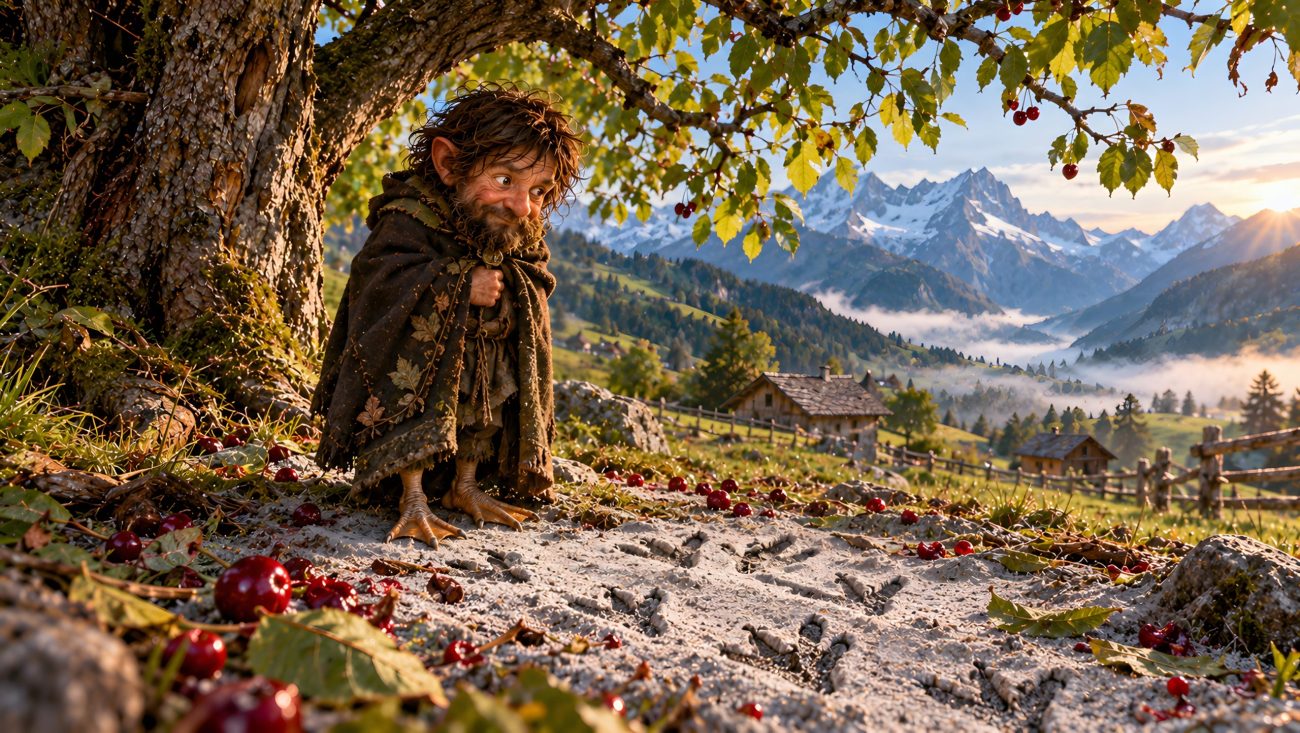
The friendship between the dwarfs and the people eventually ended because of human wickedness. A shepherd had a magnificent cherry tree high on the mountain, but every summer, when the cherries ripened, the tree was mysteriously stripped bare three nights in succession. The villagers believed the dwarfs were responsible, saying that the little beings came silently at night in long cloaks with their feet carefully covered, carrying out their work while everyone slept. The shepherd became curious about their hidden feet and wanted to discover whether they were different from human feet. The following summer, when the dwarfs once again came to harvest the cherries, he scattered ashes around the tree before going to bed. At dawn, he found that every cherry had disappeared, but the ashes revealed the secret: all around the tree were the unmistakable imprints of many goose feet.

The shepherd laughed and mocked the dwarfs, boasting that their secret had finally been discovered. The little people were furious that their hidden nature had been exposed. Soon afterward, they ransacked and destroyed their own houses before abandoning the valley and retreating deeper into the mountains. From that time onward, they refused to help humankind and were never seen again. The shepherd who had betrayed them suffered a miserable fate as well, becoming sickly and senile for the rest of his life.


Sources

“Die Füße der Zwerge.” SAGEN.at – Traditionelle Sagen aus Deutschland. Reproduced by SAGEN.at. https://www.sagen.at/texte/sagen/grimm/diefuessederzwerge.html


Little Mountain Man

Tradition: Swiss Mythology
Alternative Names: Little Mountain Spirit
Category: Dwarf


The Myth

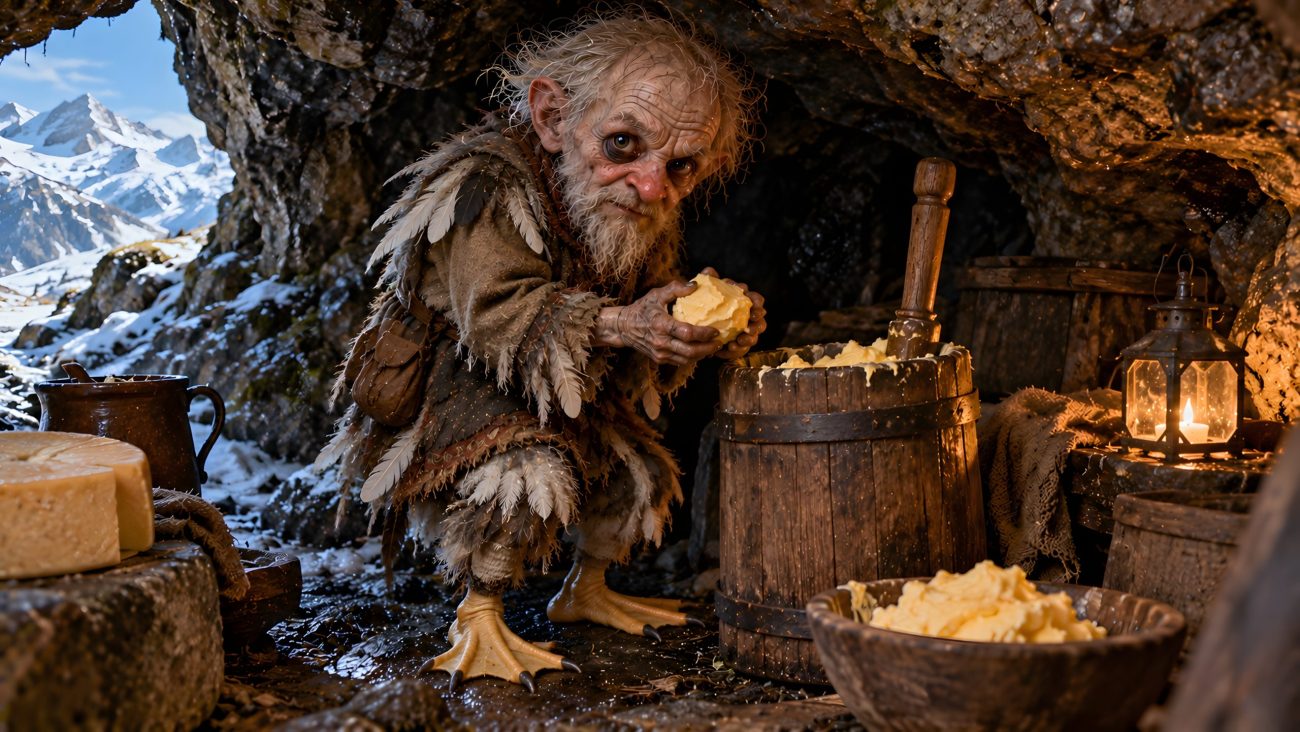
The Little Mountain Man was a tiny supernatural being with goose-like feet who lived among the mountains of Valais. He was small enough to hide inside a butter churn, and he moved about so quietly that the people he helped could never see him. An old man from Ernen owned a lonely little farm on Eggel in the Hochfluh area, where he kept his cattle during the winter. Each evening he had to climb up from Ernen to care for them, and the work became increasingly difficult as the snow deepened. One evening, exhausted after the climb, he sat beside the frozen well outside his cottage and wished aloud that someone would at least light his stove so that he could warm himself after his day’s labor. When he entered the cottage, he was astonished to find that his wish had already been fulfilled. A great log was burning brightly in the stove, the cheese had been pressed and placed neatly beneath its bricks, and the kitchen was perfectly tidy. Thinking that someone must have come to help him, he searched the parlor, but it too was empty. Yet freshly churned golden butter stood ready, the room had been swept, and everything was in perfect order. He hurried to the barn, expecting to find some helpful neighbor there, but there was no one. The cows had already been fed, groomed, and milked, and they rested contentedly on fresh straw. In the milk cellar, the milk had been placed in copper tubs and was already covered with a thick golden cream.

The old man could not understand who had done all this work. He thanked God for the mysterious help and returned to Ernen the next day. When he came back to the mountain farm that evening, everything had once again been completed before his arrival. The same thing happened day after day. The cows grew fatter, the butter and cheese grew more plentiful, and even the great haystack seemed never to lose so much as a single straw. Eventually the old man’s gratitude turned into curiosity, and he desperately wanted to see the invisible helper. He watched the house, kitchen, and stable through every crack and opening he could find, but nothing appeared. Then, near the end of winter, he finally heard the butter churn moving in the parlor. He crept closer and carefully lifted the cover. Inside the churn stood a tiny man with goose feet, quietly taking out the freshly made butter. The old man immediately understood that a little mountain spirit had been caring for his farm throughout the winter. Rather than frightening him away, he was delighted and decided to reward his mysterious helper.

He went down to Ernen and had a beautiful new coat made for the little mountain man. When he returned to the farm, he placed the coat on the table before going to bed. He intended to wake early and watch the dwarf when he discovered his gift, but he slept too long. When he finally awoke, the coat had vanished. Then he heard a voice singing outside: “Now I am a handsome man who can no longer shepherd.” With those words, the little mountain man disappeared forever.


Sources

“Das Bergmännlein.” SAGEN.at – Traditionelle Sagen aus der Schweiz. Reproduced by SAGEN.at. https://www.sagen.at/texte/sagen/schweiz/allgemein/bergmaennlein.html


Tree Dwarf

Tradition: Swiss Mythology
Alternative Names: The Dwarfs of the Hasli Valley
Category: Dwarf


The Myth

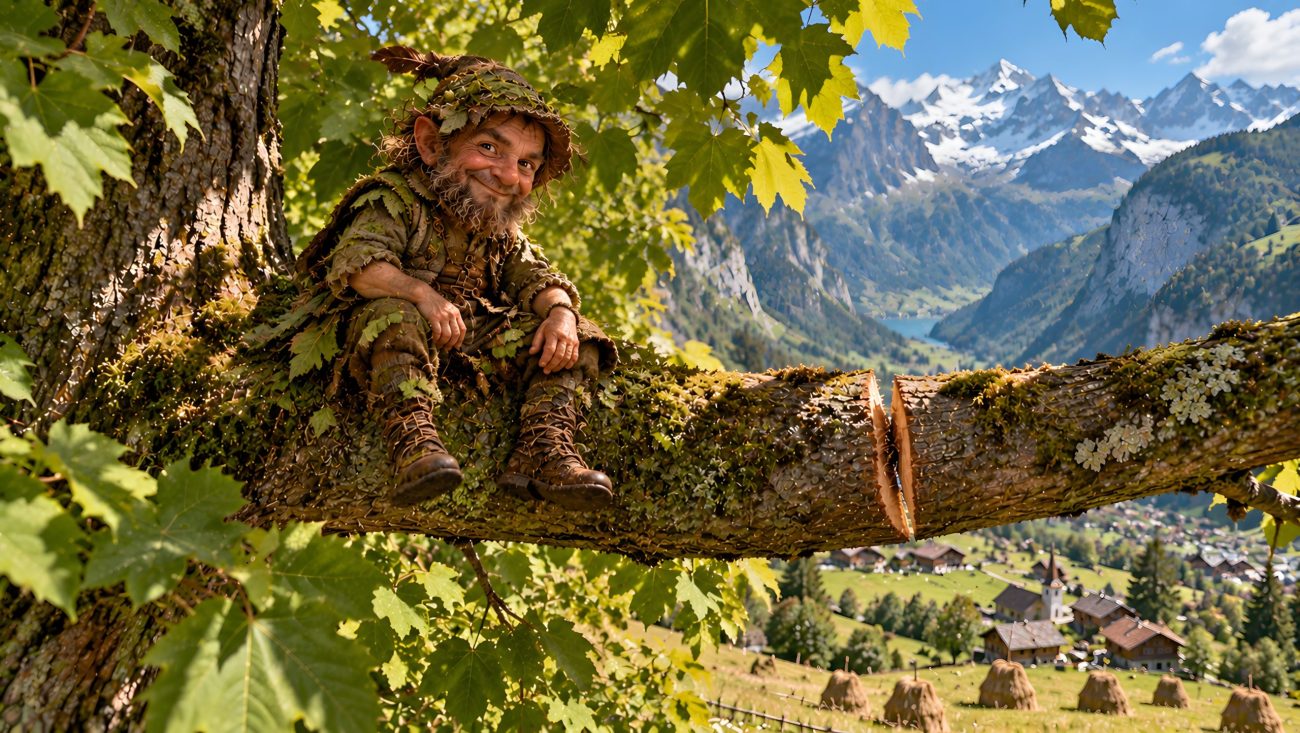
The dwarfs of the Hasli Valley were a hidden mountain folk who sometimes came down from the cliffs during summer. They would join the people working in the valley, either helping with their work or simply watching them, especially when the haymakers were busy. The dwarfs particularly enjoyed sitting together on the long, sturdy branches of a maple tree, sheltered beneath its thick green leaves.

One day, however, some wicked people decided to play a cruel trick on them. During the night they secretly sawed through one of the maple’s great branches, leaving it barely attached to the trunk. The next morning, unaware of what had been done, the dwarfs climbed onto the branch as they usually did. Suddenly it broke beneath them, sending the little mountain people tumbling to the ground. The wicked people laughed at their misfortune, and the dwarfs were furious. They cried out:

“Oh, how high the sky is
and how great the unfaithfulness!
Here today and nevermore!”

The dwarfs kept their word. From that day onward, they never again appeared among the people of the valley, disappearing forever from the country.


Sources

“Die Zwerge auf dem Baum.” SAGEN.at – Traditionelle Sagen aus Deutschland. Reproduced by SAGEN.at. https://www.sagen.at/texte/sagen/grimm/zwergeaufdembaum.html


Dwarf Woman

Tradition: Swiss Mythology
Alternative Names: Gotwärgi
Category: Dwarf


The Myth

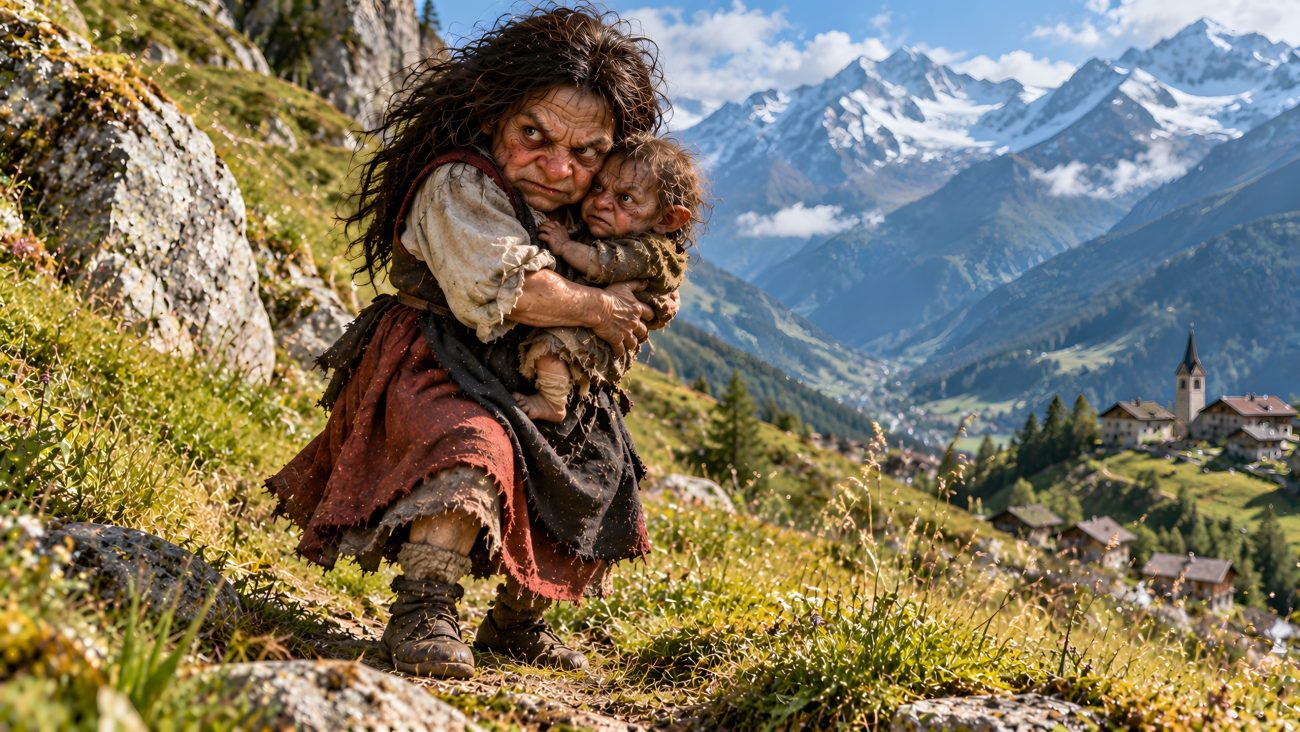
The Dwarf Woman was a small supernatural being associated with the Gotwärgi, the dwarf folk of the Valais mountains. Her child was stunted and dwarfish in appearance, unable to speak like an ordinary child, and the creature could easily be mistaken for a strange human infant.

In Zeneggen, a mother had a child who never seemed to grow properly. Despite all her loving care, it remained tiny and dwarfish, and although it appeared intelligent and understood everything she said, it never spoke a single word. Worried and unable to understand what was wrong, the mother went to her neighbor for advice. The neighbor became suspicious and told her to give the child several empty eggshell halves to play with while secretly watching what it did. The mother followed the advice, and when the child saw the eggshells, it suddenly exclaimed in amazement that it had never seen so many little pancakes before. The mother was delighted to finally hear her child speak, but her neighbor was convinced that this proved something stranger was happening. She suspected that the mother’s real child had been stolen from its cradle and replaced with a Gotwärgi, a dwarf child.

The frightened mother was told to take the strange child up the hill and beat it until its cries could be heard across the valleys, believing that this might force the dwarf people to return her real child. Although she found it almost unbearable to strike the little creature, she eventually carried it up the hill and began to beat it. The child cried out so loudly that the surrounding hills echoed with its screams. Suddenly, a little dwarf woman came rushing toward them. In her arms was a beautiful, healthy child. The mother stared in astonishment, realizing that her own child had indeed been taken. The dwarf woman immediately snatched the stunted child from the mother’s arms, placed the beautiful child in her lap, and cried, “Then you take yours and I’ll take mine, you merciless little mother!” Clutching her own dwarfish child tightly, the dwarf woman disappeared down the mountain like a chamois, while the human mother remained behind, overwhelmed with wonder and joy as she finally held her true child again.


Sources

“Die Zwergenfrau.” SAGEN.at – Traditionelle Sagen aus der Schweiz. Reproduced by SAGEN.at.
https://www.sagen.at/texte/sagen/schweiz/allgemein/zwergenfrau.html