Cherry Tree Dwarf

Tradition: Swiss Mythology
Alternative Names: The Dwarfs of the Bernese Mountains
Category: Dwarf


The Myth

The dwarfs who lived among the ravines and hills of the Bernese countryside were friendly and kind to the people of the valley, often carrying out difficult work during the night. Farmers would arrive in the morning with their wagons and tools only to discover that much of their work had already been completed. The dwarfs would hide among the bushes nearby, laughing as the people wondered who had helped them. Sometimes their help seemed strange, for they would cut down grain before it was fully ripe, angering the farmers. But when hail and thunderstorms soon swept across the fields and destroyed everything in their path, the people understood that the dwarfs had been protecting their crops and gratefully accepted their mysterious assistance.

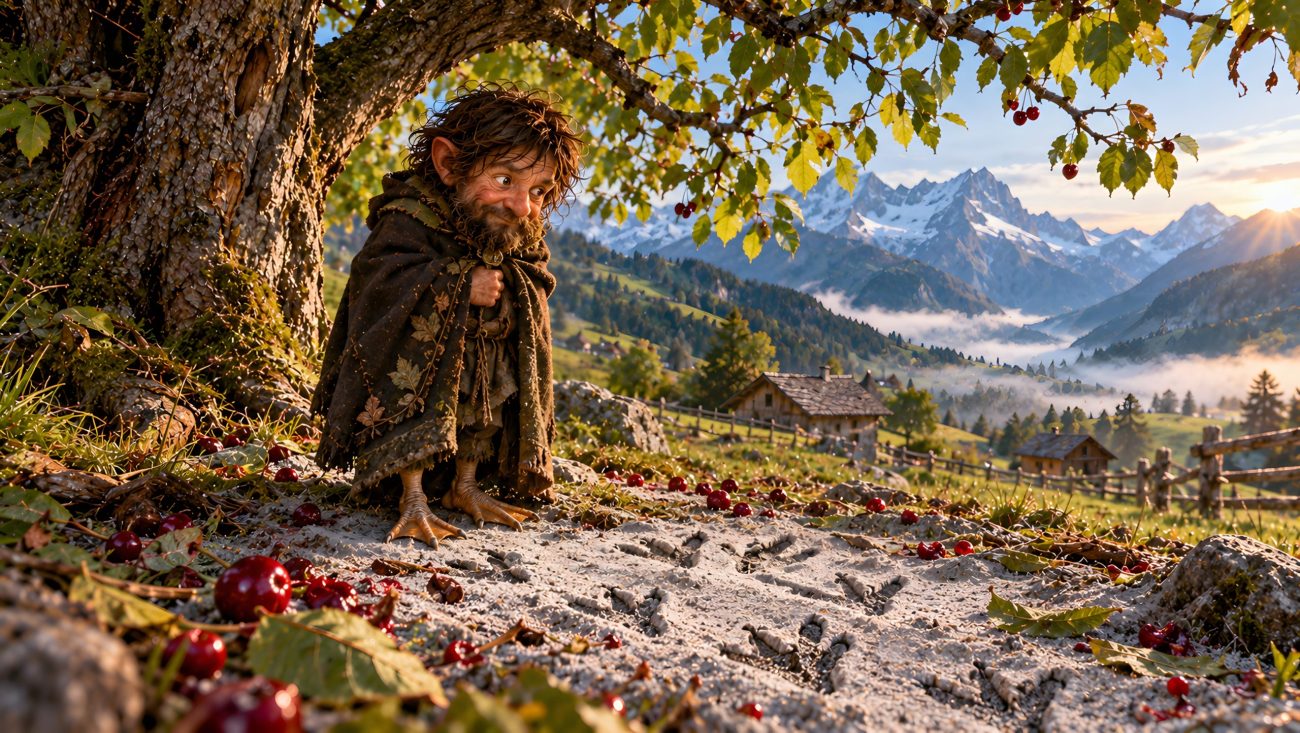
The friendship between the dwarfs and the people eventually ended because of human wickedness. A shepherd had a magnificent cherry tree high on the mountain, but every summer, when the cherries ripened, the tree was mysteriously stripped bare three nights in succession. The villagers believed the dwarfs were responsible, saying that the little beings came silently at night in long cloaks with their feet carefully covered, carrying out their work while everyone slept. The shepherd became curious about their hidden feet and wanted to discover whether they were different from human feet. The following summer, when the dwarfs once again came to harvest the cherries, he scattered ashes around the tree before going to bed. At dawn, he found that every cherry had disappeared, but the ashes revealed the secret: all around the tree were the unmistakable imprints of many goose feet.

The shepherd laughed and mocked the dwarfs, boasting that their secret had finally been discovered. The little people were furious that their hidden nature had been exposed. Soon afterward, they ransacked and destroyed their own houses before abandoning the valley and retreating deeper into the mountains. From that time onward, they refused to help humankind and were never seen again. The shepherd who had betrayed them suffered a miserable fate as well, becoming sickly and senile for the rest of his life.


Sources

“Die Füße der Zwerge.” SAGEN.at – Traditionelle Sagen aus Deutschland. Reproduced by SAGEN.at. https://www.sagen.at/texte/sagen/grimm/diefuessederzwerge.html

Little Mountain Man

Tradition: Swiss Mythology
Alternative Names: Little Mountain Spirit
Category: Dwarf


The Myth

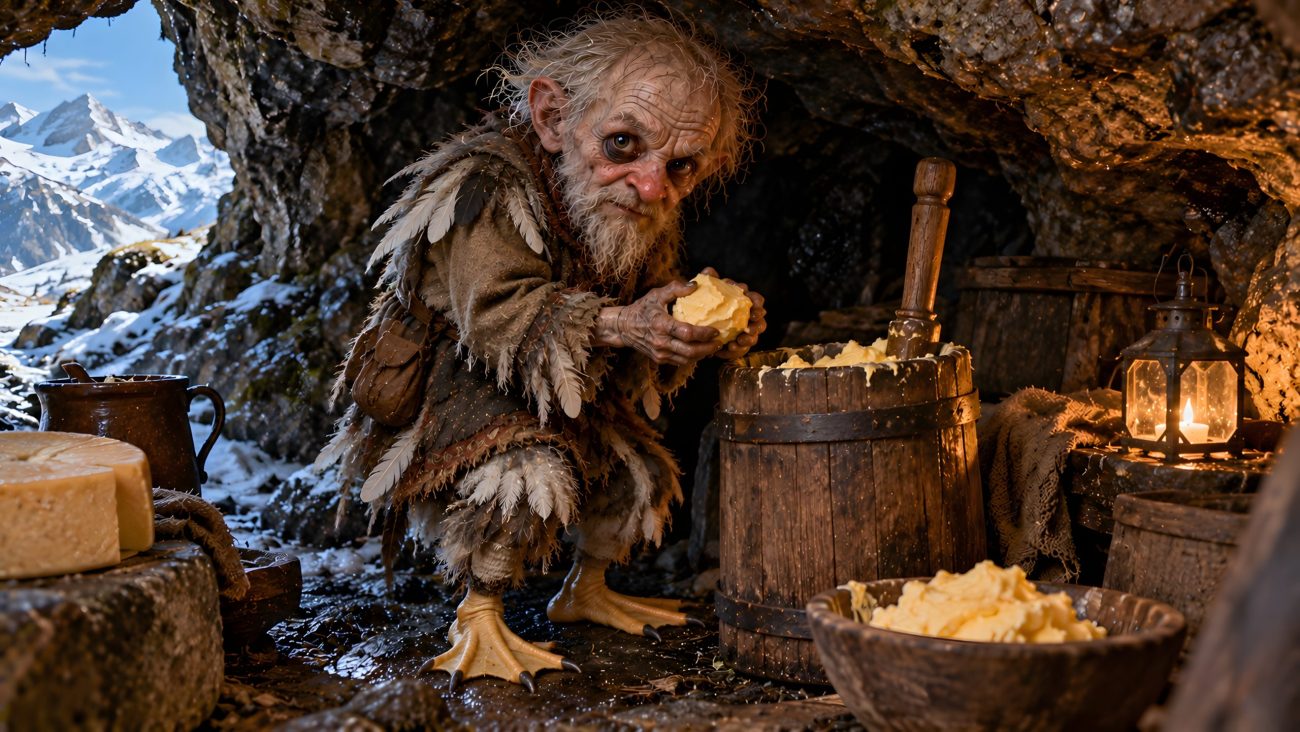
The Little Mountain Man was a tiny supernatural being with goose-like feet who lived among the mountains of Valais. He was small enough to hide inside a butter churn, and he moved about so quietly that the people he helped could never see him. An old man from Ernen owned a lonely little farm on Eggel in the Hochfluh area, where he kept his cattle during the winter. Each evening he had to climb up from Ernen to care for them, and the work became increasingly difficult as the snow deepened. One evening, exhausted after the climb, he sat beside the frozen well outside his cottage and wished aloud that someone would at least light his stove so that he could warm himself after his day’s labor. When he entered the cottage, he was astonished to find that his wish had already been fulfilled. A great log was burning brightly in the stove, the cheese had been pressed and placed neatly beneath its bricks, and the kitchen was perfectly tidy. Thinking that someone must have come to help him, he searched the parlor, but it too was empty. Yet freshly churned golden butter stood ready, the room had been swept, and everything was in perfect order. He hurried to the barn, expecting to find some helpful neighbor there, but there was no one. The cows had already been fed, groomed, and milked, and they rested contentedly on fresh straw. In the milk cellar, the milk had been placed in copper tubs and was already covered with a thick golden cream.

The old man could not understand who had done all this work. He thanked God for the mysterious help and returned to Ernen the next day. When he came back to the mountain farm that evening, everything had once again been completed before his arrival. The same thing happened day after day. The cows grew fatter, the butter and cheese grew more plentiful, and even the great haystack seemed never to lose so much as a single straw. Eventually the old man’s gratitude turned into curiosity, and he desperately wanted to see the invisible helper. He watched the house, kitchen, and stable through every crack and opening he could find, but nothing appeared. Then, near the end of winter, he finally heard the butter churn moving in the parlor. He crept closer and carefully lifted the cover. Inside the churn stood a tiny man with goose feet, quietly taking out the freshly made butter. The old man immediately understood that a little mountain spirit had been caring for his farm throughout the winter. Rather than frightening him away, he was delighted and decided to reward his mysterious helper.

He went down to Ernen and had a beautiful new coat made for the little mountain man. When he returned to the farm, he placed the coat on the table before going to bed. He intended to wake early and watch the dwarf when he discovered his gift, but he slept too long. When he finally awoke, the coat had vanished. Then he heard a voice singing outside: “Now I am a handsome man who can no longer shepherd.” With those words, the little mountain man disappeared forever.


Sources

“Das Bergmännlein.” SAGEN.at – Traditionelle Sagen aus der Schweiz. Reproduced by SAGEN.at. https://www.sagen.at/texte/sagen/schweiz/allgemein/bergmaennlein.html


Tree Dwarf

Tradition: Swiss Mythology
Alternative Names: The Dwarfs of the Hasli Valley
Category: Dwarf


The Myth

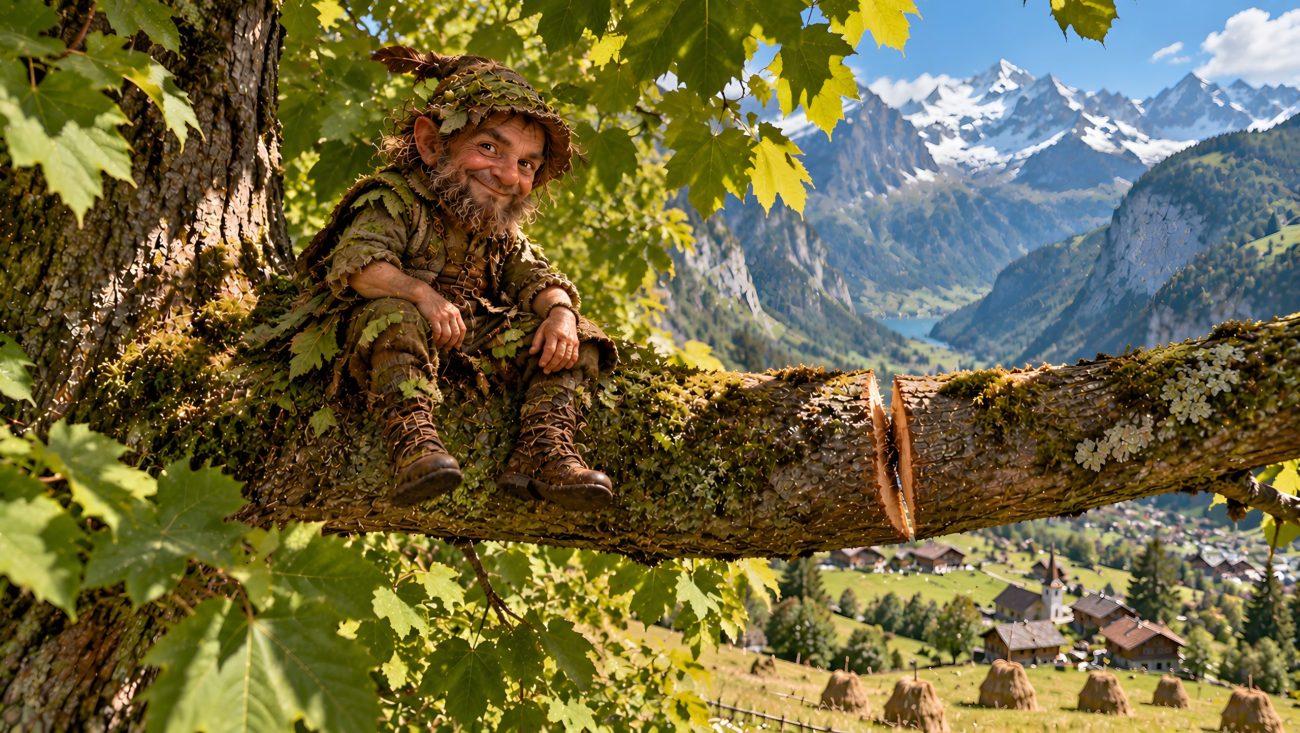
The dwarfs of the Hasli Valley were a hidden mountain folk who sometimes came down from the cliffs during summer. They would join the people working in the valley, either helping with their work or simply watching them, especially when the haymakers were busy. The dwarfs particularly enjoyed sitting together on the long, sturdy branches of a maple tree, sheltered beneath its thick green leaves.

One day, however, some wicked people decided to play a cruel trick on them. During the night they secretly sawed through one of the maple’s great branches, leaving it barely attached to the trunk. The next morning, unaware of what had been done, the dwarfs climbed onto the branch as they usually did. Suddenly it broke beneath them, sending the little mountain people tumbling to the ground. The wicked people laughed at their misfortune, and the dwarfs were furious. They cried out:

“Oh, how high the sky is
and how great the unfaithfulness!
Here today and nevermore!”

The dwarfs kept their word. From that day onward, they never again appeared among the people of the valley, disappearing forever from the country.


Sources

“Die Zwerge auf dem Baum.” SAGEN.at – Traditionelle Sagen aus Deutschland. Reproduced by SAGEN.at. https://www.sagen.at/texte/sagen/grimm/zwergeaufdembaum.html


Dwarf Woman

Tradition: Swiss Mythology
Alternative Names: Gotwärgi
Category: Dwarf


The Myth

The Dwarf Woman was a small supernatural being associated with the Gotwärgi, the dwarf folk of the Valais mountains. Her child was stunted and dwarfish in appearance, unable to speak like an ordinary child, and the creature could easily be mistaken for a strange human infant.

In Zeneggen, a mother had a child who never seemed to grow properly. Despite all her loving care, it remained tiny and dwarfish, and although it appeared intelligent and understood everything she said, it never spoke a single word. Worried and unable to understand what was wrong, the mother went to her neighbor for advice. The neighbor became suspicious and told her to give the child several empty eggshell halves to play with while secretly watching what it did. The mother followed the advice, and when the child saw the eggshells, it suddenly exclaimed in amazement that it had never seen so many little pancakes before. The mother was delighted to finally hear her child speak, but her neighbor was convinced that this proved something stranger was happening. She suspected that the mother’s real child had been stolen from its cradle and replaced with a Gotwärgi, a dwarf child.

The frightened mother was told to take the strange child up the hill and beat it until its cries could be heard across the valleys, believing that this might force the dwarf people to return her real child. Although she found it almost unbearable to strike the little creature, she eventually carried it up the hill and began to beat it. The child cried out so loudly that the surrounding hills echoed with its screams. Suddenly, a little dwarf woman came rushing toward them. In her arms was a beautiful, healthy child. The mother stared in astonishment, realizing that her own child had indeed been taken. The dwarf woman immediately snatched the stunted child from the mother’s arms, placed the beautiful child in her lap, and cried, “Then you take yours and I’ll take mine, you merciless little mother!” Clutching her own dwarfish child tightly, the dwarf woman disappeared down the mountain like a chamois, while the human mother remained behind, overwhelmed with wonder and joy as she finally held her true child again.


Sources

“Die Zwergenfrau.” SAGEN.at – Traditionelle Sagen aus der Schweiz. Reproduced by SAGEN.at.
https://www.sagen.at/texte/sagen/schweiz/allgemein/zwergenfrau.html


Little Man of Venice

Tradition: Swiss Mythology
Alternative Names: The Venetian
Category: Dwarf


The Myth

The Little Man of Venice was a small, dark-haired man who regularly traveled from Venice to the high Alpine pastures of Glarus. He was an excellent gold seeker, spending his summers among the shepherds while searching the mountain rocks and streams for glittering stones. The shepherds found him strange but entertaining, and he would share their milk, cheese, whey, and hayloft while they tended their cattle. The little Venetian was remarkably successful at his work. He would climb among the rocks and search through the mountain streams, gathering stones that caught his eye, and within only eight days he could fill seven sacks with them. Once the sacks were full, he would mysteriously disappear, only to return again and begin collecting more stones. The shepherds eventually decided to play a trick on him. They secretly hid one of his sacks and waited to see what he would do. When the little man returned, he immediately knew that one of his sacks was missing and calmly asked whether the shepherds would retrieve it or whether he should do so himself. The shepherds laughed and challenged him to find it. Without hesitation, the little Venetian climbed a steep slope straight to the hiding place and returned with the missing sack, astonishing the shepherds with his uncanny knowledge.

When the summer ended and the first cold winds began sweeping over the mountains, the little man prepared to return to Venice. Before leaving, he told the shepherds that if any of them ever came to Venice, he would reward him with a sack filled with pure silver. Most of the shepherds soon forgot the promise, but one poor shepherd remembered it. He had a sickly wife and many children and knew exactly what he could do with a sack of silver. After the herds came down from the Alps, he set off on the long journey toward Venice. When he finally reached the city, he had no idea where the little Venetian lived and did not even know his name. As he wandered sadly through the narrow streets, however, someone suddenly tapped him on the shoulder. A small, elegantly dressed gentleman greeted him warmly and immediately began asking about Glarus and the shepherds he had known there. The shepherd recognized him as the little man from the Alpine pasture. The Venetian welcomed him into his magnificent home, a marble palace whose walls were so polished that they gleamed like mirrors. A dark stream flowed outside, white doves flew above it, and the shepherd was given everything he could desire, including a rich red wine that seemed to fill him with strength. Yet despite all this luxury, the shepherd could not stop thinking about his wife and children. He became increasingly homesick and longed to see his distant home again.

The Venetian understood his sadness and led him into a room the shepherd had never seen before. On its wall hung a magnificent mirror, and when the little man told him to look into it, the shepherd saw Glarus as clearly as though it were standing on the other side of the wall. He could even see his own house, where his wife was washing their child with tears in her eyes because she missed him. The Venetian then offered to send him home with either gold or silver. The shepherd remembered the promise made on the Alpine pasture and asked only for the sack of silver he had been promised. The Venetian allowed him to enter his treasury, where the shepherd filled a sack with silver. Before he left, the little man warned him to guard the sack carefully and, if he had to sleep at an inn, to place it beneath his head. The shepherd began his journey home, but one evening, still far from Switzerland, he stopped at a small Italian inn. Exhausted from the journey, he placed the heavy sack beneath his head and fell asleep.

When he awoke, he was no longer in Italy. He was lying in his own bed in Glarus, hearing the familiar clock in his house and his goats outside. For a moment he thought the entire journey to Venice had been a dream, but then he felt something hard beneath his head and discovered that the sack of silver was still there. His wife and children rushed to him, and the poor shepherd’s fortune was transformed. He became a wealthy man, and his descendants remained respected in Glarus. They became known as the Venetian people, in memory of the mysterious little man who had brought their ancestor his fortune.


Sources

“Das Venedigermännlein.” SAGEN.at – Traditionelle Sagen aus der Schweiz. Reproduced by SAGEN.at.
https://www.sagen.at/texte/sagen/schweiz/allgemein/venediger_maennlein.html


Dwarf of Gonzen

Tradition: Swiss Mythology
Alternative Names: –
Category: Dwarf


The Myth

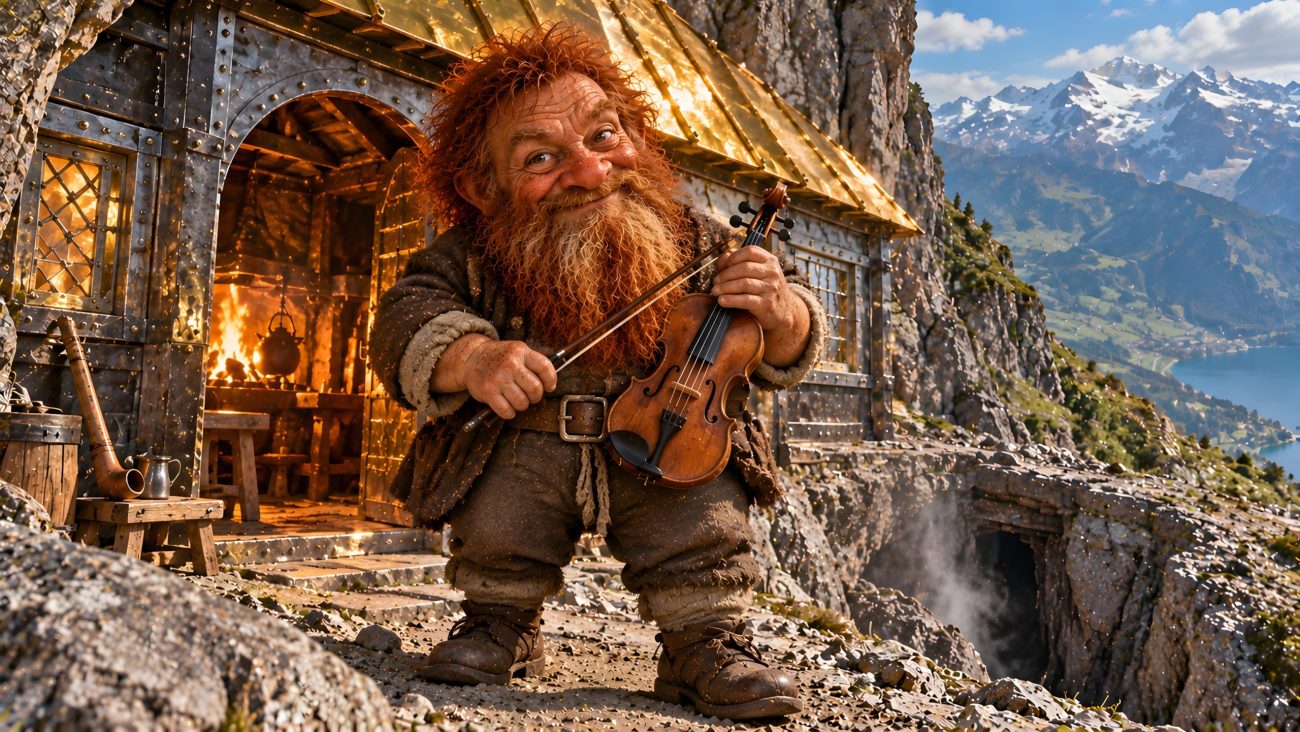
High on Gonzen, among the ancient ore-bearing rocks, lived a hidden people of dwarfs. They made their homes in deep holes within the mountain, where a cool wind rose from the underground passages. Their houses were said to be fashioned from iron and steel, with golden roofs and silver windows, making their underground dwelling as rich as the mountain itself.

During the warm months, the little men were busy working among the ore-bearing rocks. When winter came, however, their work stopped. They withdrew to their homes, gathered around a great hearth fire, and spent the cold season resting and enjoying themselves.

The dwarfs were especially fond of music. The sounds of violins and pipes were often heard coming from their hidden dwellings, accompanied by the dancing of the little people. Their music was so beautiful and clear that people above the mountain could sometimes hear the melodies as though they were floating down from the heavens.

Even the marmots living along the steep slopes were disturbed by the dwarfs’ winter celebrations. While the animals were trying to sleep through the winter in their underground shelters, the music of the hidden people could reach them beneath the mountain and interrupt their peaceful hibernation.


Sources

“Die Zwerge vom Gonzen.” SAGEN.at – Traditionelle Sagen aus der Schweiz (Kanton St. Gallen). Reproduced by SAGEN.at. https://www.sagen.at/texte/sagen/schweiz/st_gallen/zwerge_gonzen.html


Dragon of Burgdorf

Tradition: Swiss Mythology
Alternative Names: Dragon of the Drachenloch
Category: Dragon


The Myth

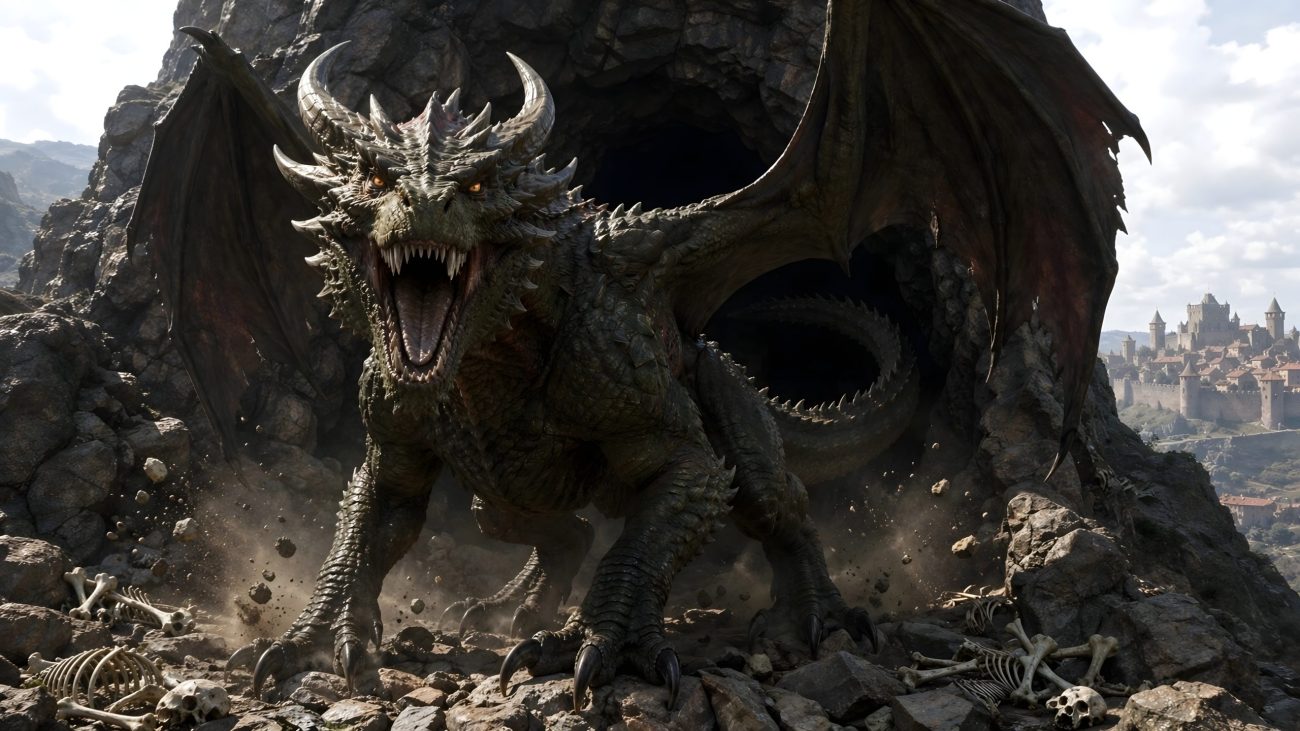
The Dragon of Burgdorf was an enormous dragon that lived inside a hollow mountain near Burgdorf in Bern. The cavern became known as the Drachenloch, or Dragon’s Cave, and the creature was said to have laid waste to the surrounding countryside.

In the year 712, the brothers Sintram and Beltram, dukes of Lenzburg, went hunting together. Deep in a wild and desolate forest they came upon a hollow mountain and discovered the dragon within. As soon as the beast saw the two men, it sprang violently toward them.

Before Beltram could escape, the dragon seized him and swallowed him alive. Sintram fought back with great courage and engaged the monster in a fierce struggle. Eventually he managed to overcome and kill the dragon.

But when Sintram cut open the dragon’s split body, he discovered something astonishing: his younger brother was still alive inside the monster. Beltram had survived being swallowed and was rescued from the dragon’s body.

To commemorate the terrible encounter and Beltram’s miraculous survival, the two princes had a chapel dedicated to Saint Margaret built at the very place where the dragon had been defeated. The story was also painted there, where it could still be seen.


Sources

“Das Drachenloch.” SAGEN.at – Traditionelle Sagen aus der Schweiz (Bern). Reproduced by SAGEN.at.
https://www.sagen.at/texte/sagen/schweiz/bern/dasdrachenloch.html


Dragon of the Giant and the Tailor

Tradition: Swiss Mythology
Alternative Names: The Dragon of the King’s City
Category: Dragon


The Myth

The dragon was a terrible monster that lived in a cave near a great city. It had a horned head and was so fearsome that the people were unable to defeat it. Every day the inhabitants were forced to give the dragon a human being to devour. If they failed to provide a victim, the monster would leave its cave and rage through the country, so violently that the people considered the daily sacrifice the lesser evil.

Eventually the king’s own beautiful daughter was chosen to become the dragon’s next victim. The king had promised that whoever could kill the monster would receive his daughter and the kingdom, but no one had yet been able to accomplish the deed.

A giant and a small tailor arrived in the city and offered to kill the dragon. The giant possessed enormous strength, while the clever tailor relied on his cunning. They took a gigantic hammer and a heavy pair of tongs and travelled toward the dragon’s cave.

They decided that the giant would enter the cave and drive the dragon out with his hammer, while the tailor waited outside with the tongs and would seize the creature when it emerged. But when the giant entered the cave and attacked the monster, the dragon suddenly burst out and snapped up the tailor like a fly, swallowing him whole.

The giant immediately pursued the dragon and brought his enormous hammer down upon its horned head. The blow crushed the monster’s skull, and the dragon fell dead. The giant then cut open its body and discovered the tailor still alive inside the dragon’s belly.

The tailor, however, feared that the giant would claim the king’s daughter and kingdom for himself. He therefore told the giant that he had deliberately allowed himself to be swallowed because he intended to turn the dragon inside out from within, like a glove. The foolish giant believed him.

The two men returned to the king with the dead dragon, each claiming the reward. After the king’s advisers failed to decide who deserved the princess and kingdom, the tailor proposed that the winner should be whoever could eat the most rice porridge.

The giant eagerly accepted, since rice porridge was his favourite food. A gigantic mountain of porridge was placed before them, and the two began eating. The giant devoured enormous quantities until he could eat no more, while the tailor continued eating without stopping. Finally the giant admitted defeat.

The tailor married the king’s daughter and received the kingdom. The giant remained behind, determined to discover how the little tailor had managed to eat so much. The tailor told him that during the meal he had cut open his own stomach so that he could continue eating indefinitely.

The foolish giant believed him. One day, while eating rice porridge, he cut open his own stomach and immediately fell dead. Thus the dragon’s death brought an end to the monster that had terrorized the kingdom, while the tailor’s cunning ultimately freed the kingdom from the giant as well.


Sources

“Der Riese Schneiderlein.” SAGEN.at – Traditionelle Sagen aus der Schweiz. Reproduced by SAGEN.at.
https://www.sagen.at/texte/sagen/schweiz/allgemein/riese_schneiderlein.html


Dragon of Lucerne

Tradition: Swiss Mythology
Alternative Names: The Dragons of the Faßbinder
Category: Dragon


The Myth

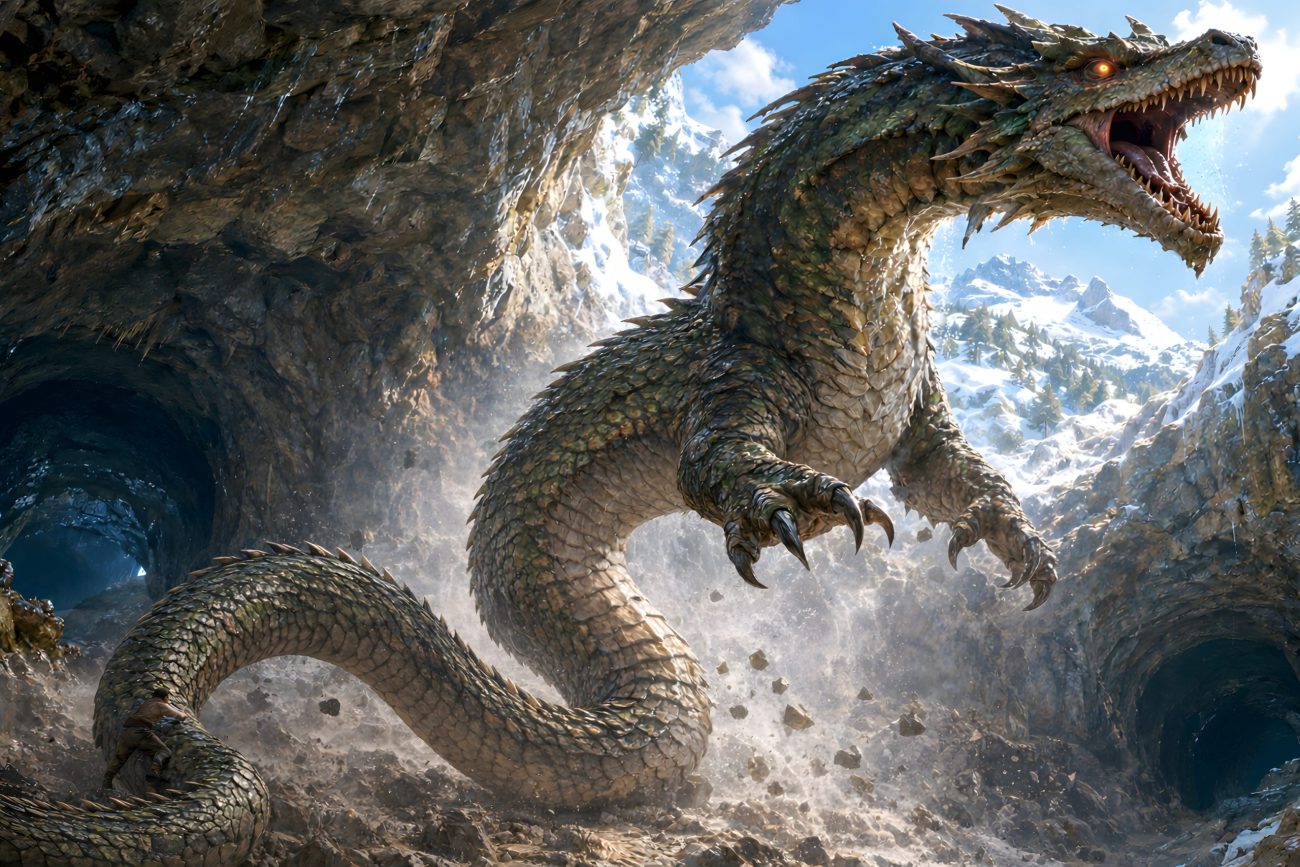
The dragons were two enormous and hideous creatures that lived deep beneath the mountains of Lucerne, inside great caves hidden at the bottom of a deep, muddy pit. They were among the dragons and worms believed to have inhabited the Swiss mountains in ancient times, creatures that could sometimes descend violently into the valleys and bring destruction with them.

In the year 1420, according to the church records, a cooper from Lucerne went into the wilderness searching for wood with which to make his barrels. He became lost in the lonely mountains after nightfall and suddenly fell into a deep pit, sinking down as though into a muddy well. At the bottom he discovered entrances leading into two enormous caves.

When he went closer to investigate, two dreadful dragons emerged from the caves. Terrified, the man prayed fervently, but the dragons did not attack him. Instead, they repeatedly wrapped their enormous bodies around him without harming him.

The unfortunate cooper remained trapped with the dragons from November 6 until April 10. He survived by feeding upon the same salty moisture that sustained the dragons, which seeped from the walls of the caves.

When winter finally ended, the dragons sensed that spring had arrived and prepared to leave their underground dwelling. One of them suddenly flew out with a tremendous rushing sound. As the second dragon prepared to follow, the cooper seized its tail and held on tightly. The dragon carried him up and out of the deep pit.

Once they reached the surface, the man released his grip and escaped. He returned safely to Lucerne, having survived months underground in the company of the two dragons.

To preserve the strange event, he had the entire story embroidered onto a priestly vestment. The embroidered account was said to remain visible in the Church of Saint Leodegar in Lucerne.


Sources

“Der Drache fährt aus.” SAGEN.at – Traditionelle Sagen aus Deutschland. Reproduced by SAGEN.at.
https://www.sagen.at/texte/sagen/grimm/derdrachefaehrtaus.html


Fire Dragon of Maltschül

Tradition: Swiss Mythology
Alternative Names: Maltschül Fire Dragon, Buchs Dragon
Category: Dragon


The Myth

Beneath the Red Plate on the Maltschül Alp lives a fiery dragon. The creature is said to appear only before a flood.

In 1762 and again in 1764, a fiery man was seen riding through the Buchserbach gorge upon the dragon. Soon afterward, the waters rose violently, sweeping away houses and barns and devastating fields and meadows.

Another tradition tells that the dragon lived on the Alp of Buchs, where it breathed fire and smoke and lured cattle toward a rocky plate. The animals would then slip from the rock and fall into the dragon’s reach, becoming its prey.

Whenever the dragon appeared, the stream was said to burst its banks and bring destructive floods. According to later tradition, the dragon is now dead and lies buried beneath the rock where it once dwelled.


Sources

“Der feurige Drache.” SAGEN.at – Traditionelle Sagen aus der Schweiz (Kanton St. Gallen). Reproduced by SAGEN.at.
https://www.sagen.at/texte/sagen/schweiz/st_gallen/feurige_drache.html