Augenbrand

Tradition / Region: Swiss Mythology
Alternate Names:
Category: Dog


The Myth

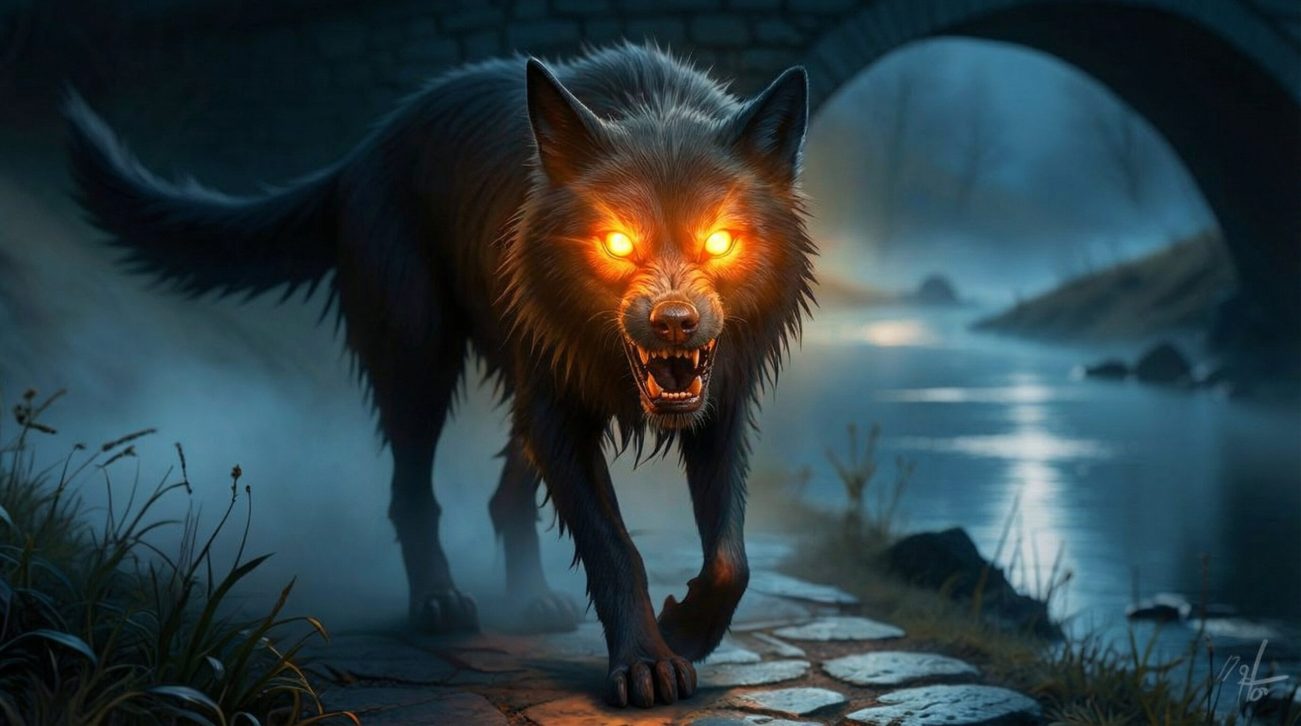
In the legends of the Jura region of Switzerland, people once spoke of a black dog known as Augenbrand.

He was said to haunt the area near the old bridge at Soyhières over the river Birs. The bridge has long since vanished, but the stories of the creature that wandered there remained. Augenbrand was described as a large black dog with burning, fiery eyes whose glow could be seen in the dark from far away. It was from these blazing eyes that he took his name.

The spirit was believed to be bound to the fate of his master, Count Rodolphe de Sogren, lord of the nearby castle. The count had been murdered in the year 1233, and after his death the dog was said to roam the countryside, searching endlessly for him.

Travelers passing the bridge or nearby roads at night sometimes claimed to see the glowing-eyed hound moving through the darkness. Others felt they were being followed, hearing movement behind them on the path. Those who strayed too far or wandered uncertainly were said to be pursued by the creature as it searched the land for the master it had lost.

Stories from the region tell that strange sounds were often heard near the castle grounds in summer nights — and among these tales was the recurring sight of the fiery-eyed dog wandering restlessly below the ruins.

Thus Augenbrand was remembered as a ghostly hound of Jura, forever roaming the place of his lord’s death, his burning eyes searching the night for the master he would never find again.


Sources

Wikipedia contributors. (n.d.). Augenbrand. In Wikipedia, from https://en.wikipedia.org/wiki/Augenbrand


Night Folk of the Mountain

Tradition / Region: Swiss Mythology
Alternate Names:
Category: Mountain dweller, Ghost


The Myth

High above the village of Flumserberg, in the dark forests and shadowed slopes of the mountain, there dwelt the Night Folk.

They were seen only at certain times.

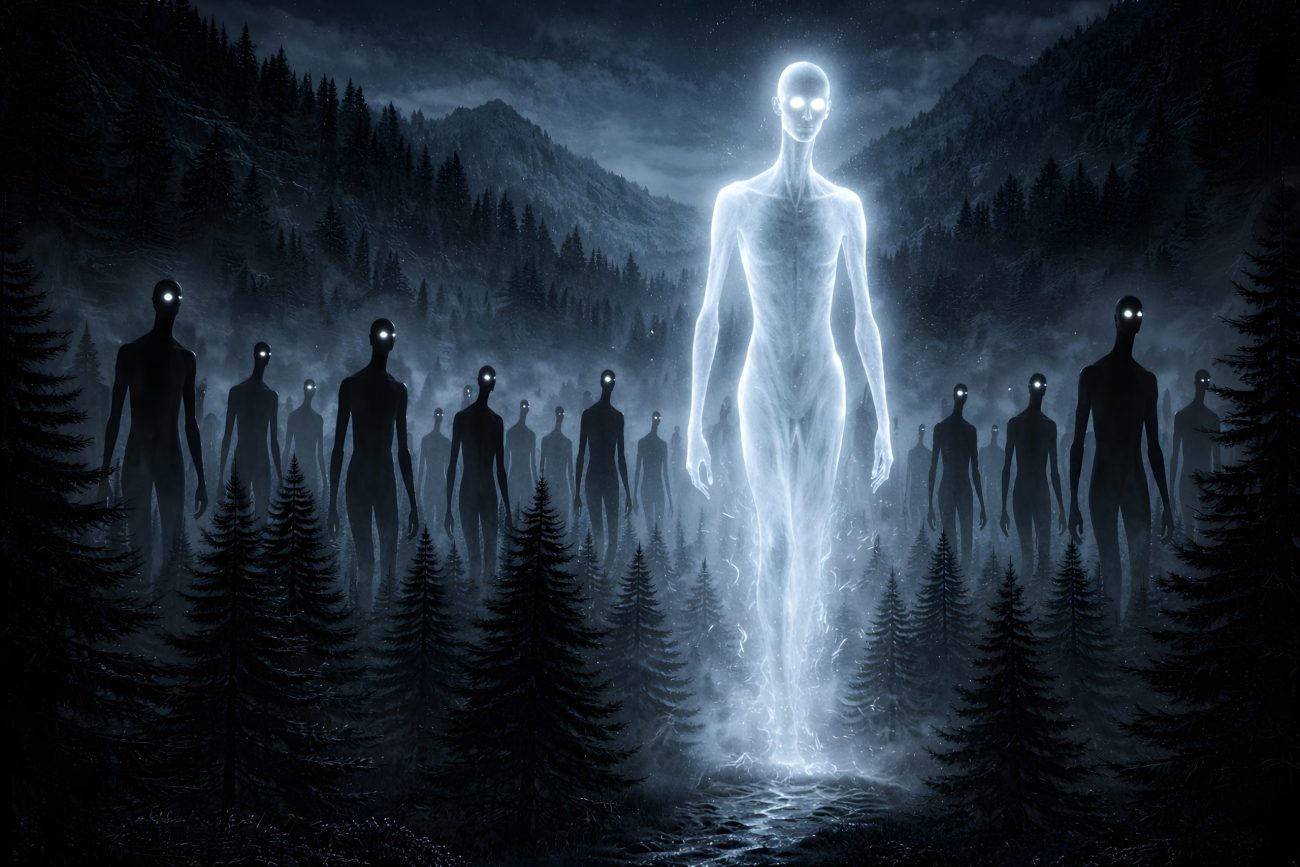
When someone in the village lay upon their deathbed, watchers would sometimes glimpse a strange procession descending from the mountain heights. A multitude of black figures moved silently in a long line. Among them strode a towering white man, conspicuous and pale, wearing a wide, floppy hat. He walked at their center, taller than all the rest.

The procession did not enter the village openly. Instead, it halted at an old, crumbling house near the former town hall. There the figures would gather, as if conferring among themselves. From that place came a low, far-reaching murmur—an eerie sound that drifted through the air but could not be understood.

They lingered for a time.

Then, just as silently, the Night Folk turned and made their way back up the mountainside. One by one they disappeared into the darkness of the forest, until no trace of them remained.

Soon after, word would spread that the dying villager had passed.

Because of this, when a body from Flumserberg was carried to burial, the funeral procession would always stop at the old town hall. There the priest would come out to meet it, as though acknowledging the unseen procession that had already come down from the mountain and returned to its hidden realm.


Sources

sagen.at contributors. (n.d.). Nachtvolk vom Berg. In sagen.at, from https://www.sagen.at/texte/sagen/schweiz/st_gallen/nachtvolk_berg.html


Barbegazi

Tradition / Region: Swiss Mythology
Alternate Names:
Category: Gnome


The Myth

High in the Alps, beyond the tree line and close to the snow-buried peaks, live the Barbegazi. They are beings of winter alone, creatures who belong to blizzards, avalanches, and frozen heights. When summer comes and the mountains soften, they vanish into deep hibernation within their hidden tunnels. Only when the cold returns do they stir again.

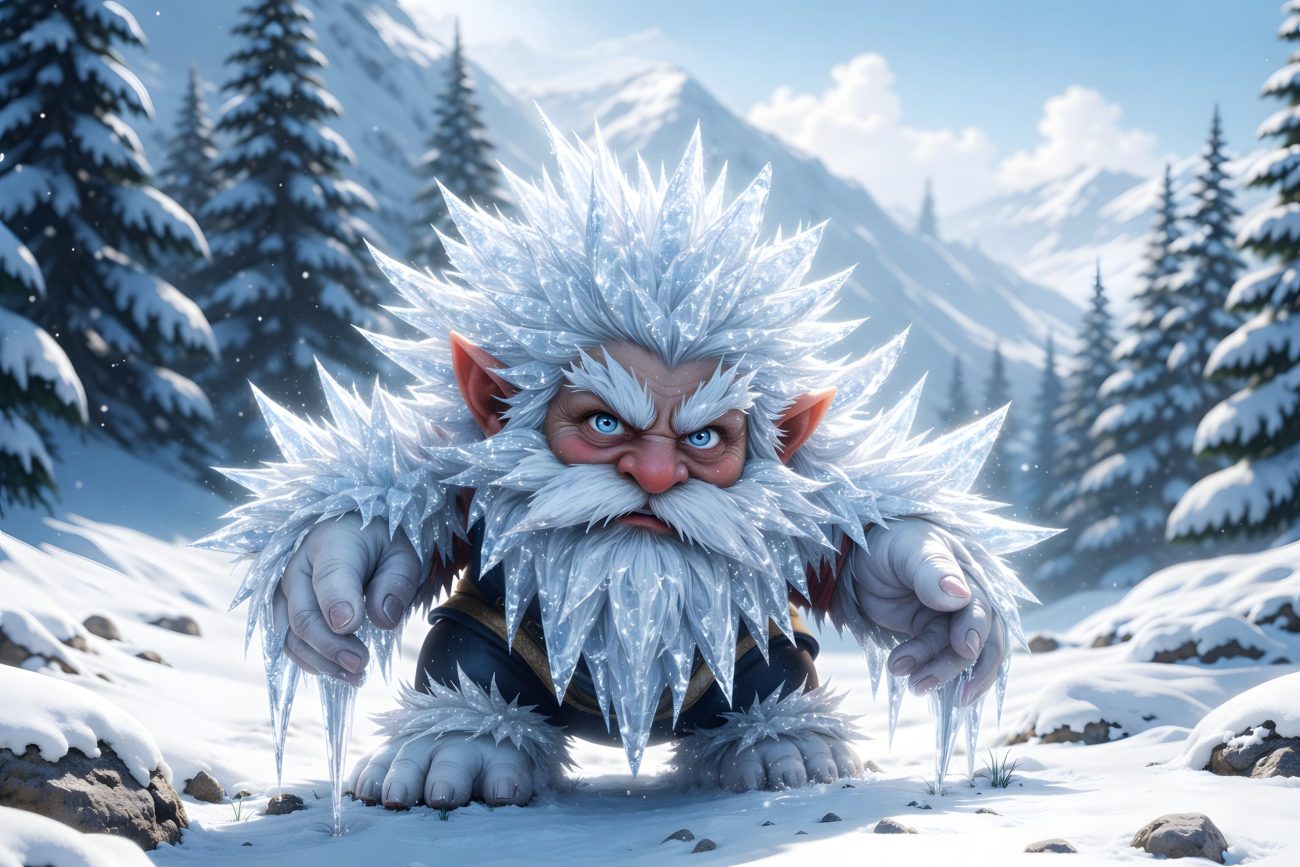
The Barbegazi dwell in networks of caves beneath the highest ridges, their entrances concealed by ice and drifting snow. They thrive only in extreme cold. In winter storms they emerge, moving easily across slopes where humans struggle to stand. Their enormous feet act like skis or snowshoes, letting them glide effortlessly over deep snow. Some say they delight in riding avalanches, laughing as they race the falling mountainside.

They are masters of snow. If buried, they can vanish beneath it in seconds or dig themselves free no matter how deep the drift. Their beards and hair hang stiff with ice, forming thick icicles that glitter in the cold. When the ice melts, ordinary hair lies beneath, but such warmth rarely touches them.

Though secretive, the Barbegazi are not cruel. Travelers tell that before an avalanche strikes, strange whistles or hollow hooting sounds echo across the peaks. These noises are said to be the Barbegazi, warning hikers away from danger. Others claim they have seen small figures digging frantically in the snow after storms, freeing trapped people or guiding lost sheep back toward safety.

Yet they are uneasy around humans. No Barbegazi is ever seen in mild weather, and none appear below the forests. Those rare stories of captured Barbegazi all end the same way: once removed from the cold, the creature weakens and dies within hours, as if winter itself were its lifeblood.

Thus the Barbegazi remain spirits of ice and altitude—helpers and watchers of the high mountains, fleeting as snowstorms, and gone as soon as the cold loosens its grip.


Sources

Fandom contributors. (n.d.). Barbegazi. In Cryptidz Wiki – Fandom, from https://cryptidz.fandom.com/wiki/Barbegazi