Doll on Klariden

Tradition: Swiss Mythology
Alternative Names: Zurrimutzi, The Living Doll of Klaridenalp
Category: Object


The Myth

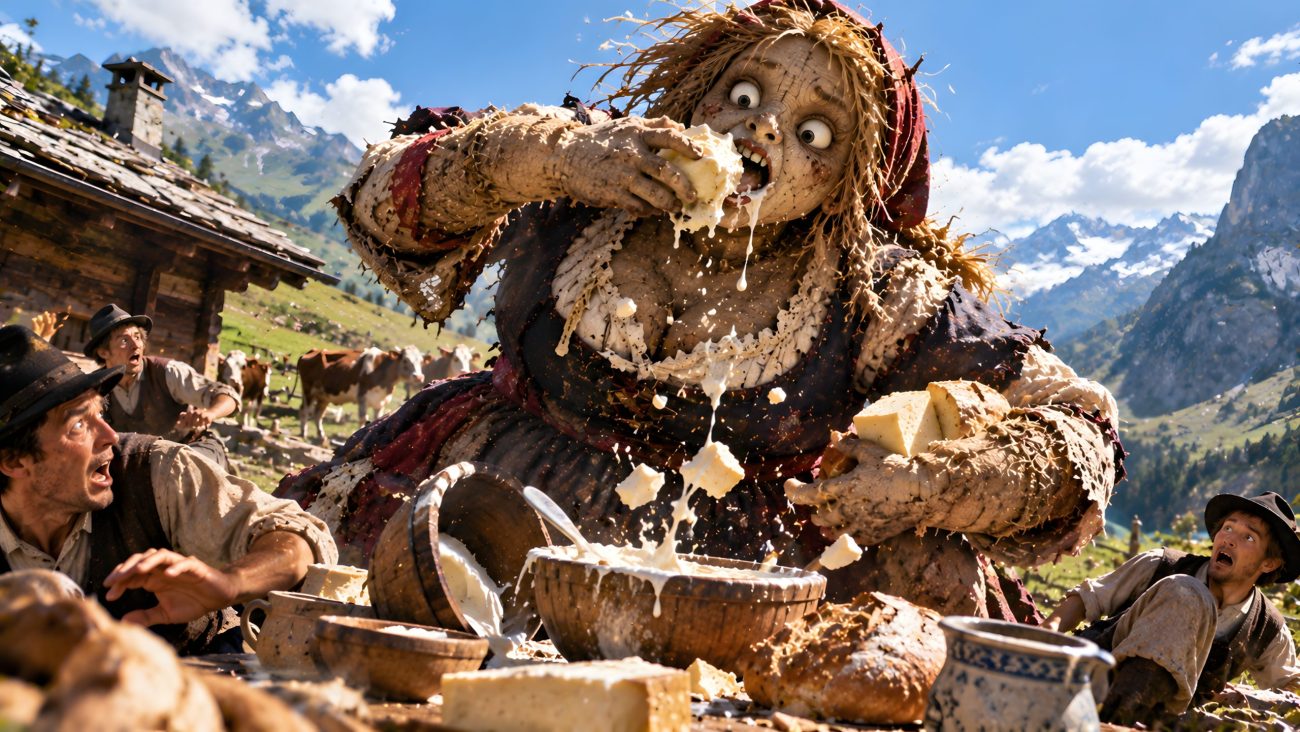
The Doll on Klariden is a supernatural creature from a legend set on Klaridenalp, a mountain pasture between the Swiss cantons of Glarus and Uri. Centuries ago, a dairyman and two farmhands spent the summer tending cattle on this exceptionally fertile alpine pasture. The cows produced so much milk that they could be milked three times a day, leaving the men with little work. Their comfortable life eventually led to boredom and mischief. Complaining that God had forgotten them, the dairyman decided to make a woman of his own. Using old rags, torn trousers, a worn felt hat, and patched socks, he constructed a life-sized female doll stuffed with hay. The men named her Zurrimutzi.

The three herdsmen treated Zurrimutzi as a companion, including her in their card games and meals. They placed her beneath the cows to milk into her mouth, propped playing cards between her stiff fingers, and jokingly offered her food. One day, while the dairyman smeared cream across her face, the doll suddenly came to life. Her eyes began to move, her mouth opened, and she started swallowing the cream. Although the men initially fled in terror, they returned when she appeared to remain peacefully seated at the table. Soon, however, Zurrimutzi developed an insatiable appetite, devouring enormous quantities of cheese, bread, butter, milk, cream, and rice pudding. She grew into a tall, strong, shapeless woman whom the three men eventually struggled to carry to a neighboring pasture for her customary Sunday sunbathing.

As Zurrimutzi grew, she began speaking and helping with household chores, although her work was clumsy and she prepared vast quantities of food primarily for herself. She also joined the men’s card games and invariably won against whoever played her. At night, she sometimes ran across the roof of the alpine hut, making it thunder as though a dozen horses were galloping overhead. When autumn arrived and the herdsmen prepared to descend into the valley, they were ashamed to take their monstrous companion with them. They decided to leave secretly while she slept, unwilling either to kill her or to abandon her openly.

Their plan failed when Zurrimutzi appeared at the doorway and ordered the dairyman, as the head of the alpine farm, to remain with her. The two farmhands were permitted to leave, provided they did not look back. They obeyed but spent the night in another hut, hoping their master would join them. When he failed to appear the following morning, they returned to investigate, praying the Lord’s Prayer at every bend in the path. Near the hut, they discovered Zurrimutzi dancing on the roof, where she had spread the dairyman’s flayed skin to dry. As blood dripped into the gutter, she hopped from one leg to the other. When she noticed the farmhands, she roared that their prayers had saved them: had they not prayed, she would have bitten their throats as she had done to their master. Horrified, the two men fled down the mountain and did not look back until they reached a chapel in the Uri lowlands.


Sources

“Puppe Klariden.” SAGEN.at. https://www.sagen.at/texte/sagen/schweiz/uri/Puppe_Klariden.html


Sterbensstein

Tradition: Swiss Mythology
Alternative Names: The Death Stone
Category: Object


The Myth

The Sterbensstein, or Death Stone, lies at Kirchetbüel in Oberhasli, along the route to Gadmen near Meiringen in the Swiss canton of Bern. The stone rests beside a narrow, rocky gorge through which the River Aare flowed in ancient times. Its surface bears several impressions resembling marks left by human fingers, as though someone had pressed a hand into the stone.

According to local legend, a murder took place at this spot long ago. A woman who suffered a violent death desperately tried to grasp the stone, leaving the impressions of her fingers behind. The marks were said to preserve the traces of her final struggle, transforming an ordinary rock into a lasting reminder of the tragedy.

The Sterbensstein is thus associated with death and the enduring physical traces of a violent event. Beyond this brief account, the legend provides no further details about the woman, her killer, or the circumstances of the murder.


Sources

“Der Sterbensstein” (The Death Stone). SAGEN.at. https://www.sagen.at/texte/sagen/grimm/dersterbensstein.html


Petrified Knight

Tradition: Swiss Mythology
Alternative Names: The Stone Knight of Waldenburg
Category: Object


The Myth

Hans von Waldenburg was an evil knight who lived in a powerful castle overlooking the small town of Waldenburg in the Basel region of Switzerland. He exploited the surrounding countryside, forcing his subjects to toil for him while he feasted day and night with his cruel companions. The people feared him so greatly that they avoided passing his castle, taking long detours to escape his attention. At the edge of town lived a poor day labourer with his wife and children. Although the father worked tirelessly, nearly everything he earned went to the knight’s enforcers, leaving his family so hungry that they had little more than watery soup to eat.

One day, a messenger arrived and ordered the labourer to go to the castle to carry stones. Having worked for the knight throughout the year, the man could endure no more. He held up his empty soup bowl and demanded that the knight provide enough food for his starving children before expecting any further labour. The messenger returned with castle servants, who dragged the man away despite his family’s desperate cries. He was thrown into the deepest dungeon, where toads and bats inhabited the darkness. As time passed and her husband failed to return, his wife watched her children grow weaker from hunger. Finally, she gathered them and struggled through the deep winter snow towards Waldenburg Castle to plead for their father’s release.

As the knight rode out with his hunting party, the woman approached him and begged him to free her husband, explaining that her children would starve without him. The knight responded with contempt, declaring that he would ride over anyone who obstructed his path as though they were filth beneath his horse. The woman then lifted her children towards him and asked him to give them even the scraps his hunting dogs refused to eat. Enraged by her appeal, the knight pointed to the fieldstones protruding from the snow and ordered her to take them as bread, promising to release the prisoner only when she had finished eating them. In despair and fury, the woman seized his horse’s bridle and cursed him: may he himself turn to stone.

The curse immediately took effect. The knight’s feet grew heavy, his whip-bearing hand sank, and his horse vanished beneath him. His body turned grey and rigid, his eyes became glassy, and a terrible groan emerged from his petrified chest. He stood transformed into a stone statue before his own castle. His terrified servants and huntsmen fled, leaving the fortress abandoned. The oppressed people of Waldenburg seized their opportunity, freed the prisoners from the dungeons, and shared the treasure they found in the castle, including with the poor labourer who was reunited with his family.

According to the legend, the stone knight still stands near the entrance to Waldenburg Castle, although centuries of wind and weather have worn away his features. On wild winter nights, when storms rage around the ruins, people are said to hear a sound emerging from the enchanted stone—a lingering reminder of the cruelty that brought about the knight’s downfall.


Sources

“Versteinerte Ritter” (Petrified Knights). SAGEN.at. https://www.sagen.at/texte/sagen/schweiz/allgemein/versteinerte_ritter.html


Bad Little Jug

Tradition: Swiss Mythology
Alternative Names: The Naughty Little Jug
Category: Object


The Myth

Saint Teutbert was a holy hermit who had travelled from Scotland to spread Christianity. In his old age, he settled among the ruins of the former Roman city of Vindonissa, near present-day Brugg in Aargau, Switzerland. There he built a small chapel and a humble hut beside the River Aare, where he spent thirty years living a life of prayer, humility, and renunciation. One evening, as the setting sun bathed his hut in golden light, Teutbert reflected on his long life of hardship and devotion. Believing that he had overcome his sins and could no longer be tempted into wrongdoing, he imagined that he was ready to enter Heaven peacefully.

His thoughts were interrupted by the arrival of a beautiful young maiden carrying a small earthenware jug. She confessed that her only fault was occasionally teasing people, and Teutbert gently advised her to abandon this mischief. Before leaving, she offered him the jug as a gift, explaining that it might make collecting water from the distant stream easier. Teutbert initially refused, saying that he had served others without payment and had drawn water with his bare hands for thirty years. After the maiden left, however, he found the jug outside his door and decided to accept it. He filled it with water and returned to his hut, delighted by the convenience of his new possession.

The jug soon began to misbehave. Whenever Teutbert placed it on the windowsill, it tipped over and spilled its water. He tried adjusting its position with stones, then hung it from a nail in the wall, but it still fell and flooded his hut during a violent thunderstorm. Frustrated and thirsty, he eventually forgot his morning prayers and Mass in his determination to make the jug stand upright. He gathered clay from the forest and moulded a firm base around it, but the jug shook itself loose and spilled its water once more. Enraged, Teutbert smashed it against the wall, shattering it into pieces.

At that moment, his hut blazed with heavenly light, and a voice rebuked him. Teutbert had believed that pride, anger, and every other vice had been banished from his heart, yet a troublesome little jug had been enough to make him abandon his religious duties and surrender to wrath. Overcome with remorse, the hermit fell to his knees and repented. After a long period of penance, he eventually died in blessed peace, having learned that even a lifetime of devotion cannot make a person immune to pride and anger. The legend teaches that humility must be maintained throughout life and that patience is a virtue tested most clearly by seemingly insignificant frustrations.


Sources

“Schlimme Krüglein” (Bad Little Jug). SAGEN.at. https://www.sagen.at/texte/sagen/schweiz/allgemein/schlimme_krueglein.html