Tradition: Swiss Mythology
Alternative Names: The Silly Giant and the Clever Tailor
Category: Giant
The Myth
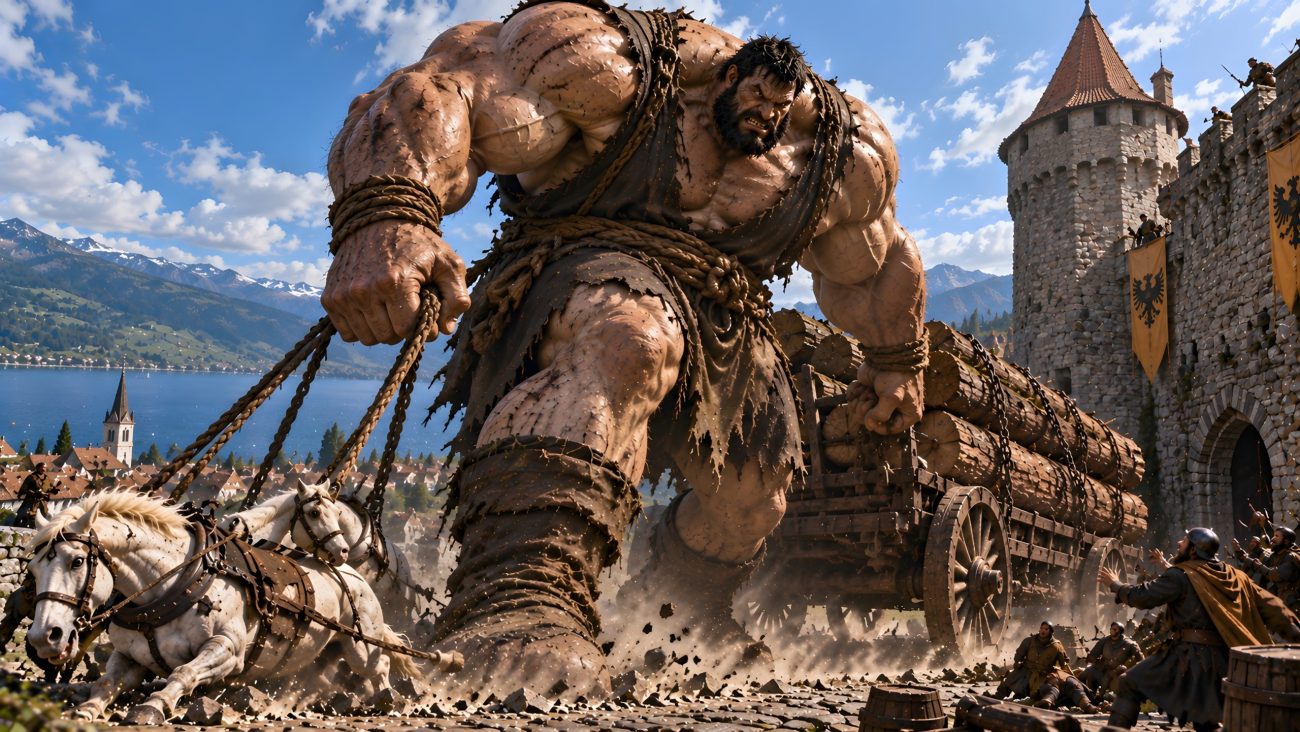
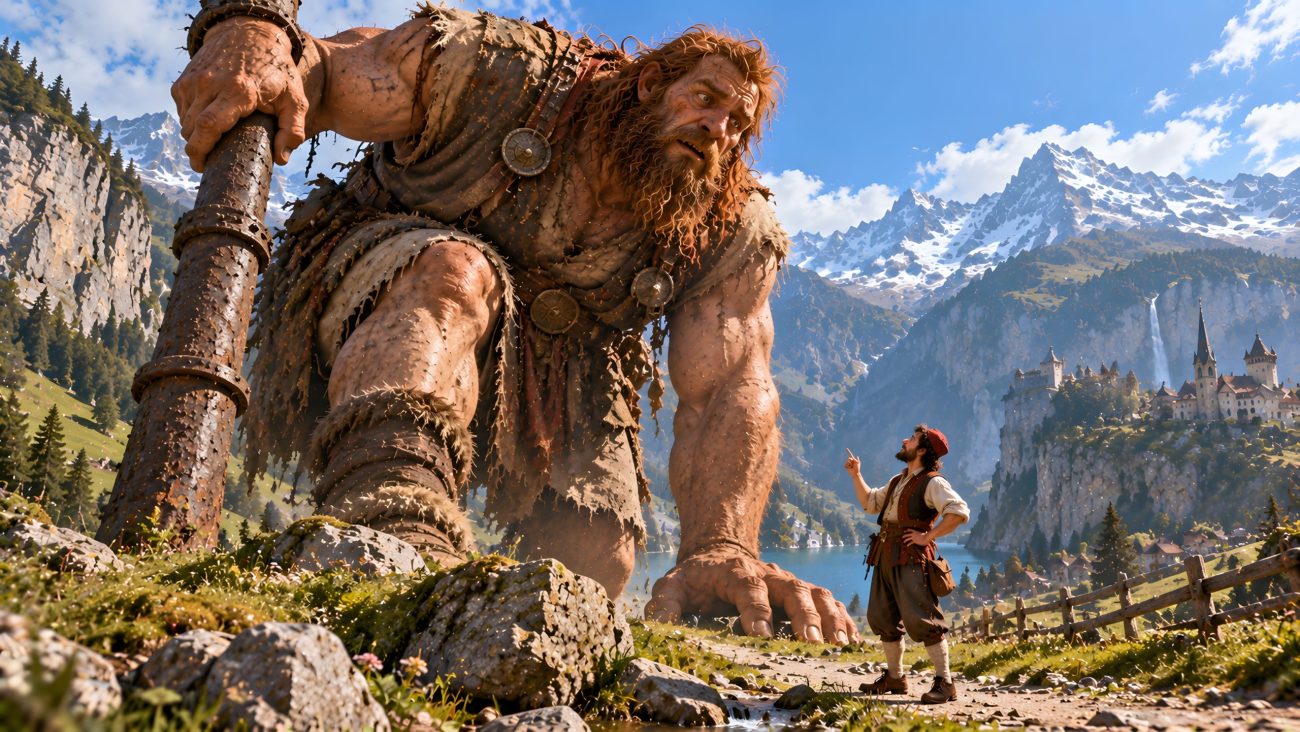
The Silly Giant and the Clever Little Tailor is a Swiss folktale set in the Lucerne hinterland and the Entlebuch region. It tells of three enormous giants whose strength is matched by their foolishness. The story begins when two giants meet while wandering through the countryside in search of a third companion. Carrying mighty iron bars as walking sticks, they eventually reach Schrattenberg in Entlebuch. One giant tears a boulder from the rock face and throws it into the abyss below. The stone strikes another giant on the forehead, but leaves him unharmed. The startled giant emerges from behind the cliff, and the three companions continue their journey together.
The giants amuse themselves by testing their strength against a thick wall of conglomerate rock. The first smashes a large piece loose with his head, the second drives his skull halfway through the wall, and the third charges so violently that his head and shoulders pass through it. Unfortunately, the third giant cannot pull himself free because a heavy stone falls onto his neck, suffocating him. One of the remaining giants later dies for an unknown reason, leaving only a single giant in Entlebuch. Enraged by his loneliness, the survivor vows to kill the first human he encounters.
His intended victim is a little tailor walking along a ditch. The giant threatens to hang him from a tree like a pine cone, but the tailor conceals his fear and boasts that he is just as strong as his enormous opponent. To prove his claim, the giant lifts a stone weighing a hundredweight and challenges the tailor to do the same. The tailor replies that lifting a stone is trivial compared with his ability to grind a hard pebble between his fingers. When the giant fails to crush a pebble in his fist, the tailor secretly takes a ball of white cheese from his satchel and squeezes it until liquid drips out. Believing that the tailor has crushed a stone, the giant is filled with admiration and invites him to travel the world as his companion.
The unlikely pair eventually arrive at a city where a dragon threatens the royal family and its people. The monster lives in a nearby lair and demands a human victim every day. If no one is delivered to it, the dragon emerges and ravages the city. The king has promised his daughter and his kingdom to whoever can slay the beast. The giant eagerly accepts the challenge, while the tailor relies on his cunning rather than physical strength. They prepare to fight the dragon with an enormous hammer and a pair of equally heavy tongs. However, the tailor persuades the giant to carry both weapons by distracting him with the promise of his favorite food, sweet rice porridge.
At the dragon’s cave, they agree that the giant will drive the monster out with his hammer while the tailor catches it with the tongs. When the dragon suddenly emerges, however, it swallows the tailor before he can act. The giant immediately smashes the dragon’s horned skull with his hammer, killing it, and then cuts the tailor alive from its belly. The giant claims the princess and kingdom for himself, insisting that his strength has won the victory. The tailor counters with an extraordinary story: he deliberately allowed the dragon to swallow him so that he could turn the monster inside out and bring it alive into the royal city. The foolish giant believes him and permits him to claim the credit for defeating the dragon.
The king is now uncertain which of the two companions deserves the promised reward. After his advisors fail to resolve the dispute, the tailor proposes an eating contest: whoever can consume the most rice porridge will win the princess and kingdom. The giant welcomes the challenge because rice porridge is his favorite food. A bowl of porridge as large as a mountain is placed before the contestants, and the giant eats furiously until he can manage no more. The tailor, however, continues eating, apparently without difficulty, until the giant admits defeat. In truth, the tailor has been placing the porridge in a large sack hanging around his neck.
The tailor marries the princess and receives the kingdom, but the foolish giant remains determined to discover how his smaller companion ate so much. The tailor tells him that he cut open his own belly while eating, allowing him to consume an unlimited amount. Believing this explanation, the giant attempts the same feat while eating rice porridge and dies from his wound. His death finally frees the tailor and the kingdom from his presence. The tale ends with the tailor revealing the truth to his wife, who learns that his apparent appetite was merely another trick.
The story contrasts brute strength with intelligence and deception. Although the giant possesses overwhelming physical power, his gullibility repeatedly makes him vulnerable to the tailor’s schemes. The tailor survives through quick thinking, exploiting the giant’s pride and limited understanding to secure a future that strength alone could not guarantee.
Sources
“Der Riese und das Schneiderlein.” SAGEN.at – Schweizer Sagen. Reproduced by SAGEN.at. https://www.sagen.at/texte/sagen/schweiz/allgemein/riese_schneiderlein.html