Black House Poltergeist

Tradition: Swiss Mythology
Alternative Names: The Black House Dweller
Category: House dweller


The Myth

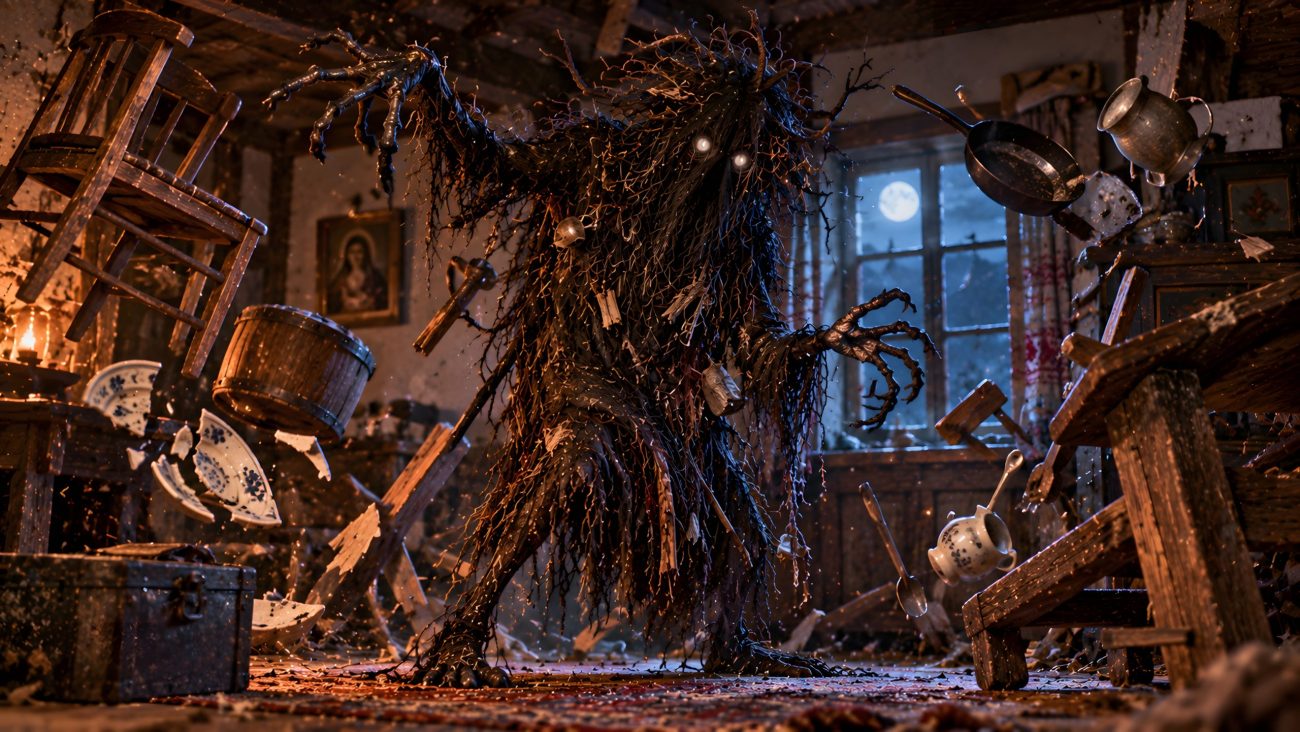
The Black House Poltergeist haunted a house in Tübach, in the Swiss canton of St. Gallen. The building had a sinister reputation, and people avoided living there because strange disturbances made it seem as though something was terribly wrong inside. Its most notorious feature was the terrible noise heard at night, as if heavy sticks or tree stumps were being thrown about the house by an unseen presence.

The disturbances were severe enough to make the house an unwelcome place to live. Although the legend does not describe the spirit’s appearance or explain why it haunted the building, the unexplained nighttime racket suggests a poltergeist whose presence was revealed through the violent movement of objects and the disruption of domestic peace.

Eventually, the Black House was demolished. A new building was constructed in its place, becoming the popular restaurant known as Ruheberg. The old haunting was no longer a source of fear, and the legend concludes that the poltergeists had finally found peace. People could enter the new establishment without worrying about the frightening disturbances associated with its predecessor.

The Black House Poltergeist represents a haunting tied closely to a particular building. Its identity is defined not by a visible form or a known history, but by the noises that made the house infamous and drove people away. The demolition of the structure brought the story to a peaceful conclusion, suggesting that the supernatural disturbance was bound to the old house itself.


Sources

“Das schwarze Haus in Tübach.” SAGEN.at – Schweizer Sagen. Reproduced by SAGEN.at. https://www.sagen.at/texte/sagen/schweiz/st_gallen/schwarze_haus_tuebach.html
Cradle Spirit

Tradition: Swiss Mythology
Alternative Names: The Good Spirit of Guggernfluh
Category: House dweller


The Myth

The Cradle Spirit is a benevolent supernatural being from a legend set at the Jessenen estate in Yberg, in the canton of Schwyz, Switzerland. The spirit is associated with Guggernfluh, a steep cliff overlooking the valley where the weather is notoriously harsh. Although the area is known for its violent storms, a good spirit is said to dwell there and occasionally help the people who live nearby.

One afternoon, near the end of the haymaking season, a farmer’s wife remained at home with her newborn twins while the rest of the household went to work gathering hay on Guggernfluh. As a thunderstorm approached, she became frightened and attempted to protect the house from the weather witches by placing an axe upright in the grass outside. While she sat beside the cradle, an unseen voice called her from the mountain, urging her to come and help with the haymaking. Although she could see nobody, she eventually left the house after the voice called her three times, moving her crying children to a corner beside the stove before departing.

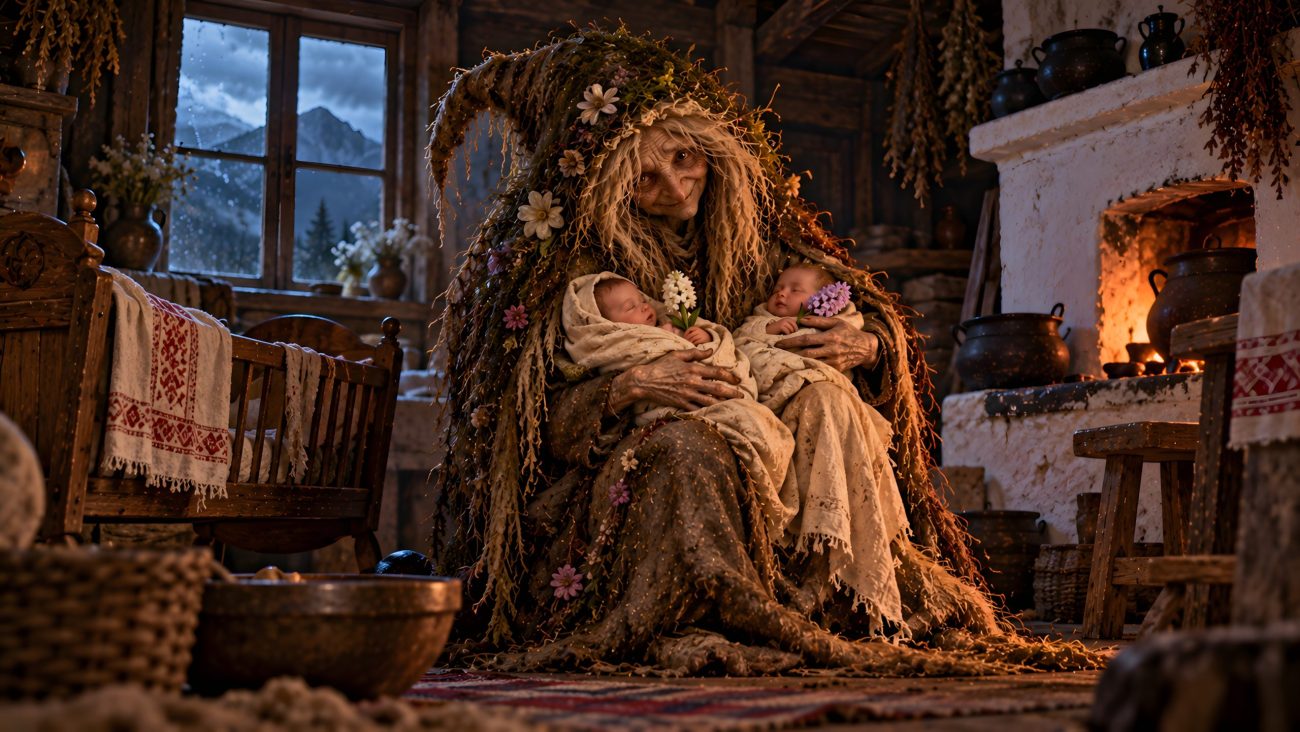
When the woman reached the meadow, she joined her husband, sons, and the farmhands in bringing the hay under cover. Before long, however, she heard persistent cries coming from the nearby woods, sounding distressingly like her own children. Following the noise to the edge of the steep cliff, she discovered a small, hunchbacked woman sitting on a patch of level grass. The strange figure was hairy and cradled something in her arms. To the mother’s horror, she recognized her own twins. As she cried out in alarm and tried to approach, the hunchbacked woman vanished, leaving only a night owl with drooping wings disappearing into the bushes. A tremendous storm then broke over the landscape.

Terrified and fearing for her children, the woman hurried home. There she found the twins safe and sound in their cradle beside the stove. Each child held a fragrant hyacinth, known in the story as a lady’s foot flower. Her husband and the farmhands confirmed that none of them had called her to the meadow. The woman realized that the good spirit of Guggernfluh had rocked and guarded her children while she was away, and that the frightening apparition she had seen at the cliff was connected to this mysterious protection.

Once the storm had passed, the grateful mother carried the two flowers to the small church in Yberg and placed them on the altar. According to the legend, their sweet fragrance lingered in the church for months afterward.

The Cradle Spirit represents the mysterious benevolence attributed to supernatural beings inhabiting dangerous landscapes. Although the encounter initially appears threatening, the children are never harmed, and the flowers reveal the spirit’s protective role. The legend links the wild and stormy heights of Guggernfluh with the safety of the family home, suggesting that unseen powers could intervene to protect vulnerable children when their parents were unable to remain beside them.


Sources

“Der Wiegengeist.” SAGEN.at – Schweizer Sagen. Reproduced by SAGEN.at. https://www.sagen.at/texte/sagen/schweiz/allgemein/wiegengeist.html


Jack o’ the Bowl

Tradition: Swiss Mythology
Alternative Names: Jack-of-the-Bowl, Jean de la Boliéta, Napf-Hans
Category: House dweller


The Myth

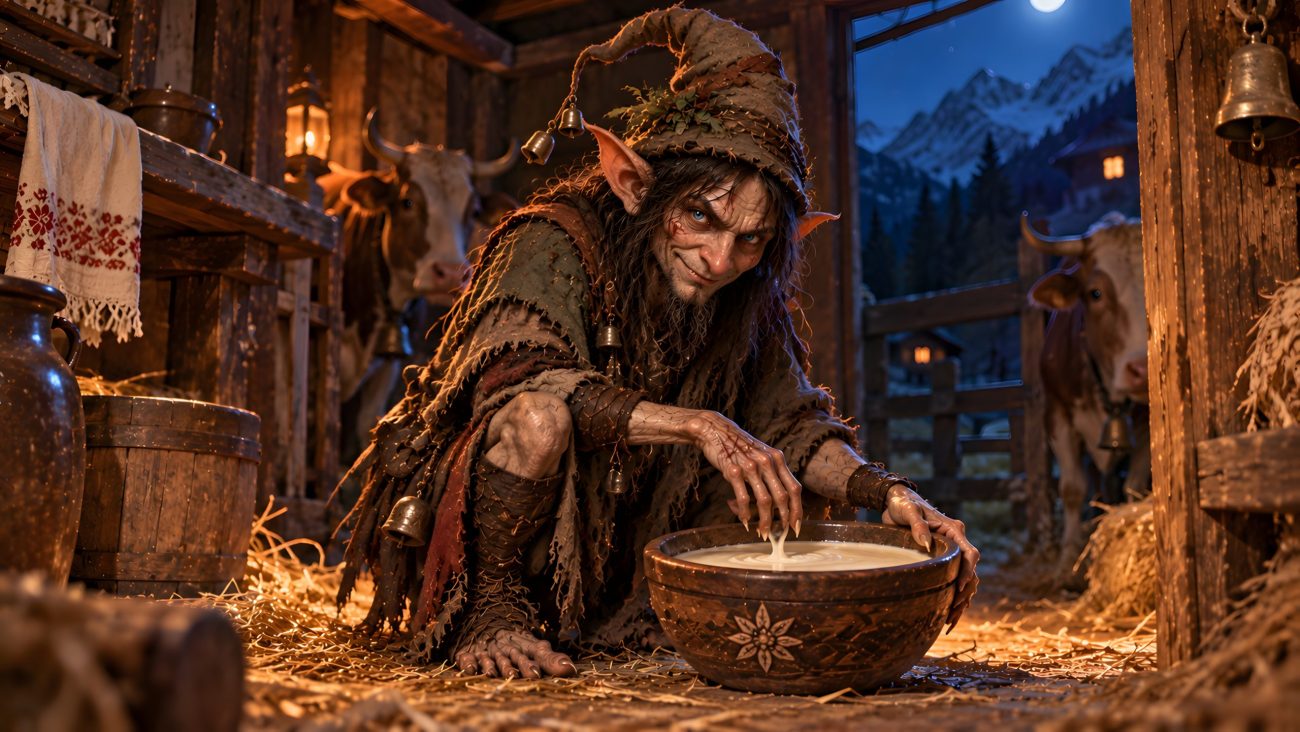
Jack o’ the Bowl is a helpful house spirit in Swiss folklore, described variously as a brownie or a kobold. He is known for protecting cattle and guiding them safely through dangerous mountain terrain. Despite the risks of grazing in such places, the cows under his care never suffer injury.

To earn his assistance, people leave a bowl of sweet cream for him each night. In return, Jack o’ the Bowl leads their cows to graze in places considered too dangerous for humans. He guides the animals across rocky mountain slopes where ordinary paths would be difficult to navigate, ensuring that the herd remains unharmed.

The route used by the spirit is said to remain clear of stones, regardless of how rocky the mountainside may be. This remarkable path became known as Boliéta’s Path, a lasting sign of the spirit’s supernatural assistance to the local herders.

Known in French as Jean de la Boliéta and in German as Napf-Hans, Jack o’ the Bowl represents the helpful household spirits believed to reward small offerings with valuable services. His legend connects domestic hospitality with the protection of livestock and the safe use of otherwise dangerous mountain pastures.


Sources

“Jack o’ the Bowl.” Wikipedia: The Free Encyclopedia. Wikimedia Foundation. Accessed October 18, 2026. https://en.wikipedia.org/wiki/Jack_o%27_the_bowl


Schrättlig

Tradition: Swiss Mythology
Alternative Names: Schrättling
Category: House dweller


The Myth

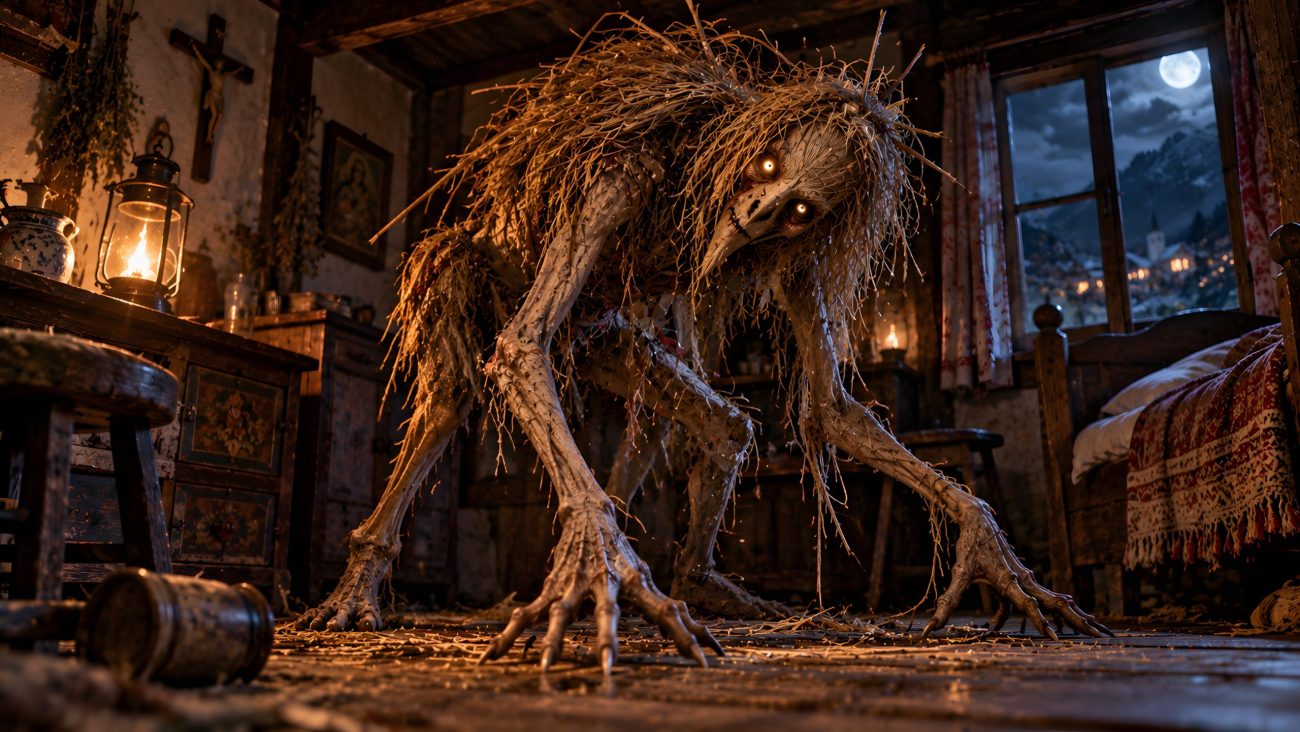
The Schrättlig is a terrifying supernatural creature that visits homes at night and torments their inhabitants. According to an oral account from the Canton of St. Gallen, it repeatedly came to one family’s house, troubling different members of the household on different nights. Its attacks created such distress that the family eventually attempted to prevent the creature from escaping.

On one occasion, the household managed to block the Schrättlig’s route out of the house. The following morning, they discovered a straw lying on the living-room floor. Believing it to be connected to the creature, they attacked it with hammers and axes. At the same time, a woman known to the family lay seriously ill in a bed in the room above.

The account does not describe the Schrättlig’s usual appearance or explain precisely how it tormented its victims. However, the discovery of the straw after its escape route had been blocked suggests that the creature could be associated with an unusual physical form or a transformation into something seemingly harmless. The seriously ill woman may have been connected to the incident, although the oral legend does not explicitly explain the relationship.

The story presents the Schrättlig as a nocturnal menace whose presence brings suffering into an otherwise ordinary household. Its brief but unsettling account reflects a folkloric fear of supernatural beings that attack people during the night and may leave behind strange clues to their identity.


Sources

“Schrättlig.” SAGEN.at. https://www.sagen.at/texte/sagen/schweiz/st_gallen/schraettlig.html