Chimi

Tradition: Japanese Mythology
Alternative Names: 魑魅, Sudama, Yama no Kami, Mountain Spirit
Category: Pig


The Myth

Chimi is a supernatural being associated with mountains and forests, known from the expression chimi mōryō, a collective term for monsters and supernatural entities originating in the ancient Chinese classic Zuo Zhuan. In traditional explanations, chimi are spirits arising from the atmosphere of mountains and forests, while mōryō are spirits associated with mountains, rivers, trees, and stones. Some interpretations identify chimi as mountain deities, with chi representing a god of the mountains and mi a deity of marshes. In Japan, chimi was also read as sudama or yama no kami, and the Heian-period dictionary Wamyō Ruijushō records the name Sudama and classifies the beings among the varieties of demons.

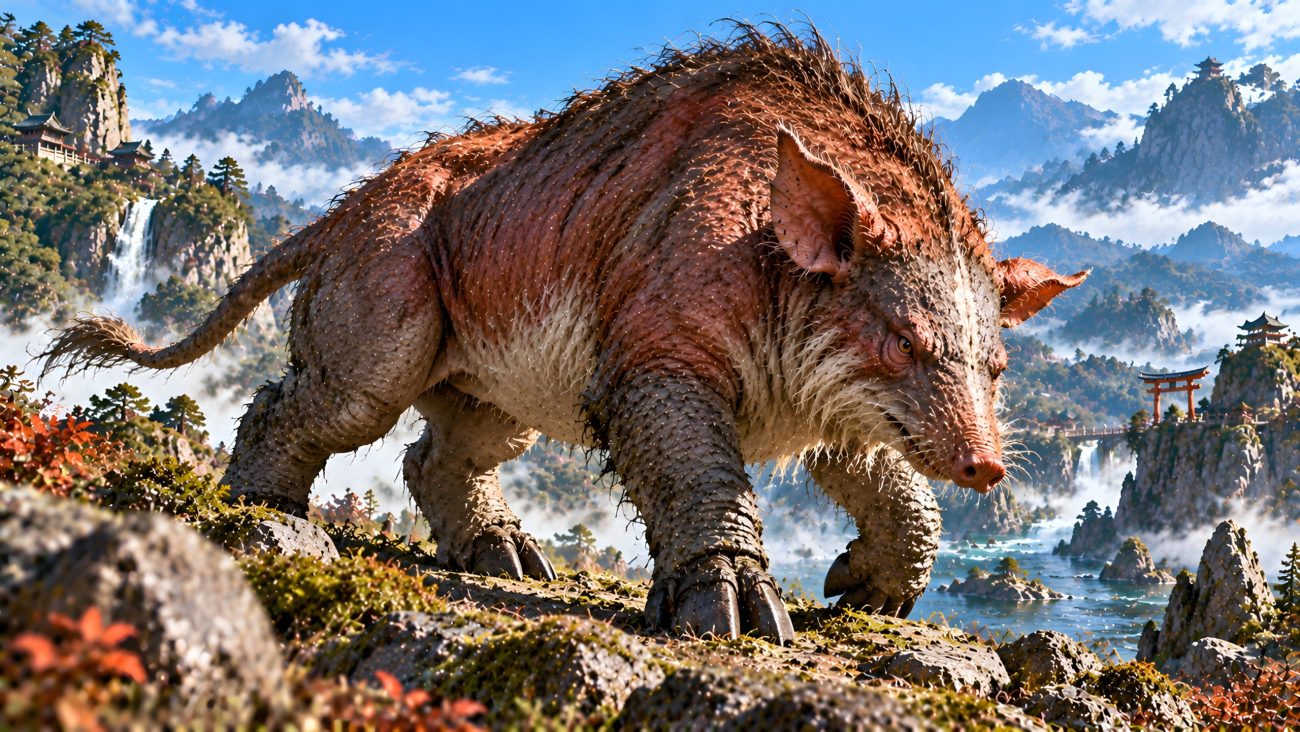
Descriptions of chimi vary across Chinese classical texts. Some portray chi as a tiger-like mountain spirit and mi as a humanoid creature with an animal’s body and four legs. A commentary on the Records of the Grand Historian describes chi as a tiger-shaped mountain deity and mi as a marsh spirit with a boar’s head and a human-shaped body. These differing descriptions have influenced later explanations and depictions of the creature, but chimi never acquired one universally established appearance in Japanese supernatural art.

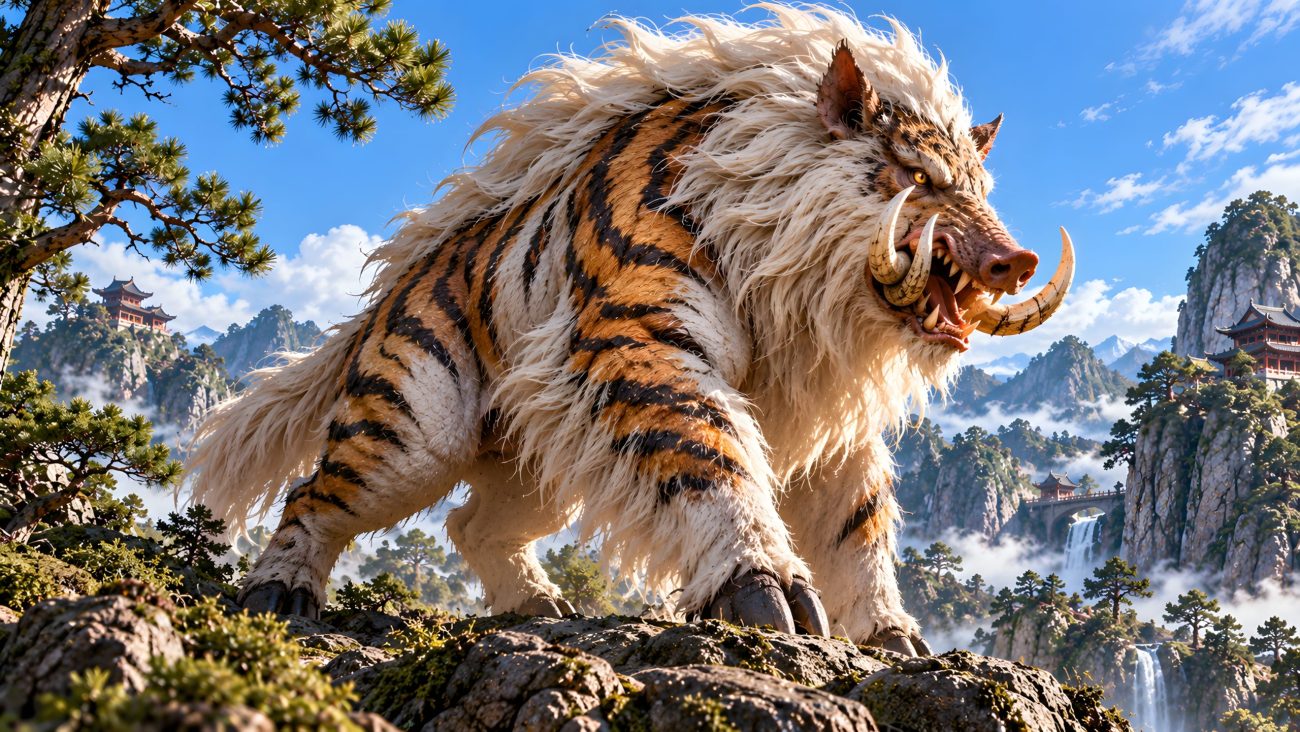
One illustrated appearance of chimi occurs in the Edo-period kibyōshi Hyakki Yagyō Bakemono-gatari, where it is portrayed alongside mōryō as a monstrous mother with a child. The hairy, long-haired chimi has a human face and demonic body, while the childlike mōryō playfully threatens to bite its mother’s breast. In the twentieth century, illustrated children’s books popularized another design combining the boar’s head associated with mi and the tiger-like body associated with chi. One such depiction describes chimi as a creature dwelling deep in the mountains, capable of raising wind and rain and exercising power over nature. Despite these illustrations, chimi remains a supernatural being whose appearance varies considerably between sources.


Sources

“Chimi.” 新版TYZ 妖怪図鑑 (New TYZ Yokai Encyclopedia). https://tyz-yokai.blog.jp/archives/1073628962.html?utm_source=chatgpt.com
Shiroi

Tradition: Japanese Mythology
Alternative Names: 白猪, White Boar, White Wild Boar
Category: Pig


The Myth

Shiroi, meaning “White Boar,” appears in the Kojiki, an ancient Japanese chronicle, in the legend of Yamato Takeru. After marrying Miyazu-hime, the daughter of the governor of Owari, Yamato Takeru set out to subdue the deity of Mount Ibuki in Ōmi Province. Before departing, he entrusted his divine sword, Kusanagi-no-Tsurugi, to his wife, having received it from Princess Yamato-hime of Ise. He intended to confront the mountain deity with his bare hands.

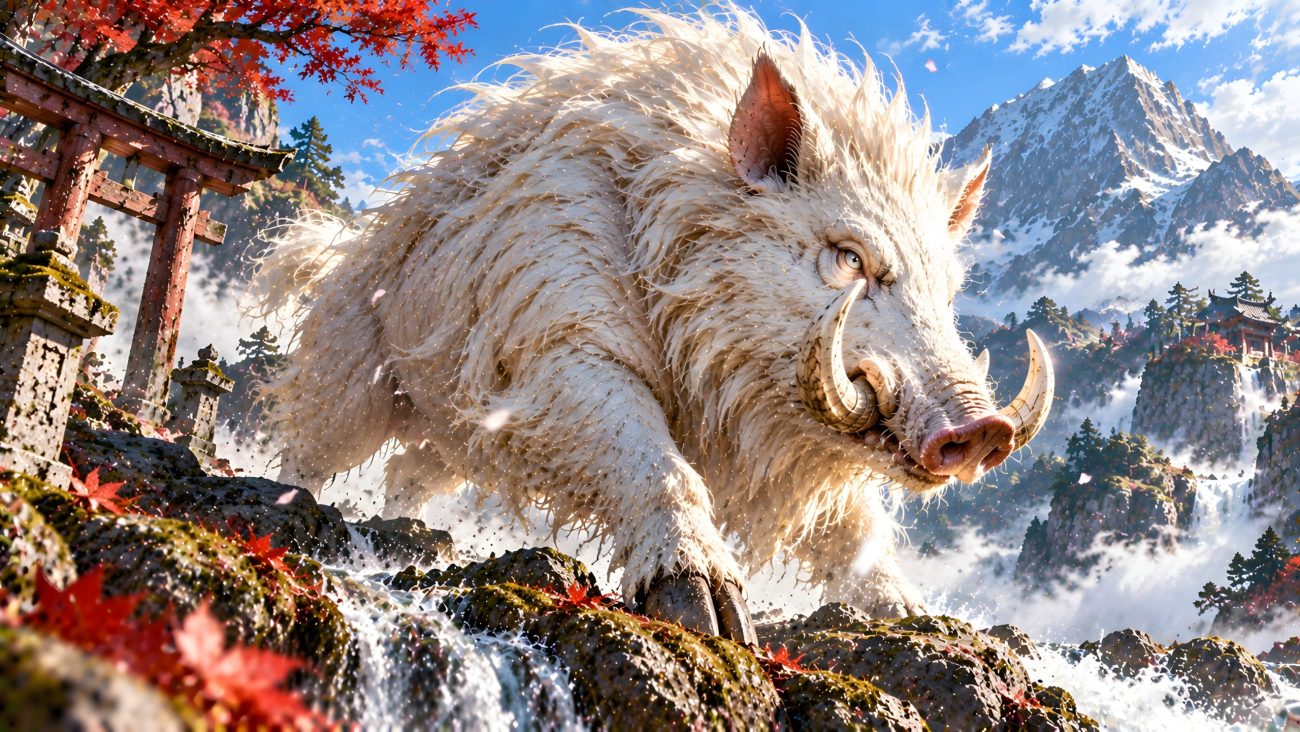
While climbing Mount Ibuki, Yamato Takeru encountered a white boar as large as an ox. He assumed that the animal was merely a messenger of the mountain god and declared that he could kill it on his return rather than stopping to deal with it immediately. However, the boar was actually the mountain deity itself. His careless declaration angered the god, which unleashed a violent storm of rain and hail that overwhelmed Yamato Takeru and caused him to lose consciousness.

When he regained consciousness, Yamato Takeru descended the mountain in a daze until he reached a clear spring at Tamakurabe, where he recovered his senses. The spring became known as the Izame no Shimizu, or “Refreshing Spring.” Having incurred the mountain deity’s wrath, Yamato Takeru fell ill and continued his journey toward Yamato in a weakened state. He eventually collapsed and died at Nobono, in present-day Kameyama, Mie Prefecture, after composing four poems, including one beginning with the famous words “Yamato is the most beautiful of lands.” His spirit then transformed into a great white bird and flew toward the heavens.

The Nihon Shoki, another early Japanese chronicle, also recounts Yamato Takeru’s encounter with the deity of Mount Ibuki, but its version differs: instead of a white boar, the deity appears in the form of a serpent. The contrasting accounts preserve different traditions concerning the divine being that brought about the hero’s downfall.


Sources

“Shiroi.” 新版TYZ 妖怪図鑑 (New TYZ Yokai Encyclopedia). https://tyz-yokai.blog.jp/archives/1073403665.html?utm_source=chatgpt.com


Puaka

Tradition: Malaysian Mythology
Alternative Names: Pig Demon, Puaka
Category: Pig


The Myth

The Puaka, whose name means “pig,” is a demonic creature in Dusun mythology that guards water in eddies. It resembles a pig with a razor-sharp tongue and is said to feed from trees. Puakas can climb to reach branches by standing on one another’s backs, forming a living tower to reach their food.

The Puaka is a dangerous pursuer. When someone encounters one, it is said to attack whenever its victim moves and stop whenever the victim stands still. If the creature catches its prey, it licks the victim’s bones clean with its sharp tongue. One traditional method of escaping is to cross a stream. Although the Puaka may follow across the water, it will pause once it reaches dry land to lick itself dry. In doing so, it supposedly licks the flesh from its own bones, giving its intended victim an opportunity to escape.

The name puaka also has a wider linguistic distribution across Polynesian and other island languages, where related forms commonly mean “pig.” Examples include puaka in Rarotongan, Mangarevan, Rotuman, and Malay; vuaka in Fijian; puaʻa in Samoan; and poaka in Māori. Although the word has been compared with terms such as Sanskrit sukara, Latin porcus, and English porker, the source suggests that it may have an independent Polynesian origin. In some regions, puaka came to refer specifically to a pig-like demon, while in others its original meaning of “pig” may have been lost, possibly through the influence of Islam.


Sources

“Puaka.” A Book of Creatures, April 13, 2015. https://abookofcreatures.com/2015/04/13/puaka/


Calydonian Boar

Tradition: Greek Mythology
Alternative Names: Aetolian Boar, Calydonian Wild Boar
Category: Pig


The Myth

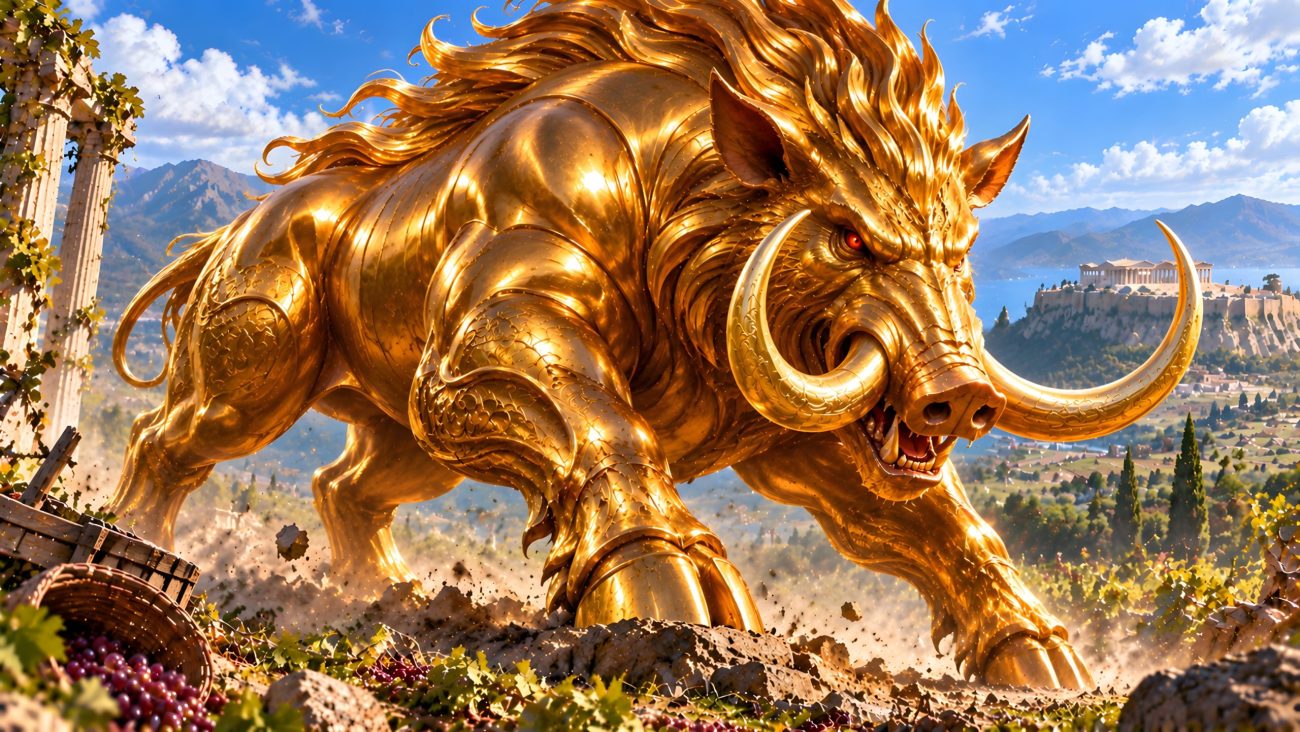
The Calydonian Boar was a monstrous wild boar sent by the goddess Artemis to ravage the countryside around Calydon in Aetolia. King Oeneus had neglected to include Artemis in his annual harvest sacrifices to the gods, angering the goddess. In retaliation, she unleashed an enormous and ferocious beast upon his kingdom, where it destroyed vineyards and crops, devastated the countryside, and forced the inhabitants to seek refuge behind the city’s walls.

The boar was described as an extraordinarily terrifying creature, with bloodshot eyes that burned like fire, a thick neck covered in stiff, spike-like bristles, enormous tusks, and jaws that produced deafening roars. According to Ovid’s Metamorphoses, its breath scorched the green fields as it rampaged through the land. Strabo records a tradition identifying the beast as the offspring of the Crommyonian Sow, another monstrous pig defeated by the hero Theseus.

To save Calydon, Meleager led a company of Greece’s greatest heroes on a hunt to kill the beast. The hunters included numerous legendary figures, and in most accounts the hunt also featured the huntress Atalanta, who was the first to wound the boar with an arrow. After the animal was killed, Meleager awarded its hide to Atalanta, provoking a dispute among the hunters that contributed to the tragedy surrounding the expedition.

The Calydonian Boar Hunt became one of the major heroic adventures of Greek mythology, bringing together heroes whose stories were connected to other famous events, including the voyage of the Argonauts and the Trojan War generation. The hunt was frequently depicted in ancient Greek and Roman art. Although Homer and Hesiod were familiar with the legend, no complete surviving account from either poet remains; important versions are preserved in fragments attributed to Stesichorus, the Bibliotheca, and Ovid’s Metamorphoses.


Sources

“Kalydonian Boar.” Theoi Greek Mythology. https://www.theoi.com/Ther/HusKalydonios.html


Buta Nezumi

Tradition: Japanese Mythology
Alternative Names: 隠鼠, Inso, Enso, 鼴鼠,偃鼠, 鼠母, Hidden Rat, Mountain Rat
Category: Pig


The Myth

Buta Nezumi, meaning “Pig Rat,” is a mysterious beast described in Terashima Ryōan’s Wakan Sansai Zue, an illustrated encyclopedic work from the Edo period. Drawing on the Chinese medical text Bencao Gangmu, the work describes the creature as a mountain-dwelling animal that belongs to the category of beasts rather than rodents. It is said to be as large as a water buffalo and shaped like a wild boar, with a greyish-red body, legs resembling those of an elephant, and hooves like those of a donkey. Its muzzle is sharp, while its chest and the area above its tail are white.

Despite its great strength and heavy build, the creature is reportedly afraid of dogs. Its appearance is also considered an omen of water disasters. Ryōan connects this description with a passage in the Chinese Book of Liang, which mentions a mountain rat in Wa (Japan) as large as a calf. However, he notes that he has never heard of such a beast existing in Japan and wonders what the creature might actually be.

A related account appears in the Chinese supernatural collection Soushen Ji, which records the appearance of an yanshu in the eleventh month of 311. The diviner and scholar Guo Pu interpreted this apparition as a possible omen that a powerful claimant would emerge and later die by suicide. These accounts associate the mysterious animal with extraordinary events and disaster, although its precise identity remains uncertain.


Sources

“Butanezumi.” 新版TYZ 妖怪図鑑 (New TYZ Yokai Encyclopedia). https://tyz-yokai.blog.jp/archives/1076684724.html


Umi no Inoshishi

Tradition: Japanese Mythology
Alternative Names: 海の猪, Sea Boar, Wild Boar of the Sea
Category: Pig


The Myth

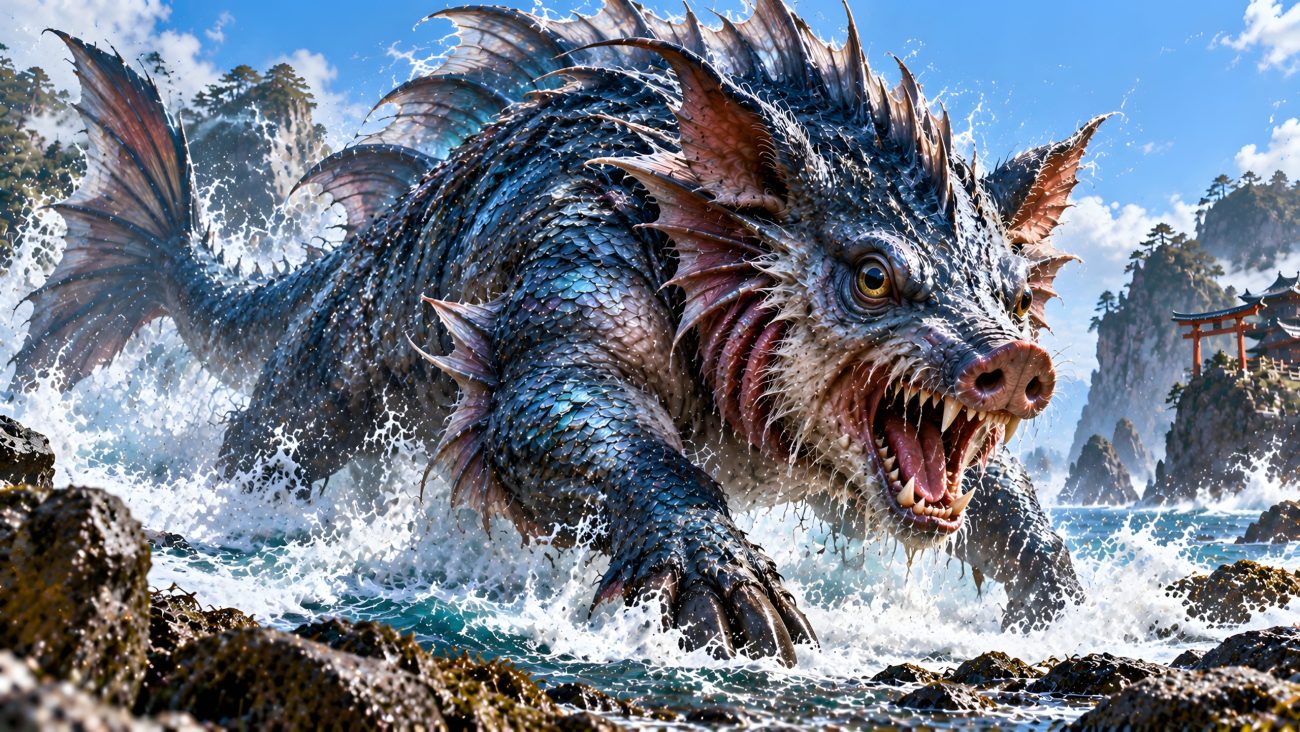
Umi no Inoshishi, meaning “Sea Boar,” appears in a traditional tale from Tanegashima, an island in southern Japan. According to the story, whales once lived on land while wild boars inhabited the sea. Both creatures struggled in their original environments, eventually prompting the gods of the mountains and the sea to arrange an exchange of habitats.

The whale originally roamed through fields and mountains in search of prey. Its enormous body knocked down trees and damaged embankments, causing floods. When it failed to catch even a rabbit, it became furious and stamped about violently. The mountain god, troubled by the destruction and feeling pity for the whale, consulted the sea god. The sea god proposed exchanging the habitats of the whale and the wild boar. At the time, the boar lived in the sea but struggled because it was a poor swimmer, and the sea god also felt sorry for it.

After moving onto land, the boar found that its familiar food was limited to small crabs called shiratagan i. Unable to satisfy its hunger, it begged the mountain god for better food. When the god learned that the boar had previously eaten erabu eels, a type of sea snake, he allowed it to eat a similar land animal: the venomous snake known as shirakuchi, or mamushi. The boar enjoyed this food so much that it began circling each snake seven times in excitement before eating it.

Meanwhile, the whale delighted in its new home in the sea, where it could swim freely and chase fish. However, its vigorous hunting disturbed the ocean, so the sea god forbade it from eating fish larger than squid and declared that breaking this rule would result in its being driven back onto land. The god told the whale that kibinago, a small fish, was its most suitable food. Still hungry, the whale sometimes disobeyed and ate larger fish. Whenever it did, a fearsome creature called the shachi attacked, cutting the whale’s body with deep, cross-shaped wounds. The whale fled toward the shore and became stranded on the beach or rocks, fulfilling the sea god’s punishment.


Sources

“Umi-inoshishi.” 新版TYZ 妖怪図鑑 (New TYZ Yokai Encyclopedia). https://tyz-yokai.blog.jp/archives/1073501646.html?utm_source=chatgpt.com


Shishi Ishi

Tradition: Japanese Mythology
Alternative Names: 猪石, Boar Stone, Inoshishi Ishi
Category: Pig


The Myth

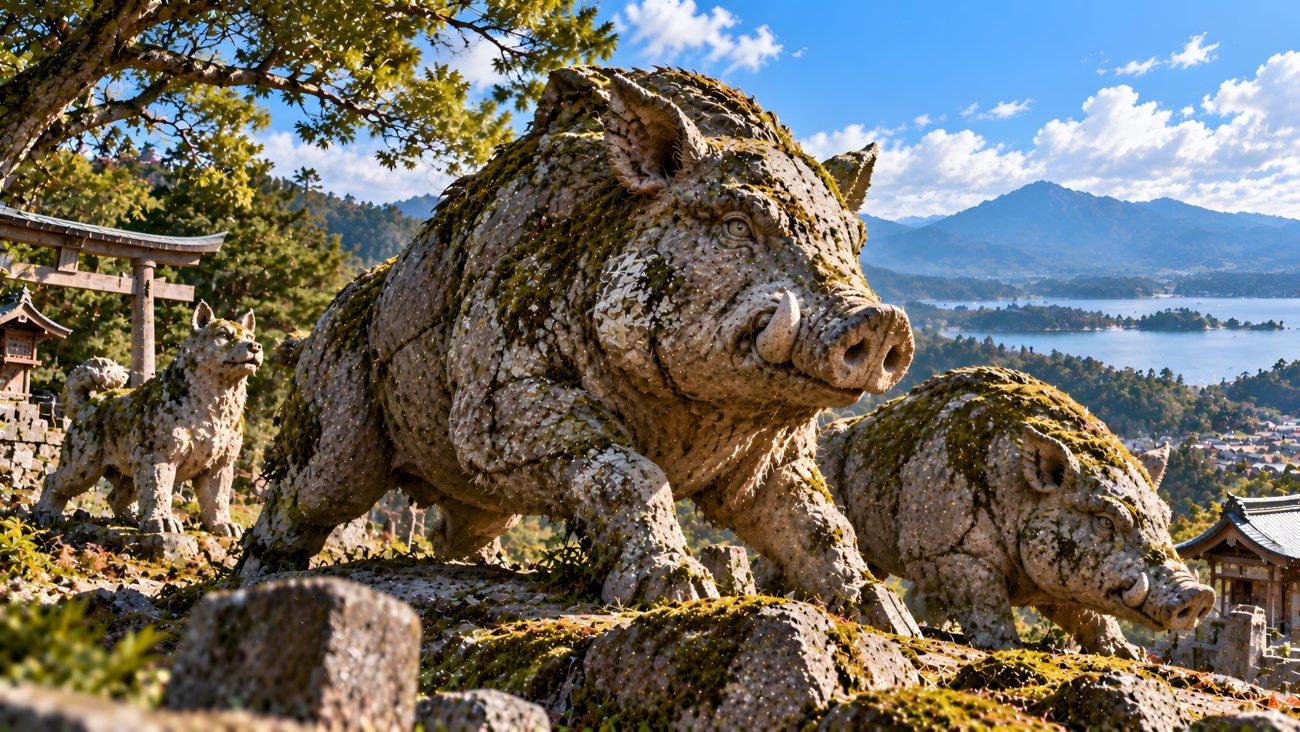
Shishi Ishi, meaning “Boar Stone,” is a pair of legendary stones described in the Izumo no Kuni Fudoki, an ancient record of Izumo Province in Japan. According to the account, Ōkuninushi, the great deity who shaped the land, once went hunting and pursued a pair of wild boars. During the chase, both boars and the dog pursuing them were transformed into stone. Their stone forms remained so similar to the original animals that they could still be recognized as boars and a dog.

The legend explains the origin of the place name Shishiji, later known as Shinji. The two boar stones were said to have measured approximately two jō and seven shaku in length and one jō in height, and two jō and five shaku in length and eight shaku in height, respectively. Their considerable dimensions distinguished them as remarkable landmarks in the landscape.

The stones identified as the Boar Stones and Dog Stone are preserved and venerated within the grounds of Ishimiya Shrine in Shinji-chō, Matsue, Shimane Prefecture. The legend connects these unusual stone formations with the hunting activities of Ōkuninushi and preserves a mythological explanation for the name of the surrounding area.


Sources

“Shishi-ishi.” 新版TYZ 妖怪図鑑 (New TYZ Yokai Encyclopedia). https://tyz-yokai.blog.jp/archives/1073414815.html


Shanjiao

Tradition: Chinese Mythology
Alternative Names: 山膏, Mountain Paste, Shan Gao
Category: Pig


The Myth

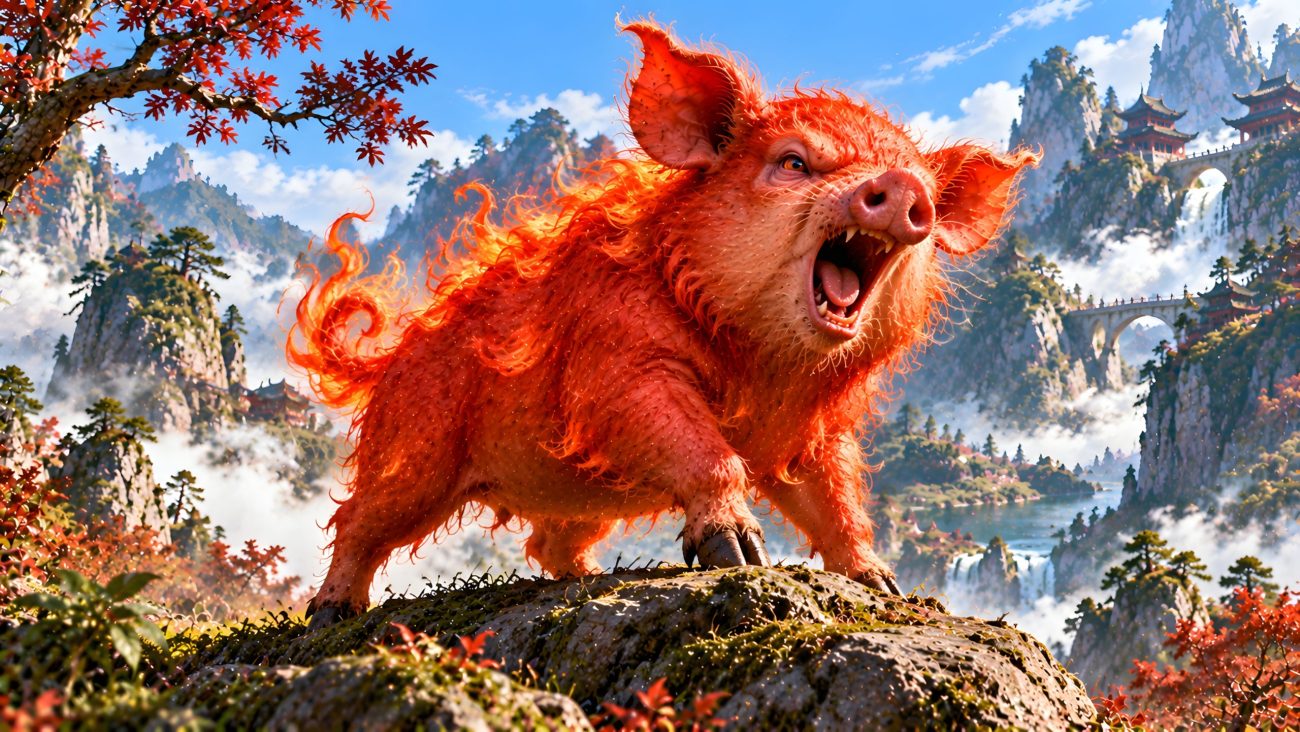
Shanjiao, also known as Shan Gao, is a strange beast described in the ancient Chinese text Classic of Mountains and Seas (Shanhaijing). According to the Classic of the Central Mountains, it inhabits Ku Mountain, approximately twenty miles to the east. The creature resembles an ordinary piglet, but its body is as red as a blazing fire. Its most distinctive characteristic is its fondness for cursing and insulting others.

Shanjiao is remembered less for physical strength or supernatural powers than for its foul mouth. Its reputation as a creature that excels at scolding became a literary reference for people who are particularly skilled at verbally attacking others. The creature’s name and description were later invoked in Chinese literary and political commentary, including a poem by Zhang Binglin inscribed on a fan for Liu Yazi, which referred to factions that were especially fond of insulting their opponents.

Through these references, Shanjiao became associated with quarrelsome behaviour and abusive speech. Despite its small, piglet-like appearance, its fiery red body and relentless tendency to curse make it a distinctive creature among the unusual animals recorded in Chinese mythology.


Sources

“Shan Gao” (山膏). Chinese Wikipedia. Wikimedia Foundation. Accessed October 27, 2026. https://zh.wikipedia.org/wiki/%E5%B1%B1%E8%86%8F?


Cuchivilu

Tradition: Chilean Mythology
Alternative Names: Cuchi Vilu, Pig-Snake
Category: Pig


The Myth

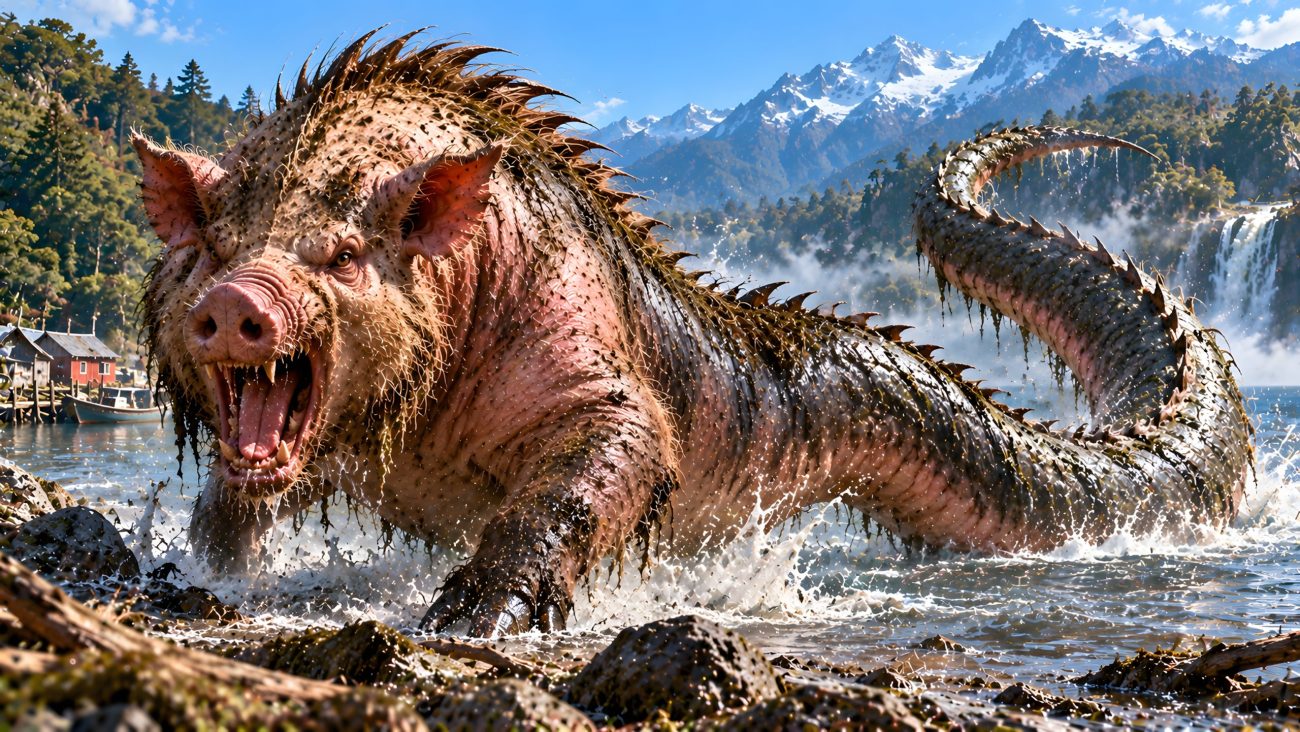
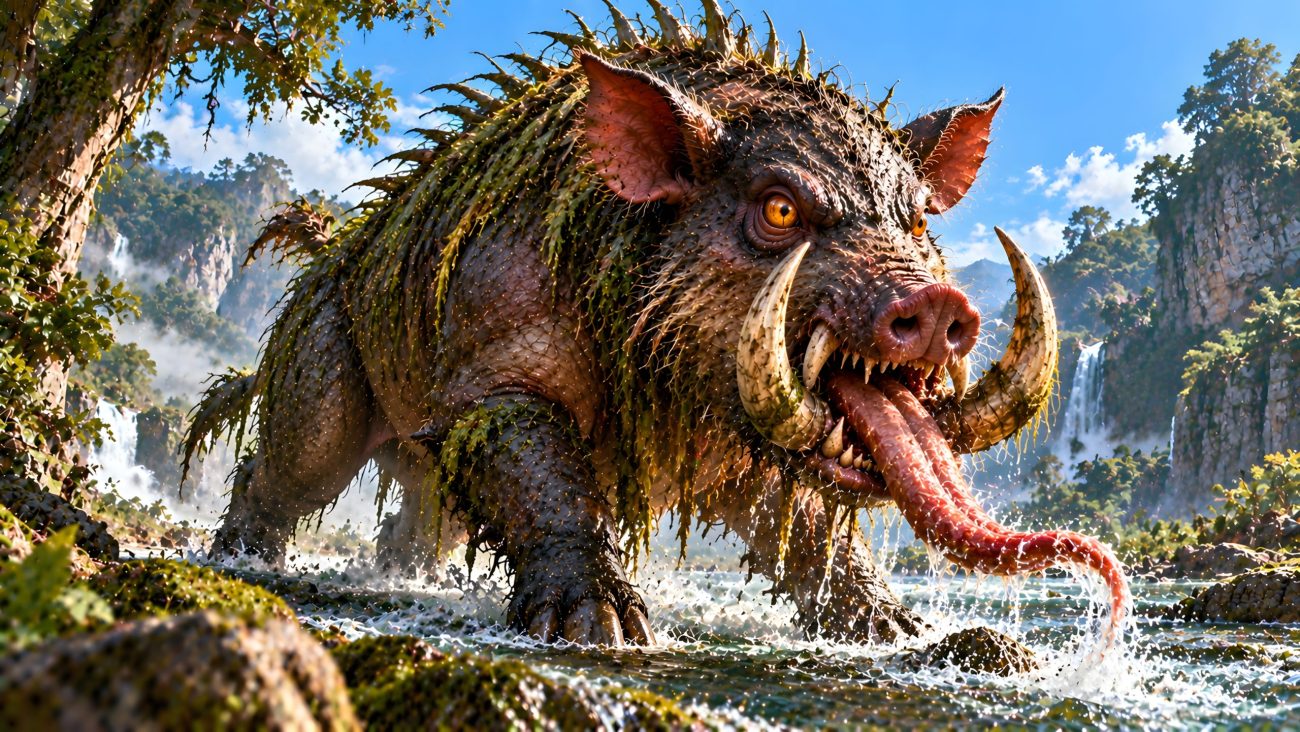
The Cuchivilu is a monstrous creature associated with Chilean mythology and Mapuche-influenced traditions. Its name combines cuchi, meaning “pig,” and vilu, meaning “snake.” It is described as a grotesque hybrid with the plump, bristly body and tusked head of a pig, joined to a long, powerful serpent-like tail. Its dark, slimy skin and coarse, matted fur help it blend into the muddy waters of rivers and coastal environments, while its small eyes are said to glow faintly in the darkness.

The Cuchivilu typically inhabits rivers and coastal waters but can also leave the water to pursue intruders on land. It is particularly hostile toward humans, especially fishermen, whom it regards as trespassers in its territory. According to the accounts, it attacks boats and tears apart fishing nets, sometimes capsizing vessels. Its guttural grunts echo across the shores as a warning to those who approach too closely. The creature is also associated with the contamination of waterways and shorelines, making the affected waters dangerous for bathing.

People who bathe in water believed to have been contaminated by the Cuchivilu are said to develop a painful, persistent rash that may worsen over time and leave permanent scars. Although the illness is not described as fatal, its disfiguring effects make the creature feared by local communities. Some accounts claim that the Cuchivilu originated after the colonial period and was formed from the souls of pigs and wild boars, embodying filth, anger, and vengeance against human intrusion.

Despite occasional modern reports of sightings, including claims from teenagers in Chonchi in southern Chile, there is no scientific evidence that the Cuchivilu exists. Its legend remains associated with the waters and fishing communities of Chile, where its unusual combination of pig and serpent characteristics distinguishes it from other supernatural creatures.


Sources

“Cuchivilu.” Cryptid Wiki. Fandom. https://cryptidz.fandom.com/wiki/Cuchivilu?utm_source=chatgpt.com


Lobisomem

Tradition: Brazilian Mythology
Alternative Names: Werewolf, Brazilian Werewolf
Category: Pig


The Myth

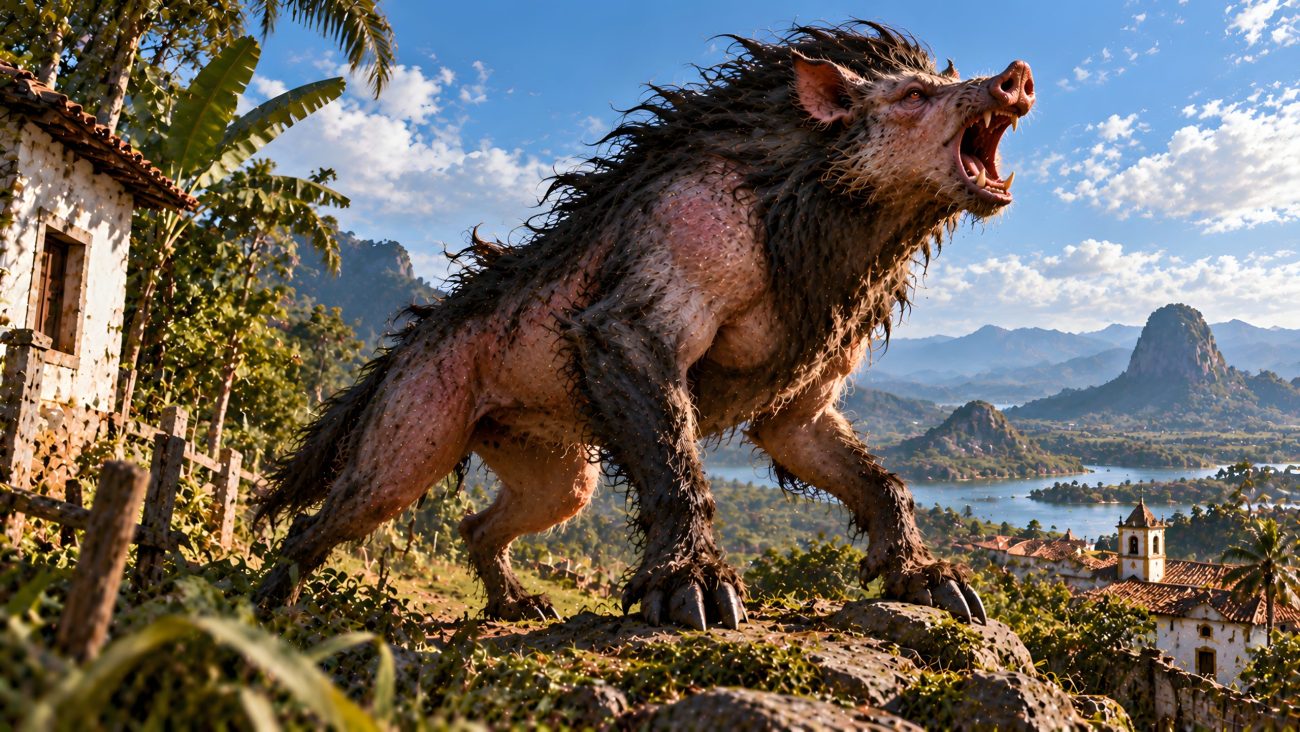
The Lobisomem is a supernatural creature found in Brazilian and wider South American traditions. It is most commonly described as a werewolf, resembling the wolf-like shapeshifters known from other cultures. However, some Brazilian accounts portray it as a ball of fire or an unusually large pig. In human form, it appears much like an ordinary person, except for slightly pointed ears and pale, yellowish skin.

There are several explanations for how a person becomes a Lobisomem. One may be transformed after being bitten by one or coming into contact with its blood. In some traditions, the curse falls upon the seventh son in a family, although it can supposedly be prevented by having an older brother serve as his godfather. Another version claims that the first male child born to parents who already have seven daughters will undergo his first transformation on his thirteenth birthday. The condition may also be understood as a punishment for incest, concubinage, or a woman’s sexual relationship with a priest.

The Lobisomem’s transformation takes place at night, although accounts differ over its timing. Some traditions claim that it transforms every night during a full moon, while others maintain that the change occurs only on Fridays when the moon is full. In its transformed state, the creature typically attacks travellers and animals encountered along roads after dark, making it a feared presence in the Brazilian countryside.


Sources

“Lobisomem.” Wikipedia: The Free Encyclopedia. Wikimedia Foundation. Accessed October 31, 2026. https://en.wikipedia.org/wiki/Lobisomem