Mengqi Bizi

Tradition: Chinese Mythology
Alternative Names: 盟器婢子, Maidservant of the Burial Objects
Category: Object


The Myth

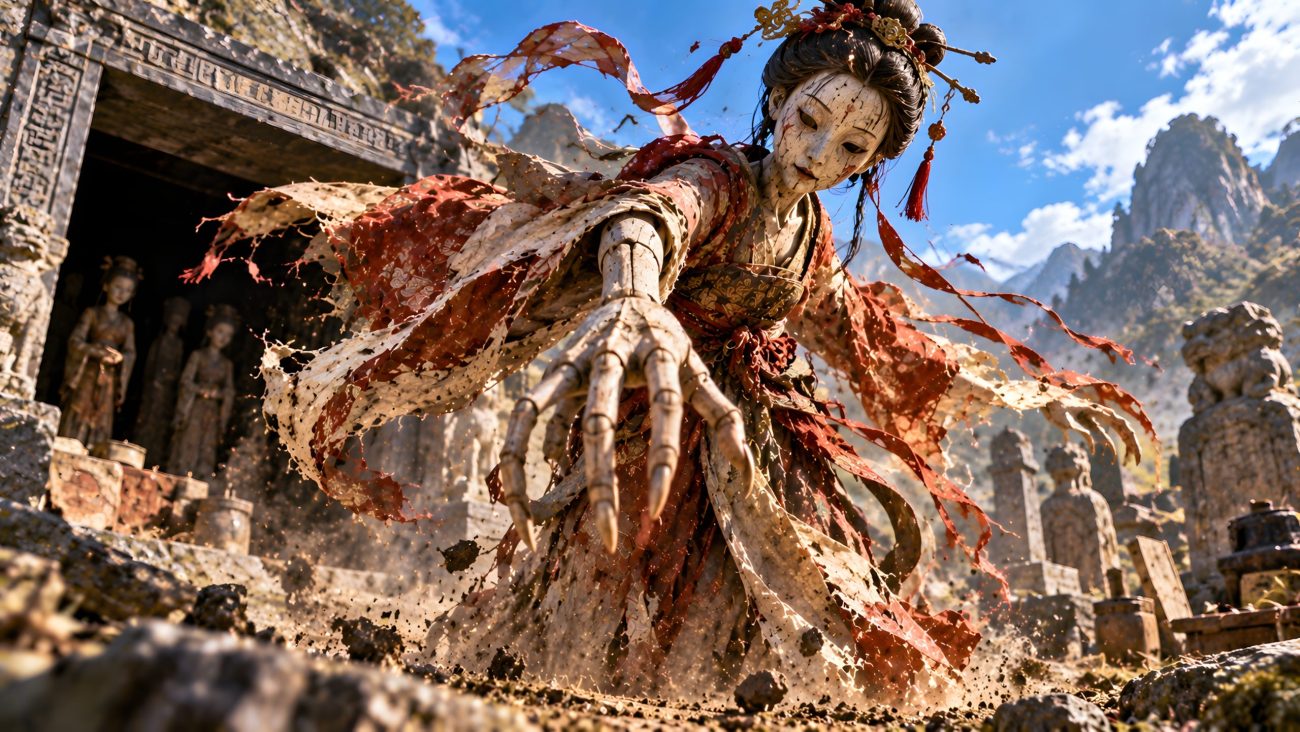
Mengqi Bizi is a supernatural being from Chinese tradition said to arise when a mengqi, a wooden figurine of a female servant made for burial, becomes a spirit. These figures were used as funerary objects, representing maidservants intended to accompany the deceased in death.

The creature is mentioned in two Chinese literary sources: Pei Yan’s Chuanqi and Zhang’s account in the Beimeng Suoyan. However, the available descriptions provide little information about its appearance, behaviour, or supernatural abilities beyond its origin as an animated burial object.

The term Mengqi Bizi can also refer directly to a female servant figurine used in burial practices, rather than to the supernatural creature itself. The legend therefore connects the idea of objects acquiring spiritual life with the tradition of placing representations of servants in tombs.


Sources

“Mengqi Bizi” (盟器婢子). Chinese Wikipedia. Wikimedia Foundation. Accessed October 24, 2026. https://zh.wikipedia.org/wiki/%E7%9B%9F%E5%99%A8%E5%A9%A2%E5%AD%90


Furuutsubo

Tradition: Japanese Mythology
Alternative Names: 古空穂, ふるうつぼ, Old Quiver
Category: Object


The Myth

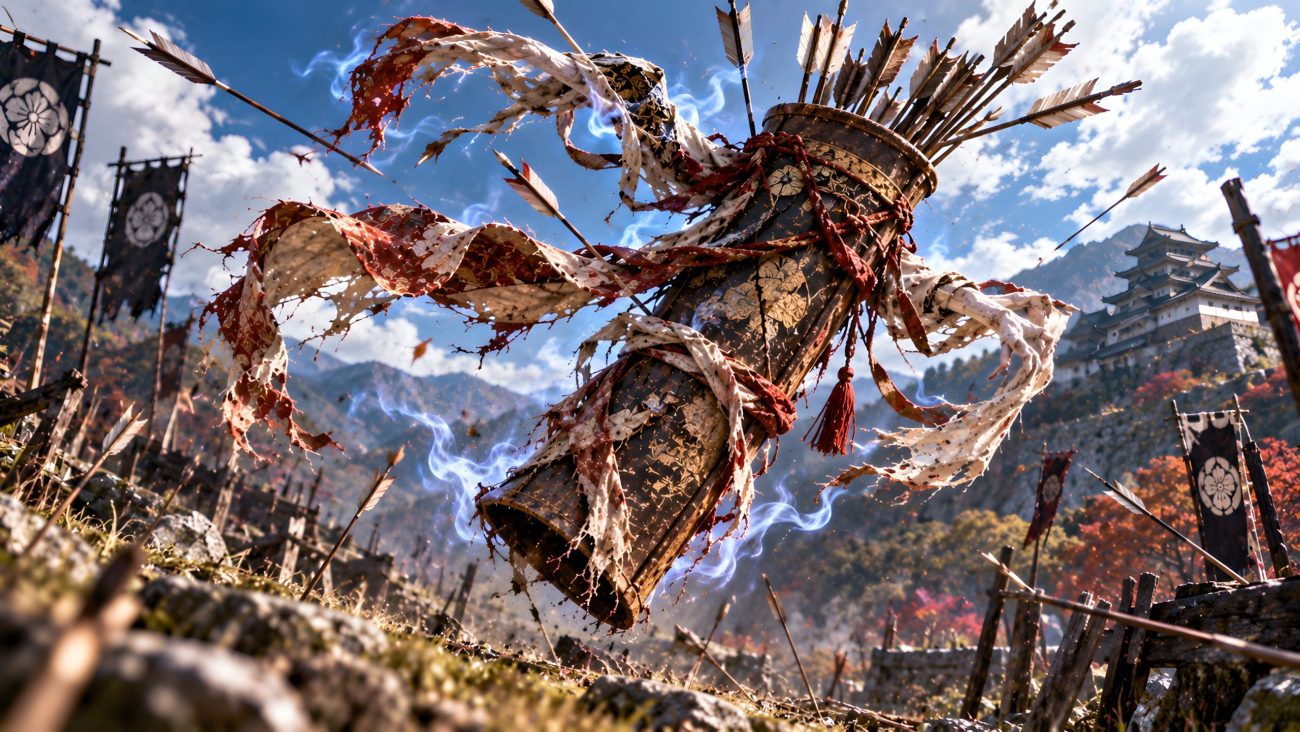
Furuutsubo, meaning “old quiver,” is a Japanese object yokai formed from the beloved quivers of archers who suffered particularly tragic deaths. Like other weapons and pieces of armour belonging to fallen warriors, these quivers can develop a life force from the lingering energy of their former owners. They eventually begin moving by themselves, transforming objects associated with warfare into supernatural beings.

The most famous Furuutsubo belonged to Miura Yoshiaki, a military commander who lived at the end of the Heian period. A brave warrior skilled with both sword and bow, Yoshiaki fought for the Minamoto clan during the Genpei War. When an enemy army besieged his castle, he arranged for his household to escape safely. After the last survivors had fled, he remained behind alone to defend the stronghold against the invading forces, sacrificing his life in the process.

Following Yoshiaki’s heroic death, his favourite quiver was overcome with grief at the loss of its master. The lingering attachment between warrior and weapon gave the quiver a life of its own, transforming it into a Furuutsubo. The yokai embodies the emotional bond between a warrior and his treasured equipment, suggesting that even an inanimate object may retain something of its owner’s spirit and memories after death.


Sources

“Furuutsubo.” Yokai.com. https://yokai.com/furuutsubo/


Kosode no Te

Tradition: Japanese Mythology
Alternative Names: 小袖の手, こそでのて, Hands of the Kosode
Category: Object


The Myth

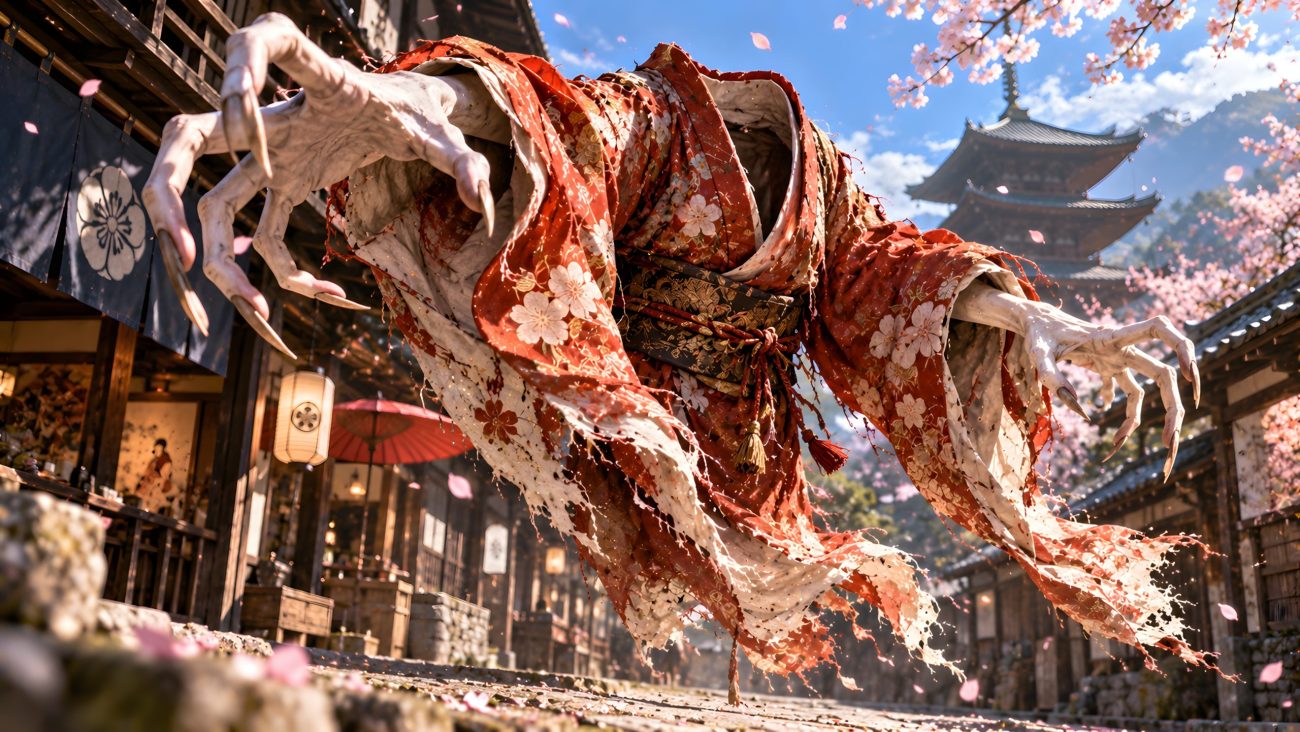
Kosode no Te, meaning “hands of the kosode,” is a Japanese yokai associated with short-sleeved kimonos formerly owned by prostitutes. It manifests as a pair of ghostly hands emerging from the garment’s sleeves. These supernatural hands attack clients who refuse to pay what they owe, although they may also assault anyone unfortunate enough to be nearby.

One account of its origin concerns prostitutes who spent many years saving money to purchase their freedom but died before achieving their goal. Traditionally, their clothing might be donated to a Buddhist temple in exchange for funeral rites and prayers. However, if a woman died still indebted to the brothel keeper, her kimono might instead be sold to recover the money owed. In such cases, the woman’s spirit could become attached to the garment rather than passing peacefully into the afterlife.

The Kosode no Te thus embodies the lingering resentment of a dead woman whose life and death were shaped by debt and exploitation. Unable to move on, her spirit inhabits the clothing she once cherished, turning it into a vessel for supernatural vengeance. Although this is one explanation for the yokai’s origin, the phenomenon may arise under other circumstances as well.


Sources

“Kosode no Te.” Yokai.com. https://yokai.com/kosodenote/


Guanzhong Guishou

Tradition: Chinese Mythology
Alternative Names: 棺中鬼手, Ghost Hand in the Coffin
Category: Object


The Myth

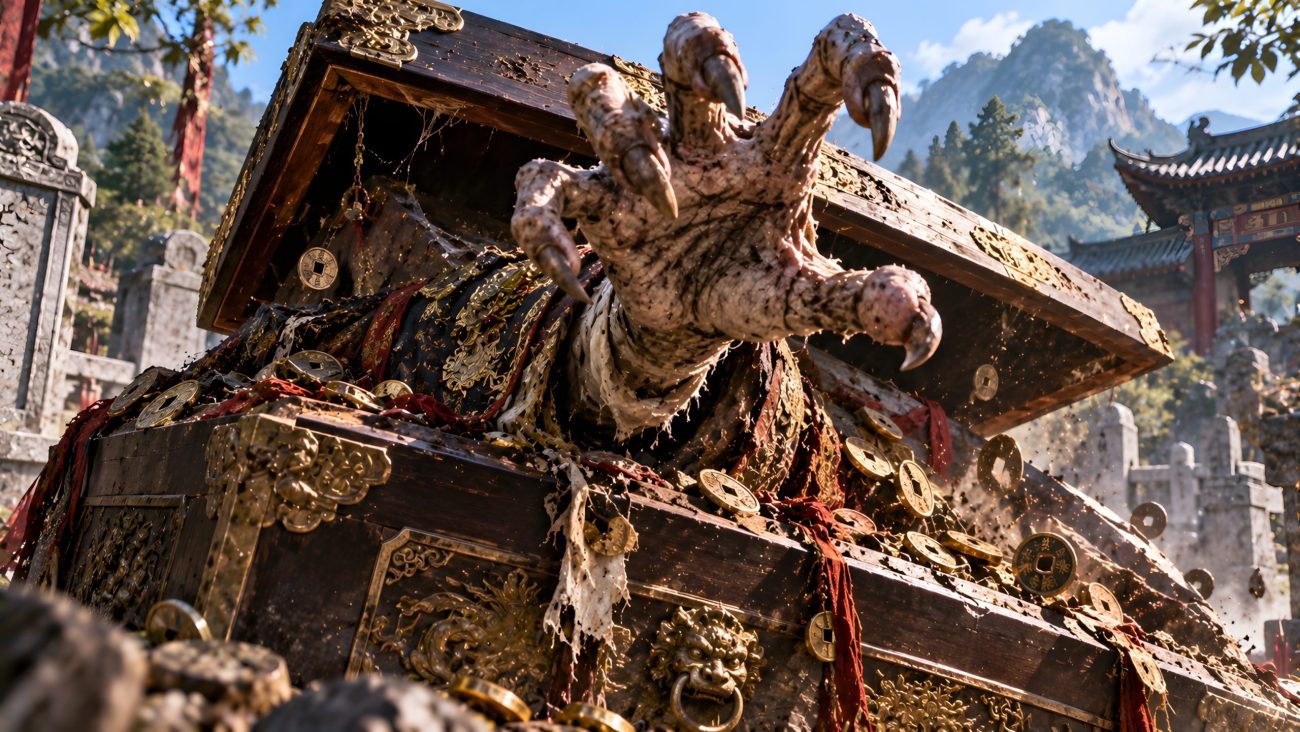
The Guanzhong Guishou, meaning “Ghost Hand in the Coffin,” is a supernatural phenomenon described in the Chinese collection Xieduo (《谐铎》). It appears as a hand reaching out from inside a coffin, emerging during the hours after midnight. The story centres on a corrupt government official whose greed persists even after death.

Even while lying dead in his coffin, the official continues to stretch out his hand to demand money. His disturbing behaviour transforms an ordinary image of the dead into a symbol of greed that cannot be satisfied, even beyond the grave. The hand represents the official’s enduring attachment to wealth and his inability to escape the corruption that defined his life.

The tale criticizes the corruption of government officials and the decay of administrative justice in Qing-era China. Through dark supernatural imagery and satire, it exposes a system in which those entrusted with authority exploit others for personal gain. The official’s posthumous demand for money suggests that corruption has become so deeply rooted that even death cannot bring it to an end.


Sources

“Guān zhōng guǐ shǒu” (棺中鬼手). Chinese Wikipedia. Wikimedia Foundation. Accessed October 24, 2026. https://zh.wikipedia.org/wiki/%E6%A3%BA%E4%B8%AD%E9%AC%BC%E6%89%8B


Ittan Momen

Tradition: Japanese Mythology
Alternative Names: 一反木綿, Ittan-momen
Category: Object


The Myth

Ittan Momen is a flying cloth yokai from Takayama in Kimotsuki District, Kagoshima Prefecture, Japan. It appears at night as a long strip of white fabric, approximately one tan in length, a traditional Japanese measurement of cloth.

The yokai flies towards unsuspecting people and wraps itself around their faces, covering their mouths and noses and suffocating them. Its seemingly ordinary appearance as a piece of cloth conceals a deadly threat, turning a familiar household material into a dangerous supernatural creature.


Sources

“Ittan Momen.” 新版TYZ 妖怪図鑑 (New TYZ Yokai Encyclopedia). https://tyz-yokai.blog.jp/archives/1010652579.html


Bès Kotak

Tradition: Malaysian Mythology
Alternative Names: Box Spirit
Category: Object


The Myth

Bès Kotak, meaning “box spirit,” is a supernatural being in the traditions of the Jah Hut people of Malaysia. It is described as having a box-like appearance and inhabiting muddy hollows in rivers. As a river spirit, it dwells beneath the water in places where the riverbed is soft and muddy, making it dangerous to those who enter its domain.

When someone dives into a river to catch fish, Bès Kotak may press down upon them or sit on their body, making them unnaturally heavy. The victim sinks into the mud and drowns, unable to escape the spirit’s grip. The danger becomes apparent only after the person has entered the water, leaving little opportunity to resist.

According to the account, the victim’s body floats to the surface two or three days later. This grim outcome serves as a warning about the dangers of entering the muddy hollows inhabited by Bès Kotak. The spirit embodies the deadly hazards concealed beneath seemingly ordinary river waters, punishing those who venture into its underwater domain.


Sources

“Bès Kotak.” A Book of Creatures, November 23, 2020. https://abookofcreatures.com/2020/11/23/bes-kotak/


Sterbensstein

Tradition: Swiss Mythology
Alternative Names: The Death Stone
Category: Object


The Myth

The Sterbensstein, or Death Stone, lies at Kirchetbüel in Oberhasli, along the route to Gadmen near Meiringen in the Swiss canton of Bern. The stone rests beside a narrow, rocky gorge through which the River Aare flowed in ancient times. Its surface bears several impressions resembling marks left by human fingers, as though someone had pressed a hand into the stone.

According to local legend, a murder took place at this spot long ago. A woman who suffered a violent death desperately tried to grasp the stone, leaving the impressions of her fingers behind. The marks were said to preserve the traces of her final struggle, transforming an ordinary rock into a lasting reminder of the tragedy.

The Sterbensstein is thus associated with death and the enduring physical traces of a violent event. Beyond this brief account, the legend provides no further details about the woman, her killer, or the circumstances of the murder.


Sources

“Der Sterbensstein” (The Death Stone). SAGEN.at. https://www.sagen.at/texte/sagen/grimm/dersterbensstein.html


Petrified Knight

Tradition: Swiss Mythology
Alternative Names: The Stone Knight of Waldenburg
Category: Object


The Myth

Hans von Waldenburg was an evil knight who lived in a powerful castle overlooking the small town of Waldenburg in the Basel region of Switzerland. He exploited the surrounding countryside, forcing his subjects to toil for him while he feasted day and night with his cruel companions. The people feared him so greatly that they avoided passing his castle, taking long detours to escape his attention. At the edge of town lived a poor day labourer with his wife and children. Although the father worked tirelessly, nearly everything he earned went to the knight’s enforcers, leaving his family so hungry that they had little more than watery soup to eat.

One day, a messenger arrived and ordered the labourer to go to the castle to carry stones. Having worked for the knight throughout the year, the man could endure no more. He held up his empty soup bowl and demanded that the knight provide enough food for his starving children before expecting any further labour. The messenger returned with castle servants, who dragged the man away despite his family’s desperate cries. He was thrown into the deepest dungeon, where toads and bats inhabited the darkness. As time passed and her husband failed to return, his wife watched her children grow weaker from hunger. Finally, she gathered them and struggled through the deep winter snow towards Waldenburg Castle to plead for their father’s release.

As the knight rode out with his hunting party, the woman approached him and begged him to free her husband, explaining that her children would starve without him. The knight responded with contempt, declaring that he would ride over anyone who obstructed his path as though they were filth beneath his horse. The woman then lifted her children towards him and asked him to give them even the scraps his hunting dogs refused to eat. Enraged by her appeal, the knight pointed to the fieldstones protruding from the snow and ordered her to take them as bread, promising to release the prisoner only when she had finished eating them. In despair and fury, the woman seized his horse’s bridle and cursed him: may he himself turn to stone.

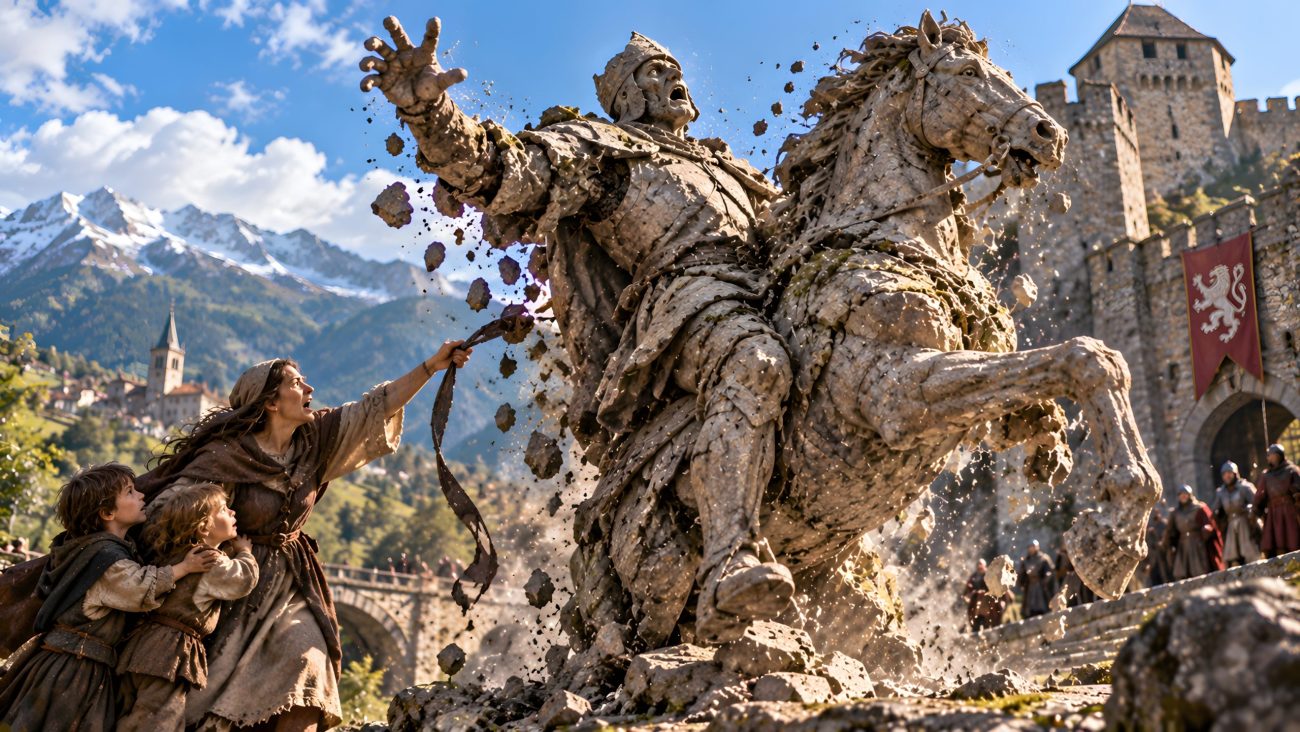
The curse immediately took effect. The knight’s feet grew heavy, his whip-bearing hand sank, and his horse vanished beneath him. His body turned grey and rigid, his eyes became glassy, and a terrible groan emerged from his petrified chest. He stood transformed into a stone statue before his own castle. His terrified servants and huntsmen fled, leaving the fortress abandoned. The oppressed people of Waldenburg seized their opportunity, freed the prisoners from the dungeons, and shared the treasure they found in the castle, including with the poor labourer who was reunited with his family.

According to the legend, the stone knight still stands near the entrance to Waldenburg Castle, although centuries of wind and weather have worn away his features. On wild winter nights, when storms rage around the ruins, people are said to hear a sound emerging from the enchanted stone—a lingering reminder of the cruelty that brought about the knight’s downfall.


Sources

“Versteinerte Ritter” (Petrified Knights). SAGEN.at. https://www.sagen.at/texte/sagen/schweiz/allgemein/versteinerte_ritter.html
Bad Little Jug

Tradition: Swiss Mythology
Alternative Names: The Naughty Little Jug
Category: Object


The Myth

Saint Teutbert was a holy hermit who had travelled from Scotland to spread Christianity. In his old age, he settled among the ruins of the former Roman city of Vindonissa, near present-day Brugg in Aargau, Switzerland. There he built a small chapel and a humble hut beside the River Aare, where he spent thirty years living a life of prayer, humility, and renunciation. One evening, as the setting sun bathed his hut in golden light, Teutbert reflected on his long life of hardship and devotion. Believing that he had overcome his sins and could no longer be tempted into wrongdoing, he imagined that he was ready to enter Heaven peacefully.

His thoughts were interrupted by the arrival of a beautiful young maiden carrying a small earthenware jug. She confessed that her only fault was occasionally teasing people, and Teutbert gently advised her to abandon this mischief. Before leaving, she offered him the jug as a gift, explaining that it might make collecting water from the distant stream easier. Teutbert initially refused, saying that he had served others without payment and had drawn water with his bare hands for thirty years. After the maiden left, however, he found the jug outside his door and decided to accept it. He filled it with water and returned to his hut, delighted by the convenience of his new possession.

The jug soon began to misbehave. Whenever Teutbert placed it on the windowsill, it tipped over and spilled its water. He tried adjusting its position with stones, then hung it from a nail in the wall, but it still fell and flooded his hut during a violent thunderstorm. Frustrated and thirsty, he eventually forgot his morning prayers and Mass in his determination to make the jug stand upright. He gathered clay from the forest and moulded a firm base around it, but the jug shook itself loose and spilled its water once more. Enraged, Teutbert smashed it against the wall, shattering it into pieces.

At that moment, his hut blazed with heavenly light, and a voice rebuked him. Teutbert had believed that pride, anger, and every other vice had been banished from his heart, yet a troublesome little jug had been enough to make him abandon his religious duties and surrender to wrath. Overcome with remorse, the hermit fell to his knees and repented. After a long period of penance, he eventually died in blessed peace, having learned that even a lifetime of devotion cannot make a person immune to pride and anger. The legend teaches that humility must be maintained throughout life and that patience is a virtue tested most clearly by seemingly insignificant frustrations.


Sources

“Schlimme Krüglein” (Bad Little Jug). SAGEN.at. https://www.sagen.at/texte/sagen/schweiz/allgemein/schlimme_krueglein.html


Kege

Tradition: Japanese Mythology
Alternative Names: Kemogen, Kemo Ken, 毛毛現
Category: Object


The Myth

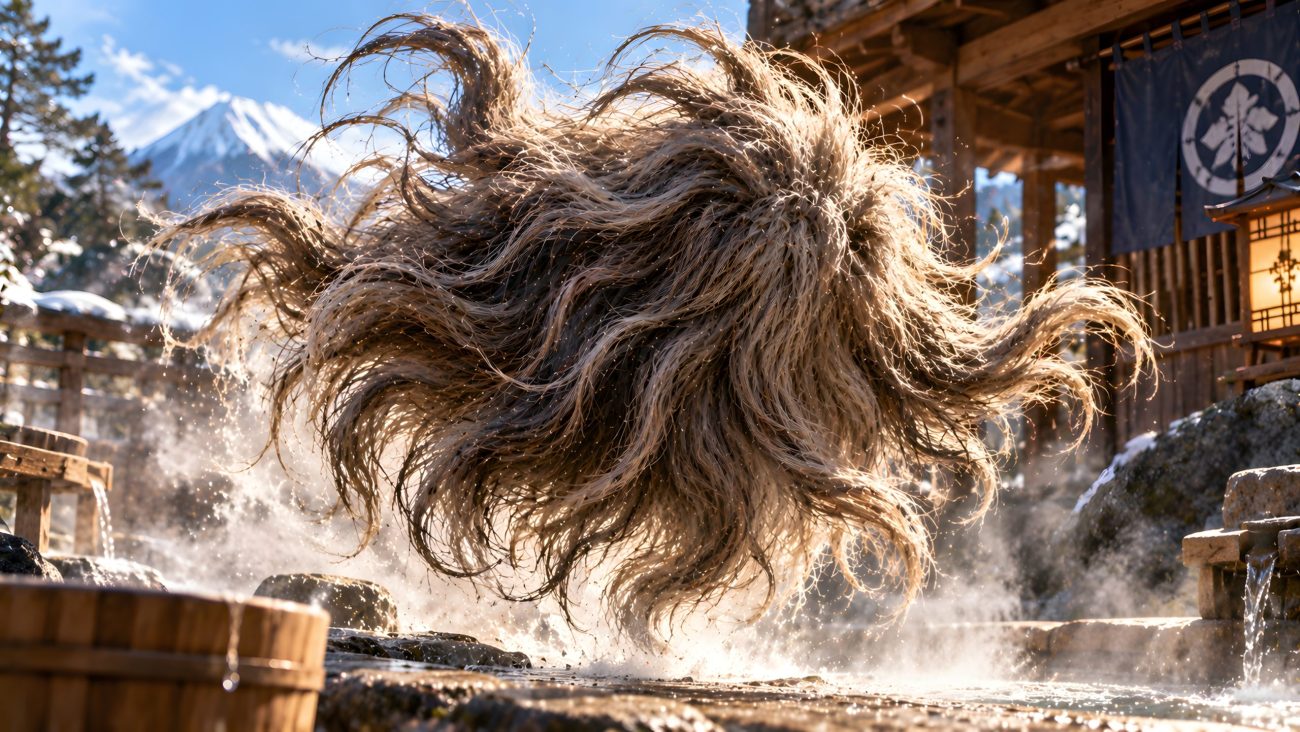
Kege is a strange, hair-covered yokai associated with an encounter described by the Japanese manga artist and yokai researcher Shigeru Mizuki. It appears as nothing more than a lump of fur, with no visible head, legs, or tail. When Mizuki and his family visited a mountain hut on Mount Fuji, they discovered a mysterious mass of hair curled up in the bathhouse. Unable to identify it, the family became frightened and caused a commotion.

Mizuki eventually approached the strange creature and lifted it with a pair of fire tongs. To his surprise, the mass of fur was extremely light and seemed to have no body or stomach beneath its hair. The account suggests that it might have been the remains of an animal that had been eaten, leaving only its fur behind. Its true nature remains uncertain, and it is unclear whether the encounter involved an actual supernatural creature.

Kege has also been listed as a yokai associated with Shizuoka Prefecture in a modern children’s encyclopedia of Japanese supernatural beings. However, the connection appears to derive from Mizuki’s unusual encounter rather than from an established regional tradition. Beyond its peculiar appearance as a creature consisting almost entirely of hair, little is known about Kege’s origins or supernatural abilities.


Sources

“Ke-fu-ke-gen.” 新版TYZ 妖怪図鑑 (New TYZ Yokai Encyclopedia). https://tyz-yokai.blog.jp/archives/1079864645.html