Kaeru Nyōbō

Tradition: Japanese Mythology
Alternative Names: Bikki no Yomekko, Frog Wife, Kaeru Nyobo
Category: Frog


The Myth

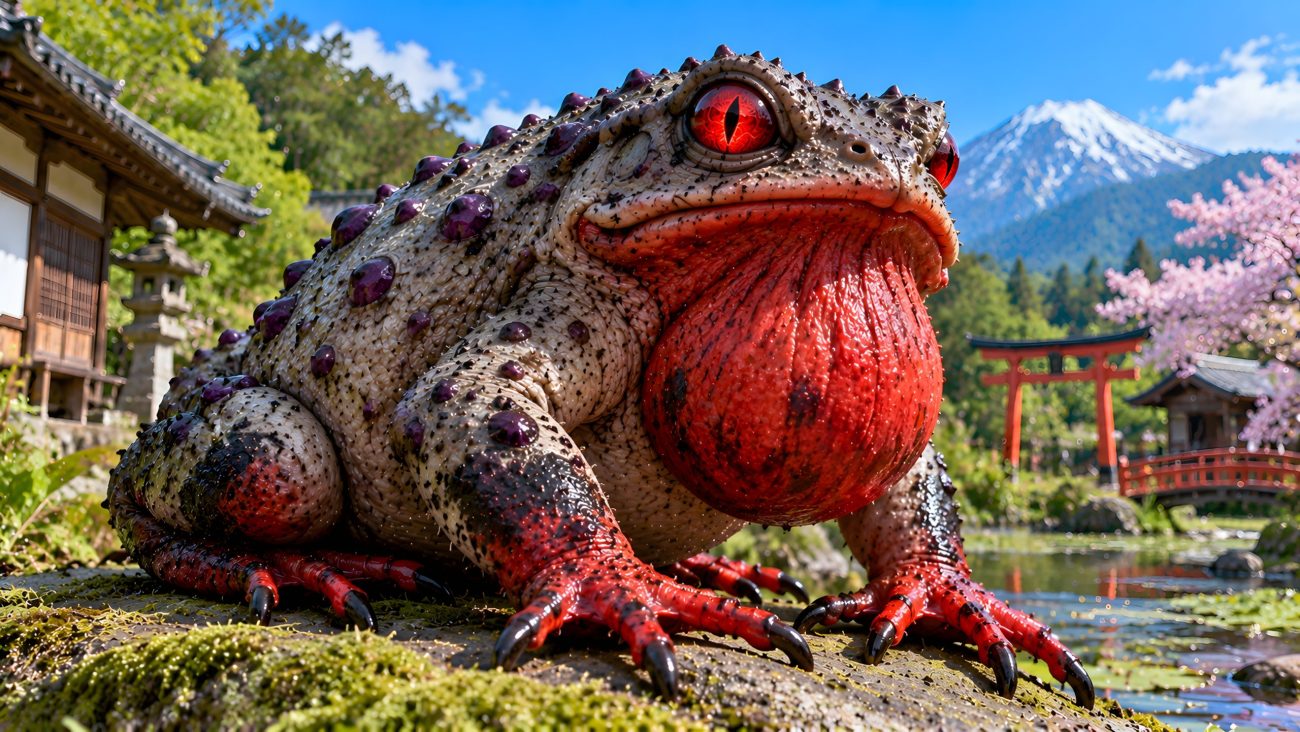
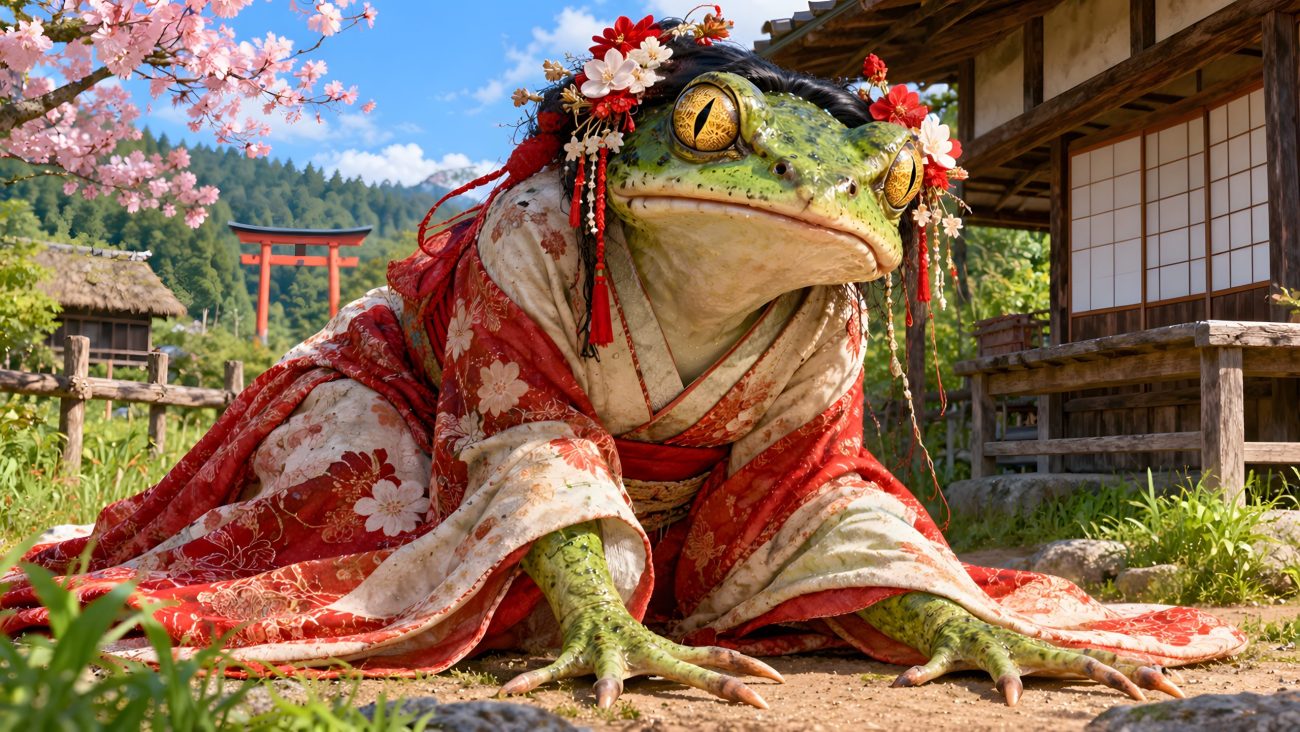
Kaeru Nyōbō, meaning “frog wife,” is a magical frog that transforms into a human woman to marry a human man. In her human form, she behaves like an ordinary wife, but she is usually extremely small and fragile, sometimes no taller than a child of three or four years. Although willing to help with household chores, she lacks the strength to perform heavy work. As long as her true identity remains hidden, she can live happily with her human husband for many years. However, if he discovers her secret and sees her transform back into a frog, the marriage ends in tragedy.

One legend tells of an impoverished old man and his son who desperately wished for a wife for the young man. One day, a tiny woman arrived at their door and asked whether they would accept her as a bride. The delighted father welcomed her, and she married his son. The woman was soaking wet despite the absence of rain, but the family warmed her by the fire and accepted her despite her unusual size. She could not perform heavy household work, yet the men were satisfied with their new family member.

Some time later, the woman needed to attend a memorial service for her father. Although they were poor, her husband and father-in-law gave her a sack of rice to bring as a gift. The load was so heavy that she was crushed flat beneath it. The men removed rice until only five cups remained, allowing her to regain her normal shape and carry the smaller load. Suspicious of her strange weakness, the old man told his son to follow her. The young husband watched her travel deep into the mountains until she reached a marsh, looked around, and leapt into the water. Unable to see her beneath the surface, he listened to the croaking of frogs and realized that they were speaking. His wife explained that the sack of rice had delayed her, and the frogs began chanting Buddhist prayers for the memorial service.

Horrified to discover that he had married a frog, the young man threw a rock into the water, striking the frog priest and abruptly silencing the prayers. He returned home and told his father what had happened. When his wife arrived later that night, she explained that a huge rock had fallen from the sky and struck the priest during the ceremony. Her husband confronted her, revealing that he had witnessed everything and had thrown the stone himself. The woman was devastated that her secret had been exposed. She covered her face in embarrassment, transformed back into a frog, and hopped out of the house. She was never seen again. The tale ends with a warning that one should not accept just anyone as a marriage partner simply because one is desperate to find a spouse.


Sources

“Kaeru Nyōbō (蛙女房).” Yokai.com: The Database of Japanese Folklore. https://yokai.com/kaerunyoubou/

Dousai

Tradition: Japanese Mythology
Alternative Names: Toad
Category: Frog


The Myth

Dousai is a supernatural toad said to be capable of taking the form of a beautiful woman. One night, a woodcutter staying in a mountain hut witnessed a mysterious woman spinning thread on a spinning wheel by the light of a lantern. Her presence in the remote hut was strange, and the woodcutter grew suspicious of the apparition.

Remaining awake throughout the night, the woodcutter took aim with his gun and fired at the lantern. The bullet struck the Dousai in the eye, revealing the creature’s true nature. The toad died from the wound, ending its mysterious appearance in the mountain hut.


Sources

“道災 (Dōsai).” 新版TYZ 妖怪図鑑 (New TYZ Yokai Encyclopedia). https://tyz-yokai.blog.jp/archives/1010655107.html


Káchabuké

Tradition: Costa Rica Mythology
Alternative Names: Achiote Frog, Achiote Red Frog
Category: Frog


The Myth

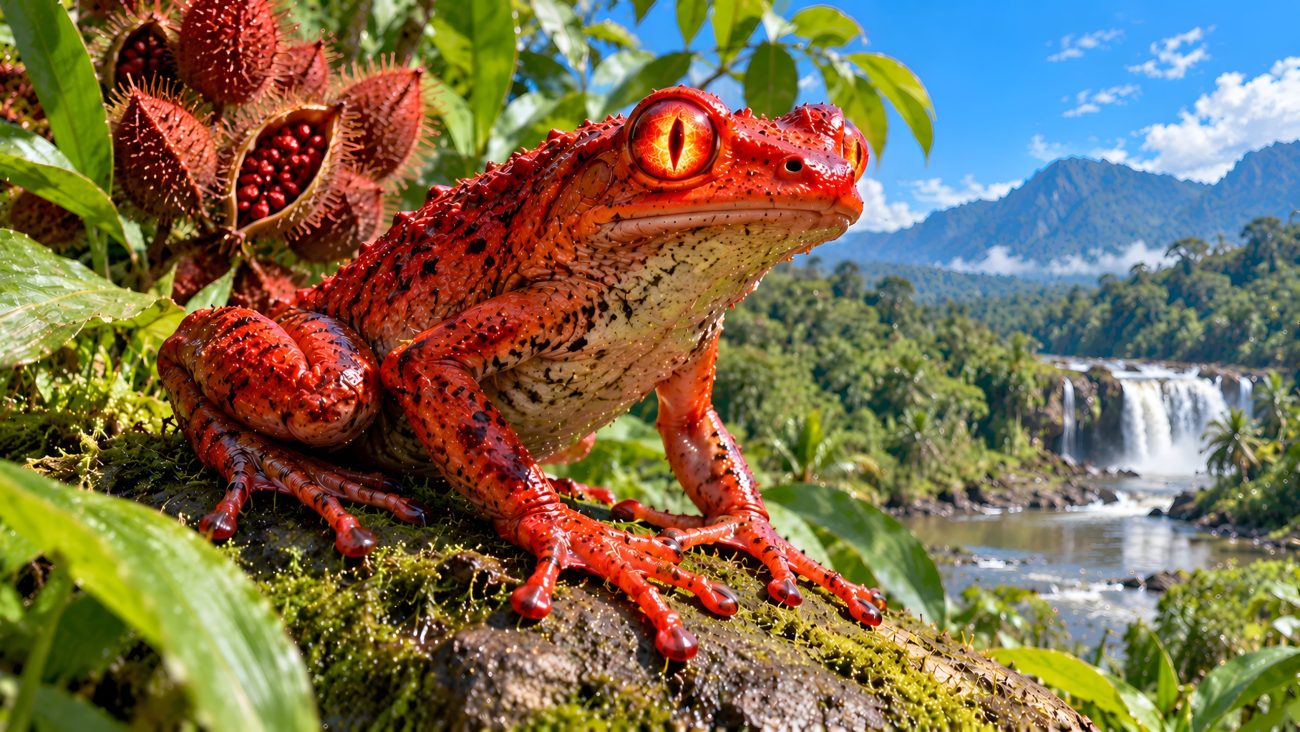
Káchabuké is a poisonous frog involved in the creation of the magical Duluítami tree in Talamancan mythology. The creature was chosen by Sibö, the creator deity, to guard the body of Bulumia after her death. Sibö wrapped her corpse in bijagua leaves and brought it to the ground, where he placed Káchabuké on her belly. He commanded the little frog to remain there for four days without moving, warning that it would be held responsible if anything happened to the body. Proud to have been entrusted with this important duty, Káchabuké settled down to keep watch.

As night fell, however, strange noises emerged from Bulumia’s belly, resembling the sound of ocean waves. The frog grew frightened by the sounds and its loneliness, while hunger gradually became unbearable. Sibö sent a bumblebee for Káchabuké to catch and eat, but the little frog failed to seize it. When the bee collided with some trees and landed, Káchabuké leapt away from its post to catch it. At that moment, the frog heard a gust of wind and hurried back to the corpse, but it was too late. Bulumia’s belly had separated from her body, and a small tree called Duluítami had emerged from within it. This magical tree would give rise to the sea and other sources of water.

The next day, Sibö returned and found Káchabuké playing while the young Duluítami tree stood nearby. When Sibö demanded to know why the frog had disobeyed his command, Káchabuké explained that hunger had driven it to chase the bumblebee. Sibö punished the creature for abandoning its duty by placing it in a tree and transforming it into the fruit of the achiote plant, whose reddish fruits gave the frog its name.


Sources

“Talamancan mythology.” Wikipedia: The Free Encyclopedia. Wikimedia Foundation. Accessed October 14, 2026. https://en.wikipedia.org/wiki/Talamancan_mythology


Sapo Fuerzo

Tradition: Chilean Mythology
Alternative Names: Strong Toad
Category: Frog


The Myth

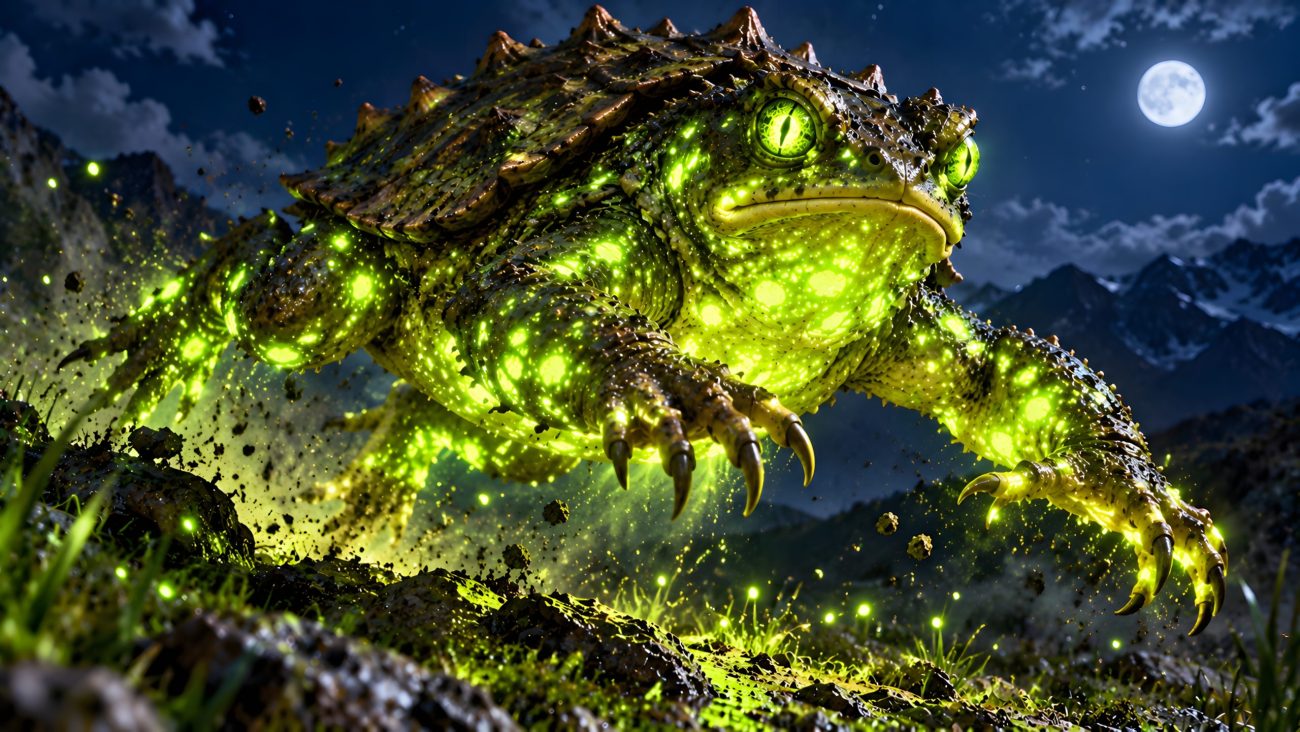
The Sapo Fuerzo, meaning “strong toad,” is a remarkable amphibian said to inhabit the Andes of Chile. Unlike ordinary toads, it possesses a hard, turtle-like shell that protects its body. Its most striking feature is its phosphorescent skin, which glows in the darkness like a firefly, making the creature appear as a mysterious light among the mountains.

The Sapo Fuerzo is renowned for its extraordinary supernatural powers and incredible resilience. Through the sheer force of its gaze, it can attract or repel anything within its reach, drawing objects toward itself or forcing them away. This power makes the creature a formidable presence, capable of influencing its surroundings without physical contact.

The toad is also virtually impossible to kill because of its remarkable ability to regenerate and recover from almost any injury. Wounds that would destroy an ordinary animal are not enough to end its life. There is only one way to kill a Sapo Fuerzo permanently: it must be burned until its body has been completely reduced to ashes. Only then can its extraordinary powers of recovery be overcome.


Sources

“Sapo Fuerzo.” A Book of Creatures. March 20, 2015. https://abookofcreatures.com/2015/03/20/sapo-fuerzo/


Toad and the Carriage Driver

Tradition: Austrian Mythology
Alternative Names: The Seefeld Toad
Category: Frog


The Myth

A mysterious toad once jumped onto the cart of a carriage driver from Innsbruck as he travelled through Leithen. No matter how often the driver tried to shoo the creature away, it kept returning to sit beside him. Unable to rid himself of the persistent passenger, he continued his journey with the toad accompanying him.

When the driver finally stopped in the church square of Seefeld, the toad suddenly disappeared, and a beautiful young woman appeared beside him. She explained that during her lifetime she had promised to make a pilgrimage to Seefeld but had failed to fulfil her vow. After her death, she was forced to undertake the journey in the form of a toad, crawling along the road until she could reach the sacred destination.

The woman explained that she had finally been freed from her punishment because a kind person had carried her along the way. Grateful to the driver for helping her complete the pilgrimage, she thanked him and disappeared into the church. She was never seen again.


Sources

“Die Kröte.” SAGEN.at – Tiroler Sagen (Seefeld). Reproduced by SAGEN.at. https://www.sagen.at/texte/sagen/oesterreich/tirol/seefeld/kroete.htm


Giant Toad of Zurich

Tradition: Swiss Mythology
Alternative Names: Charlemagne’s Giant Toad
Category: Frog


The Myth

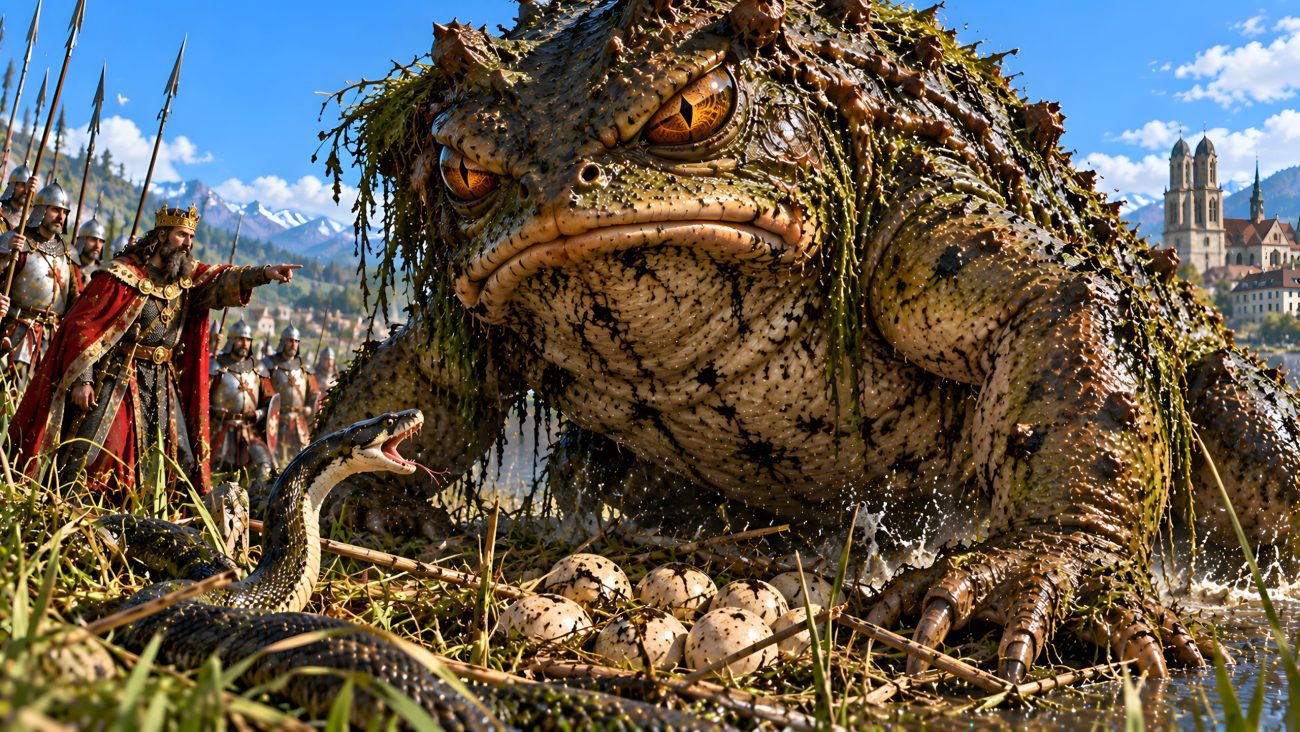
A gigantic, hideous toad once lived among the reeds at the outflow of Lake Zurich, where the Limmat River begins. The creature had settled directly upon a snake’s eggs, threatening the offspring of a serpent that would eventually seek justice from Emperor Charlemagne. The toad was so enormous and dreadful that its presence astonished the emperor when the snake led him to its nest.

The strange events began when a snake repeatedly rang a small bell attached to a pillar in Zurich, where anyone seeking justice could summon Charlemagne while he held court. At first, the emperor’s soldiers could find nobody ringing the bell. Eventually, one soldier discovered a snake coiled around the rope, pulling it to attract the emperor’s attention. Charlemagne approached the serpent, which bowed before him and led him to its nest among the reeds. There, the emperor discovered the enormous toad crouching upon the snake’s eggs.

Recognizing the creature as a threat to the snake’s offspring, Charlemagne ordered the toad removed and condemned it to death by burning. The snake’s appeal had thus been answered, and justice was carried out against the creature that had threatened its young. Some time later, the grateful serpent visited the emperor in his residence, climbed onto his table, and dropped a sparkling gemstone into his golden goblet before disappearing forever. Believing the event to be a sign from Heaven, Charlemagne ordered a church built over the place where he had discovered the snake’s nest. The church became known as the Water Church, while the emperor gave the precious gemstone to his wife, who wore it in a golden capsule over her heart for the rest of her life.


Sources

“Kaiser Karl und die Schlange.” SAGEN.at – Traditionelle Sagen aus der Schweiz. Reproduced by SAGEN.at. https://www.sagen.at/texte/sagen/schweiz/allgemein/kaiser_karl_schlange.html


Salve-Toad

Tradition: Austrian Mythology
Alternative Names: Toad of the Hohe Salve
Category: Frog


The Myth

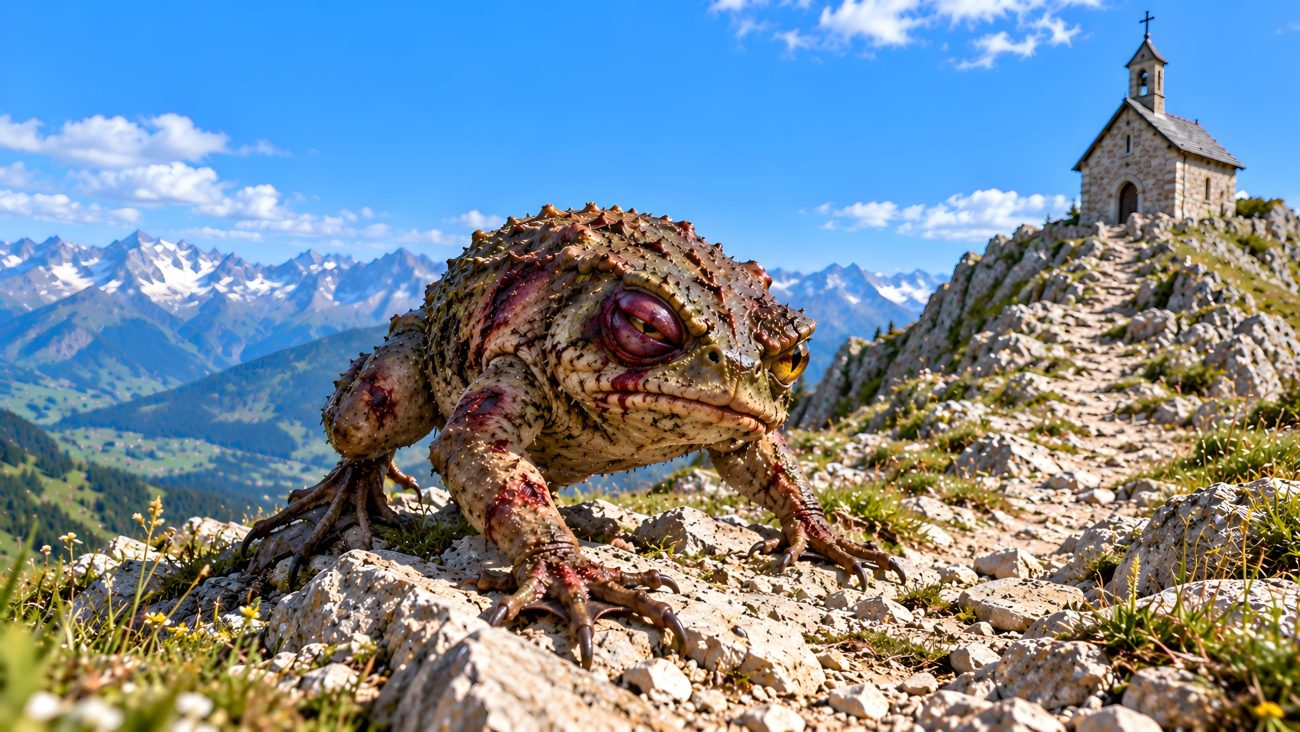
The Salve-Toad is a supernatural creature associated with the Hohe Salve mountain in Tyrol, Austria. It is said to be the transformed soul of a brigand who lived a wicked life and failed to fulfil a sacred vow. After death, he was condemned to crawl up the mountain in the form of a toad and seek redemption inside the chapel dedicated to St. John the Baptist. His punishment forced him to struggle slowly up the steep mountain while carrying the burden of his past crimes.

According to the legend, the brigand had promised to make a pilgrimage to the summit of the Hohe Salve if Heaven would help him escape his evil companions and return to a righteous life. Although he received the assistance he had prayed for, he forgot his vow. After his death, he was transformed into a toad and compelled to climb the mountain. When he finally reached the chapel, people at the entrance repeatedly pushed and kicked him away, preventing him from entering. Nevertheless, the determined creature continued trying until at last it managed to crawl inside.

Once within the chapel, the toad crawled three times around the altar. At that moment, the curse was lifted, and the creature was instantly transformed into a handsome man. He addressed the people praying there, recounting his former life as a brigand and the long, painful penance he had endured. After revealing his story, he suddenly disappeared, leaving the worshippers to wonder at the strange event.

Another version of the legend tells of a remorseful mother whose son had become the leader of a band of robbers and murderers. After he refused to surrender to justice, a vision of the ghastly head of St. John the Baptist appeared to him in a dream, prompting him to give himself up. He was executed alongside his companions, and his mother buried their heads together on the mountain. In deep repentance, she sold all her possessions and used the money to build the chapel that still stands on the summit of the Hohe Salve.


Sources

Von Günther, Amalia. Tales and Legends of the Tyrol. London: Chapman and Hall, 1874.


Yara-ma-yha-who

Tradition: Australian Mythology
Alternative Names: Yara-ma-yha-who
Category: Frog


The Myth

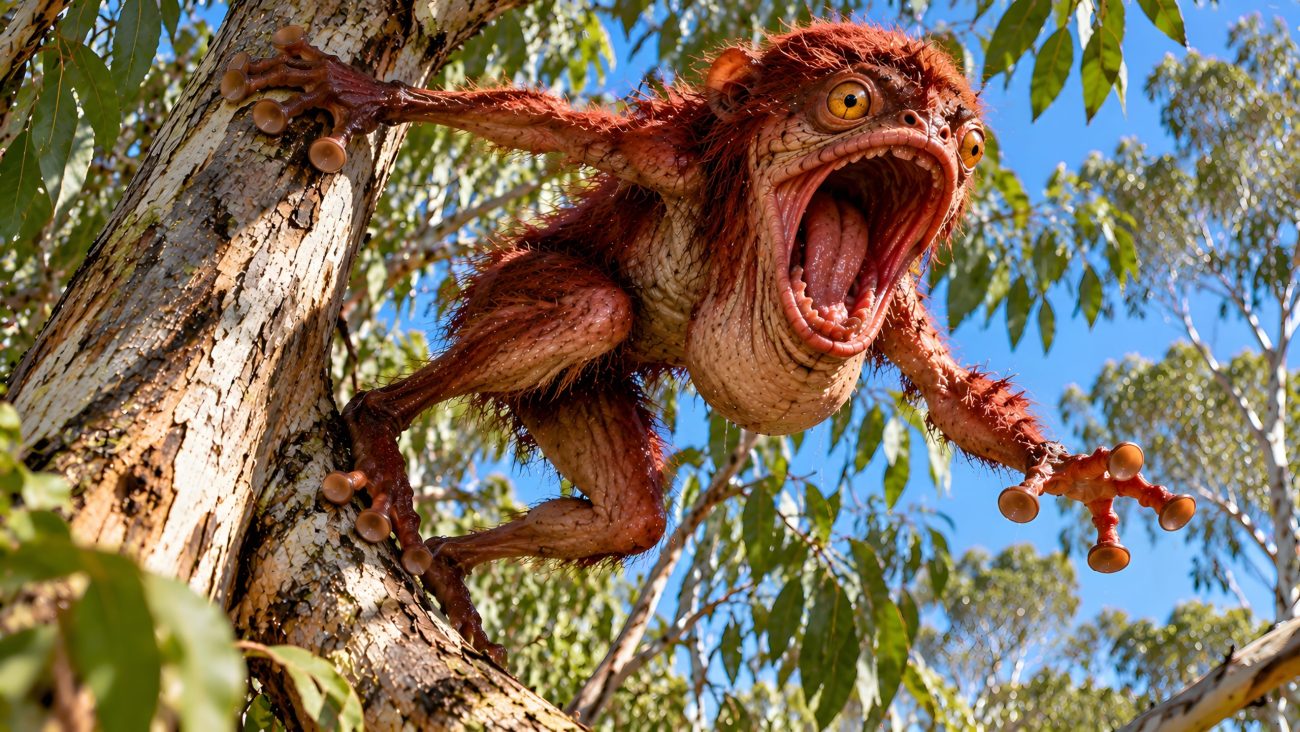
The Yara-ma-yha-who is a grotesque, blood-draining creature that inhabits the forests along Australia’s Pacific coast. It is a small, red, furry being standing no more than four feet tall, with a disproportionately large head and a wide, toothless mouth that can stretch open like a snake’s. Its throat and belly are extraordinarily expandable, allowing it to swallow an adult human whole. Its fingers and toes are equipped with suction cups that it uses to attach itself to its victims and drain their blood. Although it is an excellent climber, it moves awkwardly on the ground, waddling like a cockatoo. Thick-leaved fig trees are its favourite haunts, where it can wait for days among the branches for an unsuspecting traveller to rest beneath them. Lone children are its preferred prey, and stories of the creature serve as warnings against wandering into dangerous places.

When a Yara-ma-yha-who attacks, it clings to its victim with its suction-cup fingers and toes, draining enough blood to make the person faint without killing them outright. It then leaves the victim for a time before returning to swallow them whole, head first. A little dance helps the food slide down its throat, after which it drinks water and settles down for a nap. When it awakens, the creature regurgitates its prey. The victim is usually still alive and must remain still, pretending to be dead, because fighting back against the monster is futile. The Yara-ma-yha-who then walks five paces away before returning to poke the victim’s sides with a stick. It retreats ten paces and comes back to tickle the person beneath the arm or neck. After walking fifty yards, it returns for another round of tickling before finally going behind a bush to sleep.

This strange ritual must be completed, for the Yara-ma-yha-wha fears the spirit of the fig tree, which will whisper in its ears if it fails to perform the required actions. The punishment is a transformation into glowing mushrooms that grow on trees. Once the creature has gone to sleep, a victim can finally escape. If the Yara-ma-yha-who hears the fleeing person, it may call out in confusion and attempt to give chase, but its clumsy gait makes it relatively easy to outrun. A frustrated creature may retaliate by drinking all the water from nearby wells and waterholes, forcing people to seek moisture from tree sap and exposing themselves to further attacks.

Surviving an encounter does not guarantee that a person will remain human. Each time a Yara-ma-yha-who swallows and regurgitates its victim, the person’s body changes. After the second swallowing, the victim becomes shorter and completely hairless. After the third, the person shrinks further and grows a thick covering of hair. If the process continues, the victim gradually becomes a Yara-ma-yha-who themselves, joining the ranks of the creatures that haunt the fig trees.


Sources

“Yara-ma-yha-who.” Wikipedia: The Free Encyclopedia. Wikimedia Foundation. Accessed October 14, 2026. https://en.wikipedia.org/wiki/Yara-ma-yha-who


Yadomori

Tradition: Japanese Mythology
Alternative Names: Toad Monster
Category: Frog


The Myth

Yadomori is a supernatural toad associated with a frightening warning against killing its kind. According to Japanese legend, anyone who kills a Yadomori will face a terrible consequence, as the slain toad transforms into a monstrous spirit that returns to haunt people in their beds.

The creature is depicted alongside Umakotsu, a supernatural being associated with horse bones, in the Tosa Obake Zōshi, a Japanese ghost scroll. Its legend centres on vengeance after death, portraying the toad as a creature whose killing can bring about a terrifying supernatural visitation.


Sources

“宿守 (Yadomori).” 新版TYZ 妖怪図鑑 (New TYZ Yokai Encyclopedia). https://tyz-yokai.blog.jp/archives/1010654263.html


Witch as a Toad

Tradition: Austrian Mythology
Alternative Names: Toad Witch, Frog Witch
Category: Frog


The Myth

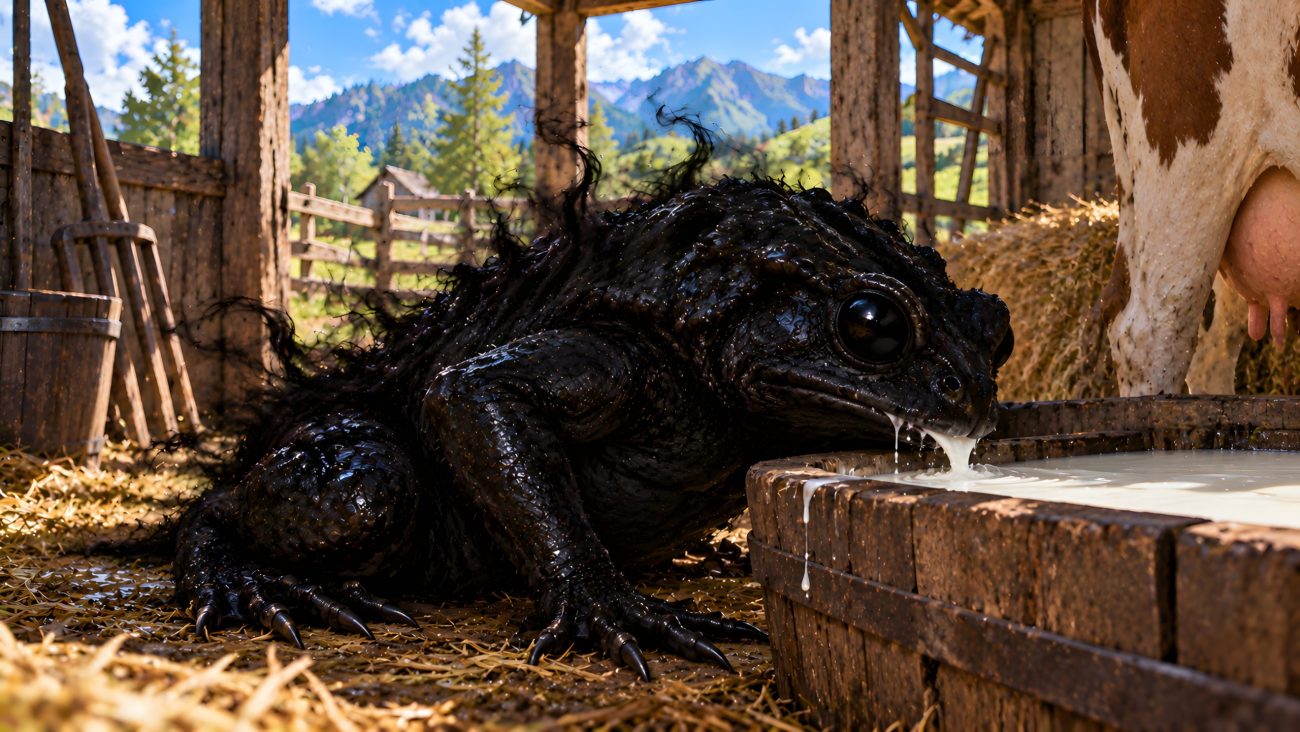
Witches in Burgenland mythology were believed to transform themselves into large frogs or toads to enter stables and steal milk from cows. They crept into barns and drank directly from the cows while the animals were lying down. After such a visit, a cow might have a swollen udder but produce no milk, or give blood instead. These strange occurrences were blamed on witches who had taken the form of enormous toads.

One tale tells of a family whose great-grandmother knew how to drive away witches. When the cows began losing their milk, a man was instructed to keep watch in the barn with an iron-tined pitchfork. He was told to attack any creature that entered, whether it was a cat, a dog, or a frog. During the night, a large toad appeared, and the man pinned it to the ground with his pitchfork. The creature began screaming and pleading with him to stop, insisting that it would not return.

The man refused to release the toad, accusing it of causing trouble by stealing the cows’ milk. As he held it down, the creature cried out that its blood was flowing and promised never to come back. Eventually, it disappeared, leaving the family to believe that the witch had been driven away. The following day, a woman was found lying in her home with the door locked. Nobody was allowed to enter, and no doctor was called. The tale presents the wounded toad and the suffering woman as two forms of the same witch, punished for stealing milk from the cattle.


Sources

Petzoldt, Franz. “Die Hexe als Kröte.” SAGEN.at – Sagen aus dem Burgenland. Reproduced by SAGEN.at. https://www.sagen.at/texte/sagen/oesterreich/burgenland/petzoldt/hexe_kroete.html