Amitabha Fish

Tradition / Region: Japanese Mythology, Budhist lore
Alternate Names: Amida Fish
Category: Fish


The Myth

Long ago, far to the southwest of the land of Shushishi, there lay an island where more than five hundred families lived by fishing. The people depended entirely on the sea, and their days were spent casting nets and hauling in their catch.

One day, an extraordinary event occurred. From the sea came countless large fish, swimming all the way onto the shore. The islanders were overjoyed and rushed to the beach, expecting a great bounty. As they gathered, they heard something strange: each fish made a sound like a human voice, repeatedly calling out, “Amida Buddha, Amida Buddha.”

The people, unfamiliar with Buddhist teachings, did not understand the meaning of the words. They simply named the creatures Amitabha Fish, after the sound they made. They soon noticed that whenever the name was spoken aloud, more fish would approach the shore. Discovering this, the islanders began chanting the name again and again, using it to lure the fish closer.

The fish did not flee. They allowed themselves to be taken and killed. When the people ate their flesh, they found it astonishingly delicious. Those who chanted the name of Amida Buddha fervently said the taste was rich and sweet, while those who chanted only weakly found the meat bitter and sharp. Entranced by the flavor, the islanders began chanting the sacred name constantly, driven by both pleasure and habit.

In time, an elder—one of the first to eat the Amitabha Fish—passed away. Three months later, he appeared on the shore riding a purple cloud, his body shining with radiant light. He spoke to the people, saying:

“After my death, I was reborn in the Pure Land. This came to pass because I delighted in the flesh of the Amitabha Fish and chanted the name of Amida Buddha. That great fish was none other than Amida Buddha himself, taking pity on our ignorance. He transformed into a fish, guided us to chant his name, and even offered his own body as food. Because of the bond formed through this act, I was reborn in the Pure Land.”

He then said that anyone who doubted his words should look upon the remains of the fish.

After the elder vanished, the people examined the discarded bones of the Amitabha Fish. They found that every bone had transformed into a lotus flower.

Filled with awe and remorse, the islanders abandoned killing and devoted themselves entirely to chanting the name of Amida Buddha. In time, each of them was reborn in the Pure Land. The island was left empty and silent, its former inhabitants gone, leaving only the shore where the sacred fish had once gathered.


Gallery


Sources

TYZ-Yokai Blog contributors. (n.d.). 狐火 (Kitsunebi). In TYZ-Yokai Blog, from https://tyz-yokai.blog.jp/archives/1065099106.html


Interpretive Lenses

Religious Readings
  • Christian Ascetic Deep Dive
Philosophical Readings
  • Nietzschean Deep Dive
Psychological Readings
  • Jungian Deep Dive
Esoteric Deep Dive
  • Hermetic Deep Dive
Political / Social Readings
  • Marxist Deep Dive
Other
  • How to Invite The Amitabha Fish
Nuegyo

Tradition / Region: Japanese Mythology
Alternate Names: Nue
Category: Fish, Cat


The Myth

Nuegyo is a strange and unsettling fish said to appear in the seas off the coast of Japan. Those who encountered it did not recognize it as any known creature of the ocean, and even experienced fishermen were unable to name it.

The Nuegyo is said to be about the length of a man’s forearm. Its skin is rough, like that of a shark, while its head resembles that of a cat. Atop its head rests a hard, bowl-shaped mass, like stone. Its nose and mouth are also catlike, and from both sides of its jaw protrude sharp, bone-like spines several inches long. A thin spine rises from the top of its head, giving it an even more unnatural appearance.

Its body is shaped somewhat like that of a gurnard, but its fins are long and soft, extending all the way toward the tail. These fins are wide and flexible, like the wings of a bat. When spread open, they form a fan-like shape. It is said that the Nuegyo can use these fins as wings, rising above the surface of the sea and gliding through the air.

Because of its bizarre combination of features—part fish, part beast, and capable of flight—people began to call it Nuegyo, likening it to the legendary Nue, a creature made of mismatched forms. Whether it truly flies or merely skims the waves is unknown, but the Nuegyo is remembered as a sea being that does not fully belong to water or sky, and whose appearance defies ordinary understanding.


Gallery


Sources

TYZ-Yokai Blog contributors. (n.d.). 座敷童子 (Zashiki-warashi). In TYZ-Yokai Blog, from https://tyz-yokai.blog.jp/archives/1010654392.html


Interpretive Lenses

Religious Readings
  • Christian Ascetic Deep Dive
Philosophical Readings
  • Nietzschean Deep Dive
Psychological Readings
  • Jungian Deep Dive
Esoteric Deep Dive
  • Hermetic Deep Dive
Political / Social Readings
  • Marxist Deep Dive
Other
  • How to Invite The Nuegyo

Senzanri

Tradition / Region: Japanese Mythology
Alternate Names: Thousand Mountain Carp
Category: Fish, Mountain dweller, Carp


The Myth

The Senzanri is a strange and transformative carp, said to be capable of leaving the water and becoming a creature of the mountains.

According to the story, a boy named Torakichi spoke of this being from his own experience. He said that when certain substances were mixed into water or shaped like fish and placed in old ponds, crucian carp would appear in great numbers. These carp were not ordinary fish. Among them were those that would later become Senzanri, carp that transform and give birth after leaving the water.

It is commonly said that carp climb waterfalls and become dragons, but Torakichi explained that this belief misunderstands what truly happens. The carp do not become dragons. Instead, using the force they gather while leaping up waterfalls, they launch themselves into the mountains. There, far from rivers and ponds, the transformation begins.

Once on land, the carp rolls about in grassy places. As time passes, its body becomes rounder and harder, forming a shell. Hair grows between its scales. Its fins change into four limbs, and the creature begins to crawl like a land animal. Though its shape changes, its inner body remains that of a carp.

In this form, the Senzanri lives in mountain pools, where it gives birth to offspring known as mountain-burrowing carp. These young inherit the strange nature of their parent, belonging neither fully to water nor to land.

The Senzanri is thus a creature that bridges worlds: born as a fish, transformed by the mountains, and living a life hidden from ordinary human sight.


Gallery


Sources

TYZ-Yokai Blog contributors. (n.d.). 雪女 (Yuki-onna). In TYZ-Yokai Blog, from https://tyz-yokai.blog.jp/archives/1010654386.html


Interpretive Lenses

Religious Readings
  • Christian Ascetic Deep Dive
Philosophical Readings
  • Nietzschean Deep Dive
Psychological Readings
  • Jungian Deep Dive
Esoteric Deep Dive
  • Hermetic Deep Dive
Political / Social Readings
  • Marxist Deep Dive
Other
  • How to Invite The Senzanri

Omoshiroi zo

Tradition / Region: Japanese Mythology
Alternate Names: Omoshiroi zo
Category: Mountain dweller


The Myth

This strange incident is said to have happened in the youth of an old man named Kikuchi Yanosuke.

One night, under a faint, pale moon, Yanosuke and several companions were crossing Sakaiki Pass, a mountain path leading toward the coast. Yanosuke was known as a skilled flute player, and as they traveled, he played his flute while walking.

As they passed through a place called Ōyachi, they entered a deep valley. White birch trees grew thickly there, and below the path ran a marshy ravine filled with reeds and tall grasses.

While they were crossing this valley, a high, piercing voice suddenly rose from the depths below. From the darkness of the ravine, something unseen cried out:

Omoshiroi zo—!
(“This is interesting!”)

At the sound of the voice, everyone turned pale with fear. Without seeing any figure or source, the group fled in terror, abandoning the path and running from the valley.

Later in his life, Yanosuke experienced another unsettling event deep in the mountains, when he heard the scream of a woman echoing through the forest. It was later discovered that, at the very same time, his sister had been killed by her own son.

The voice calling “Omoshiroi zo” was never explained, and no form was ever seen. It remains remembered as one of the many eerie, disembodied presences said to dwell in the mountains and valleys of the region.


Gallery


Sources

TYZ-Yokai Blog contributors. (n.d.). 面白いぞ (Omoshiroi zo). In TYZ-Yokai Blog, from https://tyz-yokai.blog.jp/archives/1074589312.html


Interpretive Lenses

Religious Readings
  • Christian Ascetic Deep Dive
Philosophical Readings
  • Nietzschean Deep Dive
Psychological Readings
  • Jungian Deep Dive
Esoteric Deep Dive
  • Hermetic Deep Dive
Political / Social Readings
  • Marxist Deep Dive
Other
  • How to Invite The Omoshiroi zo

The Monster of Hiroshima Tenmacho

Tradition / Region: Japanse Mythology
Alternate Names: Hiroshima Tenmacho Kaibutsu
Category: House dweller


The Myth

In Tenmacho, Hiroshima, it is said that a strange monster was born to the wife of a horseman named Yukimatsu. The birth took place in February, in an area associated with the land of the dead.

The creature was described as about eighteen inches tall, with very short limbs measuring only three to four inches. It possessed three legs instead of two. Its body was entirely red and horse-like in form. One of its most disturbing features was an enormous scrotum, said to be as wide around as the creature was tall.

The being did not resemble any known animal or human. It was regarded as an unnatural birth and was spoken of simply as a monster, remembered for its unusual shape and disturbing appearance rather than for any actions it took.

The story survives as an account of a bizarre and unsettling creature that briefly entered the human world and became part of local memory.


Gallery


Sources

TYZ-Yokai Blog contributors. (n.d.). 広島伝馬町の怪物 (Hiroshima Tenmachō no Kaibutsu). In TYZ-Yokai Blog, from https://tyz-yokai.blog.jp/archives/1062856281.html


Interpretive Lenses

Religious Readings
  • Christian Ascetic Deep Dive
Philosophical Readings
  • Nietzschean Deep Dive
Psychological Readings
  • Jungian Deep Dive
Esoteric Deep Dive
  • Hermetic Deep Dive
Political / Social Readings
  • Marxist Deep Dive
Other
  • How to Invite The The Monster of Hiroshima Tenmacho

Abumi-guchi

Tradition / Region: Japanese Mythology
Alternate Names: Abumiguchi
Category: Object, Yokai


The Myth

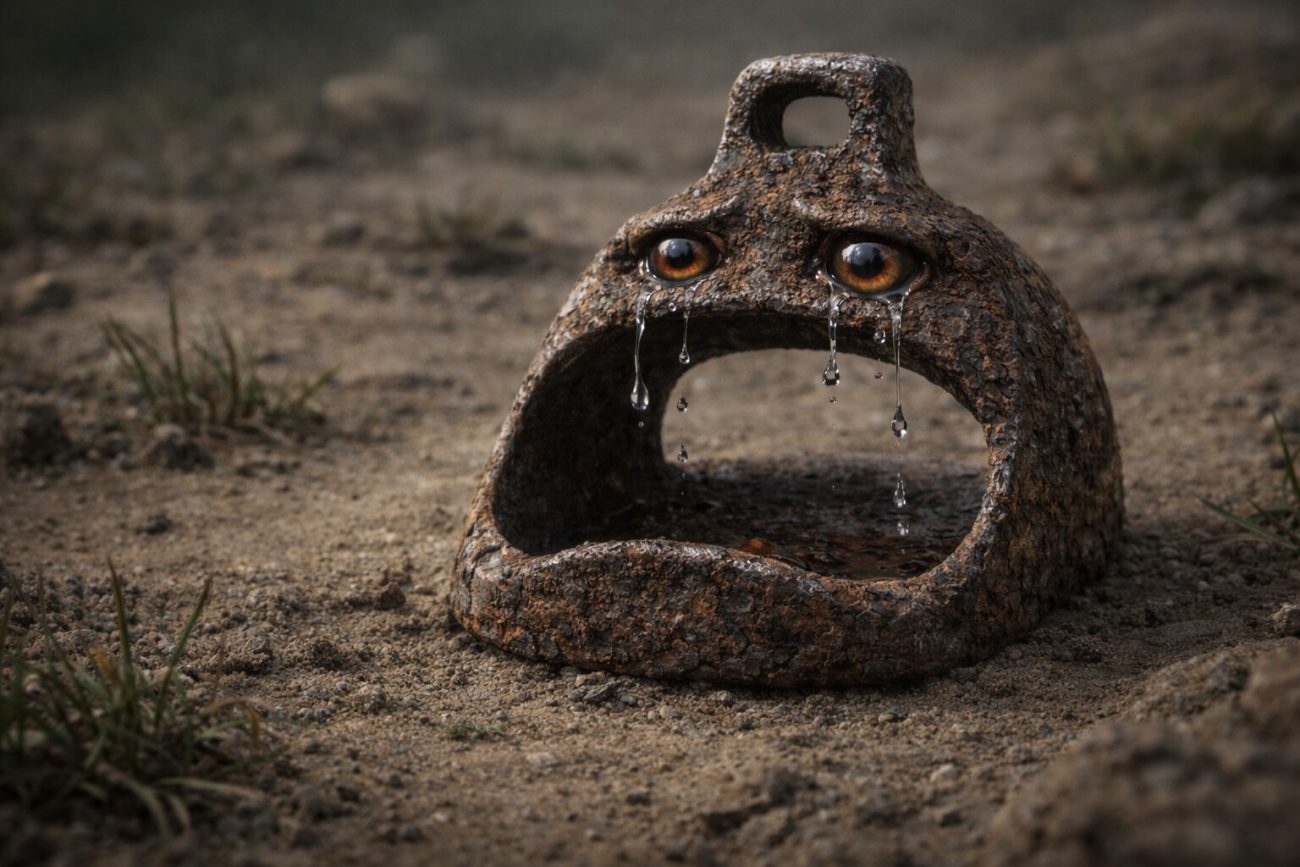
On old battlefields where grass grows over rusted iron and forgotten bones, an Abumi-guchi is said to wait.

Long ago, it was nothing more than a stirrup—one of a matched pair belonging to a warrior who rode into battle and never returned. When the fighting ended, the dead were buried or burned, the living went home, and the stirrup was left behind in the dirt, still shaped to bear a foot that would never again step into it.

As years passed, the abandoned object awakened.

The iron frame sprouted coarse fur, and where the foot once rested, a mouth formed—wide, soft, and wordless. Thus the Abumi-guchi was born, a tsukumogami shaped not by malice, but by longing.

Unlike many yōkai, the Abumi-guchi does not roam. It does not hunt, trick, or frighten travelers. It remains where it fell, half-buried in grass or mud, facing the direction from which its master once rode. It waits patiently, endlessly, believing that the warrior will return to claim it.

Those who encounter an Abumi-guchi describe it as gentle and sorrowful. It does not attack. It does not speak. If approached, it merely watches with its hollow mouth, as though expecting a familiar presence. Some say it shifts slightly when footsteps approach, mistaking strangers for its long-dead owner.

The Abumi-guchi is said to endure until it finally decays completely, or until time itself erases the memory of the battle. Until then, it remains a symbol of loyalty without reward—an object bound to a purpose that can never again be fulfilled.

In Japanese folklore, the Abumi-guchi stands as a quiet reminder that even tools can grieve, and that devotion, when left behind, may linger far longer than the lives that once gave it meaning.


Gallery


Sources

Yokai.com contributors. (n.d.). Abumi-guchi. In Yokai.com — The Japanese Mythology Database, from https://yokai.com/abumiguchi/

Wikipedia contributors. (n.d.). Abumi-guchi. In Wikipedia, The Free Encyclopedia, from https://en.wikipedia.org/wiki/Abumi-guchi


Interpretive Lenses

Religious Readings
  • Christian Ascetic Deep Dive
Philosophical Readings
  • Nietzschean Deep Dive
Psychological Readings
  • Jungian Deep Dive
Esoteric Deep Dive
  • Hermetic Deep Dive
Political / Social Readings
  • Marxist Deep Dive
Other
  • How to Invite The Abumi-guchi

Azuki Hakari

Tradition / Region: Japanese Mythology
Alternate Names: Azukihakari, Bean Counter
Category: Yōkai, Household Dweller, Red beans


The Myth

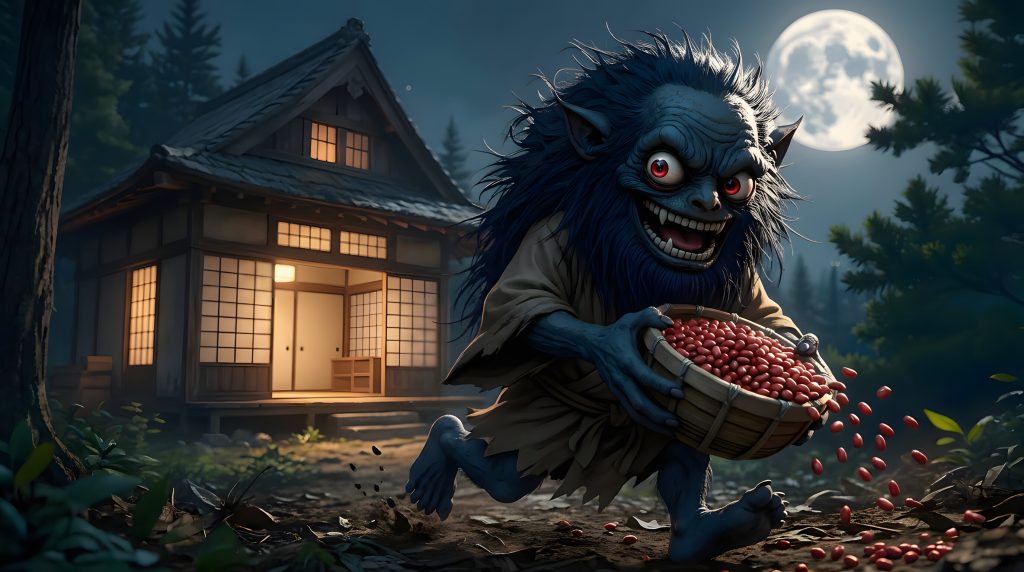
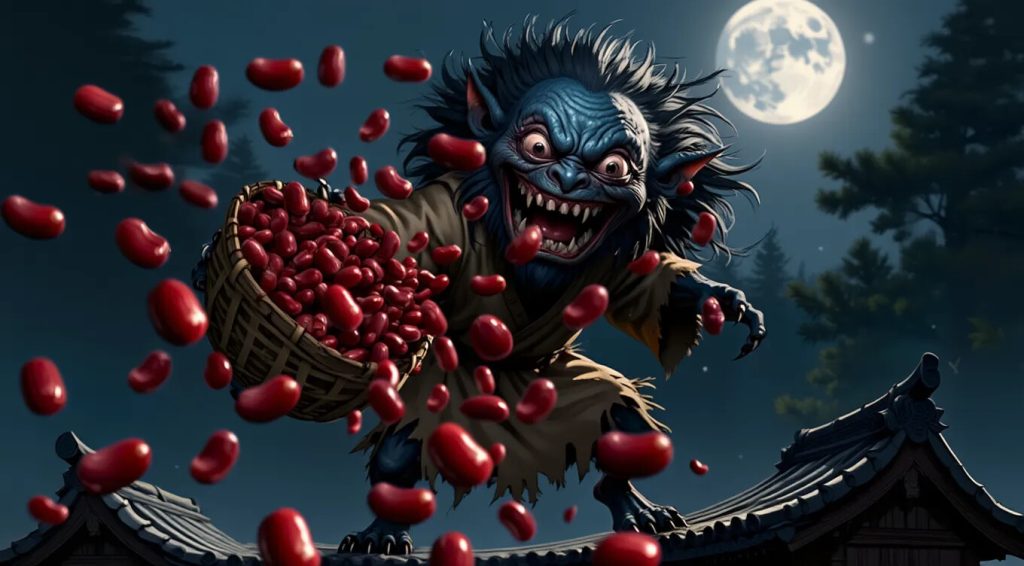
In the quiet hours after midnight, when houses settle and the world grows still, the Azuki Hakari makes itself known—not by sight, but by sound.

It is said to dwell in rural homes, temples, and old buildings, hiding in attics, ceilings, or garden shadows. No one has ever seen an Azuki Hakari. Its presence is announced only through a sequence of noises that unfold with deliberate precision, as though following a ritual known only to the spirit itself.

An encounter often begins with heavy footsteps above the room, pacing slowly in the narrow space between ceiling and roof. The steps are deliberate, neither hurried nor random, as if someone were measuring the house from above. Soon after, another sound joins the steps: the dry, rhythmic scattering of azuki beans, striking against windows or sliding doors. The sound repeats steadily, like counting—bean after bean—growing louder with time.

As the night deepens, the noises change. The dry patter of beans becomes the sound of splashing water, as though something unseen were washing or pouring liquid nearby. Finally, the rhythm resolves into the unmistakable clack of geta—wooden sandals—walking just outside the room, circling the house.

Those who dare to open the door or window in response are met with sudden silence. The footsteps vanish. The beans are gone. No water remains. There are no tracks, no marks, no sign that anything was ever there.

In older accounts, it is said that the Azuki Hakari may sometimes cause dust or scraps of paper to fall from the ceiling, but it never harms the residents. It does not steal, attack, or speak. Its purpose is unknown. It simply performs its nocturnal counting and departs.

Because the Azuki Hakari is never seen, its true nature remains uncertain. Some believe it is related to other azuki spirits, while others insist it is something separate—an invisible presence made entirely of sound. In many stories, encounters once attributed to river-dwelling azuki yōkai are now believed to have taken place within homes, pointing instead to the silent work of the bean counter.

Thus the Azuki Hakari endures in folklore as a reminder that not all spirits announce themselves with form or violence. Some are known only by rhythm and repetition, by footsteps in the dark and beans that were never there—proof that even an empty house is never truly empty.


Gallery


Sources

Wikipedia contributors. (n.d.). Azukihakari. In Wikipedia, The Free Encyclopedia, from https://en.wikipedia.org/wiki/Azukihakari

Yokai.com contributors. (n.d.). Azukihakari. In Yokai.com — The Japanese Mythology Database, from https://yokai.com/azukihakari/


Interpretive Lenses

Religious Readings
  • Christian Ascetic Deep Dive
Philosophical Readings
  • Nietzschean Deep Dive
Psychological Readings
  • Jungian Deep Dive
Esoteric Deep Dive
  • Hermetic Deep Dive
Political / Social Readings
  • Marxist Deep Dive
Other
  • How to Invite The Azuki Hakari

Umibake

Tradition / Region: Japanese Mythology
Alternate Names:
Category: Yōkai, Sea Serpent, Snake


The Myth

Umibake is a yōkai known only from monster picture scrolls drawn after the Edo period. It appears among collections of strange beings painted together, without a written tale to explain its origin or deeds.

The Umibake emerges upon the surface of the water. Its body is long and slender like that of a serpent, stretching across the waves as it rises. Though its form is aquatic and elongated, its face and the shape of its hands resemble those of a familiar kind of yōkai often seen in monster scrolls, giving it an oddly human presence despite its inhuman body.

No story tells what Umibake does when it appears, nor why it comes forth from the water. It is simply seen there, floating or rising, a quiet and unsettling shape upon the surface of the sea.

Like many yōkai preserved only in pictures, Umibake remains a vision without explanation—its meaning carried only in its form, suspended between water and imagination.


Gallery


Sources

Tyz-Yokai Blog contributors. (n.d.). 海化け (Umibake). In TYZ-Yokai Blog, from https://tyz-yokai.blog.jp/archives/1036418400.html


Interpretive Lenses

Religious Readings
  • Christian Ascetic Deep Dive
Philosophical Readings
  • Nietzschean Deep Dive
Psychological Readings
  • Jungian Deep Dive
Esoteric Deep Dive
  • Hermetic Deep Dive
Political / Social Readings
  • Marxist Deep Dive
Other
  • How to Invite The Umibake

Uso no Seire

Tradition / Region: Japanese Mythology
Alternate Names:
Category: Yōkai, Fish, Monk, Catfish


The Myth

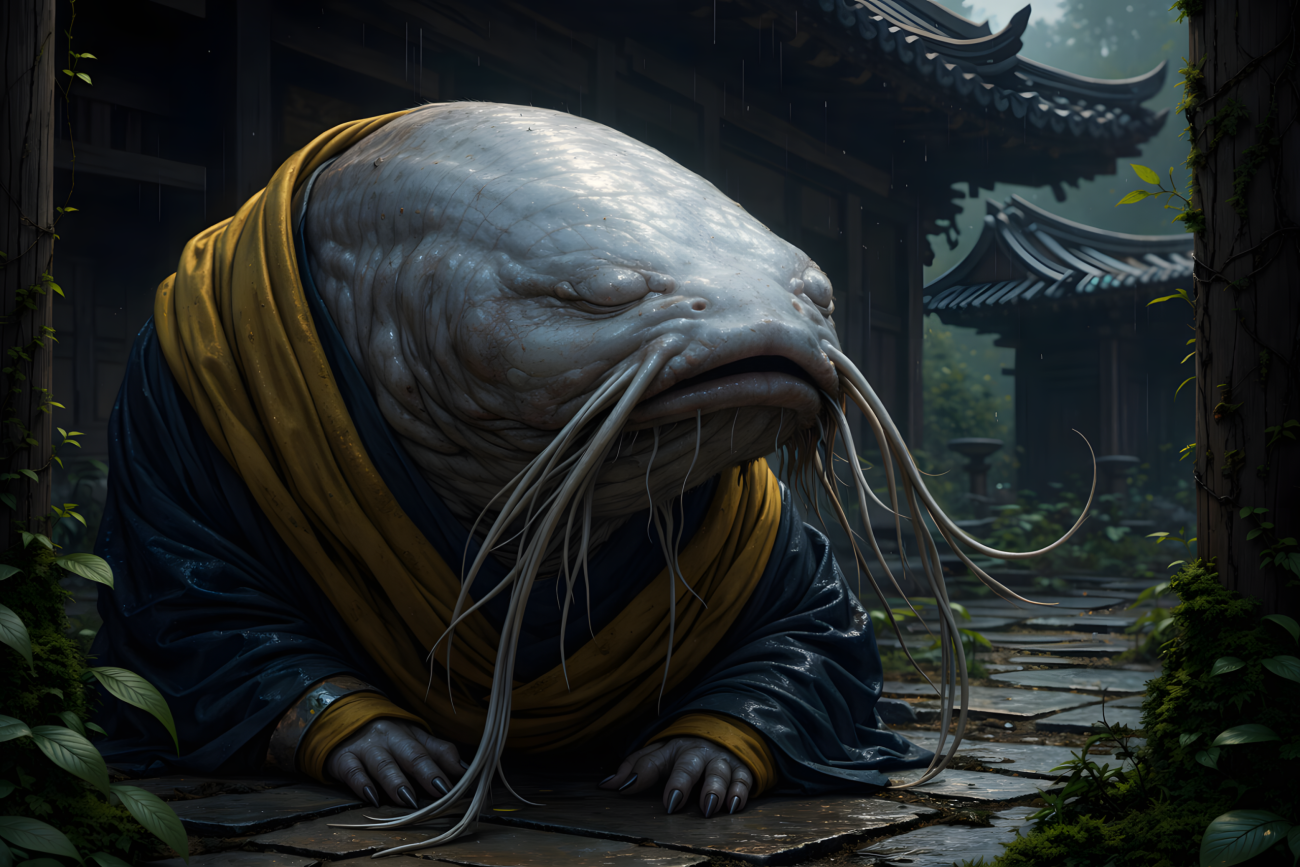
Uso no Seirei is a yōkai depicted in the Bakemono Emaki (Monster Picture Scroll) preserved in the Kawasaki City Museum.

It appears in the form of a bald monk-like figure. Its face has no eyes, no nose, and no mouth. From where its face should be, long whiskers grow, resembling those of a catfish. The creature wears a kimono patterned with images believed to represent the uso, the bullfinch.

The spirit stands silently, without expression or speech. Its lack of facial features gives it an unsettling presence, as though it exists without identity or emotion. The bullfinch pattern upon its robes marks its nature, binding it to the idea of the uso itself.

Uso no Seirei does not act violently, nor does it chase or attack. It simply appears, featureless and mute, a quiet and uncanny figure among the monsters of the scroll.


Gallery


Sources

Tyz-Yokai Blog contributors. (n.d.). [Title of entry]. In TYZ-Yokai Blog, from https://tyz-yokai.blog.jp/archives/1010653494.html


Interpretive Lenses

Religious Readings
  • Christian Ascetic Deep Dive
Philosophical Readings
  • Nietzschean Deep Dive
Psychological Readings
  • Jungian Deep Dive
Esoteric Deep Dive
  • Hermetic Deep Dive
Political / Social Readings
  • Marxist Deep Dive
Other
  • How to Invite The Uso no Seire

Asukokoko

Tradition / Region: Japanese Mythology
Alternate Names:
Category: Yokai, Demon


The Myth

Asukokoko appears in an old depiction of the Night Parade of One Hundred Demons. It is not shown as a single body, but as a mass of many monster faces and grasping hands, all emerging from what looks like a drifting black cloud.

The faces leer and stare in different directions, while the hands reach outward as if the darkness itself were alive. There is no clear center to the creature, no fixed form that can be grasped or confronted.

Its name, Asukokoko, is understood to mean “here and there.” The monster is everywhere at once, scattered and unfixed, as though demons were appearing in many places at the same time.

Thus Asukokoko is not a single being that moves through the world, but a presence that manifests wherever fear gathers—faces and hands rising from darkness, here and there, without warning.


Gallery


Sources

Tyz-Yokai Blog contributors. (n.d.). [Title of entry]. In TYZ-Yokai Blog, from https://tyz-yokai.blog.jp/archives/1010652595.html


Interpretive Lenses

Religious Readings
  • Christian Ascetic Deep Dive
Philosophical Readings
  • Nietzschean Deep Dive
Psychological Readings
  • Jungian Deep Dive
Esoteric Deep Dive
  • Hermetic Deep Dive
Political / Social Readings
  • Marxist Deep Dive
Other
  • How to Invite The Asukokoko