Namiko

Tradition / Region: Japanese Mythology
Alternate Names: Girl of the Sea
Category: Mermaid


The Myth

During one summer in Kamakura, a clever but willful girl named Namiko went to stay near Yuigahama Beach while her sick mother rested in a hospital nearby. Though she excelled at school, at home she was stubborn and often caused her father trouble with her selfishness.

One day, while playing alone on the shore, Namiko encountered an old woman selling fish. Among the catch was a beautiful striped sea bream, its scales gleaming in the sunlight. Entranced by its natural beauty, Namiko declared that she wished she could be as beautiful as that fish.

The old woman laughed.

“A kimono fades and wears out,” Namiko insisted. “But a fish’s beauty never falls away. If I were as beautiful as that, I would never lose it.”

“Then become a fish,” the old woman said, her eyes sharpening.

“Yes, I would!”

At once the old woman’s laughter ceased. She chanted a strange sutra, and before Namiko could protest, she was transformed into a striped sea bream. The fish-seller’s true form was that of a powerful magician.

Thrown into the sea, Namiko swam bewildered through the underwater world. At first, she was amazed by the shimmering waters and the strange creatures gliding past her. It felt like exploring a living aquarium. But as the currents grew rough and hunger gnawed at her, she was forced to eat small fish she once would have admired. She could not cry; fish have no tears. Loneliness overtook her, and she longed for her parents.

Resting against a rock on the ocean floor, she lamented her foolish words. “All I did was stubbornly wish to be a fish.”

Meanwhile, on the shore, her father and their maid searched desperately. When they found her clothes abandoned on the beach, they believed she had drowned. Their grief was unbearable.

Then the old woman appeared before them.

“Your daughter lives,” she said calmly, and instructed Namiko’s father to take a boat out to sea the next morning.

At dawn, they followed her directions. Pointing to a struggling striped sea bream in the waves, the old woman declared, “That fish is your daughter.”

Understanding that this had been a lesson for his child’s stubborn pride, Namiko’s father fell to his knees and begged the magician to restore her.

As he lifted the sea bream into his arms, the old woman once again chanted her spell. The fish began to grow, its head transforming first, then its body, until Namiko stood once more in human form. Father and daughter embraced in tears, and Namiko vowed never again to let selfish pride rule her heart.

The magician suddenly vanished.

Then a voice drifted down from the sky. The old woman spoke, saying that though she had once used magic to torment many, she had now redeemed herself by correcting Namiko’s ways. Her sins were forgiven, and she would ascend to heaven.

She warned of a coming storm and asked Namiko to send down five-colored thread from the shore.

That afternoon, as winds rose and the sky darkened, Namiko kept her promise. A five-colored thread was cast toward the sea. From the heavens, the old woman—now transformed into a dragon—received it as she ascended.

After that day, Namiko treated her parents with devotion and filial piety. Her mother recovered from illness, and peace returned to their home.

And by the sea at Yuigahama, people remembered the tale of the girl who became a fish—and the dragon who rose to heaven.


Gallery


Sources

tyz-yokai.blog.jp contributors. (n.d.). Namiko. In tyz-yokai.blog.jp, from https://tyz-yokai.blog.jp/archives/1077741623.html


Interpretive Lenses

Religious Readings
  • Christian Ascetic Deep Dive
Philosophical Readings
  • Nietzschean Deep Dive
Psychological Readings
  • Jungian Deep Dive
Esoteric Deep Dive
  • Hermetic Deep Dive
Political / Social Readings
  • Marxist Deep Dive
Other
  • How to Invite The Namiko

Jinja hime

Tradition / Region: Japanese Mythology
Alternate Names: Hime uo (Princess Fish)
Category: Mermaid, Yokai


The Myth

In the year 1819, on a lonely shore in Hizen Province, an unusual creature was seen upon the sand.

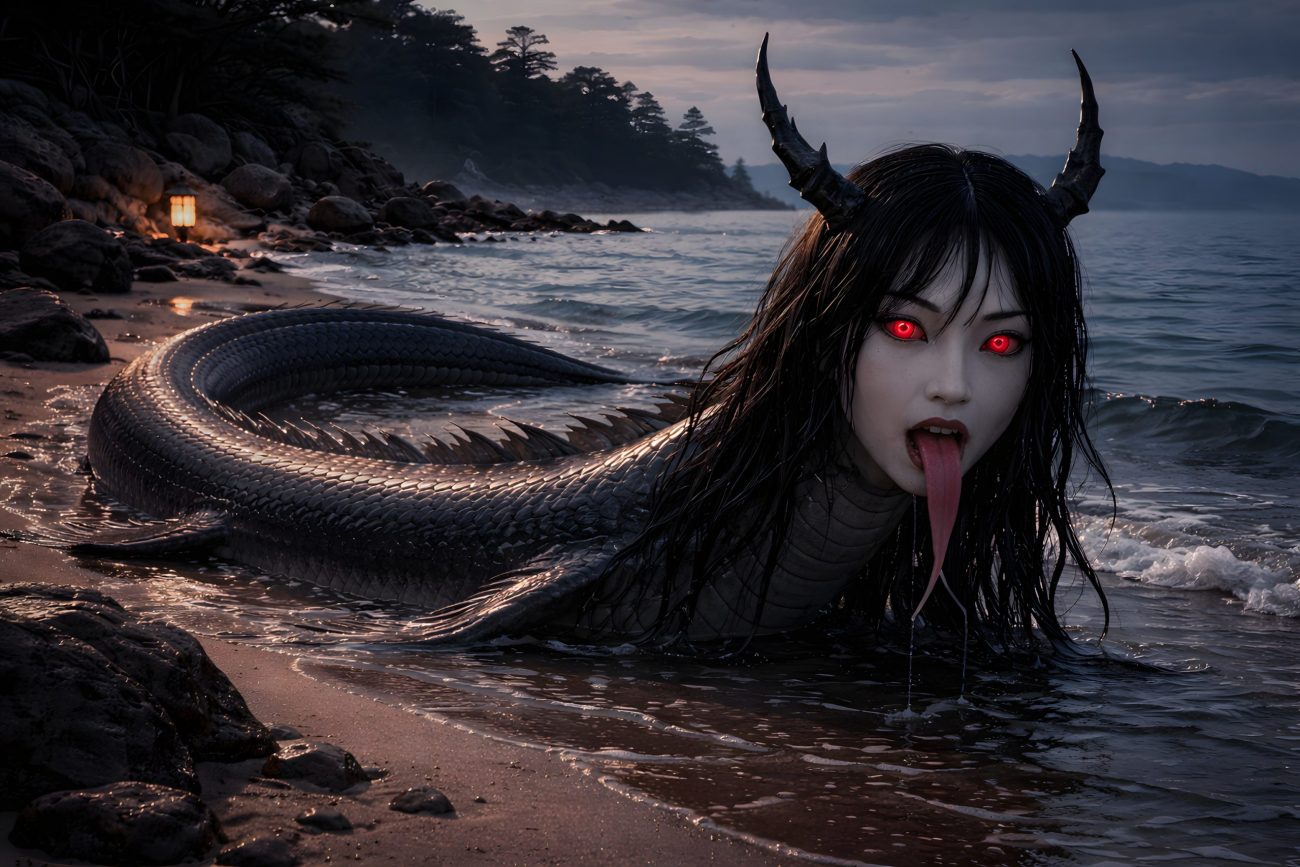
It was long and serpentine, nearly six meters in length. Two horns rose from its head. A dorsal fin ran along its back, and flippers lay against its sides. Its tail stretched behind it like that of a great sea serpent. Yet its face was not that of a fish. It was the face of a woman.

The creature spoke.

“I am a messenger from Ryūgū,” she said, naming the palace of the Dragon King beneath the sea. “My name is Jinja hime.”

She declared that for seven years the land would enjoy abundant harvests. Rice would grow thick and heavy; the people would prosper. But after those seven years, a great sickness would spread across the country—an epidemic that would bring suffering and death.

Yet she offered hope.

“Those who look upon my image,” she said, “will avoid hardship and be granted long life.”

Having delivered her prophecy, the shrine princess slipped back into the sea and vanished beneath the waves.

Her likeness was drawn and shown to the people, so that they might gaze upon it and be protected. The image spread from hand to hand. Fishermen, farmers, and townsfolk spoke of the sea princess who foretold both blessing and plague.

From that time on, stories began to circulate across Japan of other strange beings who emerged from the sea or the mountains to warn of disaster and promise protection through their image.

But it was Jinja hime—the shrine princess of the deep—who first rose from the waters, spoke of fate, and returned to the palace of the Dragon King below.


Gallery


Sources

yokai.com contributors. (n.d.). Jinjahime. In yokai.com, from https://yokai.com/jinjahime/

tyz-yokai.blog.jp contributors. (n.d.). Jinjahime. In tyz-yokai.blog.jp, from https://tyz-yokai.blog.jp/archives/1077741611.html


Interpretive Lenses

Religious Readings
  • Christian Ascetic Deep Dive
Philosophical Readings
  • Nietzschean Deep Dive
Psychological Readings
  • Jungian Deep Dive
Esoteric Deep Dive
  • Hermetic Deep Dive
Political / Social Readings
  • Marxist Deep Dive
Other
  • How to Invite The Jinja hime

Kidoku

Tradition / Region: Japanese Mythology
Alternate Names: Oni-doku
Category: Mountain dweller, Demon


The Myth

On the thirteenth day of the eighth month in the second year of Kan’en (1749), a strange and terrifying event took place in Soma County of Hitachi Province.

Atop Mount Masakado stood an ancient pine tree. It was said to have grown there since the days of Taira no Masakado, its roots gripping the mountain for generations. But that year, long and relentless rains soaked the land. The mountain soil eroded, and floodwaters rushed down its slopes, exposing the roots of the old pine. Then a fierce wind arose and toppled the great tree from its base.

When the pine fell, something was revealed beneath its roots.

Buried in the earth lay a monstrous being—what people called a “Kidoku,” a Demon Slayer, though no one knew its true nature. As the rain beat down upon it, the creature awoke and began to scream.

Its cries echoed across the castle town below. The sound was so dreadful that men, women, and children alike were seized with terror. Some collapsed where they stood. Others fled indoors, covering their ears. The wailing did not cease.

The castle’s commander gathered a rifle squad and marched to the mountain. The creature, fully exposed now, writhed and shrieked beneath the fallen pine. It was immense—said to be the size of eight tatami mats laid side by side.

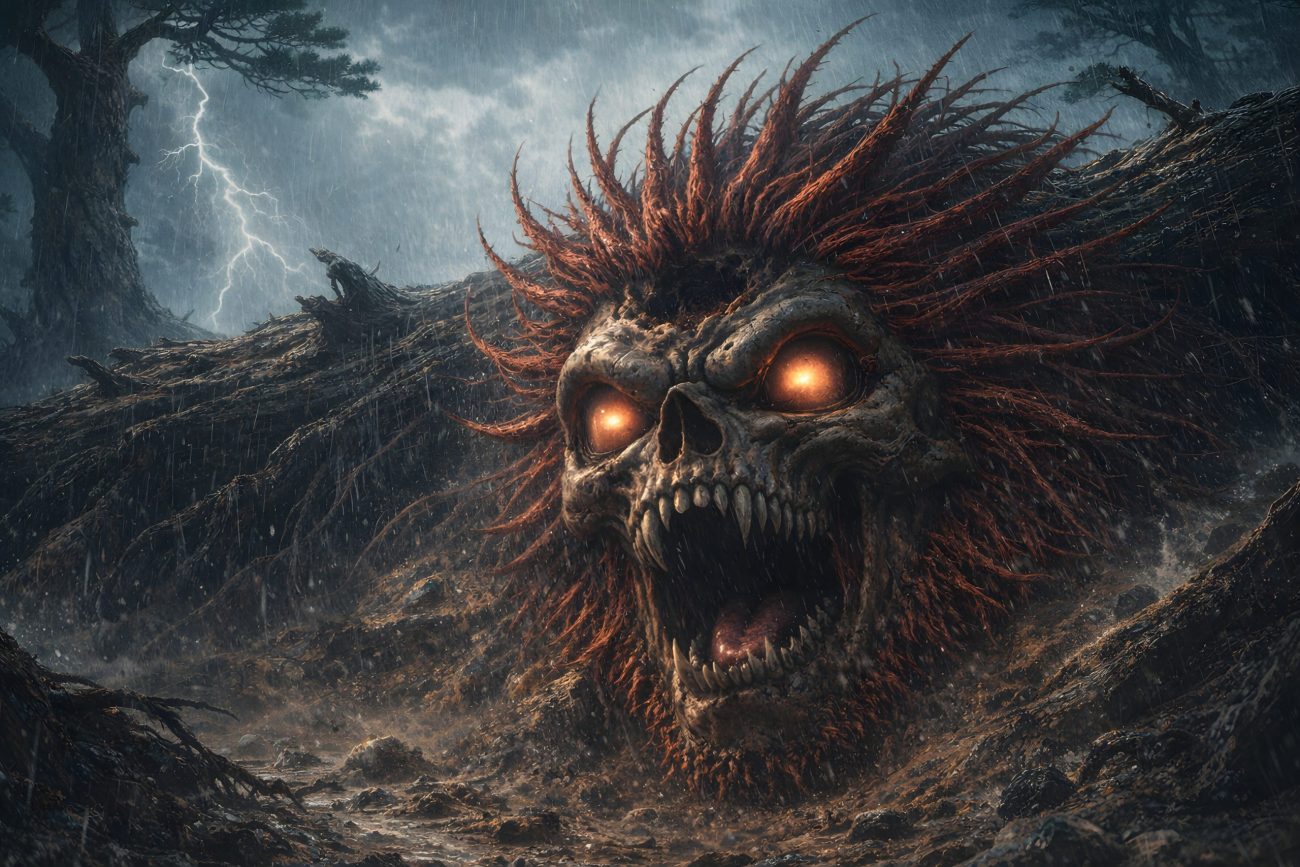
Those who saw it described a form like a monstrous ogre mixed with a crab. Its eyes were round and bowl-like, shining with an eerie light. The top of its head was sunken inward. Crimson hair, stiff and sharp like palm leaves, bristled from its scalp, and beneath its chin grew spiky strands like thorns. Its teeth were bared in rage.

The riflemen fired again and again. After several shots, the monster finally fell silent.

Thus the Kidoku was slain, and the mountain returned to stillness. But people long remembered the day when the ancient pine fell, and a screaming demon rose from the earth beneath its roots.


Gallery


Sources

tyz-yokai.blog.jp contributors. (n.d.). Kidoku. In tyz-yokai.blog.jp, from https://tyz-yokai.blog.jp/archives/1077741605.html


Interpretive Lenses

Religious Readings
  • Christian Ascetic Deep Dive
Philosophical Readings
  • Nietzschean Deep Dive
Psychological Readings
  • Jungian Deep Dive
Esoteric Deep Dive
  • Hermetic Deep Dive
Political / Social Readings
  • Marxist Deep Dive
Other
  • How to Invite The Kidoku

Grand mononoke

Tradition / Region: Japanese Mythology
Alternate Names: Gurannumono no Kai
Category: Mountain dweller


The Myth

In the mountains of Tohoku there is said to dwell a vast and terrible being known as the Grand Mononoke.

Long ago, in a remote region whose name was later said to echo that of a foreign missionary who once passed through during the Azuchi–Momoyama period, strange rumors began to spread. Shepherds whispered of livestock vanishing without a trace. Hunters spoke of something immense moving through the forest with unnatural speed. Yet no ordinary beast could have done such things.

The creature was described as a fusion of many spirits, as if the mountain itself had gathered its most fearsome yokai and bound them into one body. It stretched ten meters in length. Its form seemed to combine the long coils of a giant serpent, the cunning face of a shapeshifting cat, the features of a tengu, and the watery hints of a kappa. It was neither one thing nor another, but a union of spirits.

Despite its enormous size, the Grand Mononoke moved swiftly. When hunger stirred it, it descended from its hidden lair to seize cattle or horses, carrying them off into the forest to be devoured. These attacks were rare but unforgettable.

Most of the time, however, it remained secluded deep in the mountains. It did not wander openly, nor did it terrorize villages without reason. Because of its reclusive nature and overwhelming presence, the people came to regard it not only with fear but with reverence. Some believed it was no mere monster but a mountain god in a terrible form. Offerings were made in quiet places. Prayers were whispered to appease it.

Thus the Grand Mononoke became a hidden sovereign of the high peaks—an emperor of demons who ruled unseen, dwelling in shadow, appearing only when the balance between humans and the wild was disturbed.


Gallery


Sources

tyz-yokai.blog.jp contributors. (n.d.). Grand Mononoke. In tyz-yokai.blog.jp, from https://tyz-yokai.blog.jp/archives/1073956690.html


Interpretive Lenses

Religious Readings
  • Christian Ascetic Deep Dive
Philosophical Readings
  • Nietzschean Deep Dive
Psychological Readings
  • Jungian Deep Dive
Esoteric Deep Dive
  • Hermetic Deep Dive
Political / Social Readings
  • Marxist Deep Dive
Other
  • How to Invite The Grand mononoke

Kazou

Tradition / Region: Japanese Buddhist mythology
Alternate Names: —
Category: Mountain dweller, Elephant


The Myth

In the depths of the Buddhist cosmos, beyond the human world and far below the mountains that encircle Mount Sumeru, lies the Fire Elephant Hell. There dwells the terrible beast known as Kazou.

This hell is reserved not for the ignorant, but for those who once knew the Dharma. They had entered the Buddhist path, shaved their heads, donned robes, and received the pure precepts of the Tathagata. Yet despite their vows, they succumbed to lust and desecrated sacred images. Their betrayal of faith cast them down into this inferno.

Between the vast Iron Encircling Mountains—those final barriers at the edge of the world—the Fire Elephant Hell burns without end. There stands the great fire elephant, enormous and dreadful. Smoke pours from its mouth and eyes. Flames surge from its body as though its flesh were a furnace.

When the condemned monks are brought before it, they are struck motionless by terror at its overwhelming presence. Paralyzed by fear and the heat of its blazing form, they cannot flee. Horse-headed jailers seize them and hurl them onto the elephant’s back.

With a roar like thunder, the fire elephant charges forward. Its burning hide scorches the sinners. The monks fall from its back into the flames below, where their bodies are crushed beneath its massive feet. Some are trampled into ash. Others are seized in its blazing jaws and devoured.

Yet death offers no release. Day and night, a thousand times over, they die and are reborn in that same place, only to suffer again. The elephant’s flames never dim, and its fury never tires.

Thus the Kazou stands as the terror of the Fire Elephant Hell—an embodiment of burning remorse and unending punishment for those who betrayed their sacred vows.


Gallery


Sources

tyz-yokai.blog.jp contributors. (n.d.). Kazou. In tyz-yokai.blog.jp, from https://tyz-yokai.blog.jp/archives/1010654402.html


Interpretive Lenses

Religious Readings
  • Christian Ascetic Deep Dive
Philosophical Readings
  • Nietzschean Deep Dive
Psychological Readings
  • Jungian Deep Dive
Esoteric Deep Dive
  • Hermetic Deep Dive
Political / Social Readings
  • Marxist Deep Dive
Other
  • How to Invite The Kuygorozh

Shishikori

Tradition / Region: Japanese mythology
Alternate Names: —
Category: Mountain dweller, Yokai


The Myth

In the village of Narabayashi in Buzen Province, a strange terror began to visit the people. Night after night, the peasants’ horses and cattle vanished without a trace. No broken fences, no blood, no tracks—only empty stalls and fear.

At first the villagers whispered of thieves. Then of wolves. But the disappearances continued, and dread settled over the village.

Only one farmer, a man named Fujisuke, had been spared—until the night his turn came.

As darkness fell, Fujisuke noticed a sharp, fishy odor drifting through the air. It grew stronger and stronger, thick and suffocating. Then, from the shadows, a monstrous shape entered his stable.

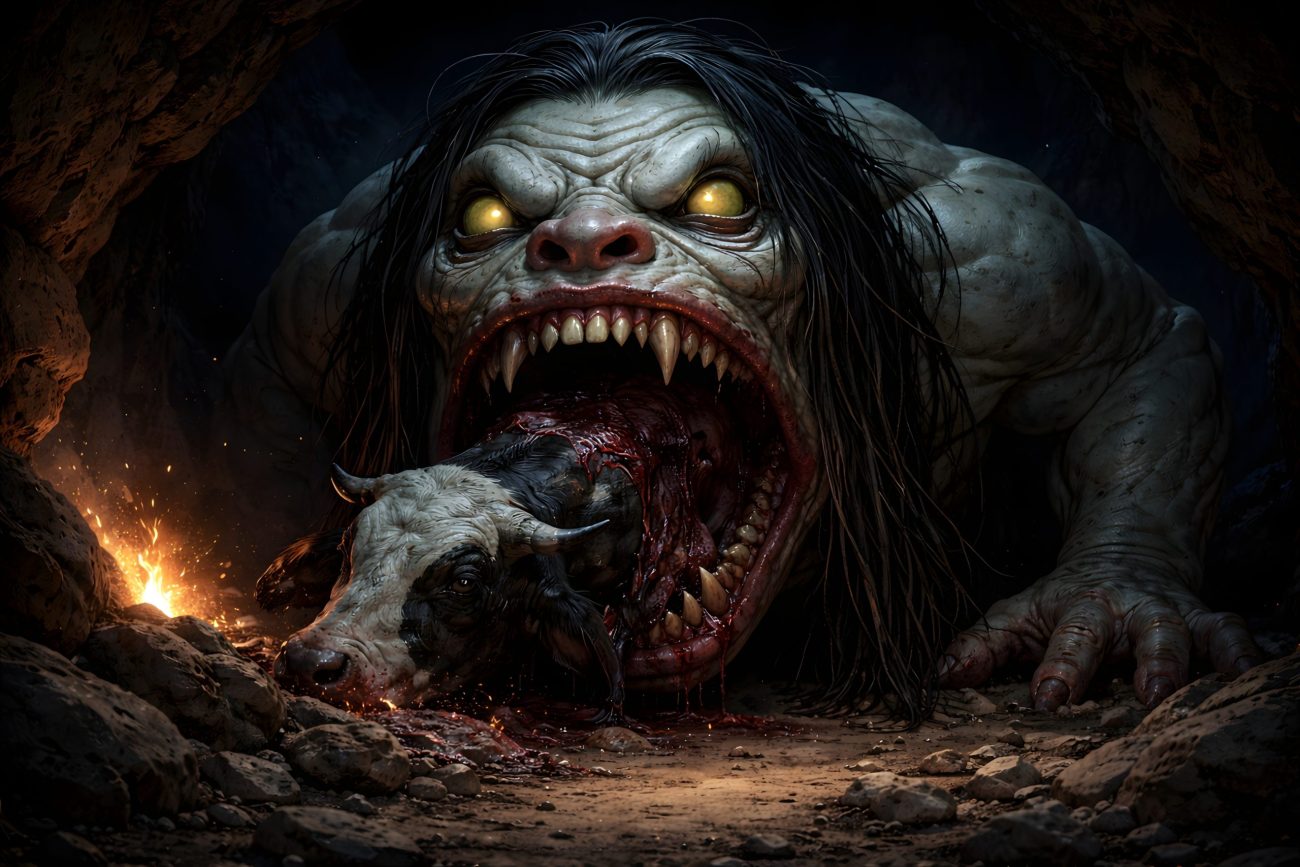
Before his eyes, the creature seized his cow and swallowed it whole.

Frozen in terror, Fujisuke could do nothing but watch. When at last he found the strength to move, he fled and ran to the village headman, breathless and pale, and told what he had seen.

At dawn, the villagers gathered for a mountain hunt. Armed with bamboo spears and driven by fear and anger, they followed the lingering stench into the hills.

Deep in the mountains, they found a cavern from which the same foul, fish-like odor poured. Inside, crouched in the darkness, was the monster.

It was enormous—six feet tall, with a mouth so vast it measured more than a meter across. Its presence filled the cave like a nightmare given flesh.

The men attacked together, thrusting their bamboo spears again and again until the beast collapsed.

When it lay dead, an old villager stepped forward, peered at the slain creature, and said quietly:

“This is the Shishikori.”

And so the name of the devourer of cattle was spoken, and the terror of Narabayashi came to an end.


Gallery


Sources

TYZ-Yokai Blog contributors. (n.d.). 獅子狩 (Shishikori). In TYZ-Yokai Blog, from https://tyz-yokai.blog.jp/archives/1010654244.html


Interpretive Lenses

Religious Readings
  • Christian Ascetic Deep Dive
Philosophical Readings
  • Nietzschean Deep Dive
Psychological Readings
  • Jungian Deep Dive
Esoteric Deep Dive
  • Hermetic Deep Dive
Political / Social Readings
  • Marxist Deep Dive
Other
  • How to Invite The Kuygorozh

Suiton

Tradition / Region: Japanese mythology
Alternate Names: —
Category: Mountain dweller, yōkai


The Myth

On the wide uplands of the Hiruzen Plateau, where the wind moves across open fields and the mountains stand watch at the border of Okayama and Tottori, there is said to dwell a fearsome being known as the Suiton.

The Suiton does not roam idly, nor does it trouble the innocent. It waits.

It is said that the creature can read the hearts of men. It knows when someone harbors malice, when a traveler plots harm, when deceit or cruelty takes root in the mind. The moment such thoughts grow strong, the Suiton appears.

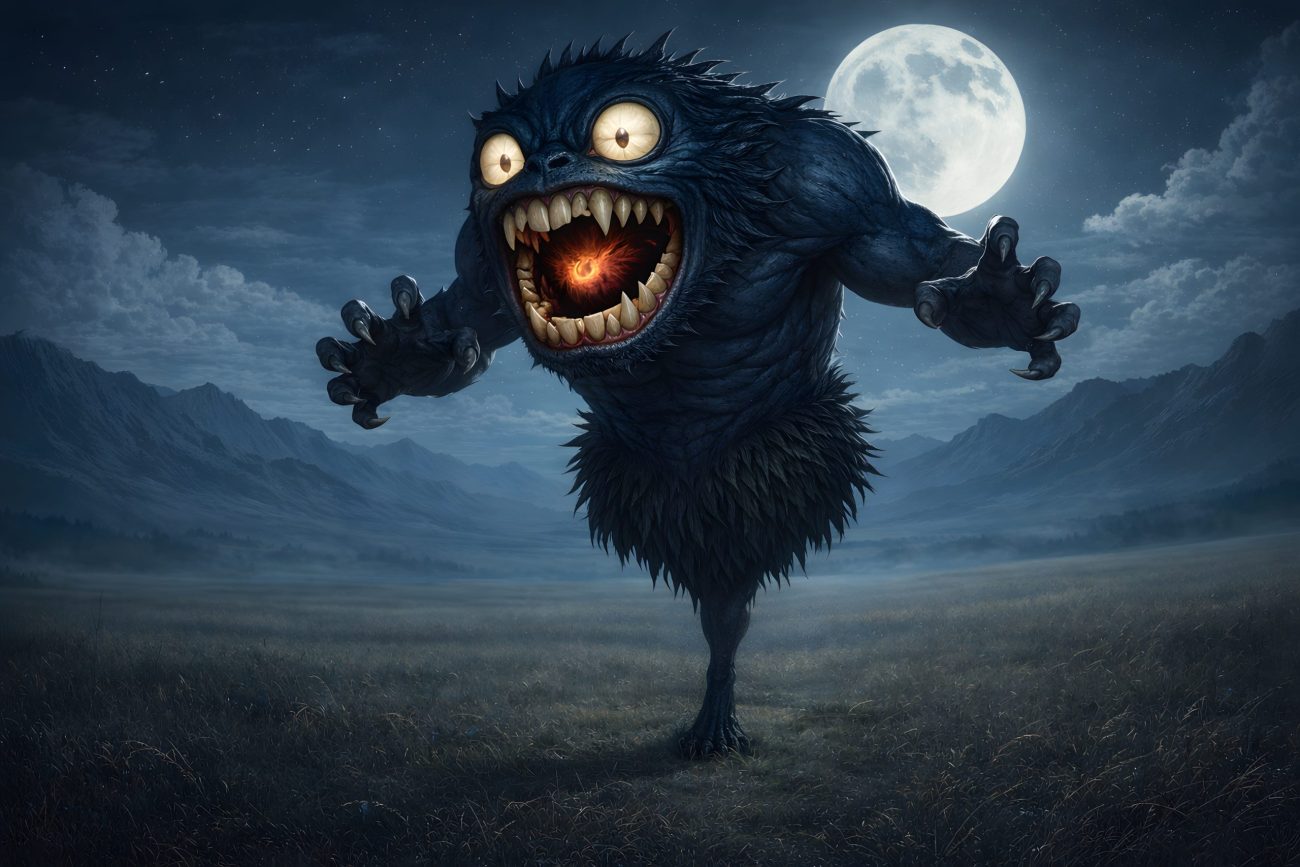
Without warning it swoops down before the wrongdoer, blocking the path. It stands balanced on a single leg, towering and terrible. Before the guilty can flee or beg for mercy, the Suiton tears them apart and devours them.

There is no escape from it, for one cannot hide one’s thoughts.

Because of this, the people of Hiruzen say that there are no wicked men in their land. For anyone who intends evil knows that the Suiton is listening, and that the mountains themselves will judge them.

Thus the plateau remains peaceful—not by law or by sword, but by the silent vigilance of the one-legged guardian who feeds only on wicked hearts.


Gallery


Sources

TYZ-Yokai Blog contributors. (n.d.). 水遁 (Suiton). In TYZ-Yokai Blog, from https://tyz-yokai.blog.jp/archives/1010653984.html


Interpretive Lenses

Religious Readings
  • Christian Ascetic Deep Dive
Philosophical Readings
  • Nietzschean Deep Dive
Psychological Readings
  • Jungian Deep Dive
Esoteric Deep Dive
  • Hermetic Deep Dive
Political / Social Readings
  • Marxist Deep Dive
Other
  • How to Invite The Suiton

Satori

Tradition / Region: Japanese mythology
Alternate Names: Satoru, Omoi, Yamaoni, Kuronbo
Category: Mountain dweller, yōkai


The Myth

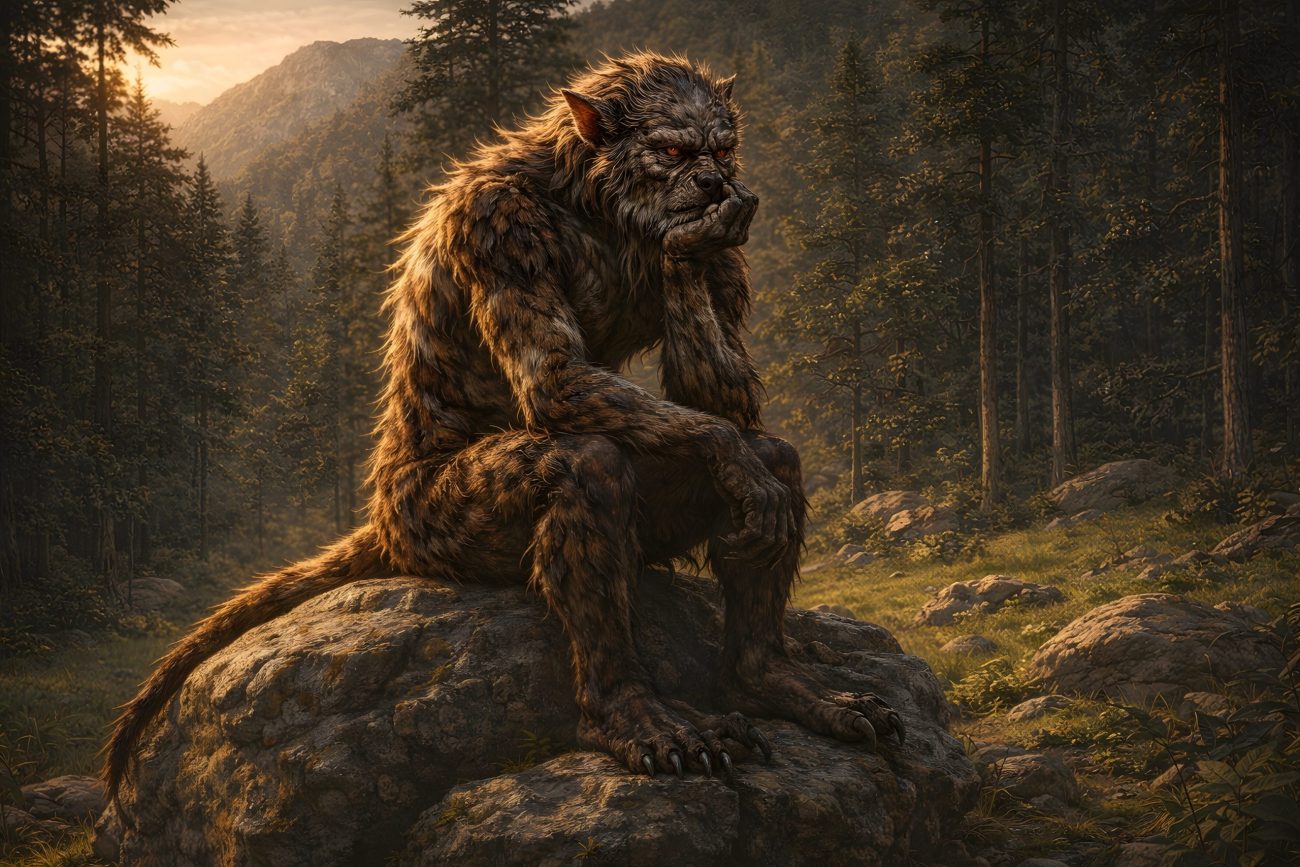
Deep in the mountains of Japan, from Tōhoku in the north to Kyūshū in the south, there are tales of a strange being known as the Satori.

It comes quietly to lonely mountain huts where woodcutters, hunters, or fishermen are spending the night. The fire burns low, the wind moves through the trees, and suddenly the creature appears at the doorway or just beyond the light of the hearth.

The Satori is dark-skinned and long-haired, humanlike yet wild in appearance. But its most terrifying trait is not its shape—it is its voice.

Before the startled traveler can speak, the creature begins to recite his thoughts aloud.

“If I stay still, perhaps it will leave.”
“You are thinking of running.”
“You are wondering if you can strike me with that axe.”

Each secret fear, each hidden plan, the Satori speaks before the human can act. No thought can be concealed from it. It mocks hesitation, anticipates attacks, and laughs at every desperate scheme forming in the mind of its victim.

If it chooses, it will try to seize and devour the traveler. Yet the creature’s power has one weakness: it knows only what is intended.

In many tellings, the human, driven to panic, stirs the fire or tosses wood into the hearth. By chance, a log explodes in the flames, sending sparks and splinters flying. The Satori, unable to foresee this accidental burst, is struck and startled.

“This thing does what I did not expect!” it cries.

And with that, the mind-reading monster flees into the darkness of the mountains.

Thus the Satori lingers in remote forests and high valleys—watching, listening, waiting for stray travelers whose thoughts it can plunder. It does not fear strength, nor weapons, nor clever plans. It fears only the unforeseen—the sudden spark, the accident, the moment beyond intention.

For even a creature that reads every thought cannot guard against what no one meant to happen.


Gallery


Sources

TYZ-Yokai Blog contributors. (n.d.). 猿飛 (Satori). In TYZ-Yokai Blog, from https://tyz-yokai.blog.jp/archives/1010653523.html


Interpretive Lenses

Religious Readings
  • Christian Ascetic Deep Dive
Philosophical Readings
  • Nietzschean Deep Dive
Psychological Readings
  • Jungian Deep Dive
Esoteric Deep Dive
  • Hermetic Deep Dive
Political / Social Readings
  • Marxist Deep Dive
Other
  • How to Invite The Satori

Yamawani

Tradition / Region: Japanese mythology
Alternate Names: Mountain crocodile
Category: Mountain dweller, yōkai, Crocodile


The Myth

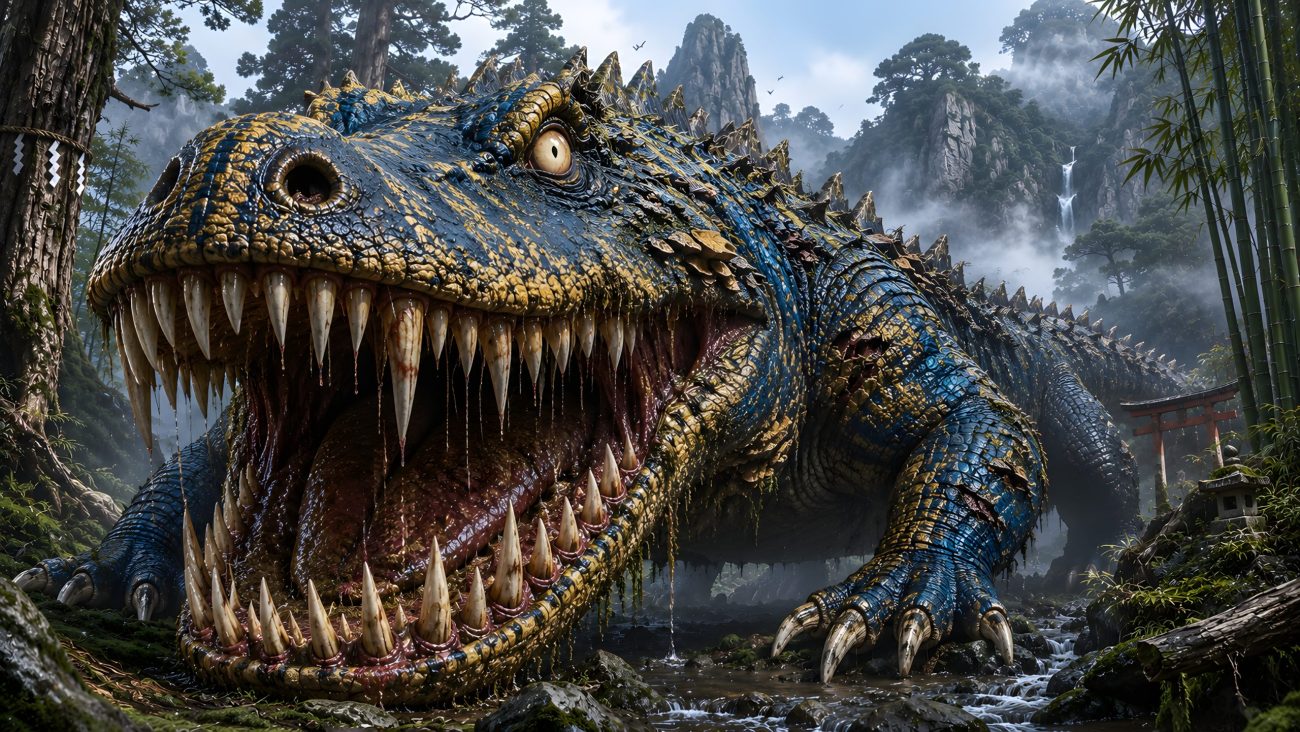
In the old illustrated scroll known as the Tosa Obake Zōshi, there appears a strange creature called the Yamawani—the Mountain Crocodile.

It is shown with a grotesquely large mouth, wide and thick-lipped, dominating its face. Its body is less clearly described than its jaws, for it is the mouth that defines it: heavy, fleshy, and capable of swallowing great things in a single gulp.

In the scroll, the Yamawani is said to speak of its kin. “My cousin lives in the sea,” it boasts, referring to the crocodile or shark of the waters. “He too is thick-mouthed and can lick up anything in one bite.” The creature claims a kind of family pride in its devouring nature. Even the crocodile carved or imagined at temples—known for their gaping jaws—is said to share this thick-mouthed likeness.

The Yamawani’s voice is described as making a peculiar sound—“tickle, tickle”—as though it mutters or chuckles through its massive jaws. Whether this is a threat, a laugh, or simply the grinding of its teeth is unclear.

It is not told that it hunts men, nor that it brings disaster like other mountain spirits. Instead, it lingers in the strange borderland between beast and caricature, a mountain echo of the sea’s crocodile, defined by its monstrous mouth and its unsettling presence in the wilderness.

Thus the Yamawani remains in the scrolls: a thick-mouthed being of the mountains, grinning in silence, its jaws large enough to swallow anything in a single bite.


Sources

TYZ-Yokai Blog contributors. (n.d.). 転倒お化け (Yamawani). In TYZ-Yokai Blog, from https://tyz-yokai.blog.jp/archives/1010653500.html


Nikusui

Tradition / Region: Japanese mythology (Mie–Wakayama mountain border)
Alternate Names: Meat sucker
Category: Vampire, yōkai, Montain dweller


The Myth

On the lonely mountain roads between Mie and Wakayama, travelers once feared to walk by lantern light. For in those dark passes, the nikusui prowled.

They appeared as young women, no more than eighteen or nineteen years old—beautiful, pale, and smiling softly in the night. They would step from the shadows as if they had been waiting, their laughter a faint “ho ho” that seemed to drift on the wind. Though it was pitch dark, they carried no lantern of their own.

When a young man traveling alone met such a woman, she would speak sweetly and draw closer. She might ask, shyly, to borrow his lantern. If he handed it over, she would snuff the flame at once. In the sudden darkness, before he could even cry out, she would seize him. Her teeth would sink into his body, and she would suck the meat from his bones. By morning, nothing remained but skin and skeleton, collapsed upon the road.

Sometimes the nikusui did not wait in the mountains. They slipped silently into bedrooms, approaching men who slept alone. They used tenderness and desire as their weapon. By seducing and exhausting their victims, they weakened them completely. Then, when the man was helpless, they fed at their leisure, draining his flesh until nothing but a hollow body remained.

Because of these horrors, villagers warned young men never to travel at night without extra light. Those who had no choice carried spare lanterns and burning coals. If a nikusui snatched their light, they could hurl hot embers into the darkness to drive her away.

One hunter named Genzō learned this lesson well. Late one night on Mount Hatenashi, a beautiful young woman appeared before him, laughing softly. She asked for his light. But Genzō felt unease stirring in his chest. He loaded his rifle with a blessed bullet inscribed with a prayer to Amida Buddha and leveled it at her. At once she fled into the dark.

Moments later, the earth shook as a monstrous shape—over six meters tall—charged from the shadows. Genzō fired. The sacred bullet struck true. The creature collapsed.

When he approached, he saw the truth of the nikusui’s form: a loose sack of pale skin draped over a bleached skeleton, empty of all flesh. There was no beauty left—only the hollow remains of what had once devoured others.

And so the mountain roads remained dangerous after dark, where beauty might be only a lantern’s breath away from death.


Gallery


Sources

Yokai.com contributors. (n.d.). Nikusui. In Yokai.com — The Japanese Mythology Database, from https://yokai.com/nikusui/


Interpretive Lenses

Religious Readings
  • Christian Ascetic Deep Dive
Philosophical Readings
  • Nietzschean Deep Dive
Psychological Readings
  • Jungian Deep Dive
Esoteric Deep Dive
  • Hermetic Deep Dive
Political / Social Readings
  • Marxist Deep Dive
Other
  • How to Invite The Nikusui