Bożątka

Tradition: Polish Mythology
Alternative Names: Bożątki, Bożonka, Duszyczki, Duszyczkami
Category: House dweller


The Myth

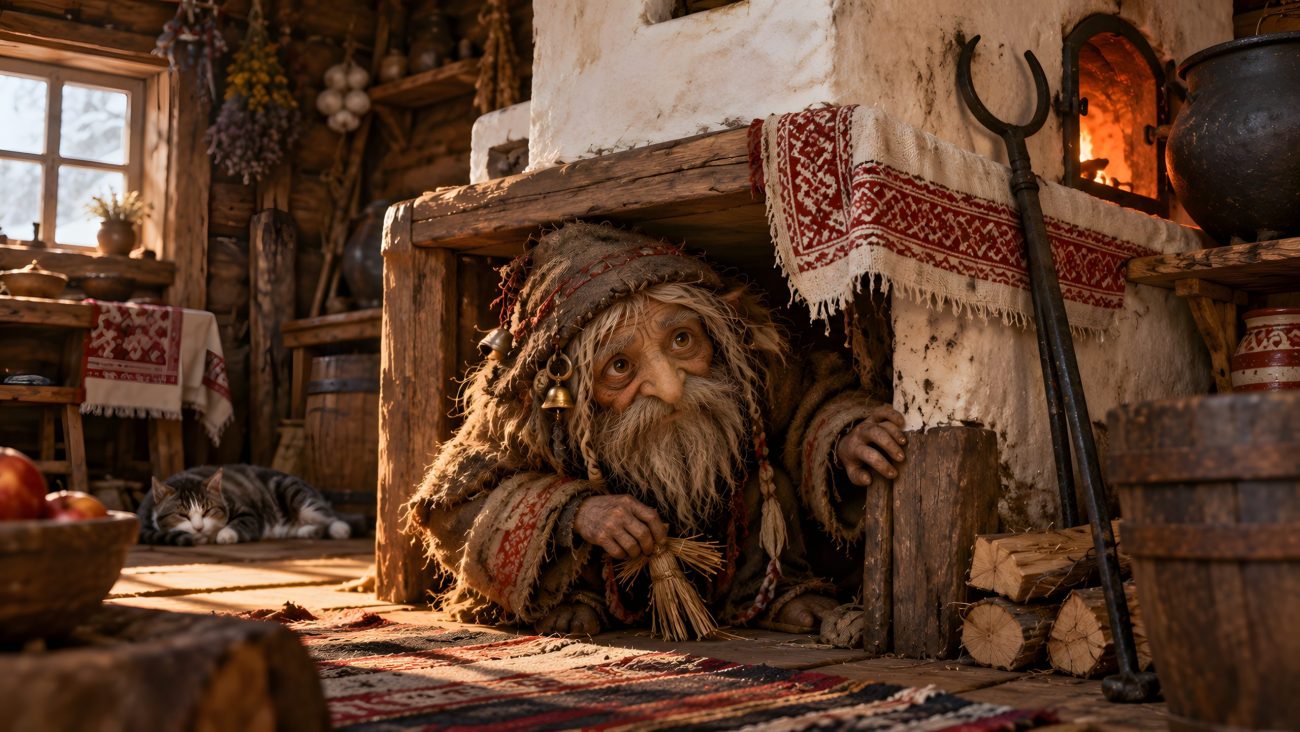
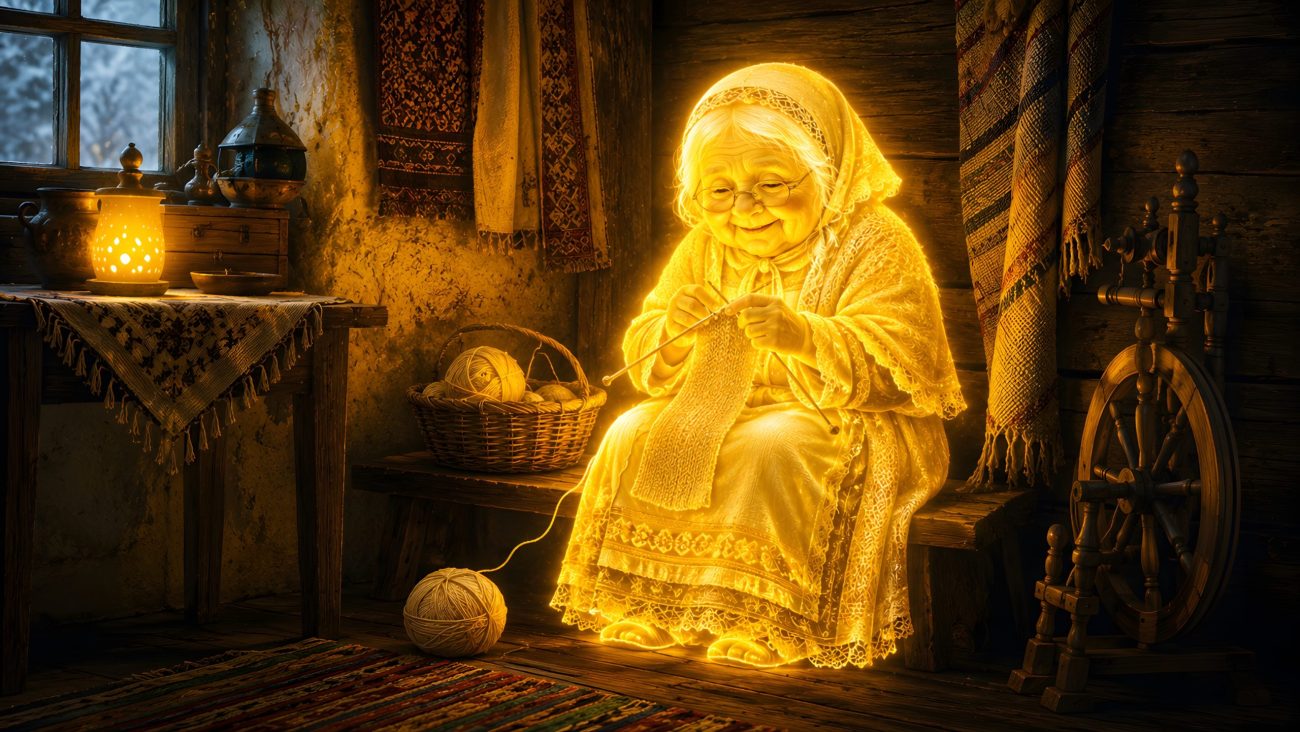
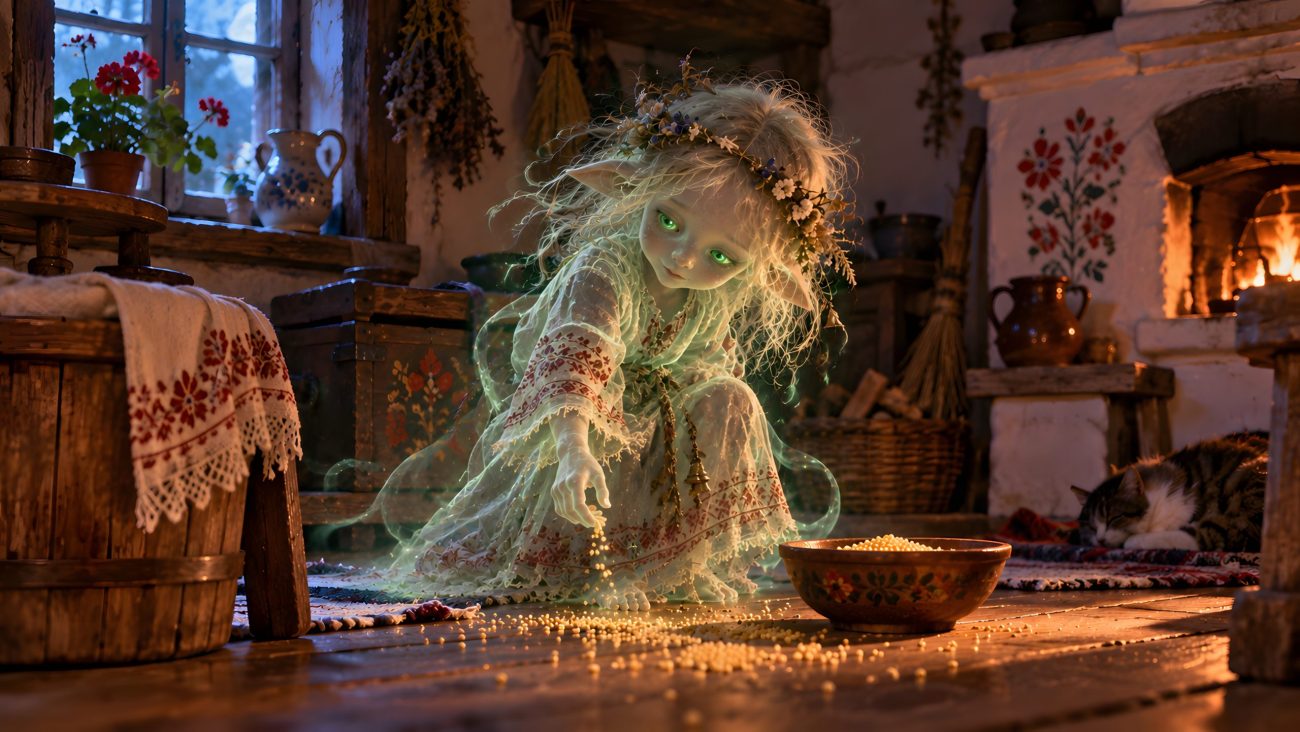
Bożątka are small, quiet household spirits in Polish folklore, believed to be the souls of children who died before being baptised. They are described as harmless, gentle, and obedient beings that inhabit cottages alongside human families. Often invisible to the people around them, they live in huts and settle in small holes or hidden corners, remaining close to the household they inhabit.

Despite their ghostly origins, Bożątka are generally benevolent. They help with domestic work and protect the homes of families who treat them properly. In return for their assistance, householders may leave them a little food in a bowl, particularly milk or other simple offerings. Their presence is considered fortunate, bringing prosperity and protection from evil spirits.

In the Tarnobrzeg region, villagers sometimes expected these spirits to help with household chores. Families in the Mielec area held similar beliefs about the bożąta, and it was customary to sprinkle millet on the floor while reciting a rhyme asking the little beings to remember the children and eat the millet. These practices reflected the belief that the spirits could be encouraged to continue helping the household through small acts of kindness.

In the Silesian Beskids, Bożątka were also associated with the souls of unbaptised children, sometimes called duszyczki, meaning little souls. They were considered gentle, noble, and respectful beings. Although they were sometimes described as grey and inconspicuous, their hearts were believed to remain close to the people they served. Their work was often linked to the prosperity of the household, including the care of livestock and the success of domestic life.

Some traditions describe the spirits as especially helpful to diligent and well-behaved people. They might assist with household tasks, protect animals, and bring good fortune to families that treated them with respect. They could also be offended by neglect or improper treatment, making regular offerings and considerate behaviour important to maintaining their goodwill.

Bożątka resemble the British brownie in their role as invisible domestic helpers, but their origin is specifically connected to the souls of children who died without baptism. They embody a belief that these lost children could remain near the living, helping families and protecting their homes when treated with kindness.


Sources

“Bozhontka.” New Bestiary (Bestiary.us). https://www.bestiary.us/bozhontka/pl

Vagateva

Tradition: Scottish Mythology
Alternative Names: Wag-at-the-Wa’
Category: House dweller


The Myth

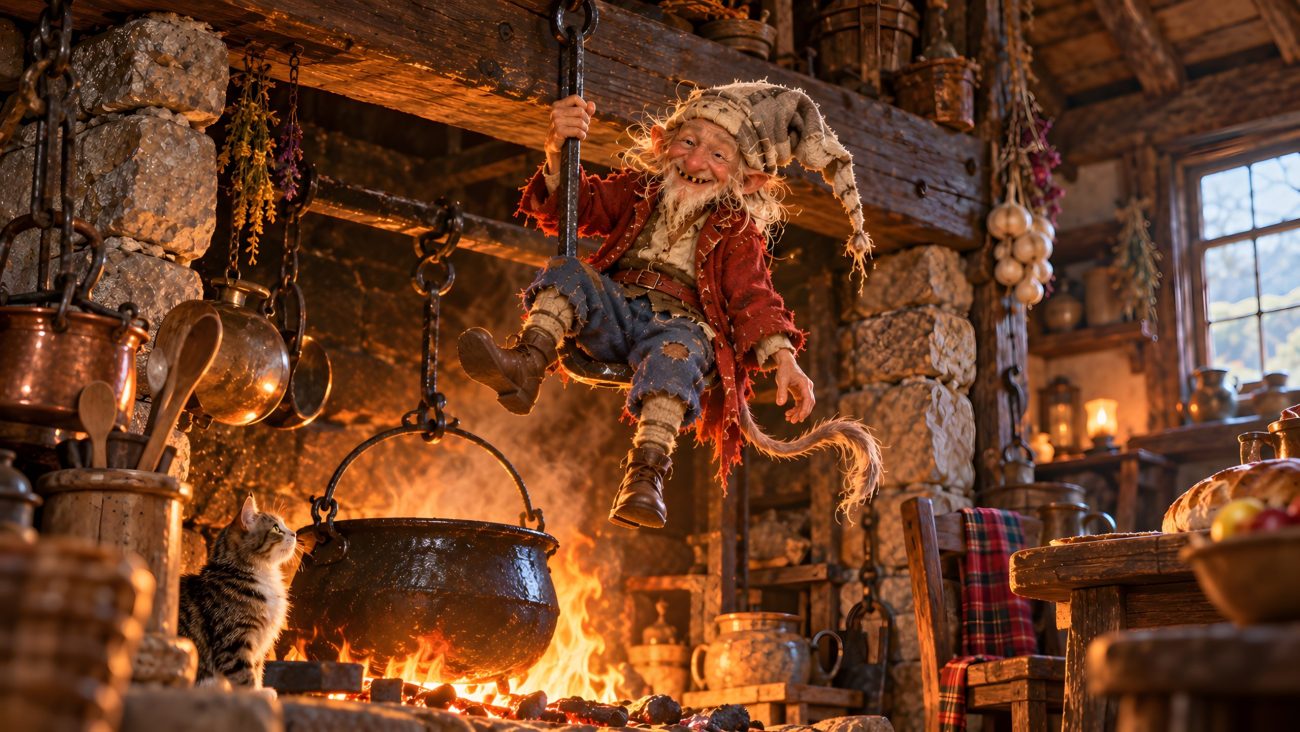
Wag-at-the-Wa’ is an eccentric household spirit of the Scottish Borders, belonging to the brownie family. He appears as a grisly old man with short, crooked legs and a long tail, which he uses to keep his seat on a swinging pot-hook. Sometimes he wears a grey mantle with the remains of an old nightcap on his head, drawn down over the side of his face that has been disfigured by a harelip and a constant grimace. More commonly, he wears a red coat and blue breeches made of familiar woo, a traditional woollen fabric.

Wag-at-the-Wa’ is especially fond of human cheerfulness and the company of children. His usual seat is the swinging pot-hook above the kitchen fire. When the hook is empty, he sits on it and swings himself to and fro, laughing and chuckling at the merriment of the household. He enjoys watching children play and is delighted by the sound of a lively, cheerful home.

Despite his fondness for merriment, Wag-at-the-Wa’ has little patience for lazy cooks and kitchen servants. He punishes those who neglect their work, sometimes with a good deal of rough humour. His cheerfulness is considered a great credit to him, particularly because he suffers from a perpetual toothache. However, he is not especially concerned with the cleanliness or neatness of the house, and his presence can become a torment to slow or careless kitchen workers.

Wag-at-the-Wa’ also has an unusual fear of cold iron and, in some accounts, the sign of the cross. When the swinging pot-hook was marked with a cross to protect the fire from witches, the spirit was said to disappear. A tale recorded by William Henderson tells of a woman who visited a house where the pot-hook had been marked in this way. When she asked one of the women why the spirit no longer lived there, she was told that it would not remain in a house where such protection was practised.

Wag-at-the-Wa’ is therefore a distinctive Scottish brownie: a mischievous but cheerful household presence whose love of children and laughter contrasts with his harsh treatment of lazy servants and his fear of traditional protections against supernatural beings.


Sources

“Wag-at-the-Wa’.” Encyclopedia Mythica. https://pantheon.org/articles/w/wag-at-the-wa.html


Golbeshnik

Tradition: Russian Mythology
Alternative Names: Golbetsnik
Category: House dweller


The Myth

Golbeshnik is a household spirit in Russian folklore, a type of brownie responsible for the home. Unlike spirits associated with fields or forests, Golbeshnik inhabits a specific part of the traditional Russian hut: the space beneath the stove. More precisely, it lives inside the wooden framework of the stove, on the side facing the underground space beneath the house.

Golbeshnik is associated with the golbets, a partition or wooden structure located behind the stove. This area was considered a favourite place for the spirit to dwell. Its name derives from this part of the house, reflecting the close connection between the being and its particular domestic habitat.

As a type of domovoy, Golbeshnik belongs to the tradition of household spirits that inhabit human dwellings. The available account identifies it as a spirit in charge of the household, although it provides no further details about its appearance, temperament, or specific activities.


Sources

“Golbeshnik.” New Bestiary (Bestiary.us). https://www.bestiary.us/golbeshnik


Zashiki-warashi

Tradition: Japanese Mythology
Alternative Names: Zashiki bokko, Zashiki-warashi
Category: House dweller


The Myth

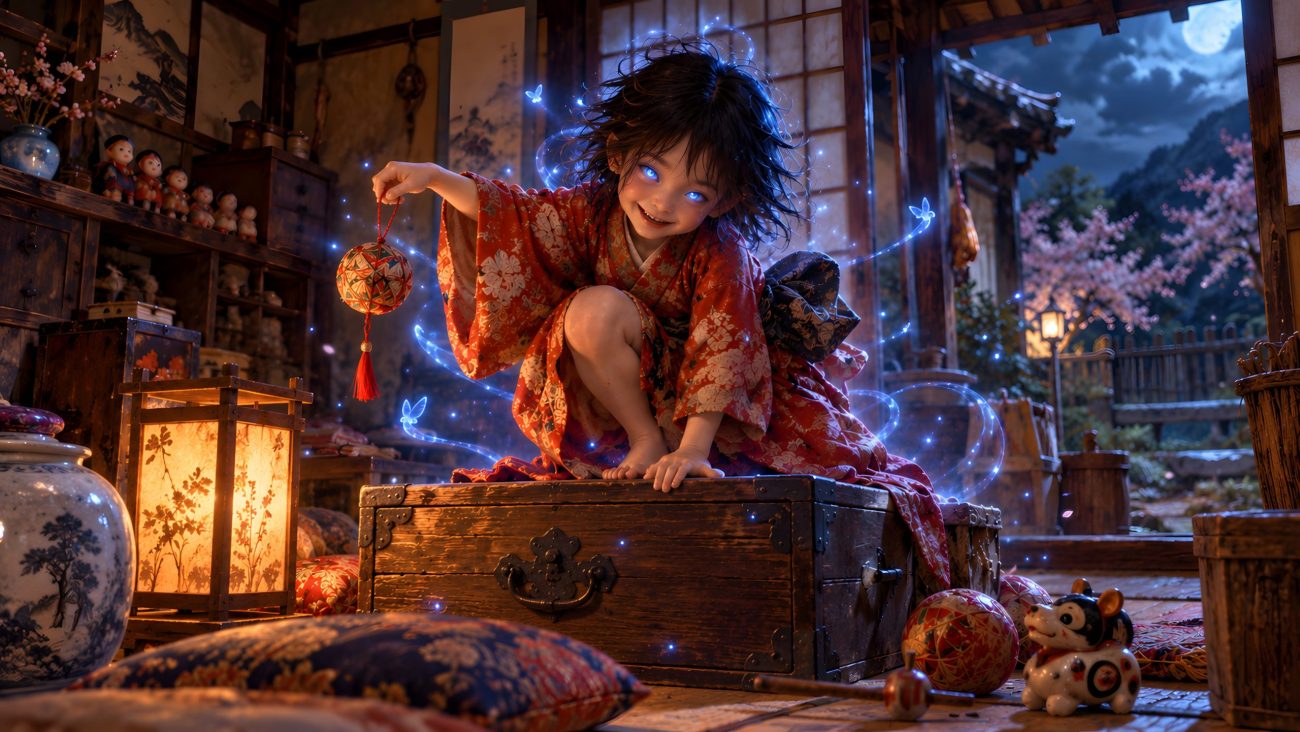
Zashiki-warashi are childlike supernatural beings in Japanese folklore, especially associated with Iwate Prefecture and the Tōhoku region of northeastern Japan. They inhabit traditional homes, particularly parlors and storage rooms, where they perform mischievous pranks. Although their appearance is not described in detail in every account, they are understood as spirits that take the form of children. Their presence is often considered a sign of good fortune, and families believed to host one could become prosperous and wealthy.

These spirits are not always seen directly. Their activities may be noticed through disturbances inside the house, and some traditions describe them moving around the edges of homes on rainy days, frightening visitors. Related beings include the notabariko, which peeks out from the inner dirt-floored room and crawls around, and the usu-tsuki warashi, which makes noises with a stone mortar. These figures are regarded as related, lower-ranking forms of the zashiki-warashi.

The presence of a zashiki-warashi is traditionally associated with the prosperity of a household. In the Tōno Monogatari, a collection of Japanese folktales recorded by Kunio Yanagita, it is said that families in whose homes these spirits dwell become prosperous. Their appearance in a house can therefore be interpreted as a sign that the family’s fortunes will improve. Conversely, stories connect the departure or loss of supernatural protection with a household’s decline, making the spirits important figures in explanations of changing fortunes within village communities.

Some darker traditions connect zashiki-warashi with the spirits of children who died through infanticide. In parts of the Tōhoku region, accounts describe unwanted children being killed and buried in the dirt-floored rooms or kitchens of homes. The spirits of these children were said to wander around houses, particularly on rainy days, frightening visitors. These traditions offer a more tragic explanation for the spirits’ childlike appearance and their association with old family homes.

Other stories suggest that zashiki-warashi may be connected to curses involving carpenters and tatami makers, or that they are related to kappa, supernatural beings associated with water. In some accounts, a kappa leaves the depths and enters a nearby house to play pranks before settling there. Their childlike form has also been linked to religious beliefs in which children serve as intermediaries between the human and divine worlds, resembling protective child-shaped figures in Buddhism.

Zashiki-warashi therefore occupy an ambiguous place in Japanese folklore. They can be playful household tricksters, protective spirits, or reminders of darker histories hidden within traditional homes. Above all, they are closely associated with family prosperity and the belief that the presence of an unseen supernatural being can influence the fortunes of an entire household.


Sources

“Zashiki-warashi.” Wikipedia: The Free Encyclopedia. Wikimedia Foundation. Accessed October 24, 2026. https://en.wikipedia.org/wiki/Zashiki-warashi


Bai

Tradition: Belarusian Mythology
Alternative Names: Baj, Bajac
Category: House dweller


The Myth

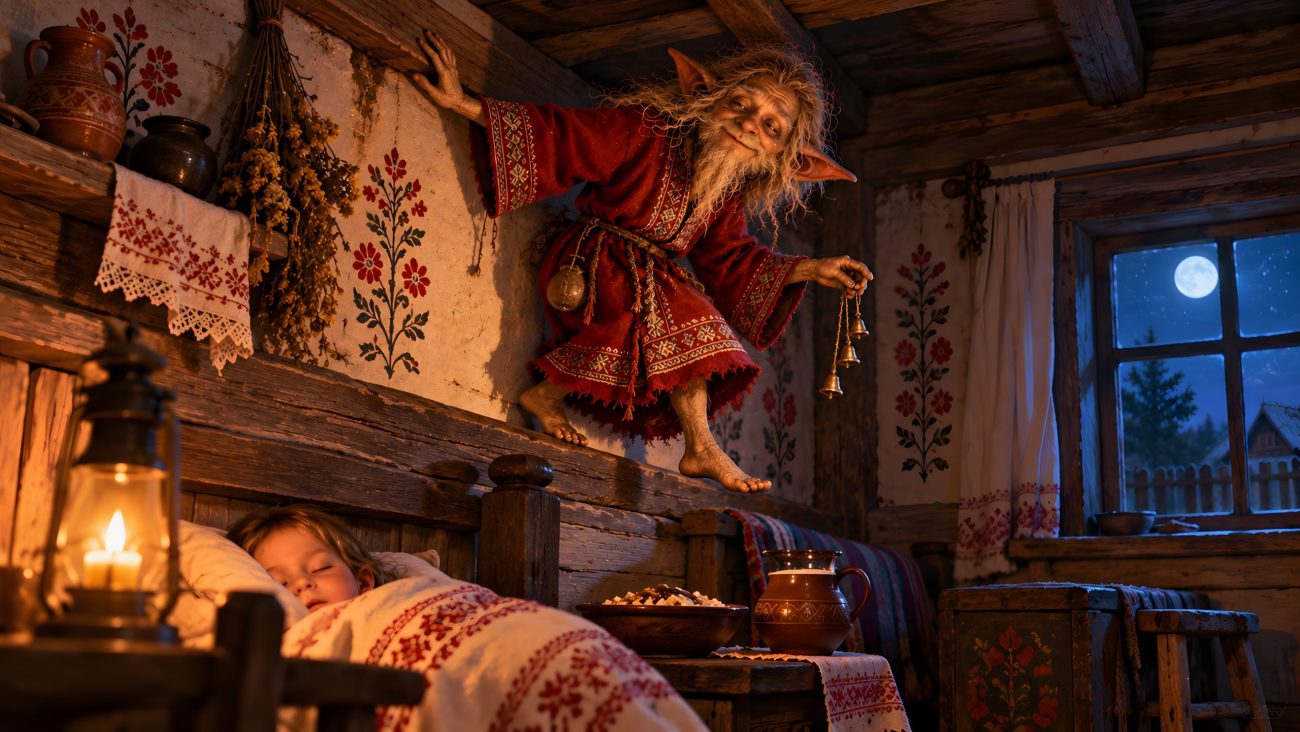
Bai is a peculiar supernatural creature in Belarusian folklore that lives inside a hut and wanders invisibly along its walls at night. It lulls children to sleep with barely audible, melodious singing. In return, it receives a daily bowl of milk and a spoonful of porridge made from buckwheat. Although its appearance is not clearly described in the traditional accounts, modern artistic representations portray Bai as a strange, goblin-like being.

Bai is closely associated with Belarusian lullabies and children’s storytelling. Its name appears in a recurring poetic exchange in which a child asks for a story and Bai responds by walking along the wall. The creature’s barely audible song and repetitive movements help soothe children to sleep, while the exchange between the child and the spirit becomes a playful way of encouraging the child to settle down.

In some versions of the lullaby, Bai is described as wearing a red caftan. The child repeatedly asks whether Bai will tell a story, while the creature answers with variations of the same phrase. In one version, Bai shows the child his backside; in another, the exchange ends with the child being told to sleep. These humorous and sometimes deliberately inappropriate variations illustrate how the traditional verses could be adapted to different audiences and circumstances.

The Belarusian poet Yanka Kupala also drew upon the Bai refrain in a well-known poetic work. In this version, the repeated question and response frame a longer narrative about village life, bees, honey gathering, and the passing of the seasons. The recurring refrain connects the poem to the older oral tradition in which Bai’s name was used to engage children through rhythm and repetition.

Bai therefore occupies an unusual place in Belarusian folklore. Rather than appearing primarily as a terrifying monster, it is associated with the domestic world, children’s sleep, and the oral traditions of lullabies. Its invisible nighttime wanderings and soft singing give it a mysterious presence within the household, while the offerings of milk and porridge reflect the traditional relationship between supernatural beings and the people who live alongside them.


Sources

“Bai.” New Bestiary (Bestiary.us). https://www.bestiary.us/bai


Bodachan Sabhail

Tradition: Scottish Mythology
Alternative Names: Little Old Man of the Barn
Category: House dweller


The Myth

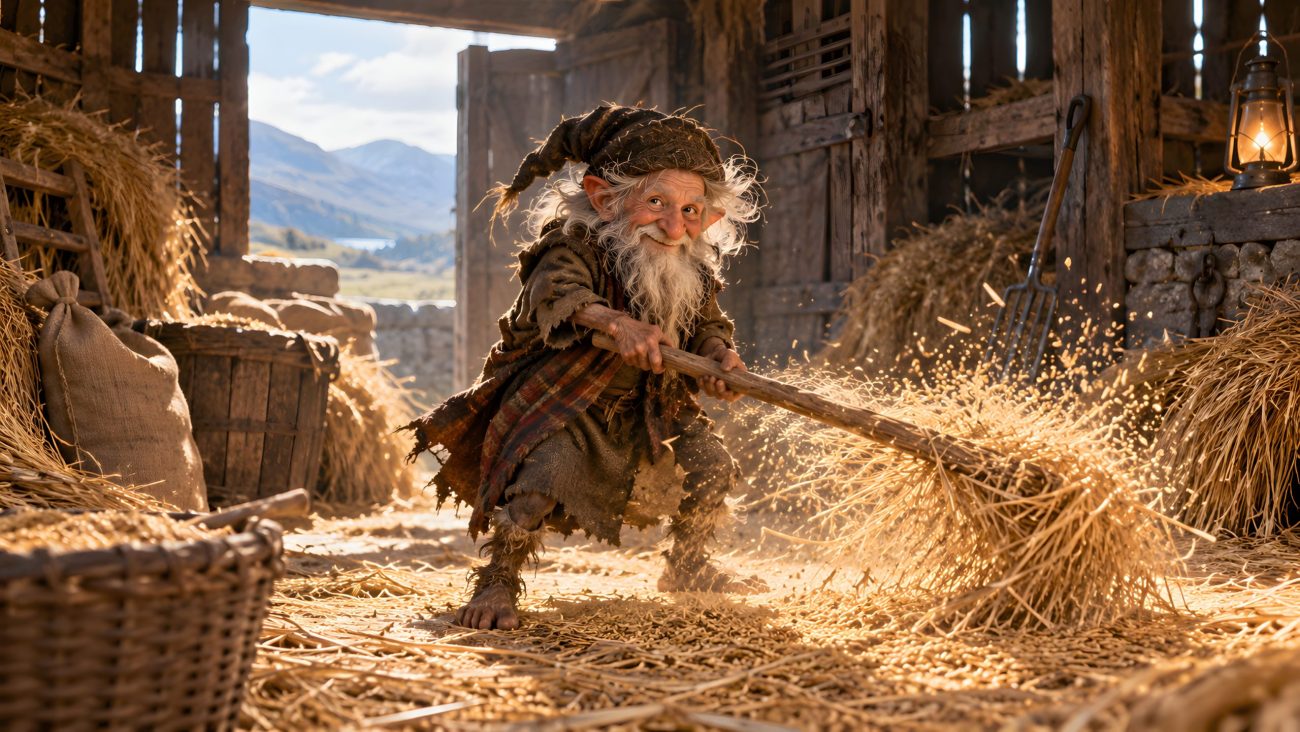
Bodachan Sabhail is a Scottish Highland brownie associated with barns and agricultural work. Known by the nickname “Little Old Man of the Barn,” he is a helpful supernatural being who takes pity on elderly men and assists them with threshing. His role connects him to traditional farming life, particularly the labour of separating grain from its stalks after harvesting.

Unlike malevolent spirits that trouble people, Bodachan Sabhail is remembered for his compassion towards those who struggle with their work. He helps old men with threshing, easing the burden of demanding agricultural labour. His presence in the barn reflects the belief that supernatural helpers could assist people with everyday tasks, especially when age or weakness made those tasks difficult.

Bodachan Sabhail is also mentioned in a Scottish poem that evokes the arrival of night and the end of the day’s work. As the peat fire turns grey and shadows deepen, the Little Old Man of the Barn is imagined threshing in the darkness, continuing his labour when the old man Galium is asleep. This portrayal reinforces his association with tireless work and his quiet presence in the agricultural world of the Scottish Highlands.


Sources

“Botukan Sovil.” New Bestiary (Bestiary.us). https://www.bestiary.us/botukan-sovil/en


Alel

Tradition: Ket Mythology, Siberian Mythology, Russian Mythology
Alternative Names: Alelas (plural)
Category: House dweller


The Myth

Alel is a female household spirit in Ket mythology, the patron and guardian of the home, family, and hearth. She protects the household against troubles, illnesses, and evil spirits, helping to preserve the family’s health, wealth, and well-being. Alel is considered an indispensable companion of every Ket family, and traditional beliefs hold that a family cannot exist without her.

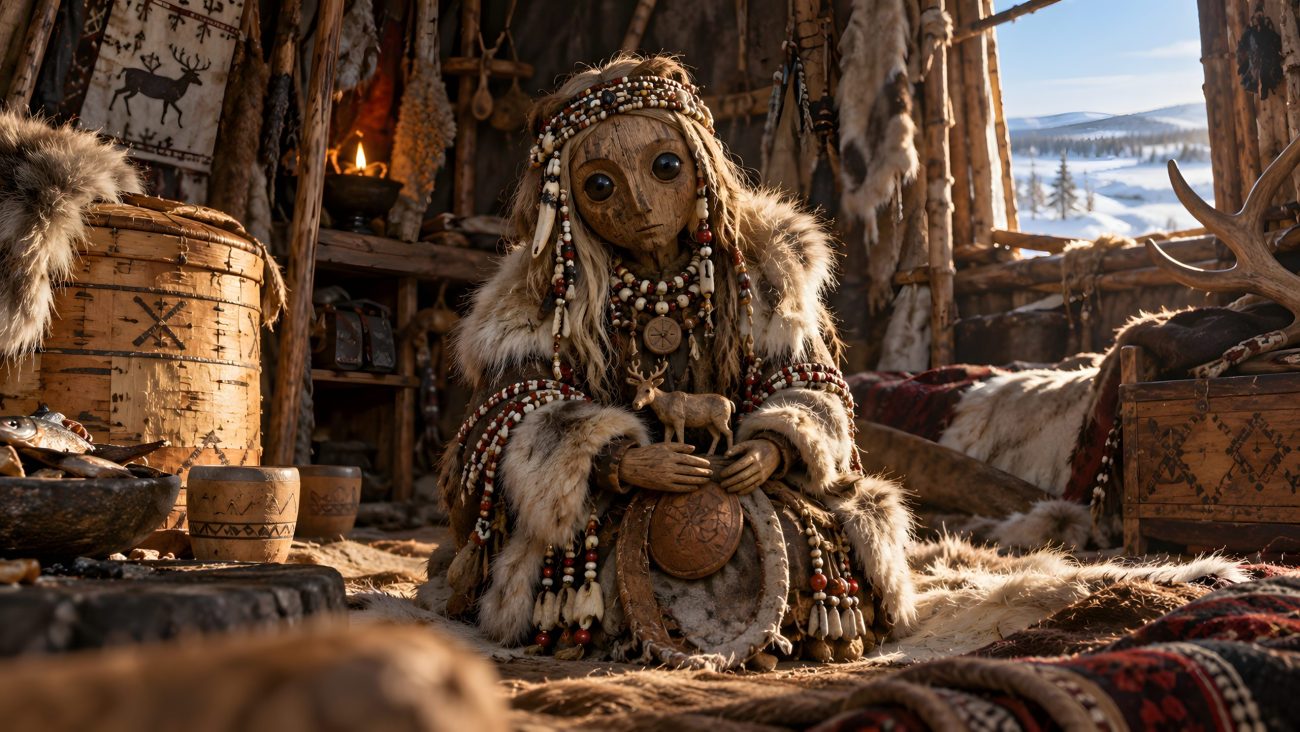
Alel is usually represented as a small wooden female figure dressed in animal skins, rags, or traditional clothing. She may be depicted as a wooden humanoid doll with a large head, arms, legs, and eyes made of beads, buttons, or seed heads. Her face and body are carefully carved from a single piece of wood. Some figures wear simple garments, while others are dressed in traditional clothing made from cloth and reindeer skin, sometimes decorated with fur or beadwork.

Every Ket family traditionally keeps one or more Alelas inside the house. These figures are carefully preserved and passed down from one generation to the next. If the family line is broken, the Alel may lose its image. The figures are dressed and cared for because they are believed to protect the household and help its members in everyday life. They assist with household work, protect family wealth and health, and help care for children and livestock, including reindeer and dogs.

Alel figures are often placed in a special birch-bark container inside the house. When a family moves, the Alelas are carried in sledges containing household goods. They are treated with particular care, and their clothing is regularly maintained. Their fur garments may be decorated with bead embroidery, and they can wear beaded headbands, necklaces, and boots. Some traditions prescribe rubbing their mouths with fish oil and reindeer blood. Neglecting these figures is believed to leave the family without constant, dependable helpers and may bring misfortune.

Alel is also associated with Ket shamanic rituals. Shamans may use the figures in practices connected with fortune-telling, while the functions of the shaman and the Alel as human and supernatural guardians overlap. Both are understood to help protect people from misfortune and maintain the well-being of the community. Through their enduring presence in the home, the Alelas represent the close relationship between family life, ancestral tradition, and spiritual protection in Ket culture.


Sources

“Aljel.” New Bestiary (Bestiary.us). https://www.bestiary.us/aljel


Ahjualune

Tradition / Region: Estonian Mythology
Alternative names: Hearth Gnome, Under-the-Stove Spirit
Category: Household dweller, Gnome


The Myth

The Ahjualune is a household spirit that lives beneath the hearth or stove. It appears as a small man with an unusually large head.

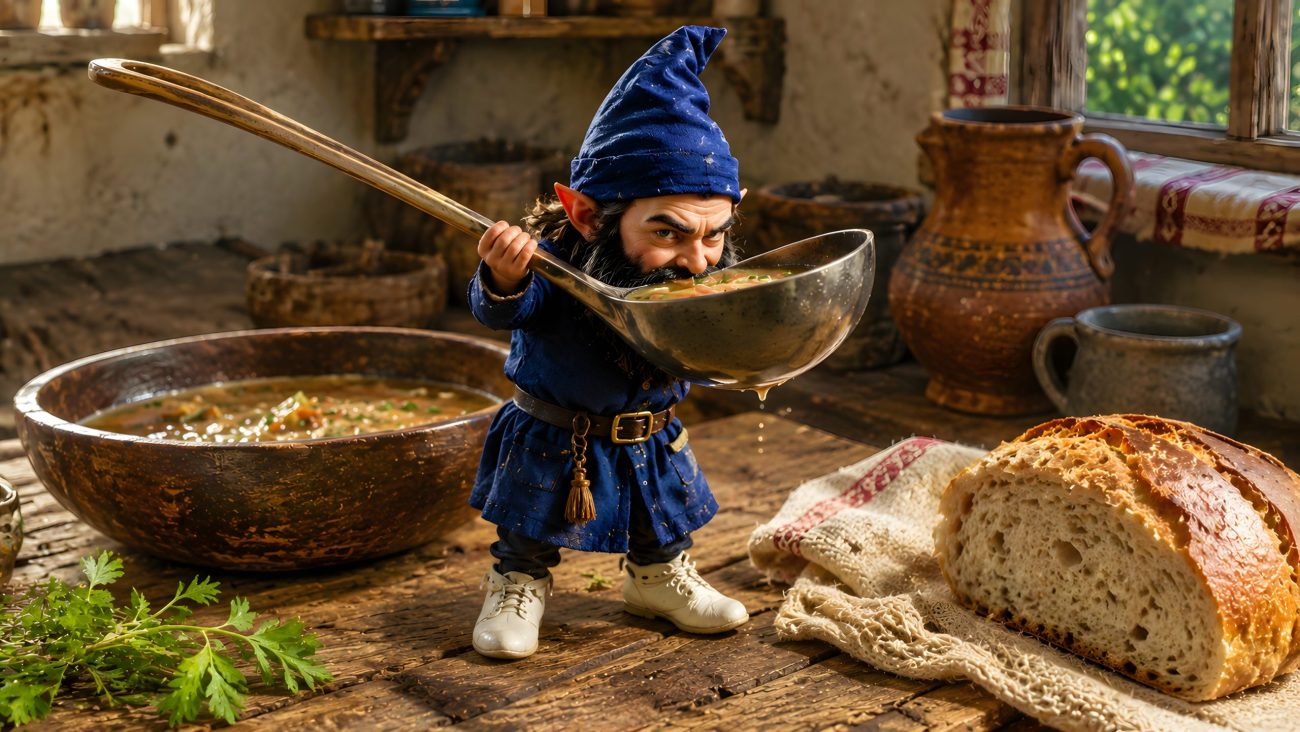
According to folklore, the Ahjualune emerges when food is being prepared and asks for a small taste. If it is welcomed and given a share, it remains content. If ignored or refused, it can leap upon the meal and, with a single motion, swallow an entire pot of food, leaving the household hungry before vanishing beneath the stove once more.


Sources

Bestiary.us. (n.d.). Akhyualune. In New Bestiary: Encyclopedia of Imaginary Beings. Retrieved June 29, 2026, from https://www.bestiary.us/akhyualune


Majahaldjas

Tradition / Region: Estonian Mythology
Alternative names: House Spirit, Home Spirit, Farm Spirit, Building Spirit, House Guardian, House Ghost, Viruskundra (regional form)
Category: House Dweller


The Myth

Majahaldjas is the protective spirit that dwells within every home. It may live inside houses, barns, mills, threshing houses, churches, and other buildings, quietly watching over the people who live there. The spirit cares for the household, protects its inhabitants, and helps maintain peace and prosperity.

It rarely reveals itself. When it does appear, it usually takes the form of an elderly man or woman, often believed to be a former resident of the house who continues to guard it after death. It is also said to appear around the time of a household member’s death, while many people claimed to see it only in dreams.

The Majahaldjas is kind only to good people. Because it knows every corner of the home, it can warn the family of danger, offer advice during difficult times, and quietly help with household affairs. However, it cannot tolerate constant quarrels, insults, or a household filled with anger. If driven away by fighting or mistreatment, it abandons the home, taking its protection with it and leaving the family vulnerable to misfortune.

Families traditionally sought to keep the spirit content by making small offerings. Food was left on shelves or near the hearth, while drops of beer or homemade ale were poured into the corners of the house as gifts for the unseen guardian. These offerings were believed to restore harmony if the spirit had become offended.

In southern Estonia, especially in Võru and Setomaa, the house spirit is known as Viruskundra. It was believed to live beneath the stove, sometimes above it or on the sleeping platform. Although rarely seen, its voice was often heard, and children were warned to respect it. At Christmas, food was left for Viruskundra, and when a child’s baby tooth fell out, it was thrown onto the stove with the words: “Viruskundra, take this bone tooth and give me an iron tooth.” The spirit was also believed to reveal treasures hidden beneath the house to families it favored.


Sources

Wikipedia contributors. (n.d.). Majahaldjad. In Vikipeedia. Retrieved June 29, 2026, from https://et.wikipedia.org/wiki/Majahaldjad


Charnel House Spirit

Tradition / Region: Czech Mythology
Alternate Names: —
Category: House Dweller


The Myth

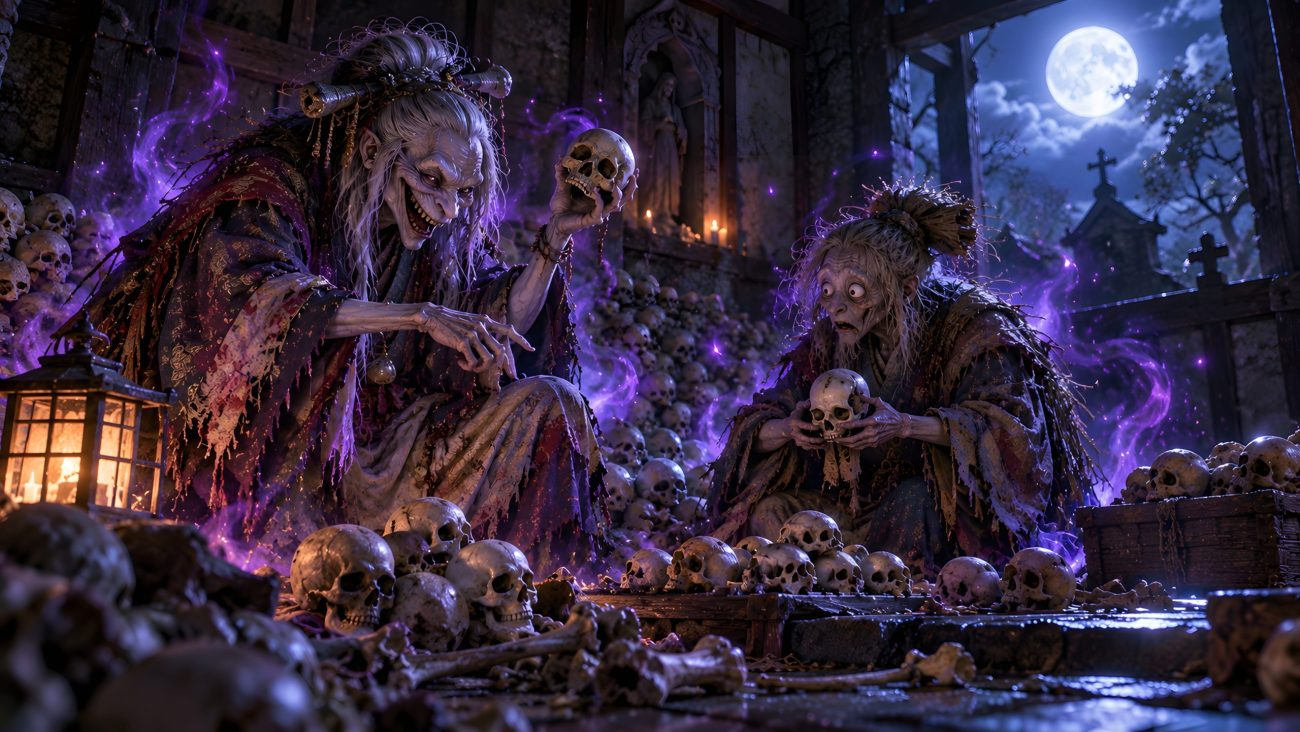
The Charnel House Spirits are eerie entities said to inhabit ossuaries—rooms where human bones and skulls are stored after burial. In one such chamber near a church, countless skulls were piled together, forming a place closely tied to death and the afterlife.

One night, a man approached the charnel house with ill intent. As he drew near in the darkness, he heard strange noises from within—rolling, clattering, and hollow knocking, as if the bones themselves were in motion.

Driven by curiosity, he listened at the door and discovered that two unseen spirits were inside. They were handling the skulls, dividing them between themselves as if they were objects in a game. The spirits treated the remains of the dead like playthings, using them almost as pieces in a contest.

One of the spirits was cunning and deceitful. As he divided the skulls, he manipulated the process so that he always ended up with more than the other, repeating the same trick again and again. The other spirit, simple-minded and unaware, was continually cheated.

The scene revealed something unsettling: even in death, deception and imbalance persisted. The spirits mirrored human flaws—greed, cunning, and foolishness—within a realm that should have been beyond such behavior.

Terrified by what he witnessed, the man fled immediately. His fear was so great that he abandoned his original sinful plan, unwilling to risk encountering such forces again.

The Charnel House Spirits embody a grim idea in folklore:
that places of the dead are not always silent or sacred, but may be inhabited by restless, mocking forces that imitate the worst traits of the living.


Sources

sagen.at contributors. (n.d.). Halbscheid!. In sagen.at, from http://sagen.at/texte/sagen/tschechien/watzlik/halbscheid.html